Space & Physics
JWST study reveals how rare exoplanet pair formed
MIT study uses JWST to decode a rare exoplanet system, revealing how mini-Neptunes form beyond the frost line.
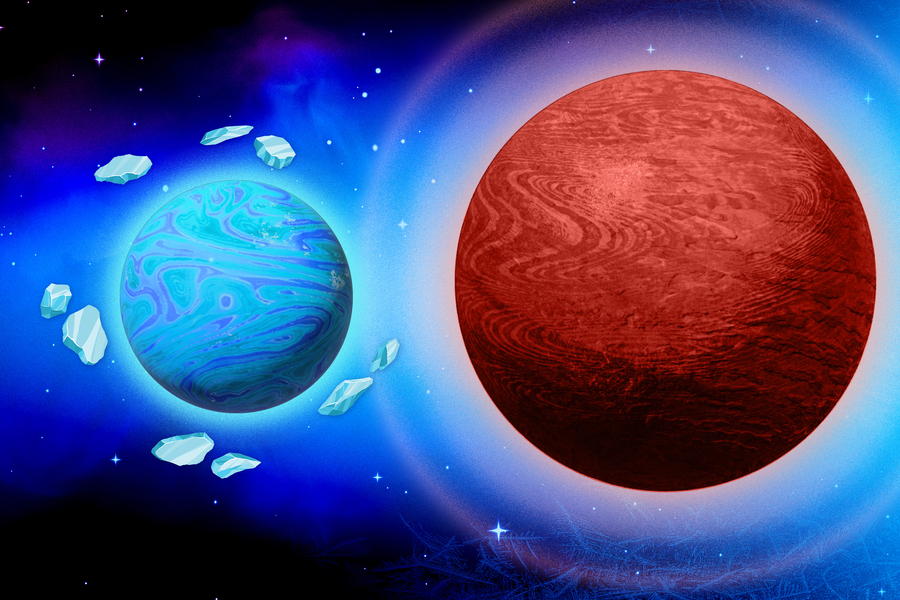
Astronomers have uncovered fresh clues about how distant worlds form, thanks to a new JWST mini-Neptune study that examines a rare planetary system 190 light years away. Using NASA’s powerful space telescope, researchers analysed the atmosphere of a small gas planet orbiting unusually close to its star — and found evidence that challenges long-held assumptions about where such planets originate.
In a discovery that’s quietly reshaping how astronomers think about planet formation, scientists have uncovered new clues behind one of the Milky Way’s strangest planetary pairings — a hot Jupiter and a mini-Neptune orbiting the same star.
The finding by scientists from MIT, based on observations from NASA’s James Webb Space Telescope (JWST), suggests that these two unlikely neighbours didn’t form where they are today. Instead, they likely began life much farther out in their star system and gradually migrated inward — staying together against the odds. The study, appeared in The Astrophysics Journal of Letters, reveals new measurements of the mini-Neptune’s atmosphere.
JWST mini-Neptune study : A rare planetary pairing
The system, located about 190 light years from Earth, has puzzled astronomers since its discovery in 2020. Hot Jupiters — massive gas giants that orbit very close to their stars — are usually “lonely,” with no nearby planetary companions.
But this one breaks the rule.
“This is the first time we’ve observed the atmosphere of a planet that is inside the orbit of a hot Jupiter. This measurement tells us this mini-Neptune indeed formed beyond the frost line,” says Saugata Barat, a postdoc in MIT’s Kavli Institute for Astrophysics and Space Research and the lead author of the study.
“This was a one-of-a-kind system,” Chelsea X. Huang, faculty at University of South Queensland, said in a media statement, explaining how such massive planets typically scatter away anything inside their orbit.
Yet in this case, a smaller mini-Neptune somehow survives closer to the star, orbiting every four days, while the hot Jupiter circles every eight.
Back in 2020, Chelsea Huang — then a Torres Postdoctoral Fellow at MIT — spotted something unusual: a mini-Neptune orbiting its star alongside an unexpected companion, a hot Jupiter.
JWST captures a crucial clue
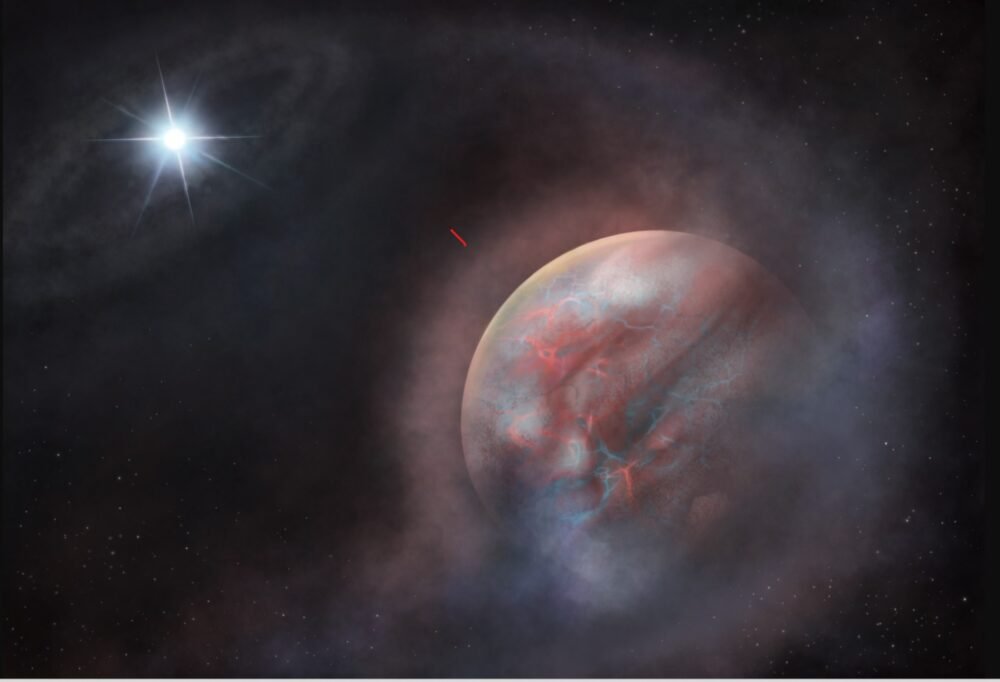
To understand how this system formed, researchers from MIT and international institutions turned to JWST, focusing on the inner planet, TOI-1130b.
What they found was telling.
The mini-Neptune’s atmosphere is unusually “heavy,” rich in water vapour, carbon dioxide, sulfur dioxide, and traces of methane — a composition that shouldn’t exist if the planet formed close to its star.
JWST mini-Neptune study : Rethinking planet formation
That “frost line” — the region in a young star system where temperatures are low enough for ice to form — appears to be central to the story.
Scientists now believe both planets likely formed in this colder, outer region, where icy materials helped build dense atmospheres. Over time, they migrated inward together, maintaining their unusual orbital arrangement.
The findings challenge earlier assumptions that mini-Neptunes forming close to stars should have lighter atmospheres dominated by hydrogen and helium.
A system that shouldn’t exist — but does
Even observing the system was no easy task. The two planets are in what astronomers call a “mean motion resonance,” subtly tugging at each other’s orbits and making their movements harder to predict.
“It was a challenging prediction, and we had to be spot-on,” Barat said, referring to the effort required to time JWST’s observations precisely.
JWST mini-Neptune study : Why this matters
Mini-Neptunes are among the most common planets in the galaxy, yet none exist in our own solar system — making them both familiar and mysterious.
This study, appeared in Astrophysical Journal Letters, offers the clearest evidence yet that such planets can form far from their stars and migrate inward, carrying their atmospheres with them.
“This system represents one of the rarest architectures that astronomers have ever found,” Barat said in a media statement.
And in a universe full of planets, that rarity might just hold the key to understanding how many of them — including worlds very different from our own — come to be.
Space & Physics
Total Solar Eclipse 2026: What Happened and Where Was It Visible?
The August 12, 2026 total solar eclipse saw the Moon completely cover the Sun along a narrow path across parts of Greenland, Iceland, northern Russia, Spain and Portugal. While much of Europe and parts of North America and northwestern Africa experienced a partial eclipse, the event was not visible from India.
On August 12, the Moon passed between the Sun and Earth, producing a total solar eclipse. Along a narrow path, the Moon completely covered the Sun, briefly darkening the daytime sky. Much of Europe and parts of North America and northwestern Africa saw a partial eclipse.
A solar eclipse occurs when the Moon passes between the Sun and Earth and casts its shadow on Earth’s surface. Because the Moon’s darkest shadow covers only a limited area, an eclipse can be total in one region, partial in another and invisible elsewhere.
Why did some places go dark?
The Moon casts two main shadows during a solar eclipse. The umbra is the central shadow, where the Sun is completely blocked. People within it experience totality.
The penumbra extends beyond the umbra. People in this larger region see only part of the Sun covered and therefore experience a partial eclipse.
This is why the same eclipse looks different from different locations. A place inside the path of totality can experience a few minutes of daytime darkness, while a location farther away may see only a portion of the Sun covered.
Where was the eclipse visible?
Totality was visible across parts of Greenland, Iceland, northern Russia, Spain and northeastern Portugal, as well as parts of the Atlantic and Arctic oceans.
A much larger area experienced a partial eclipse. This included much of Europe, parts of North America and northwestern Africa, along with areas over the Atlantic, Arctic and Pacific oceans.
For mainland Europe, the event was particularly notable because it brought totality to the region for the first time since 1999.
Why couldn’t India see it?
India was outside the eclipse’s visibility zone. The eclipse’s path of totality was concentrated much farther north, and India was not within the region from which the August 12 event could be observed.
This illustrates an important point about solar eclipses: an eclipse may occur over Earth without being visible from a particular country. The Moon’s shadow covers only a limited part of the planet.
How often do solar eclipses occur?
Solar eclipses are not exceptionally rare. There are generally two to five solar eclipses somewhere on Earth each year.
However, a total solar eclipse at a particular location is much rarer. A 2026 analysis by timeanddate estimates that, on average, a total solar eclipse occurs at a given location about once every 373 years. The actual interval can vary considerably between locations.
The reason is the geometry of the Moon’s orbit. It is tilted by about five degrees relative to Earth’s orbit around the Sun, so the Moon usually passes above or below the Sun rather than directly in front of it. Only when the alignment is sufficiently close does its shadow fall across Earth.

Why are total solar eclipses scientifically important?
During normal daylight, the Sun’s bright surface makes its faint corona difficult to observe. During totality, the Moon blocks the bright disk, revealing the corona around it.
Scientists study the corona to better understand the Sun’s atmosphere, magnetic activity and solar wind. These processes are also important to the study of space weather, which can affect satellites and communications.
The August 12 eclipse was therefore more than a striking change in the daytime sky. For observers along its narrow path, a few minutes of darkness provided a rare opportunity to see the Sun’s outer atmosphere—while much of the world saw only a partial eclipse or nothing at all.
Space & Physics
Astronomers Discover a ‘Black Hole Star’, a New Kind of Object in the Early Universe
MIT-led team says the star-sized, black-hole-powered object could explain the mysterious ‘little red dots’ seen across James Webb Space Telescope images
Astronomers using NASA’s James Webb Space Telescope have identified a possible new type of object they call a “black hole star.” Roughly the size of the Solar System and powered by a black hole about 100,000 times the Sun’s mass, the object could help explain the mysterious little red dots appearing across JWST’s images of the early universe.
Astronomers led by a team at MIT have identified what they describe as an entirely new type of astrophysical object: a blindingly bright, deep-red point of light from the early universe that behaves like an enormous star but produces energy on a scale that only a black hole should be capable of. They are calling it a “black hole star.”
The object, spotted using NASA’s James Webb Space Telescope (JWST), spans roughly the size of our solar system and appears to be putting out about 100 billion times more energy than any known star could physically generate through nuclear fusion. The findings, published in the journal Nature, suggest the object is instead powered by a black hole embedded inside a dense cocoon of gas — a combination that has not been observed before.
A ‘Black Hole Star’ in the Early Universe
“Our picture of this object is evolving very rapidly,” lead author Rohan Naidu, a NASA Hubble Fellow and Pappalardo Fellow at MIT’s Kavli Institute for Astrophysics and Space Research, said in a statement released by MIT News. “We think there is a central black hole that is 100,000 times as massive as the sun. And around this black hole, there would be this very extended envelope of gas that looks like a star the size of the solar system. It’s huge.”
The discovery could help resolve one of the more persistent puzzles of the JWST era: the identity of so-called “little red dots” that have turned up in nearly every deep-field image the telescope has captured. “These little red dots seem to be everywhere in the early universe but essentially disappear by the present day,” Naidu said. “What exactly these objects are has been one of the most debated topics of the JWST era.”
MIT’s Robert Simcoe, director of the Kavli Institute and the Bruno B. Rossi Professor of Experimental Physics, and Wendy Sun, a member of the MIT class of 2026, are among the study’s co-authors, alongside collaborators from several other institutions.
A Search for Something Else Entirely
The team wasn’t looking for a black hole star when they found one. Naidu and his colleagues were using JWST to hunt for the earliest, most distant galaxies, as part of a survey they named “Mirage or Miracle” (MoM) — an effort to work out which unusually bright early-universe objects were genuine galaxies, and which were something else entirely masquerading as one.
“There’s been this puzzle of many bright galaxies showing up at extremely early times,” Naidu said in a statement released by MIT News. “What we found was that what looks like an extremely bright early galaxy, aka a ‘miracle,’ in some cases actually could be a ‘mirage.’”
While scanning JWST’s images for candidates, the team noticed a dot that stood out for being unusually red and unusually bright. A very red object in space is typically read as a sign that it is shrouded in dust. “When we see something very red in the universe, we often assume that it is surrounded by dust, like soot or ash,” Simcoe said in a statement released by MIT News. “The same way that the wildfire smoke from Canada recently made the sky in Boston look bright red, astronomical objects can also appear redder than their intrinsic colour when you see them through a veil of dust.”
But the light didn’t fully fit a dust explanation. The team found another unusual pattern: the object’s brightness dropped off sharply and almost completely below a certain wavelength — a signature known as a “Balmer break,” normally associated with dense gas absorbing light in the atmospheres of stars a few hundred million years old. “The break we observed in this object is the deepest break we have ever observed in any object, ruling out ‘ordinary’ stars as the source,” Naidu said. “But it made us wonder if we were seeing a new kind of ‘stellar atmosphere,’ but on a spectacular scale.” The object’s light also showed almost no trace of any element beyond hydrogen and helium.
Modelling an Impossible Star
To work out what could produce such a distinctive signature, the researchers ran simulations testing different combinations of astrophysical features. “We started to ask: could you make something that red using just hydrogen, without any dust?” Simcoe said in a statement released by MIT News. “To our surprise, it turns out you can, if you have an extremely dense screen of hydrogen, so dense that it looks more like the surface of an enormous star than a wispy interstellar nebula.”
A dense hydrogen cocoon around a powerful, hidden energy source could account for the Balmer break and the near-total absence of heavier elements. It could not, on its own, account for the object’s extreme brightness. “You have something that looks a bit like a star but is 100 billion times brighter,” Naidu said. “That means you can’t be powering this by nuclear fusion, which is the energy source that sits at the heart of all the stars we have.”
Black holes, by contrast, can generate energy at exactly that scale. When the team added an actively feeding black hole into their simulation of a hydrogen-cocooned star and adjusted its mass and other parameters, the closest match to JWST’s observations pointed to a central black hole roughly 100,000 times the mass of the sun, wrapped in a dense, star-like envelope of hydrogen about the size of the solar system.
The researchers have named the object MoM-BH*-1, after the survey that found it. They believe black hole stars, generally fainter than this one, could account for many of the other little red dots turning up across JWST’s images. “Every little red dot is consistent with being a black hole star, embedded in a generic early galaxy,” Naidu added. “But what is special about MoM-BH*-1 is, the black hole star is essentially completely outshining its surrounding host galaxy, such that we’re seeing pure black hole star light.”
Space & Physics
M P Parameswaran: The Scientist Who Took Science to the People
M. P. Parameswaran, who died aged 91 on August 11, 2026, spent decades taking science beyond laboratories through KSSP, Malayalam science writing, literacy campaigns and environmental activism.
M P Parameswaran, who died on 11 August 2026 at the age of 91, spent his life trying to close the distance between scientific knowledge and the people it was meant to serve. Trained as a nuclear engineer, he walked away from India’s atomic establishment in 1975 to build one of the country’s most influential people’s science movements from the ground up.
He leaves behind an unusual body of work spanning nuclear science, science writing, literacy, language technology, environmental activism, rural development and political thought.
What connected these seemingly disparate pursuits was a single conviction: science should not remain confined to experts. Scientific knowledge, he argued through his work, had to become accessible enough for ordinary people to understand, question and participate in decisions affecting their lives.
From Nuclear Science to People’s Science
Parameswaran was born on 18 January 1935 in Kiralur (Kiraloor), a village in Thrissur district then part of the princely state of Cochin. He graduated in electrical engineering from the College of Engineering, Thiruvananthapuram, in 1956, before travelling to the Soviet Union, where he earned a doctorate in nuclear engineering from the Moscow Power Engineering Institute in 1965. He joined the Bhabha Atomic Research Centre (BARC), India’s premier nuclear research institution, in 1957 and remained there until 1975 — becoming part of the scientific establishment building the foundations of India’s nuclear programme.
But the work that made him a public intellectual began when he left the laboratory.
In 1975, Parameswaran resigned from BARC and joined the Kerala Sasthra Sahithya Parishad (KSSP). The move changed the direction of his life. KSSP had begun as a forum of science writers but evolved, with Parameswaran among its central figures, into a much broader people’s science movement. Under his involvement, science communication became connected with literacy, health, environment, technology and development.
He helped take science out of laboratories and classrooms and into public spaces — through books, magazines, campaigns, village meetings and travelling programmes.
Language was Central to This Effort
Parameswaran wrote extensively in Malayalam, Kerala’s regional language, producing popular science books and hundreds of articles on subjects including nuclear science, astronomy, mathematics, ecology and social science. His contribution was not simply to translate scientific concepts; he helped establish Malayalam as a language in which scientific ideas could be discussed with a wider public.
His interest in accessibility even extended to technology itself. Between 1969 and 1973, while on deputation from BARC, he served as Assistant Director of the State Institute of Languages in Kerala. During this period he was involved in developing a Malayalam keyboard layout for typewriters — work later associated with the development of the INSCRIPT keyboard layout used in Indian-language computing today.

It was a small but revealing example of his approach: technology had little value if people could not use it.
Building a National People’s Science Movement
Parameswaran’s contribution went beyond writing. He played a major role in taking the people’s science movement beyond Kerala. In 1987, as convener of the National Organising Committee, he was central to the Bharat Jan Vigyan Jatha, a nationwide science communication campaign that took scientific ideas to communities rather than waiting for audiences to come to scientific institutions. He was also instrumental in establishing the All India People’s Science Network, bringing together people’s science organisations from across the country.
These initiatives changed the scale of science communication. It became not merely the work of individual writers explaining discoveries, but an organised effort to build public engagement with science.
Literacy As Participation
The same philosophy shaped Parameswaran’s work in literacy. He played an important role in the Total Literacy Campaign in Ernakulam, in which KSSP worked with the district administration to take literacy beyond conventional classroom structures. The experience later became an important model for India’s national literacy campaign.
In 1990, he was also instrumental in organising the Bharat Gyan Vigyan Jatha in support of the National Literacy Mission, a movement that eventually contributed to the formation of the Bharat Gyan Vigyan Samiti.
For Parameswaran, literacy and scientific awareness were closely related. Knowing how to read was only the beginning; people also needed the ability to examine information, weigh evidence and participate in public decisions.
When Science Met Development
Parameswaran’s questions became more difficult when he began examining the consequences of technology itself. He increasingly focused on appropriate technology, rural development, decentralisation and environmental sustainability, and was associated with the Integrated Rural Technology Centre.
He was also a central figure in two of Kerala’s defining environmental campaigns: the movement against the Silent Valley hydroelectric project, which helped save one of India’s last untouched rainforests, and the later opposition to the Athirappilly hydroelectric project. Both battles shaped his conviction that development decisions could not be left to engineers and planners alone.
The Bhopal gas disaster of 1984 sharpened these concerns further. It demonstrated that scientific and industrial advances could produce enormous social and environmental risks when technological decisions were made without adequate attention to safety and public accountability. For Parameswaran and the people’s science movement, the lesson was not to reject science or technology but to ask harder questions about their use: Who benefits? Who bears the risks? And who gets to decide?
Questioning the Idea of Progress
His intellectual journey eventually took him beyond science communication into a broader critique of development. In his book Fourth World: Dream and Reality, Parameswaran set out an alternative model built around decentralisation, ecological sustainability, democracy and a critique of consumerism. The “Fourth World” thesis brought him into sustained conflict with the Communist Party of India (Marxist), or CPI(M), to which he had long belonged, and ultimately led to his expulsion from the party.
His political conclusions remain a subject of debate. But they reveal an important feature of his intellectual life: he was willing to question established ideas of progress, including those within his own political tradition. He later reflected on that journey — from young engineer in Moscow to nuclear scientist, people’s science activist and Marxist theorist who found himself outside the party he had served for decades — in his Malayalam autobiography, Kaalaharanamillatha Swapnangal (Timeless Dreams).
For Parameswaran, development could not simply be measured by economic growth or technological advancement. It also had to be judged by its effects on people, communities and the environment.
Recognition
Parameswaran’s writing and activism were recognised early and late in his career. He received the Books for Neoliterates Award in 1962, the Basic and Cultural Literature Award in 1964, and the Children’s Literature Award in 1984. In 2022, the Government of Kerala honoured him with the Kerala Sree Award, the state’s third-highest civilian award, for his lifetime contribution to science and society.
Science Without Silos
Parameswaran’s contributions are spread across several fields. He helped build KSSP into one of India’s most influential people’s science movements. He helped establish national networks for science communication. He wrote extensively in Malayalam and brought scientific subjects into public discourse. He contributed to language technology. He played important roles in literacy campaigns that reached far beyond Kerala. He helped shape landmark environmental struggles. And he became a prominent critic of environmentally and socially unsustainable models of progress.
But reducing his legacy to this list would miss what made these contributions part of the same story. Parameswaran did not see science as a body of knowledge that moved in one direction — from laboratories to the public. He saw it as something that should enable people to participate. That is why his career could move so naturally from nuclear research to Malayalam publishing, from science campaigns to literacy, and from technology to questions of ecology and democracy.
His relevance may be even clearer today. Artificial intelligence, biotechnology, climate change, nuclear energy and public health increasingly shape everyday decisions, while the knowledge needed to understand them often remains concentrated among specialists. Parameswaran spent much of his life trying to narrow that distance.
He began by working with some of India’s most sophisticated scientific technologies. He ended up devoting his life to a more fundamental question: how can scientific knowledge become part of public life without losing its rigour — and without leaving the public behind? His answer was not simply to popularise science. It was to make people participants in it.
-
Math3 weeks agoThe 2026 Fields Medals: Four Proofs, Four Decades-Old Problems Solved
-
Climate2 weeks agoAfter Kerala’s Deadliest Landslide, the Hardest Thing to Rebuild Was Childhood
-
Society1 month agoWest Asia Crisis: Can Kerala’s Returning Gulf Migrants Find a Future in the Green Economy?
-
Space & Physics3 months agoIndia Semiconductor Mission: ‘It’s Not About Fabs. It’s About Building An Entire Ecosystem’
-
Climate2 months agoThe Climate World Cup? How Climate Change Could Affect Player Performance at the 2026 World Cup
-
Society1 month agoWhat Is Civilisational Diplomacy? Understanding India’s Newest Foreign Policy Tool
-
Society2 months agoFrom Bell Labs to the Classroom: A Second Career in Teaching

-
Space & Physics2 months agoEngineers Develop Dual-Mode Propulsion System for Next-Generation Small Satellites