Space & Physics
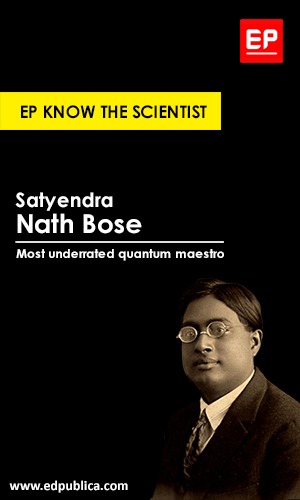
S N Bose – the world’s most underrated quantum maestro
There are plenty of scientists across the world from history, across the colonial era and beyond – which this ‘Know the Scientist’ page seeks to shed light on. It’s through us retelling these stories time and again do their experiences become immortalized in time for us to understand.


It’s 1924, and Satyendra Nath Bose, going by S.N. Bose was a young physicist teaching in Dhaka, then British India. Grappled by an epiphany, he was desperate to have his solution, fixing a logical inconsistency in Planck’s radiation law, get published. He had his eyes on the British Philosophical Magazine, since word could spread to the leading physicists of the time, most if not all in Europe. But the paper was rejected without any explanations offered.

But he wasn’t going to give up just yet. Unrelenting, he sent another sealed envelope with his draft and this time a cover letter again, to Europe. One can imagine months later, Bose breathing out a sigh of relief when he finally got a positive response – from none other than the great man of physics himself – Albert Einstein.
In some ways, Bose and Einstein were similar. Both had no PhDs when they wrote their treatises that brought them into limelight. And Einstein introduced E=mc2 derived from special relativity with little fanfare, so did Bose who didn’t secure a publisher with his groundbreaking work that invented quantum statistics. He produced a novel derivation of the Planck radiation law, from the first principles of quantum theory.
This was a well-known problem that had plagued physicists since Max Planck, the father of quantum physics himself. Einstein himself had struggled time and again, to only have never resolved the problem. But Bose did, and too nonchalantly with a simple derivation from first principles grounded in quantum theory. For those who know some quantum theory, I’m referring to Bose’s profound recognition that the Maxwell-Boltzmann distribution that holds true for ideal gasses, fails for quantum particles. A technical treatment of the problem would reveal that photons, that are particles of light with the same energy and polarization, are indistinguishable from each other, as a result of the Pauli exclusion principle and Heisenberg’s uncertainty principle.
Fascinatingly, this July will mark the 100 years since Einstein submitted Bose’s paper, “Planck’s law and the quantum hypothesis” on his behalf to Zeitschrift fur Physik.
Fascinated and moved by what he read, Einstein was magnanimous enough to have Bose’s paper translated in German and published in the journal, Zeitschrift für Physik in Germany the same year. It would be the beginning of a brief, but productive professional collaboration between the two theoretical physicists, that would just open the doors to the quantum world much wider. Fascinatingly, this July will mark the 100 years since Einstein submitted Bose’s paper, “Planck’s law and the quantum hypothesis” on his behalf to Zeitschrift fur Physik.
With the benefit of hindsight, Bose’s work was really nothing short of revolutionary for its time. However, a Nobel Committee member, the Swedish Oskar Klein – and theoretical physicist of repute – deemed it a mere advance in applied sciences, rather than a major conceptual advance. With hindsight again, it’s a known fact that Nobel Prizes are handed in for quantum jumps in technical advancements more than ever before. In fact, the 2001 Nobel Prize in Physics went to Carl Wieman, Eric Allin Cornell, and Wolfgang Ketterle for synthesizing the Bose-Einstein condensate, a prediction made actually by Einstein based on Bose’s new statistics. These condensates are created when atoms are cooled to near absolute zero temperature, thus attaining the quantum ground state. Atoms at this state possess some residual energy, or zero-point energy, marking a macroscopic phase transition much like a fourth state of matter in its own right.
Such were the changing times that Bose’s work received much attention gradually. To Bose himself, he was fine without a Nobel, saying, “I have got all the recognition I deserve”. A modest character and gentleman, he resonates a lot with the mental image of a scientist who’s a servant to the scientific discipline itself.
He was awarded the Padma Vibhushan, the highest civilian award by the Government of India in 1954. Institutes have been named in his honour, but despite this, his reputation has little if no mention at all in public discourse.
But what’s more upsetting is that, Bose is still a bit of a stranger in India, where he was born and lived. He studied physics at the Presidency College, Calcutta under the tutelage that saw other great Indian physicists, including Jagdish Chandra Bose and Meghnad Saha. He was awarded the Padma Vibhushan, the highest civilian award by the Government of India in 1954. Institutes have been named in his honour, but despite this, his reputation has little if no mention at all in public discourse.
To his physicists’ peers in his generation and beyond, he was recognized in scientific lexicology. Paul Dirac, the British physicist coined the name ‘bosons’ in Bose’s honor (‘bose-on’). These refer to quantum particles including photons and others with integer quantum spins, a formulation that arose only because of Bose’s invention of quantum statistics. In fact, the media popular, ‘god particle’, the Higgs boson, carries a bit of Bose as much as it does of Peter Higgs who shared the 2013 Nobel Prize in Physics with Francois Englert for producing the hypothesis.
There are plenty of scientists across the world from history, across the colonial era and beyond – which this ‘Know the Scientist’ page seeks to shed light on. It’s through us retelling these stories time and again do their experiences become immortalized in time for us to understand.









Space & Physics
How Scientists Traced the Flow of Matter Around a Dead Star Using X-rays
By studying changes in X-ray signals from Centaurus X-3, researchers at Bengaluru’s Raman Research Institute have found evidence of an unusual way in which matter reaches a neutron star. The discovery could change how scientists explain the radiation coming from this distant system.

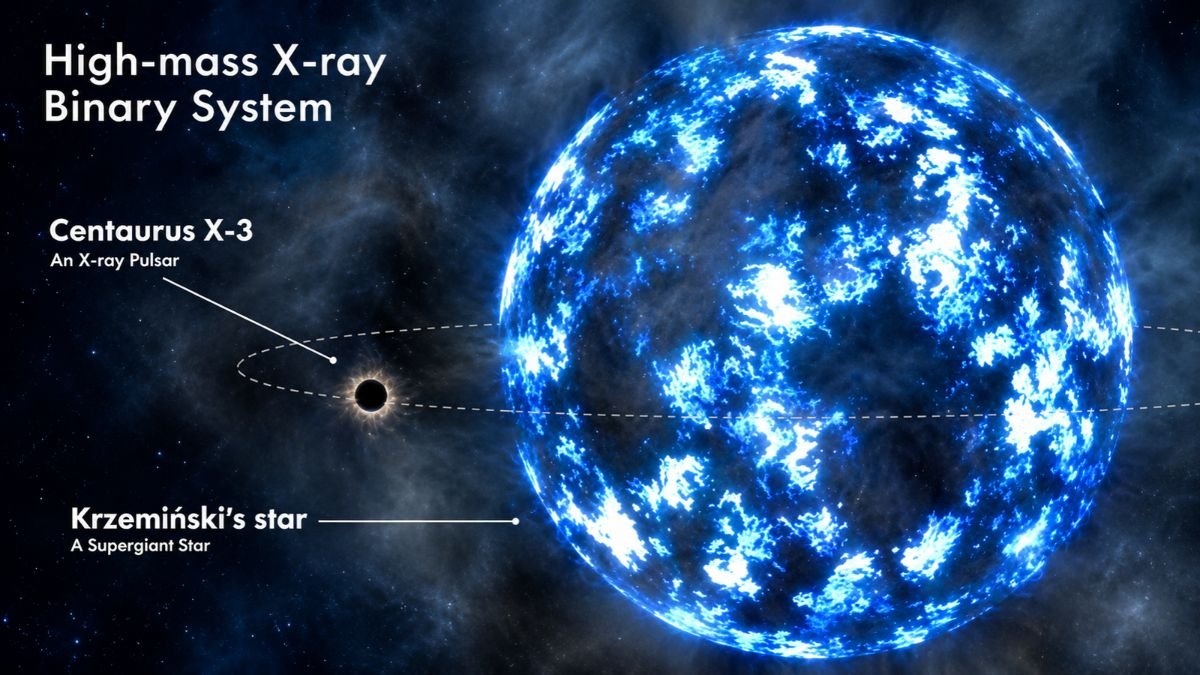
When a massive star dies, its core can collapse into an extremely dense object called a neutron star. Despite being only about the size of a city, it can have a mass comparable to that of the Sun. Its powerful gravity can pull matter away from a nearby companion star, releasing energy in the form of X-rays as the material falls towards it.
Scientists at Bengaluru’s Raman Research Institute (RRI) have studied these X-ray signals from Centaurus X-3, a star system about 24,000 light-years from Earth. By examining changes in the signals, the researchers identified a stream of matter flowing towards the neutron star and found evidence of a rotating disk of material around it. This is an unusual finding because such disks are not commonly expected in this type of star system. The discovery could help scientists better understand how matter moves around neutron stars and how these distant objects produce X-rays.
Star That Pulls in Matter
Centaurus X-3 is in the constellation Centaurus. It belongs to a class of systems known as high-mass X-ray binaries. These systems contain a neutron star and a massive companion star held together by gravity.
A neutron star forms when the core of a massive star collapses at the end of its life. It packs roughly the Sun’s mass into a sphere only about the size of a city. Its gravity is so strong that it can pull in material from a nearby companion star. As this material falls towards the neutron star, it releases enormous amounts of energy, including X-rays. Scientists study this radiation to understand how the material behaves and how the system works.
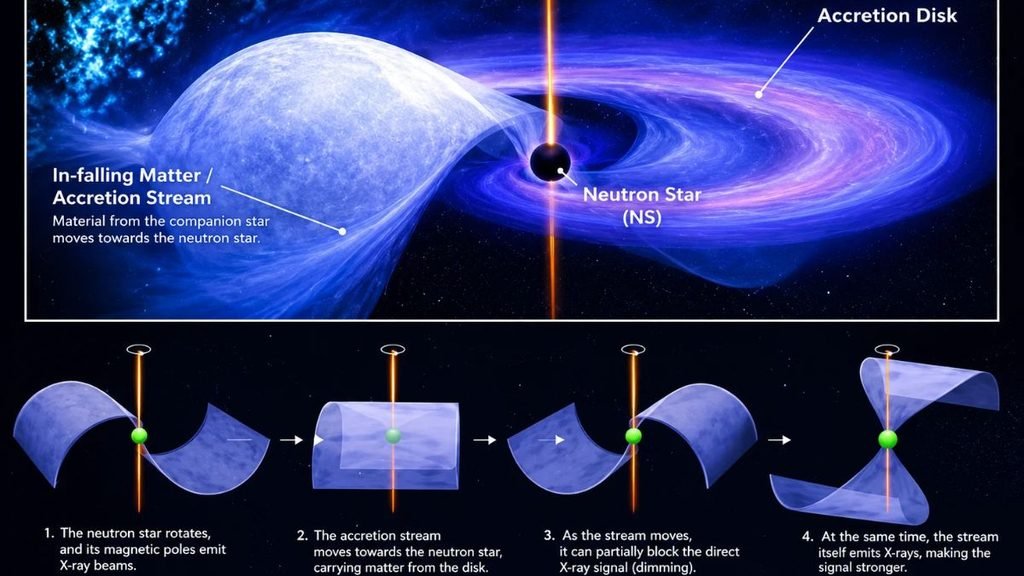
Centaurus X-3 is also a pulsar. Its neutron star rotates and sends out radiation from regions near its magnetic poles. As the star spins, these beams sweep across space. When a beam passes an observing satellite, the satellite detects a pulse of radiation, much as a lighthouse produces a repeating flash as it turns. These regular pulses provide scientists with a way to study the neutron star and its surroundings.
What the Changing Signals Revealed
The radiation from Centaurus X-3 does not come only from the neutron star itself. Some of it interacts with nearby material, including the surface of the companion star, gas flowing away from it and matter surrounding the neutron star. This material absorbs radiation and emits it again. Scientists call this secondary radiation.
Changes in this radiation can help researchers work out what is happening around the neutron star. However, Centaurus X-3 is so far away that telescopes cannot clearly distinguish its surrounding structures. It appears as a single point of light. Scientists must therefore piece together the system’s structure from the signals they receive.
Earlier observations had shown that the intensity of certain secondary X-ray emission lines changed as the neutron star rotated. An emission line is a feature in a spectrum that can reveal information about the material producing or interacting with the radiation. A research team led by Kinjal Roy of RRI examined four such emission lines in detail. The researchers found that the structure producing these changes must be rotating along with the neutron star.
The pattern helped them identify the likely source which is a stream of matter moving towards the neutron star.
Following the stream of matter
This stream is part of a process called accretion, in which a compact object draws in material from its surroundings. In Centaurus X-3, the stream carries matter from an accretion disk towards the neutron star. The disk is a rotating structure of gas and other material that moves around the star before being drawn inwards. The neutron star’s magnetic field then guides the incoming matter towards its magnetic poles.
The stream also changes what an observing satellite sees. As it moves around the neutron star, it can come between the satellite and the star, partially blocking the direct radiation. When this happens, the primary X-ray signal weakens. At the same time, radiation from the stream itself becomes stronger in the observed signal.
The researchers used these changing signals to connect the observed variations to the movement of matter around the neutron star. The evidence for an accretion stream also points to an accretion disk feeding it. This matters because scientists generally expect high-mass X-ray binaries to gather material in a different way.
Why an accretion disk matters
In many high-mass X-ray binaries, a neutron star captures gas directly from the stream of material blown away by its companion star. This is known as stellar-wind accretion. An accretion disk involves a different arrangement: material gathers into a rotating structure before flowing towards the neutron star. The findings from Centaurus X-3 indicate that this disk-based process is taking place in a system where it is not generally expected.
That difference matters when scientists calculate how the system produces and releases radiation. If their models leave out the disk, they may fail to account for some of the radiation coming from the surrounding material.
“Accretion disk is not expected to occur in [HMXBs] So, if an accretion disk is forming in this system, emission models have to be modified,” Roy said in the Department of Science and Technology’s announcement. He added that future models of Centaurus X-3 would need to account for radiation from the disk.
The research does not mean that scientists have directly photographed the disk. Instead, they have used the changing X-ray signals to infer the presence and behaviour of structures that remain too distant to resolve clearly. Published in The Astrophysical Journal, the study adds to the understanding of Centaurus X-3, one of the most widely studied binary pulsars. It also shows how small changes in radiation can reveal the movement of matter around objects that are otherwise beyond the reach of direct observation.
By identifying the flow responsible for the changing signals, the researchers have provided a more detailed picture of how this neutron star draws in material. That picture will help scientists refine their models of Centaurus X-3 and examine whether similar processes occur in other high-mass X-ray binaries.
Space & Physics
World Space Week 2026: How the Rocket Revolution Is Changing Space
World Space Week 2026 explores the Rocket Revolution, from reusable launchers and private space companies to the growing role of satellites.

Space & Physics
A Dead Star Feeds Off Planet Formed From Its Ashes
It adds to a known coterie of planets now found orbiting dead stars, astronomers are busy studying to spot signs of life.
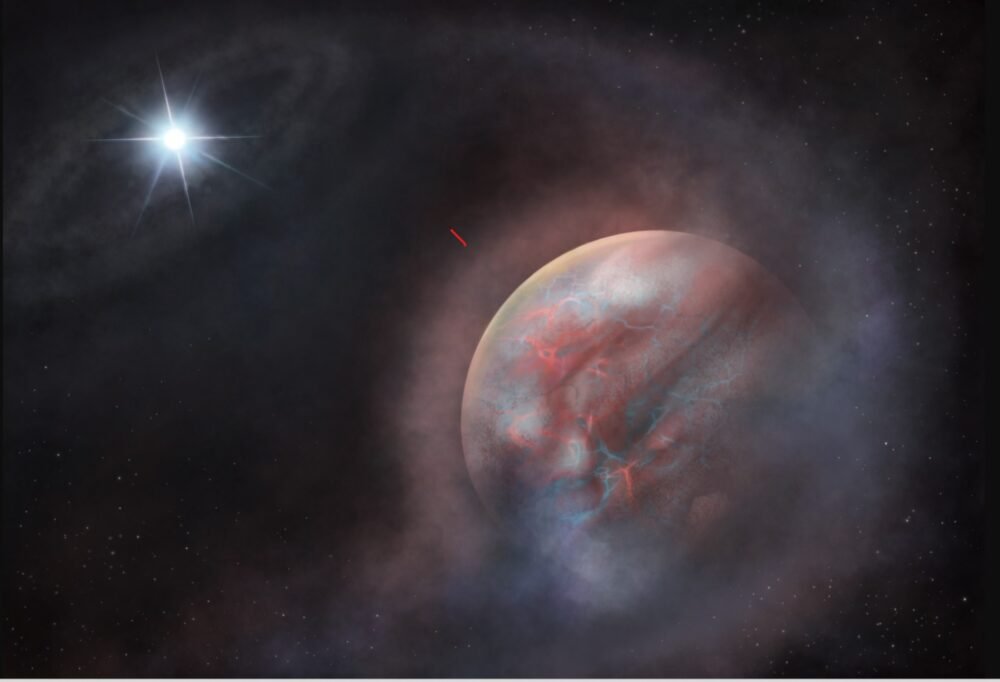
A planet orbiting once every 4 days around a white dwarf star HS 0209+0832 – about 270 light years in the direction of the constellation Pisces – is steadily losing its atmosphere to its host star. While many stars in solar systems beyond our own often feed on their planets, this particular star feeds on its own ashes.
The gaseous planet HS 0209+0832 b was discovered in 2024, when the Transiting Exoplanet Survey Satellite, a NASA space telescope, found it orbiting the white dwarf star over the course of four days. The new study followed through with detailed observations from TESS data, NASA’s space-based Far Ultraviolet Spectroscopic Explorer, in addition to the ESO’s mountain-based Very Large Telescope, to study the star’s atmosphere and in turn inferring some chemistry occurring in the planet.
In a study published in the journal Nature Astronomy on Monday and funded by NASA, European Research Council, Fundación Occident and the Instituto de Astrofísica de Canarias, an international team of astronomers have reported imprints of niobium, a heavy element, in the atmosphere of a white dwarf star.
Astronomers predict the transiting young planet around the dead star is supplying that niobium back to its host. The sighting is evidence of a “second generation” planet, one of many candidates identified over several years, manifesting in a myriad different ways from spent gas ejected in the wake of stellar deaths.
It adds to a known coterie of planets now found orbiting dead stars, astronomers are busy studying to spot signs of life.
What are white dwarf stars?
White dwarves are an exotic stars, and are all that’s left off giant stars shedding their large gaseous skin in violent deaths. Our sun is destined one day to transform into a white dwarf, but only after swelling in size some five billion years from now to become a red giant when it will eclipse past the earth’s orbit. It would take several million years after that for the red giant sun to shed its gaseous exterior to become a white dwarf.
Planets if any, found orbiting these dead stars may have likely migrated from the new solar system’s outer reaches. All that’s left off the progenitor star’s past are imprints of light metals and other elements on the white dwarf’s atmosphere. Such planets have previously been spotted orbiting pulsars, a kind of neutron star, back in 1992. In fact, its discovery had marked the first ever detection of any planet orbiting a star beyond our sun.
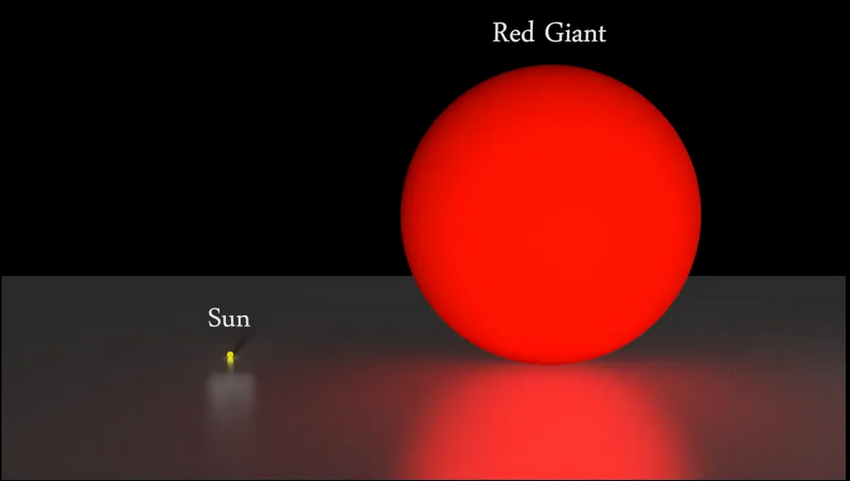
In five billion years, our sun will evolve to become a red giant star. Credit: Svitlana Leonidivna Malchenko
Sighting niobium
Elements such as niobium don’t typically form in the core of stars like our sun. Chemical production usually limits to elements lighter than or until iron, with its 26 protons and 30 neutrons. Beyond that, slamming an extra proton or neutron will cause those to split, leaving iron to be the last element to be directly forged.
Niobium, with 41 protons and 52 neutrons, is thought to be born after absorbing slow passing neutrons when the red giant star dies to form a white dwarf star. This niobium hitches a ride along with rest of the contents of the red giant star, farther into the outer reaches of the system after the formation of the white dwarf.
These contents could create a new disc of circumstellar material with dust and gas that could condense one day to form new planets. The “second generation” planet found orbiting the white dwarf star from the new study, could have been born this way.
Alternatively, it may have been a planet in the outskirts like Neptune, migrating inwards, and enriching itself with niobium-rich star material.
Either way, the planet got too close to its host star, which is irradiating its newfound niobium-rich atmosphere, stripping it away and devouring it.
While it’s likely not a candidate planet for life as we know it to be found, it’s discovery can help ascertain how such worlds are formed in the aftermath of a star’s various phases of evolution.


How Scientists Traced the Flow of Matter Around a Dead Star Using X-rays

India Scores Just 2 Out of 32 for Integrating Health into Climate Commitments

Global Job Market Faces a Growing Inclusion Gap as AI and Digitalisation Reshape Work

FSSAI Moves to Restrict Added Sugars in Infant Foods, Citing Need for Stronger Nutritional Safeguards

NMC Directs Medical Colleges to Set Up Patient Safety Committees

From Scams to Screens: How the National Stock Exchange Rewrote India’s Equity Story

Knowing When to Think for Ourselves: AI, Intuition and the Education of Discernment

After a Scorching Summer, Delhi’s Children Are Slow to Return Outdoors

Two Chemists Win Nobel Prize for Solving a Century-Old Puzzle: Why Life Picks One Hand Over the Other

Marshall Islands: Why the US Nuclear Legacy Is Back Before the UN
-

 Math3 months ago
The 2026 Fields Medals: Four Proofs, Four Decades-Old Problems Solved
-
EP Deep Dive: Data & Solutions3 months ago
After Kerala’s Deadliest Landslide, the Hardest Thing to Rebuild Was Childhood
-
EP Deep Dive: Data & Solutions4 months ago
West Asia Crisis: Can Kerala’s Returning Gulf Migrants Find a Future in the Green Economy?
-
Space & Physics5 months ago
India Semiconductor Mission: ‘It’s Not About Fabs. It’s About Building An Entire Ecosystem’
-
Interviews4 weeks ago
From Scams to Screens: How the National Stock Exchange Rewrote India’s Equity Story
-
Climate5 months ago
The Climate World Cup? How Climate Change Could Affect Player Performance at the 2026 World Cup
-
Society3 months ago
What Is Civilisational Diplomacy? Understanding India’s Newest Foreign Policy Tool
-
Society4 months ago
From Bell Labs to the Classroom: A Second Career in Teaching