Society
Who is Karuna Mantena, the winner of Infosys Prize in Social Sciences
Professor Mantena has made significant contributions to the field of political theory through her groundbreaking book, Alibis of Empire















Health
Not Broken but Unheld: A New UN Report Asks Us to Tend the Forest, Not Only the Tree
A new UN report on youth mental health calls for an ecosystem approach linking well-being with education, work, housing, climate, technology and community.

Society
Digital Detox: Why Taking a Break From Screens Matters
A digital detox can help children and adults reduce screen dependence, reconnect with nature and relationships, and create space for reflection and creativity.


Society
When a Village Walks Together, Even Drought Is Defeated. How Halma Breathed Life Back into Kesarpura’s Pond
How a traditional Halma brought Kesarpura villagers together to restore a pond, strengthen water security and revive community-led conservation.

About 22 kilometres from the Petlawad block headquarters in Jhabua district of Madhya Pradesh, the village of Kesarpura has a story to tell, one about the confidence of an entire community. A Halma was held here on 19 May 2026, and what followed convinced the village that the solution it had long sought from outside had been within it all along.
Halma is a word from the Bhili dialect, often translated as a “call for help”, and it means collective voluntary labour. When a family in the Bhil community is weighed down by a burden, whether raising a house, bringing in a harvest or facing a calamity, the word goes round the village and people come, unpaid and with their own tools, to stand by them. The message is simple: you are not alone. In Jhabua the tradition has also been turned to the work of saving water. Since 2009 the local organisation Shivganga has organised large Halmas for soil and water conservation, and one in February 2020 drew some 20,000 people from about 500 villages.
Kesarpura’s only pond had been waiting for exactly this tradition. Years of neglect had left it so choked with silt and weeds that its depth was shrinking, and so was its capacity to hold water. Seepage through one stretch of the embankment quietly drained away the rainwater it collected. This is a tribal district, where Scheduled Tribes made up about 87 per cent of the population at the 2011 Census, and a hilly one: as the district administration itself notes, water runs off the slopes instead of being held by the soil, so even good rainfall can leave villages short of water. In such a landscape a failing pond meant a direct threat to a full year of farming and to the water that livestock depend on. As summer set in, the pond bed would fill with cracks, and the village’s hopes would drain away with it.
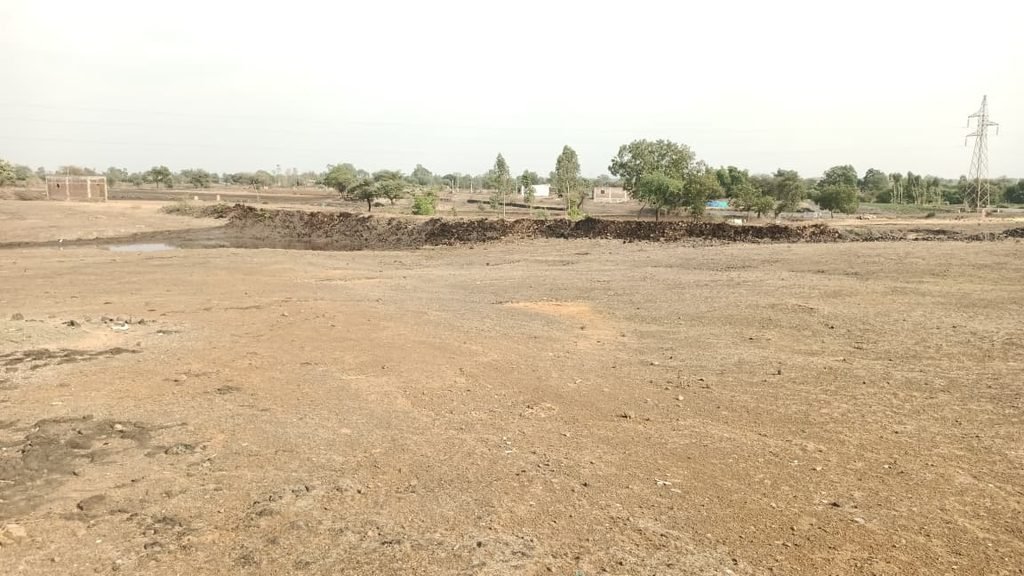
Before the Halma: a dry pond bed, heaps of silt and seepage along the embankment. Photo: Mukesh Porwal, Block Facilitator, VAAGDHARA
The village knew the problem was big, but it also knew the solution lay in its own hands. With the support of the Gram Swaraj Samuh, a village self-governance group of ten women and ten men formed by VAAGDHARA, it was decided that a Halma would be held at the pond. The idea was not new to the area: less than a fortnight earlier, on 6 May, villagers of Borpada, also in Petlawad, had used a Halma to clear a silted public well after repeated appeals to the panchayat brought no result. On the morning of 19 May, Kesarpura showed its true strength.
It began not with speeches or formal announcements but with the beat of the dhol, kundi and thali. A rally wound through the village. Children ran ahead carrying a banner that read “Traditional Halma Method,” with the slogan beneath it: “Save water regularly, and the future is secure.” Behind them walked elders, youth and women, with someone from every household carrying a pickaxe, a spade or a metal pan.
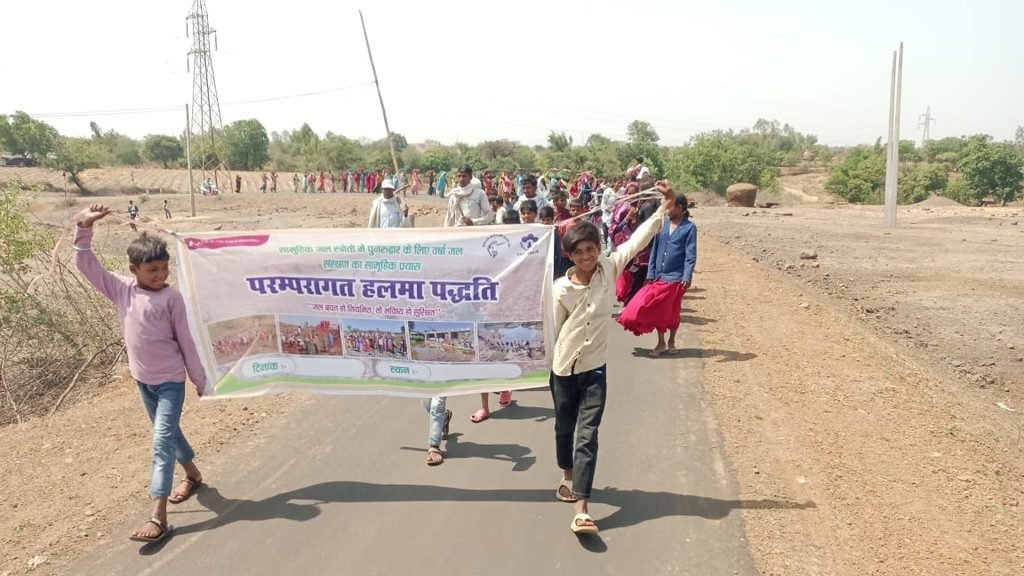
The rally sets out to the beat of the dhol and thali, with a banner reading “Traditional Halma Method”; enthusiastic children lead the way. Photo: Mukesh Porwal, Block Facilitator, VAAGDHARA
Around 150 people gathered at the pond for the Halma. There is no attendance register and no list; people come of their own accord and leave having done more than they thought they could. Under the blazing sun, heads were covered with gamchas and dupattas, yet faces glowed instead of showing fatigue. The work divided itself. Some waded into the pond to cut the weeds, others dug out silt with pickaxes and spades, and the silt was loaded into pans and basins and handed to a long line of women. The pans passed from hand to hand and head to head, and the silt made its way out of the pond.
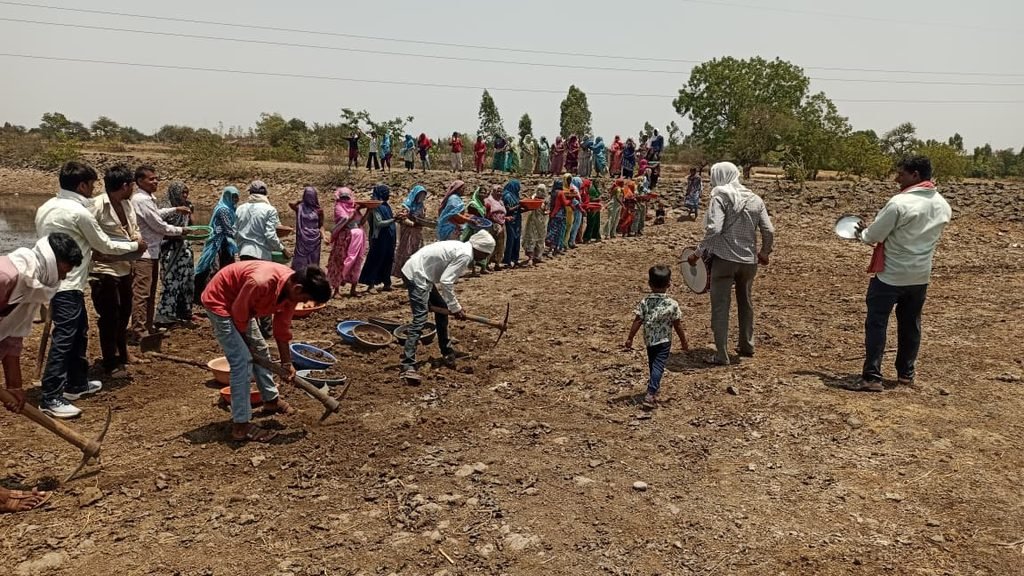
Men wielding pickaxes and spades on the pond bed, while women stand in line holding pans. Photo: Mukesh Porwal, Block Facilitator, VAAGDHARA
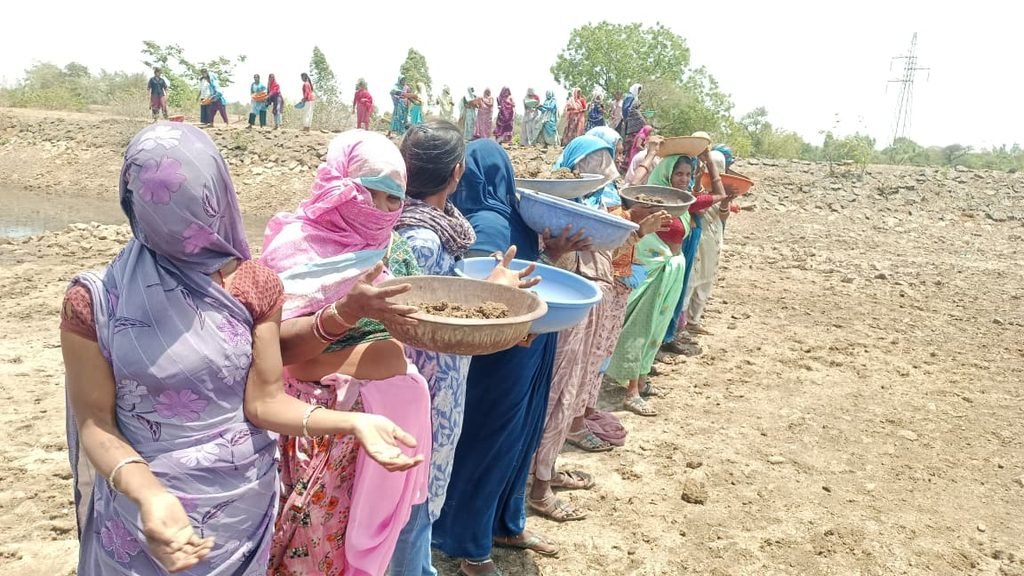
The role of women was the most remarkable part of the scene. Amid their household responsibilities, they stayed at the pond all day. Recalling that day, Basanti Ninama says that when the dhol sounded she could not sit at home, and standing in line with a pan on her head, it felt like work in her own courtyard.
“I was tired, but my heart felt light. I felt I was doing something for my village.”
– Basanti Ninama
Everyone also worked together to pile soil on the embankment where water had been seeping out, pressing it down and strengthening it. Clearing silt and weeds and strengthening the earthen bund are the standard steps in restoring a village pond, and those who know water conservation understand that the strength of the embankment and the depth of the pond decide how long a water body lasts. When noon came, the tools were set down, but the bond of togetherness did not break. Lunch, too, was cooked by everyone together on the pond’s bank. The women wove plates from tree leaves, and then everyone sat in a long row on colourful mats. An elderly woman and a small child ate the same meal on the same mat, and the true meaning of Halma came alive right there. Here, trust takes the place of accounts, and hard work and celebration blend into one another.
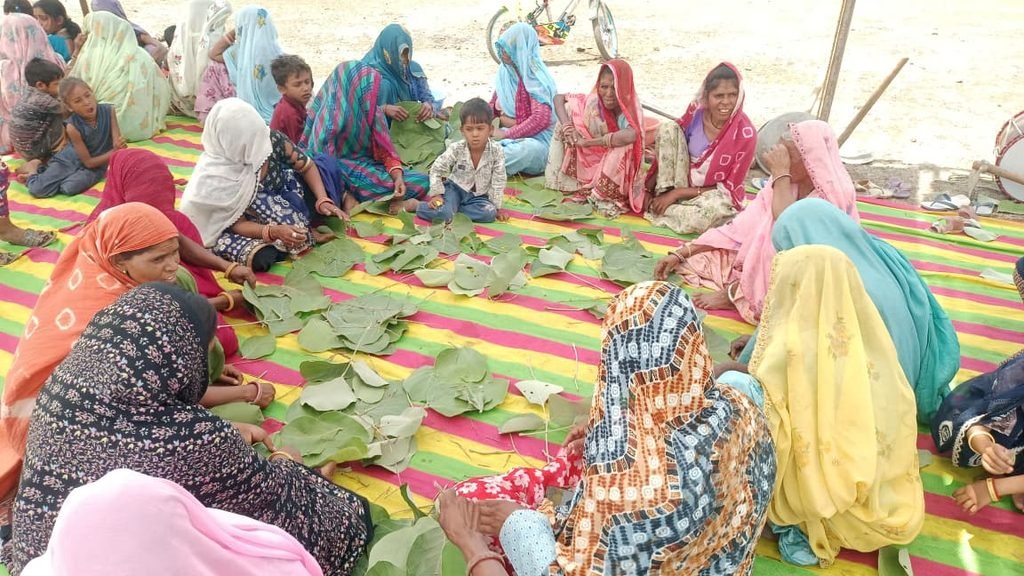
Women making leaf plates: even the preparation of the meal was a collective effort. Photo: Mukesh Porwal, Block Facilitator, VAAGDHARA
The simplicity of the leaf plate is a lesson in itself. A plate made from tree leaves leaves no plastic waste and needs no water for washing. Leaf plates have long been part of community feasts across India, and researchers describe them as a renewable alternative to plastic disposables. At an event whose very purpose is to save water, this goes beyond symbolism and becomes practice. Traditions often carry such eco-friendly solutions quietly, without any announcement.
Those who restored the pond that day included Basanti Ninama, Ganga Ninama, Surta Ninama, Sundar Mavi, Anadu Maida, Devli Mori, Phula Katara, Seema Maida, Anita Katara, Kala Ninama, Sukhram Maida, Ukarlal Maida, Mansingh Ninama, Ukar Ninama, Laxman Ninama, Dilip Vasuniya, Gendu Mori, Khima Mori, Anil Maida and Sunil Katara. Though they differ in age and family, their experiences seem threaded on a single string. For Ganga Ninama it was an emotional day: generations of her family have drunk this pond’s water, and it pained her to see it buried under silt.
“The day the pond was cleaned, I felt we had repaid our debt.” – Ganga Ninama
For men like Sukhram Maida and Anil Maida, the experience changed the way they thought. They used to believe that work on the pond was the government’s job, but on the day of the Halma they realised that when a village comes together, it has no one to wait for. “Before the Halma, we thought the government would do this work. This time we understood that when the village becomes one, we don’t have to wait for anyone.” – Anil Maida. The thought was not unique to Kesarpura: at the Samuh meeting in Borpada, someone had remarked that waiting for the government could cost another three years.
“It was very hot, but nobody complained. We want our children to see how work for the village is done.” – Devli Mori
During the event, Paramesh Patidar, Implementation Leader at VAAGDHARA, spoke with the villagers and explained that Halma is not merely voluntary labour but a tradition of standing by one another in joy and sorrow and sharing collective responsibility.
Behind the scenes, Block Facilitator Mukesh Porwal and his team also played a vital role, working at every level from mobilising people to planning the work. The steady guidance of Team Leader Dharmendrasingh Chunawat gave direction to the entire effort.
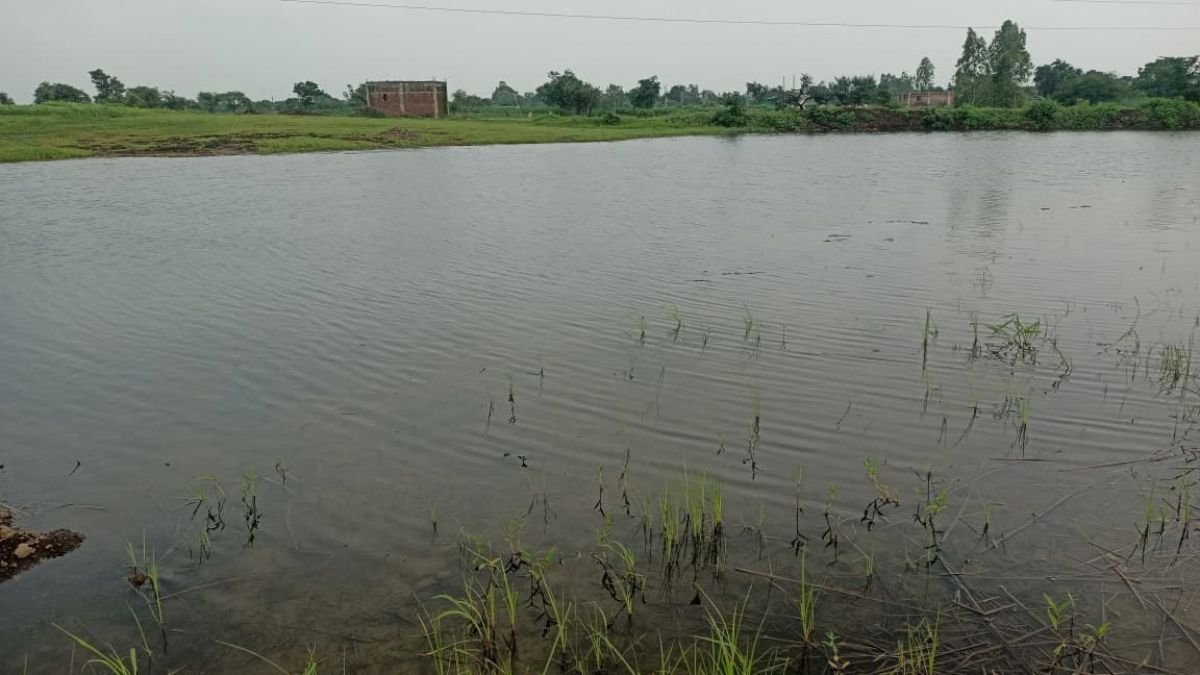
After the Halma the village returned to its routine, but nobody expected the result to show so soon. The monsoon turned out weaker than hoped. The India Meteorological Department had forecast a below-normal season, and by late July Jhabua was among the Madhya Pradesh districts reporting rainfall 33 to 45 per cent below normal; by 9 September the district’s shortfall stood at about 36 per cent. There was every fear that the pond would once again be left only partly filled. But about three months later, around August 2026, when villagers looked towards the pond, it was filled to the brim with water.
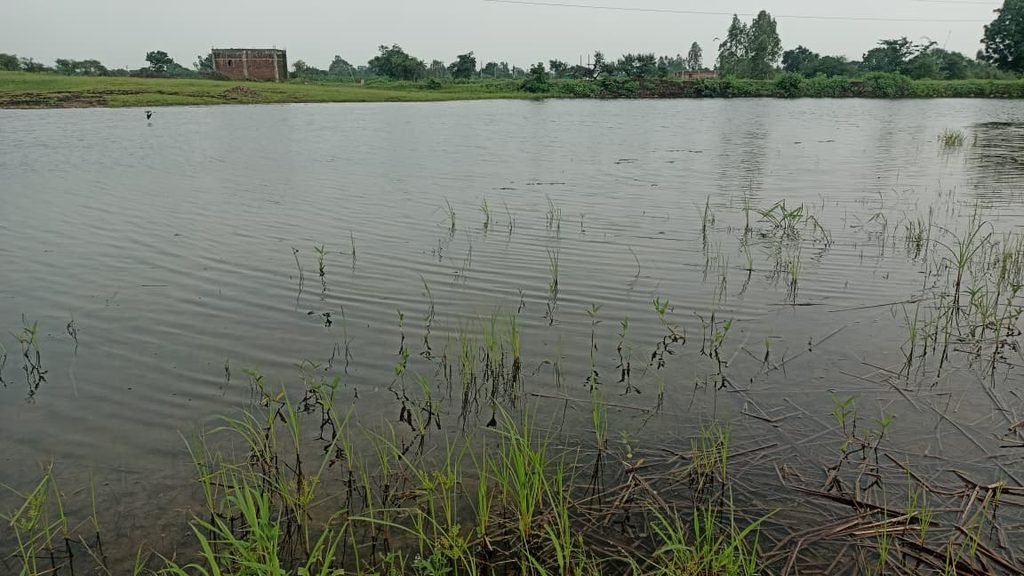
Where dust once flew, calm water now stretches far into the distance; the green grass sprouting along the edge is proof of life’s return. Photo: Mukesh Porwal, Block Facilitator, VAAGDHARA
The greatest joy was that the seepage through the embankment had also stopped. The water that came had stayed. For farmers like Sunil Katara and Mansingh Ninama, the meaning was direct: their fields will get irrigation and their cattle will have drinking water.
It is worth asking why such ponds last. Studies of India’s water infrastructure describe a recurring cycle of construction, neglect and rebuilding, with upkeep after construction as the weak link, and village ponds that were once maintained by the communities who used them fell into disrepair as that responsibility moved elsewhere. Experience shows that when a water structure is built from outside by a contractor, its upkeep often becomes nobody’s responsibility; the embankment breaks, the silt returns, and within a few years the pond can be back to its old state. A structure built through voluntary labour creates an emotional bond. Someone who has put soil into it with their own hands cannot bear to see it deteriorate. This is Halma’s greatest invisible achievement: along with the structure, it raises a whole generation of guardians. One good season in a poor monsoon is encouraging, but it is early evidence rather than proof; how long the pond lasts will depend on the desilting and embankment care the village now commits to.
The hopes ahead are considerable. In the rabi season, when fields need water the most, this stored water can become the farmers’ mainstay. With water standing in the pond, groundwater levels in nearby wells and hand pumps may also improve; case studies of desilted village ponds in Maharashtra’s Marathwada region report that nearby borewells recharged and the irrigated area grew in both the kharif and rabi seasons. Greenery is returning to the embankment, and guarding it is now the village’s shared responsibility. Remove the silt, bind the embankment, hold the rain, raise the groundwater, then irrigate the fields: this entire cycle of water conservation now appears to be complete in Kesarpura.
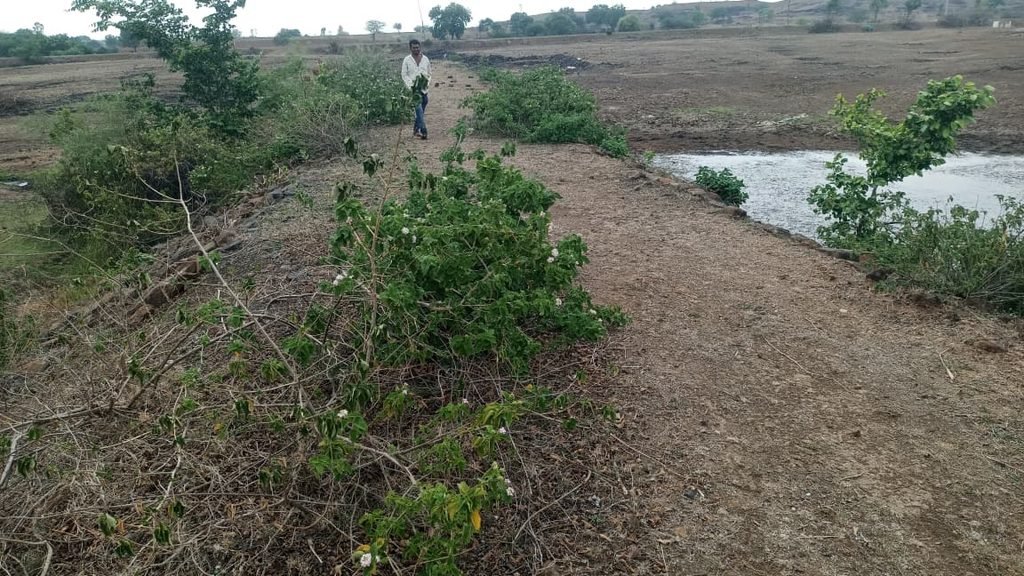
Greenery on the strengthened embankment, with still water on one side. Photo: Mukesh Porwal, Block Facilitator, VAAGDHARA
One sees the tradition of the elders and the labour of the young, the support of women and families, and above all a collective resolve to do something for one’s own village.
Kesarpura’s story is a reminder that development does not always wait for help from outside. In a country where, by NITI Aayog’s 2018 assessment, some 600 million people face high to extreme water stress, and where even large investments in water structures struggle with upkeep once they are built, examples like this show that the key often lies in local knowledge and community ownership. Three things together have given this pond a new lease of life: tradition meeting present-day need, institutions staying in the role of facilitators (in Borpada, too, the Samuh gave villagers room to decide for themselves rather than handing them ready-made answers), and a village that regards its resource as its own. Halma did not remove only silt and weeds from Kesarpura’s pond; it rekindled hope in people’s hearts, and today that hope is as clear as the pond’s water.


Not Broken but Unheld: A New UN Report Asks Us to Tend the Forest, Not Only the Tree

Ebola Outbreak Worsens in DRC as WHO Calls for Urgent Patient Care

Flash Energy Droughts Could Put New Pressure on Renewable Grids

MIT engineers develop light-controlled robot powered by living muscle

India Tightens CAFE Norms as Fuel Demand and Car Sales Rise

From Scams to Screens: How the National Stock Exchange Rewrote India’s Equity Story

Farmers Borrowed to Build ‘Diggis’. Two Years Later, They Are Still Waiting for the Subsidy

Aim for the Stars: Anjali Thomas’s Journey from a Small College in Kerala to the Frontiers of Medical Imaging

When the Himalayas Collapse Without Warning, What Counts as Preparedness?

Anxiety Freezes Career Decisions. Curiosity Unfreezes Them

-

 Math2 months ago
The 2026 Fields Medals: Four Proofs, Four Decades-Old Problems Solved
-
Climate2 months ago
After Kerala’s Deadliest Landslide, the Hardest Thing to Rebuild Was Childhood
-
Society3 months ago
West Asia Crisis: Can Kerala’s Returning Gulf Migrants Find a Future in the Green Economy?
-
Space & Physics4 months ago
India Semiconductor Mission: ‘It’s Not About Fabs. It’s About Building An Entire Ecosystem’
-
Interviews1 week ago
From Scams to Screens: How the National Stock Exchange Rewrote India’s Equity Story
-
Climate4 months ago
The Climate World Cup? How Climate Change Could Affect Player Performance at the 2026 World Cup
-
Society3 months ago
What Is Civilisational Diplomacy? Understanding India’s Newest Foreign Policy Tool
-
Society4 months ago
From Bell Labs to the Classroom: A Second Career in Teaching