The Sciences
Anxiety Freezes Career Decisions. Curiosity Unfreezes Them
A framework that integrates emotion and identity for modern careers.


Career anxiety is neither a pathology nor a personal failure. Yet most career paralysis stems not from a lack of options but from a fundamental misunderstanding of what career decisions entail. Not more certainty, but more cognitive agility.
Career paralysis occurs when our minds get stuck in a single cognitive mode. Scanning for threats, seeking certainty, protecting identity. The pathway forward requires the ability to shift between modes. Exploring possibilities while committing to direction, noticing losses while imagining gains, questioning our current self while becoming the next version.
This is the skill that modern careers actually demand. And unlike what anxiety tells us, it is not something we need to possess before we act. It is something we develop through engaging.
Why Career Decisions Feel So Uniquely Terrifying
Career choices combine three elements that the human mind struggles with: uncertainty (outcomes are delayed and ambiguous), identity threat (the choice feels like a statement about who we are becoming), and perceived irreversibility (the haunting sense that choosing one path closes all others).
Psychologists Lazarus and Folkman demonstrated that anxiety emerges when situations feel highly consequential and low in perceived control. Career decisions fit this profile perfectly. Add loss aversion. The psychological fact is that we weigh potential losses more heavily than equivalent gains. And we understand why career anxiety feels so intense.
The anxiety is predictable. The problem is that once it arrives, we treat it as a decision maker rather than a source of information.
The Five Dimensions of Career Cognitive Agility
Career decisions require what cognitive psychologists call cognitive agility. The capacity to move fluidly between different cognitive modes in response to uncertainty. The original research defined this as three components (cognitive openness, focused attention, and cognitive flexibility). This paper adds two more (emotional recalibration and identity enactment) for career-length transitions.
Cognitive Openness. The capacity to notice new information, consider multiple possibilities, and think divergently. This is where curiosity lives. The willingness to explore the unfamiliar.
Focused Attention. The ability to filter out distractions and concentrate on what matters most. Without this, we would be paralysed by the sheer number of options.
Cognitive Flexibility. The capacity to shift between openness and focus as the situation demands. This is the often-overlooked skill. Knowing when to explore and when to execute.
Emotional Recalibration. As we move between cognitive modes, our nervous system must also shift. Curiosity activates reward pathways and opens us to uncertainty. Focused commitment engages different systems. Emotional agility means tolerating the discomfort of each shift without becoming defensive.
Identity Enactment. Professional identity is not fixed. It is continuously created through our moment-to-moment experiences of choices. Exploring options is itself an act of professional identity. We are the people willing to engage, learn, and grow.
These five dimensions working together create the capacity to navigate career uncertainty without being paralysed by it.
A Real Example: When Cognitive Agility Matters
Consider Maya, who is good at engineering. Objectively, demonstrably good. But she is drawn to product design. Both paths matter to her, but in different ways.
Anxiety asks, “What if you choose wrong? Engineering is secure. Design is uncertain. What if you fail at design? What does it mean about your intelligence if you choose design instead?”
The anxiety is not irrational. It is protecting her. But it is also freezing her in a single mode. Threat scanning, certainty seeking, identity protecting.
What cognitive agility looks like for Maya:
Openness. Instead of “Which is the right choice?” she asks, “What would six months in design teach me about my actual interests?” She reaches out to designers, shadows product teams, and builds something.
Focus. She does not float endlessly in exploration. She commits to specific learning goals. She enrols in a design course. She builds a portfolio piece. She sets a decision timeline.
Emotional Recalibration. The shift from “safe engineering” to “uncertain design” creates real discomfort. She has to tolerate anxiety about her capabilities, social pressure about “throwing away” engineering, and fear of starting something afresh. These feelings are real. Cognitive agility does not eliminate them. It means moving forward while holding them.
Identity Enactment. She is not abandoning her “engineer” identity. She is expanding it. Six months of design exploration is a legitimate act of professional identity. She is someone willing to interrogate her path, test her interests, and integrate what she is learning.
Flexibility. She knows the point at which she will shift from exploring to committing. She has decision criteria. When she has gathered enough information, she will move decisively.
What Maya developed was not certainty. It was the cognitive and emotional capacity to navigate uncertainty without being controlled by it. That capacity is what unfroze her decision.
How Curiosity Changes Everything
Curiosity operates through a fundamentally different system than anxiety. While anxiety narrows attention to scan for threats, curiosity expands it. Psychologist George Loewenstein calls this the information gap theory. Curiosity arises from perceived gaps in understanding.
Neuroscience shows that curiosity activates reward-related neural pathways associated with dopamine, increasing tolerance for uncertainty and improving learning under ambiguous conditions.
Most importantly, curiosity does not require confidence in outcomes. It requires interest in the process.
Identity Enactment: Why Career Decisions Are Actually Identity Questions
Here is what makes career anxiety different from other decisions.
Most decisions are choice problems. Comparing options and selecting the best one. Career decisions are also identity problems. We are not just choosing a path. We are choosing who we will become. That is what creates the deeper anxiety.
Organisational psychologist Herminia Ibarra has shown that during career transitions, people often reconstruct their professional identity through narrative reframing. Telling themselves a new story about who they are. This is valuable work. It helps people make sense of change.
But there is something deeper happening in how professionals actually navigate uncertainty. They do not just reconstruct identity. They continuously enact it through their choices and actions.
Identity enactment means this: your professional identity is not stored somewhere waiting to be recovered or reconstructed. It is actively created moment by moment through what we do, what we choose, and how we show up. When we engage with a new opportunity, we are not abandoning an old identity to build a new one. We are continuously constituting who we are through our choices right now.
This distinction matters profoundly because it changes what we need to do.
If identity is fixed and we reconstruct through reflection, then we need to figure it out before we act. We need clarity first. This is where career paralysis lives.
If identity is something continuously enacted through action, then we do not need to figure it out in advance. We create it through engagement. The identity emerges through the doing, not before it.
The deeper fear beneath career anxiety. It is not actually the fear of failure. It is the fear of becoming someone different from what we imagined. It is the fear that choosing engineering (or design, or therapy, or entrepreneurship) means we are becoming an “engineer” (or designer, or therapist, or entrepreneur), permanently and irrevocably.
But this fear assumes identity is fixed. Once we recognise that identity is continuously enacted, we know that we create and recreate our professional self through our choices. The terror diminishes.
We are not choosing an identity. We are choosing an experience through which we will enact our identity. We are not committing to forever. We are committing to what we will learn in this chapter.
How this reframes everything. Exploring options becomes an act of professionalism, not a sign of inadequacy. Taking a step into uncertainty becomes an act of identity creation, not identity abandonment. Changing direction becomes integration of learning, not rejection of our past self.
This is where cognitive agility and identity enactment connect. The ability to shift between exploration and focus, between openness and commitment, between questioning and acting. That fluidity is how enacted career identity actually develops. Each shift is an act of becoming.
The Experiment Mindset
Cognitive agility fundamentally reframes what a career decision means.
Instead of asking, “Is this the right career for me?” — which demands certainty — ask, “What would this option teach me over the next year?” — which invites learning.
Career psychologist John Krumboltz argued for decades that careers are not discovered through prediction — they are constructed through experience, what he called planned happenstance. Contemporary theorist Mark Savickas emphasises that modern careers are built through iterative meaning-making rather than linear planning.
When a choice becomes a time-bound experiment rather than a permanent identity decision, its emotional weight changes. The illusion of irreversibility — one of the primary drivers of career anxiety — begins to loosen.
A 6-month experiment in a new field feels manageable. A permanent identity change feels terrifying. The only difference is our frame.
A Practical Exercise Before Our Next Decision
Before our next career decision, let us pause and work through these questions. They are designed to help us practice cognitive agility across all five dimensions.
1. Name the anxiety. What am I most afraid of losing or getting wrong? This activates our focused attention on real constraints and risks.
2. Reframe the choice. If this were a 6- to 12-month experiment, what would I want to learn? This shifts us into cognitive openness mode — exploration over evaluation.
3. Activate curiosity. What questions am I genuinely interested in answering about this path? This sustains openness by connecting to intrinsic interest. Curiosity is also emotional work. It requires nervous system activation.
4. Lower the risk. What is one small, reversible step that allows exploration without overcommitment? This uses focus to make curiosity actionable — filtering from all possibilities to one concrete action.
5. Build identity coherence. How can I see this choice as continuous with my development rather than discontinuous with my past? This is the identity dimension. We are not abandoning who we were. We are integrating who we are becoming.
6. Build cognitive flexibility. How will I know when it is time to shift from exploring to committing? What signals will tell me I have enough information? This is a metacognitive step — thinking about our thinking — that allows us to move fluidly between modes.
Small voluntary actions increase perceived control, a key factor in reducing anxiety. But this works deeper. We are practising the cognitive agility that modern careers actually demand.
When Structural Barriers Are Real
Let us be clear. Curiosity is not a solution to financial pressure, caregiving responsibilities, or systemic barriers. These are not mindset problems. They are real constraints that demand real scaffolding: parallel plans, incremental transitions, income buffers, and social support.
Cognitive agility operates within constraints, not instead of them.
What Modern Careers Actually Reward
In stable career systems, commitment to a single path was everything. Focus was the entire skill set.
In today’s volatile landscape, a different capacity, cognitive agility, matters more. The ability to flexibly operate with both curiosity and focus. Knowing when to explore and when to execute. When to question and when to commit.
Cognitive agility is not about being indecisive or constantly changing direction. It is about integrating openness, focus, and the flexibility to shift between them as situations demand.
The Final Reframing
Research on career resilience shows something crucial. Cognitive agility does not develop through prior preparation. It develops through engaging with challenges that demand it.
Each time we navigate a career transition — each time we choose openness over defensive closure, shift attention to what matters, integrate emotion without being controlled by it, and act on our evolving identity — we are strengthening the neural networks, emotional systems, and identity integration that enable future navigation.
We do not need to feel cognitively agile before pursuing an opportunity. The pursuit itself develops the agility we will need.
Anxiety wants certainty before action.
Curiosity creates action before certainty.
Modern careers rarely reward those who wait for perfect clarity. They reward those who learn their way forward.




The Sciences
MIT Researchers Develop Origami-Based Method for Lightweight, Load-Bearing Structures
MIT researchers have developed an origami-inspired construction technique that could enable lightweight, rigid structures using less material and simpler assembly methods.

Researchers at the Massachusetts Institute of Technology (MIT) have developed an origami-inspired construction method that could enable the fabrication of lightweight, rigid structures using less material and simpler assembly techniques. The approach could eventually be used for emergency shelters, architectural components and lightweight aerospace parts.
The modular system uses components cut from flat sheets of material, folded into shape and connected to form three-dimensional structural shells. According to MIT, simulations indicate that the structures can be approximately 3.5 times stiffer than those produced using some other structural origami techniques, while requiring only about two-thirds as much material.The research was announced by MIT on October 27 and published in the International Journal of Solids and Structures.
Building structures through folding
The researchers drew inspiration from geometric patterns developed by artist and scientist Ron Resch in the 1960s. Unlike methods that fold a single sheet into a complete structure, the new approach uses individually fabricated components that are folded and connected to create a larger framework.
Alfonso Parra Rubio, a graduate student at MIT’s Center for Bits and Atoms and lead author of the study, developed a method for combining two tripod-shaped units into a rigid building block. These blocks can be interconnected to form a network of beams that creates a lightweight structural shell.
To simplify the design process, the team developed computational software that automatically generates components according to the intended structure. The software checks whether individual units can be folded before combining them into the final design.
The resulting files can be sent to computer-controlled cutting equipment to manufacture components from flat sheets of material, including aluminium. Workers can then fold and assemble the units using basic hand tools, without requiring large-scale welding equipment.
Demonstration at architectural scale
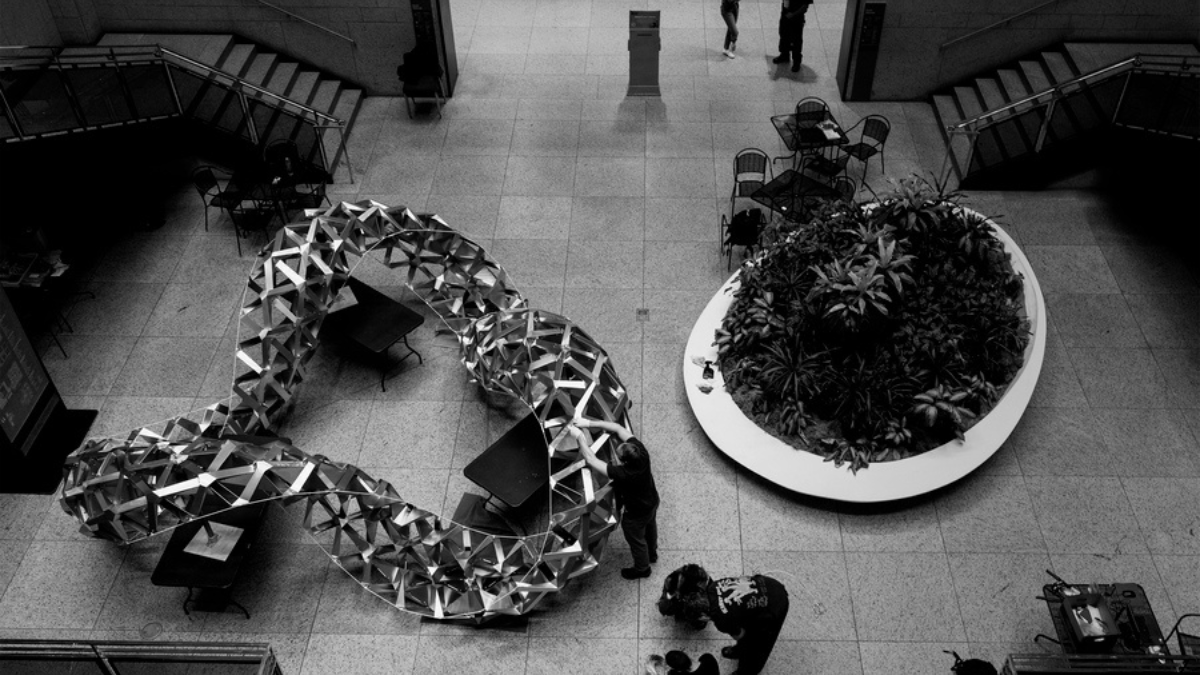
To demonstrate the method’s scalability, the researchers constructed a 23-foot folded-aluminium sculpture that was installed in the atrium of the Boston Public Library. According to MIT, a team without professional construction experience assembled the structure in a matter of days.
The researchers say the modular design simplifies assembly because the components are engineered to fit into their intended positions as the structure takes shape.

Representational image.Image credit:Pexels
However, the reported stiffness improvements are based on simulations comparing the method with other origami-based systems. Further testing will be necessary to establish its performance across different materials, loading conditions and real-world construction environments.
Potential applications
One potential application is disaster-relief housing. Flat-packed components could be transported efficiently to areas affected by earthquakes or floods and assembled on site, potentially reducing transportation and construction requirements.
The approach could also be explored for lightweight aerospace components, modular robots, sound-dampening panels and building facades. Its ability to create rigid structural shells without interior support columns could offer additional flexibility in architectural design.
The researchers plan to test the technique in larger architectural structures and investigate more complex component geometries that could improve strength and stiffness. They also intend to develop a more accessible interface for designing structures using the system.
While the method has yet to demonstrate widespread use in buildings, the research illustrates how geometric design and digital manufacturing could offer alternatives for constructing complex structures.
Its practical adoption will depend on factors including durability, manufacturing costs, structural safety and performance under real-world conditions. Nevertheless, the approach presents a potential option for applications where reducing material use and simplifying assembly are priorities.
Space & Physics
Indian-Belgian Team Develops Portable Detectors to Image Mountains and Monuments Using Cosmic Rays
Portable cosmic-ray detectors could help researchers examine mountains, tunnels and historical monuments without invasive procedures, opening new possibilities for scientific imaging and infrastructure inspection.
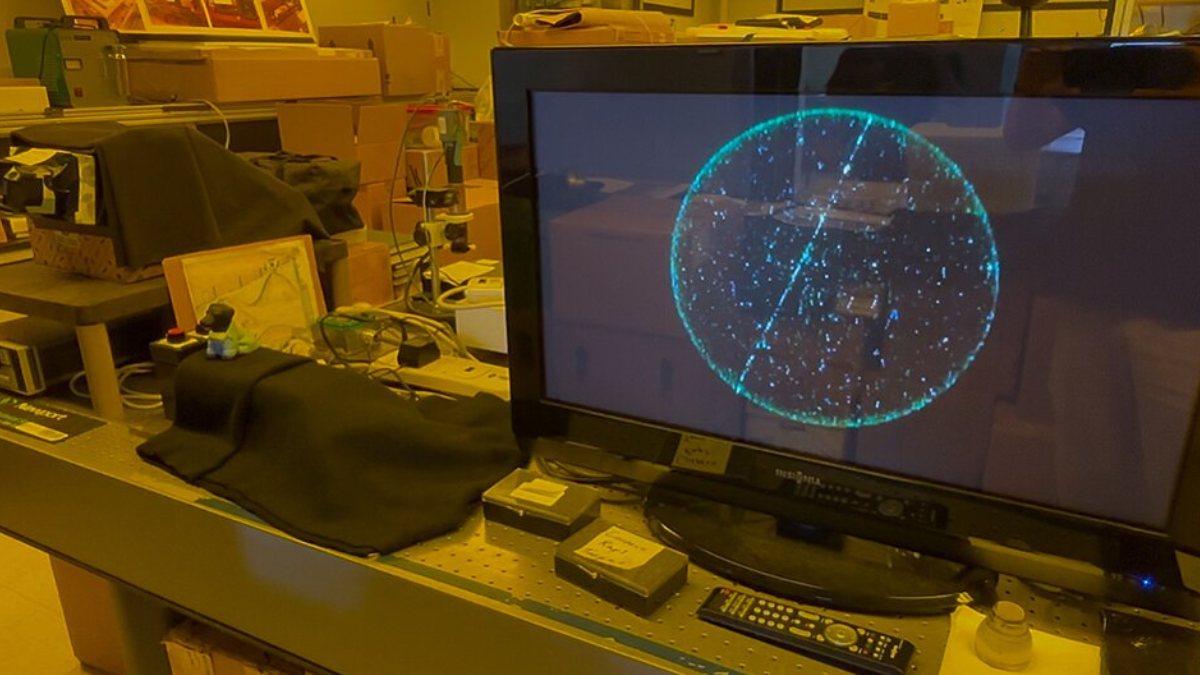
An international team of researchers from India and Belgium has developed portable particle detectors that could help scientists examine the interiors of mountains, tunnels and historical monuments without damaging them. The technology uses naturally occurring cosmic-ray particles to map variations in the density of objects, offering a potential approach to non-invasive imaging of large structures.
The detectors, developed using glass-based Resistive Plate Chambers (RPCs), achieved a particle-detection efficiency exceeding 95% during testing, according to a report published by Research Matters on October 24, 2026. The findings demonstrate the potential of compact detector systems to investigate dense materials and support future applications in geology, archaeology and infrastructure assessment.
The collaboration includes researchers from India’s National Institute of Science Education and Research (NISER), Bhubaneswar, and the Homi Bhabha National Institute (HBNI), alongside researchers from Belgian institutions, including Université catholique de Louvain and the Inter-University Institute for High Energies.
How cosmic rays reveal hidden structures
The technology uses muons, high-energy particles produced when cosmic rays interact with Earth’s atmosphere. These particles continuously reach the Earth’s surface and can penetrate substantial thicknesses of rock, concrete and other materials.
As muons travel through an object, some are absorbed or deflected depending on its density and thickness. By measuring the number and trajectories of particles passing through a structure, researchers can identify variations in internal density and reconstruct images of otherwise inaccessible areas.
The technique, known as muography, is comparable in principle to X-ray imaging, but uses naturally occurring particles instead of an artificial radiation source. It has previously been used to investigate geological formations, including volcanoes, and to explore archaeological structures.
However, conventional muon detectors can be bulky, difficult to transport and challenging to operate in remote locations. The new glass-based detectors aim to address some of these limitations through a compact design and sealed operation, reducing dependence on continuous gas supplies.
Testing the detector system
The researchers developed three glass RPC prototypes using thin glass electrodes separated by gas-filled gaps. When a muon passes through a chamber, it ionises the gas, generating an electrical signal that can be recorded to determine the particle’s position.
Electronic readout systems capture these signals and help reconstruct the trajectories of incoming particles. During testing, the detectors achieved an efficiency exceeding 95%, with a timing resolution of approximately 1.8 nanoseconds, according to the research report.
To examine the system’s ability to detect dense materials, the team conducted an absorption experiment using one prototype. During an open-sky measurement, researchers recorded nearly 55,000 muon tracks. After placing a lead block in the experimental setup, the recorded count fell to 30,894, demonstrating how dense material reduced the number of particles reaching the detector.

Representational image.Image credit:Pexels
The experiment provided proof of principle that the system could measure muon attenuation and support radiographic imaging. However, imaging complex structures such as mountains or monuments requires measurements from multiple directions and further computational reconstruction.
Applications and challenges ahead
Portable muon detectors could eventually help researchers investigate hidden cavities, examine geological formations, inspect tunnels and study the internal structures of historical monuments. Engineers could also explore their application in assessing infrastructure such as dams and bridges, although these uses would require additional testing and validation.
For cultural heritage conservation, muography could offer a valuable alternative where drilling or other invasive investigations risk damaging fragile structures. A 2025 review published in iScience highlighted the technique’s potential as a complementary, non-destructive method for studying cultural heritage objects, while noting that the relatively low flux of naturally occurring muons can require lengthy data-collection periods.
The technology is not yet a universal replacement for existing inspection methods. Its practical application will depend on factors such as spatial resolution, detector size, measurement duration and the complexity of the structure being examined.
The researchers have proposed further improvements, including lighter structural materials, larger detector areas and enhanced readout systems. These developments could make the detectors easier to deploy and improve the quality of reconstructed images.
Technology
Thorium-229 Nuclear Clock Opens New Way to Probe Dark Matter
Scientists have demonstrated a working thorium-229 nuclear clock, opening new possibilities for precision timekeeping and research into dark matter.
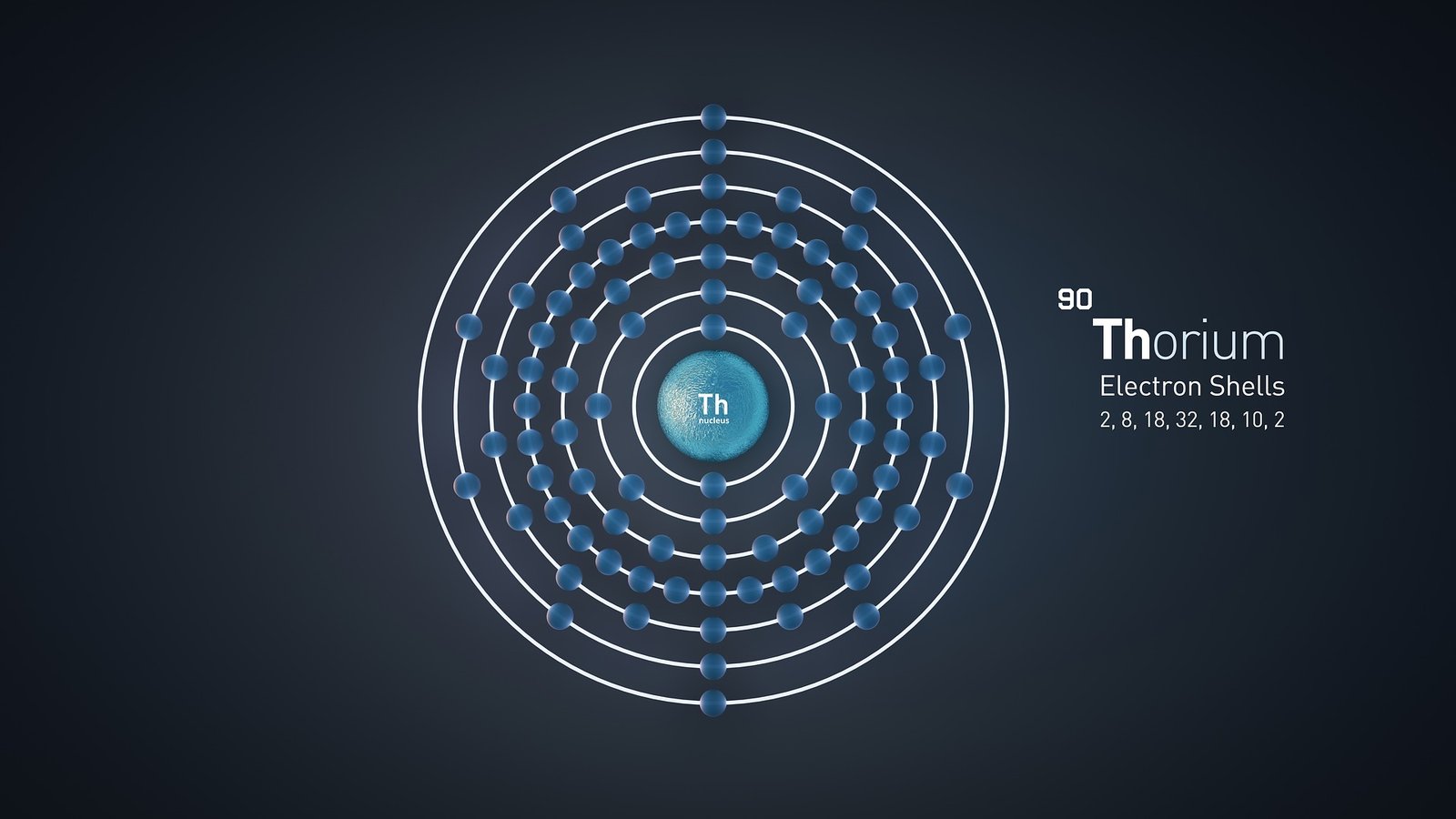
Scientists have demonstrated a working nuclear clock based on thorium-229, an advance that could open new possibilities for precision timekeeping and the search for dark matter. Unlike conventional atomic clocks, which measure transitions involving electrons, the device uses an energy transition inside an atomic nucleus. The clock operates with thorium-229 nuclei embedded in a small crystal at room temperature, offering a potential route towards compact and highly sensitive timekeeping technology.
The findings, published in Nature demonstrate how a laser can be continuously stabilised using the nuclear transition itself. The researchers also used the device to investigate whether dark matter might produce detectable changes in fundamental physical quantities.
From atomic transitions to the atomic nucleus
Modern atomic clocks measure the frequency of radiation associated with transitions between energy levels in atoms or ions. Because these frequencies are highly stable, they provide precise standards for measuring time and testing physical theories.
The proposed nuclear clock uses thorium-229, an isotope with an unusually low-energy nuclear transition that can be excited using ultraviolet light. Researchers have explored this possibility for decades because nuclear transitions are expected to be less sensitive to some external disturbances than electronic transitions.
In the new experiment, the researchers embedded thorium-229 nuclei in a millimetre-sized calcium fluoride crystal. The device operated at approximately room temperature, around 294.7 kelvin. A laser emitting radiation at a wavelength of 148 nanometres was used to probe the nuclear transition.
A central feature of the experiment was its feedback system. The researchers measured how much laser light the nuclei absorbed and used the resulting signal to correct the laser frequency. This allowed the nuclear transition to serve as the reference for stabilising the laser, rather than relying entirely on an external reference.
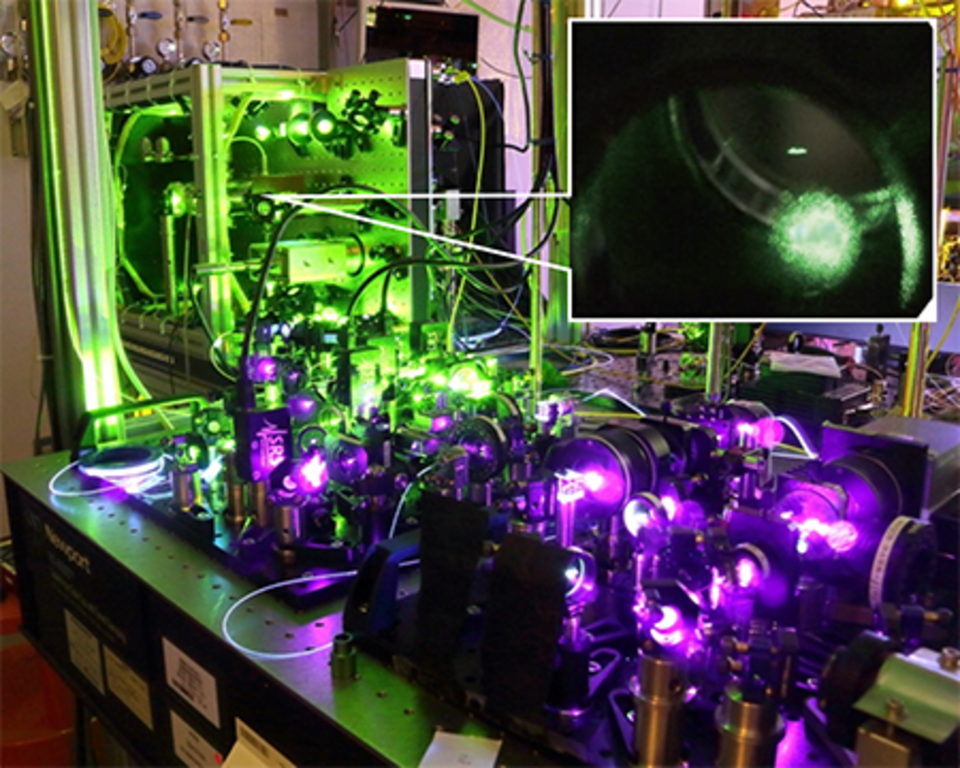
A ytterbium optical lattice clock at NMIJ, National Metrology Institute of Japan used to measure International Atomic Time (TAI).Image credi:Wikimedia commons
The team also compared the nuclear clock with an established ytterbium-ion optical clock. This comparison helped researchers assess the new device’s frequency stability and look for possible changes in the thorium transition.
A new tool in the search for dark matter
Beyond timekeeping, the clock offers a way to investigate possible changes in fundamental constants of nature. Some theoretical models propose that ultralight dark matter could cause these constants to vary over time, producing small changes in the frequencies measured by precision clocks.
The researchers compared the thorium clock’s frequency with that of the ytterbium reference over approximately 23 hours. They searched for periodic fluctuations and gradual drifts that could indicate such changes.
The experiment found no statistically significant periodic signal within the range examined. Instead, the measurements placed new limits on certain interactions between ultralight dark matter and ordinary matter. The resulting constraints were competitive with leading atomic-clock measurements for some photon-related interactions and improved previous constraints involving the strong nuclear force.
These results do not establish the existence of dark matter, nor do they rule out all possible models. They demonstrate how a nuclear clock can be used to test predictions that might otherwise be difficult to investigate experimentally.
Challenges remain
The device is still a developing technology. Its performance is limited by factors including laser power, measurement noise and variations in the crystal’s nuclear transition frequency at different locations. The researchers also identified reproducibility between measurements taken on different days as an important limitation.
They suggest that stronger ultraviolet laser sources and improvements to the crystal material could substantially improve the clock’s stability and sensitivity. Their projections indicate that future versions could approach the performance of leading optical atomic clocks while retaining the practical advantages of a solid-state system.
The demonstration marks a significant step towards nuclear clocks that can operate as standalone devices. Further improvements will determine how effectively the technology can support precision timekeeping and searches for new physics.


Indian universities lead Asia in research output per faculty, but the country’s top six all slip in QS ranking

Greener Forests, Weaker Carbon Sinks? Study Finds Declining Productivity in Northeast India

Climate Change Contributed to 10,600 Excess Preterm Births in Asia During April 2024 Heatwave

Neuropixels Probes Allow Scientists to Record Hundreds of Brain Cells at Once, Opening New Possibilities for Neuroscience

Overshooting 1.5°C Could Trigger Irreversible Damage to Earth’s Ice Systems, Warns UN-Backed Report

Knowing When to Think for Ourselves: AI, Intuition and the Education of Discernment

After a Scorching Summer, Delhi’s Children Are Slow to Return Outdoors

Two Chemists Win Nobel Prize for Solving a Century-Old Puzzle: Why Life Picks One Hand Over the Other

Climate Change, Overfishing and the Uncertain Future of Bangladesh’s Hilsa Fishermen

Europe Braces for Extremes as Commission Unveils Climate Resilience Framework
-

 Math3 months ago
The 2026 Fields Medals: Four Proofs, Four Decades-Old Problems Solved
-
EP Deep Dive: Data & Solutions3 months ago
After Kerala’s Deadliest Landslide, the Hardest Thing to Rebuild Was Childhood
-
EP Deep Dive: Data & Solutions4 months ago
West Asia Crisis: Can Kerala’s Returning Gulf Migrants Find a Future in the Green Economy?
-
Space & Physics5 months ago
India Semiconductor Mission: ‘It’s Not About Fabs. It’s About Building An Entire Ecosystem’
-
Interviews1 month ago
From Scams to Screens: How the National Stock Exchange Rewrote India’s Equity Story
-
Climate5 months ago
The Climate World Cup? How Climate Change Could Affect Player Performance at the 2026 World Cup
-
Society4 months ago
What Is Civilisational Diplomacy? Understanding India’s Newest Foreign Policy Tool
-
Society5 months ago
From Bell Labs to the Classroom: A Second Career in Teaching