
Energy
Energy Independent by 2047? India’s Electricity Is Getting There. Its Oil and Gas Aren’t.
IEA’s World Energy Outlook 2026 shows India’s power sector going non-fossil fast — but oil, gas and LPG imports are set to rise, not fall, by 2035.

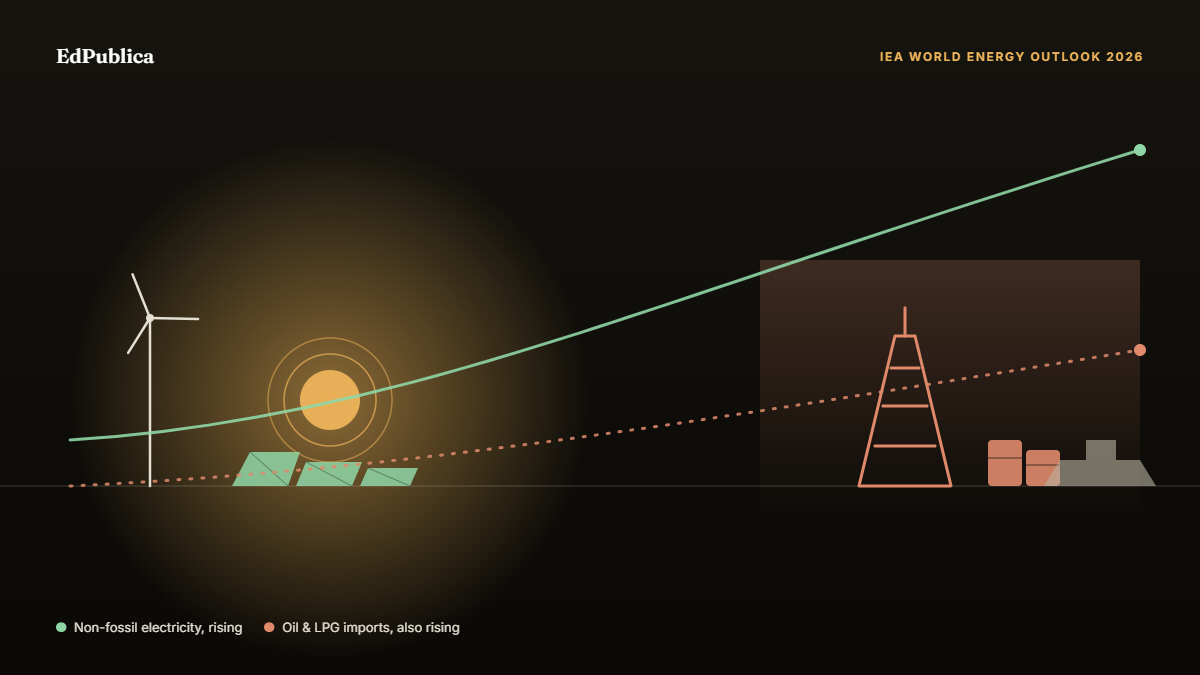
IEA’sWorld Energy Outlook 2026 has India’s electricity shifting fast towards non-fossil sources. For oil, gas and cooking fuel, the same projections show more imports, not fewer.
India has said since 2021 that it wants to be energy independent by 2047. The International Energy Agency’s World Energy Outlook 2026, published on 19 November, does not say India is on course for that. Its projections stop at 2035, and for oil and gas they point the other way.
India already meets about 40 per cent of its energy needs through imports, including 90 per cent of its crude oil and 50 per cent of its natural gas, according to the Outlook. Over the next decade its energy demand is projected to grow by 2.5 per cent a year in the agency’s Stated Policies Scenario (STEPS), roughly three times the global rate. STEPS counts existing policies plus measures that governments have formally proposed. “In all our scenarios, India accounts for more growth in energy demand over the next decade than any other country or region in the world,” the IEA said.
The picture is uneven. Electricity is moving quickly away from imported fuel. Oil and LPG are not. And the one scenario in the Outlook where India pushes harder on imports shows gains that are real but partial.
Is India Really Heading Toward Energy Independence?
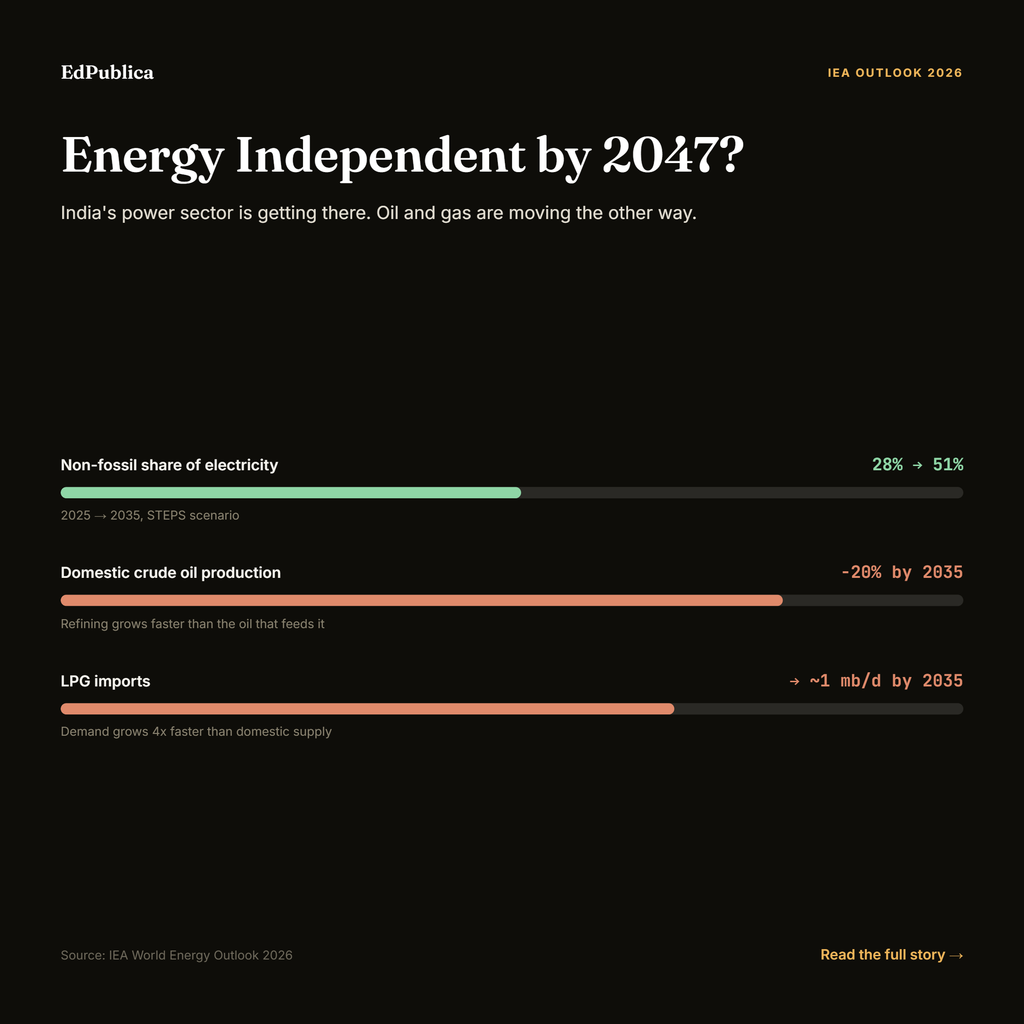
India’s electricity generation rises from 2,114 terawatt-hours (TWh) in 2025 to 3,585 TWh in 2035 under STEPS, an increase of about 70 per cent. The non-fossil share, meaning renewables and nuclear, goes from 28 per cent to 51 per cent. “As non-fossil capacity continues to expand, India generates well over half of its electricity from non-fossil sources by 2035 in the STEPS,” the report says. Solar PV accounted for half of India’s capacity additions over the past decade.
A quick calculation with those rounded shares adds a wrinkle. Non-fossil output roughly triples, from about 590 TWh to about 1,830 TWh. But fossil generation, 72 per cent of the 2025 total and 49 per cent of the 2035 total, still rises from about 1,520 TWh to about 1,760 TWh, an increase of around 15 per cent. The share of coal and gas falls while the amount of electricity made from them goes up. (These are our own calculations from rounded IEA shares, not figures the IEA publishes.)
Globally, Ben Backwell, chair of the Global Renewables Alliance, pointed to the IEA’s expectation that “Renewables are now expected to grow from 33% of electricity generation today to around 50%, and potentially even higher, by 2035.” India’s non-fossil share, which includes nuclear, goes from 28 to 51 per cent over the same years. The measures differ, but the direction and rough scale are similar.
Dave Jones, chief analyst at Ember, reads the Hormuz crisis as an accelerant. “Hormuz will speed up electrification and renewables, likely faster than many people think,” he said. The IEA’s own summary lists a push for faster electrification among the common responses it sees from countries hit by the crisis.
Oil and LPG: the other direction
Domestic crude production is projected to fall by nearly 20 per cent by 2035 under STEPS. Over the same period refining capacity grows by about 1 million barrels a day from nearly 6 million in 2025, with another 840,000 barrels a day already under construction, 660,000 of it expansions at existing plants and 180,000 greenfield. India ranks fourth in the world by refining capacity and third by refinery runs, and it remains a net exporter of petroleum products. But a larger refining industry fed by a shrinking home supply means more crude has to come from abroad.
The Outlook expects crude imports from the Middle East to stay broadly flat while total imports rise, with most of the extra supply coming from outside the Gulf. West Asia supplied roughly half of India’s refinery intake in 2025.
Cooking gas is the sharper problem. India produced about 450,000 barrels a day of LPG in 2025, around 40 per cent of what it uses. Under STEPS, domestic supply grows by less than 100,000 barrels a day by 2035 while demand grows by nearly 400,000, which could take LPG imports to nearly 1 million barrels a day.
This year showed what that exposure costs. The IEA estimates that the LPG used in half of India’s residential cooking cylinders passes through the Strait of Hormuz. LPG imports fell by more than 50 per cent in the first two months of the conflict, and the government maximised domestic production and put household supplies ahead of other users. “The Strait of Hormuz remains critical to India’s energy security,” the report said.
IEA Executive Director Fatih Birol put the wider lesson plainly. “I don’t see any credible pathway for the energy world to return to the way it was before,” he said. He also warned that “In pursuit of greater energy security, countries must take care not to replace one dependency with another.”
What a harder push would buy
The Outlook includes a scenario in which India goes further to cut its reliance on imported fuel: faster adoption of electric vehicles, more industrial electrification, better efficiency, more renewables and more domestic coal. By 2035 electric car adoption is 30 per cent faster than under STEPS. India’s oil requirement is 580,000 barrels a day lower and its natural gas use is 8 per cent lower than in STEPS.
For scale, Jan Rosenow, Professor of Energy and Climate Policy at the University of Oxford, noted that “China’s electric vehicle fleet, for example, is avoiding around 1.5 million barrels of oil a day.” The baselines differ, since that is China’s fleet today and India’s figure is an extra saving in 2035, but it gives a sense of the size of the prize. Rosenow’s broader point was that “countries which had electrified more of their energy use were better protected from this year’s supply shock.”
Coal does much of the work on the import side. Greater domestic coal production could bring steam coal imports down from nearly 150 million tonnes of coal equivalent in 2025 to around 30 million by 2035, and cut overall coal import dependence from about 30 per cent to 15 per cent. But rising steel output pushes coking coal demand up by 55 per cent, and India would still depend on imports for much of that extra requirement.
That sits awkwardly with climate goals, and campaigners have said so. David Tong of Oil Change International said the IEA “has yet again reiterated that there is no room for new oil, gas, and coal beyond existing fields to limit global warming to 1.5ºC.” Maria Pastukhova of E3G made a different point about the global picture: “over three quarters of the additional reduction in oil and gas imports that could result from policy responses to the Hormuz crisis comes from energy efficiency, electrification and renewables.” That is a worldwide figure, not an Indian one.
The cooling load
Over the next decade India is expected to add more than 12,000 cars to its roads every day, see a 33 per cent increase in built-up space and install another 200 million air conditioners. Globally, the IEA finds that energy needed to keep buildings cool is now overtaking the energy needed to heat them for the first time.
Pastukhova called this one of the report’s most alarming and least noticed findings: “by 2035, cooling will account for 30% of global peak electricity demand.” She added that “In emerging and developing economies outside China, 85% of households are exposed to high temperatures, yet fewer than one in five of these households have air conditioning.” India is in that group. Her warning on the fix was blunt: “Falling clean technology costs alone will not prevent it”.
Air conditioning is what drives peak demand, and the Outlook says coal will keep an important role in meeting India’s electricity demand. Anyone judging how independent India’s power system can become by 2047 has to count that load.
Reading 2047 against the data
The 2047 goal was announced by the Prime Minister in his 2021 Independence Day speech, with the stated aim of bolstering energy security by reducing imports. The IEA’s own policies database lists it as announced. The Outlook does not test it directly, because its projections end in 2035.
The case that it can be done comes from elsewhere. A 2023 modelling study from Lawrence Berkeley National Laboratory set out a pathway to near-complete energy independence by 2047 across power, transport and industry, mainly by cutting imported oil used in road transport and imported coal used in industry and power.
Set against the IEA’s numbers, the power half of that pathway is visibly under way. The oil half is not yet there. Under STEPS, crude output falls, refining grows and LPG imports climb. The stronger scenario narrows the gap but does not close it, and it leans on coal to do so.
Birol said that “energy security and energy transitions have never been so closely aligned.” For India, the next decade will show whether that alignment reaches the fuels it buys from abroad, or stays mostly in the power grid.










Energy
India’s Clean-Energy Transition: Will It Replace Oil Dependence With Mineral Dependence?
India’s shift towards electric vehicles, renewable energy and green hydrogen could reduce its dependence on imported fossil fuels. But with critical minerals, battery materials and clean-energy components sourced from global supply chains, a new question emerges: will the transition bring energy independence or create another form of import dependence?


Energy
Fossil Fuels Linked to Millions of Premature Deaths as Ministers Call for Healthy Energy Transition
A new ministerial declaration is calling for public health to become central to the global transition away from fossil fuels. Highlighting the health and economic costs of air pollution, it urges governments to accelerate the shift towards clean energy and strengthen the role of health systems in climate action.
The transition away from fossil fuels is not merely an environmental necessity but also a public health imperative, according to a new ministerial declaration calling on governments to accelerate the shift towards clean and renewable energy. The Political Declaration on a Healthy Transition seeks to place public health at the centre of international energy and climate policies as the 31st Conference of the Parties (COP31) to the UN Framework Convention on Climate Change (UNFCCC), which began on November 9, continues in Antalya, Türkiye.
The declaration highlights the health consequences of fossil fuel dependence, including air pollution, respiratory illnesses, cardiovascular diseases and the growing risks associated with climate change. It argues that transitioning towards cleaner energy systems could reduce the burden of disease, lower healthcare expenditure and improve workforce productivity.
According to the World Health Organization (WHO), ambient and household air pollution together account for approximately 6.7 million premature deaths annually. The declaration cites estimates that fossil fuel dependence contributes to between five and eight million premature deaths every year.
The health consequences extend beyond direct exposure to polluted air. The extraction and combustion of coal, oil and natural gas contribute to global warming, intensifying heatwaves, droughts, floods and storms. These changes threaten food and water security, increase heat-related illnesses and create conditions favourable for the spread of infectious diseases.
The Lancet Countdown 2025 Report on Health and Climate Change estimated that fossil fuel-derived outdoor air pollution caused approximately 2.52 million deaths in 2022, while household air pollution from polluting fuels and technologies accounted for another 2.3 million deaths. The report also found that heat-related mortality had increased by 23% since the 1990s, reaching an average of 546,000 deaths annually during 2012–2021.
The economic case for cleaner energy
Beyond the human toll, the declaration draws attention to the economic costs of fossil fuel dependence. World Bank estimates cited in the document put the global economic damage associated with air pollution at approximately $8.1 trillion annually, equivalent to 6.1% of global gross domestic product (GDP).
The declaration also refers to International Monetary Fund (IMF) estimates suggesting that eliminating explicit and implicit fossil fuel subsidies could prevent 1.6 million premature deaths annually and generate an additional $4.4 trillion in government revenue.
The benefits of reducing fossil fuel dependence are also reflected in improvements in air quality. The 2025 Lancet Countdown report estimated that reductions in coal-related outdoor air pollution between 2010 and 2022 helped avoid approximately 160,000 premature deaths annually.
However, the transition must also address unequal access to energy. The declaration notes that approximately 750 million people lacked access to electricity in 2023. For communities dependent on traditional biomass fuels, access to clean electricity and cooking technologies remains essential to reducing household air pollution. Off-grid solar systems and mini-grids are identified as potential solutions for underserved populations.
Healthcare systems must also reduce emissions
An important aspect of the declaration is its recognition that healthcare systems themselves contribute to climate change. The document estimates that the healthcare sector accounts for approximately 5% of global carbon emissions, reflecting its dependence on energy-intensive infrastructure, pharmaceutical manufacturing and supply chains.
It calls for healthcare institutions to lead by example through energy-efficient hospital buildings, sustainable waste management and low-carbon pharmaceutical manufacturing. Healthcare systems also have considerable purchasing power, which could help create demand for cleaner technologies.
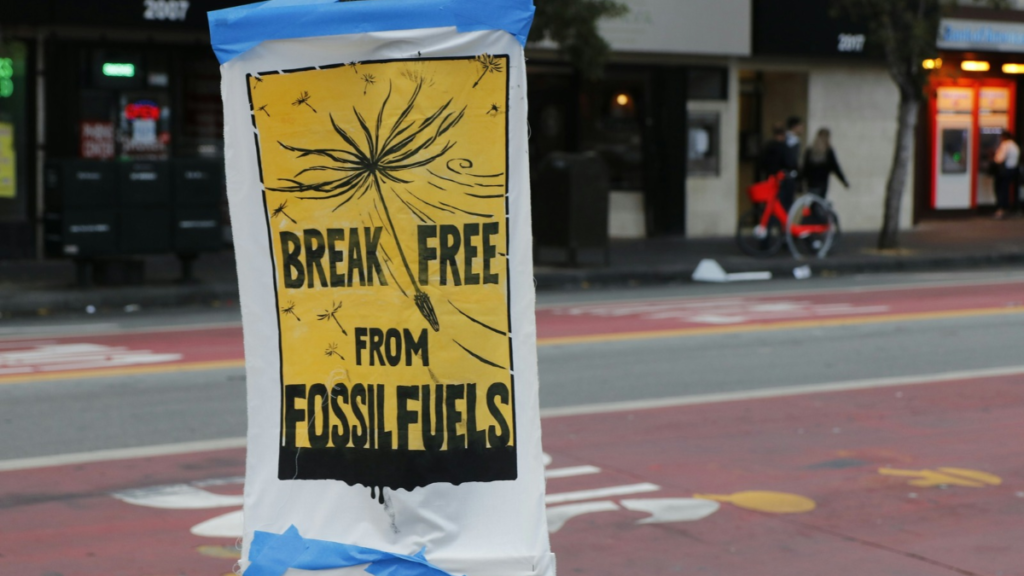
Representative image.Image credit:Unsplash
The declaration encourages countries to incorporate health considerations into their Nationally Determined Contributions (NDCs) and National Adaptation Plans (NAPs). It also calls on the WHO to provide technical assistance and coordinate international efforts towards a just and orderly energy transition.
From commitments to implementation
The initiative builds on momentum from COP30, where around 90 countries expressed support for a roadmap to transition away from fossil fuels. It also follows the first international conference on transitioning away from fossil fuels, co-organised by Colombia and the Netherlands in April 2026.
The declaration identifies three ways health ministries can influence the transition: raising public awareness about the health costs of fossil fuels, using the healthcare sector’s purchasing power to promote cleaner technologies, and working with other ministries to align climate and health policies.
However, translating these commitments into measurable outcomes remains a challenge. The declaration acknowledges differences in national capacities, development priorities and energy security requirements, particularly among least developed countries and small island developing states.
It does not establish binding emissions targets, dedicated funding commitments or country-specific implementation deadlines. Its effectiveness will therefore depend on whether governments translate its recommendations into national policies and allocate resources for implementation.
As countries are negotiating at COP31 and looking forwards to the 80th World Health Assembly in May 2027, the declaration seeks to strengthen the connection between climate action and public health. Its central argument is that cleaner energy is not simply about reducing carbon emissions; it is also about preventing avoidable deaths, reducing health inequalities and building more resilient healthcare systems.
Energy
India’s renewable energy boom faces a growing challenge as power grids struggle to absorb clean electricity
India’s renewable energy expansion is facing a growing challenge as grid constraints and limited power storage lead to clean electricity curtailment. New research highlights the need for stronger transmission infrastructure, battery storage and greater flexibility in coal-fired power generation.
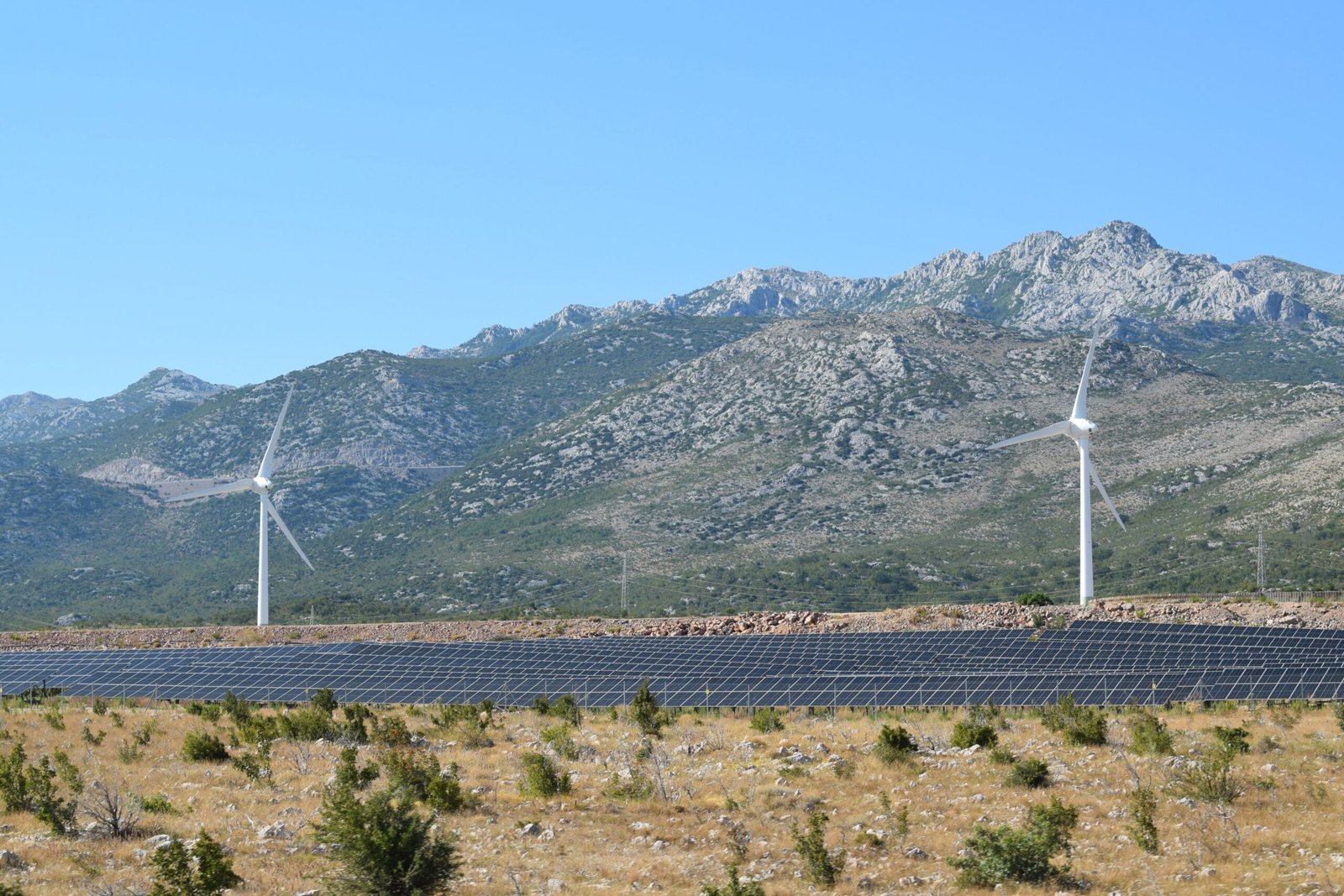
India’s rapid expansion of solar and wind energy is creating a new challenge for its electricity sector: ensuring that the power generated from renewable sources can be absorbed and supplied when needed. A growing volume of clean electricity is being curtailed because of grid constraints and the operational limitations of coal-fired power plants, raising questions about whether the country’s electricity infrastructure can keep pace with its energy transition.
An analysis published by energy think tank Ember on June 17, 2026, estimates that India curtailed approximately 2.1 terawatt-hours (TWh) of renewable electricity during the financial year 2025–26 because coal-fired power plants had to maintain their minimum technical operating levels. This represents around 1.3% of total renewable electricity generation and an estimated ₹629 crore worth of foregone electricity.
The report, titled Bottleneck to the Next Phase of Renewable Energy Growth in India, identifies the limited operational flexibility of coal-based power plants as a significant obstacle to integrating additional renewable electricity into the grid. It estimates that around 10 gigawatt-hours (GWh) of battery storage capacity is immediately needed to prevent this form of renewable energy curtailment.
The findings highlight a growing mismatch between India’s expanding renewable energy capacity and the flexibility of its existing electricity infrastructure.
Coal dependence and grid constraints complicate the energy transition
Solar power generation is concentrated during daylight hours, particularly around midday, while electricity demand often remains high after sunset. Coal-fired power plants, which continue to provide a substantial share of India’s electricity, cannot always reduce their output sufficiently during periods of high solar generation without affecting their stable operation.
Coal plants have minimum technical load requirements, below which they cannot operate safely and reliably. When these plants reach their operating limits, grid operators may have to reduce renewable electricity generation to maintain the balance between electricity supply and demand.
Ember’s analysis found that coal plants were operating at or below their minimum technical load in more than half of midday dispatch intervals in April 2026. During the same month, renewable energy curtailment accounted for 37% of down-regulation, compared with almost zero a year earlier.
More recent findings from the Centre for Research on Energy and Clean Air (CREA) indicate that the problem extends beyond coal-related operational constraints.
Its Quarterly Energy Snapshot for India: Q2 2026–27, published on October 12, estimates that approximately 1,835 million units of renewable electricity were curtailed during July and August 2026 because of grid and operational constraints. Of this, 1,462 million units came from solar generation and 373 million units from wind.
The report also records India’s peak electricity demand reaching 270 GW on July 16, 2026, an 18% increase from the corresponding quarter of the previous financial year. Coal and lignite continued to account for approximately 66% of electricity generation during the quarter, supplying 351 billion units.
These figures illustrate the difficulty of balancing increasing renewable generation with a power system that continues to depend heavily on conventional sources.
Energy storage emerges as a critical solution
Energy storage systems could help address this mismatch by storing surplus solar and wind electricity when generation is high and releasing it when demand increases or renewable output declines.
Battery energy storage systems (BESS) can respond quickly to fluctuations in electricity supply and demand. Pumped-storage hydropower offers another option, using surplus electricity to pump water to an elevated reservoir and generating power when it is released through turbines.
A 2026 report by the Rocky Mountain Institute (RMI), titled Catalysing Energy Storage in India: From Procurement to Reliable Power, estimates that India will require at least 60 GW of grid energy storage capacity by 2030. This includes 42 GW, equivalent to 208 GWh, of battery energy storage systems.
According to CREA, approximately 9.1 GWh of battery storage capacity was operational in India as of its Q2 2026–27 assessment. Although tenders for nearly 290 GWh of storage capacity had been issued by August 2026, the gap between planned and operational infrastructure remains substantial.
The International Energy Agency’s (IEA) India Renewable Energy Market Report 2026, released on November 3, also identifies faster investment in electricity grids and energy storage as essential to sustaining renewable energy expansion.
The report notes that India’s renewable power capacity has surpassed 300 GW in 2026, almost quadrupling over the past decade. It projects that capacity could reach approximately 530 GW by 2030, with solar photovoltaic technology accounting for more than 80% of new additions.
The IEA also warns that faster transmission development, improved forecasting, energy storage and greater flexibility in electricity generation will be necessary to integrate increasing volumes of variable renewable power.
India’s renewable energy expansion has already delivered significant energy security benefits. According to the IEA, renewable electricity helped the country avoid more than $100 billion in cumulative coal and natural gas import expenditure between 2011 and 2025.
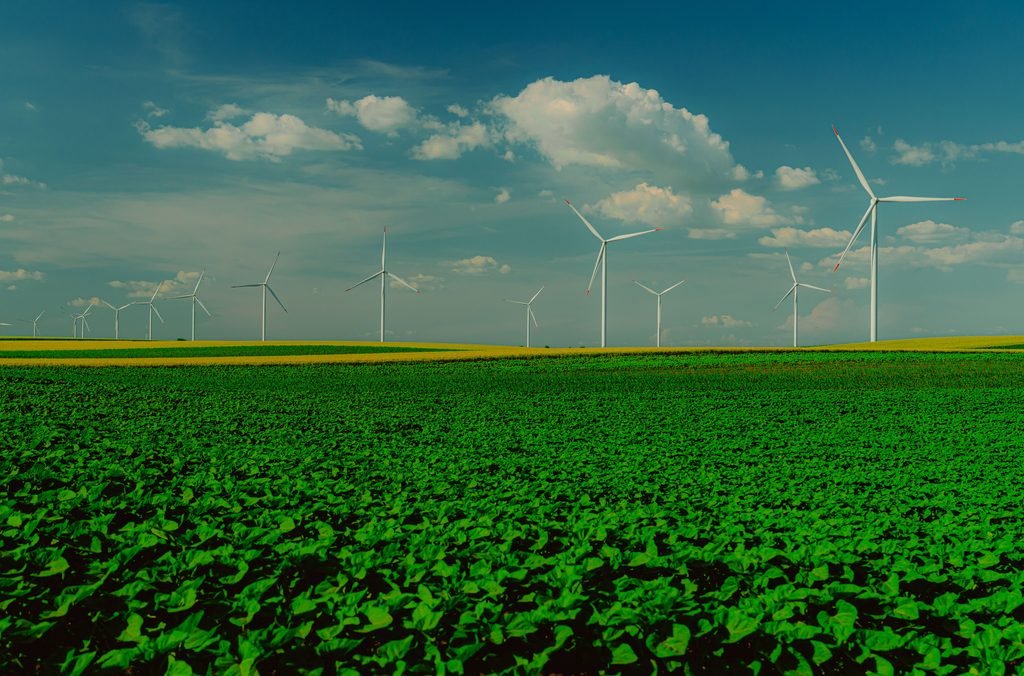
A vast field of wind turbines.Image credit:Pexels
However, the growing incidence of renewable electricity curtailment highlights the need to strengthen the infrastructure supporting this transition. Expanding generation capacity alone will not ensure that clean electricity reaches consumers when it is needed.
As India moves towards its 2030 renewable energy targets, investments in storage, transmission networks and more flexible power generation will be critical to reducing electricity losses and making its transition away from fossil fuels more effective.

Energy Independent by 2047? India’s Electricity Is Getting There. Its Oil and Gas Aren’t.

What is the Mysterious ‘Egoviruses’ in the Guts of 180 Million People

India’s medical students show interest in research, but mentorship and institutional support remain major hurdles

CUSAT ranks 849th globally in sustainability, tops Kerala universities

AI adoption outpaces university preparedness as Indian students turn to generative tools, FICCI-EY report finds

Indian universities lead Asia in research output per faculty, but the country’s top six all slip in QS ranking

Why Delhi’s Geography Makes It Vulnerable to Severe Air Pollution

Europe Braces for Extremes as Commission Unveils Climate Resilience Framework

NASA recruits new astronauts for future Moon Base and Mars missions

Between Lectures and Lyrics: Kabeer Is Building a Malayalam Hip-Hop Career One Self-Taught Skill at a Time
-

 Math4 months ago
The 2026 Fields Medals: Four Proofs, Four Decades-Old Problems Solved
-
EP Deep Dive: Data & Solutions4 months ago
After Kerala’s Deadliest Landslide, the Hardest Thing to Rebuild Was Childhood
-
EP Deep Dive: Data & Solutions5 months ago
West Asia Crisis: Can Kerala’s Returning Gulf Migrants Find a Future in the Green Economy?
-
Space & Physics6 months ago
India Semiconductor Mission: ‘It’s Not About Fabs. It’s About Building An Entire Ecosystem’
-
Interviews2 months ago
From Scams to Screens: How the National Stock Exchange Rewrote India’s Equity Story
-
Climate & Environment6 months ago
The Climate World Cup? How Climate Change Could Affect Player Performance at the 2026 World Cup
-
Society4 months ago
What Is Civilisational Diplomacy? Understanding India’s Newest Foreign Policy Tool
-
Society5 months ago
From Bell Labs to the Classroom: A Second Career in Teaching