
COP30
COP30: How People, Not Politics, Are Powering the Next Phase of Climate Action
From rooftop revolutions to billion-dollar clean-energy investments, the global shift toward renewables is already happening — citizens and markets are leading where politics still hesitates.

As the world converges on Belém for the 30th UN Climate Change Conference (COP30), the air is heavy not just with Amazonian humidity—but with expectation. Ten years after the Paris Agreement, the story of global climate action has entered a new chapter. One defined less by negotiation rooms and more by rooftops, communities, and citizens who have already begun to build the future politicians still debate.
A new statement released just a week before the summit, titled “Protect What We Love,” captures this shift. Signed by 75 leaders across politics, culture, and civil society—including Christiana Figueres, Ban Ki-Moon, Mary Robinson, Richard Branson, Stella McCartney, and Dia Mirza—the call to action urges governments to finally transform past commitments into tangible plans.
“You agreed to transition away from fossil fuels. You agreed to halt and reverse deforestation. You agreed to mobilize finance for adaptation and mitigation in developing countries,” the statement reminds world leaders. “At COP30, we ask you to show us how—through concrete plans and timelines—so that we can protect the people and places we love.”
This appeal comes amid fresh global polling data showing what the authors call “the 89%”—an overwhelming majority of citizens worldwide who want faster climate action. The findings, by the Potential Energy Coalition, reveal that eight in ten people across ten countries support government investment in wind, solar, and nuclear energy—double the number backing fossil fuels. And notably, that support transcends politics. Even conservatives, often framed as skeptics, are 1.6 times more likely to favour clean-energy investment than fossil fuel subsidies.
A Decade That Defied Predictions
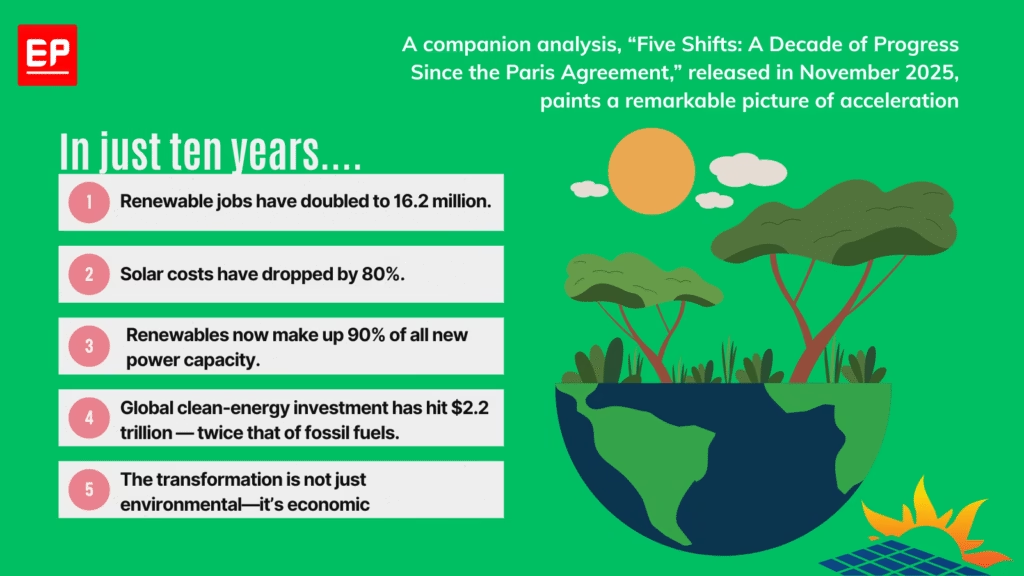
That popular consensus coincides with new evidence of real progress. According to “Five Shifts: A Decade of Progress Since the Paris Agreement,” released in early November 2025, the world has made more headway in clean-energy deployment and policy integration than most experts dared to expect back in 2015.
In the decade since Paris, renewable energy jobs have nearly doubled to 16.2 million, and annual clean-energy investments reached $2.2 trillion—twice that of fossil fuels. Ninety percent of all new power capacity added globally in 2025 came from renewables. Solar costs have plummeted by 80% since 2014.
The transformation is not just environmental—it’s economic. “The fossil fuel industry knows that the new economy is rising,” said Christiana Figueres, one of the architects of the Paris Agreement. “They know that they can no longer compete. We are no longer in a world in which only climate politics has a leading role, but increasingly climate economics.”
That’s a profound shift in the centre of gravity. In 2015, climate action depended on international consensus. In 2025, it increasingly depends on investment logic.
From Pledges to Proof
Still, COP30 will test whether politics can keep pace with the real world. “It’s a different kind of COP than we’ve had before,” said Jennifer Morgan, Germany’s Special Envoy for International Climate Action. “It is one where there’s not one big fund or one big outcome. One really needs to be looking at the signals, the decisions, and the proof points to see how leaders and countries are accelerating implementation—because that’s what this is all about: going faster, going further, building on the success, learning the lessons of the lack of success.”
The Five Shifts report echoes that sentiment. Its authors warn that while clean energy is winning both economically and politically, emissions are not yet falling at the speed required. The UNEP Emissions Gap Report 2025, published days before the summit, estimates that even with full implementation of current national climate plans (NDCs), global warming would reach 2.3–2.5°C, and 2.8°C under existing policies.
$2.2 trillion in clean-energy investment in 2025 — twice fossil fuels
The world is already 1.35°C warmer, with extreme heat events multiplying by a factor of nine since 2015. Yet the same report highlights practical successes: half of all countries now have heat-warning systems, and 47 operate national heat action plans, saving lives in cities from Senegal to Japan.
For Bill Hare, CEO of Climate Analytics, the takeaway is simple: “The world can still return to well below 1.5°C if the highest possible ambition is pursued by countries starting now. Getting to net zero carbon dioxide emissions means that we can halt warming pretty quickly.”
Citizens Are the New Climate Majority
What distinguishes COP30 from the summits before it is not just scientific urgency—it’s civic clarity. As the Protect What We Love statement declares, “We are the 89%: the overwhelming majority of the global population who want you to act faster on climate change.”
That human dimension is front and centre. Leanne Brummell, representing Parents for Future Global, spoke for millions of families when she said:
“As parents, our first duty is to protect our children. The climate crisis is a direct threat to their safety and their future… We are part of the 89% of people globally who want to see their governments take more action to protect the places and people we love.”
The emotional urgency resonates far beyond activist circles. Dia Mirza, actor and UN advocate, said: “As a mother, I see the truth of today’s statement in my children’s eyes every day. People everywhere are rising to build, buy, and create the solutions that will keep our children safe. Public support for climate action is undeniable, and the technology and answers already exist. At COP30, I ask world leaders to act with the same instinct every parent has—to protect what we love most: our children and their future.”
This groundswell of public will is now being matched by business leadership. A new E3G poll found 97% of global executives backing a rapid transition to renewable-based electricity. Major corporations have joined the We Mean Business coalition, urging governments to create policies that reward decarbonization rather than delay it.
“Climate breakdown is no longer a distant risk for business—it’s already disrupting operations through extreme weather events such as floods and droughts,” said Fiona Duggan, Global Sustainability Manager at Unilever. “Forward-thinking companies are moving to adapt and decarbonise as rapidly as their sectors will allow. The real question is whether governments will support them to go further, faster.”
Constructive Pathways: What’s Working
A decade of experimentation has produced more success stories than cynics expected. Countries once seen as dependent on fossil fuels—Nigeria, Senegal, Brazil, Indonesia—are embedding climate action into fiscal and planning systems. Nigeria’s 2021 Climate Law supports a 2060 net-zero target; Senegal’s local experts now drive national adaptation plans; Brazil’s Finance Ministry leads an Ecological Transformation Plan linking fiscal reform with green growth.
According to Henri Waisman, Director of the DDP Initiative, “Countries have begun to reshape climate governance, embed long-term perspectives into policymaking, and accelerate technological change. This progress is significant. But the lesson of the past decade is equally clear: if we are to achieve the goals of Paris, the next decade must be about scaling up efforts, addressing social and industrial challenges, and ensuring that ambition is consistently translated into effective action.”
These local models, backed by citizens’ trust and economic dividends, suggest that climate action isn’t just a moral imperative—it’s a viable development strategy.
The Belém Moment
If there’s a unifying message emerging from Rio’s press releases to Belém’s plenary halls, it’s this: the transition has already begun.
Citizens, investors, and innovators are not waiting for permission. “Ordinary people understand that clean energy will improve their lives and have begun the transition their leaders keep promising,” said environmentalist Bill McKibben. “Rooftop by rooftop, community by community, they’re proving the future can arrive before the politics to govern it.”
COP30 thus becomes less about what to agree upon—and more about how fast to deliver what’s already agreed. The Five Shifts report puts it succinctly: “COP30 must move beyond pledges to concrete delivery: addressing the ambition gap in current NDCs, accelerating finance for adaptation, and ensuring just transitions away from fossil fuels. The decisions made in Belém will determine whether the 2030s become a decade of decisive implementation.”
From Political Will to Public Proof
Ten years ago, in Paris, climate ambition was an act of collective imagination. In Belém, it’s a lived reality, visible in data, rooftops, and balance sheets. The clean-energy revolution is no longer hypothetical—it’s happening.
The challenge now is whether governments will catch up with their citizens. Because, as the 89% have made clear, the mandate to act isn’t waiting for another conference. It’s already out there—building, investing, and protecting what we love.









COP30
Pacific Nations Push 1.5°C and Climate Finance Ahead of COP31
Pacific nations are using Pre-COP31 talks in Fiji to push for stronger action on climate change, including keeping the 1.5°C target within reach and improving access to climate finance.

Pacific island nations are seeking to put their climate concerns at the centre of global negotiations as ministers, climate negotiators and senior officials gather in Fiji for preparatory talks ahead of the COP31 climate summit.
The Pre-COP meeting, scheduled in Nadi from October 5 to 8, is intended to build momentum for the United Nations climate conference in Antalya, Türkiye, in November. COP31 will be held from November 9 to 20.
For Pacific countries, however, the meeting is more than a diplomatic step towards the main summit. It is an opportunity to press the world’s major economies on issues that directly affect the region, particularly the 1.5°C warming limit, climate finance and the growing impact of climate change on oceans and coastal communities.
Fiji has outlined four priorities for the Pre-COP discussions: keeping the 1.5°C target within reach, improving access to climate finance, placing oceans more prominently in climate negotiations and strengthening Pacific leadership.
The 1.5°C target is particularly important for small island nations facing rising seas, coastal erosion, extreme weather and growing pressure on communities and infrastructure.
Fiji’s climate officials have said the country wants to maintain the role of climate science in international decision-making and “hold the line” on 1.5°C. The country is also calling for climate finance to reach vulnerable communities more quickly, arguing that lengthy funding procedures can leave communities waiting for resources while climate risks continue to increase.
Access to finance is expected to be one of the key issues carried from the Pacific discussions into COP31. Pacific governments are seeking greater support for adaptation and resilience, including through a proposed Pacific Resilience Facility that would finance climate projects across the region.
The region is also seeking to bring oceans more firmly into the climate agenda. For Pacific island states, climate change is closely connected to the health of marine ecosystems, coastal communities, fisheries and food security.
The preparatory talks will therefore bring together two aspects of the climate debate: the global effort to limit further warming and the immediate need to protect communities already experiencing its effects.
The setting is significant. Leaders and delegates will also spend time in Tuvalu, a low-lying Pacific island nation particularly exposed to sea-level rise. The programme includes visits to adaptation projects, including reclaimed land and solar installations, allowing visiting leaders to see some of the measures being used by island states to respond to climate risks.
But the meeting comes with a diplomatic challenge. Reuters reported that relatively few leaders from outside the Pacific have confirmed their participation. Leaders from Antigua and Barbuda, Cabo Verde, Thailand, the Maldives and Timor-Leste are among those confirmed, while around 30 representatives of countries and institutions are expected at the leaders’ segment.
A placard displaying ‘Save the Earth’.Representational image.Image Credit:Pexels
The limited participation has drawn criticism from some Pacific officials, who argue that the region’s climate concerns deserve greater international attention. At the same time, the meeting is expected to bring thousands of delegates to Fiji, giving Pacific governments a platform to shape discussions before the main negotiations in Türkiye.
For the Pacific, the focus in Nadi will therefore be on translating regional concerns into negotiating priorities for COP31 — from keeping the 1.5°C goal central to improving access to climate finance and strengthening attention to oceans and adaptation.
The outcome of the Fiji discussions will feed into negotiations at COP31, where governments will have to work through the wider questions of climate ambition, finance and implementation.
For island nations on the frontline of climate change, the immediate priority is to ensure that their experience and demands are reflected proportionately in those negotiations.
COP30
Greenwashing at Scale: How Big Oil Flooded Brazil With Ads Ahead of COP30
A global investigation reveals a 2,900% spike in oil-funded Google ads targeting Brazil, exposing a sophisticated digital greenwashing campaign designed to shape public opinion before COP30.

COP30
From 6% to 16%: The Philippines Shows the World How Fast Climate Budgets Can Shift
In just four years, the Philippines has expanded its climate spending from PHP 282 billion to over PHP 1 trillion — one of the fastest fiscal shifts anywhere in the world.



India Captures 5.7% of Global Greenfield Investment, Outpacing China

World Mental Health Day: How Late-Night Scrolling May Be Disrupting Sleep and Fuelling Anxiety

Climate Science Faces a Deadline: Can the IPCC Deliver Before the 2028 Global Stocktake?

Knowing When to Think for Ourselves: AI, Intuition and the Education of Discernment

Puberty, Pregnancy and Menopause Reshape the Female Brain Differently, Study Finds

From Scams to Screens: How the National Stock Exchange Rewrote India’s Equity Story

Aim for the Stars: Anjali Thomas’s Journey from a Small College in Kerala to the Frontiers of Medical Imaging

Two Chemists Win Nobel Prize for Solving a Century-Old Puzzle: Why Life Picks One Hand Over the Other

India’s AI Moment Rests on More Than Code

Marshall Islands: Why the US Nuclear Legacy Is Back Before the UN

-

 Math3 months ago
The 2026 Fields Medals: Four Proofs, Four Decades-Old Problems Solved
-
Climate2 months ago
After Kerala’s Deadliest Landslide, the Hardest Thing to Rebuild Was Childhood
-
Society3 months ago
West Asia Crisis: Can Kerala’s Returning Gulf Migrants Find a Future in the Green Economy?
-
Space & Physics4 months ago
India Semiconductor Mission: ‘It’s Not About Fabs. It’s About Building An Entire Ecosystem’
-
Interviews3 weeks ago
From Scams to Screens: How the National Stock Exchange Rewrote India’s Equity Story
-
Climate4 months ago
The Climate World Cup? How Climate Change Could Affect Player Performance at the 2026 World Cup
-
Society3 months ago
What Is Civilisational Diplomacy? Understanding India’s Newest Foreign Policy Tool
-
Society4 months ago
From Bell Labs to the Classroom: A Second Career in Teaching