
Sustainability
CBAM May Hurt India’s Steel Exports Less Than Feared. Here’s What Mills Can Do
India’s steelmakers face growing pressure from the EU’s CBAM, but cleaner production could help reduce costs and protect exports. A new analysis outlines how mills can adapt by directing lower-emission steel to Europe, improving emissions reporting and investing in cleaner capacity.

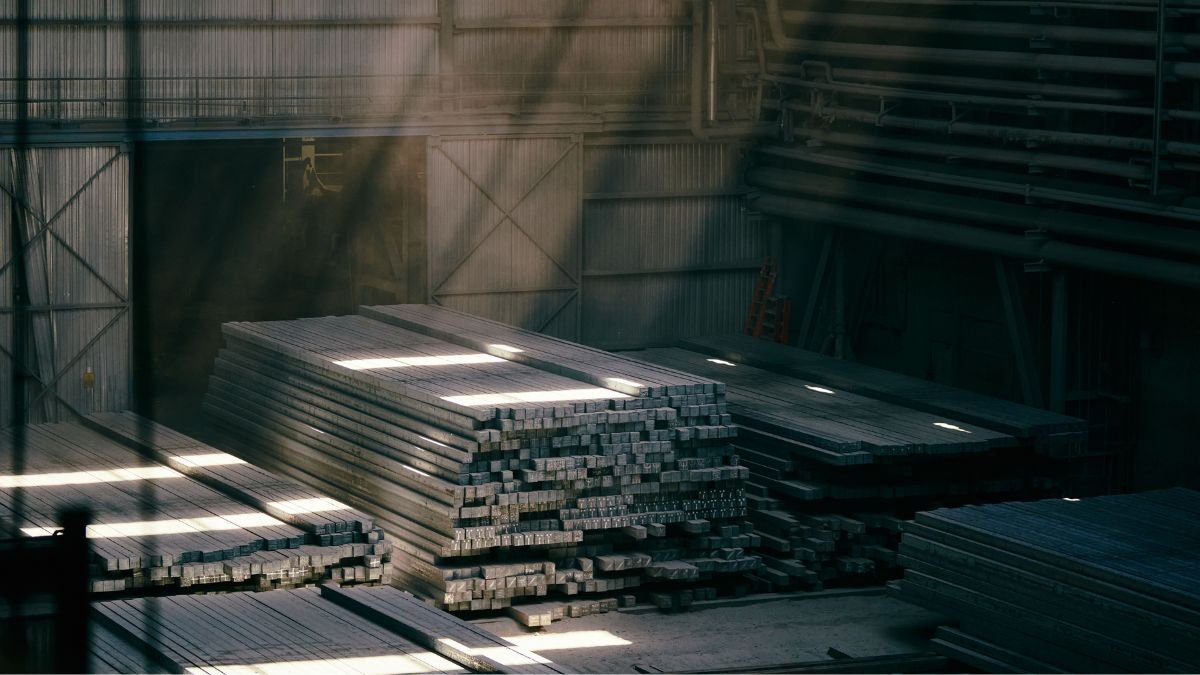
For India’s steelmakers, the European Union’s Carbon Border Adjustment Mechanism (CBAM) is no longer a distant policy concern. The system entered its definitive phase in January 2026, putting the carbon intensity of exported steel firmly on the industry’s balance sheet. The focus is now shifting from the potential impact of CBAM to how Indian steelmakers can adapt to it.
A new analysis by climate think tank Sandbag argues that the impact could be substantially smaller than feared if Indian producers make strategic changes to where and how they produce steel. Its modelling suggests that, under an “expected” scenario, total CBAM costs for India’s steel exports could fall from 762 million Euro to around 79 million Euro as exporters optimise low-emission production. Under a more ambitious scenario involving new low-emission capacity, the modelling puts the sector at a potential 44 million Euro net benefit.
The Impact Is Already Showing Up in Trade
There are early signs of pressure on India’s steel exports to Europe.
India’s iron and steel exports to the EU fell 13% in the four months through April 2026 following the rollout of CBAM, according to Department of Commerce data cited by ICRIER. A June 2026 ICRIER study estimated that India’s steel exports to the EU could eventually fall by 24% because of CBAM.
However, the decline cannot be attributed to CBAM alone. Steel exports are also influenced by global prices, demand, freight costs and trade measures. The significance for Indian mills is therefore not just the possibility of selling fewer tonnes. Higher carbon-related costs could also squeeze margins or make Indian steel less competitive against lower-emission producers.
This is where the Sandbag analysis offers a different perspective. Its modelling suggests that Indian steelmakers can reduce their exposure by changing what they produce, where they sell it and how quickly they lower emissions.
First: Stop Treating Indian Steel as One Block
India’s steel industry is not uniformly high-emission. Different plants and production routes have different carbon intensities. That matters because CBAM does not simply impose the same burden on every tonne of steel. The emissions embedded in production determine the exposure.

Sandbag identifies Indian steel plants whose emission intensity is already low enough to potentially benefit from CBAM. It specifically points to ArcelorMittal’s NS Hazira plant as an example of existing relatively low-carbon capacity that could serve European demand. For the industry, the first step is therefore to know where it stands.
Rather than approaching CBAM as a sector-wide penalty, steelmakers need to identify which plants, production lines and products have the lowest emissions and where those tonnes can earn the greatest value.
Send The Cleaner Tonnes to Europe
Immediate recommendation is strategic rather than technological: allocate lower-emission steel to the European market.
Report finds that Indian companies could reduce their CBAM liability by strategically reallocating low-emission output towards Europe. The same producers could also benefit from higher European steel prices, potentially offsetting the cost of CBAM certificates. That changes the way exporters need to think about their production portfolio.
If a company has several plants with different emissions profiles, sending the same type of steel to every market may no longer make commercial sense. Europe could increasingly become the destination for the cleaner end of the portfolio, while more carbon-intensive production faces greater pressure elsewhere. In effect, carbon intensity becomes another variable in export planning, alongside price, freight and demand.
Use Existing Low-Carbon Capacity Before Building from Scratch
India does not necessarily have to wait for a completely new generation of green-steel plants. Some relatively low-emission capacity already exists. Sandbag argues that this infrastructure can be leveraged to maintain Indian steel’s competitiveness in Europe, provided companies make the necessary operational adjustments.
That means the transition does not begin and end with new technology. Steelmakers can first examine how existing plants can be operated more efficiently, which products can be routed towards Europe and whether current capacity is ready for the reporting and verification requirements associated with CBAM.
For an industry under pressure to keep capital expenditure and production costs under control, that could be a more immediate route to reducing exposure.
Investment in New Low-Emission Capacity
The longer-term strategy is harder — and more expensive. Sandbag’s “ambitious” scenario assumes the deployment of new low-emission production capacity. Its modelling suggests that this could change the economics of CBAM enough to turn a net cost into a projected 44 million Euro net benefit.
This is where CBAM intersects with India’s larger steel decarbonisation challenge.
The industry is expected to expand significantly to meet domestic demand, but much of India’s steelmaking remains tied to coal-intensive production. Moving towards lower-emission technologies therefore requires substantial investment as well as changes in energy sources, raw materials and production processes.
For exporters targeting Europe, however, those investments could increasingly be viewed not simply as compliance costs but as a way of protecting market access.
Get The Carbon Numbers Right
There is another piece of groundwork that cannot be ignored: emissions measurement and reporting. CBAM effectively puts a carbon price on the emissions embedded in imported products. That means steelmakers need to know, and be able to demonstrate, the emissions associated with their production.
The Sandbag report itself flags “readiness for CBAM reporting” among the factors that will determine which existing low-emission facilities are best positioned to benefit. For Indian mills, reducing emissions without being able to credibly quantify them could limit the commercial advantage.
The carbon footprint of steel is therefore becoming part of the product information that exporters need to manage.
The Industry Cannot Rely on Cleaner Steel Alone
There is a catch. The Sandbag modelling does not suggest that CBAM will simply disappear as a problem for Indian steel. Its projected outcomes depend on producers responding appropriately — by optimising production, reallocating cleaner output and investing in low-emission capacity.
That makes the transition uneven. Companies with access to relatively low-emission plants, capital for technological upgrades and the ability to accurately measure emissions could be better placed than smaller or more carbon-intensive producers.
This could create a new fault line within India’s steel industry: not simply between large and small producers, but between those that can demonstrate lower-carbon production and those that cannot.
Europe May Become the Proving Ground
India has strongly opposed CBAM, calling it discriminatory and protectionist and questioning its compatibility with international trade principles. But whatever the broader policy dispute, Indian steelmakers now have to deal with the market reality. Europe is putting a price on carbon-intensive imports. At the same time, India is looking to strengthen its position in international steel markets.
That makes the European market a useful proving ground for India’s transition to cleaner steel. The Sandbag analysis suggests that Indian steelmakers have several levers to pull: identify their lowest-emission capacity, direct those tonnes towards Europe, improve operational efficiency, strengthen emissions reporting and invest in new low-emission production where commercially viable.
The opportunity is not guaranteed. Nor will every steelmaker benefit equally. But the takeaway is that CBAM does not have to be treated simply as a bill Indian-steelmakers must pay. For companies that can clean up production and put the right steel in the right market, it could become a competitive test they are capable of passing.











Sustainability
The Climate Problem Hiding in Your Kitchen Bin
Food waste sent to landfills can generate methane as it decomposes without oxygen, adding to greenhouse gas emissions and the climate crisis.
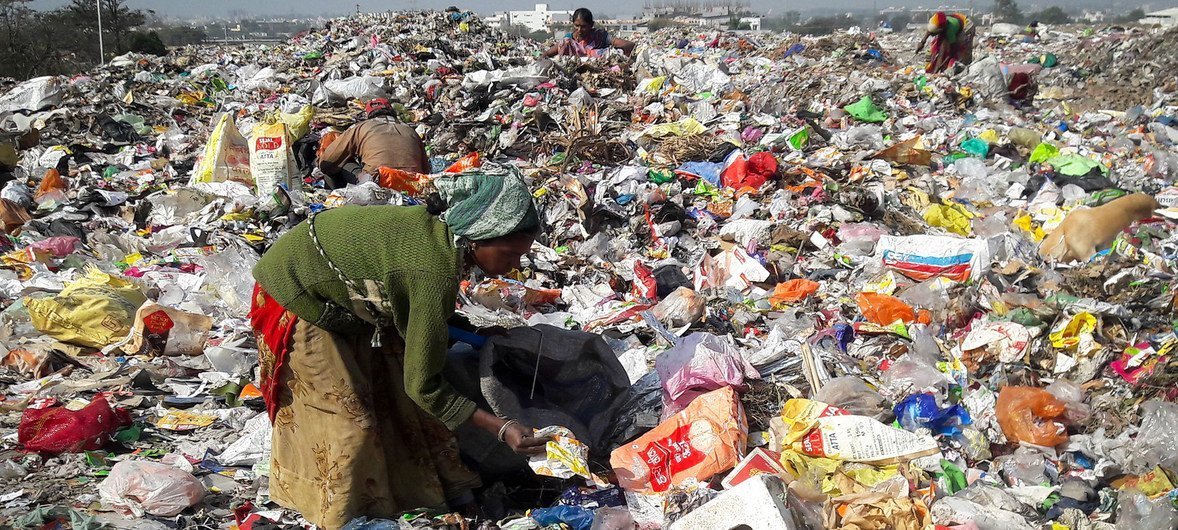
Every day, more than one billion meals go uneaten around the world. What appears to be a problem of excess food, poor planning or household waste is also becoming a climate problem, as discarded food can generate methane when it decomposes in landfills.
Global food waste reached an estimated 1.05 billion tonnes in 2022, accounting for nearly one-fifth of all food available to consumers at the retail, food service and household levels, according to the United Nations Environment Programme (UNEP) Food Waste Index Report 2024.
Households accounted for about 60 per cent of this waste, highlighting how everyday food consumption is closely connected to the global climate challenge.
How wasted food becomes a climate problem
Food waste becomes particularly problematic when it is sent to landfills. Buried beneath layers of other waste, organic matter decomposes in oxygen-poor conditions. Microorganisms then break it down and release methane.
Methane is a far more powerful heat-trapping gas than carbon dioxide over shorter periods. The UN estimates that methane traps about 86 times more heat than carbon dioxide over a 20-year period.
Landfills are therefore an important source of human-caused methane emissions. In the United States, municipal solid waste landfills are the third-largest source of human-related methane emissions.
The scale of food waste also means that the climate impact begins long before food reaches a landfill. Food that is never eaten still requires land, water, energy and other resources to produce, process, transport and store.
The Food and Agriculture Organization (FAO) estimates that around 1.4 billion hectares of agricultural land ,roughly 28 per cent of the world’s agricultural land is used to produce food that is ultimately lost or wasted.
Food waste can also contribute indirectly to deforestation because agricultural expansion remains a major driver of forest loss. Wasting food therefore means wasting the land and natural resources used to produce it.
Cutting waste could deliver faster climate benefits
The climate implications are significant, but methane’s relatively short atmospheric lifetime also presents an opportunity.
Unlike carbon dioxide, which can remain in the atmosphere for centuries, methane breaks down much faster. Cutting methane emissions can therefore produce climate benefits within decades.
“At a time when the world is searching for practical ways to slow warming quickly, tackling food waste may be one of the most immediate and cost-effective climate solutions available,” said Martin Krause, Director of the Climate Change Division at UNEP.
The Food Waste Breakthrough initiative aims to halve food waste by 2030 and could reduce methane emissions by up to 7 per cent.

Food waste represents a major environmental threat .Image credit: Unsplash/Simon Peel
Several countries are already attempting to reduce waste before it reaches landfills. Brazil has introduced national plans focused on reducing food and organic waste, while UNEP is working with authorities, schools, communities and food businesses in Rio de Janeiro to reduce food waste.
In Kenya, a UNEP-supported initiative is recovering surplus food from across the agricultural value chain and redirecting it to early childhood education centres in underserved communities.
What happens to unavoidable food scraps?
Preventing food waste is the most effective way to avoid methane emissions. But food scraps that cannot be prevented can also be managed differently.
When organic waste is separated from other rubbish and composted in oxygen-rich conditions, it does not produce methane in the same way as food buried in an anaerobic landfill environment.
This approach is being promoted in several African countries, where organic material makes up more than half of municipal solid waste. Eleven governments, with support from the UNEP-convened Climate and Clean Air Coalition, have committed to incorporating waste pickers into formal waste-management systems and training them to sort and compost organic waste.
Another emerging approach uses black soldier flies. Their larvae consume organic waste, allowing food scraps to be converted into useful biomass. The approach is already being used in waste-management systems in countries including Uganda and Malawi.
A climate solution hiding in the bin
Global efforts to tackle food waste have gained momentum, but progress remains insufficient. The world is still far from meeting the Sustainable Development Goal of halving per-capita food waste by 2030.
More than 60 countries have also pledged, through the Declaration on Reducing Methane from Organic Waste, to cut waste-sector methane emissions by 30 to 35 per cent below 2020 levels by 2030.
For consumers, the climate connection can begin with something as simple as buying only what is needed, storing food properly and using leftovers.
“Every meal rescued, shared or never wasted is food put to better use. It is also methane avoided,” Krause said.
The message is straightforward: reducing food waste is not only about saving food. It is also about reducing the methane released when that food becomes rubbish and slowing warming in the process.
Earth
Hunter Valley Coal Mine Gets Approval to Run to 2045. What Does It Mean for Australia’s Climate Transition?
Australia’s Hunter Valley coal mine has been approved to operate until 2045, raising questions about how the extension fits into the country’s transition towards lower emissions and its net-zero target.
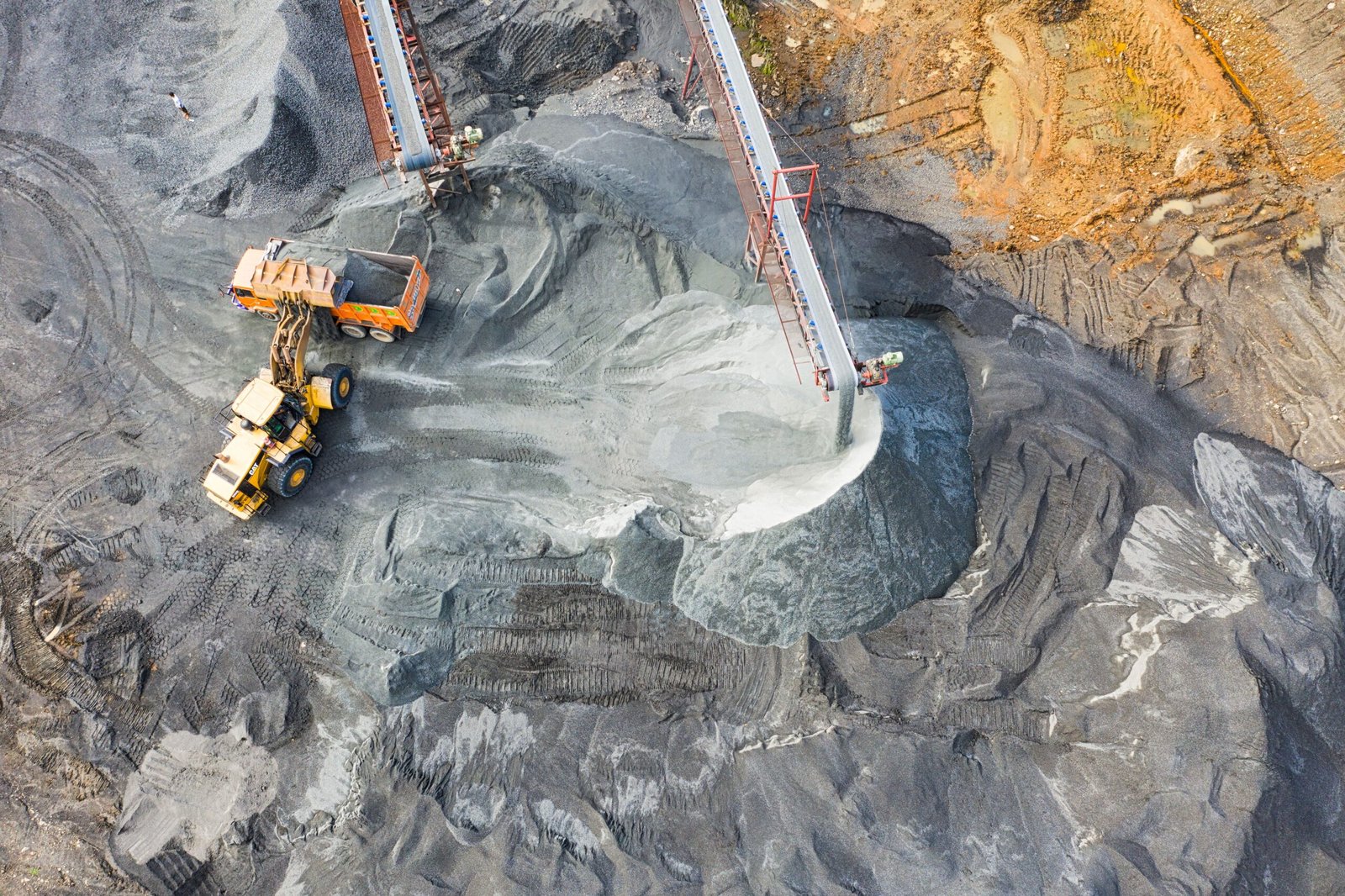
Australia’s transition away from fossil fuels faces a new test after New South Wales approved the continuation of the Hunter Valley Operations (HVO) coal mine until 2045.
The NSW Independent Planning Commission (IPC) on September 30 approved the continuation of HVO North until the end of 2045 and HVO South until the end of 2042. The project would allow an estimated 429 million tonnes of coal to be extracted from the Hunter Valley near Singleton.
The decision is significant not only because of the scale of the mine, but because it extends a major coal operation into the period in which Australia is committed to sharply reducing its greenhouse-gas emissions.
Australia’s current climate commitments include cutting national emissions by 43 per cent from 2005 levels by 2030 and by 62–70 per cent by 2035, with net-zero emissions targeted for 2050.
The latest government inventory estimates Australia’s emissions at 452.4 million tonnes of carbon dioxide equivalent in the year to June 2026, a preliminary 1.8 per cent decline from the previous year. Emissions in the year to March 2026 were 25 per cent below 2005 levels.
Against that backdrop, the IPC acknowledged that the HVO project would have a substantial climate footprint. Its statement of reasons estimates that the project could result in about 809 million tonnes of greenhouse-gas emissions from local mining operations and the eventual combustion of exported coal overseas. The commission said those emissions would contribute to climate impacts in the Hunter, NSW and globally.
The 809-million-tonne figure needs an important qualification to note. it is a lifecycle-related estimate that includes overseas combustion emissions and should not be interpreted as emissions produced directly by the mine.
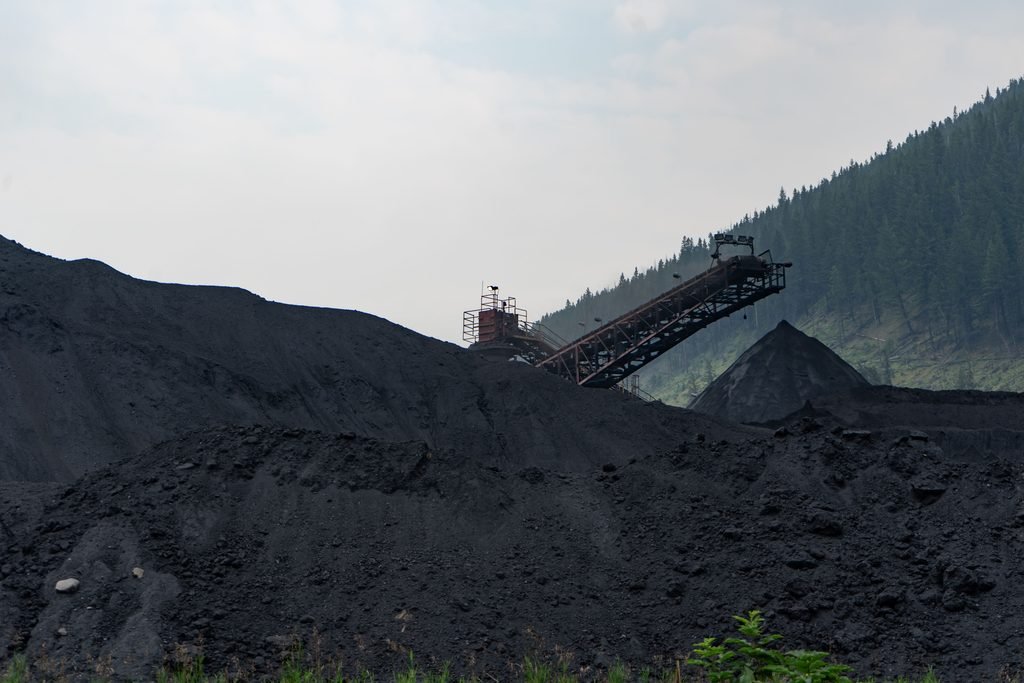
Coal mine.Representational image.Image credit:Pexels
The economic case for the extension is substantial. HVO employs more than 1,500 people and engages more than 800 suppliers, according to evidence presented to the IPC. The NSW Government says the continuation could secure up to 1,500 ongoing jobs and create about 600 temporary positions through infrastructure upgrades, subject to federal approval.
The approval also comes with conditions intended to address the mine’s emissions and its eventual transition. HVO must prepare a Scope 3 Management Plan dealing with emissions associated with exported coal, maximise renewable electricity use at the mine and purchase additional carbon offsets. It must also prepare a comprehensive closure plan within 12 months, in consultation with local councils and communities, outlining how the mine will transition towards closure while supporting workers and the local economy.
The NSW Government argues that the decision can support regional employment while maintaining the state’s broader emissions-reduction pathway. It says the approved proposal has 43 per cent lower Scope 1 emissions than the company’s 2022 application. NSW’s 2026–50 coal policy also allows extensions of existing mines while ruling out applications for new greenfield coal mines.
At the national level, the federal Safeguard Mechanism is intended to reduce emissions from Australia’s largest industrial facilities. The government says the mechanism is designed to put covered facilities on a trajectory consistent with the country’s 2030 target and net-zero goal.
That creates the central question around HVO’s extension. How does Australia manages the economic and employment role of existing coal regions while reducing emissions over the same period.
The NSW approval does not settle that question. The project still requires approval from the Australian Government under the Environment Protection and Biodiversity Conservation Act.
For the Hunter Valley, the decision provides a longer operating horizon for an established coal industry. For Australia’s climate transition, it brings the challenge of managing an economy in which existing fossil-fuel assets continue operating while national policy seeks progressively sustainable energy and lower emissions.
Society
When a Village Walks Together, Even Drought Is Defeated. How Halma Breathed Life Back into Kesarpura’s Pond
How a traditional Halma brought Kesarpura villagers together to restore a pond, strengthen water security and revive community-led conservation.

About 22 kilometres from the Petlawad block headquarters in Jhabua district of Madhya Pradesh, the village of Kesarpura has a story to tell, one about the confidence of an entire community. A Halma was held here on 19 May 2026, and what followed convinced the village that the solution it had long sought from outside had been within it all along.
Halma is a word from the Bhili dialect, often translated as a “call for help”, and it means collective voluntary labour. When a family in the Bhil community is weighed down by a burden, whether raising a house, bringing in a harvest or facing a calamity, the word goes round the village and people come, unpaid and with their own tools, to stand by them. The message is simple: you are not alone. In Jhabua the tradition has also been turned to the work of saving water. Since 2009 the local organisation Shivganga has organised large Halmas for soil and water conservation, and one in February 2020 drew some 20,000 people from about 500 villages.
Kesarpura’s only pond had been waiting for exactly this tradition. Years of neglect had left it so choked with silt and weeds that its depth was shrinking, and so was its capacity to hold water. Seepage through one stretch of the embankment quietly drained away the rainwater it collected. This is a tribal district, where Scheduled Tribes made up about 87 per cent of the population at the 2011 Census, and a hilly one: as the district administration itself notes, water runs off the slopes instead of being held by the soil, so even good rainfall can leave villages short of water. In such a landscape a failing pond meant a direct threat to a full year of farming and to the water that livestock depend on. As summer set in, the pond bed would fill with cracks, and the village’s hopes would drain away with it.
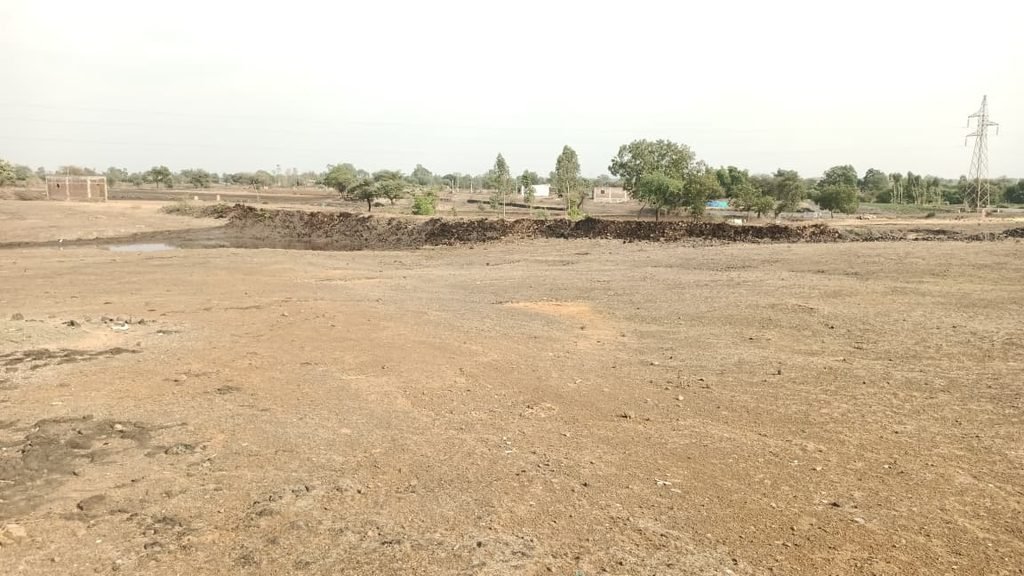
Before the Halma: a dry pond bed, heaps of silt and seepage along the embankment. Photo: Mukesh Porwal, Block Facilitator, VAAGDHARA
The village knew the problem was big, but it also knew the solution lay in its own hands. With the support of the Gram Swaraj Samuh, a village self-governance group of ten women and ten men formed by VAAGDHARA, it was decided that a Halma would be held at the pond. The idea was not new to the area: less than a fortnight earlier, on 6 May, villagers of Borpada, also in Petlawad, had used a Halma to clear a silted public well after repeated appeals to the panchayat brought no result. On the morning of 19 May, Kesarpura showed its true strength.
It began not with speeches or formal announcements but with the beat of the dhol, kundi and thali. A rally wound through the village. Children ran ahead carrying a banner that read “Traditional Halma Method,” with the slogan beneath it: “Save water regularly, and the future is secure.” Behind them walked elders, youth and women, with someone from every household carrying a pickaxe, a spade or a metal pan.
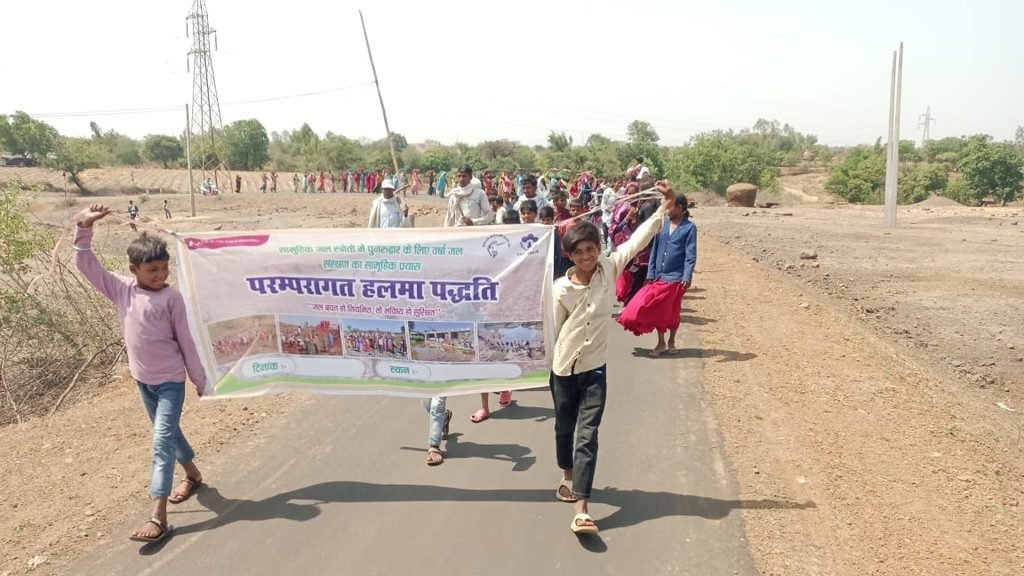
The rally sets out to the beat of the dhol and thali, with a banner reading “Traditional Halma Method”; enthusiastic children lead the way. Photo: Mukesh Porwal, Block Facilitator, VAAGDHARA
Around 150 people gathered at the pond for the Halma. There is no attendance register and no list; people come of their own accord and leave having done more than they thought they could. Under the blazing sun, heads were covered with gamchas and dupattas, yet faces glowed instead of showing fatigue. The work divided itself. Some waded into the pond to cut the weeds, others dug out silt with pickaxes and spades, and the silt was loaded into pans and basins and handed to a long line of women. The pans passed from hand to hand and head to head, and the silt made its way out of the pond.
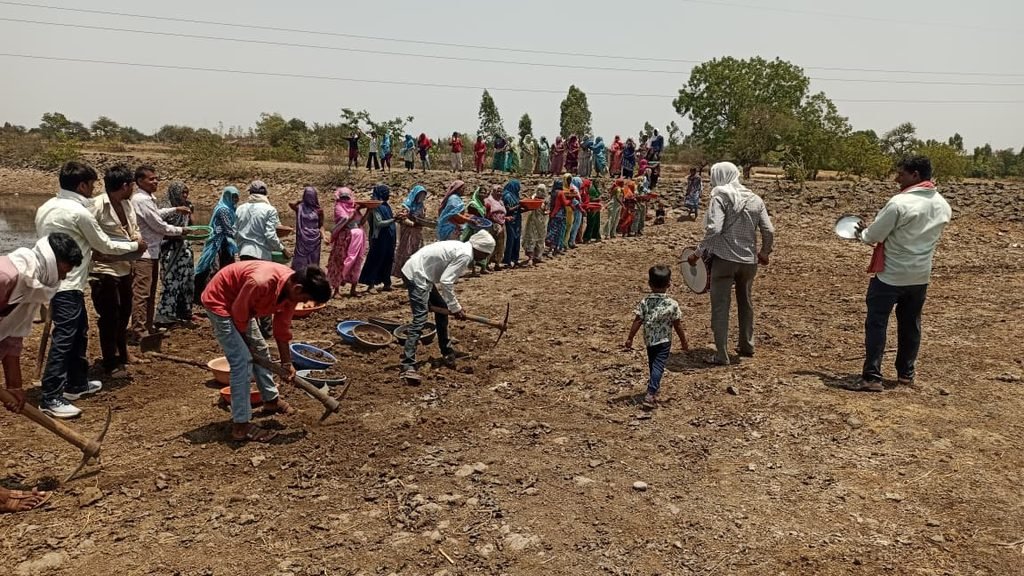
Men wielding pickaxes and spades on the pond bed, while women stand in line holding pans. Photo: Mukesh Porwal, Block Facilitator, VAAGDHARA
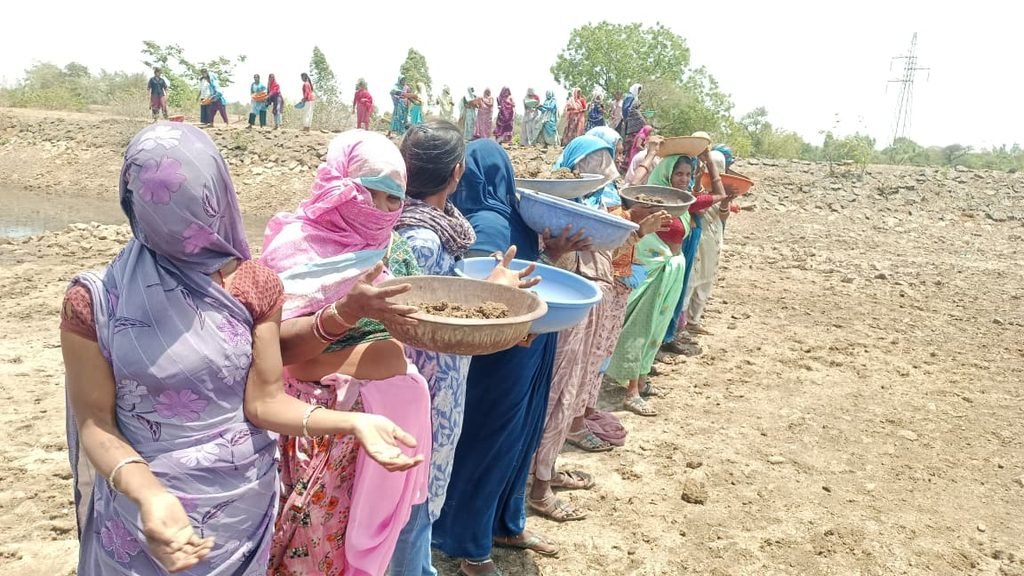
The role of women was the most remarkable part of the scene. Amid their household responsibilities, they stayed at the pond all day. Recalling that day, Basanti Ninama says that when the dhol sounded she could not sit at home, and standing in line with a pan on her head, it felt like work in her own courtyard.
“I was tired, but my heart felt light. I felt I was doing something for my village.”
– Basanti Ninama
Everyone also worked together to pile soil on the embankment where water had been seeping out, pressing it down and strengthening it. Clearing silt and weeds and strengthening the earthen bund are the standard steps in restoring a village pond, and those who know water conservation understand that the strength of the embankment and the depth of the pond decide how long a water body lasts. When noon came, the tools were set down, but the bond of togetherness did not break. Lunch, too, was cooked by everyone together on the pond’s bank. The women wove plates from tree leaves, and then everyone sat in a long row on colourful mats. An elderly woman and a small child ate the same meal on the same mat, and the true meaning of Halma came alive right there. Here, trust takes the place of accounts, and hard work and celebration blend into one another.
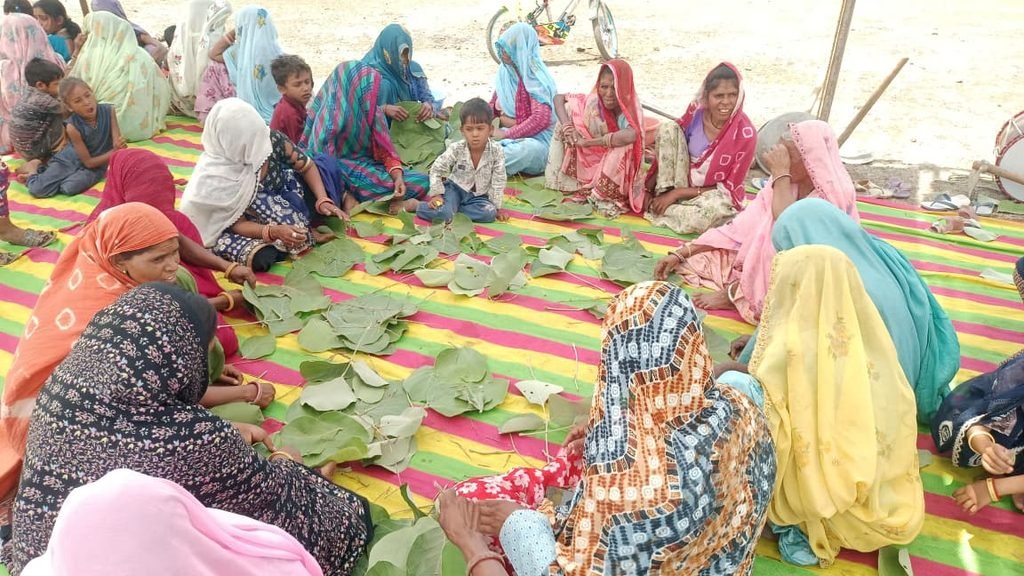
Women making leaf plates: even the preparation of the meal was a collective effort. Photo: Mukesh Porwal, Block Facilitator, VAAGDHARA
The simplicity of the leaf plate is a lesson in itself. A plate made from tree leaves leaves no plastic waste and needs no water for washing. Leaf plates have long been part of community feasts across India, and researchers describe them as a renewable alternative to plastic disposables. At an event whose very purpose is to save water, this goes beyond symbolism and becomes practice. Traditions often carry such eco-friendly solutions quietly, without any announcement.
Those who restored the pond that day included Basanti Ninama, Ganga Ninama, Surta Ninama, Sundar Mavi, Anadu Maida, Devli Mori, Phula Katara, Seema Maida, Anita Katara, Kala Ninama, Sukhram Maida, Ukarlal Maida, Mansingh Ninama, Ukar Ninama, Laxman Ninama, Dilip Vasuniya, Gendu Mori, Khima Mori, Anil Maida and Sunil Katara. Though they differ in age and family, their experiences seem threaded on a single string. For Ganga Ninama it was an emotional day: generations of her family have drunk this pond’s water, and it pained her to see it buried under silt.
“The day the pond was cleaned, I felt we had repaid our debt.” – Ganga Ninama
For men like Sukhram Maida and Anil Maida, the experience changed the way they thought. They used to believe that work on the pond was the government’s job, but on the day of the Halma they realised that when a village comes together, it has no one to wait for. “Before the Halma, we thought the government would do this work. This time we understood that when the village becomes one, we don’t have to wait for anyone.” – Anil Maida. The thought was not unique to Kesarpura: at the Samuh meeting in Borpada, someone had remarked that waiting for the government could cost another three years.
“It was very hot, but nobody complained. We want our children to see how work for the village is done.” – Devli Mori
During the event, Paramesh Patidar, Implementation Leader at VAAGDHARA, spoke with the villagers and explained that Halma is not merely voluntary labour but a tradition of standing by one another in joy and sorrow and sharing collective responsibility.
Behind the scenes, Block Facilitator Mukesh Porwal and his team also played a vital role, working at every level from mobilising people to planning the work. The steady guidance of Team Leader Dharmendrasingh Chunawat gave direction to the entire effort.
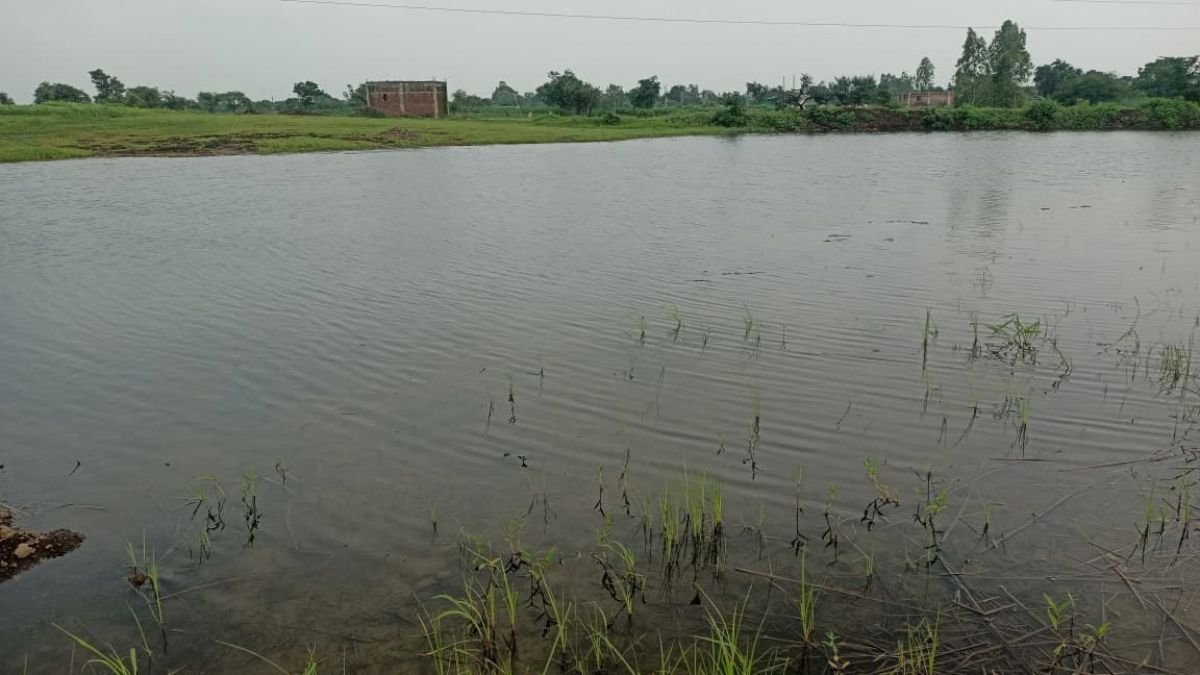
After the Halma the village returned to its routine, but nobody expected the result to show so soon. The monsoon turned out weaker than hoped. The India Meteorological Department had forecast a below-normal season, and by late July Jhabua was among the Madhya Pradesh districts reporting rainfall 33 to 45 per cent below normal; by 9 September the district’s shortfall stood at about 36 per cent. There was every fear that the pond would once again be left only partly filled. But about three months later, around August 2026, when villagers looked towards the pond, it was filled to the brim with water.
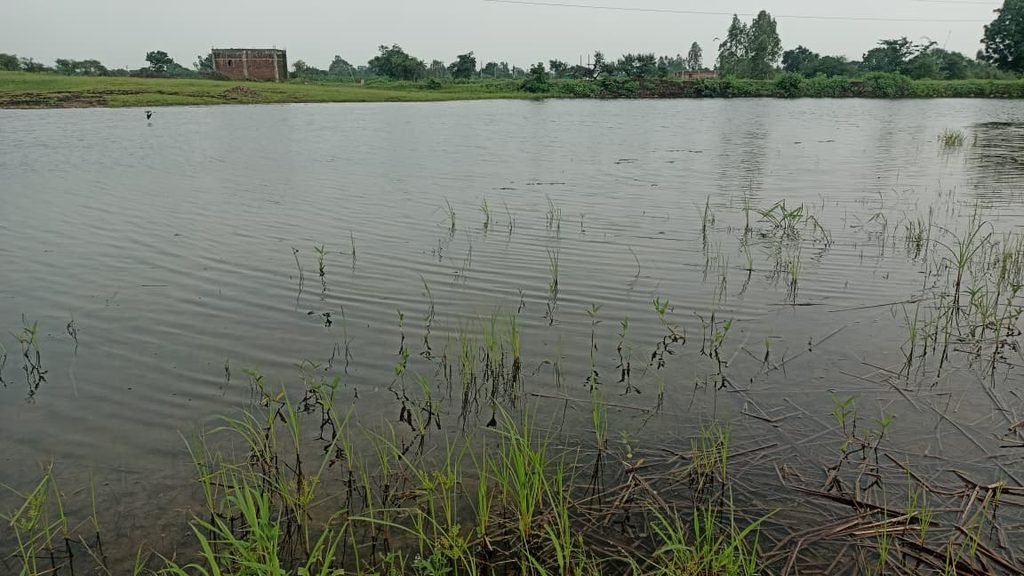
Where dust once flew, calm water now stretches far into the distance; the green grass sprouting along the edge is proof of life’s return. Photo: Mukesh Porwal, Block Facilitator, VAAGDHARA
The greatest joy was that the seepage through the embankment had also stopped. The water that came had stayed. For farmers like Sunil Katara and Mansingh Ninama, the meaning was direct: their fields will get irrigation and their cattle will have drinking water.
It is worth asking why such ponds last. Studies of India’s water infrastructure describe a recurring cycle of construction, neglect and rebuilding, with upkeep after construction as the weak link, and village ponds that were once maintained by the communities who used them fell into disrepair as that responsibility moved elsewhere. Experience shows that when a water structure is built from outside by a contractor, its upkeep often becomes nobody’s responsibility; the embankment breaks, the silt returns, and within a few years the pond can be back to its old state. A structure built through voluntary labour creates an emotional bond. Someone who has put soil into it with their own hands cannot bear to see it deteriorate. This is Halma’s greatest invisible achievement: along with the structure, it raises a whole generation of guardians. One good season in a poor monsoon is encouraging, but it is early evidence rather than proof; how long the pond lasts will depend on the desilting and embankment care the village now commits to.
The hopes ahead are considerable. In the rabi season, when fields need water the most, this stored water can become the farmers’ mainstay. With water standing in the pond, groundwater levels in nearby wells and hand pumps may also improve; case studies of desilted village ponds in Maharashtra’s Marathwada region report that nearby borewells recharged and the irrigated area grew in both the kharif and rabi seasons. Greenery is returning to the embankment, and guarding it is now the village’s shared responsibility. Remove the silt, bind the embankment, hold the rain, raise the groundwater, then irrigate the fields: this entire cycle of water conservation now appears to be complete in Kesarpura.
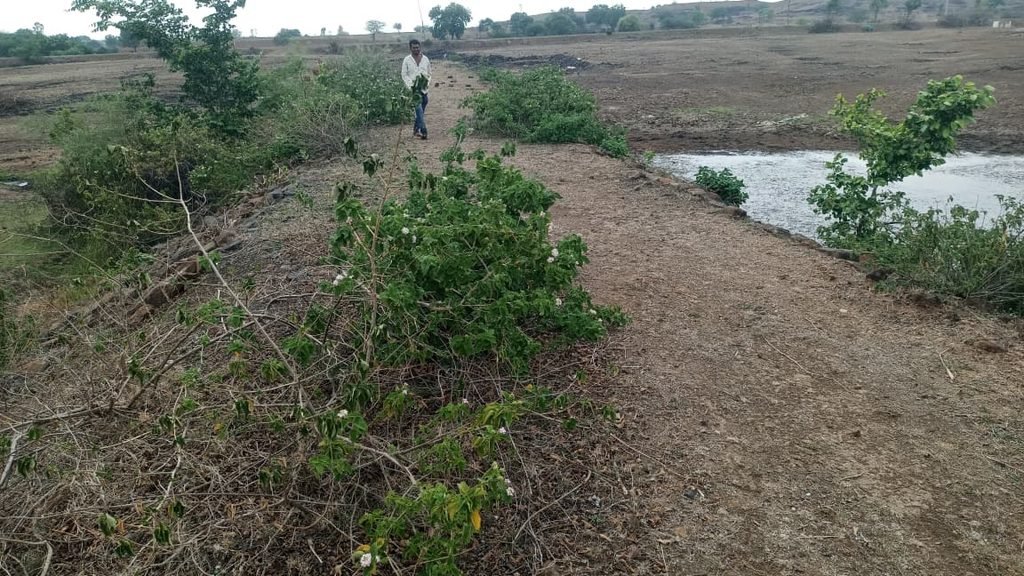
Greenery on the strengthened embankment, with still water on one side. Photo: Mukesh Porwal, Block Facilitator, VAAGDHARA
One sees the tradition of the elders and the labour of the young, the support of women and families, and above all a collective resolve to do something for one’s own village.
Kesarpura’s story is a reminder that development does not always wait for help from outside. In a country where, by NITI Aayog’s 2018 assessment, some 600 million people face high to extreme water stress, and where even large investments in water structures struggle with upkeep once they are built, examples like this show that the key often lies in local knowledge and community ownership. Three things together have given this pond a new lease of life: tradition meeting present-day need, institutions staying in the role of facilitators (in Borpada, too, the Samuh gave villagers room to decide for themselves rather than handing them ready-made answers), and a village that regards its resource as its own. Halma did not remove only silt and weeds from Kesarpura’s pond; it rekindled hope in people’s hearts, and today that hope is as clear as the pond’s water.


Climate Change, Overfishing and the Uncertain Future of Bangladesh’s Hilsa Fishermen

A Dead Star Feeds Off Planet Formed From Its Ashes

Trump’s AI Accord Puts Big Tech in Charge of Its Own Safety. Is That Enough?

Standing with Teachers: The People Who Shape India’s Future

An Ageing Teacher Workforce Is Becoming a Recruitment Problem

From Scams to Screens: How the National Stock Exchange Rewrote India’s Equity Story

Aim for the Stars: Anjali Thomas’s Journey from a Small College in Kerala to the Frontiers of Medical Imaging

India’s AI Moment Rests on More Than Code

Marshall Islands: Why the US Nuclear Legacy Is Back Before the UN

From Silicon Valley to Sustainable Period Care; How This Engineer Is Rethinking Menstruation with Science

-

 Math2 months ago
The 2026 Fields Medals: Four Proofs, Four Decades-Old Problems Solved
-
Climate2 months ago
After Kerala’s Deadliest Landslide, the Hardest Thing to Rebuild Was Childhood
-
Society3 months ago
West Asia Crisis: Can Kerala’s Returning Gulf Migrants Find a Future in the Green Economy?
-
Space & Physics4 months ago
India Semiconductor Mission: ‘It’s Not About Fabs. It’s About Building An Entire Ecosystem’
-
Interviews2 weeks ago
From Scams to Screens: How the National Stock Exchange Rewrote India’s Equity Story
-
Climate4 months ago
The Climate World Cup? How Climate Change Could Affect Player Performance at the 2026 World Cup
-
Society3 months ago
What Is Civilisational Diplomacy? Understanding India’s Newest Foreign Policy Tool
-
Society4 months ago
From Bell Labs to the Classroom: A Second Career in Teaching