Society
India Has Robots. So Why Does Manual Scavenging Still Put Workers in Sewers?
India has recorded at least 662 sewer and septic-tank deaths in 10 years, despite a legal ban on hazardous sanitation work and growing use of robotic cleaning. EdPublica examines why manual scavenging persists—and what it will take to end dangerous human entry into sewers.

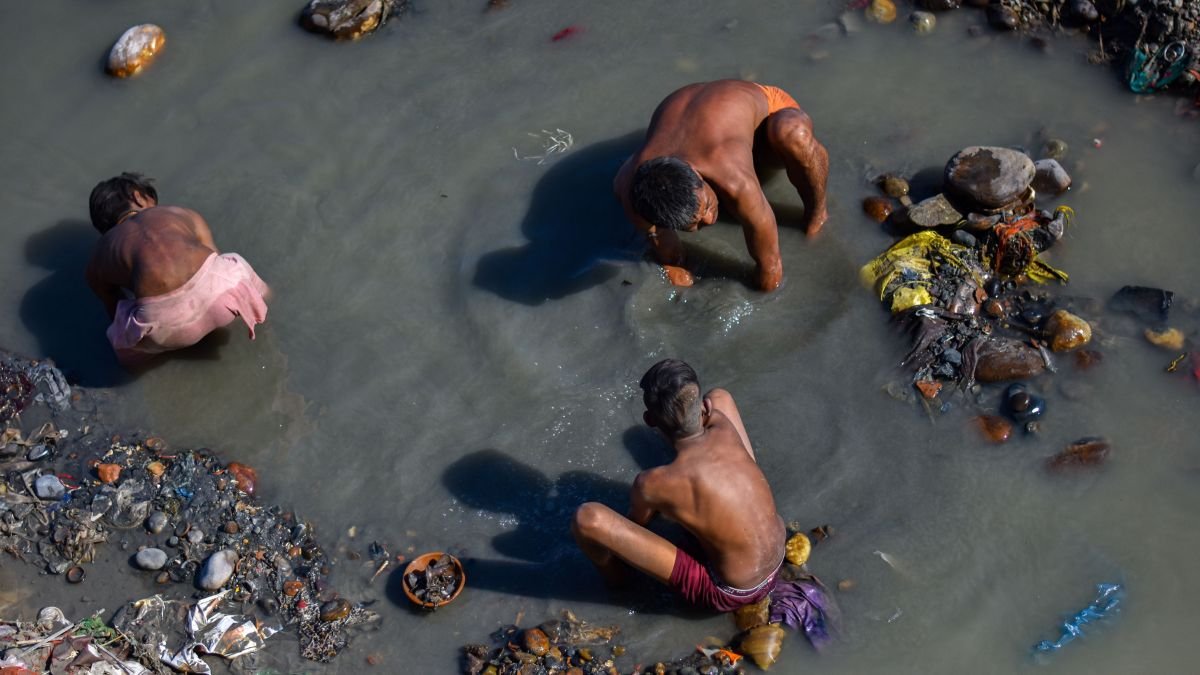
Around 10 pm on 30 September 2025, a worker went down into the septic tank of a hotel in Kattappana, in Kerala’s Idukki district, to clean it. He became trapped. Two colleagues went in to pull him out and were trapped too.
The manhole was too small for rescuers to enter. The fire force brought in an earthmover to break open part of the structure, and after a rescue operation of about an hour and a half the three men were taken to hospital, where they could not be saved. They were Jayaraman, from Cumbum in Tamil Nadu’s Theni district, and Sundara Pandian, 36, and Michael, 23, both from Gudalur in the Nilgiris. The Idukki District Collector’s report later attributed the deaths to inhalation of toxic gas in a tank with critically low oxygen, though the gas itself was not identified. It recommended a multi-department inquiry and compensation for their families of the dead involved in manual scavenging.
Kerala is the state where this is least expected. In the dataset used for this report, it recorded three sewer deaths in the decade to 2025: two in 2016, one in 2017, and none since. The men of Kattappana do not appear in that count. Nor does Joy, a sanitation worker who drowned in a waste-choked canal in Thiruvananthapuram in July 2024. Every figure in this story is a minimum.
Between 2016 and 2025, the National Commission for Safai Karamcharis (NCSK) recorded 662 deaths across India in connection with hazardous sanitation work. India banned the employment of manual scavengers in 1993. The 2013 Act went further, barring anyone from being employed to clean sewers and septic tanks hazardously, that is, without the protective gear and safeguards its rules prescribe. Yet sanitation workers still enter through narrow openings, sometimes with only basic protective equipment, to clear blockages and clean spaces where sewage, toxic gases and human waste accumulate. The work can take hours; in the wrong conditions, it takes lives.
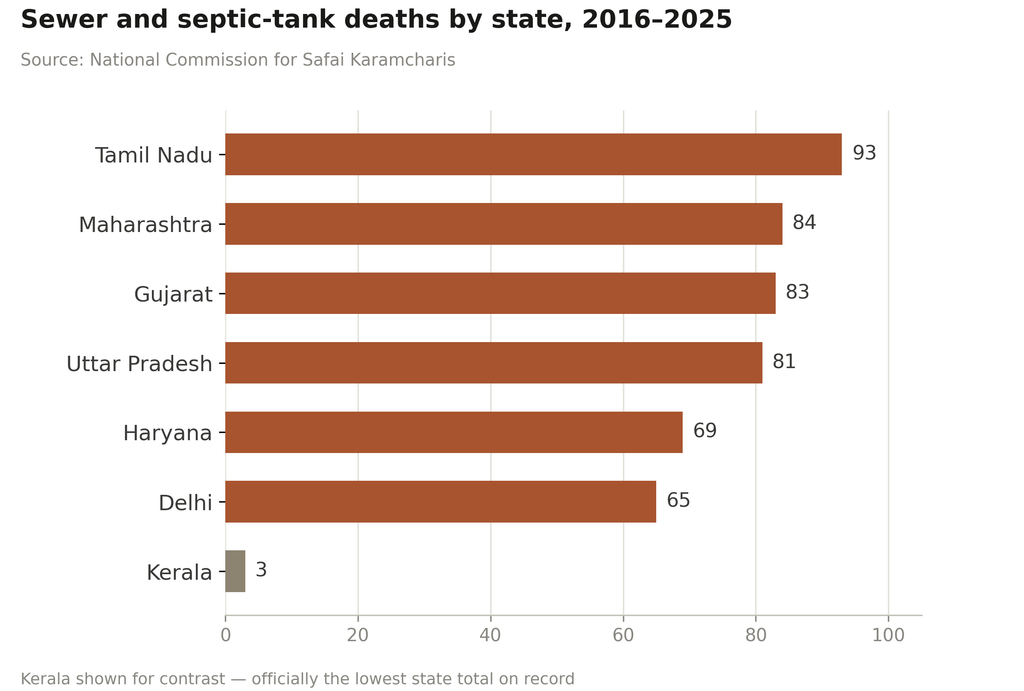
The toll peaked in 2019, at 124 deaths. Tamil Nadu recorded the most over the decade, at 93, followed by Maharashtra (84), Gujarat (83), Uttar Pradesh (81) and Haryana (69); Delhi recorded 65. The five states named accounted for about 62 per cent of the deaths. Since the NCSK began counting in 1993, it has logged 1,361 such deaths, 264 of them in Tamil Nadu and 13 in Kerala.
Official series differ by source and date, because states report late. Replies in Parliament have put the toll for 2019 anywhere between 116 and 133, and a reply in March 2026 that counted from 2017 onwards ranked Uttar Pradesh first (86), ahead of Maharashtra (82) and Tamil Nadu (77). The pattern is consistent even if the totals are not.
A note on terms also matters here. The government draws a legal line between “manual scavenging”, which the 2013 Act defines as lifting human excreta from insanitary latrines, and the “hazardous cleaning” of sewers and septic tanks. It has told Parliament that no deaths have been reported from the first, while counting those in the second. Campaigners treat both as the same caste-bound labour. This report uses “manual scavenging” for the wider practice and “sewer deaths” for the deaths.
Behind the toll lies a harder question: if India has achieved significant technological advancement, why does manual scavenging still persist at all? What keeps people entering spaces they should never have to enter?
For Bezwada Wilson, national convenor of the Safai Karmachari Andolan (SKA) and a Ramon Magsaysay Award winner, the fight against manual scavenging has always been about more than sewers. Through the SKA, he helped document the practice, challenge official claims and take the issue to the Supreme Court. The Supreme Court’s 2014 judgment recognised the continuing problem, ordered the identification and rehabilitation of workers, and directed compensation of ₹10 lakh to the families of those who died in sewers, bringing dignity, equality and caste discrimination to the centre of the debate.
The Work Begins Long Before the Sewer
Wilson grew up in a community that has been tied to sanitation work for generations, and he has spent much of his life challenging the system that kept it that way. As a child, he says, he studied in a separate school near his settlement, where caste and language shaped where children from his community were sent to learn. He came to the movement against manual scavenging through an understanding of what prolonged contact with human excreta does to a person’s health and life.
People who come into contact with human excreta, he says in an interview with EdPublica, are exposed to deadly diseases. Their quality of life deteriorates. That, for Wilson, was reason enough to act. But the deeper problem is what happens when a community is identified with one kind of work for generations. Even education does not necessarily erase that association.
Wilson says government programmes aimed at upskilling members of sanitation-worker communities exist, but questions whether they are reaching people effectively. The Ministry of Social Justice and Empowerment told the Lok Sabha in 2022 that it had spent ₹266.16 crore on its self-employment scheme for the rehabilitation of manual scavengers since 2013-14; that scheme has since been replaced by NAMASTE. Students in these communities still face difficulties accessing education in many places.
Then there is discrimination. When people have been treated as inferior for generations, Wilson argues, a change in law does not automatically change the way society sees them. That matters because manual scavenging is not simply a story about a hazardous job. It is also a story about who is expected to do it.
The Number that Remains Visible
The 662 deaths recorded between 2016 and 2025 are a floor, not a full count. They are the deaths captured in the available dataset, and that distinction matters: the scale of the problem is larger than the deaths that make it into official or reported records. The NCSK says its figures draw on state governments’ reports, media reports and complaints it receives.
The gap between official and civil-society counts is wide. The Ministry told the Lok Sabha in August 2026 that 498 people died in hazardous sewer and septic-tank cleaning between January 2019 and June 2026, a toll that fell from 132 in 2019 to 47 in 2025. The SKA’s own tracking runs the other way, as the table shows. It has counted 113 deaths in the first seven months of 2026 alone; the government’s figure for the first four months is 52.
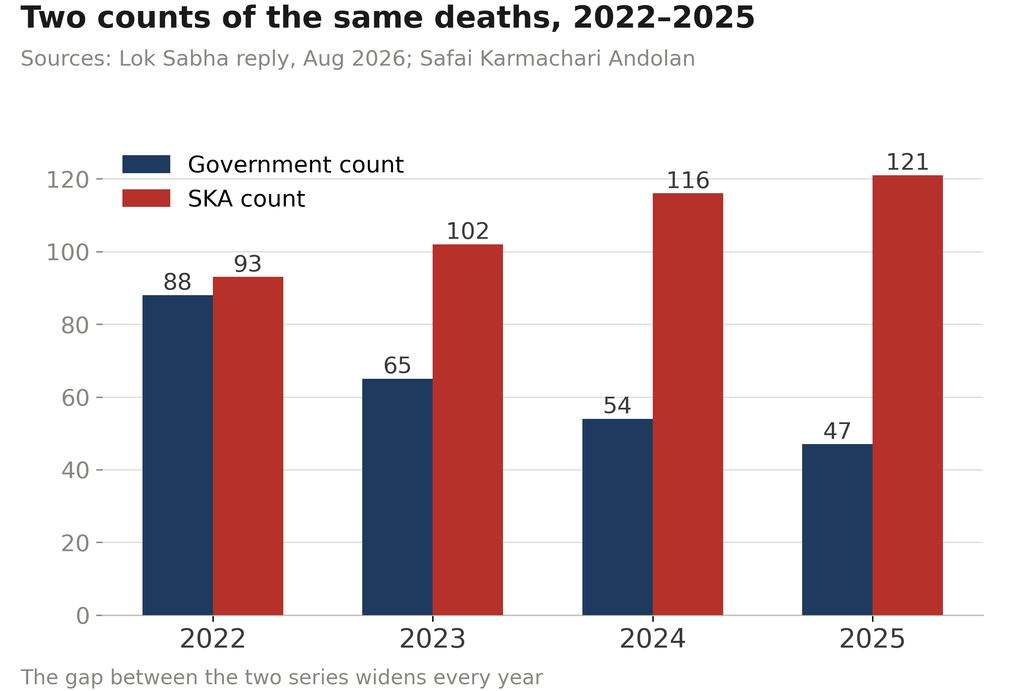
The two series cannot both be right, and the difference is not only about counting. It is also about classification, since the government counts hazardous cleaning but not “manual scavenging”. Even among the deaths that are recorded, accountability is slow: the NCSK says compensation has been paid in 1,206 of the 1,361 cases logged since 1993, with 101 still pending.
Vimal Govind M K, founder and CEO of Kerala-based Genrobotics, came to the problem from the technology side. His company turned its robotics towards sewer cleaning, he says, after the founders came across a newspaper photograph of a man who had died inside a sewer in Kozhikode, Kerala. The image changed the direction of their work.
“We decided to pivot the technology we were developing towards a completely different problem—to prevent people from entering sewers and doing this dangerous work manually,” Govind said.
That decision eventually produced Bandicoot, a robotic system designed to clean manholes without sending a person inside. Genrobotics says it was first deployed in Kerala in 2018. But the existence of a machine does not mean people stop entering sewers.
A Robot Exists. So Why are People Still Entering?
Genrobotics says it has trained more than 3,000 workers and has around 400 robots operating in India. Its public figures have varied: a March 2026 press release spoke of more than 275 deployments, while earlier interviews cited 300 and 350 robots. Govind says a task that can take three to four hours when done manually can be completed in around 20 minutes using the technology. Operating one robot takes two workers, he says.
Figures from the field point the same way. Chennai’s water board has been reported to have cleaned more than 5,000 manholes in the first year of deployment, and a company case study lists 1,111 manholes cleaned by two robots for Mumbai’s civic body between September 2024 and March 2025. Both figures come from the company or from secondary reports.
On paper, the logic seems straightforward: if a machine can enter a sewer, a human being should not have to. But India’s sanitation infrastructure does not operate on paper. Municipalities and water boards buy machines, yet many of the deadliest jobs are commissioned by someone else. Kattappana was a hotel’s tank. This week in Mumbai’s Santacruz East, Santosh Kashate, 50, died and Ajay Thakur, 30, was hospitalised after they allegedly entered a municipal sewer manhole while cleaning a housing society’s drain. Police were registering a case of death by negligence against the contractor, and said society members could also be booked for hiring private workers without informing the Brihanmumbai Municipal Corporation.
Some facilities need specialised cleaning only occasionally. Private establishments have little reason to invest in technology for a task they might need once a year, or once in several years. Govind points to another problem: safety enforcement.
In India, confined-space management and workplace safety remain uneven, he says. In countries such as Singapore and the UAE, workers require safety training and permits before undertaking such work, with safety procedures built into the job itself. India’s problem is therefore not simply a shortage of machines. It is also a shortage of systems that make entering the sewer unacceptable.
The courts have pushed in that direction. In October 2023, in Dr Balram Singh v Union of India, the Supreme Court raised compensation for sewer deaths from ₹10 lakh to ₹30 lakh. In January 2025 it barred manual sewer cleaning in six metropolitan cities, and in July 2026 it issued show-cause notices on contempt to the chief secretaries of five states. After two contract workers died in a Tiruchirappalli manhole on 22 September 2025, the corporation announced ₹30 lakh for each family and filed a complaint against the contractor. Compensation and complaints now follow such deaths. Prevention still lags.
When Protective Equipment is not Enough
For years, the response to hazardous sanitation work has often included protective equipment—masks, gloves and other safety gear. But Govind says equipment alone does not necessarily change behaviour. He says workers who have spent years entering sewers can become accustomed to the practice, and that even after being provided with protective equipment, some continue to enter because that is how the work has traditionally been done.
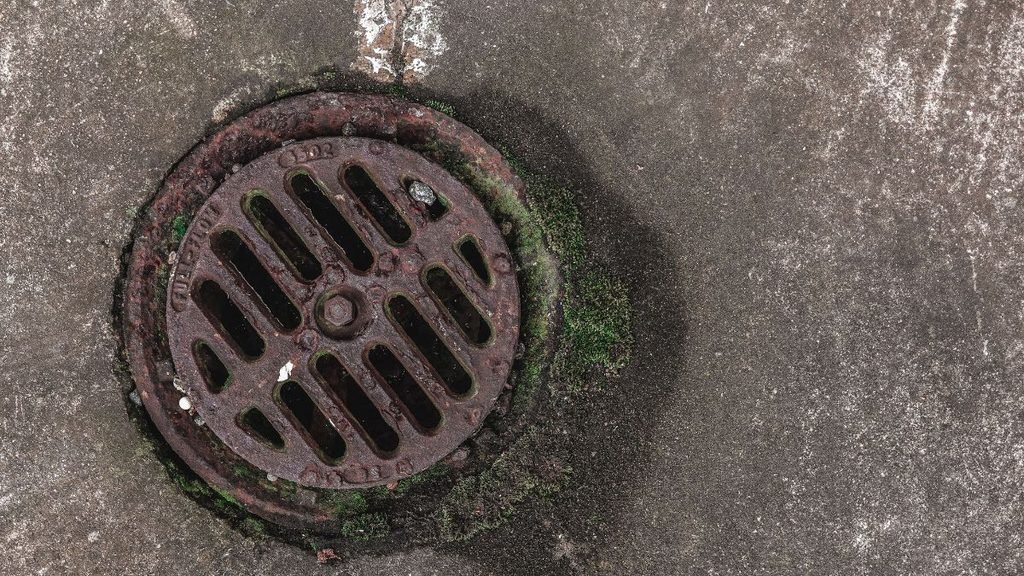
Official figures show the limits of the equipment route. Under the government’s NAMASTE scheme, 89,915 sewer and septic-tank workers had been validated by August 2026, and about 87,000 protective kits had been distributed by the scheme’s third anniversary in July. The Lok Sabha was also told that 52 people died in hazardous cleaning in the first four months of 2026. The figures do not say who the dead were or whether they had been profiled. They do show that distributing equipment has not, by itself, ended the deaths.
Changing that, Govind says, requires training and a cultural shift. That observation brings the technology debate back to Wilson’s argument. If caste has historically determined who performs sanitation work, and if generations of workers have been conditioned to see hazardous cleaning as part of their occupation, then a robot can solve only one part of the problem. It can keep a person out of the sewer. It cannot, by itself, determine what happens to that person afterwards.
What Happens to the Worker When the Robot Arrives?
This may be the most important question in the mechanisation debate. Automation is often discussed in terms of machines replacing people. In sanitation, however, the better outcome is different: workers moving from hazardous manual entry to safer, skilled roles.
Genrobotics says sanitation workers are trained to operate its technology and become part of its teams. The company said in January 2025 that more than 1,000 of the workers it had trained had become robot operators. It says the transition removes direct interaction with sewage from their work. A worker who once entered a manhole could instead operate a machine from outside it.
The job remains. The danger does not have to. Those numbers are the company’s own, though. What would settle the question is what operators earn, who employs them and whether the jobs last. The model also depends on municipalities and other employers actually investing in mechanisation, training workers and enforcing the rules.
Govind says budget allocation remains one of the major barriers to adoption. Government programmes and funds can support mechanisation, but ultimately policymakers and local administrators have to decide to spend the money. The government’s main programme is NAMASTE, launched in July 2023 with an outlay of ₹349.73 crore over three years to 2025-26 across more than 4,800 urban local bodies. It profiles sewer and septic-tank workers, provides protective kits and health insurance, and offers capital subsidies of up to 50 per cent for sanitation machines and enterprises. An extension to rural areas, with an additional outlay of about ₹498.73 crore for 2026-27 to 2030-31, has been reported.
The Geography Tells Another Story
The deaths are not evenly distributed across India. Kerala, by comparison, recorded three deaths in the dataset, two in 2016 and one in 2017, with none from 2018 to 2025.
That contrast is worth examining, but not celebrating too quickly. A decline in reported deaths does not, by itself, prove that hazardous sanitation work has disappeared. Differences in reporting, infrastructure, enforcement and the kinds of sanitation work carried out in each state can all affect the numbers. Kattappana and Joy’s death in Thiruvananthapuram sit outside Kerala’s count.
Govind says Kerala has stronger safety practices than many other states, while acknowledging that enforcement and investment remain challenges nationally. Genrobotics first deployed Bandicoot in Kerala in 2018, the year the zero run begins. The timing is suggestive, not proof, and Kattappana shows what a municipal robot does not reach: a private tank behind a hotel.
The more useful question, then, is not simply which state has the fewest deaths. It is what is different about the systems that keep workers out of hazardous spaces.
Besides the Number 662
India’s response has increasingly moved towards mechanisation. The government has also introduced programmes aimed at eliminating hazardous sanitation work, rehabilitating workers and creating safer sanitation systems.
The experiences of Wilson and Govind point to two requirements for the same goal. One is technological: make it possible to clean a sewer without sending a person inside. The other is social: make sure the person who no longer enters the sewer has the education, income, skills and social acceptance to move into safer work. Neither can replace the other. A third, the law, is meant to hold them together.
A robot can pull a worker away from toxic sewage. A law can prohibit an employer from sending that worker back in. A rehabilitation programme can offer another livelihood. But unless all three work together, the prohibition remains vulnerable to the same pressures that created the occupation in the first place.
Govind predicts that the sanitation industry could become almost completely automated within the next five to six years, with very little human involvement in hazardous work. It is an ambitious prediction. Against more than 4,800 urban local bodies, the company’s own count is a few hundred robots.
The technology may arrive before the social transformation does. And that is the real test for India. Not whether it can build a robot capable of entering a sewer. But whether it can build a system in which no human being has to.











Society
Who Cares for India’s Older People?
On International Day of Older Persons, a HelpAge India study highlights gaps in healthcare, income, family care and social support facing older people in India, including added risks from climate-related hazards.

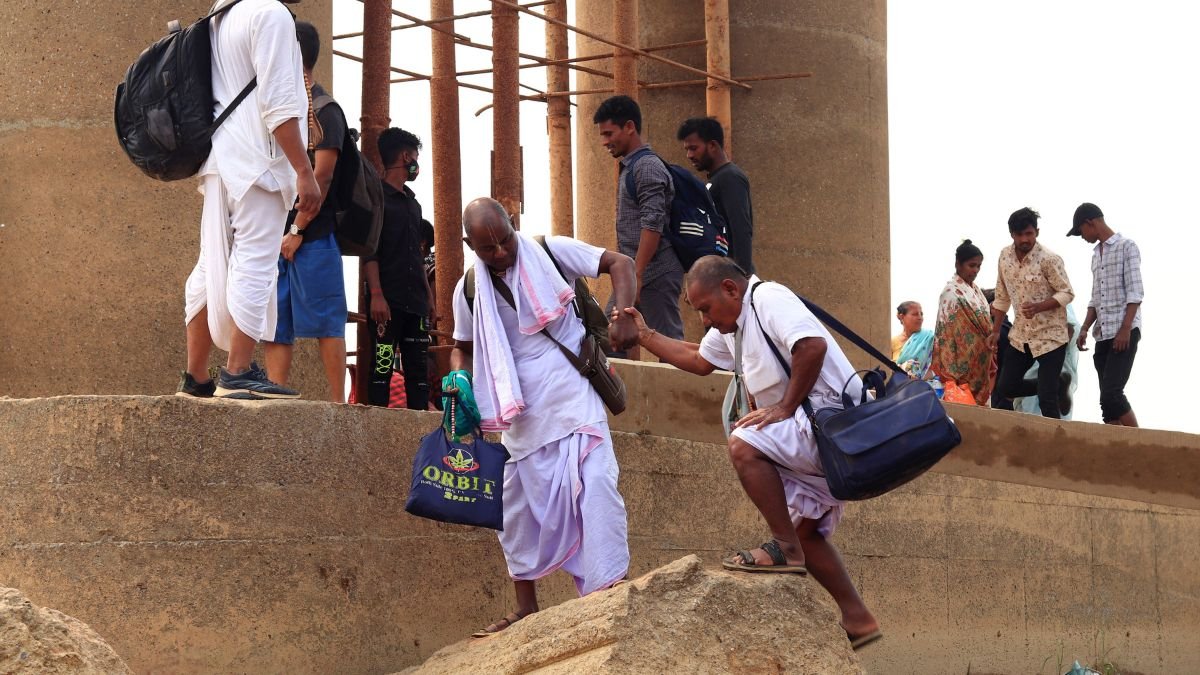
Growing older can change something as ordinary as getting medicines, visiting a doctor or managing a difficult day alone. For many older people, the question is not simply whether help exists, but whether someone is close enough and able to provide it when it is needed.
A recent HelpAge India study of 2,224 older people across 20 districts in 10 states offers a picture of the support systems on which they depend. It found that 94% of older people who needed care received it from family members. But that support is not equally available to everyone.
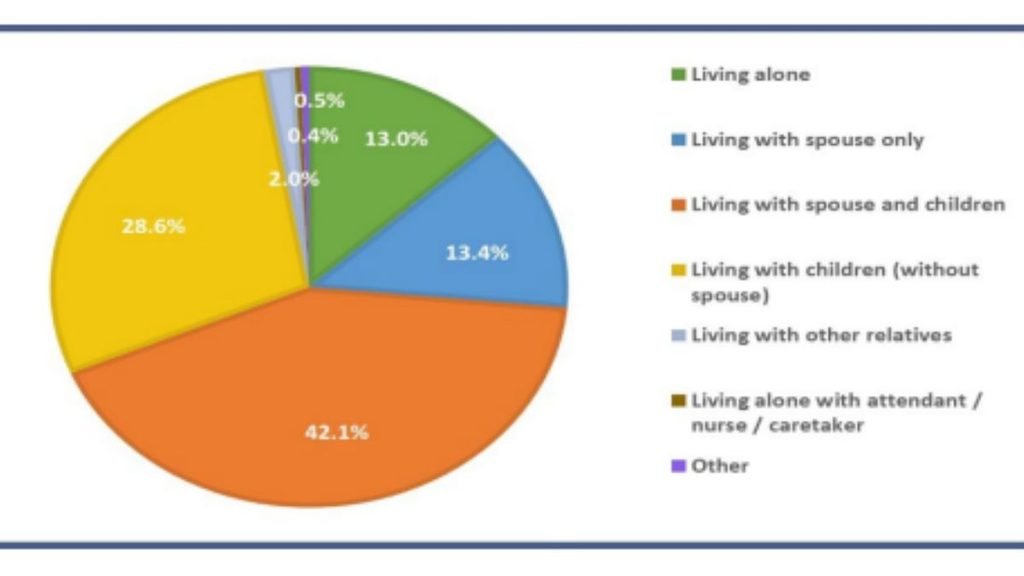
Thirteen percent of those surveyed lived alone, 33% were widows and 28% were aged 80 or above. Nearly half reported a long-term impairment, including mobility and vision difficulties. These circumstances matter because everyday care often depends on another person being physically present.
When Family is not Nearby
India’s older population continues to rely heavily on family for care. But migration for work is changing household arrangements. In the HelpAge study, 18% of households reported that a family member had migrated for work. Sons accounted for 76% of those migrants.
For older people living alone, neighbours often fill part of the gap. Thirty-eight percent depended on neighbours for care, while 20% relied on family members living elsewhere. Sixteen percent said they received no care.
Distance does not necessarily mean that families stop supporting older relatives. Financial assistance and regular communication can continue. But some needs cannot be met remotely: taking someone to a hospital, collecting medicines, helping them move around the house or responding when they suddenly fall ill. This distinction becomes particularly important during emergencies.
Health Harder to Manage
The study found that 52% of respondents could not afford medicines. Public facilities were an important source of healthcare, with 51% using primary health centres and 49% government hospitals.
Climate-related events exposed some of these existing difficulties further. Seventy-eight percent of those surveyed had experienced at least one such hazard in the previous three years, with heatwaves the most common.
Among those who experienced heatwaves, 74% said illness increased and 44% said existing health conditions worsened. One-third reported difficulty accessing healthcare. These figures are less about the hazard itself than about what happens when an older person already managing health problems has fewer options for care.
“Older persons are among those most at risk from rising climate shocks, particularly those living alone or with impairments, yet they remain largely invisible in climate response efforts,” says Rohit Prasad, CEO, HelpAge India. “Climate impacts extend beyond physical hazards, affecting health, income, housing, care and social wellbeing.”
Prasad says age-related physical, financial and social challenges can limit older people’s ability to prepare for, withstand and recover from climate events. He calls for ageing to be integrated into climate adaptation, climate financing, elder-centric disaster risk reduction and social protection policies.
Income Constraint
Healthcare is only one part of financial insecurity in later life. Pensions were the main source of income for 49% of respondents. Sixteen percent had neither work nor income, while others continued to work in agriculture, agricultural labour or other forms of employment.
The ability to pay for medicines, travel to healthcare facilities, household repairs or basic necessities depends heavily on this income. Work also changes with age. The HelpAge study found that the proportion reporting no work or income rose from 11% among those aged 60–69 to 21% among those aged 80 and above.
For people who have spent much of their lives in informal employment, growing older can therefore mean entering a period with limited savings, little employment protection and greater healthcare needs.
The Problem of Access
Government schemes can provide important support, but knowing about a benefit does not always mean being able to obtain it. The study found relatively high awareness of the Public Distribution System, pensions, subsidised healthcare and housing schemes. Yet access was more difficult for people with poor health, those severely affected by climate hazards, people without formal education and those from lower socioeconomic groups.
Respondents also reported delays, difficulties with digital access and a lack of assistance with applications. For an older person with limited mobility, poor eyesight or little experience with digital services, even a relatively straightforward application can become difficult without help.
Ageing Needs More Than Family Care
India’s ageing population is growing, while the family structures that have traditionally provided care are changing.
UNFPA estimates that the number of Indians aged 60 and above could approach 193 million by 2030. That growth will increase the need for healthcare, financial support and forms of care that do not depend entirely on whether an older person’s children live nearby.
The answer is not to replace family care, which remains central to the lives of many older people. It is to ensure that those who do not have family nearby, cannot afford private care or need support beyond what relatives can provide are not left without alternatives.
Ageing policy therefore needs to look beyond longevity. It has to account for who provides care, who pays for healthcare, how older people access public services and what happens when the person they depend on is no longer close by. For many older Indians, these are not future questions. They are questions of everyday life.
Health
Not Broken but Unheld: A New UN Report Asks Us to Tend the Forest, Not Only the Tree
A new UN report on youth mental health calls for an ecosystem approach linking well-being with education, work, housing, climate, technology and community.


Society
Digital Detox: Why Taking a Break From Screens Matters
A digital detox can help children and adults reduce screen dependence, reconnect with nature and relationships, and create space for reflection and creativity.




India Has Robots. So Why Does Manual Scavenging Still Put Workers in Sewers?

Icnoic Matterhorn Almost Snow-Free as Record Heat Accelerates Swiss Glacier Loss

Who Cares for India’s Older People?

Climate Change Is Already on Your Dinner Table. Here Is How It Got There

India Records Driest Monsoon in 11 Years as Rainfall Deficit Hits 12.6%

From Scams to Screens: How the National Stock Exchange Rewrote India’s Equity Story

Aim for the Stars: Anjali Thomas’s Journey from a Small College in Kerala to the Frontiers of Medical Imaging

Anxiety Freezes Career Decisions. Curiosity Unfreezes Them

The Engineer of Tomorrow Is Already Here

India’s AI Moment Rests on More Than Code

-

 Math2 months ago
The 2026 Fields Medals: Four Proofs, Four Decades-Old Problems Solved
-
Climate2 months ago
After Kerala’s Deadliest Landslide, the Hardest Thing to Rebuild Was Childhood
-
Society3 months ago
West Asia Crisis: Can Kerala’s Returning Gulf Migrants Find a Future in the Green Economy?
-
Space & Physics4 months ago
India Semiconductor Mission: ‘It’s Not About Fabs. It’s About Building An Entire Ecosystem’
-
Interviews1 week ago
From Scams to Screens: How the National Stock Exchange Rewrote India’s Equity Story
-
Climate4 months ago
The Climate World Cup? How Climate Change Could Affect Player Performance at the 2026 World Cup
-
Society3 months ago
What Is Civilisational Diplomacy? Understanding India’s Newest Foreign Policy Tool
-
Society4 months ago
From Bell Labs to the Classroom: A Second Career in Teaching