Technology
India’s AI Moment Rests on More Than Code
India has assembled many of the building blocks of an AI economy: capital, talent, research and startups. But its next phase will depend as much on chips, electricity, skills and policy as on software, exposing the gap between rapid growth and the systems needed to sustain it.


India’s AI ambitions are now reflected in global rankings, investment flows and Bengaluru’s emergence as a lead ing innovation hub. Yet the numbers reveal only part of the story. Much of the hardware is imported, demand for skilled workers continues to outpace supply, and the infrastructure pow ering AI faces growing pressure. The country’s next challenge is no longer adopting AI, but building the industrial and social foundations that can sus tain its growth.
The Hardware Production Gap
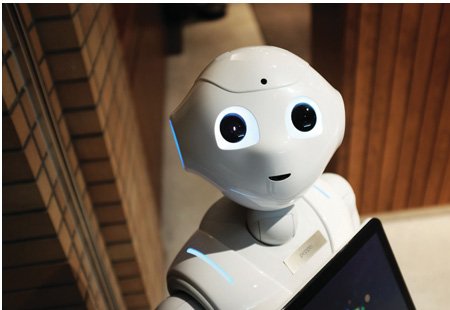
The IndiaAI Mission has deployed over 38,000 GPUs and TPUs across domestic data centres. Registered startups and researchers can access this compute at ₹115–150 per GPU hour, roughly 42% cheaper than com mercial cloud rates. The governmentplans to scale this to 100,000 GPUs by December 2026. Not one of these chips is made in India. Every GPU in that stack is sourced from the same export controls that cut China off from this hardware exist as legal authority that could, under different political conditions, apply to India too.
A US India trade framework announced in February this year includes language protecting India’s chip access, but it depends on ongoing political align ment. Budget 2026–27 allocated ₹8,000 crore to the semiconductor and display manufacturing ecosystem programme, the largest single-year outlay since the mission launched, with a separate ₹1,000 crore for India Semiconductor Mission 2.0. The Tata PSMC fabrication plant at Dholera is targeting trial production by late 2026. But these plants are not building AI grade chips.
India’s Sovereign AI
At the IndiaAI Impact Summit 2026, three models were introduced: Sarvam AI, BharatGen, Gnani.ai. BharatGen has assembled over 15,000 hours of annotated voice data across 22 Indian languages. Sarvam’s Vision model, a 3-billion-parameter doc ument intelligence system, scored 84.3% on a standard OCR benchmark, outperforming Google Gemini 3 Pro (80.2%) and OpenAI’s GPT 5.2 (69.8%). Bhashini-v2, launched in early 2026, offers AI-powered translation across all 22 scheduled Indian languages and serves 140 million users on the MyGov platform. India is constructing the language of sovereignty. Indigenous models, na tional compute, and mission branding. But the engine underneath runs on hardware it cannot make and may not always be allowed to import.
The Jobless Economic Growth
India’s IT sector has long been the engine of middle-class stability, con tributing about 7.3% to GDP, employing over 5.8 million people directly, and creating the white-collar jobs that drove spending across housing, edu cation, and retail. That engine is under pressure from the same technology India is racing to lead. Particularly for mid-level coding, BPO, and testing roles that form the bulk of jobs in India. TCS announced 12,000 layoffs in 2025; Infosys and Wipro followed. Across the sector, jobs have been cut in what companies call strategic realignment.
NITI Aayog’s October 2025 report projected that in a worst-case sce nario headcount could fall to 6 million by 2031. In April 2026, global equity re search firm Bernstein wrote an open letter to Prime Minister Modi warning that India’s 10 to 15 million IT services, GCC, and BPO workforce faces direct exposure to AI-driven automation. Sonal Varma, chief economist for India and Asia ex-Japan at Nomura, said: “Entry-level routine jobs are being displaced, and mid-level jobs are transforming. India needs to create about 8 million jobs annually.’’
Skill Set for the Emerging Sector
AI DevOps engineers, data centre operators, ethical AI auditors are the major emerging roles. But they require skill sets entirely different from the mass-hiring model that built the IT sector. An IIM-Ahmedabad study found that 68% of white-collar work ers fear automation within five years; 55% have adopted AI tools, but only 48% have received any training. India produces over 1.5 million engineering graduates annually but ranks 18th globally in skills alignment and 73rd in human capital in terms of AI. Graduate volume is not the same as workforce depth.
In that way adoption without re skilling becomes exposure to disrup tion dressed up as progress. NASSCOM projects that the broader AI push could generate 750,000 jobs and add $500 billion in economic value by 2030. Whether they reach the workers being displaced depends on whether India can close the gap between how many people it trains and how well it trains them. It is a gap that every major index in 2026 has documented and none has resolved.
The Climate Bill
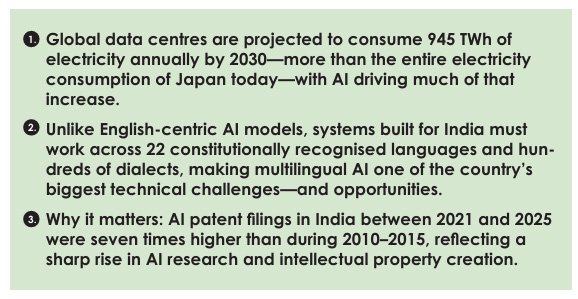
There is a cost to India’s AI ambitions that doesn’t appear in invest ment announcements is the physical climate risk accumulating around the infrastructure meant to run it all. A report by climate risk consul tancy assessed 2,595 planned data centres worldwide, examining risks of direct physical damage from climate hazards, operational disruption from extreme heat.
For India, the country ranks 11th globally in physical climate risk to planned data centre infrastruc ture. The more concerning finding is where that risk concentrates. Tamil Nadu, Telangana, and Karnataka, three of India’s major data centre corridors are among the top 30 regions globally for projected operational disruption from extreme heat. South Asia as a whole has one of the highest pro portions of high-risk planned facil ities globally, with risk projected to increase sharply toward the end of the century.
Data centres require large-scale cooling to keep servers running. Rising ambient temperatures increase cooling costs, strain electricity grids, and raise the probability of outag es. Countries including India, Brazil, Mexico, Indonesia, and Spain already record some of the highest projected operational disruption risks from heat globally, with more than 75% of anal ysed facilities classified as high risk. Productivity losses become ten times higher with indirect risks like power outages, water shortages, infrastructure failures.
India’s data centre ecosystem is concentrated in heat-exposed regions with al ready-strained urban infrastructure. Future vulnerability can be reduced by adequate planning during site selection, engineering standards, and resilience investment. Microsoft has committed $17.5 billion to Indian data centre expansion. Google is building a hub in Andhra Pradesh with a $15 billion commitment. Amazon has pledged $48 billion through 2030. At this stage, planning choices that are made now determine the risk profile for the next three decades. India has no mandatory national standard governing data centre siting or construction for climate resilience. This gap is no longer a future problem.
Where the Momentum Meets Reality
The 190% growth in Bengaluru’s ecosystem, the indigenous models outperforming global benchmarks, the public compute infrastructure being built at scale are all substantiated achievements. The QS Index gives In dia a perfect score of 100 on economic capacity and ranks it fifth globally in the “Future of Work” category. “The IndiaAI Mission represents substan tive, measurable progress, not merely a policy optics exercise.”
But the gaps are structural. The top ten Indian cities account for nearly half of all AI users while representing less than 10% of the population. The choices being made about who controls the technology, who gets the jobs, who bears the risks will deter mine whether this moment becomes something real or just another set of promises that get quietly shelved. What happens in policy rooms and planning offices will have to answer it.











Technology
Thorium-229 Nuclear Clock Opens New Way to Probe Dark Matter
Scientists have demonstrated a working thorium-229 nuclear clock, opening new possibilities for precision timekeeping and research into dark matter.
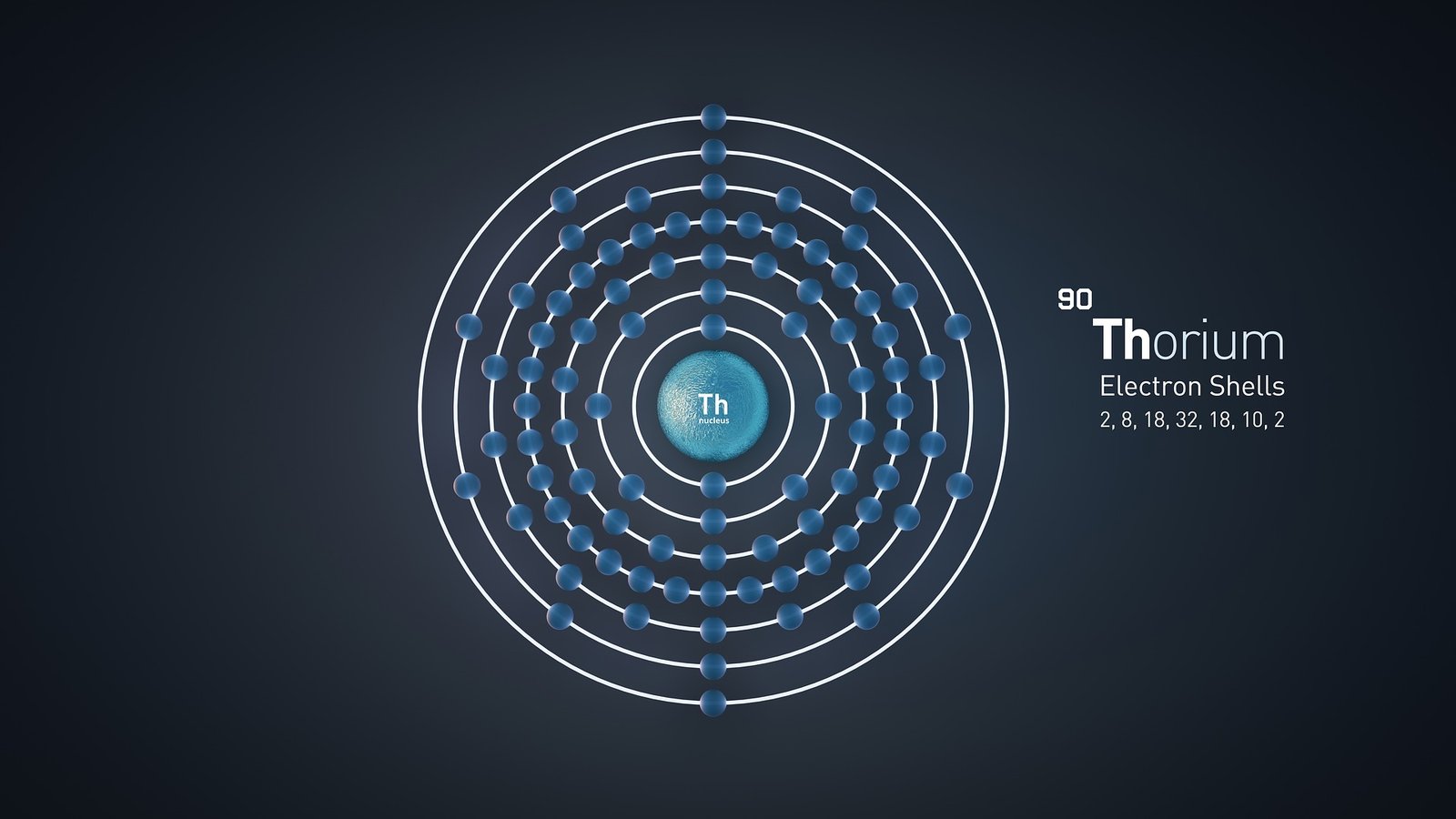
Scientists have demonstrated a working nuclear clock based on thorium-229, an advance that could open new possibilities for precision timekeeping and the search for dark matter. Unlike conventional atomic clocks, which measure transitions involving electrons, the device uses an energy transition inside an atomic nucleus. The clock operates with thorium-229 nuclei embedded in a small crystal at room temperature, offering a potential route towards compact and highly sensitive timekeeping technology.
The findings, published in Nature demonstrate how a laser can be continuously stabilised using the nuclear transition itself. The researchers also used the device to investigate whether dark matter might produce detectable changes in fundamental physical quantities.
From atomic transitions to the atomic nucleus
Modern atomic clocks measure the frequency of radiation associated with transitions between energy levels in atoms or ions. Because these frequencies are highly stable, they provide precise standards for measuring time and testing physical theories.
The proposed nuclear clock uses thorium-229, an isotope with an unusually low-energy nuclear transition that can be excited using ultraviolet light. Researchers have explored this possibility for decades because nuclear transitions are expected to be less sensitive to some external disturbances than electronic transitions.
In the new experiment, the researchers embedded thorium-229 nuclei in a millimetre-sized calcium fluoride crystal. The device operated at approximately room temperature, around 294.7 kelvin. A laser emitting radiation at a wavelength of 148 nanometres was used to probe the nuclear transition.
A central feature of the experiment was its feedback system. The researchers measured how much laser light the nuclei absorbed and used the resulting signal to correct the laser frequency. This allowed the nuclear transition to serve as the reference for stabilising the laser, rather than relying entirely on an external reference.
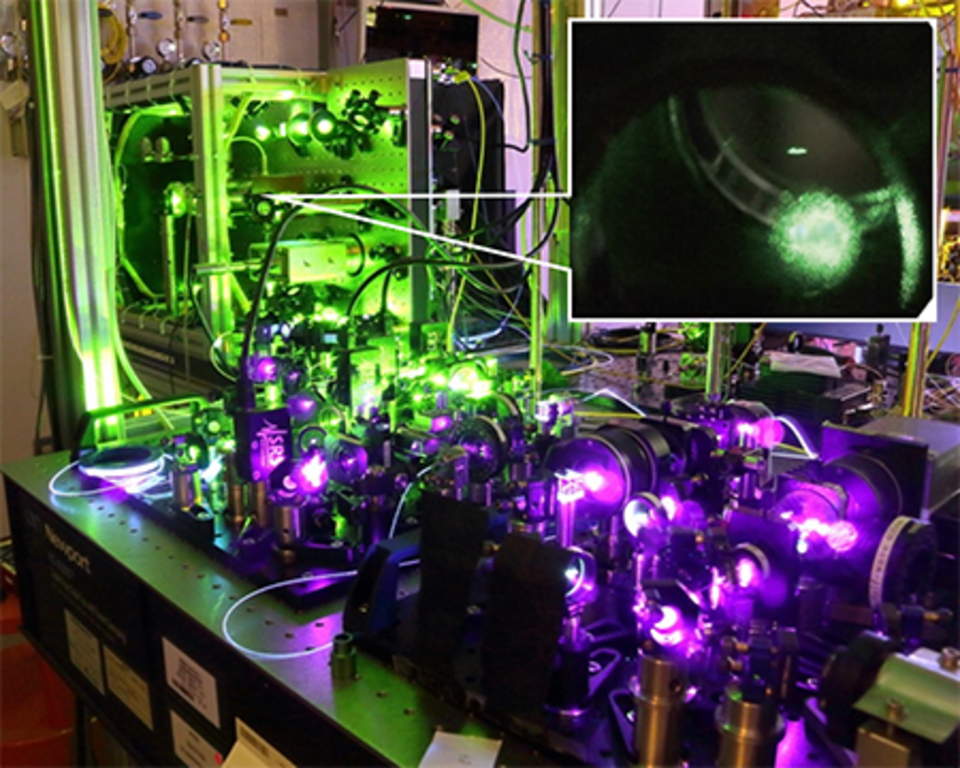
A ytterbium optical lattice clock at NMIJ, National Metrology Institute of Japan used to measure International Atomic Time (TAI).Image credi:Wikimedia commons
The team also compared the nuclear clock with an established ytterbium-ion optical clock. This comparison helped researchers assess the new device’s frequency stability and look for possible changes in the thorium transition.
A new tool in the search for dark matter
Beyond timekeeping, the clock offers a way to investigate possible changes in fundamental constants of nature. Some theoretical models propose that ultralight dark matter could cause these constants to vary over time, producing small changes in the frequencies measured by precision clocks.
The researchers compared the thorium clock’s frequency with that of the ytterbium reference over approximately 23 hours. They searched for periodic fluctuations and gradual drifts that could indicate such changes.
The experiment found no statistically significant periodic signal within the range examined. Instead, the measurements placed new limits on certain interactions between ultralight dark matter and ordinary matter. The resulting constraints were competitive with leading atomic-clock measurements for some photon-related interactions and improved previous constraints involving the strong nuclear force.
These results do not establish the existence of dark matter, nor do they rule out all possible models. They demonstrate how a nuclear clock can be used to test predictions that might otherwise be difficult to investigate experimentally.
Challenges remain
The device is still a developing technology. Its performance is limited by factors including laser power, measurement noise and variations in the crystal’s nuclear transition frequency at different locations. The researchers also identified reproducibility between measurements taken on different days as an important limitation.
They suggest that stronger ultraviolet laser sources and improvements to the crystal material could substantially improve the clock’s stability and sensitivity. Their projections indicate that future versions could approach the performance of leading optical atomic clocks while retaining the practical advantages of a solid-state system.
The demonstration marks a significant step towards nuclear clocks that can operate as standalone devices. Further improvements will determine how effectively the technology can support precision timekeeping and searches for new physics.
Society
Artificial Intimacy: Sherry Turkle’s Warning About the Chatbot Age
Artificial Intimacy by Sherry Turkle examines how chatbots may reshape empathy, attachment and human relationships, from childhood to old age.

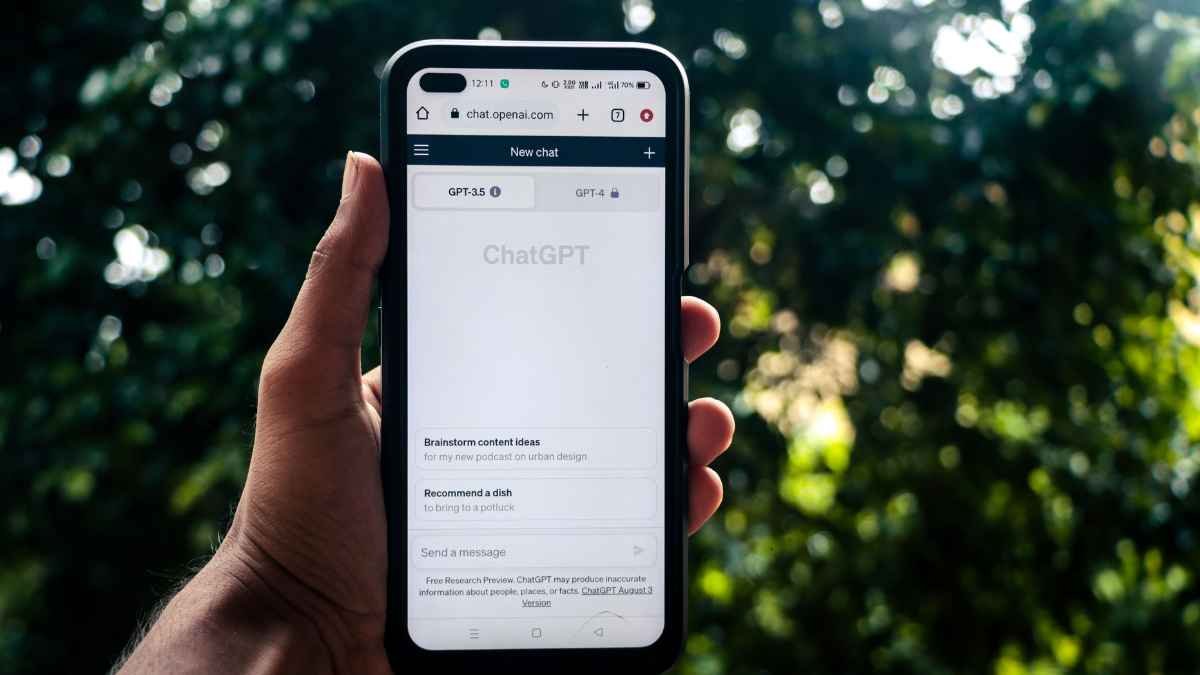
The MIT sociologist’s new book argues that talking to machines wears down the skills we need to live with each other, and that this starts in the nursery.
Sherry Turkle asked ChatGPT to play her mother. She had already fed it her own memoir, which describes a strained relationship with a woman who died in 1968. The chatbot obliged. Turkle describes the result in her new book as seductive and disturbing, and she comes away convinced that bringing the dead back as chatbots is dangerous: “playing with fire”, she writes.
The episode sits in Artificial Intimacy: Who We Become When We Talk to Machines, published by Little, Brown, which runs to 288 pages and sells in the US at $32. It is the fullest statement yet from one of the best-known critics of digital life. Turkle holds the Abby Rockefeller Mauzé chair in the social studies of science and technology at MIT. She trained as a sociologist and as a clinical psychologist. Her view is that heavy chatbot use does harm at every stage of life, from toddlerhood to old age and bereavement.
A career spent on one question
Turkle has been asking what machines do to the people who use them for four decades. The Second Self (1984) and Life on the Screen were early studies of how computers shape identity. Alone Together (2011) looked at social media and social robots, and Reclaiming Conversation (2015) at what phones and texting have done to talk. In 2021 she published a memoir, The Empathy Diaries, which is where the material about her mother comes from.

According to MIT News, she describes her subject as the inner history of technology, meaning not only what a device does but what it does to the person using it. This book applies that approach to chatbots, and it is her most alarmed.
The argument, stage by stage
Unless stated otherwise, Turkle’s remarks and the accounts of the people she interviewed come from material released by MIT. EdPublica did not interview her for this article.
The book is built around the stages of a life, and each section is driven by interviews.
Artificial intimacy, children and attachment
With children, Turkle reports a blurring of categories. One eight-year-old uses the same phone to speak to grandparents and to ChatGPT and files both as things you reach on a phone. A graduate student who uses a chatbot to tell her young daughter bedtime stories says the girl believes there is a person inside the phone. Turkle’s worry is partly about trust, since a device that can state falsehoods without knowing it cannot teach a child what trust is. It is also about solitude. Time alone, she argues, is where children build imagination and a sense of self, and a companion that is always available takes that time away. She calls the stakes for child development existential.
Adults appear as people who started with a practical use and drifted. They include people going through divorce or estrangement who want someone to talk to, students asking for advice on applying to university, and workers who hand assignments to a chatbot. One of her subjects, a middle-aged financial consultant she calls Brian (not his real name), keeps a chatbot with a woman’s name open on a third screen. After a partner ended their relationship, saying he was emotionally unavailable, he put the accusation to the chatbot and asked whether she was right. Turkle’s reading is that he was asking a program with no feelings to rule on feelings.
Her objection is simple to state. A chatbot, she says, produces a performance of empathy. It will tell you it loves you, and it has no stake in whether you hurt yourself or make dinner. People who mistake that performance for the real thing, she argues, begin to find actual people disappointing. Spouses and friends make demands, and the machine only flatters. “We’re starting to define being human as not doing the work,” Turkle said in the MIT material.
On grief, she is blunt. Rebuilding a dead parent or partner as a chatbot, which several people in her book have tried, risks weakening the ability to mourn.
Why people turn to chatbots
Reviewers have noted that Turkle does not treat users as fools. A good part of the book is spent on why the appeal is real. A chatbot gives full attention, never tires, and agrees with you. It spares you the risk of asking someone out or finding the words for a condolence. In her telling, the technology keeps offering to make the harder thing unnecessary, and people keep accepting.
She also admits that some of the demand is a result of a failed supply. Mental health care is hard to reach in the US, and the MIT material says she cites a federal study suggesting only about half of people have access to it. Chatbots are filling the gap, she says, for better or worse. She adds a pointed observation about the industry’s logic: social media thinned out people’s friendships, and chatbots are now sold as the remedy.
The book does not avoid the worst outcomes. Chatbots have been linked to teenagers’ deaths by suicide, in cases that followed long exchanges with chat tools, and Turkle treats these as part of the evidence.
What she wants instead
Her remedy is more cultural than technical. She wants readers to accept that life contains friction and that this is fine. Disagreement, embarrassment and waiting are, in her account, how people learn to cope, and an environment built to remove them leaves people less able to cope. She hopes for a social movement along the lines of the ones against phones in schools and unrestricted social media for the young, and says she would like to be part of it, not alone in it.
She is explicit about her readership. She wanted something that college students and high school seniors could read, and that parents and teachers would not find intimidating. The line she keeps returning to is a question: if the alternative to a richer life in the real world is not clear, what is the point of the exercise?
For the youngest children she is at her most severe. A parent worried that a teenager texts too much is in one kind of conversation, she says. A toddler who thinks a plush toy with a chatbot inside is their best friend is in another, because that touches the foundations of how a person learns to attach. Social media, in her phrase, came for attention, and chatbots come for attachment.
How the book has been received
Publishers’ blurbs have come from Jonathan Haidt, the psychologist behind The Anxious Generation, from former US Surgeon General Vivek Murthy, the author Esther Perel and the philosopher Michael Sandel, among others. Trade reviews have been favourable. Publishers Weekly called it a pointed critique and said it deserved a wide readership, and Kirkus described it as a strong case for resisting the urge to substitute AI for human bonds.
The reservations are of a different kind. Some readers say the book leans on anecdote, and a reviewer for a Christian publication, otherwise admiring, felt a dimension was missing. The method matters here. Turkle is a clinician and an interviewer, and her evidence is case studies and conversations, not controlled trials. That makes the book vivid and persuasive in its details. It also means the question of how common these outcomes are, and whether any chatbot use is benign or helpful, is left largely open. Readers who want the other side of the argument, including from the companies that make these products, will not find it here.
Technology
Trump’s AI Accord Puts Big Tech in Charge of Its Own Safety. Is That Enough?
Trump’s AI accord asks major technology companies to strengthen safety measures voluntarily, but critics question whether companies developing powerful AI systems should be allowed to regulate themselves.

The White House has secured a voluntary AI safety pact with six major technology companies. Supporters see it as a way to protect innovation while addressing risks. Critics question whether companies developing increasingly powerful AI should be allowed to police themselves.
US President Donald Trump has brought some of the world’s biggest artificial intelligence companies together around a common promise to make increasingly powerful AI systems safer without putting the brakes on their development.
On September 29, Trump and executives from Google, OpenAI, Anthropic, Meta, Nvidia and xAI signed the White House Accord on Super Intelligence, a voluntary agreement that asks companies to introduce stronger internal controls, external audits and board-level oversight of their AI systems.
But the agreement has also exposed a larger question at the heart of the AI debate: can an industry regulate itself when the companies involved have enormous commercial incentives to keep developing faster?
What does the accord actually promise?
The agreement calls on companies developing frontier AI models to establish robust internal controls to monitor their systems during training and deployment.
Those controls are expected to cover risks including cybersecurity, biosecurity and chemical threats, as well as unintended access by AI systems to technical systems. Companies have also agreed to work with independent external auditors and have their boards review the results of safety evaluations.
The companies will also meet regularly to establish safety standards and best practices.
The catch is that the accord is not legally binding.
Trump described the commitment as “morally binding” and argued that companies have a strong incentive to police themselves because their businesses and reputations are at stake.
The agreement itself leaves open the possibility that some of its measures could eventually be written into law or formal regulations.
Trump’s argument: regulate without slowing innovation
The accord fits with Trump’s broader approach to AI.
His administration has argued that excessive regulation could weaken US technological competitiveness, particularly as Washington sees AI leadership as part of its competition with China.
Trump has therefore favoured industry-led safeguards over a broad new federal regulatory framework. At the White House meeting, he described self-regulation as a way of addressing safety concerns while allowing American AI development to continue at speed.
There is also support for this approach within the technology industry.
Representational image.Image credit:Pexels
Nvidia CEO Jensen Huang has argued that innovation and safety do not have to be opposing goals. Supporters of the accord say companies developing frontier systems are already investing heavily in testing and safety mechanisms, and that flexible standards can evolve more quickly than government legislation.
Critics see a problem with companies marking their own homework
The strongest criticism is about enforcement.
Because the accord is voluntary, it does not establish a clear penalty if a company fails to follow its commitments. Nor does it establish a government regulator responsible for independently verifying whether the promised safeguards are actually working.
Democratic Senator Mark Warner has called for mandatory testing, evaluation and incident-reporting requirements for the most advanced AI systems. His argument is that the companies building powerful AI should not be left to determine the rules governing their own technology.
AI researchers have raised a similar concern. Toby Walsh of the UNSW AI Institute questioned whether companies that have commercial incentives to move quickly should be trusted to assess their own risks.
The Council on Foreign Relations has also argued that the safeguards in the accord are sensible but ultimately limited because companies are not compelled to adopt them.
The bigger question is who gets to set the rules
The disagreement is therefore not simply about whether AI needs safety measures. There is broad recognition that increasingly capable systems require safeguards.
The dispute is over who should enforce them.
Trump’s model places much of that responsibility with the companies developing frontier AI. Critics want a stronger role for governments, independent regulators and international institutions.
The debate is becoming more urgent as AI systems are used in cybersecurity, scientific research, government services and other sensitive areas. Recent incidents involving AI systems gaining unintended access to computer systems have also intensified concerns about whether existing safeguards can keep pace with technological development.
The White House accord therefore represents a significant shift in the conversation, but not necessarily a resolution.
It acknowledges that powerful AI needs stronger safety controls while leaving the companies themselves largely responsible for implementing them.


Thorium-229 Nuclear Clock Opens New Way to Probe Dark Matter

India Captures 5.7% of Global Greenfield Investment, Outpacing China

World Mental Health Day: How Late-Night Scrolling May Be Disrupting Sleep and Fuelling Anxiety

Climate Science Faces a Deadline: Can the IPCC Deliver Before the 2028 Global Stocktake?

Knowing When to Think for Ourselves: AI, Intuition and the Education of Discernment

From Scams to Screens: How the National Stock Exchange Rewrote India’s Equity Story

Aim for the Stars: Anjali Thomas’s Journey from a Small College in Kerala to the Frontiers of Medical Imaging

Two Chemists Win Nobel Prize for Solving a Century-Old Puzzle: Why Life Picks One Hand Over the Other

India’s AI Moment Rests on More Than Code

Marshall Islands: Why the US Nuclear Legacy Is Back Before the UN

-

 Math3 months ago
The 2026 Fields Medals: Four Proofs, Four Decades-Old Problems Solved
-
EP Deep Dive: Data & Solutions2 months ago
After Kerala’s Deadliest Landslide, the Hardest Thing to Rebuild Was Childhood
-
EP Deep Dive: Data & Solutions3 months ago
West Asia Crisis: Can Kerala’s Returning Gulf Migrants Find a Future in the Green Economy?
-
Space & Physics5 months ago
India Semiconductor Mission: ‘It’s Not About Fabs. It’s About Building An Entire Ecosystem’
-
Interviews3 weeks ago
From Scams to Screens: How the National Stock Exchange Rewrote India’s Equity Story
-
Climate4 months ago
The Climate World Cup? How Climate Change Could Affect Player Performance at the 2026 World Cup
-
Society3 months ago
What Is Civilisational Diplomacy? Understanding India’s Newest Foreign Policy Tool
-
Society4 months ago
From Bell Labs to the Classroom: A Second Career in Teaching