Sustainable Energy
Could This Molecular Sponge Change Nuclear Wastewater Forever?
Tritium has long resisted conventional wastewater treatment because it behaves almost exactly like ordinary water. Researchers now say a “molecular sponge” may finally make separating the radioactive isotope faster and more efficient.

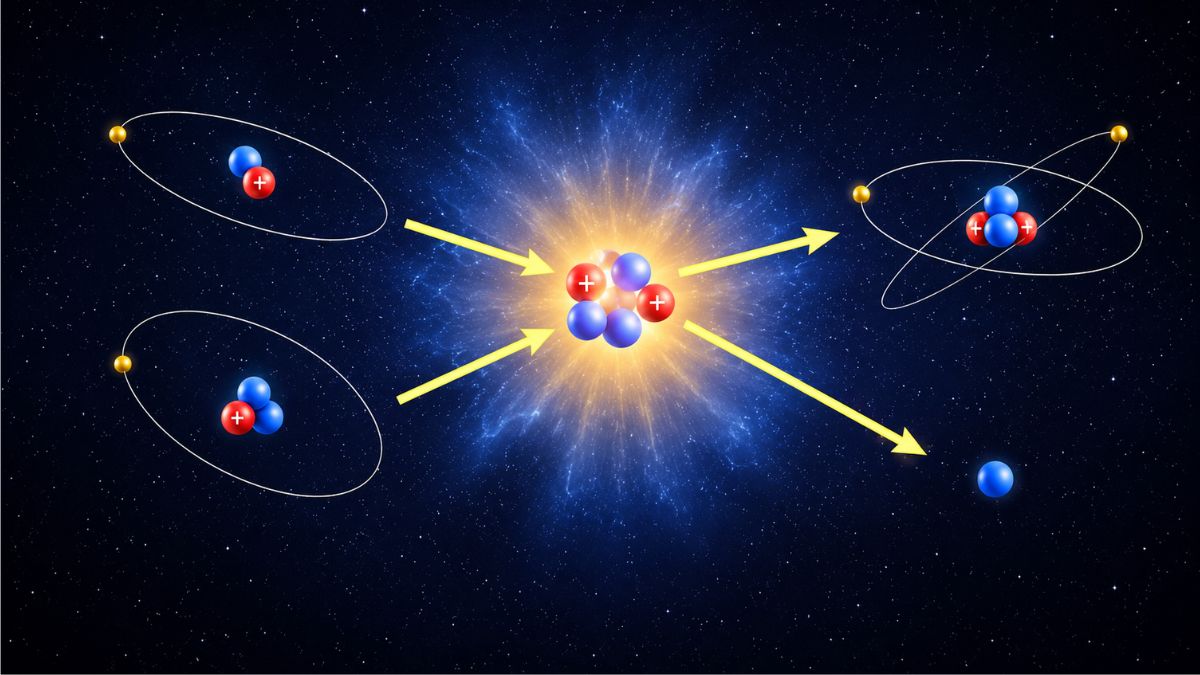
For decades, tritium has remained the one radioactive contaminant that nuclear engineers could not efficiently remove from wastewater. Unlike other radioactive elements, tritium becomes part of the water molecule itself, making it nearly impossible to separate using conventional treatment methods. Instead, facilities have relied on energy-intensive distillation or, in some cases, the controlled dilution and release of treated water that still contains tritium within regulatory safety limits.
Now, researchers in China report a possible solution. In a study published in Environmental Science & Technology, they developed a metal-organic framework (MOF)-coated material that significantly improves tritium separation during distillation. This study builds on work that won the Nobel Prize in Chemistry last year. If the technology performs similarly outside the laboratory, it could make treating radioactive wastewater far more efficient.
The problem Hidden Inside a Water Molecule
Most radioactive contaminants can be removed using filters or chemical treatment. Tritium is different because it replaces one of the hydrogen atoms in the water molecule itself. That means the contaminated water looks and behaves almost exactly like clean water.
For decades, the only practical way to separate the two has been distillation. Since tritiated water boils at a slightly different temperature, the process eventually works. But the difference is so tiny that it requires enormous distillation towers and a great deal of energy.
The difficulty came into public focus in 2023 when Japan began releasing treated wastewater from the Fukushima Daiichi nuclear power plant into the Pacific Ocean. Although most radioactive substances had been removed, tritium remained because no practical technology existed to separate it at such a large scale. Instead, the water was diluted before being released under international safety standards.
A Sponge at the Molecular Level
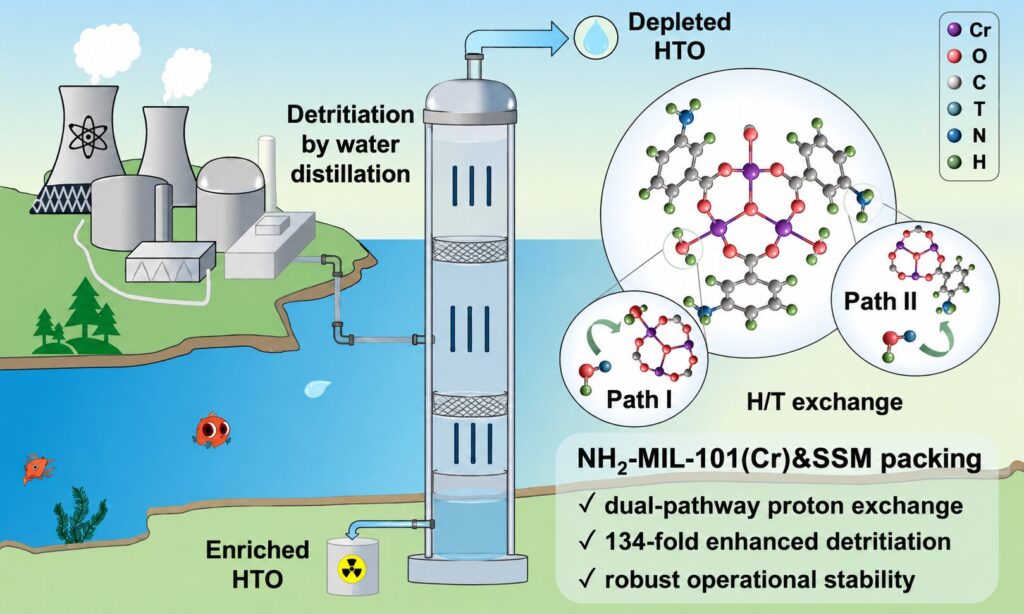
Inside every distillation tower are materials called packings, which create surfaces where water vapour and liquid interact. Traditionally, these packings simply help the process along. The researchers turned them into active participants.
They coated a stainless-steel mesh with a metal-organic framework (MOF) called NH₂-MIL-101(Cr). MOFs are often described as molecular sponges because they contain countless microscopic pores packed into a tiny space. But this sponge does more than hold water. Its chemical structure encourages tritium atoms to exchange places with ordinary hydrogen atoms, making them easier to separate during distillation.
In laboratory tests, the material achieved a separation efficiency of 42.5 theoretical plates per metre, the highest reported for this type of distillation system. The team estimates that a 10-metre distillation column fitted with the new material could outperform the best previously reported packing by 134 times. Compared with the commercial packing materials used today, its overall separation performance could be up to one million times greater under similar industrial conditions.
Those figures still need to be validated outside the laboratory, but they suggest that future treatment systems may no longer need the massive, energy-hungry towers used today.











Society
Six Months of the Hormuz Crisis: A USD 330 Billion Global Fuel Bill — and India’s USD 22.5 Billion Share

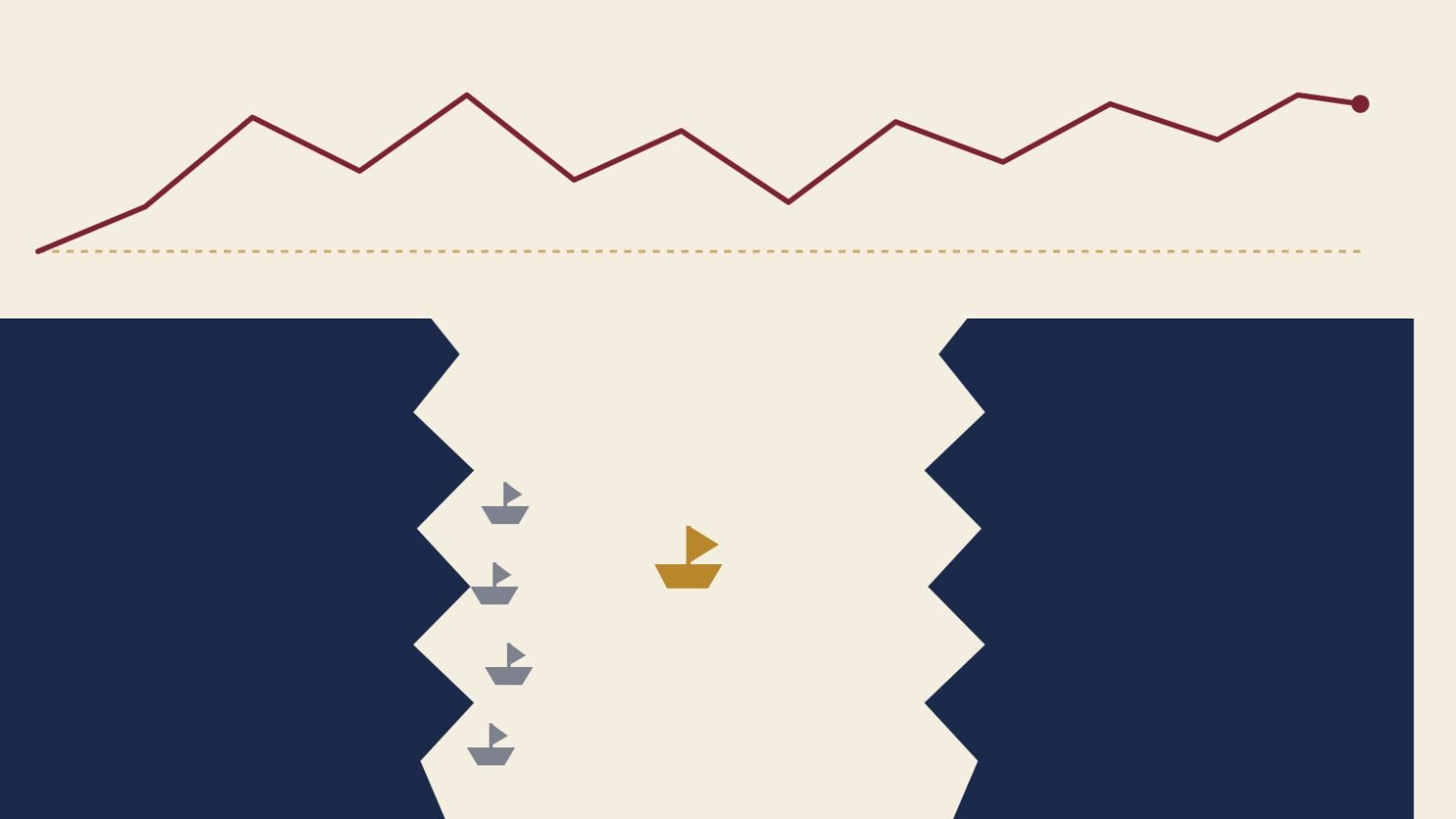
Six months into the Hormuz crisis, global fossil fuel importers have paid USD 330 billion above expected prices, with India’s additional bill reaching USD 22.5 billion.
EdPublica Data Desk | Analysis
Since the United States and Israel struck Iran on 28 February 2026 and shipping through the Strait of Hormuz collapsed, countries that import oil and gas by sea have paid more than USD 330 billion above what markets had expected to charge them, according to new research published by the Centre for Research on Energy and Clean Air (CREA). That works out to roughly USD 55 billion extra every month for half a year — the largest sustained fossil fuel price shock since the 1990 Gulf War, and one that is still running.
Hormuz crisis drives global fuel costs higher
India’s share of that bill is USD 22.5 billion, the second-highest of any country in the world, behind only China’s USD 35.5 billion and ahead of the United States, despite America being the world’s largest oil producer. That ranking is a direct consequence of how much of its energy India buys from abroad: the country imports close to 90 percent of the crude oil it uses, more than almost any other major economy, which leaves it with limited room to absorb a shock at the source.
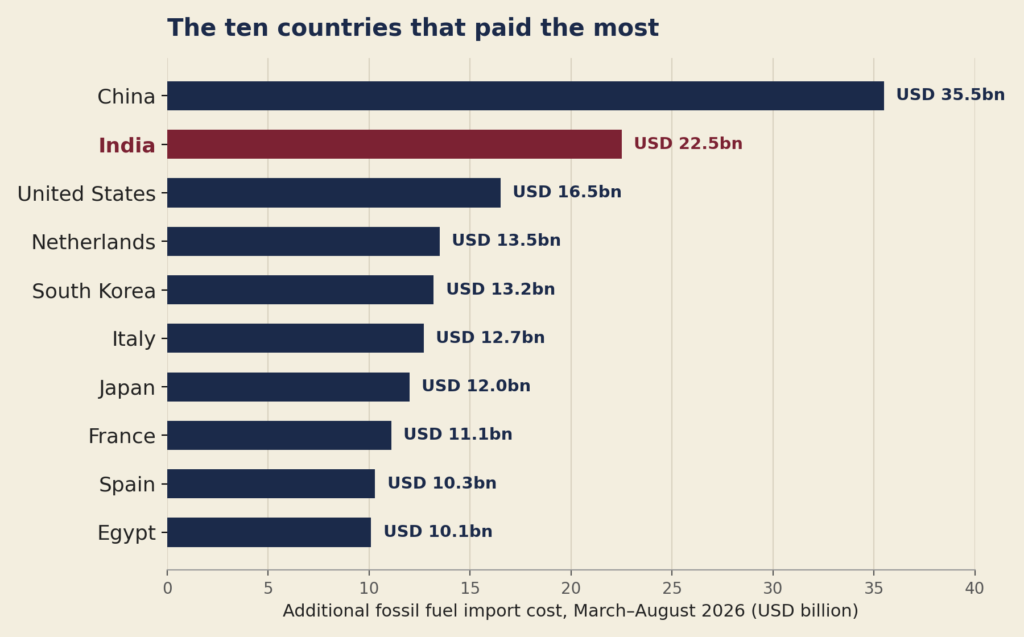
India paid the second-highest fossil fuel import premium of any country over the six months to August 2026, behind only China. Source: CREA analysis. Illustration: EdPublica
A shock rivalled only by the 1990 Gulf War
CREA’s estimate is built from actual, ship-tracked cargo data — sourced from Kpler — for crude oil, refined fuels and gas that moved by sea between March and August 2026, compared against the futures prices the market had already set for those same delivery months in the twelve days before the strikes. Because both sides of the comparison are settlements of the same contract, the gap is a direct, like-for-like price difference rather than a modelled estimate. The analysis covers 170 countries and deliberately excludes pipeline gas, coal, fuel oil, naphtha, freight and war-risk insurance, all of which would push the true cost higher. CREA describes its USD 330 billion figure as conservative on that basis.
Brent crude’s trajectory over the six months traced a path familiar from past oil shocks: a sharp spike in the first weeks, a partial retreat, and a second surge later on. Prices briefly touched pre-war levels in late June before climbing back above USD 100 a barrel in late July, a pattern CREA’s researchers compared directly against the 1990 Gulf War, the 2019 Abqaiq attack and the 2022 Russian invasion of Ukraine. Of those four episodes, only the Gulf War produced a larger and longer-lasting price premium than the current crisis.
Refined fuels rose faster than crude itself
Crude oil accounts for the largest single share of the extra cost, USD 164 billion, at an average premium of 35 percent over pre-war expectations. But the fuels people and businesses actually use day to day rose by a steeper proportion still. Diesel and gasoil were up 59 percent, adding USD 74 billion; gasoline rose 43 percent, adding USD 36 billion; jet fuel rose 59 percent, adding USD 20 billion; and LNG rose 60 percent in the Atlantic basin and 75 percent in the Pacific, adding USD 38 billion.
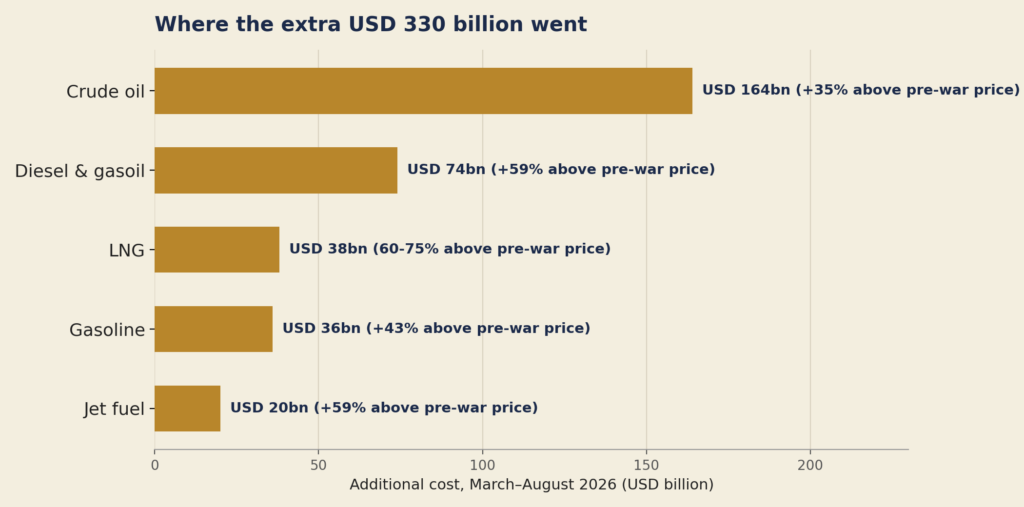
Refined fuels — diesel and gasoil in particular — rose by a steeper margin than crude oil itself. Source: CREA analysis. Illustration: EdPublica
Diesel’s premium mattered more than any other single figure in the analysis, because of how widely it is used. Industry, freight and farming all run substantially on diesel, so its price feeds directly into the cost of nearly everything else. Of the 170 countries CREA analysed, 134 paid more for diesel than their pre-war futures had implied. The war premium for diesel stayed above 55 percent in five of the six months, dipping to 43 percent in June before climbing back to 65 percent by August. Even the United States, the world’s largest oil producer, was not insulated: the average price of a gallon of diesel rose to USD 5.57 in the week of 17 August, the highest level since 2022 and closing in on that year’s record, according to AAA.
The clean energy dividend
The research’s central finding on mitigation is that a country’s exposure to the shock has been shaped less by geography than by how much of its power already comes from clean sources. Clean power capacity added since 2020 saved importing countries an estimated USD 36 billion in avoided coal, gas and oil imports in the first five months of the crisis alone. Of that, USD 10.6 billion existed only because of the war itself: every unit of coal or gas a country did not need to buy was a unit it did not have to purchase at inflated wartime prices, on top of whatever it would ordinarily have saved.
| “The best way to protect against high oil prices is to get off the black stuff as quickly as possible. Oil and gas prices have long proven to be an Achilles’ heel for both household finances and the global economy as a whole.” — Luke Wickenden, Energy Analyst, CREA |
“The energy transition is an investment,” Wickenden added, “so the best day to have started is yesterday.” Electrification is compounding the effect: the world’s electric vehicle fleet is on course to displace around five million barrels of oil a day by 2030, roughly comparable to the volume of crude Saudi Arabia currently moves through its East-West Yanbu pipeline specifically to bypass the Strait of Hormuz, according to the International Energy Agency’s Global EV Outlook.
Poorer countries are absorbing a bigger hit
The burden of the crisis has fallen unevenly by income, not just by geography. Low- and lower-middle-income countries paid an additional 1.0 percent of their 2024 GDP in higher fossil fuel costs, more than twice the 0.45 percent burden faced by high-income countries.
| “Across every fossil fuel product, this crisis is a multi-car pile-up, and where you land depends on what you’re driving. Wealthier nations, for whom paying extra is less of a burden in the short term, can absorb the higher prices. That’s not the case for lower-income countries that are far more price-sensitive. The countries best placed are the ones already in the EV lane: with fuel imports slashed, they can skirt the pile-up altogether.” — Luke Wickenden, Energy Analyst, CREA |
India’s particular exposure
India’s position in the top three is not simply a function of the size of its economy. The country entered 2026 already navigating a difficult trade-off on energy: after Washington imposed additional tariffs on Indian exports over New Delhi’s imports of discounted Russian crude, India had been cutting back on Russian oil and increasing purchases from the Middle East in pursuit of a US trade deal. The Hormuz crisis disrupted that shift almost immediately, cutting off much of the Middle Eastern supply India had been leaning on and pushing it back toward Russian crude even as prices climbed and a separate US sanctions waiver on Russian oil purchases lapsed in April.
By June, India’s total crude imports had hit a monthly record of roughly five million barrels a day, with Russian supplies alone reaching an unprecedented 2.6 million barrels a day — 54 percent of the country’s total crude imports, and more than double the volume seen in February. That pivot briefly inverted the usual arithmetic: discounted Urals crude, which had traded well below Brent since 2022, began trading at a premium to it in March, as Indian and Chinese refiners competed for the limited Russian cargoes still reaching them outside the Gulf. By July, as Gulf supply chains began to normalise, Urals discounts had reopened to more than USD 10 a barrel below Brent.
Russian crude functioned, in effect, as India’s insurance policy against a disruption its strategic reserves were not large enough to absorb on their own — but insurance still has a premium, and India’s USD 22.5 billion bill is a measure of how much of that premium it ultimately paid, on top of what it saved through the Russian discount.
Sustainable Energy
India Wants 100 GW of Nuclear Power. Can Opening the Sector Deliver It?
India wants to expand nuclear power from 8.78 GW to 100 GW by 2047, with private participation expected to provide a significant share. But financing, construction risks, safety, liability and long-term environmental concerns could determine whether the ambitious target is achievable.
India is preparing to open its civilian nuclear power sector to wider private participation as it attempts to increase nuclear capacity more than elevenfold by 2047. The country currently has 8.78 GW of installed nuclear capacity across 24 reactors, contributing about 3.1% of electricity generation. The government wants to raise this to 100 GW by 2047.
That means adding more than 91 GW in two decades.
The scale of the ambition explains the policy shift. The government expects nuclear capacity to reach around 22 GW by 2031–32. Beyond that, NPCIL is expected to account for about 54 GW by 2047, while the remaining 46 GW is expected to come from other public-sector enterprises, state governments, private companies and joint ventures. The 46-GW figure is crucial. Private participation is not simply an experiment in changing ownership. It has become part of the government’s arithmetic for reaching 100 GW.
But opening the sector does not guarantee that the reactors will be built. The harder questions concern finance, construction, technology, safety, liability and who ultimately bears the risks of nuclear power.
Why Nuclear Power When Renewables are Expanding?
India’s nuclear power expansion is taking place alongside a much larger renewable-energy programme. By June 2026, renewable-energy capacity had reached 288.58 GW, including 162.15 GW of solar, 57.44 GW of wind and 57.24 GW of hydropower. So why invest heavily in nuclear?
The government’s argument is that the two technologies perform different functions. Solar and wind generation varies with weather and time of day, while nuclear reactors are designed to provide continuous generation.
Nuclear power is therefore being positioned as a source of firm, low-carbon electricity alongside renewables, rather than as a replacement for them. That distinction matters as electricity demand rises. Government projections put India’s peak demand at around 446 GW in 2034–35, with electricity requirements of about 3,215 billion units.
The projected power mix for that year includes 22 GW of nuclear, 679 GW of renewable and 327 GW of thermal capacity. The question, then, is not whether India needs electricity. It clearly does. The question is how much nuclear capacity makes economic sense within an electricity system increasingly dominated by renewables and supported by storage and other technologies.
What Actually Changes Under the New Framework?
The SHANTI Act, 2025 provides the legal framework for wider participation in specified civilian nuclear activities. This is not unrestricted privatisation. Private entities remain subject to government licensing and nuclear-safety requirements.
The significance is that the pool of potential participants can now extend beyond the traditional state-controlled nuclear establishment. The government expects this to create opportunities for private investment, manufacturing, technology development and new project structures. But permission to participate is not the same as willingness to invest.
Nuclear power projects are expensive, technically complex and slow to build. Investors have to commit large amounts of capital long before a plant begins generating revenue. That is why the success of the reform will depend less on how many companies enter the sector and more on whether they are willing to put substantial capital behind actual projects.
Can Private Capital Solve the Financing Problem?
The strongest case for private participation is that it could broaden the pool of capital available for nuclear construction. The government’s own roadmap makes clear that NPCIL is not expected to deliver the entire 100-GW target. About 46 GW must come from other public-sector entities, states, private companies and joint ventures.
But private participation should not automatically be equated with lower costs. Globally, nuclear projects have faced problems with construction delays, cost overruns and high financing requirements. The International Energy Agency has identified these as major challenges for nuclear investment.
For India, the critical questions will therefore be whether private investors can secure affordable financing, whether projects can be completed on schedule and whether the electricity generated can remain competitive with other sources. The reform changes who can invest. It does not remove the underlying economics of nuclear construction.
The SMR Bet
India is also placing considerable emphasis on small modular reactors. The government has allocated INR 20,000 crore to research, development and deployment of indigenous SMRs and aims to have at least five operational by 2033. BARC is developing the 220-MWe BSMR-200 and 55-MWe SMR-55, among other designs. The government sees potential applications in captive industrial power, replacing retiring fossil-fuel capacity and locations where conventional large reactors may be less suitable.
But India’s indigenous SMR designs are still under development. Their eventual contribution to the 100-GW target will depend on whether they can move from demonstration to commercially viable deployment. For now, SMRs are an important part of India’s nuclear power strategy, not a guaranteed solution to its capacity challenge.
The Liability Question
The most consequential issue for private investors may be nuclear liability. The SHANTI framework retains no-fault liability for nuclear operators while establishing graded limits depending on the category and size of a nuclear installation. The draft rules propose operator liability ranging from INR 100 crore to INR 3,000 crore.
The government argues that a clearer liability structure will make investment and insurance more predictable. But there is another side to the question: is the statutory compensation framework sufficient if an accident causes losses far beyond the operator’s liability?
That issue is now before the Supreme Court. On 17 August 2026, the court sought clarification from the Union government on whether constitutional courts would remain able to determine fair and just compensation following a nuclear power accident under the new framework. The court has not struck down the liability provisions. But the proceedings highlight an important tension in the reform: making risk predictable for investors while ensuring that victims are adequately protected.
Nuclear Power: Who Bears the Long-term Risks?
Nuclear power also raises questions that cannot be reduced to the cost of electricity. A major accident could affect workers, nearby communities, livelihoods and ecosystems far beyond the balance sheet of the company operating the facility.
Radioactive waste presents a different challenge. Electricity generated today can create waste that requires management over much longer periods. The government retains responsibility for certain aspects of spent-fuel management, while licensed entities are responsible for managing radioactive waste generated through their activities.
This raises an intergenerational question: How should today’s electricity consumers ensure that future generations are not left with the financial and environmental burden of today’s nuclear expansion?
There is also a question of distribution. Nuclear power facilities require land, water and supporting infrastructure. Communities near proposed projects can therefore bear costs that are spread much more widely across the country than the benefits and electricity generated by the plant.
A larger nuclear power programme will need credible mechanisms for land acquisition, rehabilitation, emergency preparedness, compensation and public participation. Safety cannot become secondary to speed The government maintains that expanding private participation will not mean lowering safety standards.
Does the regulatory system has enough independence, technical capacity and enforcement power to oversee a larger and more commercially diverse nuclear power industry? That becomes particularly important when project developers have strong financial incentives to control costs and meet construction schedules.
A successful private nuclear power model therefore requires more than investment rules. It requires strong regulation that can remain independent of both political and commercial pressure.
The Real Test is Beyond the 100-GW Target
India’s nuclear power ambition is clear: 8.78 GW today, 22 GW by 2031–32, 100 GW by 2047. The government expects NPCIL to deliver roughly 54 GW of that eventual capacity and other public and private entities to account for the remaining 46 GW.
The SHANTI Act makes that wider participation possible. But it does not guarantee that private companies will invest, that projects will be financed cheaply, that reactors will be built on time or that nuclear power will remain economically attractive as renewables and storage expand.
Nor does it settle the ethical questions around liability, waste, community impacts and long-term risk. That is why the success of the reform should not be measured simply by the number of companies that enter the nuclear sector. The real test will be whether India can build enough nuclear capacity at a reasonable cost while maintaining strong safety oversight and ensuring that the risks are not disproportionately transferred to communities, taxpayers or future generations.
Sustainable Energy
When the Sun Goes Down, Is India’s Solar Boom Ready to Face Its Real Test
India’s solar expansion is entering a new phase, where generating electricity is only part of the challenge. A new IECC study examines how battery storage can make solar power available after sunset and during periods of weaker generation, while showing how India’s monsoon and regional climate patterns shape the cost and scale of storage needed.
India’s story of solar energy has largely been a story of scale. More panels, more capacity, more electricity from the sun. The next phase will be less straightforward. A solar panel produces electricity during daytime, while the grid has to function around the clock. The hours when solar generation begins to fall are often the hours when electricity demand starts rising.
That makes energy storage more than an accessory to solar power. It could determine how much of the electricity system solar can ultimately supply. On this scenario, India Energy & Climate Center (IECC), examines whether solar power paired with batteries can provide electricity with the reliability expected from conventional thermal generation. The study uses the recently concluded Solar Energy Corporation of India (SECI) firm renewable energy tender as its benchmark.
During the day, solar electricity meets immediate demand while charging batteries with surplus power, which can then be discharged after sunset, turning intermittent generation into electricity available when it is needed.
Instead of asking developers to supply renewable electricity whenever it is available, the contract imposes delivery requirements across different parts of the day. The requirement rises to at least 90 per cent during six peak hours, falls to 50–60 per cent during solar hours and remains at 70 per cent during the other hours. A shortfall attracts a penalty of 1.5 times the contracted tariff.
Therefore, to make solar power more efficient, the focus shifts from selling sunshine to selling firm electricity.

The Battery is What Makes That Possible
The IECC researchers modelled what it would take to meet this obligation using solar and batteries. They tested 64 combinations of solar and storage across ten states, using ten years of weather data from 2015 to 2024. The solar capacity tested ranged from 2.5 GW to 6 GW, while battery storage ranged from 6 GWh to 24 GWh for a 1 GW grid connection.
The result shows something simple: solar power alone is not enough — batteries are doing a lot of the heavy lifting. To supply just 1 GW of steady electricity, the model suggests you would actually need about 3 GW worth of solar panels and a large battery system that can store 12 GWh of electricity.
With this setup, electricity could be supplied at around ₹5.15 per unit (kWh). In the real government auction, companies agreed to sell it at a very similar price of ₹5.25–₹5.26 per unit. In simple terms, this means solar power becomes reliable and usable at all hours only when it is backed by large batteries — and the cost is already close to what the market is willing to pay.
Why is Coal the Immediate Option?
Coal has traditionally been valuable to the electricity system not merely because it generates power, but because it can generate it on demand, with India’s coal fleet still supplying roughly 70–75% of the country’s electricity in recent years. Batteries begin to close this gap by decoupling the time of generation from the time of consumption, effectively shifting daytime solar energy into the evening peak window, which in India typically occurs between 6 pm and 10 pm when demand remains high but solar output has already declined.
This is also why the amount of storage required cannot be understood without looking at India’s climate.
How Does India and Europe Has Different Solar Problem?
Solar storage is often discussed as if the problem were identical everywhere. But India has a structural advantage in this respect. In Germany or Britain, solar generation varies substantially between summer and winter. A storage system designed to compensate for that seasonal decline would have to deal with periods far longer than a single night.
India’s solar resource behaves differently. The IECC study found that, across its ten years of data, India’s lowest monthly solar output was about 76 per cent of the ten-year monthly average. Annual generation varied by only about 4.5 per cent. By comparison, the study notes that December solar generation in Germany can be only 9–18 per cent of June’s output, while Britain’s can be 10–15 per cent.
India’s central storage problem is largely daily rather than seasonal. Batteries do not necessarily have to carry electricity through an entire winter. They need to carry it through the night. But India’s climate has another complication: the monsoon.
The Monsoon is the Weak Point
Cloudy periods create a double problem. The Rajasthan simulation found that June to September accounted for 56 per cent of the decade’s shortfall. August was the weakest month, with the average shortfall reaching 65 GWh, or 13 per cent of the month’s requirement. In the worst year, it reached 24 per cent.

The pattern changes across the country. In Gujarat, Madhya Pradesh, Karnataka, Kerala, Telangana and Maharashtra, 70–79 per cent of the simulated shortfall occurred during the June–September monsoon. In Kerala, a coastal state with heavy southwest monsoon cloud cover, the shortfall is also concentrated in June–September, with occasional spillover into October–November. Tamil Nadu had a different seasonal weakness, with November and December emerging as its most difficult months because of the northeast monsoon. Haryana’s weakest period was January.
So while India may not need the kind of seasonal storage required in northern Europe, it cannot treat solar generation as uniform throughout the year. The model puts the least-cost solar-plus-storage system at ₹4.93 per kWh in Jammu and Kashmir, ₹5.15 in Rajasthan and ₹5.22 in Gujarat. Tamil Nadu comes in at ₹5.41, while Maharashtra is at ₹5.58. The latter states require more solar capacity to maintain the same level of supply through periods of weaker sunlight.
The battery, in other words, is only one part of the equation. Where and when solar electricity is generated determines how hard the battery has to work.
Climate Question or Power-price Question
The economic case could strengthen as batteries become cheaper. The researchers estimate that every $10/kWh reduction in battery system cost would lower the modelled Rajasthan tariff by about ₹0.28 per kWh. At battery costs of $60–65/kWh, the same configuration could approach ₹4.3–₹4.4 per kWh under the study’s assumptions.
The study points to green steel, data centres and continuous industrial loads such as aluminium as potential users of firm renewable power.
While the results are modelled rather than drawn from long-term commercial operation and depend on assumptions about costs, financing and efficiency, policy is already moving in the same direction. India is no longer treating batteries as experimental add-ons; it is procuring them at scale. The SECI firm renewable energy tender is explicitly storage-linked, and states such as Rajasthan, Gujarat, Maharashtra and Tamil Nadu are issuing or planning multi-gigawatt bids that bundle solar with batteries to meet evening demand. Together, these tenders signal a rapidly expanding pipeline of storage-backed capacity requiring large-scale investment as the system shifts from buying daytime electricity to buying dispatchable power.


Nepal’s Glacier Disaster Exposes the Unequal Cost of Climate Change

When Health Care Becomes a Target, Patients Pay the Price

Academic Diplomacy: How India Can Build Global Influence Through Universities

Six Months of the Hormuz Crisis: A USD 330 Billion Global Fuel Bill — and India’s USD 22.5 Billion Share

The Giant Steel Gates Guarding the Netherlands from the Sea

When the Monsoon Returns, Fear Returns: How Climate Disasters Are Reshaping Mental Health in Himachal Pradesh

Astronomers Discover a ‘Black Hole Star’, a New Kind of Object in the Early Universe

From Bell Labs to the Classroom: Finding Purpose After Retirement

From Soil to Profit: How Organic Turmeric Changed the Fortunes of a Tribal Farming Family

Kerala Floods Highlight a Recurring Health Crisis as Disease Risks Rise

-

 Math1 month ago
The 2026 Fields Medals: Four Proofs, Four Decades-Old Problems Solved
-
Climate1 month ago
After Kerala’s Deadliest Landslide, the Hardest Thing to Rebuild Was Childhood
-
Society2 months ago
West Asia Crisis: Can Kerala’s Returning Gulf Migrants Find a Future in the Green Economy?
-
Space & Physics3 months ago
India Semiconductor Mission: ‘It’s Not About Fabs. It’s About Building An Entire Ecosystem’
-
Climate3 months ago
The Climate World Cup? How Climate Change Could Affect Player Performance at the 2026 World Cup
-
Society2 months ago
What Is Civilisational Diplomacy? Understanding India’s Newest Foreign Policy Tool
-
Society2 months ago
From Bell Labs to the Classroom: A Second Career in Teaching
-
Space & Physics3 months ago
Engineers Develop Dual-Mode Propulsion System for Next-Generation Small Satellites