Connect with us

Climate

Climate Change Could Turn Ocean Food into ‘Fast Food’, MIT Study Warns

MIT study finds climate change could shift phytoplankton to low-nutrient “fast-food” forms, impacting marine food webs and global nutrition.

Published

on

interview 18 1
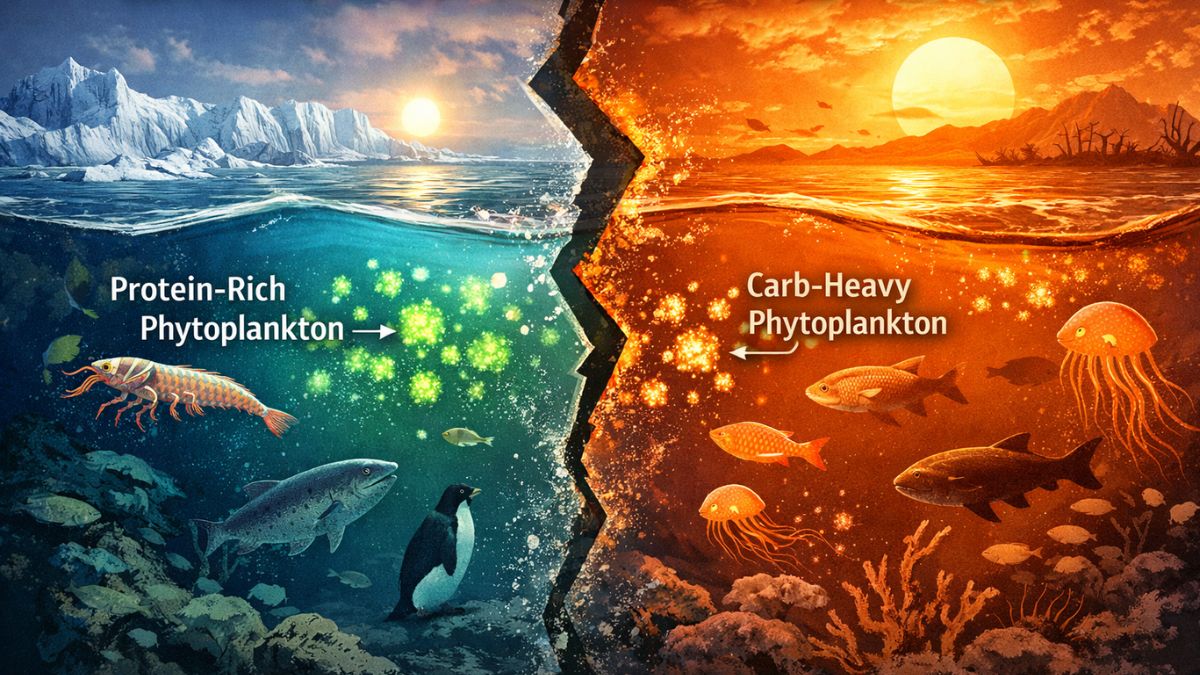
A warming ocean could shift phytoplankton from nutrient-rich to carbohydrate-heavy forms, reshaping marine food webs and global nutrition.

From nutrient-rich to energy-dense but less nourishing—climate change is transforming the composition of ocean food at its source.

Climate change could fundamentally alter the nutritional foundation of the ocean, with new research suggesting that warming waters may turn phytoplankton—the base of the marine food web—into a form of “fast food” with reduced nutritional value.

A study by researchers at the Massachusetts Institute of Technology (MIT), published in Nature Climate Change, finds that rising ocean temperatures could shift phytoplankton composition from protein-rich to carbohydrate-heavy, particularly in polar regions. This transformation could have cascading effects across marine ecosystems and ultimately impact human food systems.

A Shift at the Base of the Food Chain

Phytoplankton are microscopic, plant-like organisms that form the primary food source for a wide range of marine life, including krill, small fish, and jellyfish. These organisms, in turn, sustain larger species and top predators, including humans.

The study suggests that under continued greenhouse gas emissions through 2100, ocean warming will significantly alter the nutritional profile of these organisms. According to the researchers’ model, phytoplankton in polar regions could shift their balance of proteins to carbohydrates and lipids by approximately 20 percent.

“We’re moving in the poles toward a sort of fast-food ocean,” said lead author Shlomit Sharoni, an MIT postdoctoral researcher, in a media statement. “Based on this prediction, the nutritional composition of the surface ocean will look very different by the end of the century.”

Why Nutritional Composition Matters

While previous research has largely focused on how climate change affects phytoplankton populations, this study highlights a less explored dimension: their internal composition.

“There’s been an awareness that the nutritional value of phytoplankton can shift with climate change,” Sharoni said in a media statement, “But there has been very little work in directly addressing that question.”

Phytoplankton are composed of essential macromolecules such as proteins, carbohydrates, and lipids. These components determine their nutritional value for the organisms that consume them. Any imbalance at this foundational level can ripple through the entire food chain.

“Nearly all the material in a living organism is in these broad molecular forms, each having a particular physiological function, depending on the circumstances that the organism finds itself in,” said Mick Follows, professor at MIT.

Warming Oceans, Changing Chemistry

Using a combination of laboratory data and advanced ocean models, the researchers simulated how phytoplankton respond to changing environmental conditions such as temperature, light, and nutrient availability.

Under current conditions, phytoplankton cells are composed of slightly more than 50 percent protein. However, in future climate scenarios where global temperatures rise by around 3°C, this balance shifts significantly.

In polar regions, reduced sea ice allows more sunlight to penetrate the ocean surface, decreasing the need for light-harvesting proteins. At the same time, warmer temperatures and reduced ocean circulation limit the availability of nutrients such as nitrogen and iron.

As a result, protein levels in phytoplankton could decline by up to 30 percent, while carbohydrates and lipids increase.

Uneven Global Impacts

The effects of this shift are not uniform across the globe.

While phytoplankton populations in polar regions may increase, their nutritional quality is expected to decline. In contrast, subtropical regions could see a reduction in phytoplankton populations by up to 50 percent due to reduced nutrient availability.

In these regions, phytoplankton may adapt by moving to deeper waters, where they can access both light and nutrients, potentially increasing their protein content slightly.

Overall, however, the global trend points toward a more carbohydrate-heavy and less nutrient-dense ocean ecosystem.

Early Signs Already Visible

The researchers compared their model with real-world observations from Arctic and Antarctic regions. The findings indicate that this shift is already underway.

“In these regions, you can already see climate change, because sea ice is already melting,” Sharoni said in a statement. “And our model shows that proteins in polar plankton have been declining, while carbs and lipids are increasing.”

Follows added that the implications extend beyond marine ecosystems.

“It turns out that climate change is accelerated in the Arctic, and we have data showing that the composition of phytoplankton has already responded,” he said in a media statement. “The main message is: The caloric content at the base of the marine food web is already changing. And it’s not a clear story as to how this change will transmit through the food web.”

Implications for Marine Life and Humans

The long-term consequences of this shift remain uncertain. Some species may struggle with reduced protein availability, while others that rely on lipid storage could adapt more easily.

However, scientists warn that any disruption at the base of the marine food chain could have far-reaching impacts on biodiversity, fisheries, and global food security.

As the study highlights, climate change is not only altering how much food the ocean produces—but also how nutritious that food is.

Climate

The Climate World Cup? How Climate Change Could Affect Player Performance at the 2026 World Cup

Climate change and the 2026 FIFA World Cup could affect 97 matches, increasing heat risks for players, altering performance and raising safety concerns.

Dipin Damodharan

Published

on

Climate change and the 2026 FIFA World Cup could expose players and fans to higher temperatures during matches across North America.
Climate change and the 2026 FIFA World Cup could expose players and fans to higher temperatures during matches across North America. Image credit: Jason Charters /Unsplash

Climate change and the 2026 FIFA World Cup are on a collision course, with new research suggesting that rising temperatures could affect player performance, match intensity and fan safety in nearly every game of football’s biggest tournament.

When football fans tune in to the 2026 FIFA World Cup on June 11, they will be watching more than a battle between the world’s best teams. They may also be witnessing a new reality for global sport: a tournament increasingly shaped by climate change.

A new analysis by Climate Central suggests that rising global temperatures are making it more likely that players will compete in conditions known to affect performance during much of the tournament. The findings raise questions not only about athlete safety but also about how the game itself may evolve in a warming world.

The 2026 FIFA World Cup, scheduled from June 11 to July 19, 2026, will be the largest in the tournament’s history, featuring 48 teams and 104 matches across venues in the United States, Canada and Mexico. But according to Climate Central’s analysis, 97 of those 104 matches now face a higher likelihood of experiencing temperatures above 28°C, a threshold associated with reduced football performance.

Researchers found that nearly half the matches have at least a 50 per cent chance of being played in conditions that can impair performance. In several cases, climate change has increased those odds substantially. One of the most affected fixtures is the June 26 match between Uruguay and Spain in Guadalajara, where the probability of performance-affecting heat has increased by 37 percentage points because of climate change.

Climate Change and the 2026 FIFA World Cup Could Alter the Game

For decades, discussions about climate change and sport focused primarily on scheduling disruptions, extreme weather events or damaged infrastructure. The new analysis points to something more fundamental: the possibility that rising temperatures may influence what happens on the pitch itself.

Research cited by Climate Central shows that temperatures above 28°C can reduce sprint frequency, decrease the total distance players cover and slow recovery times. In a sport where margins are often measured in seconds and centimetres, even small declines in physical performance can influence tactics, intensity and match outcomes.

Professor Mike Tipton of the University of Portsmouth’s Extreme Environments Laboratory said the effects of heat extend beyond discomfort.

“Playing in temperatures above 28°C changes the game – affecting tactics, tempo and overall quality. We see reduced intensity, less sprinting and potentially fewer chances being created. As temperatures climb further, the risks also increase. Prolonged exposure and dehydration can lead to heat exhaustion or even heat stroke, particularly in high-stakes matches where players are more likely to push beyond their natural limits.”

Climate change and the 2026 FIFA World Cup could affect 97 matches, increasing heat risks for players, altering performance and raising safety concerns.
As the 2026 FIFA World Cup gets underway on June 11, concerns are growing that rising temperatures could influence how the tournament is played. Image credit: Franco Monsalvo

The implications are not limited to players. Slower matches, altered tactics and more frequent cooling breaks could affect the experience for millions of spectators in stadiums and billions watching worldwide.

Climate Change and the 2026 FIFA World Cup Raise New Safety Questions

Concerns about heat are becoming increasingly common across international sport.

Athletes competing in marathons, tennis tournaments and Olympic events have already faced extreme temperatures in recent years. Football, despite its global popularity, is not immune.

Norwegian international Morten Thorsby, who is expected to play at the 2026 World Cup, argues that the conversation can no longer focus solely on performance.

“This analysis makes clear that rising temperatures are not only a serious health risk for players and fans, but they are also starting to affect the quality of the game itself. When heat impacts sprinting, recovery, and overall intensity, it changes the way football is played – and not for the better,” he said.

interview 24
Source: Climate Central

“That’s exactly why I signed the players’ letter to FIFA last week. We need to take these risks seriously and ensure that the game we love is protected, both for those on the pitch and everyone watching around the world.”

The analysis arrives as sports governing bodies face increasing pressure to adapt competitions to a changing climate. Possible responses include scheduling more matches during cooler periods of the day, increasing player protection measures and reconsidering host venue requirements.

The Future of Football in a Warming World

Climate scientists argue that what is happening to football mirrors broader changes taking place across society.

Shel Winkley, a meteorologist at Climate Central, said climate change is already reshaping many of the traditions people associate with sport.

“The World Cups of the past won’t happen again — not because the players have changed, but because the planet has. Heatwaves, unpredictable weather, and shifting seasons are rewriting the rules of the games we love,” Winkley said.

“Athletes are forced to play more cautiously, strategize differently, and abandon the risks that once made sport thrilling. Unless we stop burning fossil fuels, the future of competition won’t be about who plays best — it’ll be about who can tolerate the heat.”

For football fans, the warning is striking. Climate change is often discussed through statistics, emissions targets and policy debates. The 2026 World Cup offers a more visible illustration of its impact.

If the analysis proves accurate, the world’s biggest sporting event may become a reminder that climate change is no longer a distant environmental issue. It is increasingly becoming a factor that shapes how people work, travel, compete and even play the games they love.

Continue Reading

Climate

The Next Five Years Could Be Earth’s Hottest Yet, WMO Warns

A new WMO forecast warns that Earth could see new global temperature records before 2030, with Arctic warming continuing to outpace the global average.

Joe Jacob

Published

on

Global temperature record trends highlighted in a climate change analysis showing rising temperatures worldwide.
Image credit: WMO

Global temperature record levels are likely to be challenged again before the end of this decade, according to a new World Meteorological Organization forecast. Scientists say there is a high chance that one of the next five years will become the warmest ever recorded, as rising greenhouse gas emissions and a possible El Niño event continue to push the planet toward new climate extremes.

The world is heading into another stretch of exceptional heat, with a strong chance that a new global temperature record will be set before the end of the decade.

According to a new assessment from the World Meteorological Organization (WMO), global temperatures are expected to remain at or near record levels between 2026 and 2030, extending a warming trend that has already pushed climate indicators into uncharted territory.

The report paints a picture of a planet that continues to warm despite international efforts to curb greenhouse gas emissions. While the Paris Agreement aims to limit long-term warming to 1.5°C above pre-industrial levels, scientists now estimate there is a 91% chance that at least one of the next five years will temporarily cross that threshold.

Global Temperature Record Could Be Broken Again by 2030

Even more striking, there is a 75% chance that the average temperature across the entire five-year period from 2026 to 2030 will exceed 1.5°C above pre-industrial levels.

The findings do not mean the Paris Agreement has officially failed. The agreement’s temperature targets are measured over decades rather than individual years. Still, climate scientists view the growing frequency of these temporary breaches as a sign of how rapidly the planet is approaching those long-term limits.

The report projects annual global temperatures during 2026–2030 to range between 1.3°C and 1.9°C above the 1850–1900 average. There is also an 86% chance that one of those years will surpass 2024, currently the warmest year ever recorded.

One factor behind the forecast is the likely return of El Niño conditions in the tropical Pacific Ocean.

2027 Could Become the Next Global Temperature Record Year

Dr. Leon Hermanson, lead author of the report, said: “There is an El Niño predicted for the end of 2026, which increases the chances of the following year, 2027, being the next record-breaking year.”

El Niño events typically raise global temperatures by releasing additional heat from the Pacific Ocean into the atmosphere. When combined with the long-term warming caused by greenhouse gas emissions, they can push global temperatures to new highs.

Global Temperature Record Highlights Faster Arctic Warming

While rising temperatures affect every region, the Arctic continues to stand out.

The WMO forecasts that Arctic temperatures during the next five northern hemisphere winters will average about 2.8°C above the 1991–2020 baseline. That is more than three times the projected global average anomaly over the same period.

Scientists have long observed that the Arctic is warming faster than the rest of the world, a phenomenon known as Arctic amplification. The consequences include shrinking sea ice, thawing permafrost and disruptions to weather patterns far beyond the polar region.

The report also points to continued declines in sea ice across parts of the Arctic, particularly in the Barents Sea, Bering Sea and the Sea of Okhotsk.

A Wetter North, A Drier South

The warming climate is also reshaping rainfall patterns.

According to the forecast, northern high-latitude regions are likely to experience wetter-than-average winters over the next five years. Increased rainfall is also expected across parts of the tropics.

At the same time, many subtropical regions are projected to become drier. The Amazon is among the areas where below-average rainfall is considered more likely during the coming years.

Seasonal forecasts for 2026–2030 suggest wetter conditions in the Sahel region of Africa, northern Europe, Alaska and Siberia. Such shifts are consistent with what climate scientists have long expected in a warming world, where a warmer atmosphere holds more moisture and alters long-established rainfall patterns.

Beyond Records

The report is not simply about whether another temperature record will be broken.

For governments, businesses and communities, the findings serve as a reminder that climate change is increasingly shaping everyday realities—from agriculture and water supplies to infrastructure, health and disaster preparedness.

The assessment was produced by the UK Met Office on behalf of the WMO and draws on forecasts from 13 international climate centres. Scientists say confidence in the temperature projections is high because similar forecasting systems have performed well when tested against past climate conditions.

If the projections prove accurate, the second half of this decade could become a defining period in the world’s climate story—not because warming suddenly accelerates, but because the consequences of a steadily warming planet become harder to ignore.

Continue Reading

Climate

FIFA Under Fire Over ‘Impossible to Justify’ Heat Rules for 2026 World Cup

Global experts warn FIFA’s heat safety rules for the 2026 World Cup could endanger players amid rising climate-driven temperatures.

Published

on

FIFA heat safety guidelines: Football players competing under extreme heat conditions during an international match as experts warn FIFA over 2026 Football World Cup safety risks.

Experts warn players could face life-threatening conditions as climate change intensifies heat risks across host cities

A coalition of leading global experts in health, climate science and sports performance has issued a sharp warning to FIFA, accusing football’s governing body of maintaining dangerously weak heat safety standards ahead of the 2026 FIFA World Cup. Experts criticize FIFA heat safety guidelines and warn players could face life-threatening conditions as climate change intensifies heat risks across host cities

In a strongly worded open letter, seen by EdPublica, the experts argue that FIFA’s current thresholds for allowing matches to continue in extreme heat are “impossible to justify”, even for athletes who are fully acclimatised to hot conditions.

FIFA heat safety guidelines raising alarm

The tournament, set to be hosted across 16 cities in the United States, Mexico and Canada, is already raising alarm among scientists because of the likelihood of soaring temperatures and humidity during summer matches. Experts fear that players could be pushed into dangerous levels of heat stress, especially during afternoon kick-offs.

The warning comes amid growing concern that climate change is making extreme heat events more frequent and more severe worldwide. Scientists say the burning of fossil fuels is directly contributing to these rising temperatures — a point the letter connects to FIFA’s controversial sponsorship relationship with Saudi oil giant Aramco.

FIFA heat safety guidelines and fossil fuels

The authors of the letter describe FIFA’s “active promotion” of fossil fuels as “a conflict of interest with the protection of player welfare.”

Prof Mike Tipton from the University of Portsmouth’s Extreme Environments Lab and President of The Physiological Society warned that the dangers go beyond simple discomfort.

“Competitive exercise in hot environments can lead to a range of problems from impaired performance and enforced alterations in game strategy, to the medical emergency of heat stroke. Amongst the most important ways of minimising the chance of such hazards is to employ effective interventions, including complying with internationally recognised heat-related thresholds for the postponement or relocation of events. As it stands, and due in part to climate-change driven increases in environmental thermal stress, some of the venues for the 2026 World Cup are likely to exceed the recommended heat-related “high risk” threshold, especially during afternoon kick-offs”

At the centre of the criticism is FIFA’s current Wet Bulb Globe Temperature (WBGT) threshold — a heat stress measure that factors in humidity, solar radiation, wind speed and air temperature. Under FIFA’s existing framework, matches may continue until WBGT levels exceed 32°C.

Experts argue that threshold is dangerously high. The open letter notes that a WBGT of nearly 32°C can correspond to air temperatures around 45°C with moderate humidity — conditions many scientists consider unsafe for intense athletic activity.

Professor Douglas Casa, CEO of the Korey Stringer Institute at the University of Connecticut, said FIFA’s current rules fall well behind accepted scientific standards.

“The science supports the concept that high intensity sport above a 28oC Wet Bulb Globe Temperature can compromise performance and put a player at risk. The fact that under current FIFA Guidelines action will only be taken above 32oC is far from optimal. Additionally, the hydration break in each half absolutely needs to be longer than 3 minutes- at least five minutes for each break and preferably six. We hope this open letter convinces FIFA to update its heat guidelines before the World Cup.”

Although FIFA has introduced cooling breaks and a Heat Illness Mitigation and Management Task Force for the tournament, the experts say current measures remain insufficient. The letter argues that the existing three-minute cooling breaks are “too short to have a meaningful impact on rehydration and body cooling.”

The group is urging FIFA to adopt stricter protections similar to those recommended by FIFPRO, the international footballers’ union. Among the proposed measures are mandatory cooling breaks once WBGT exceeds 26°C and postponement or relocation of matches once temperatures rise above 28°C.

Professor Hugh Montgomery of University College London connected the debate directly to the broader climate crisis.

Climate change threatens human health and survival, now. In this regard, the World Cup shines less bright, tarnished by its core funding coming from a major polluter and by the threat posed to players by the extreme temperatures to which they may now be exposed.”

The controversy also highlights the growing collision between elite sport and climate change. The 2026 FIFA World Cup is expected to become the most carbon-polluting tournament in history due to its expansion to 48 teams and the vast travel demands across three countries.

Recent events across global sport have intensified fears. In 2025, extreme heat at the Shanghai Masters reportedly caused Novak Djokovic to vomit on court, while tennis player Holger Rune publicly asked: “do you want a player to die on court?” after receiving treatment for heat stress.

As the countdown to the 2026 World Cup continues, pressure is now mounting on FIFA to decide whether football’s biggest spectacle can safely coexist with a rapidly warming planet.

Continue Reading

Trending