Space & Physics
India’s space economy soars: A $130 million VC fund to ignite innovation
The $130 million Venture Capital Fund is more than just a financial investment; it’s a catalyst for growth, innovation, and self-reliance in India’s space sector













Space & Physics
A Dead Star Feeds Off Planet Formed From Its Ashes
It adds to a known coterie of planets now found orbiting dead stars, astronomers are busy studying to spot signs of life.

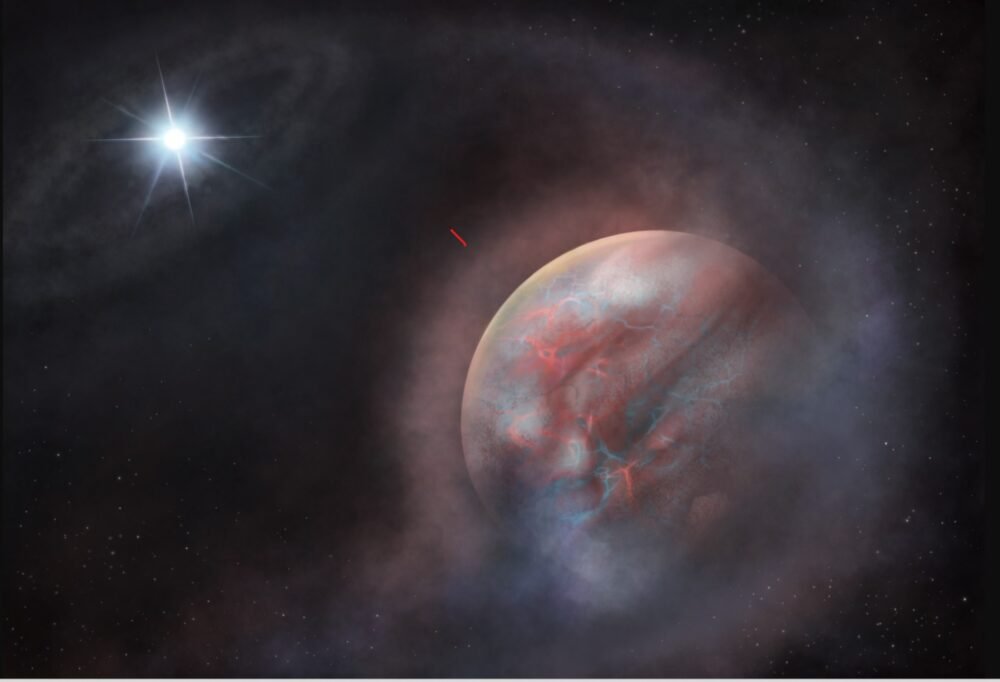
A planet orbiting once every 4 days around a white dwarf star HS 0209+0832 – about 270 light years in the direction of the constellation Pisces – is steadily losing its atmosphere to its host star. While many stars in solar systems beyond our own often feed on their planets, this particular star feeds on its own ashes.
The gaseous planet HS 0209+0832 b was discovered in 2024, when the Transiting Exoplanet Survey Satellite, a NASA space telescope, found it orbiting the white dwarf star over the course of four days. The new study followed through with detailed observations from TESS data, NASA’s space-based Far Ultraviolet Spectroscopic Explorer, in addition to the ESO’s mountain-based Very Large Telescope, to study the star’s atmosphere and in turn inferring some chemistry occurring in the planet.
In a study published in the journal Nature Astronomy on Monday and funded by NASA, European Research Council, Fundación Occident and the Instituto de Astrofísica de Canarias, an international team of astronomers have reported imprints of niobium, a heavy element, in the atmosphere of a white dwarf star.
Astronomers predict the transiting young planet around the dead star is supplying that niobium back to its host. The sighting is evidence of a “second generation” planet, one of many candidates identified over several years, manifesting in a myriad different ways from spent gas ejected in the wake of stellar deaths.
It adds to a known coterie of planets now found orbiting dead stars, astronomers are busy studying to spot signs of life.
What are white dwarf stars?
White dwarves are an exotic stars, and are all that’s left off giant stars shedding their large gaseous skin in violent deaths. Our sun is destined one day to transform into a white dwarf, but only after swelling in size some five billion years from now to become a red giant when it will eclipse past the earth’s orbit. It would take several million years after that for the red giant sun to shed its gaseous exterior to become a white dwarf.
Planets if any, found orbiting these dead stars may have likely migrated from the new solar system’s outer reaches. All that’s left off the progenitor star’s past are imprints of light metals and other elements on the white dwarf’s atmosphere. Such planets have previously been spotted orbiting pulsars, a kind of neutron star, back in 1992. In fact, its discovery had marked the first ever detection of any planet orbiting a star beyond our sun.
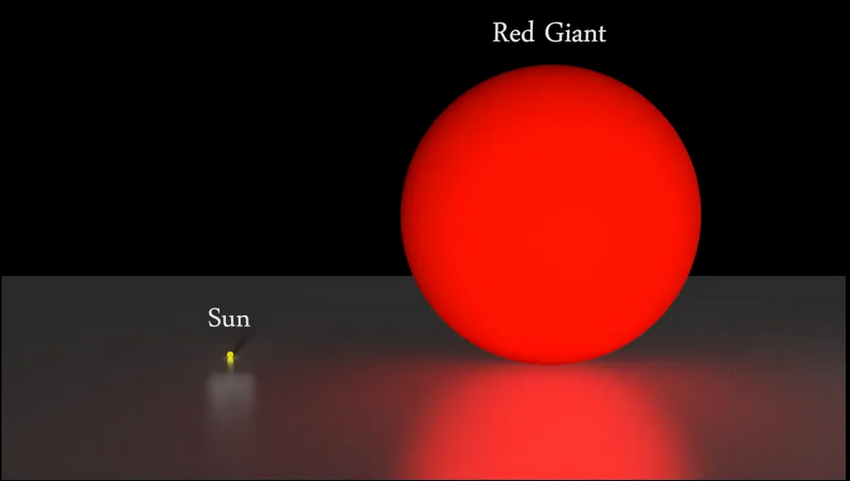
In five billion years, our sun will evolve to become a red giant star. Credit: Svitlana Leonidivna Malchenko
Sighting niobium
Elements such as niobium don’t typically form in the core of stars like our sun. Chemical production usually limits to elements lighter than or until iron, with its 26 protons and 30 neutrons. Beyond that, slamming an extra proton or neutron will cause those to split, leaving iron to be the last element to be directly forged.
Niobium, with 41 protons and 52 neutrons, is thought to be born after absorbing slow passing neutrons when the red giant star dies to form a white dwarf star. This niobium hitches a ride along with rest of the contents of the red giant star, farther into the outer reaches of the system after the formation of the white dwarf.
These contents could create a new disc of circumstellar material with dust and gas that could condense one day to form new planets. The “second generation” planet found orbiting the white dwarf star from the new study, could have been born this way.
Alternatively, it may have been a planet in the outskirts like Neptune, migrating inwards, and enriching itself with niobium-rich star material.
Either way, the planet got too close to its host star, which is irradiating its newfound niobium-rich atmosphere, stripping it away and devouring it.
While it’s likely not a candidate planet for life as we know it to be found, it’s discovery can help ascertain how such worlds are formed in the aftermath of a star’s various phases of evolution.
Space & Physics
Artemis Accords Reach 76 Countries: What It Means for India
The Artemis Accords now have 76 signatories. With NASA inviting ISRO to its Moon Base programme, India’s role in lunar exploration is expanding.

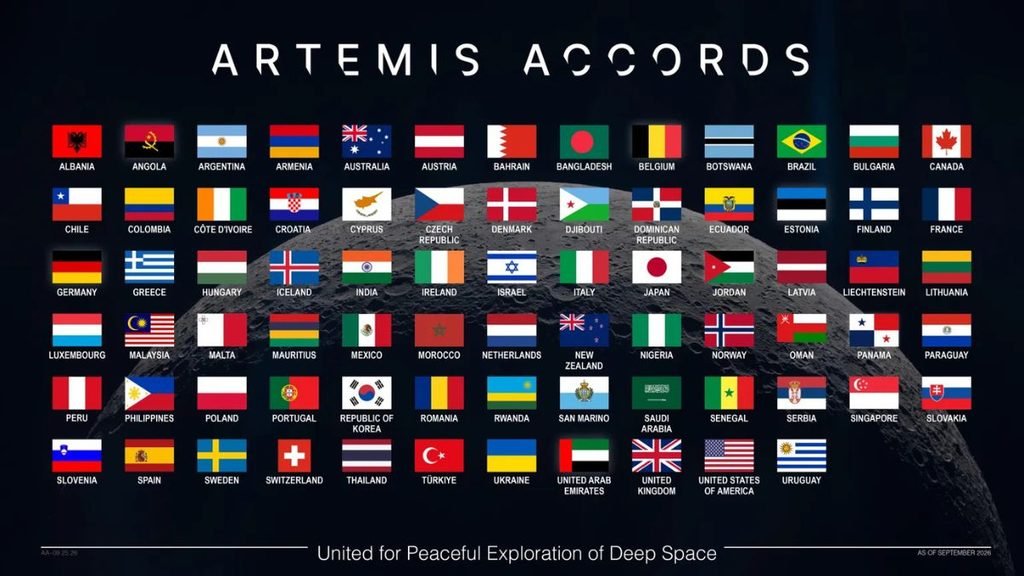
The Artemis Accords now have 76 signatories, expanding the international framework around the next phase of lunar exploration. For India, the milestone comes weeks after NASA invited the Indian Space Research Organisation (ISRO) to participate in its planned Moon Base programme.
Albania, Croatia, Côte d’Ivoire and San Marino joined the Accords in September, taking participation to 76 countries. NASA says nearly 40% of the world’s nations are now part of the framework, which sets principles for peaceful, transparent and responsible exploration of the Moon, Mars and beyond.
India became the 27th signatory in June 2023. At the India-US Civil Space Joint Working Group meeting in Bengaluru in August, NASA invited ISRO to participate in its Moon Base programme. The two countries also agreed to advance discussions on open scientific-data sharing under the Accords.
India’s Moon Base opportunity
The invitation does not specify what India will contribute. NASA has said every Artemis Accords signatory can participate through scientific payloads, technology demonstrations, CubeSats and other capabilities. Any specific Indian contribution would require further agreements.
India, however, is developing its own increasingly ambitious lunar programme. ISRO’s Chandrayaan-4 is planned as a lunar sample-return mission, designed to collect samples from the Moon’s polar region and bring them back to Earth. Chandrayaan-5/LUPEX, being developed with Japan’s JAXA, will study lunar polar volatiles in situ.
These missions could give India experience and scientific capabilities relevant to a future international lunar infrastructure.
ISRO Shaping the Data Conversation
Scientific data could be another area of Indian participation. In May 2026, ISRO led an initial Artemis Accords discussion on advancing open-data practices. NASA subsequently held two workshops focused on making lunar scientific data more accessible, interoperable and reproducible across countries.
That is significant as more lunar missions target the same regions. Shared standards could allow researchers to combine observations from different spacecraft instead of treating each mission’s data separately.
Moon – Space Coperation
India-US space cooperation is also expanding into human spaceflight. ISRO’s 2025–26 annual report records that Indian astronaut Shubhanshu Shukla travelled to the International Space Station in June 2025 as part of the Axiom-4 mission and conducted seven microgravity experiments. ISRO also held discussions with NASA on potential cooperation related to Gaganyaan.
The Artemis relationship therefore sits alongside an existing programme of India-US cooperation, including the NASA-ISRO Synthetic Aperture Radar (NISAR) mission.
What Changes for India?
The significance of the 76-country milestone lies in the network developing around it. The Artemis Accords cover scientific-data sharing, interoperability, non-interference between missions, emergency assistance and protection of historically significant lunar sites. NASA says signatories are now working through technical meetings and workshops to put these principles into practice.
For India, that creates several possible avenues: contributing technology or science to NASA’s Moon Base effort, sharing lunar data, and working with a growing group of countries on standards for increasingly crowded lunar operations. What India’s specific contribution to the Moon Base remains undecided. But with Chandrayaan-4, LUPEX and its human-spaceflight programme advancing alongside deeper NASA cooperation, India is entering the next phase of lunar exploration with its own capabilities already taking shape.
Space & Physics
JWST Finds Water Around a Dying Star Near the Milky Way’s Black Hole
A dying star near the Milky Way’s central black hole is shedding water, gas and dust into one of the galaxy’s most extreme environments.
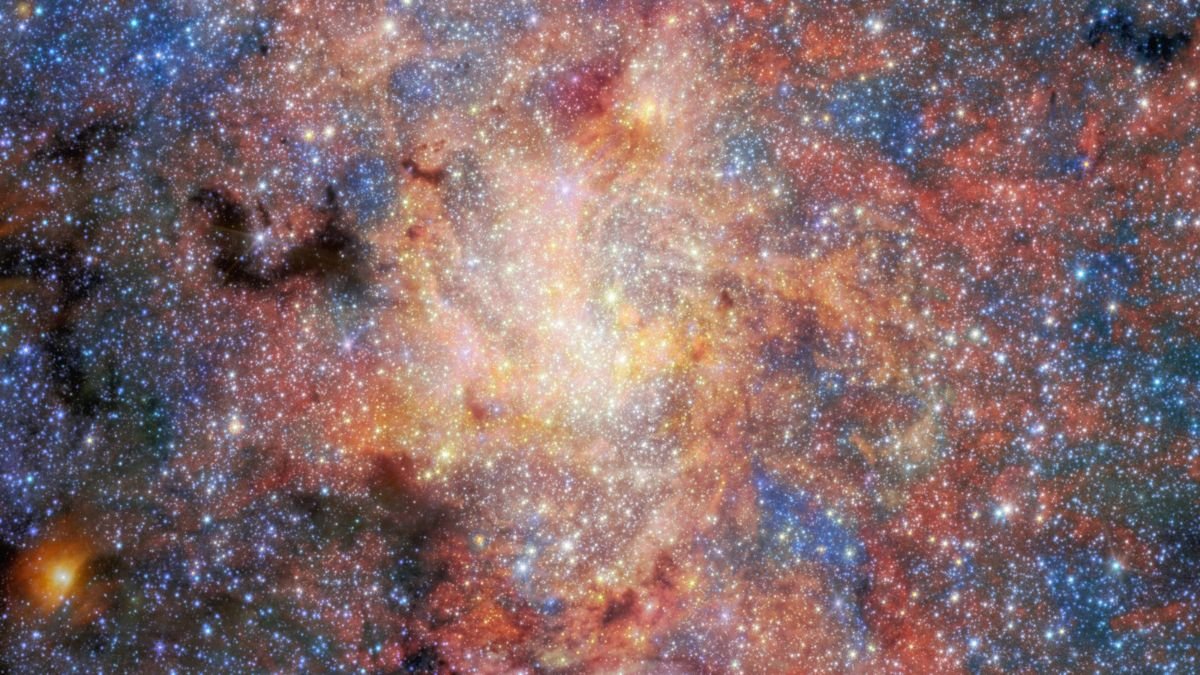
A dying star nearing the end of its life is shedding material into space just 0.55 light-years from the Milky Way’s central black hole. And somehow, some of that material is holding on. New observations from the James Webb Space Telescope have revealed water and oxygen-rich dust surrounding IRS 3, an evolved star living remarkably close to Sagittarius A*, the supermassive black hole at the heart of our galaxy.
The finding gives astronomers a rare view of what happens when an ordinary stage of stellar evolution unfolds in an anything-but-ordinary neighbourhood.
A Dying Star Beside a Black Hole
IRS 3 is an asymptotic giant branch (AGB) star, a late stage in the life of stars like this one. As such stars age, they swell, cool and lose material through powerful stellar winds. IRS 3 is doing exactly that. Gas and dust are streaming away from the star, creating a large envelope around it.
The star sits only about 0.55 light-years from Sagittarius A*. That may sound distant, but on the scale of the Galactic Centre it is remarkably close. Earth is about 26,000 light-years away from the same black hole.
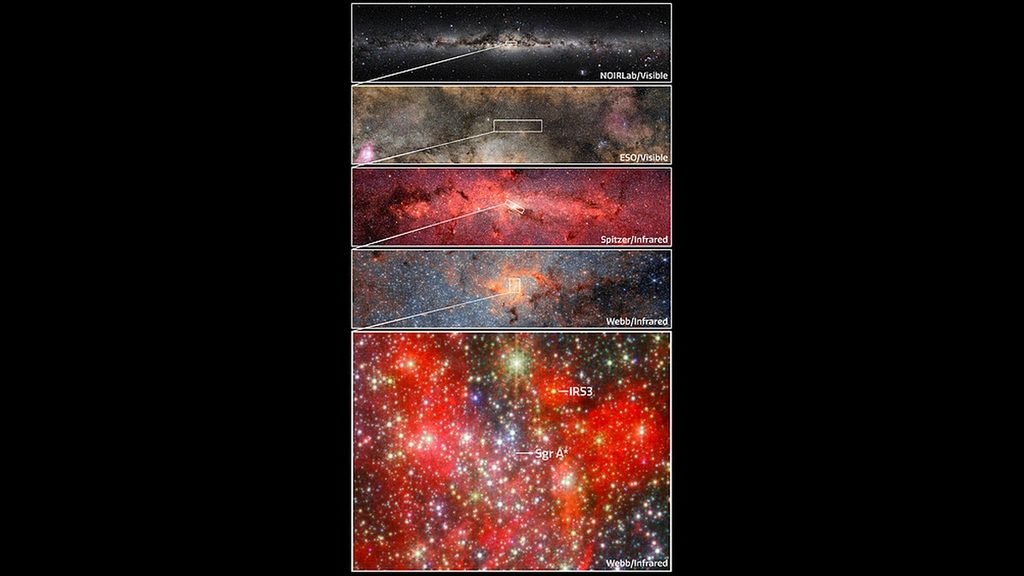
Around Sagittarius A* is a crowded, energetic environment filled with intense radiation, dense gas and powerful gravitational forces. Astronomers have long wondered how stars manage to evolve and shed material there. IRS 3 is offering an answer.
Webb Finds Water in the Stellar Outflow
NASA‘s James Webb Space Telescope looked at IRS 3 using its Mid-Infrared Instrument, or MIRI. Infrared observations are particularly useful here because the dust surrounding the star glows strongly at these wavelengths.
The observations revealed oxygen-rich dust in the star’s envelope. They also produced the first detection of water in this material. This does not mean Webb found a pool, cloud or droplets of water. The water exists as molecules mixed into the hot gas and dust surrounding the star.
That distinction matters because molecules can be vulnerable in the harsh environment around the Galactic Centre. Radiation can break them apart, while the conditions around a supermassive black hole can affect the material being expelled by nearby stars. Yet water molecules are present around IRS 3.
The Star is Feeding Its Surroundings
IRS 3 is losing material rapidly as it approaches the end of its life. Researchers estimate that the star is shedding roughly the mass of Earth every 18 days. That enormous outflow is important beyond IRS 3 itself.
When evolved stars lose their outer layers, they return material to the space between stars. The gas carries elements produced during the star’s lifetime, while newly formed dust becomes part of the reservoir from which future cosmic structures can emerge. IRS 3 is therefore caught in a familiar cycle of stellar life: a star is dying, but the material it releases can become part of something else.
What makes this case unusual is that the recycling process is happening almost next door to a supermassive black hole.
How Much Can Survive Here?
The observation does not mean that the black hole has little influence on its surroundings. Sagittarius A* still creates an extreme environment, and the researchers are interested precisely because IRS 3 shows that stellar material can persist within it.
“Galactic centres are among the most extreme environments,” said Florian Peißker of the University of Cologne, the study’s lead author to media. With Webb, researchers can now examine the material around stars such as IRS 3 in much greater detail and ask how stellar winds, dust formation and molecular chemistry behave so close to a black hole. The answer emerging from IRS 3 is intriguing: the environment may be extreme, but it does not necessarily shut down the chemistry of a dying star.
For IRS 3, the end of its stellar life is already underway. Its outer layers are drifting away into the Galactic Centre, carrying dust, molecules and the chemical ingredients of future cosmic systems with them. Even in the shadow of the Milky Way’s central black hole, a dying star is still leaving something behind.


Climate Change, Overfishing and the Uncertain Future of Bangladesh’s Hilsa Fishermen

A Dead Star Feeds Off Planet Formed From Its Ashes

Trump’s AI Accord Puts Big Tech in Charge of Its Own Safety. Is That Enough?

Standing with Teachers: The People Who Shape India’s Future

An Ageing Teacher Workforce Is Becoming a Recruitment Problem

From Scams to Screens: How the National Stock Exchange Rewrote India’s Equity Story

Aim for the Stars: Anjali Thomas’s Journey from a Small College in Kerala to the Frontiers of Medical Imaging

India’s AI Moment Rests on More Than Code

Marshall Islands: Why the US Nuclear Legacy Is Back Before the UN

From Silicon Valley to Sustainable Period Care; How This Engineer Is Rethinking Menstruation with Science

-

 Math2 months ago
The 2026 Fields Medals: Four Proofs, Four Decades-Old Problems Solved
-
Climate2 months ago
After Kerala’s Deadliest Landslide, the Hardest Thing to Rebuild Was Childhood
-
Society3 months ago
West Asia Crisis: Can Kerala’s Returning Gulf Migrants Find a Future in the Green Economy?
-
Space & Physics4 months ago
India Semiconductor Mission: ‘It’s Not About Fabs. It’s About Building An Entire Ecosystem’
-
Interviews2 weeks ago
From Scams to Screens: How the National Stock Exchange Rewrote India’s Equity Story
-
Climate4 months ago
The Climate World Cup? How Climate Change Could Affect Player Performance at the 2026 World Cup
-
Society3 months ago
What Is Civilisational Diplomacy? Understanding India’s Newest Foreign Policy Tool
-
Society4 months ago
From Bell Labs to the Classroom: A Second Career in Teaching