Standing with Teachers: The People Who Shape India’s Future
Standing with teachers means supporting their professional growth, working conditions and role in shaping India’s future amid rapid technological change.
Standing with teachers means more than celebrating them on World Teachers’ Day. It means giving them the support, professional autonomy and working conditions needed to shape India’s future.
Every year, World Teachers’ Day gives us a chance to speak about teachers. But 5 October 2026 is more than another day of appreciation. This year marks 60 years of the 1966 ILO/UNESCO Recommendation concerning the Status of Teachers, and the theme, set by UNESCO with the ILO, UNICEF and Education International, is “Standing with teachers: 60 years of protecting the profession, advancing its status and shaping our futures.” Respect for teachers cannot remain a ceremonial idea. It must become a continuing social and educational responsibility.
Standing With Teachers in a Changing Education System
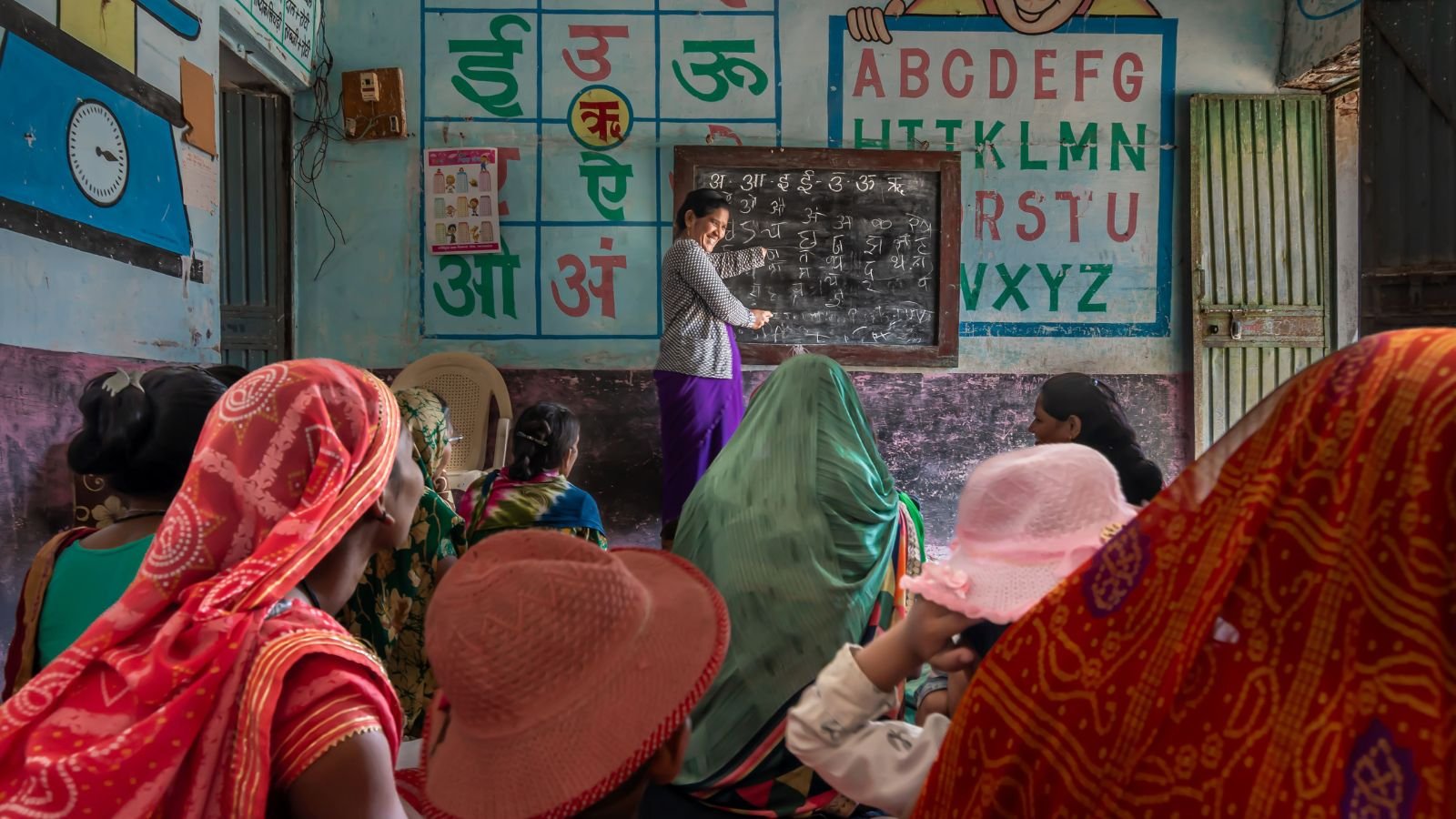
India has always given the teacher an important place. From the traditional gurukula system to the modern classroom, the teacher has been more than a person who delivers lessons. A teacher has been a guide, a mentor, a listener and, often, a source of confidence for a young person. The subjects taught in a classroom may be forgotten with time, but the encouragement received from a good teacher can last a lifetime.
The teacher’s role, however, is changing rapidly. Students today live in a world of smartphones, social media, artificial intelligence and unlimited digital information. A student can find an explanation for almost any question within seconds. This does not make the teacher less important. In many ways, it makes the teacher more important.
Information is not the same as knowledge, and knowledge is not the same as wisdom. Students need someone who can help them tell reliable information from misinformation, understand different points of view, ask meaningful questions and develop the confidence to think independently. Technology can provide information, but education also requires human understanding.
This is why the teacher of the future cannot be seen simply as a provider of content. The teacher must increasingly become a mentor and a facilitator of learning. Technology should remain a tool in the teacher’s hands, not a substitute for the teacher. Artificial intelligence can explain a concept, but it cannot fully understand the circumstances, emotions, aspirations and difficulties of every student in a classroom.
The human relationship between teacher and student remains at the heart of education.
India also needs to think seriously about the professional status of teachers. Respect should not be limited to Teachers’ Day speeches, greetings and awards. A profession is respected only when its practitioners receive adequate professional support, opportunities for continuous learning, reasonable working conditions and a meaningful voice in decisions that affect education.
UNESCO’s concept note for this year describes teacher status in three parts: symbolic, meaning how far teaching is valued; professional, meaning autonomy, support and a voice in policy; and material, meaning salaries, workloads and working conditions. It adds that the world needs 50 million more teachers by 2030 to meet the global education goal.
Teachers are expected to do much more than teach. They prepare lessons, assess students, maintain records, attend meetings and activities, communicate with parents and often respond to children’s social and emotional needs. These responsibilities require time, training and institutional support. The quality of education therefore depends not only on curriculum and infrastructure but also on the conditions in which teachers work.
Context matters too. Education in India takes place in very different social and geographical circumstances. A teacher in a major city and a teacher in a remote village face very different challenges, yet both are expected to prepare young people for an increasingly complex future.
Teachers in smaller towns and rural areas often become important links between school and community. They encourage children to continue their studies, guide families, identify students who need extra support and create opportunities where resources are limited. Their contribution deserves greater visibility.
Teachers also have a responsibility to preserve values while preparing students for change. Education should build employability and technological skills, but it should also cultivate honesty, compassion, discipline, respect for others and democratic values. An education system cannot be judged by examination results alone. It must also ask what kind of citizens its classrooms are producing.
World Teachers’ Day should therefore be a day of reflection, not only celebration.
The relationship between education and society is inseparable from the relationship between teachers and society. If we want responsible citizens, we must give teachers the freedom and support to nurture responsibility. If we want innovative young people, teachers must themselves be encouraged to experiment and learn. If we want inclusive classrooms, teachers must be supported in understanding different learning needs.
World Teachers’ Day should therefore be a day of reflection, not only celebration.
India has made significant progress in expanding access to education and embracing digital learning. The next challenge is to ensure that technology, policy and institutional reform strengthen the teacher rather than marginalise them. The teacher should remain at the centre of education even as its tools change.
The world also faces new challenges, including climate change, migration, social inequality and rapid technological transformation. UNESCO’s concept note for this year’s observance points to similar pressures on the profession, among them digital technologies and artificial intelligence, climate change, migration, conflict and displacement. Teachers are among those who must help young people understand and respond to them.
That responsibility cannot rest on teachers alone. Governments, educational institutions, parents, communities and society at large must stand with them.
A teacher may not always see the result of their work. A student may become a scientist, entrepreneur, farmer, civil servant, artist, engineer or teacher many years after leaving the classroom. Somewhere in that journey there may be a lesson, a word of encouragement or a moment of trust that came from a teacher.
That is the quiet power of teaching.
On World Teachers’ Day 2026, the question should not simply be, “How do we thank our teachers?” It should also be, “How do we create an environment in which teachers can do their best work?”
Standing with teachers means respecting their knowledge, listening to their experiences, supporting their professional growth and giving them the conditions they need to teach well.
The future of education will certainly involve new technologies. Classrooms will change and learning methods will evolve. But one thing should remain constant: the importance of a committed teacher who sees a student not merely as a mark or a data point, but as a human being with potential.
If we want to shape a better future, we must invest in those who help shape the people who will live in it.
V. Rajesh Mohan Rao is a higher secondary commerce teacher from Dharmadam, Thalassery, Kerala. He writes on education, society, culture and contemporary issues, and is involved in cultural and literary activities. His particular interests are education, language and community life.
Global Patent Applications Hit Record 3.9 Million in 2025; India Sees 37.5% Growth
Global patent applications reached a record 3.9 million in 2025, with China accounting for more than half the increase. India recorded a 37.5% rise, crossing 100,000 applications for the first time.
Patent applications seek legal protection for new inventions, giving applicants exclusive rights if their inventions meet the requirements for a patent grant. Representational image. Image credit: Markus Spiske/ Pexels
Global patent applications crossed 3.9 million in 2025, registering a 6% increase over the previous year and the fastest annual growth since 2016. According to the World Intellectual Property Organization (WIPO), China accounted for more than half of the additional applications. India recorded a 37.5% rise, crossing 100,000 filings for the first time.
Patent applications are formal requests for legal protection of inventions. They allow individuals, companies and research institutions to seek exclusive rights over their innovations, preventing others from commercially using them without permission if a patent is granted. The number of applications therefore offers an indication of innovation and research activity, although not every application results in a granted patent or a marketable technology.
The increase of approximately 224,000 applications worldwide was concentrated largely in four countries: China, Japan, India and South Korea. Together, they accounted for about 94% of the net global increase, according to WIPO’s World Intellectual Property Indicators 2026 report.
China Accounts for More Than Half of Global Patent Application Increase
China contributed 113,693 additional patent applications in 2025, accounting for more than half of the worldwide increase. Inventors and applicants residing in China filed approximately 1.9 million applications globally, retaining the country’s position as the largest source of patent filings.
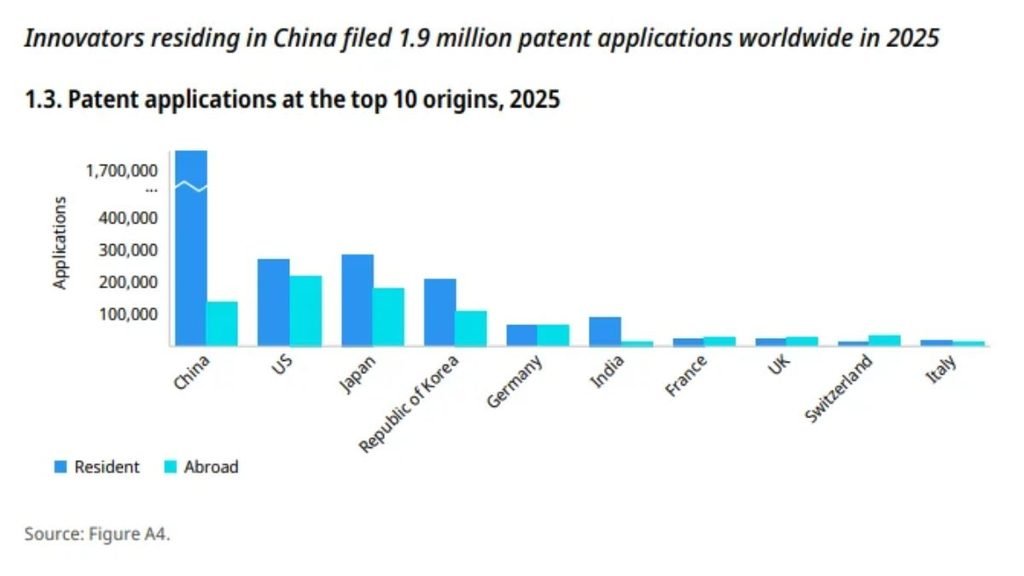
China led global patent filings in 2025, with its residents submitting approximately 1.9 million applications worldwide, followed by the United States and Japan. India also featured among the top 10 origins of patent applications.Source: WIPO, World Intellectual Property Indicators 2026, Figure A4.
The United States followed with 489,766 applications, while Japan recorded 466,301. These figures include applications filed both within the respective countries and abroad. Japan added 45,310 applications during the year, making it the second-largest contributor to global growth. India followed with an additional 28,690 applications, while South Korea contributed 23,169.
India Crosses 100,000 Patent Applications
India recorded 105,163 patent applications in 2025, marking the first time the country crossed the 100,000 threshold. The 37.5% increase also marked its seventh consecutive year of double-digit growth. The rise was driven primarily by an increase in applications filed by Indian residents, indicating growing domestic participation in patent activity. India was the third-largest contributor to the global increase, after China and Japan.
WIPO’s figures also show that applications received by India’s patent office increased by 27.8% in 2025. This marks the ninth consecutive year of growth at the office and the fourth successive year of double-digit increases. Kerala recorded 827 patent applications in 2024–25, up from 637 in the previous financial year, according to the Indian Patent Office.
However, a separate analysis by the Gulati Institute of Finance and Taxation has pointed to a gap between the state’s research spending and patent generation, raising questions about how effectively research investments are translating into intellectual property. The study also highlighted a gap between government research funding and patent output. Educational institutions received 44.81% of the state’s R&D allocation but accounted for only 7.29% of its patents.
Asia Accounts for 71.2% of Global Patent Filings
Intellectual property offices located in Asia received approximately 2.8 million patent applications in 2025, accounting for 71.2% of the global total. The region’s share has increased from 61.9% in 2015, reflecting a steady shift in global patent activity over the past decade.
China accounted for approximately 68.5% of the applications received across Asian offices. Africa was the other region, besides Asia, to record an average annual growth rate above the global average over the past decade.
Computer Technology Leads Patent Filings
Computer technology remained the largest field of patenting, accounting for 13.6% of global patent filings, according to WIPO’s technology-sector analysis. The field’s share has grown over the past decade, reflecting its expanding role in technological development.
WIPO’s report also tracks patent activity across fields such as digital communication, medical technology and electrical machinery, offering insights into areas attracting research and development activity.
Woxsen University Ranks 12th Globally in MBA Entrepreneurship Ranking, Fourth in Startup Launches
Woxsen University has secured 12th place in the 2027 Poets&Quants MBA entrepreneurship ranking, with 15% of its MBA graduates from the 2021–2025 cohorts reportedly launching ventures within three months of graduation.
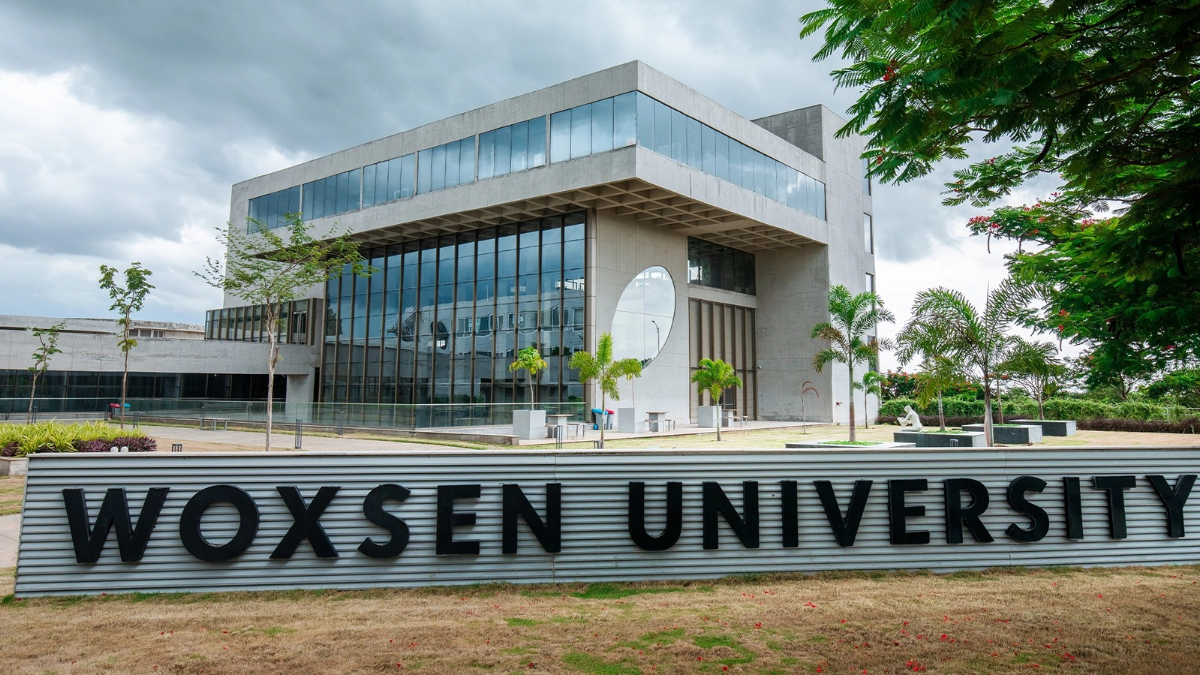
Woxsen University's campus in Hyderabad, Telangana.Image credit:Woxsen university
Woxsen University in Hyderabad has been ranked 12th globally in the 2027 Best MBA Programs for Entrepreneurship ranking released by Poets&Quants, with the institution placing fourth worldwide in the category measuring startup launches by MBA graduates.
According to the university’s press release, an average of 15% of its MBA graduates from the Classes of 2021–2025 launched ventures within three months of completing their degrees. The figure contributed to the institution’s performance in a ranking that places considerable emphasis on entrepreneurial outcomes rather than relying solely on academic reputation or programme structure.
Woxsen’s overall position puts it ahead of several established business schools, including Arizona State University’s W. P. Carey School of Business, Brigham Young University’s Marriott School of Business, London Business School and Carnegie Mellon University’s Tepper School of Business.
The 2027 ranking assigns 25% weightage to the proportion of MBA graduates pursuing entrepreneurial ownership within three months of graduation. It also recognises business acquisitions as a form of entrepreneurship, broadening the scope beyond graduates establishing new ventures.
Students attend a classroom session at a business school.Image credit:Woxsen university
The university’s fourth-place position in the startup-launch category indicates the reported proportion of graduates moving into venture creation. However, the 15% figure represents an average across five graduating cohorts and does not, by itself, establish the long-term survival, revenue generation or employment impact of these ventures.
Woxsen first entered the Poets&Quants entrepreneurship ranking in 2026, when it featured among the global top 12 and was identified by the university as the only Asian business school in that group. Its position in the 2027 edition marks a continuation of that presence.
The ranking draws attention to a broader question facing MBA programmes: how effectively do business schools translate entrepreneurship education into actual venture creation? While business schools increasingly incorporate startup development, business planning and experiential learning into their curricula, graduate venture formation offers one measurable indicator of their outcomes.
Woxsen’s latest ranking provides one such indicator, although further information on the ventures launched, their subsequent performance and the methodology used to verify startup activity would offer a more comprehensive picture of the programme’s entrepreneurial impact.
Indian universities lead Asia in research output per faculty, but the country’s top six all slip in QS ranking
Five Indian institutions are in the regional top 10 for papers per faculty member. IIT Delhi, still India’s highest-ranked university, falls from 59th to 66th.
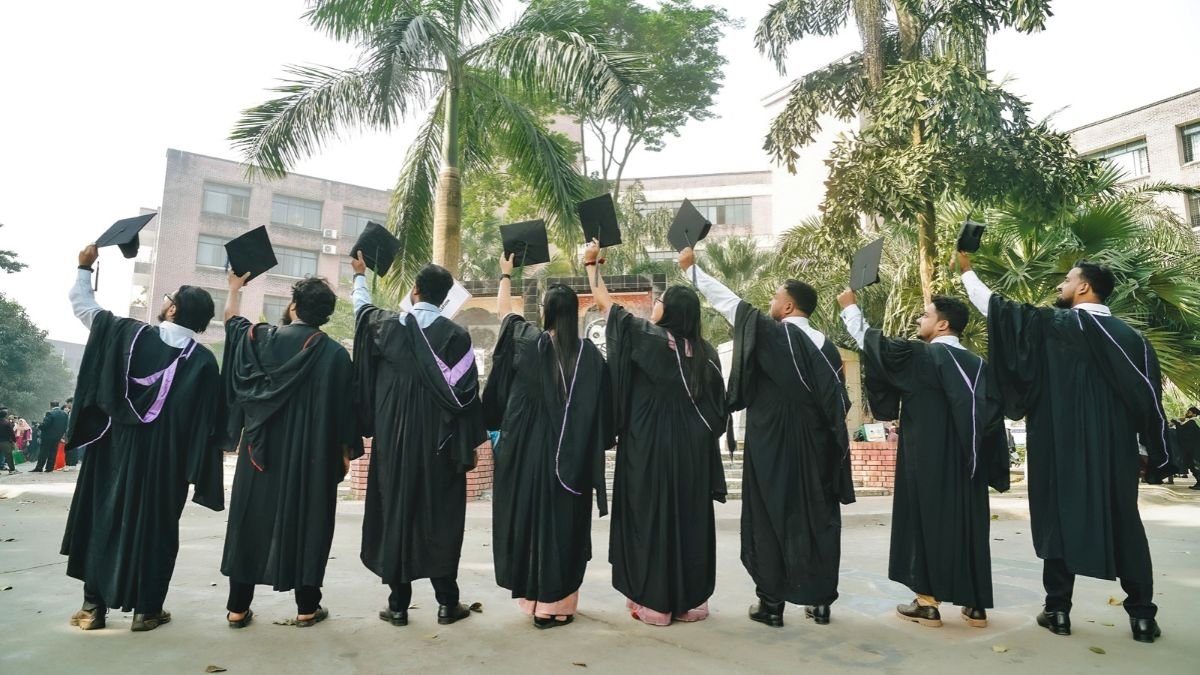
Indian universities lead Asia in research output per faculty, but all six of the country’s highest-ranked institutions have slipped in the QS Asia University Rankings 2027, with IIT Delhi falling to 66th.
All six of India’s highest-ranked universities have dropped in the QS World University Rankings: Asia 2027, released on Tuesday, even as Indian institutions recorded the strongest research output per academic in the region.
Top Six Slip in QS Asia University Rankings 2027
IIT Delhi stays at the head of the Indian list at 66th, down from 59th. IISc Bangalore is 79th (64th last year), IIT Bombay 83rd (71st), IIT Madras 85th (70th), IIT Kharagpur 90th (77th) and IIT Kanpur 97th (77th). The University of Delhi fell from 95th to 106th and left the top 100, which now holds six Indian institutions.
The declines came in a larger, more crowded table. QS Quacquarelli Symonds ranked 1,722 universities from 26 higher education systems this year, including 195 new entrants. Of India’s 325 ranked universities, 71 per cent fell, 18 per cent rose and 11 per cent held their position. Japan saw 85 per cent of its universities fall, while Taiwan and Indonesia saw 70 per cent each.
India has the second-largest number of ranked universities in Asia after Mainland China, which has 448. It added 34 this year. In 2016, only 24 Indian institutions were ranked.
Research output stands out
India has more universities in the regional top 10 for papers per faculty member than any other system. IISc Bangalore ranks first on the indicator and IIT Madras third. Twenty-seven Indian universities are in the top 50, up from 10 in 2018.
Doctoral qualifications show a similar pattern. Fifteen Indian universities share first place for the proportion of staff with a PhD, more than double the number from Iran, the next-best system. India also holds 47 of the top 100 places on that indicator.
“India has built remarkable research capacity,” said QS Senior Vice President Ben Sowter. “The challenge now is to translate this strength more consistently into research impact and international recognition.”
Those two indicators carry 5 per cent of the overall score each. The two reputation surveys carry far more: 30 per cent for academic reputation and 20 per cent for employer reputation. QS data show that 76 per cent of Indian universities lost ground on academic reputation and 83 per cent on employer reputation.
Citations and international links lag
Output has not translated into citations at the same rate. Only three Indian universities are in Asia’s top 50 for citations per paper, and one is in the top 10. India also sits below the regional average on international faculty, international students and student exchange, QS said, though the effect differs from one university to another.
Employer reputation is a relative strength. IIT Bombay is seventh in Asia on the indicator and IIT Delhi 10th, the first Indian universities to reach the top 10. Six Indian institutions are in the top 50, up from five. QS noted that this recognition is concentrated in a small group of institutions, in a country where about 45 million students were enrolled in higher education in 2023-24.
Climbers
Seven Indian universities in the regional top 200 moved up: Chandigarh University, Jawaharlal Nehru University, Lovely Professional University, Symbiosis International, Amity University, Jamia Millia Islamia and Manipal Academy of Higher Education.
Chandigarh University reached its best rank, 104th, on gains in international research, citations and papers per faculty. Manipal entered the top 200 at 195th. Further down the table, GLA University rose nearly 300 places to 491st, Jain University climbed 221 places to 374th and Woxsen University gained 195 places to reach 499th.
The wider region
The University of Hong Kong is first for a second year, followed by Peking University. Tsinghua University rose from ninth to third. The National University of Singapore fell from third to sixth and Nanyang Technological University from third to eighth.
QS pointed to India’s policy framework for the next stage. The National Education Policy 2020 placed research at the centre of reform, and the Anusandhan National Research Foundation, set up in 2024, backs efforts to widen research capacity. QS says India has built its output on national R&D spending of around 0.64 per cent of GDP.
“Deeper international research partnerships, more international faculty and students, and closer links with industry can help ensure that research produced on this scale achieves greater impact,” said Ashwin Fernandes, QS Vice President for Strategic and International Engagement.
He added: “With foreign universities opening campuses in India and Indian institutions expanding overseas, the country has an opportunity to become a major global centre for education and research.”