Technology
MIT engineers develop light-controlled robot powered by living muscle
MIT engineers have developed a paper-thin soft robot powered by living muscle cells that responds to flashes of light, allowing it to swim and change direction in water.


MIT soft robot powered by living muscle cells can move through water in response to flashes of light, according to engineers at the Massachusetts Institute of Technology. The robot, described in a study published in Advanced Functional Materials, is the first very thin, two-dimensional muscle-powered robot demonstrated to achieve locomotion, according to the researchers.
The robot is built from a thin film of gelatin methacrylate, or GelMA, which acts as its flexible skeleton. The film forms two fins, each covered with a layer of living muscle cells thinner than a strand of hair.
The cells are genetically engineered to contract when exposed to light. When researchers shine light on one fin, the muscle cells contract and cause the fin to flap, pushing the robot through the water. By changing which fin is illuminated and how frequently the light is flashed, researchers can control the robot’s movement and direction.
In experiments, the robot was able to swim through a simple maze placed inside a dish of water. At its fastest, it travelled a distance of about four times its body length in one minute.
While that speed is slow compared with human swimmers, the experiment demonstrates that even a single layer of muscle cells can generate enough force to move a small robot through water.
“It takes a lot of force to move through water versus air. The robot’s quite strong, given its size.” said in a media statement issued by MIT.
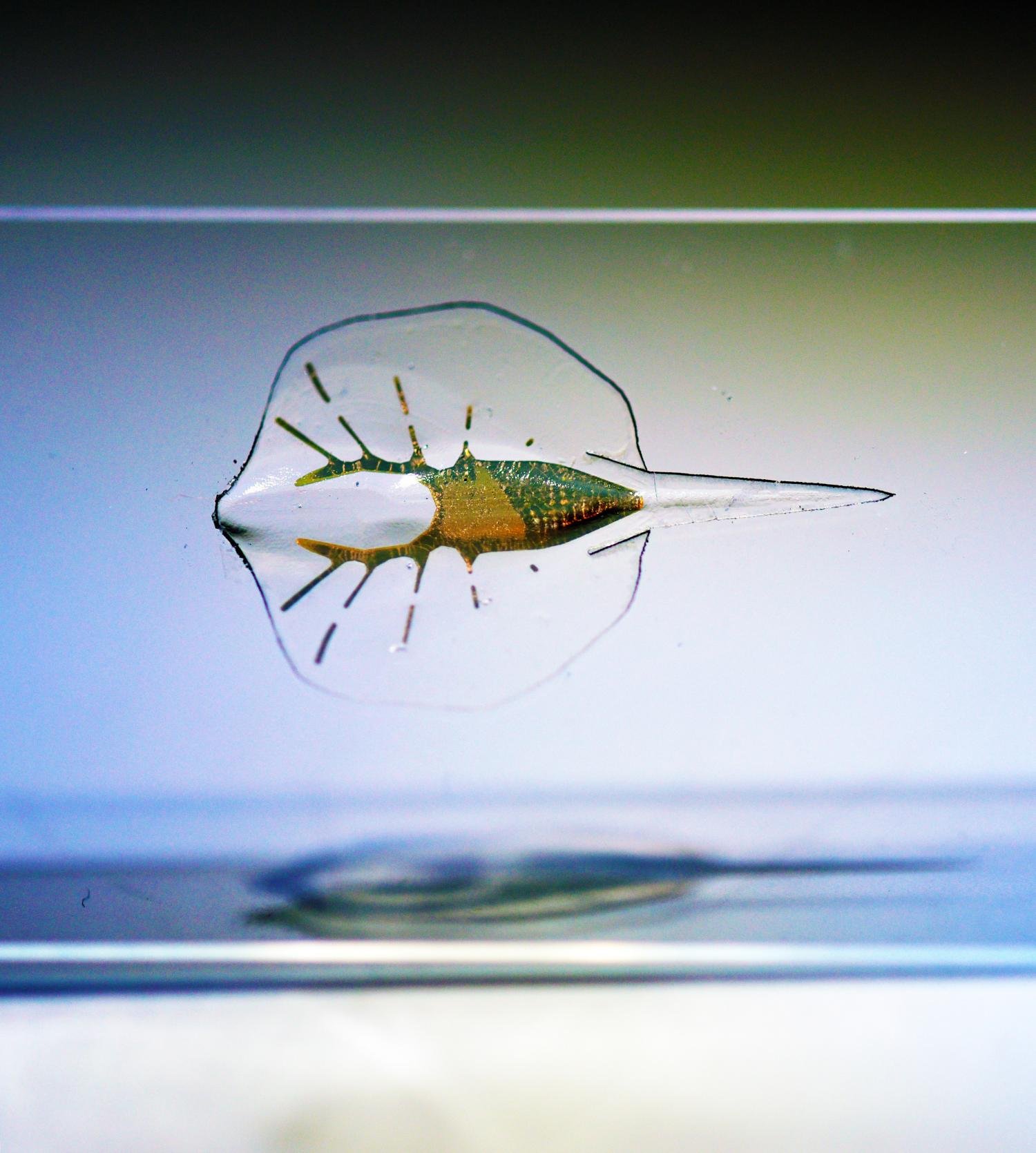
Tissue-engineered soft-robotic ray. Representational image .Credit: Karaghen Hudson and Michael Rosnach
MIT Soft Robot: Designing the robot around its muscle
The research builds on an earlier project by Raman’s group that used muscle cells to create an artificial structure inspired by the human iris.
In that work, researchers grew muscle cells on a thin gel containing a pattern of grooves. When exposed to light, the cells contracted in different directions, producing movement similar to the way the iris expands and contracts.
“People hadn’t seen this muscle architecture engineered from scratch before ,and the cells were moving in multiple directions. But they only moved about 100 microns. From a robotics perspective, their movements were tiny.” MIT engineer said.
They therefore focused on the material supporting the muscle cells. The team tested gels with different levels of stiffness, compositions, thicknesses and groove patterns.
The researchers found that square-bottomed grooves helped the muscle cells align more effectively than curved grooves. Better alignment allowed the cells to fuse into stronger muscle fibres and generate greater force.
The team also replaced fibrin, an ultrasoft gel used in the earlier design, with GelMA. Stiffer GelMA provided better support for the cells and allowed them to produce more force.
A GelMA film about half a millimetre thick was found to provide enough support while remaining light enough for the muscle cells to contract without pulling away from the surface.
The researchers also “trained” the muscle cells by repeatedly exposing them to flashes of light before incorporating them into the robot.
The resulting device effectively has two independent muscle-powered fins. Lighting one fin causes movement on that side, while illuminating both makes both fins flap.
The researchers say such biohybrid robots could eventually have applications in aquatic environmental monitoring. Because they combine living tissue with engineered materials, the technology could potentially be adapted for delicate environments where conventional rigid robots may be difficult to use.The MIT soft robot shows how living muscle cells can power biohybrid machines. The use of light-controlled robots could eventually be used for environmental monitoring and other delicate tasks in aquatic environments where conventional robots may be difficult to operate.
For now, the MIT team is working to improve the robot’s body design and increase its swimming speed to further develop the experiment.






Technology
AI Is Growing Fast, But Women Remain Underrepresented
Men hold nearly 80% of AI jobs and 90% of senior leadership positions, while 44% of 133 AI systems showed gender bias, UN Women reports.


Society
Digital Detox: Why Taking a Break From Screens Matters
A digital detox can help children and adults reduce screen dependence, reconnect with nature and relationships, and create space for reflection and creativity.


Technology
What is AGI? AI’s Next Era: When Machines Start Taking on the Work
As AI systems move from answering prompts to handling complex, multi-step tasks, the boundary between today’s AI agents and the broader idea of artificial general intelligence is becoming harder to ignore. This article examines what AGI means, how autonomous AI is changing knowledge work, and what the shift could mean for India.

The next phase of artificial intelligence is taking shape inside the companies building it. AI agents are being trained to handle hours-long assignments, while researchers are using AI to write code, investigate technical problems and help develop the next generation of AI systems. AGI generally refers to an AI system capable of learning, reasoning and applying knowledge across a broad range of tasks, rather than being limited to a narrow set of functions.
There is no universally accepted definition or test for AGI, so there is still no agreed threshold for declaring that a system has reached it. But many jobs gradually moving into automation, pushing thousands into uncertainty might help us understand the whole story.
OpenAI says more than 70% of sampled Codex users in May 2026 asked the coding agent to handle tasks estimated to take more than an hour. About a quarter made at least one request estimated at more than eight hours. Anthropic reported in August that Claude was leading 26% of the AI research and development work covered by its internal measurement system, compared with less than 1% in February. Both figures come from the companies themselves and are not measures of the wider economy.
For most people, AI is still something they consult. Ask a question, get an answer. Give it a document, get a summary. Ask for code, get code. That model is changing. The newer systems can take an assignment, break it into steps, use software and other tools, check their progress and continue working with less human intervention.
What happens when AI can handle much more of the work itself? That question sits at the heart of the debate over artificial general intelligence, or AGI.
From Prompts to Assignments
A programmer can ask AI to write a function. An agent can be given a larger job: inspect an existing project, build a feature, run tests, find problems and make corrections. The AI is handling a sequence of tasks rather than producing one answer. That distinction could eventually change how many kinds of knowledge work are organised.

AI is Helping Build AI
Frontier AI companies are already making the change clear. OpenAI says it has developed an “automated research intern” capable of performing defined research tasks under human direction. The company says it is working towards an automated AI researcher by March 2028.
Anthropic’s August figures point in the same direction. The company says Claude is increasingly being used in its own AI research and development, although it remains dependent on human researchers and is not fully autonomous in the measured work. AI is helping researchers build better AI.
So, When does AGI Arrive?
Researchers disagree about the capabilities AGI should demonstrate, and no accepted test exists. Google DeepMind CEO Demis Hassabis said in May that he expected AGI could arrive within roughly four years, possibly sooner. If an AI can research a subject, analyse data, write software, use several digital tools and complete a complex assignment, how much of that work still needs to be done by a person? Work will change before we have an answer.
A researcher could delegate a literature review and data analysis. A programmer could hand over an entire software feature. Some tasks may disappear from jobs. Others may become faster. New work will emerge around supervising, testing and governing AI systems.
India is Preparing for the Shift
India is investing heavily in the infrastructure needed for the next phase of AI. The IndiaAI Mission has an approved outlay of ₹10,371.92 crore over five years. The government said in August 2026 that more than 45,000 GPUs had been onboarded through its shared computing programme and 237 projects had accessed subsidised capacity. Twenty indigenous foundation-model proposals had also been selected from 506 applications.
AI systems need to work across Indian languages and very different economic and institutional settings. OpenAI announced an India initiative with Tata Group in February covering areas including AI infrastructure and local capability. Google DeepMind has partnered with Indian institutions on applications in science, education, agriculture and energy.
It becomes harder when an AI system spends hours researching, writing code, analysing information and making decisions before presenting a result. The human role will increasingly involve setting the objective, judging evidence and deciding when a system should be trusted. AGI remains undefined, and nobody can put a reliable date on its arrival. But the shift towards more autonomous AI is already visible.


Not Broken but Unheld: A New UN Report Asks Us to Tend the Forest, Not Only the Tree

Ebola Outbreak Worsens in DRC as WHO Calls for Urgent Patient Care

Flash Energy Droughts Could Put New Pressure on Renewable Grids

MIT engineers develop light-controlled robot powered by living muscle

India Tightens CAFE Norms as Fuel Demand and Car Sales Rise

From Scams to Screens: How the National Stock Exchange Rewrote India’s Equity Story

Farmers Borrowed to Build ‘Diggis’. Two Years Later, They Are Still Waiting for the Subsidy

Aim for the Stars: Anjali Thomas’s Journey from a Small College in Kerala to the Frontiers of Medical Imaging

When the Himalayas Collapse Without Warning, What Counts as Preparedness?

Anxiety Freezes Career Decisions. Curiosity Unfreezes Them

-

 Math2 months ago
The 2026 Fields Medals: Four Proofs, Four Decades-Old Problems Solved
-
Climate2 months ago
After Kerala’s Deadliest Landslide, the Hardest Thing to Rebuild Was Childhood
-
Society3 months ago
West Asia Crisis: Can Kerala’s Returning Gulf Migrants Find a Future in the Green Economy?
-
Space & Physics4 months ago
India Semiconductor Mission: ‘It’s Not About Fabs. It’s About Building An Entire Ecosystem’
-
Interviews1 week ago
From Scams to Screens: How the National Stock Exchange Rewrote India’s Equity Story
-
Climate4 months ago
The Climate World Cup? How Climate Change Could Affect Player Performance at the 2026 World Cup
-
Society3 months ago
What Is Civilisational Diplomacy? Understanding India’s Newest Foreign Policy Tool
-
Society4 months ago
From Bell Labs to the Classroom: A Second Career in Teaching