
Technology
Indian School Students Develop Waste-Based Material for Affordable Prosthetics
Reviv3D, developed by three Bengaluru school students, combines recycled plastic, bagasse and basalt to explore a more affordable and sustainable material for prosthetic technology. The innovation won the global finals of Monash University’s Change It Challenge.

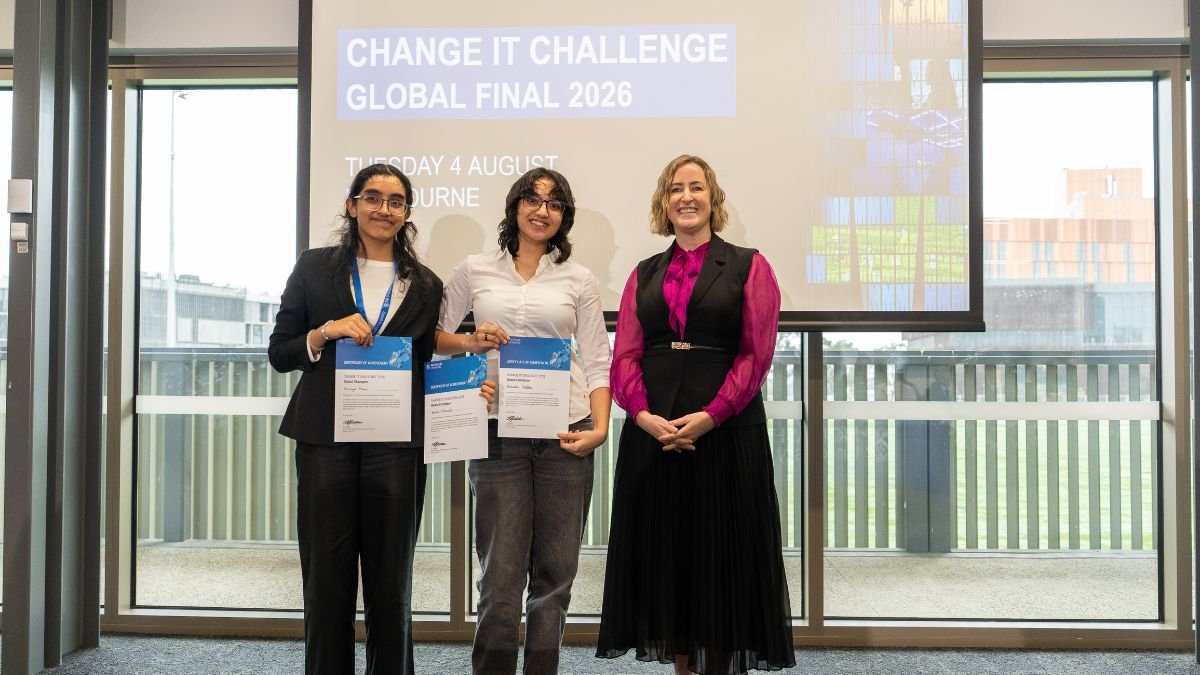
For thousands of people living with limb loss in India, getting a prosthetic limb can remain out of reach because of cost and limited access. Vidushee, Shravya and Shloka, students of Mallya Aditi International School in Bengaluru, have developed a material that they believe could help make some prosthetic components more affordable. Their project, Reviv3D, uses a composite made from recycled plastic, bagasse and basalt. The students say the material is stronger than some fibreglass alternatives, considerably cheaper and recyclable.
The project has now won the global finals of Monash University’s Change It Challenge in Melbourne, giving the students an international platform to present their approach to an issue that sits at the intersection of healthcare, materials science and sustainability.
A Shortage Shaped By Cost
Access to a prosthetic limb is not determined only by whether the technology exists. Its cost, availability and suitability for an individual’s needs can determine whether a person is able to obtain and use one. The competition material cites around 23,000 amputations annually in India and notes that many people do not receive prosthetic limbs because of their cost.
India has developed several approaches to making prosthetic technology more accessible. The Jaipur Foot, for example, became widely recognised for providing relatively low-cost prostheses designed around local requirements.
Reviv3D approaches the problem from another direction: the material itself. The students asked whether materials that are readily available as waste could be combined to produce a strong, functional and lower-cost material for prosthetic applications.
Reviv3D: Three Waste Materials, One Composite
Reviv3D combines three main inputs. Recycled plastic forms the polymer component of the material. Bagasse, the fibrous residue left after sugarcane or sorghum is crushed to extract its juice, provides plant-based reinforcement. Basalt, sourced from stone-crushing waste, adds another reinforcing component. Together, these materials form a composite. The principle behind a composite is to combine materials with different properties so that the final product can perform better than its individual components might on their own.
Bagasse has been studied as a natural fibre for reinforcing composite materials, while basalt is valued for properties such as strength and stiffness. The students’ work brings these materials together with recycled plastic for a potential use in prosthetic technology.
Their stated aim is to produce a material that can offer the required strength at a substantially lower cost than some conventional alternatives.
An Environmental Solution Alongside a Healthcare Problem
The project also has a second dimension. Each of the materials used in Reviv3D comes from a waste stream or a material that can otherwise have limited value after its primary use. Plastic waste is one of India’s persistent environmental challenges. Agricultural residues such as bagasse are generated in large quantities, while stone-crushing produces substantial quantities of mineral waste.

Using such materials in a new composite creates the possibility of turning waste into a resource. This idea is central to the circular economy: rather than following a linear model in which materials are extracted, manufactured into products and eventually discarded, materials are kept in use for as long as possible.
Reviv3D does not solve the plastic or industrial-waste problem by itself. But it demonstrates how a waste material can be considered as an engineering input rather than simply something that needs to be disposed of. That becomes particularly interesting when the resulting product is intended for a socially important application.
Why the Material Matters
For a prosthetic application like Reviv3D, affordability cannot come at the expense of performance. A prosthetic component may be exposed to repeated loads and movement over long periods. The material therefore needs to withstand mechanical stress while remaining light and durable.
That means the students’ claims about strength and cost will need to be tested systematically. Further research would need to examine properties such as tensile and compressive strength, fatigue resistance, impact resistance, weight, flexibility and durability. Researchers would also need to establish whether the material can be manufactured consistently at scale.
The conditions in which a prosthetic is used can also affect material performance. Exposure to moisture, temperature changes and repeated mechanical stress can alter materials over time. If Reviv3D progresses towards medical use, additional safety testing, clinical evaluation and regulatory approval would be required.
The information released by Monash does not indicate that the material has undergone clinical trials or received regulatory approval. It is therefore more accurate to describe Reviv3D as a student-developed material innovation with potential for further research, rather than as an already validated prosthetic technology.
From Bengaluru to Melbourne
The project Reviv3D was developed by Vidushee, Shravya and Shloka at Mallya Aditi International School. Their work progressed to the global finals of Monash University’s Change It Challenge, which brings high school students together to develop solutions to real-world problems.
Vidushee and Shravya represented the team at the Melbourne final, while Shloka was unable to attend. The judging panel, led by Monash University Executive Director of Student Recruitment Amy Gledden, praised the team’s problem-solving abilities, scientific approach and human-centred design.
As part of the programme, the students attended academic sessions, visited Monash’s Clayton and Caulfield campuses and interacted with researchers.
For Vidushee and Shravya, the experience also offered an opportunity to develop the project further. They said the competition helped them strengthen their research, communication and teamwork skills and encouraged them to explore how their work could contribute to more affordable healthcare.
What Needs to Happen Next?
Winning the competition is an important milestone, but determining whether Reviv3D can become a practical prosthetic material will require further research. The first step would be rigorous laboratory testing to establish how the composite behaves under different mechanical conditions. Researchers would then need to examine manufacturing, cost, durability and the specific prosthetic components for which the material might be suitable.
There is also an important question about who would use the technology and how it would be produced for them. Prosthetic devices often require individual fitting and adjustment, so affordability depends not only on the raw material but also on manufacturing, design, fitting and follow-up services.
These are challenges that the students’ prototype cannot answer on its own. But Reviv3D begins with an important idea: a healthcare problem does not always require a solution from a single field. Here, materials science meets assistive technology, while waste materials become part of the search for a more affordable solution. The project does not yet establish that recycled plastic, bagasse and basalt can replace existing prosthetic materials. That will depend on further testing.
What the three students have demonstrated is that a question about access to healthcare can lead to another question about how we use the materials around us—and whether some of what we call waste could instead become part of the solution.



Society
Digital Detox: Why Taking a Break From Screens Matters
A digital detox can help children and adults reduce screen dependence, reconnect with nature and relationships, and create space for reflection and creativity.


Technology
What is AGI? AI’s Next Era: When Machines Start Taking on the Work
As AI systems move from answering prompts to handling complex, multi-step tasks, the boundary between today’s AI agents and the broader idea of artificial general intelligence is becoming harder to ignore. This article examines what AGI means, how autonomous AI is changing knowledge work, and what the shift could mean for India.

The next phase of artificial intelligence is taking shape inside the companies building it. AI agents are being trained to handle hours-long assignments, while researchers are using AI to write code, investigate technical problems and help develop the next generation of AI systems. AGI generally refers to an AI system capable of learning, reasoning and applying knowledge across a broad range of tasks, rather than being limited to a narrow set of functions.
There is no universally accepted definition or test for AGI, so there is still no agreed threshold for declaring that a system has reached it. But many jobs gradually moving into automation, pushing thousands into uncertainty might help us understand the whole story.
OpenAI says more than 70% of sampled Codex users in May 2026 asked the coding agent to handle tasks estimated to take more than an hour. About a quarter made at least one request estimated at more than eight hours. Anthropic reported in August that Claude was leading 26% of the AI research and development work covered by its internal measurement system, compared with less than 1% in February. Both figures come from the companies themselves and are not measures of the wider economy.
For most people, AI is still something they consult. Ask a question, get an answer. Give it a document, get a summary. Ask for code, get code. That model is changing. The newer systems can take an assignment, break it into steps, use software and other tools, check their progress and continue working with less human intervention.
What happens when AI can handle much more of the work itself? That question sits at the heart of the debate over artificial general intelligence, or AGI.
From Prompts to Assignments
A programmer can ask AI to write a function. An agent can be given a larger job: inspect an existing project, build a feature, run tests, find problems and make corrections. The AI is handling a sequence of tasks rather than producing one answer. That distinction could eventually change how many kinds of knowledge work are organised.

AI is Helping Build AI
Frontier AI companies are already making the change clear. OpenAI says it has developed an “automated research intern” capable of performing defined research tasks under human direction. The company says it is working towards an automated AI researcher by March 2028.
Anthropic’s August figures point in the same direction. The company says Claude is increasingly being used in its own AI research and development, although it remains dependent on human researchers and is not fully autonomous in the measured work. AI is helping researchers build better AI.
So, When does AGI Arrive?
Researchers disagree about the capabilities AGI should demonstrate, and no accepted test exists. Google DeepMind CEO Demis Hassabis said in May that he expected AGI could arrive within roughly four years, possibly sooner. If an AI can research a subject, analyse data, write software, use several digital tools and complete a complex assignment, how much of that work still needs to be done by a person? Work will change before we have an answer.
A researcher could delegate a literature review and data analysis. A programmer could hand over an entire software feature. Some tasks may disappear from jobs. Others may become faster. New work will emerge around supervising, testing and governing AI systems.
India is Preparing for the Shift
India is investing heavily in the infrastructure needed for the next phase of AI. The IndiaAI Mission has an approved outlay of ₹10,371.92 crore over five years. The government said in August 2026 that more than 45,000 GPUs had been onboarded through its shared computing programme and 237 projects had accessed subsidised capacity. Twenty indigenous foundation-model proposals had also been selected from 506 applications.
AI systems need to work across Indian languages and very different economic and institutional settings. OpenAI announced an India initiative with Tata Group in February covering areas including AI infrastructure and local capability. Google DeepMind has partnered with Indian institutions on applications in science, education, agriculture and energy.
It becomes harder when an AI system spends hours researching, writing code, analysing information and making decisions before presenting a result. The human role will increasingly involve setting the objective, judging evidence and deciding when a system should be trusted. AGI remains undefined, and nobody can put a reliable date on its arrival. But the shift towards more autonomous AI is already visible.
Technology
India’s AI Moment Rests on More Than Code
India has assembled many of the building blocks of an AI economy: capital, talent, research and startups. But its next phase will depend as much on chips, electricity, skills and policy as on software, exposing the gap between rapid growth and the systems needed to sustain it.

India’s AI ambitions are now reflected in global rankings, investment flows and Bengaluru’s emergence as a lead ing innovation hub. Yet the numbers reveal only part of the story. Much of the hardware is imported, demand for skilled workers continues to outpace supply, and the infrastructure pow ering AI faces growing pressure. The country’s next challenge is no longer adopting AI, but building the industrial and social foundations that can sus tain its growth.

The Hardware Production Gap
The IndiaAI Mission has deployed over 38,000 GPUs and TPUs across domestic data centres. Registered startups and researchers can access this compute at ₹115–150 per GPU hour, roughly 42% cheaper than com mercial cloud rates. The governmentplans to scale this to 100,000 GPUs by December 2026. Not one of these chips is made in India. Every GPU in that stack is sourced from the same export controls that cut China off from this hardware exist as legal authority that could, under different political conditions, apply to India too.
A US India trade framework announced in February this year includes language protecting India’s chip access, but it depends on ongoing political align ment. Budget 2026–27 allocated ₹8,000 crore to the semiconductor and display manufacturing ecosystem programme, the largest single-year outlay since the mission launched, with a separate ₹1,000 crore for India Semiconductor Mission 2.0. The Tata PSMC fabrication plant at Dholera is targeting trial production by late 2026. But these plants are not building AI grade chips.
India’s Sovereign AI
At the IndiaAI Impact Summit 2026, three models were introduced: Sarvam AI, BharatGen, Gnani.ai. BharatGen has assembled over 15,000 hours of annotated voice data across 22 Indian languages. Sarvam’s Vision model, a 3-billion-parameter doc ument intelligence system, scored 84.3% on a standard OCR benchmark, outperforming Google Gemini 3 Pro (80.2%) and OpenAI’s GPT 5.2 (69.8%). Bhashini-v2, launched in early 2026, offers AI-powered translation across all 22 scheduled Indian languages and serves 140 million users on the MyGov platform. India is constructing the language of sovereignty. Indigenous models, na tional compute, and mission branding. But the engine underneath runs on hardware it cannot make and may not always be allowed to import.
The Jobless Economic Growth
India’s IT sector has long been the engine of middle-class stability, con tributing about 7.3% to GDP, employing over 5.8 million people directly, and creating the white-collar jobs that drove spending across housing, edu cation, and retail. That engine is under pressure from the same technology India is racing to lead. Particularly for mid-level coding, BPO, and testing roles that form the bulk of jobs in India. TCS announced 12,000 layoffs in 2025; Infosys and Wipro followed. Across the sector, jobs have been cut in what companies call strategic realignment.
NITI Aayog’s October 2025 report projected that in a worst-case sce nario headcount could fall to 6 million by 2031. In April 2026, global equity re search firm Bernstein wrote an open letter to Prime Minister Modi warning that India’s 10 to 15 million IT services, GCC, and BPO workforce faces direct exposure to AI-driven automation. Sonal Varma, chief economist for India and Asia ex-Japan at Nomura, said: “Entry-level routine jobs are being displaced, and mid-level jobs are transforming. India needs to create about 8 million jobs annually.’’
Skill Set for the Emerging Sector
AI DevOps engineers, data centre operators, ethical AI auditors are the major emerging roles. But they require skill sets entirely different from the mass-hiring model that built the IT sector. An IIM-Ahmedabad study found that 68% of white-collar work ers fear automation within five years; 55% have adopted AI tools, but only 48% have received any training. India produces over 1.5 million engineering graduates annually but ranks 18th globally in skills alignment and 73rd in human capital in terms of AI. Graduate volume is not the same as workforce depth.
In that way adoption without re skilling becomes exposure to disrup tion dressed up as progress. NASSCOM projects that the broader AI push could generate 750,000 jobs and add $500 billion in economic value by 2030. Whether they reach the workers being displaced depends on whether India can close the gap between how many people it trains and how well it trains them. It is a gap that every major index in 2026 has documented and none has resolved.
The Climate Bill
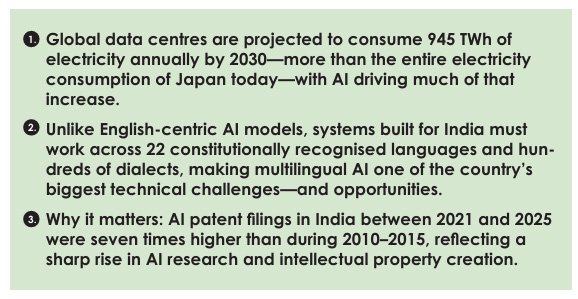
There is a cost to India’s AI ambitions that doesn’t appear in invest ment announcements is the physical climate risk accumulating around the infrastructure meant to run it all. A report by climate risk consul tancy assessed 2,595 planned data centres worldwide, examining risks of direct physical damage from climate hazards, operational disruption from extreme heat.
For India, the country ranks 11th globally in physical climate risk to planned data centre infrastruc ture. The more concerning finding is where that risk concentrates. Tamil Nadu, Telangana, and Karnataka, three of India’s major data centre corridors are among the top 30 regions globally for projected operational disruption from extreme heat. South Asia as a whole has one of the highest pro portions of high-risk planned facil ities globally, with risk projected to increase sharply toward the end of the century.
Data centres require large-scale cooling to keep servers running. Rising ambient temperatures increase cooling costs, strain electricity grids, and raise the probability of outag es. Countries including India, Brazil, Mexico, Indonesia, and Spain already record some of the highest projected operational disruption risks from heat globally, with more than 75% of anal ysed facilities classified as high risk. Productivity losses become ten times higher with indirect risks like power outages, water shortages, infrastructure failures.
India’s data centre ecosystem is concentrated in heat-exposed regions with al ready-strained urban infrastructure. Future vulnerability can be reduced by adequate planning during site selection, engineering standards, and resilience investment. Microsoft has committed $17.5 billion to Indian data centre expansion. Google is building a hub in Andhra Pradesh with a $15 billion commitment. Amazon has pledged $48 billion through 2030. At this stage, planning choices that are made now determine the risk profile for the next three decades. India has no mandatory national standard governing data centre siting or construction for climate resilience. This gap is no longer a future problem.
Where the Momentum Meets Reality
The 190% growth in Bengaluru’s ecosystem, the indigenous models outperforming global benchmarks, the public compute infrastructure being built at scale are all substantiated achievements. The QS Index gives In dia a perfect score of 100 on economic capacity and ranks it fifth globally in the “Future of Work” category. “The IndiaAI Mission represents substan tive, measurable progress, not merely a policy optics exercise.”
But the gaps are structural. The top ten Indian cities account for nearly half of all AI users while representing less than 10% of the population. The choices being made about who controls the technology, who gets the jobs, who bears the risks will deter mine whether this moment becomes something real or just another set of promises that get quietly shelved. What happens in policy rooms and planning offices will have to answer it.


Earth is Heating Up: The Economic Cost of a Rising Sea

Digital Detox: Why Taking a Break From Screens Matters

When a Village Walks Together, Even Drought Is Defeated. How Halma Breathed Life Back into Kesarpura’s Pond

100% Access in China, 5% in South Sudan: The Global Electricity Gap

India to Push Indian Sign Language Into Everyday Life

From Scams to Screens: How the National Stock Exchange Rewrote India’s Equity Story

Farmers Borrowed to Build ‘Diggis’. Two Years Later, They Are Still Waiting for the Subsidy

Aim for the Stars: Anjali Thomas’s Journey from a Small College in Kerala to the Frontiers of Medical Imaging

When the Himalayas Collapse Without Warning, What Counts as Preparedness?

Anxiety Freezes Career Decisions. Curiosity Unfreezes Them

-

 Math2 months ago
The 2026 Fields Medals: Four Proofs, Four Decades-Old Problems Solved
-

 Climate2 months ago
After Kerala’s Deadliest Landslide, the Hardest Thing to Rebuild Was Childhood
-

 Society3 months ago
West Asia Crisis: Can Kerala’s Returning Gulf Migrants Find a Future in the Green Economy?
-

 Space & Physics4 months ago
India Semiconductor Mission: ‘It’s Not About Fabs. It’s About Building An Entire Ecosystem’
-

 Interviews3 days ago
From Scams to Screens: How the National Stock Exchange Rewrote India’s Equity Story
-

 Climate4 months ago
The Climate World Cup? How Climate Change Could Affect Player Performance at the 2026 World Cup
-

 Society3 months ago
What Is Civilisational Diplomacy? Understanding India’s Newest Foreign Policy Tool
-

 Society3 months ago
From Bell Labs to the Classroom: A Second Career in Teaching