Connect with us

Climate

Climate Change, Not El Niño, Is Driving Global Coral Bleaching, New Study Finds

Human-caused climate change—not El Niño—is driving global coral bleaching, according to a new Oceanography study that warns reefs face escalating risks.


Joe Jacob

Published

on

Why Human-Caused Warming Is Driving Coral Bleaching
Coral reefs are among the world's most biodiverse ecosystems but are increasingly threatened by rising ocean temperatures driven by climate change. Image credit: Francesco Ungaro /Pexels

Nearly every global coral bleaching event over the past four decades would not have occurred without human-caused climate change, according to a new study published in Oceanography. Researchers found that while El Niño can intensify ocean warming, fossil fuel-driven climate change has been the decisive factor behind mass bleaching events since 1998. The findings suggest rising global temperatures—not natural climate variability—are now the dominant threat to coral reefs and the millions of people who depend on them.

Nearly every mass coral bleaching event of the past four decades would not have happened without human-caused climate change, according to new research published in the journal Oceanography — a finding that upends the common assumption that El Niño is the primary trigger behind the world’s worst reef die-offs.

The study, led by Climate Central, examined the four global bleaching events recorded since 1998 — in 1998, 2010, 2014–2017, and 2018–2025 — periods that have typically been associated with El Niño’s warming influence on the Pacific Ocean. Researchers found that fossil fuel-driven ocean heat, not the natural climate cycle, was the fundamental force behind the bleaching and coral mortality in each case.

Climate Change Is Driving Global Coral Bleaching,

Scientists used a multi-model extreme event attribution method — a technique that isolates how much of an observed climate event can be traced to human-caused warming versus natural variability — to assess climate change’s influence on sea surface temperatures. They then layered those results onto the coral bleaching risk model developed by NOAA’s Coral Reef Watch program to calculate how much of the observed bleaching risk was attributable to each factor.

The results were stark for the most recent and most severe event. During the 2018–2025 bleaching event, the analysis found there would have been essentially no coral bleaching — and certainly no global-scale event — in a world without human-caused climate change. Of the 71 regions where bleaching was observed during that period, only one would have faced even a moderate bleaching risk absent climate change. Researchers found similar results across all of the other three global events: in each case, climate change was necessary to push ocean temperatures over the threshold at which bleaching occurs.

“Our study shows that without climate change, coral bleaching would be a rare and isolated event, and global mass coral bleaching simply would not occur,” said Andrew Pershing, Chief Program Officer at Climate Central and the study’s lead author. “Millions of people and entire countries rely on healthy coral reefs for livelihoods and food security. But our emissions of carbon pollution are causing increasingly widespread damage and death to these vital and vibrant ecosystems. Without immediate emissions reduction, coral reefs as we know them will disappear.”

What it means for the El Niño underway now

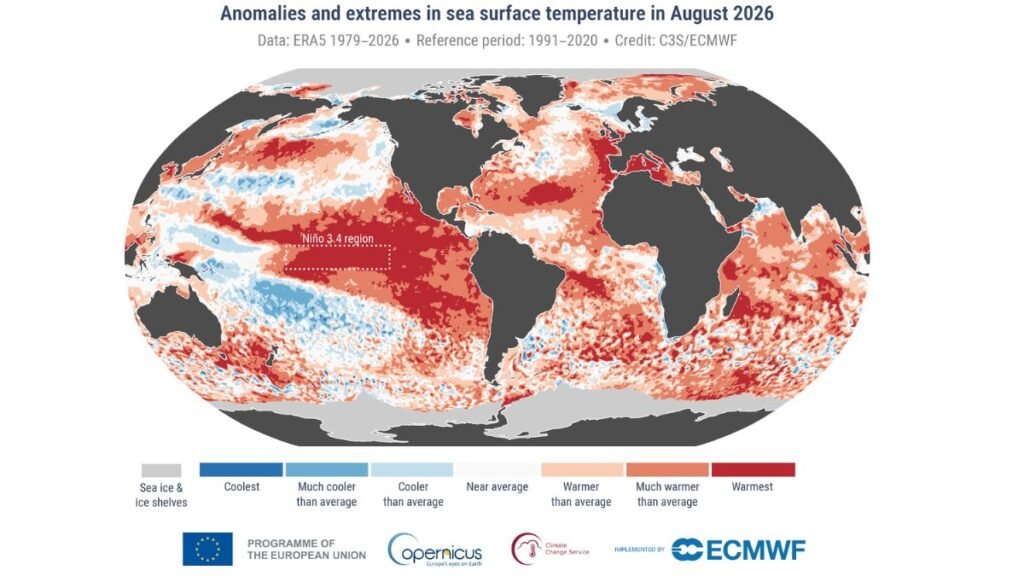
Using the same methodology, the researchers also modeled bleaching risk for the El Niño event currently underway, which began in 2026. They project that while natural El Niño-driven warming could produce low levels of bleaching risk in a handful of regions, human-caused climate change is likely to drive bleaching more broadly across the globe — with the southern Caribbean, the Central and South American coasts, and the coasts of eastern Asia identified as particular hotspots.

The researchers argue the finding matters because public discussion of bleaching events tends to focus on El Niño rather than the underlying warming trend. That framing, they say, is likely to become increasingly inaccurate: under current warming rates, the study concludes that rising temperatures driven by human-caused climate change will outweigh El Niño’s contribution in every coral-containing region on Earth by 2028.

A narrowing window for reefs already under strain

The paper adds to a growing body of evidence that coral reefs, despite some documented capacity to adapt to warmer conditions, remain at escalating risk. Absent a reduction in carbon emissions, the study’s authors conclude, continued ocean warming raises the likelihood that reef ecosystems as they currently exist could disappear permanently.

Coral reefs cover a small fraction of the ocean floor but support an outsized share of marine life, and provide fisheries, coastal protection, and tourism revenue that hundreds of millions of people depend on directly.

Climate

South India to Develop India’s First Personalized Heat Health Risk Tool

Researchers in South India are developing a personalised heat health risk tool that could improve heat warnings by linking environmental conditions with individual health risks.

Published

on

A farmer managing heat health risks under a black umbrella in a sunny field in South India.
Protecting heat health during intense summer waves: A South Indian farmer uses an umbrella and damp cloth to prevent heat-related illnesses in the field. Representational image. Image credit: Ferdous Hasan/Pexels

India’s response to extreme heat is entering a new phase. As climate change intensifies heat stress across the country, researchers are moving beyond forecasting temperatures to understanding how heat affects the human body. A new four-year study in Tamil Nadu and Karnataka hopes to answer that. Researchers are working to develop what could become India’s first personalised heat health risk tool—one that combines weather data with physiological and health information to identify who faces the greatest risk during extreme heat.

The heat health impacts of are already being felt in ways that go beyond heatstroke and dehydration, affecting everyday aspects of life, including sleep and well-being. Climate Central estimates that people across southern India lose 78 to 91 hours of sleep each year because nights remain too warm, with eight to nine hours directly attributable to climate change. In a separate analysis, the organisation also identified Tamil Nadu as India’s most affected state by rising humid heat, highlighting the growing burden of hotter, more humid conditions on heat health.

The findings are expected to strengthen Heat Action Plans and support the development of a location-specific early warning application. The initiative is led by the M.S. Swaminathan Research Foundation (MSSRF) in collaboration with the governments of Tamil Nadu and Karnataka, the Indian Institute of Science (IISc), the Schizophrenia Research Foundation (SCARF), and two Indian Council of Medical Research (ICMR) institutes—the National Institute of Traditional Medicine in Belagavi and the National Institute of Epidemiology in Chennai.

The Same Heat, But Different Heat Health Risks

Heatwave alerts issued by the India Meteorological Department (IMD) are based on temperature thresholds. While they warn people when dangerous conditions are expected, they cannot capture how differently heat affect an individual’s hea.

An elderly person in a poorly ventilated home, a sanitation worker outdoors for hours and an office employee in an air-conditioned building may experience the same day’s temperature, but not the same health risks. Humidity, air pollution, housing, occupation, age and existing illnesses all influence how the body responds to heat.

Heat health risk tool in south india
Outdoor workers carry heavy loads in full sun, highlighting the intense heat health risks faced by laborers during extreme weather conditions. Representational image. Image Credit: Rakib Hasan Redoan/Pexels

The need to understand these differences is growing. In its seasonal outlook for April to June 2026, the IMD forecast above-normal heatwave days across parts of east, central and northwest India, as well as the southern peninsula. It also warned that maximum temperatures in several regions would range between 40°C and 44°C, with some areas likely to record temperatures more than 5°C above normal.

Children, older adults, outdoor workers and people living with chronic illnesses are expected to be among the most vulnerable.

Studying Heat Inside and Outside the Home

The research will cover Perungudi in Chennai and Poompuhar in Mayiladuthurai district in Tamil Nadu, along with Sirwar in Raichur district and Challakere in Chitradurga district in Karnataka. Around 1,200 households will participate, with data collected during both summer and non-summer months to compare seasonal changes in heat health.

Weather monitoring systems at each site will continuously record temperature, humidity, air quality and pollution levels. Selected participants will also wear digital watches that track their surface body temperature, helping researchers compare environmental conditions with the body’s physiological response.

The study will examine physical and mental heat health impacts, document how households cope with prolonged heat and estimate how much heat stress is associated with even a one-degree rise in environmental temperature.

According to MSSRF Chairperson Dr. Soumya Swaminathan, the goal is to generate detailed evidence on heat’s health impacts so government departments can better target interventions.

Researchers will also assess how prepared healthcare facilities—from primary health centres to tertiary hospitals—are to manage heat-related illnesses, an area that has received relatively little attention.

Rethinking Heat Action

One of the study’s key outcomes will be a personalised heat-impact metric for individuals, households and communities, along with a location-specific early warning application that translates scientific findings into practical risk information.

The research marks a shift in India’s approach to extreme heat. Rather than focusing only on forecasting high temperatures, it seeks to understand how heat affects different people under different living conditions. The findings could help governments refine Heat Action Plans, improve healthcare preparedness and direct resources towards populations facing the greatest risk.

As heatwaves become more frequent, predicting where temperatures will rise is only part of the challenge. Understanding who is most vulnerable could prove just as important.

Continue Reading

Climate

After Kalladi, Meppadi’s Biggest Fear Still Looms Above the Hill

A landslide at the Kalladi tunnel project has renewed fears in Meppadi, where residents say every monsoon brings uncertainty. Experts explain why fragile geology, changing rainfall and human interventions are increasing landslide risks.

Vaishnavi V S

Published

on

Excavated soil covered with blue tarpaulin at the Anakkampoyil–Kalladi tunnel construction site in Meppadi, Wayanad, where residents fear landslide risks during the monsoon.
A large mound of excavated soil covered with tarpaulins remains on the hillside above the Anakkampoyil–Kalladi twin-tunnel project in Meppadi, Wayanad. Residents say the slope has become a source of anxiety during every monsoon following the July 2026 Kalladi landslide. Photo: Vaishnavi VS/EdPublica

Every monsoon, residents of Kalladi in Wayanad look not at the rain, but at the hill above their homes. Two years after the Chooralmala tragedy, Kalladi landslide has reignited questions about whether fragile landscapes, climate change, and development are together creating an increasingly dangerous future.

MEPPADI (WAYANAD, KERALA): Every monsoon begins with a Look Up. When the rain begins, Nishal no longer watches the road outside his house. He watches the hill. A massive mound of excavated soil sits on the slope above his village in Kalladi, a hamlet in Meppadi panchayat in Kerala’s Wayanad district, where work on the Anakkampoyil–Kalladi–Meppadi twin-tunnel project is underway. It has sat there since the earth was excavated for the project, and with every spell of rain, it has become the first thing residents look at.

“People are scared to live here,” Nishal says. “The soil was kept there so it could be used later for construction. But once the monsoon arrives, we don’t feel safe anymore. If it isn’t managed properly, another disaster could happen.”

His fears are rooted in recent memory.

On July 7, 2026, a landslide swept through the tunnel construction site, killing eight workers. Although the disaster was far smaller than the Chooralmala-Mundakkai landslides that devastated Meppadi in July 2024, it reopened a question many thought would have been answered after that tragedy, two years ago: how safe are the hills people continue to live beneath?

A house stands below the Anakkampoyil–Kalladi tunnel construction site in Meppadi, Wayanad, where July 2026 landslide and stored excavated soil have heightened fears of future slope failures.
A house located below the Anakkampoyil–Kalladi–Meppadi twin-tunnel construction site in Kalladi, Wayanad. Residents living beneath the excavated hillside say every spell of monsoon rain renews fears of another landslide after the July 2026 disaster that claimed eight lives. Photo: Vaishnavi VS/EdPublica

The Landslide Changed the Questions

For Roshna, a former Block Panchayat member who lives near the construction site, the latest landslide has made every rainy day uncertain again.

“I am 56 now. If something happens to my house, I cannot build another one,” she says.

She is not opposed to the tunnel project. Few residents say they are. What worries them is whether the landscape has been made more fragile than it already was.

After the landslide, a committee was appointed to study how the excavated soil stored on the hill could be removed safely. Residents say experts have suggested reducing the height of the mound gradually instead of removing it all at once.

“I only want the issue to be handled properly,” Roshna says. “The project should be completed safely.”

More Than Just Heavy Rain

The Kalladi landslide has also drawn attention because it did not unfold under the same conditions as the Chooralmala disaster.

Scientific studies on the 2024 landslides show that Chooralmala was preceded by nearly two weeks of persistent rainfall that progressively saturated the slopes before they failed. That prolonged rainfall was a crucial factor behind the scale of the disaster.

Prof. S. Abhilash, Head of the Department of Atmospheric Sciences, Cochin University of Science and Technology say the situation at Kalladi was different.

“Landslides are not caused by the rainfall received on a single day,” he says. “What matters is antecedent rainfall. When rain continues over several days, the soil becomes saturated. At that stage, even another 20 or 30 millimetres of rain can trigger a landslide.”

That is why, he says, rainfall alone cannot explain the Kalladi incident. The geology of the slope and the way the landscape has been altered also need to be understood. He argues that replacing native deep-rooted trees with coffee and tea plantations, which have shallower root systems, has made the slopes more vulnerable to landslides.

Why Meppadi Keeps Failing

The hills around Meppadi have always been vulnerable.

The Western Ghats are among the oldest mountain systems in the world. Millions of years of weathering under the southwest monsoon have weakened the rocks beneath Wayanad. Above them lie thick layers of weathered soil. In places such as Meppadi, the terrain is further weakened by steep slopes, fractured rocks, foliated joints and geological lineaments.

“Meppadi has historically remained a landslide-prone area,” says Prof. S. Abhilash. “Not every high-hazard zone experiences repeated landslides, but this landscape has all the conditioning factors that make slope failure more likely.”

The record bears that out. In 2019, a landslide at Puthumala, another settlement within Meppadi panchayat, killed 17 people, five years before Chooralmala. Kalladi is now the third major landslide to strike this one panchayat in seven years. The Geological Survey of India estimates that nearly 19,301 sq. km, or 49.7 per cent of Kerala, falls within landslide-prone terrain, with Wayanad among the districts facing the highest risk — GSI assessments put 51 per cent of Wayanad and 74 per cent of Idukki on mountainous slopes classified as landslide-prone. Kerala recorded 2,239 major landslides between 2015 and 2022, the highest of any state in the country, according to Union government data.

A Changing Monsoon Meets an Old Landscape

The vulnerability of the hills is now intersecting with a changing climate.

Prof. Abhilash says the warming southeastern Arabian Sea is altering the behaviour of rain-bearing clouds over Kerala. Vertically developed cumulonimbus clouds that once discharged much of their moisture over the sea are increasingly moving inland. Over the past decade, northern Kerala has witnessed more frequent episodes of intense rainfall, contributing to flash floods and landslides.

But climate alone does not explain what is happening.

“The trigger may be rain,” he says, “but whether a slope fails depends on the condition of the landscape.”

Where Development Meets Risk

That is where residents believe the conversation should now shift.

Prof. Abhilash says replacing native forests with plantations, cutting roads through hillsides and excavating the base of slopes without adequate stabilisation can all increase landslide risk. In Kerala’s weathered mountains, where thick soil rests on fragile bedrock, even relatively small disturbances can destabilise a slope.

“The tunnel project is not the problem,” he says. “The question is whether the site was geologically suitable.”

He argues that infrastructure in fragile mountain regions should be preceded by detailed geological investigations, slope stability assessments and rigorous environmental impact studies rather than relying on engineering models developed for very different terrains.

Waiting for the Next Rain

After the Kalladi landslide, Dilip Buildcon Ltd — the construction company Konkan Railway Corporation awarded the tunnel project to in June 2025 — announced ₹6 lakh as immediate assistance to the families of its seven employees who died in the incident. The family of a contract worker was offered ₹5 lakh, while the Kerala government announced an ex gratia of ₹5 lakh for each bereaved family.

For Nishal and his neighbours, however, compensation is not what occupies their thoughts.

What they see every day is the mound of earth still overlooking their homes.

It is not simply excavated soil. It is a reminder that, in Meppadi, recovery is measured not only by rebuilding after a landslide, but by whether people can trust the hillside above them again.

Continue Reading

Climate

Heavy Rain Slows Rescue as Flash Floods Devastate Parts of Jammu and Kashmir

Days of intense monsoon rain triggered flash floods and landslides in Jammu and Kashmir’s Poonch and Rajouri districts, killing at least 14 people and damaging homes, schools and roads. As rescue teams battle continuing rain and blocked access routes, the India Meteorological Department has warned of more heavy rainfall, raising the risk of fresh floods and landslides.

Published

on

Aerial view of floodwaters inundating homes and roads after heavy rainfall, representing the impact of flash floods in Jammu and Kashmir.
Floodwaters inundate residential areas following heavy rainfall, highlighting the impact of flash floods on communities. Representational image. Image credit: Imad Clicks/Pexels

Flash floods in Jammu triggered by days of intense monsoon rain have pushed parts of the Union Territory into a humanitarian crisis. Torrential rain unleashed flash floods and landslides across Poonch and Rajouri districts, killing at least 14 people, damaging homes and schools, and cutting off several remote settlements. With the India Meteorological Department forecasting more heavy rainfall over the next two days, authorities fear rescue and relief operations could become increasingly difficult.

Search Continues Amid Difficult Conditions

Rescue operations entered their second day on Monday, with teams from the National Disaster Response Force (NDRF), State Disaster Response Force (SDRF), the Army, police and civil administration searching for those still missing and assisting residents stranded in flood-hit villages.

However, continuous rain, waterlogged roads and fresh landslides have slowed the operations. In several places, debris, damaged roads and overflowing streams have prevented rescue teams and heavy machinery from reaching affected villages, forcing personnel to proceed cautiously in difficult terrain.

Officials said the death toll could rise as search efforts continue in remote areas that remain inaccessible, while authorities work to restore road connectivity and other essential services disrupted by the heavy rain.

Very Heavy Rainfall Triggers Widespread Damage

The India Meteorological Department (IMD) said Rajouri recorded 135 mm of rainfall in the 24 hours ending 8.30 a.m. on July 20, placing it in the ‘very heavy rainfall’ category. The weather system has remained active over the region, and the IMD has forecast heavy to very heavy rainfall across Jammu and Kashmir until July 22, with isolated spells of extremely heavy rainfall likely in some places.

The weather office has also warned of flash floods, landslides, mudslides and shooting stones in vulnerable areas, particularly across the Jammu division. The continuing rainfall has increased the risk of fresh slope failures, making rescue work more hazardous.

Flash floods in Jammu
Residents navigate fast-flowing floodwaters after heavy rain, illustrating the risks of flash floods in vulnerable regions. Representational image. Image credit: Павел Хлыстунов/ Pexels

Flash Floods in Jammu: Homes, Schools and Public Infrastructure Affected

The floods have caused extensive damage to homes and public infrastructure. According to the administration’s preliminary assessment, more than 100 houses have been damaged across the affected districts.

The disaster has also disrupted education. Around 24 school buildings have sustained damage, although officials are still assessing the extent of structural loss. Several schools are expected to remain closed until safety inspections are completed.

Road connectivity has also been severely affected. Landslides have blocked key routes, while electricity, drinking water supply and communication services have been disrupted in many villages.

Government Steps Up Response

Chief Minister Omar Abdullah chaired a high-level review meeting in Jammu on Sunday to assess the situation. He directed Deputy Commissioners to closely monitor flood- and landslide-prone areas and ensure rescue teams, machinery and emergency services remain ready for immediate deployment.

He also instructed officials to expedite the restoration of roads, electricity, drinking water supply and communication links, while prioritising efforts to trace missing persons and provide relief to affected families.

More Rain Likely Over the Next Two Days

As extreme weather events become more frequent across India, communities are increasingly living with the aftermath of recurring natural disasters. Weather conditions are expected to remain unfavourable. According to the IMD, heavy rainfall is likely to continue over parts of Jammu and Kashmir until July 22. The forecast has prompted authorities to issue fresh advisories asking people living near rivers, streams and landslide-prone slopes to remain alert and avoid unnecessary travel.

The latest disaster is another reminder of the growing challenges posed by extreme rainfall in the Himalayan region. For now, the focus remains on locating the missing, restoring essential services and reaching isolated communities before another spell of heavy rain arrives.

Continue Reading

Trending