Society
From Bell Labs to the Classroom: Finding Purpose After Retirement
In the previous part of my story, I described how retirement led me to pursue certification as a high school mathematics teacher after my career at Bell Labs.


Second Act is Education Publica’s column on professionals who reinvent themselves after retirement or at major turning points in life. In the previous issue, former Bell Labs researcher Sudhir M. Ambedkar recounted his journey from IIT Bombay and the University of California, Berkeley to nearly three decades of research and innovation at Bell Labs. In this concluding part, he reflects on how retirement opened the door to an equally rewarding second career—as a mathematics teacher, mentor and lifelong learner.
In the previous part of my story, I described how retirement led me to pursue certification as a high school mathematics teacher after my career at Bell Labs. Standing in a classroom for the first time as a teacher marked the beginning of an entirely new chapter in my life.
After completing my certification, I taught mathematics full-time for about seven years. Teaching mathematics in the United States was a new experience for me, and it took some time to adjust to a different way of teaching. While teaching, I learned a few things about some fundamental mathematics concepts that I had never thought about before.
I used a hybrid approach, combining the Indian method and the American method of teaching mathematics. During my tenure as a teacher, I made several observations about the education system where I was teaching, although many of them were generally applicable to the education system in New Jersey as well. I documented those observations in a white paper and sent them to a few education professors at major universities. Some agreed with my observations but said I could not publish the paper in an academic journal because I was not an education researcher.
One observation was the amount of repetition in the curriculum across Algebra I, Algebra II and Pre-Calculus. I felt it would be better to build a stronger foundation in the earlier stages rather than repeat many of the same topics in subsequent courses.
I also noticed that calculators were introduced in very early grades. As a result, many students became overly dependent on them and often lacked the ability to perform mental mathematics. I believe it is important to build a strong understanding of basic mathematical operations and concepts—including addition, subtraction, multiplication, division, fractions and solving equations—before relying heavily on technology.
The mathematics textbooks used in American schools are excellent. They contain colourful illustrations, graphics and worked examples that make concepts easier to understand. At the same time, students often expected teachers to explain every step in detail, rather than working through some of the reasoning independently.

Another aspect that interested me was the grading system. Homework and classwork accounted for a significant portion of students’ grades, while tests and quizzes carried comparatively less weight. In my opinion, this did not always accurately reflect a student’s mathematical skills and knowledge.
The students hardly ever received failing grades, and almost everyone progressed to the next level. On one occasion, I was under pressure to pass a student so that the school could maintain a 100 per cent graduation rate—a highly valued performance indicator.
These observations are not intended as criticism of the education system, but simply to illustrate how it differed from the one I had experienced in India. Bright students always rise to the top in this system as well.
I thoroughly enjoyed teaching, and it was gratifying to see students succeed and gain admission to excellent universities. Unlike research, where results often take years to become visible, I could see the impact of my work immediately.
After about seven years of teaching, I underwent knee surgery. As a result, I gave up classroom teaching and began focusing more seriously on preparing students for the SAT and ACT, the standardised tests widely used for college admissions in the United States.
I worked with two learning centres that referred students to me for SAT and ACT coaching. Over the years, both examinations changed considerably in their format and content, so I had to keep up with those changes and adjust my teaching accordingly.
Initially, I taught students in person. During the COVID-19 pandemic, all instruction shifted to Zoom. Even after the pandemic, I continued teaching online because, since most of my classes were one-to-one, I found Zoom to be both efficient and physically less demanding.
As a result of teaching these examinations, I developed several practical strategies that enabled students to complete the tests accurately within the allotted time. Some students later told me they found these strategies useful not only in the SAT and ACT but also in their regular mathematics and English classes.
I eventually published these strategies as a series of guidebooks on Amazon. The feedback from students and parents has been consistently encouraging.
In terms of years, my teaching career has now lasted about 75 per cent as long as my engineering career. In both professions, I could see the results of my work, but teaching has been more gratifying because I had direct contact with the people who benefited from it.
I expect to continue this second career for as long as possible.
Sudhir M. Ambedkar is a mechanical engineer trained at IIT Bombay and the University of California, Berkeley. He spent nearly three decades at Bell Labs working in telecommunications research and development. After retirement, he became a certified mathematics teacher and now tutors students preparing for the SAT and ACT while authoring test-preparation guides.
Society
Greece Passes Social Media Ban for Children Under 15
Greece’s new law will bar children under 15 from social media from January 2027, adding to international efforts to regulate young people’s access to online platforms.


Climate
Climate Disasters Disrupted Schooling for 171 Million Students in 2025, UNICEF Finds
Climate disasters disrupted schooling for 171 million students worldwide in 2025, highlighting the urgent need for climate-resilient schools and education systems.

Climate-related disasters disrupted schooling for at least 171 million students worldwide in 2025, affecting one in every 10 school-age children, according to a new UNICEF report that warns of growing threats to learning, educational equality and future economic prospects.
The report, Learning Interrupted: Global Snapshot of Climate-Related School Disruptions in 2025, released on September 10, analysed data from 106 countries and territories. It found that storms, floods, heatwaves, droughts and wildfires caused school closures, shortened teaching hours, reduced attendance and shifts to remote learning.
The findings underline how climate change is emerging as a threat to educational continuity, particularly in countries where schools lack the infrastructure and resources to withstand extreme weather.
Storms and floods interrupt learning
Storms were the leading cause of climate-related school disruptions in 2025, affecting 109 million students globally. Floods affected at least 70 million, while heatwaves disrupted schooling for approximately 50 million children. These figures overlap and should not be added together as separate groups.
In Pakistan, severe monsoon flooding in August delayed the return to school for more than 28 million students. In Egypt, a powerful Khamsin wind-and-dust storm prompted a nationwide suspension of classes for one day, affecting more than 28 million students.
The problem extends beyond individual disasters. Forty countries experienced multiple rounds of climate-related school disruptions during 2025, exposing students to repeated interruptions throughout the academic year.
Floods can damage classrooms, sanitation facilities and learning materials, while extreme heat can make classrooms unsafe and undermine students’ ability to concentrate. Even after schools reopen, damaged infrastructure, disrupted transport and household financial pressures can prevent children from returning to regular attendance.
A growing threat to educational equality
Three-quarters of the students affected in 2025 lived in low- and lower-middle-income countries, where education systems often have fewer resources to prepare for disasters and restore teaching afterwards, UNICEF found.
The World Bank’s 2024 report, Choosing Our Future: Education for Climate Action, offers further evidence of the long-term challenge. It estimated that 400 million students globally experienced school closures due to extreme weather between 2022 and 2024. In affected schools in low-income countries, students lost approximately 45 instructional days between January 2022 and June 2024, compared with around six days in high-income countries.
These interruptions can compound existing educational disadvantages. Students from wealthier households may have access to private tutoring, digital devices and alternative learning arrangements. Children from poorer households may lack internet connectivity, electricity or suitable spaces to study during closures.
South Asia’s exposure highlights the challenge
UNICEF’s previous assessment, covering 2024, recorded at least 242 million students experiencing climate-related school disruptions across 85 countries and territories. South Asia was the most affected region, with 128 million students impacted. Heatwaves affected an estimated 171 million students worldwide that year.
India was among the countries affected by heat-related educational disruptions. In April 2024, extreme heat contributed to school interruptions across Bangladesh, Cambodia, India, the Philippines and Thailand, affecting at least 118 million children collectively. The figure represents the five-country group, not India alone.
The 2024 and 2025 totals should not be interpreted as a direct year-on-year decline. The reports covered different sets of countries and climate events, and the number of recorded disruptions depends on the incidents identified in each assessment.
Climate-resilient schools become a priority
UNICEF estimates that disruptions experienced in 2025 could cost affected students at least US$200 billion in lifetime earnings through lost learning and widening educational inequalities. This is a projection of potential future losses, rather than income already lost.
The World Bank has argued that relatively modest investments can help schools adapt. Its 2024 analysis estimated that a one-time investment of US$18.51 per child could help mitigate learning losses through measures such as improving classroom temperatures, strengthening school infrastructure and training teachers.
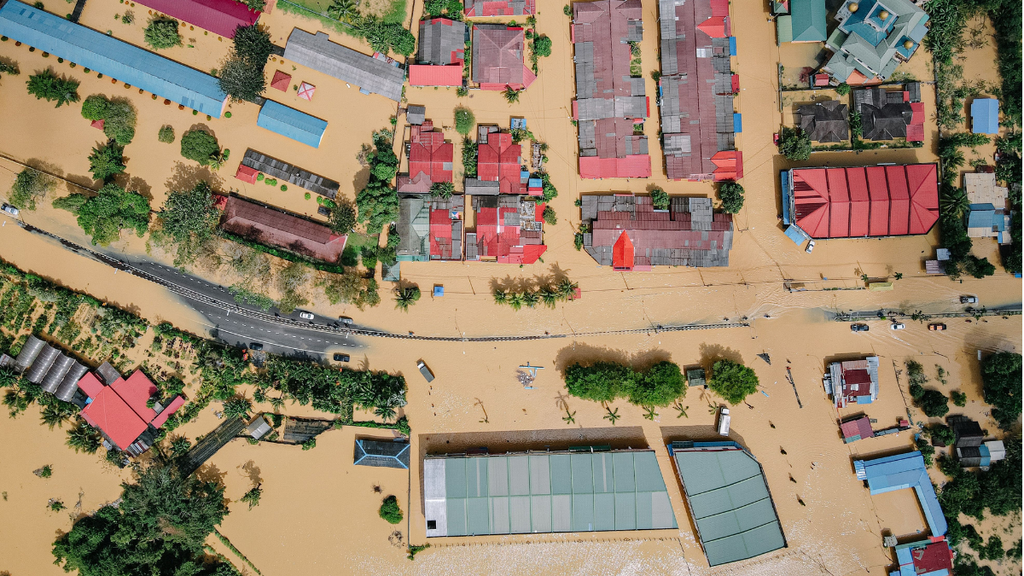
Aerial view showing significant flood damage in a residential neighborhood with inundated streets and homes.Image credit:Pexels
UNICEF is calling for climate resilience to be incorporated into education planning, alongside investment in stronger school buildings, emergency preparedness and systems that allow teaching to continue during disasters.
As extreme weather increasingly interrupts academic calendars, education systems must prepare not only to enrol children but also to protect their ability to learn. Climate-resilient infrastructure, early-warning systems and plans for educational continuity will be essential to ensuring that disasters do not deepen existing inequalities in access to education.
Society
Global Job Market Faces a Growing Inclusion Gap as AI and Digitalisation Reshape Work
Global employment faces a growing inclusion gap as AI and digitalisation reshape the labour market. UN and ILO reports highlight persistent informal employment, youth exclusion and unequal access to the skills needed for emerging jobs.

The global economy is undergoing a profound employment transition, driven by artificial intelligence (AI), digitalisation, demographic changes and the shift towards greener industries. Yet, while these forces are expected to create new career opportunities, access to employment and the benefits of technological progress remain deeply unequal, according to the United Nations’ World Social Report 2026.
Released on October 15, the report, published by the UN Department of Economic and Social Affairs (UN DESA), warns that billions of people remain excluded from the jobs, skills, infrastructure and social protections required to participate in economic transformation. Its findings highlight a central challenge for policymakers: creating employment opportunities is not enough unless people can access them and secure decent working conditions.
The scale of the problem is evident in the report’s latest figures. In 2025, 58 per cent of workers worldwide were informally employed, while 27 per cent of young women aged 15–24 were neither employed nor participating in education or training. An estimated 2.2 billion people also lacked internet access, limiting their ability to benefit from digital services, online learning and emerging employment opportunities.
More Jobs, but Unequal Opportunities
The challenge extends beyond unemployment to the quality and security of work. The International Labour Organization’s Employment and Social Trends 2026 report estimated that global unemployment would remain at 4.9 per cent in 2026, equivalent to approximately 186 million people. However, nearly 300 million workers continued to live in extreme working poverty, surviving on less than US$3 a day. The report also projected that 2.1 billion workers would be in informal employment in 2026, often without adequate social protection or employment security.
Young people face particular difficulties entering the labour market. According to the ILO, youth unemployment reached 12.4 per cent in 2025, while approximately 260 million young people were not in employment, education or training. For many, the transition from education to work remains uncertain, particularly where economies fail to generate enough productive jobs.
These challenges coincide with substantial changes in the kinds of jobs employers expect to need. The World Economic Forum’s Future of Jobs Report 2025, based on projections from more than 1,000 employers, estimates that technological, economic, demographic and green-transition trends could create 170 million jobs globally by 2030 while displacing 92 million. This would produce a net gain of 78 million jobs. However, the report warns that the transition will require extensive workforce adaptation. Nearly 40 per cent of workers’ existing skills are expected to change by 2030, and 63 per cent of surveyed employers identified skills gaps as a major barrier to business transformation.
The projections suggest that the central employment challenge is not simply whether jobs will disappear, but whether workers can move into emerging roles. Demand is expected to grow in areas such as AI, data analysis and cybersecurity, alongside essential occupations in healthcare, education and agriculture. Workers whose skills do not match changing requirements risk being excluded even as new vacancies emerge.
Digital Access and Skills Will Shape the Transition
Access to technology is another dividing line. The World Bank’s Digital Progress and Trends Report 2025 identifies disparities in connectivity, computing infrastructure, relevant data and digital skills as barriers to wider participation in the AI economy. While AI adoption is expanding, high-income countries continue to dominate important areas of AI innovation and computing capacity.

Representational image.Image credit:Pexels
For people without reliable internet access, affordable devices or opportunities to acquire digital skills, the shift towards online recruitment, digital services and AI-assisted work can deepen existing disadvantages. Connectivity alone, however, is insufficient: workers also need relevant training, accessible education and opportunities to apply their skills in productive employment.
The UN report argues that governments must invest in quality education, lifelong learning, digital and AI capabilities, affordable connectivity and stronger social protection. Labour-market policies must also support decent working conditions, equal opportunities and training that helps workers move between occupations.
For developing economies with large young populations, the stakes are particularly high. A growing workforce can support economic growth only when enough productive jobs are available and workers can acquire the capabilities those jobs demand. Without such opportunities, demographic potential can translate into prolonged unemployment, insecure work and widening inequality.


Overshooting 1.5°C Could Trigger Irreversible Damage to Earth’s Ice Systems, Warns UN-Backed Report

India Targets Recognition of One Lakh Tribal Healers. Can It Improve Healthcare and Livelihoods?

India’s Wildlife Reserves Face Changing Fire Patterns, 21-Year Study Finds

New Semiconductor Could Help Make Solar Cells More Efficient, Oxford Study Finds

Europe Braces for Extremes as Commission Unveils Climate Resilience Framework

Knowing When to Think for Ourselves: AI, Intuition and the Education of Discernment

After a Scorching Summer, Delhi’s Children Are Slow to Return Outdoors

Two Chemists Win Nobel Prize for Solving a Century-Old Puzzle: Why Life Picks One Hand Over the Other

Climate Change, Overfishing and the Uncertain Future of Bangladesh’s Hilsa Fishermen

Automated Homoeopathic Dispensing System Receives Indian Patent

-

 Math3 months ago
The 2026 Fields Medals: Four Proofs, Four Decades-Old Problems Solved
-
EP Deep Dive: Data & Solutions3 months ago
After Kerala’s Deadliest Landslide, the Hardest Thing to Rebuild Was Childhood
-
EP Deep Dive: Data & Solutions4 months ago
West Asia Crisis: Can Kerala’s Returning Gulf Migrants Find a Future in the Green Economy?
-
Space & Physics5 months ago
India Semiconductor Mission: ‘It’s Not About Fabs. It’s About Building An Entire Ecosystem’
-
Interviews1 month ago
From Scams to Screens: How the National Stock Exchange Rewrote India’s Equity Story
-
Climate5 months ago
The Climate World Cup? How Climate Change Could Affect Player Performance at the 2026 World Cup
-
Society4 months ago
What Is Civilisational Diplomacy? Understanding India’s Newest Foreign Policy Tool
-
Society5 months ago
From Bell Labs to the Classroom: A Second Career in Teaching