Connect with us

Learning & Teaching

The new skill revolution

Why the old advice about school, career, and getting ahead no longer applies

Lakshmi Narayanan

Published

on

featured 1
Image:Mikhail Nilov/Pexels

Last spring, a hiring manager at a mid-sized logistics company in Ohio did something she’d never done before. She had two finalists for an entry-level analyst role. One had a spotless transcript from a well-known business school. The other had a two-year degree from a community college and a portfolio of spreadsheets, dashboards, and a small AI-assisted forecasting tool she’d built for a local nonprofit, unpaid, over a summer.

She hired the second candidate. Not because the degree didn’t matter, but because the portfolio answered a question the transcript couldn’t: can this person actually do the job, today, with the tools that exist today?

j3
Image:Gera Cejas/Pexels

That hiring manager isn’t a futurist. She’s not trying to make a statement about the death of the diploma. She’s just trying to fill a seat with someone useful. But multiply her decision by a few million hiring managers, teachers, parents, and college admissions officers, all quietly recalibrating what “useful” means, and you start to see the outline of something bigger than a hiring trend. It’s a shift in what it means to be prepared for a working life at all.

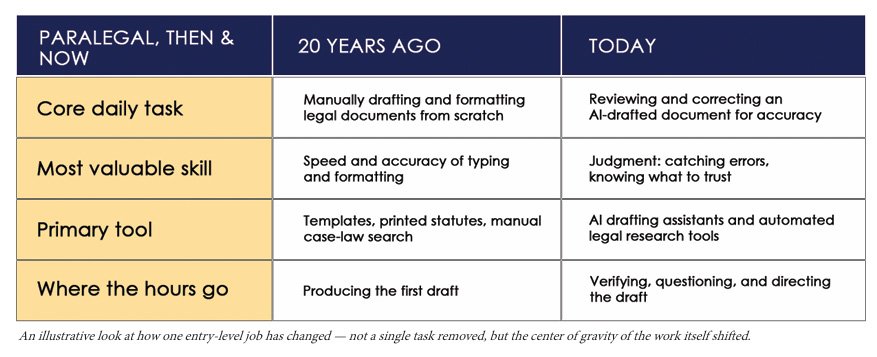
For most of the last century, the deal was simple. Go to school, accumulate knowledge, get credentialed, and the credential would open doors. Employers trusted the credential because it was a reasonable proxy for competence — if you could survive four years of coursework, you could probably survive four years of a job. That deal is quietly breaking down, and it isn’t breaking down because school stopped mattering. It’s breaking down because the thing school was a proxy for — reliable access to knowledge and the ability to execute routine cognitive work — is no longer scarce. A machine can retrieve, summarize, draft, calculate, and code faster than any graduate. What’s scarce now is something else entirely, and most classrooms, workplaces, and parents haven’t caught up to what that something else is.

This isn’t a story about which ten skills to add to a resume. Lists like that come and go every few years, and they age badly, because they treat skills like items on a shopping list instead of what they actually are: symptoms of a deeper change in how work gets done. To understand what to teach, hire for, or learn next, you have to understand the shift underneath the skills — how work itself is being rearranged. Once you see that shift clearly, the right skills become almost obvious. Skip that step, and you end up chasing a list that’s already out of date by the time it’s printed.
j2

From knowing things to judging things

For most of human history, knowing things was hard and expensive. You needed a library, a teacher, an apprenticeship, or decades of hard-won experience to hold useful knowledge in your head. Schools were built, quite reasonably, around the job of transferring that knowledge from people who had it to people who didn’t. Grades measured how much of it stuck.

That scarcity is gone. A teenager with a phone has faster and broader access to facts, explanations, and even competent first drafts than the most decorated professor did twenty years ago. This is genuinely new in human history, and it changes what “being smart” is useful for.

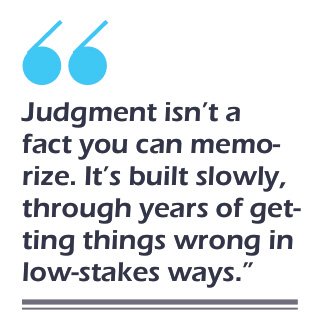
What doesn’t come bundled with that access is judgment: knowing which facts matter, which sources to trust, which draft is actually good, and which confident-sounding answer is quietly wrong. A machine can produce five plausible answers to a hard question in five seconds. It cannot, on its own, tell you which one is worth betting your business, your patient, or your bridge design on. That’s still a human job, and it’s a much harder job than it sounds, because judgment isn’t a fact you can memorize.

This is the part that should worry educators most, not because it’s a crisis, but because it’s invisible. A student can now produce a polished essay, a working piece of code, or a tidy lab report without ever practicing the underlying judgment that used to get built in the struggle of producing those things badly first. The finished product looks the same. The skill underneath it may not exist at all. A teacher grading the essay has no way of knowing, from the essay alone, whether they’re looking at understanding or assistance. This is why so many schools have spent the last two years fighting the wrong battle — chasing detection software and honor codes — when the real question was always about what to ask students to demonstrate in the first place. You can’t test judgment by asking someone to produce a finished artifact. You have to watch them decide.
j4

From doing the work to directing the work

There’s a second shift happening alongside the first, and it’s less discussed but arguably more disruptive. For most of the last century, being good at a job meant being good at doing the tasks the job required: writing the code, drafting the memo, designing the layout, running the numbers. Increasingly, being good at a job means being good at directing those tasks — breaking a fuzzy goal into clear instructions, choosing which tool or which person should handle each piece, checking the results, and stitching them into something coherent.

Think about what a marketing coordinator’s job looked like a decade ago versus what it looks like now. A decade ago, a large part of the job was execution: writing copy, building slide decks, formatting reports. Today, a capable coordinator can generate a rough draft of any of those things in minutes. What separates a mediocre coordinator from an excellent one is no longer typing speed or design software fluency. It’s the ability to know what a good campaign actually requires, to give clear enough direction that the drafts come back usable, and to catch the subtle ways a fast draft can be confidently wrong. That’s a management skill, not a production skill, and it used to be something people only learned after ten or fifteen years of climbing a career ladder. Now it’s showing up as a baseline expectation for twenty-two-year-olds.

This shows up outside offices, too. A high school student researching a history paper isn’t primarily short on facts anymore. She’s short on the skill of directing her own inquiry: knowing what question is worth asking, what a good source looks like, and how to push back on an answer that sounds authoritative but is thin. That’s orchestration in miniature, and almost nobody is explicitly teaching it, because it doesn’t map neatly onto a single subject or a single grade.

j5
Image:Alex Dos Santos/Pexels

From a stable career to a life of re-skilling

A third shift is quieter but touches every reader of this magazine directly. The idea of a stable career — pick a field at eighteen, train for it, practice it for forty years — was never as universal as nostalgia suggests, but it was common enough to organize school systems, family expectations, and government policy around it. That idea is fading faster than most institutions are willing to admit.

The honest version of career advice today isn’t “learn skill X.” It’s “build the capacity to become competent at something new every few years, on purpose, without waiting for a crisis to force it.” That’s a different kind of preparation. It has less to do with any specific subject and more to do with comfort in being a beginner again — a tolerance for feeling incompetent that most adults spend their careers trying to avoid.

This is where the gap between what schools optimize for and what students actually need becomes sharpest. Schools are very good at rewarding people who avoid failure. Grades, transcripts, and class rank all quietly punish the wrong answer. But a working life defined by repeated re-skilling rewards exactly the opposite instinct: a willingness to be visibly bad at something new, in public, long enough to get good at it. Very few students get meaningful practice at that in a system built to minimize visible failure.
j6

Some of the most interesting responses to this aren’t happening in universities at all. Community colleges, trade programs, and short intensive courses — the parts of the education system that have always had to prove their value quickly, because their students can’t afford four idle years — are quietly becoming the place where re-skilling is being figured out first. A forty-five-year-old retail manager retraining as a solar installer isn’t going back to a four-year lecture hall. She’s doing something closer to an apprenticeship compressed into months, with clear, testable outcomes at the end. That model, built for adults out of necessity, is starting to look like a preview of what education for teenagers might need to become too.

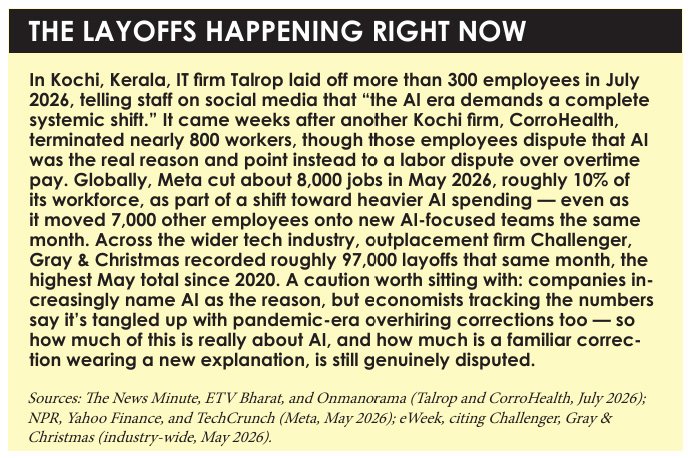
None of this is theoretical, and it isn’t only happening to distant strangers. It’s showing up in real layoff notices right now, in Kerala and well beyond it.

From the credential to the receipt

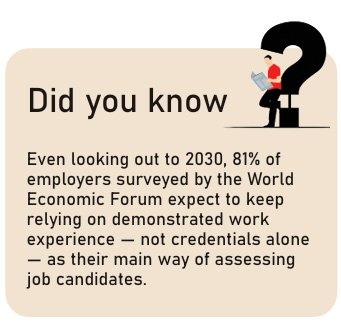
Tie these threads together and you arrive at the fourth shift, the one that’s easiest to see because it shows up directly in hiring decisions like the one in Ohio. Employers have relied on credentials — degrees, certifications, GPAs — as a proxy for competence because verifying actual competence directly used to be expensive and slow. You couldn’t watch every candidate do the job before hiring them, so you trusted the signal instead.

That’s changing, because it’s now cheap for a candidate to show, rather than claim, what they can do. A portfolio, a public project, a documented piece of real work carries more information than a line on a resume, and increasingly, hiring managers know it. This doesn’t mean the degree is worthless. It still signals persistence, baseline literacy, and access to certain networks. But it’s no longer sufficient on its own, and in some fields it’s no longer even the deciding factor.

For a sixteen-year-old reading this, that’s not a reason to skip college. It’s a reason to stop treating college, or any single credential, as the finish line. The real asset being built during those years isn’t the diploma. It’s the trail of real, demonstrable work left behind along the way — the tool that was built, the problem that was solved, the thing that exists in the world because you made it. That trail is becoming the actual currency. The diploma is increasingly just one line in a longer story.
j7

Two classrooms, one hallway

Picture two ninth-grade classrooms down the same hallway, teaching the same unit on persuasive writing in the same week.

In the first, students are asked to write a five-paragraph essay arguing for or against school uniforms, due Friday. Most will finish it in twenty minutes with a chatbot open in another tab, polish the wording themselves so it doesn’t sound too smooth, and hand in something serviceable. The teacher will grade the essays over the weekend, mostly checking structure and grammar, largely unable to tell which students actually wrestled with the argument and which ones outsourced the wrestling. Everyone technically completes the assignment. Almost no one practices the thing the assignment was supposed to teach.

In the second classroom, down the same hallway, the assignment looks almost identical on the surface — same topic, same due date — but the teacher has changed what gets turned in. Students submit three drafts, not one, each with a short note explaining what they changed and why. They present their argument out loud for two minutes and take questions from classmates who were assigned to push back. The final grade weighs the defense as heavily as the essay itself. A chatbot can still help someone start a first draft in that classroom. It cannot answer a classmate’s pointed follow-up question in real time, and it cannot explain, convincingly, why a student changed their mind between draft two and draft three.

Nothing about the second classroom rejects technology, and nothing about it requires a bigger budget or a new curriculum. It requires a teacher who decided that what’s worth grading isn’t the finished paragraph, but the thinking that produced it — and who was willing to make that thinking visible instead of assuming a polished page proves it happened. Multiply that small design choice across a school, a district, or a generation of assignments, and you get something close to an answer to the question everyone in education is currently circling without quite landing on: not how do we stop students from using AI, but what should we actually be asking them to prove, now that a finished product no longer proves it for us.
j8
Image:Tara Winstead/Pexels

That’s the real dividing line forming in schools right now, and it has very little to do with which tools are allowed. It has to do with whether an assignment is designed around a process a student has to live through, or a product a student merely has to produce. The first kind of assignment is quietly future-proof. The second kind was arguably already outdated before any of this started — it just took a widely available tool to expose it.

What this means for society

For policymakers

The uncomfortable truth is that most education funding and accountability structures still measure the thing that’s losing value — content coverage and standardized recall — rather than the things gaining value: judgment, direction-setting, and demonstrated capability. Shifting assessment systems is slow and politically fraught, but a handful of states and districts are already piloting portfolio-based and project-based accountability in place of pure test scores. Watching those pilots closely, rather than waiting for a national consensus that may never arrive, is probably the highest-leverage thing a policymaker can do in the next few years.

For K-12 educators

The shift doesn’t require throwing out the curriculum. It requires changing what counts as evidence of learning. A finished essay proves less than it used to. A recorded process — drafts, decisions, revisions, a defense of choices made along the way — proves more. Teachers who’ve started grading the process rather than only the product report that it’s initially more work, and quickly becomes the more honest and more interesting way to teach. It also happens to be far more resistant to being quietly outsourced to a chatbot, not because it blocks the tool, but because it asks students to show their thinking, which is the one thing the tool can’t do for them.
j9

For parents

The useful shift is in the questions asked at the dinner table. “What grade did you get” measures compliance with an old system. “What did you make, and what was hard about it” measures something closer to what will actually matter. This isn’t about abandoning academics or grades entirely — they still open doors and still matter for now — but about making sure a child’s sense of their own competence isn’t built entirely on a metric that’s losing relevance.

For higher education

The pressure is most acute and least resolved. Admissions offices are still largely built around transcripts and test scores, at the exact moment employers are discounting those signals. The universities responding well are the ones building in real project work, co-ops, and public portfolios as a graduation requirement, not an optional extra. The ones responding poorly are the ones tightening plagiarism policy as though the problem is cheating, when the deeper problem is that the assignments themselves stopped measuring anything scarce.
j11
Image:Pavel Danilyuk/Pexels

For students

Here is the plain version, without the hedging. You are the first generation for whom knowing things and producing polished work is no longer, by itself, impressive or rare. That can feel unsettling, because it removes a kind of safety that “doing well in school” used to provide. But it also means the things that will actually set you apart are things you have more control over than you think: whether you can tell a good answer from a confident-sounding bad one, whether you can direct a messy project toward a clear outcome, whether you’re willing to be a beginner again next year at something you’re not good at yet, and whether you have anything real to point to that you actually built. None of that requires waiting for permission from a curriculum. Most of it can start this semester, in whatever class or afterschool project or messy personal experiment you’re already halfway through.
j12

The take-home

Every generation of parents and teachers has faced some version of the question “what should we prepare kids for, when we can’t know what the world will look like.” Usually that question was slightly overstated — the future was uncertain, but not that uncertain. This time it’s a little different, not because change is happening faster than it ever has, but because the specific thing schools have optimized for over the last century — reliable transfer and retrieval of knowledge — is precisely the thing that’s stopped being scarce.

That’s not a reason for despair, and it’s not a reason to panic-add a coding class or an “AI literacy module” and call it solved. It’s a reason to get honest about what’s actually being measured in classrooms, hiring decisions, and family expectations, and to start measuring the things that are actually becoming scarce instead: judgment, direction-setting, the willingness to be a beginner again, and the habit of leaving behind real evidence of real work.

The skills that will matter after AI were never really about AI at all. They’re the skills that matter whenever the tools change faster than the institutions built to teach around them — which, if this last decade is any guide, may simply be a permanent condition from here on out. The sooner schools, employers, and parents stop asking “what should we add to the list” and start asking “what does our current way of measuring people get wrong,” the sooner the next generation stops feeling like they’re being prepared for a world that no longer exists.

Learning & Teaching

AI in Classrooms: Threat to Learning or Catalyst for Educational Transformation?

Artificial Intelligence is transforming classrooms worldwide. Is AI enhancing personalized learning or weakening critical thinking and academic integrity?
Rishika Nair

Published

on

ai classrooms
Image credit: Pavel Danilyuk/Pexels

It was 2012 when a fifth-grade student watched her classroom change forever. The long, familiar blackboard was shortened to make space for something new: a smart board. The wall that once carried chalk dust now lit up with colours, sound, and animation.

Learning felt different. Some students still preferred chalk and quiet explanation. Others were drawn to the vivid visuals and interactive content. Teachers began noticing something important — students did not learn in the same way. The monochrome board worked for some; audio-visual tools helped others grasp concepts faster.

With that shift, transformation had quietly begun.

Today, another shift is underway.

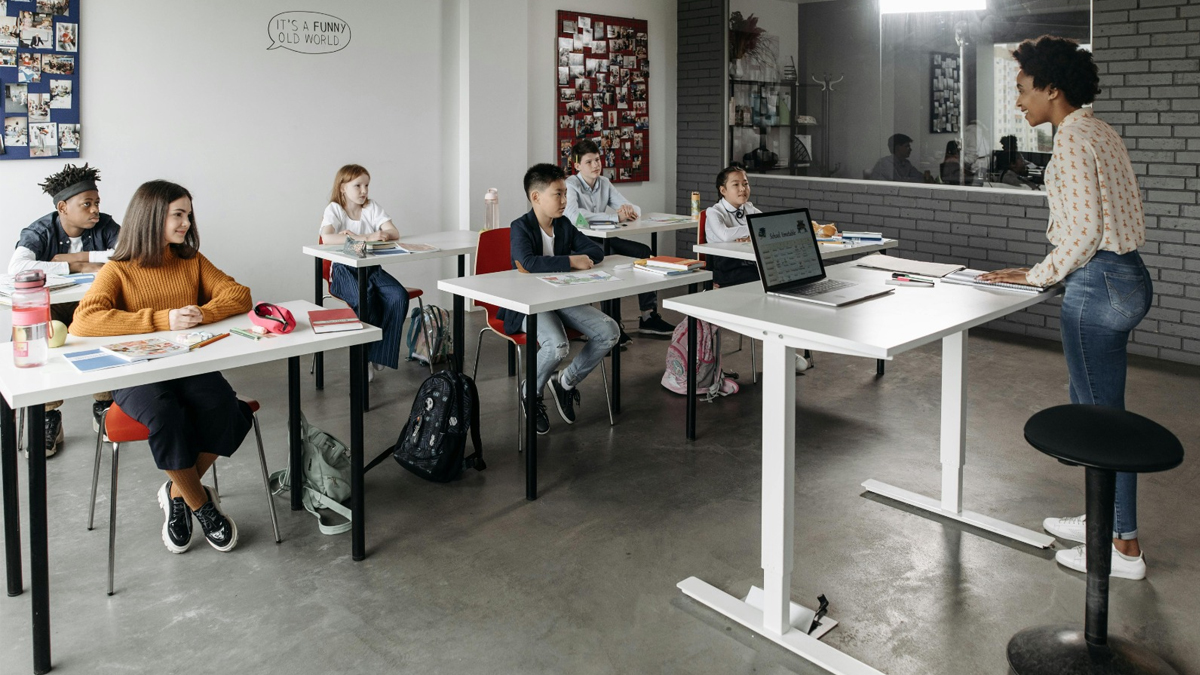
A Monday morning might begin with a student completing an assignment she had postponed — not after hours of effort, but within minutes, assisted by an AI chatbot. In another classroom, a teacher reviews essays while an automated system highlights grammar issues and suggests feedback. Elsewhere, students debate whether an AI-generated response is accurate or biased.

These scenes are no longer speculative. They are unfolding in classrooms now.

And with this transformation comes a new tension.

The pressing question

Artificial Intelligence (AI) has moved rapidly from abstract concept to active participant in education. From generative chatbots to adaptive learning systems, AI is reshaping how students learn and how teachers teach. This raises a pressing question: Is AI a threat to traditional education, or a transformative force that enhances it?

One of AI’s strongest advantages lies in personalization

Across schools and universities, educators are navigating this terrain cautiously. Many describe AI not as a replacement, but as an assistant. Educational institutions and research bodies report growing use of AI to personalize learning, streamline lesson preparation, and provide immediate feedback. Students use AI to brainstorm, clarify difficult concepts, and refine writing. Teachers experiment with automated tools to reduce repetitive administrative work, freeing time for deeper classroom engagement.

One of AI’s strongest advantages lies in personalization. Students process information differently — some visually, some through repetition, discussion, or practice. AI-powered platforms can adapt to individual pace, provide tailored examples, and offer instant clarification. Perspectives shared by Cengage Group suggest that many students do not merely seek shortcuts; they want structured guidance on using AI responsibly because they recognize its relevance to future careers. For this generation, AI is not optional — it is expected.

AI also strengthens accessibility. Schools such as Stonebridge School highlight the role of speech-to-text tools, translation software, and grammar support systems in assisting students with learning differences or language barriers. For these learners, AI is not convenience; it is inclusion. It creates entry points into academic participation that were previously difficult to access.

From a psychological standpoint, this aligns with learner-centered education. Immediate, tailored feedback enhances motivation. According to Self-Determination Theory, feelings of competence and autonomy strengthen intrinsic motivation. When students experience structured support that builds mastery, learning deepens. In this sense, AI can support psychological growth rather than undermine it.

Yet, concerns emerge when assistance becomes substitution.

The question of creativity

If students rely entirely on AI to generate assignments, the learning process risks weakening. Educational psychology consistently emphasizes effortful processing — the mental struggle involved in organizing ideas, revising drafts, and solving problems independently. That cognitive effort strengthens memory, comprehension, and critical thinking. When AI eliminates that struggle completely, it may also eliminate valuable opportunities for intellectual growth.

Emerging research on AI integration suggests that while AI can increase short-term engagement, it does not automatically guarantee long-term retention. Students may accept AI-generated responses without questioning them, potentially weakening analytical reasoning and originality. Creativity, too, may suffer if learners default to algorithmic suggestions rather than developing their own ideas.

Academic integrity presents another challenge. AI blurs boundaries between assistance and authorship. Without clear institutional policies, confusion can foster mistrust between students and educators.

Beyond academics lies the human dimension. Teaching is not merely the transfer of information; it involves mentorship, empathy, and social development. A teacher notices shifts in a student’s confidence. A classroom discussion builds emotional intelligence. AI cannot replicate lived experience or genuine human encouragement. Overdependence on technology risks diminishing the relational core of education.

However, rejecting AI outright may be neither realistic nor constructive. History shows that educational innovations — from calculators to the internet — were once met with resistance. Over time, integration replaced fear.

The true transformation lies not in AI’s presence, but in pedagogical adaptation.

Balanced integration appears most sustainable. AI can assist with idea generation, but students can be required to reflect on how they used it. AI can provide explanations, but learners can critique and verify them. Assessments can shift toward oral presentations, in-class writing, debates, and applied problem-solving that demand originality and reasoning.

In this framework, AI becomes a tool for thinking — not a substitute for it.

AI in classrooms is both a threat and a transformation. It threatens depth, independence, and authenticity when misused. It transforms accessibility, personalization, and instructional efficiency when guided ethically.

When the smart board arrived, the blackboard was not erased. It simply shared space.

Perhaps AI, too, does not need to replace human thought or human teachers. It needs boundaries, guidance, and wisdom.

AI has already entered the classroom. The future of education will depend not on whether students use AI, but on whether we teach them to think critically, ethically, and independently — beyond it.

References

https://www.researchgate.net/publication/386122854_AI_in_the_Classroom_A_Boon_or_a_Threat_to_Pedagogical_Practices

https://papers.iafor.org/wp-content/uploads/papers/aceid2024/ACEID2024_79202.pdf

Continue Reading

Learning & Teaching

Understanding AI: The Science, Systems, and Industries Powering a $3.6 Trillion Future

Explore how artificial intelligence is transforming finance, automation, and industry — and what the $3.6 trillion AI boom means for our future

Jay Magiya

Published

on

featured 3

Artificial intelligence has become a major point of discussion and a recent focal point, experiencing remarkable growth in recent years. Artificial intelligence is a branch of computer science that refers to computer systems and machines with the capability to mimic human cognitive abilities, such as learning, critical decision-making, problem-solving, and creativity. Its ability to identify objects, understand human language, and act independently makes it possible to reduce the need for direct human intervention, increasing the feasibility of AI use in industries such as automotive manufacturing, financial services, and fraud detection.

A Market Measured in Billions

As of now, the projected value of the global artificial intelligence market is approximately USD 638.23 billion, marking an 18.6 percent increase from the 2023 value of USD 538.13 billion. This advancement is expected to continue with a compound annual growth rate (CAGR) of 19.1 percent from 2024 to 2034. Major North American countries, including the United States and Canada, have incorporated AI at scale and accumulated the largest market share, accounting for 36.9 percent of the global AI market. For example, the US artificial intelligence market is currently valued at around USD 146.09 billion in 2024, representing approximately 22 percent of global market value.

f2
Image Credit: pixabay.com

Machines That Do Not Learn

The evolution of AI has resulted in several distinct model types. IBM’s Deep Blue chess system is a notable example of a reactive machine model. It was designed using brute-force computation and complex algorithms, enabling it to generate approximately 200 million potential chess positions per second. Deep Blue employed a deep search tree to evaluate optimal moves and was used to challenge human grandmasters, achieving a historic milestone by defeating the reigning world chess champion Garry Kasparov in one game of a six-game match. The system relied entirely on predefined responses and immediate input data, as it had no memory or learning capability.

While this marked a historic achievement in computational performance, the lack of adaptability limited the broader applicability of reactive machines. Their inability to learn from experience or respond effectively to unexpected scenarios restricts their use to narrow, task-specific applications. Despite these limitations, reactive AI systems remain widely used in industrial automation due to their precision and reliability in controlled environments.

Learning From the Past

To address these constraints, Limited Memory AI models were developed. These systems retain historical data from previous experiences, enabling improved decision-making over time. Limited Memory AI is widely used in self-driving vehicle technology, where it analyses traffic patterns, road conditions, and obstacles to make informed real-time decisions. Similarly, in financial forecasting, these systems use historical market data to predict trends and risks. Limited Memory AI gathers data through multiple inputs, stores it temporarily, and applies analytical models to enhance accuracy.

f3

However, such systems still struggle with high levels of complexity, particularly in areas such as advanced natural language processing, where long-term contextual understanding and reasoning are required.

Can Machines Read Minds?

More advanced AI concepts, including Theory of Mind and self-aware models, remain largely theoretical and experimental. Theory of Mind AI aims to interpret and predict human emotions, beliefs, and intentions, enabling more natural social interaction between humans and machines. These systems analyse behavioural patterns derived from user interactions and historical context using advanced algorithms.

Researchers such as Neil Rabinowitz at Google DeepMind have made progress in this area. Rabinowitz and his team developed a system known as ToMnet, which uses artificial neural networks inspired by the structure of the human brain to model decision-making behaviour. Despite this progress, Theory of Mind AI cannot accurately replicate the complexity of human mental states. The intricate nature of human cognition, emotions, and social reasoning means real-world applications remain limited, and widespread deployment is likely years away.

The Idea of Self-Aware AI

The final hypothetical stage of AI development involves systems with genuine self-awareness. Such models would possess the ability to understand their own internal states and adapt behaviour accordingly. Self-aware AI systems could potentially tailor interactions based on environmental and emotional cues, making engagement more effective and personalised.

In environmental management, these systems could predict ecosystem changes, recommend conservation strategies, and assist in biodiversity protection. In education, self-aware AI could personalise learning experiences by adapting to individual learning styles and progress patterns. However, AI remains far from achieving self-awareness, largely because significant aspects of human cognition, including consciousness, memory integration, and proactive reasoning, remain poorly understood.

f4
Artificial intelligence is evolving from a niche technology to a global economic powerhouse. According to Precedence Research, the global AI market is expected to expand nearly sevenfold between 2023 and 2034, driven by applications in finance, healthcare, and manufacturing.

Furthermore, self-aware AI would require vast quantities of data, raising ethical concerns related to privacy, surveillance, and data exploitation. As a result, the development of such systems necessitates strict regulatory frameworks governing data collection, storage, and use.

Finance Goes Algorithmic

The financial services sector is currently undergoing a significant transformation driven by artificial intelligence. AI has reshaped analytics, operational efficiency, and strategic decision-making across the industry. Corporate Performance Management has benefited from AI-driven tools that enhance speed and accuracy in financial planning, budgeting, and forecasting.

Major financial institutions such as JPMorgan Chase and Goldman Sachs employ Natural Language Processing technologies to analyse large volumes of financial data. NLP enables machines to interpret and generate human language, supporting applications such as chatbots, market analysis, and risk assessment.

Reading the Fine Print at Scale

When combined with Optical Character Recognition, which converts image-based financial documents into machine-readable text, NLP systems can rapidly process reports, contracts, and news articles. Document parsing technologies further enhance efficiency by extracting relevant information from unstructured data sources, including social media content.

However, the effectiveness of NLP systems depends heavily on the availability of diverse, high-quality datasets. Biased or inaccurate data can undermine model performance and lead to flawed decision-making.

f5 1
From financial services (38%) to healthcare (35%), sectors are integrating AI to improve efficiency, prediction, and decision-making. Manufacturing, retail, and education are close behind, showing that automation and data intelligence are reshaping every industry

Machines That Create

Generative AI has emerged as a powerful subset of artificial intelligence within the financial sector. Generative AI systems can create original content, including text, images, audio, video, and three-dimensional models. These capabilities have advanced significantly due to developments in Large Language Models, which learn patterns from vast datasets and generate outputs that resemble human-created content.

Generative AI systems use techniques such as text generation and image synthesis to produce new samples based on training data. A key underlying technology is the Generative Adversarial Network, which consists of two neural networks: a generator and a discriminator.

Fighting Fraud With Fakes

The generator produces synthetic data, while the discriminator evaluates its authenticity, enabling continuous improvement in output quality. This architecture has proven particularly valuable in fraud detection, where simulated fraud scenarios can be used to stress-test detection systems. Financial institutions such as PayPal and American Express employ generative models to improve fraud prevention mechanisms.

The Transformer Revolution

Transformers have revolutionised both Natural Language Processing and generative AI. This deep learning architecture enables the modelling of complex sequences in text, images, and audio. Transformer-based models underpin systems such as OpenAI’s GPT, which can generate coherent, human-like text.

Financial organisations use transformer models for investment research, analysing market trends, generating reports, and summarising extensive financial documents to accelerate decision-making processes.

f6

Bias, Attacks, and Blind Spots

Despite these advantages, generative AI presents several challenges. These systems are vulnerable to adversarial attacks, in which manipulated inputs produce misleading outputs. Bias in training data remains a critical concern, particularly in financial applications such as lending and credit assessment, where biased outputs can reinforce systemic inequalities.

Automation, Upgraded

Artificial intelligence has also become integral to intelligent automation, significantly transforming business process management and robotic process automation. Traditional RPA systems were limited to repetitive, rule-based tasks. The integration of AI has enabled automation systems to perform more complex activities that require judgement and adaptive decision-making.

This advancement has expanded the scope of automation across industries while maintaining high levels of accuracy and efficiency.

Predicting Failure Before It Happens

Predictive maintenance is another area where AI has demonstrated significant value. By analysing data from sensors and machinery, AI systems can anticipate equipment failures before they occur. This reduces downtime, extends equipment lifespan, and lowers maintenance costs.

In manufacturing and automotive industries, AI-powered machine vision systems use cameras and optical sensors to detect defects during production. These systems analyse images with greater precision than traditional inspection methods, ensuring consistent product quality.

The Building Blocks of Machine Learning

Machine learning models represent one of the most influential branches of artificial intelligence. These systems enable computers to learn from data and improve performance without explicit programming. Three foundational models commonly used across industries are decision trees, linear regression, and logistic regression.

Decision trees break complex decision-making processes into structured branches based on informative data features and are widely used in healthcare diagnostics and financial credit assessment.

From Trends to Probabilities

Linear regression models establish statistical relationships between dependent and independent variables and are commonly applied in financial forecasting. Logistic regression predicts the probability of binary outcomes and is widely used in healthcare and credit risk analysis due to its efficiency and interpretability.

Teaching Machines to Learn

Machine learning algorithms enable systems to learn patterns from data and improve performance over time. The three primary categories are supervised learning, unsupervised learning, and reinforcement learning.

Supervised learning uses labelled datasets for classification and regression tasks, including spam detection and image recognition. Unsupervised learning operates on unlabelled data and identifies hidden structures through clustering and association analysis.

Continue Reading

Learning & Teaching

What’s Your Learning Superpower? Here’s How to Find It

Let’s dive into the Honey-Mumford and VAK (Visual, Auditory, Kinaesthetic) models—two of education’s most influential maps for personalizing the learning journey.

Joe Jacob

Published

on

design 36 jpeg
Illustrated image. Credit: EdPublica

Imagine being dropped in a brand-new city where everyone speaks a different language. Some people grab a map and start drawing routes. Others listen intently to locals, some race into the streets to explore by doing, and a few quietly observe from a café, making notes. Which traveler are you? In the world of learning, discovering your “learning style” is like finding your unique superpower—the secret key to faster, deeper, more enjoyable learning.

How do you unlock your own learning?

Let’s dive into the Honey-Mumford and VAK (Visual, Auditory, Kinaesthetic) models—two of education’s most influential maps for personalizing the learning journey.

Why Learning Styles Matter (and Why They Change)

It’s important to realize learning preferences aren’t set in stone. Just as a traveler adapts to new cities, learners shift styles based on the challenge. Most of us lean toward one or two favourite modes, but flexibility is key. According to Peter Honey and Alan Mumford’s classic model, being able to “wear all four hats” is crucial for mastering new skills. If you stubbornly avoid certain ways of learning, you may unknowingly tie your own shoelaces together.

Here’s how the four Honey-Mumford learning styles look in action:

Activist: The daredevils of learning! Activists live for new experiences. They’re first to leap into workshops, group activities, and hands-on challenges. They learn best when they’re doing, discussing, and exploring.

Reflector: These learners are the wise owls. Quietly observing first, they watch from every angle, gathering information before jumping in. Their superpower? Drawing connections and insights from deep thinking.

Theorist: Think of the philosophers and scientists. Theorists want the “why” behind everything. They thrive on models, structures, and clear explanations, asking, “Does this make sense?” and “Is there a theory here?”

Pragmatist: These are the builders and fixers. Pragmatists want practical, real-world application. “How can I use this?” is their guiding question. They flourish when they’re solving problems and trying out ideas.

The Visual, Auditory, and Kinaesthetic Adventure

But wait—there’s more! According to neuro-linguistic programming and the globally popular VAK model, everyone navigates the world of knowledge in their own preferred “language”: seeing, hearing, or doing. Here’s how to spot yours:

Visual Learner: You see the world in pictures. Diagrams, charts, videos, and handouts light up your mind. If you sketch ideas or remember faces better than names, visual is your superpower.

Auditory Learner: Sound is your guide. You remember best what you hear—lectures, podcasts, discussions, even recording and replaying information. You may even talk aloud to “think.”

Kinaesthetic Learner: Your hands lead the way. You learn by doing. Whether painting, building, or physically working through problems, motion and touch fuel your brain.

So, How Do You Find Your Style?

No one is 100% one type. Like expert travelers, the best learners pack more than one compass. Educational researcher Niel Fleming expanded on these ideas, showing that all of us use a mix—sometimes favoring one “sense,” sometimes another. Being stuck with just one style can slow you down; flexibility makes the difference.

Educators, coaches, and students can all benefit by asking simple questions—”Do I remember better what I see, hear, or do?”—and using practical inventories from Honey, Mumford, or Fleming to discover strengths.

Want to unlock your learning superpower? Pay attention to how you most naturally enjoy, remember, and apply new information—and don’t be afraid to experiment with new learning adventures. Your secret strength might just surprise you.

Continue Reading

Trending