Climate
India’s Infrastructure Push Is Racing Ahead of Its Climate Insurance Cover
India’s infrastructure spending has crossed 3% of GDP, but climate risk is rising even faster. As floods and extreme weather become more predictable, parts of the country are edging towards the limits of insurability—raising urgent questions about how resilient India’s growth really is.


India is investing in infrastructure at a scale unprecedented in its post-liberalisation history. Capital expenditure on infrastructure has now crossed 3% of GDP, spanning railways, highways, ports, power plants and airports—assets designed to last well over half a century. Yet, as new research shows, a growing share of this infrastructure is coming up in regions increasingly exposed to climate extremes, raising a critical question for policymakers, insurers and investors alike: can India afford to insure the future it is building?
A new report by Climate Trends on climate risks and insurance for India’s infrastructure argues that climate impacts are no longer episodic shocks. Instead, they are following a clear upward trajectory in frequency, severity and geographic spread, particularly after the mid-2010s. Hydro-meteorological disasters—floods, extreme rainfall, cyclones and landslides—now dominate India’s climate risk profile, with flood risk emerging as the most persistent hazard for fixed, high-value assets.
When Growth and Risk Rise at Different Speeds
One of the report’s central findings is the non-linear relationship between asset growth and climate exposure. Using Delhi as a case study, the analysis shows that while urban expansion grew at roughly 1.3% CAGR between 1986 and 2016, flood exposure increased at nearly 2.46% CAGR, creating a widening divergence that is projected to grow further over time.
This divergence matters because infrastructure assets are geographically fixed and designed for long operational lives. As asset concentration rises and climate impacts become more predictable, the report warns that certain regions may approach the threshold of uninsurability, where premiums become unaffordable or coverage simply unavailable.
Insurers See Opportunity—and Limits
To test these risks against market realities, the researchers surveyed leading non-life insurers and reinsurers operating in India, including SBI General Insurance, Munich Re India, Swiss Re India and General Insurance Corporation of India.
The responses reveal a nuanced picture. Insurers broadly agree that most of India remains insurable, and climate risk insurance is still viewed as a business opportunity. However, hydropower projects and national highways located in flood- and landslide-prone regions repeatedly emerged as areas of concern. One insurer reported rising premium unaffordability for hydropower projects—an especially notable finding given that many planned hydropower assets are located in high-risk Himalayan regions vulnerable to landslides, floods and glacial lake outburst floods (GLOFs).
| >> Globally, insured property losses exceeded USD 140 billion in FY 2024–25 |
| >> India’s natural catastrophe losses in 2023 alone reached USD 12 billion |
A consistent challenge flagged across insurers is the difficulty of pricing climate risk under deep uncertainty. Respondents highlighted gaps in modelling for long-term risks such as sea-level rise, forest fires and compound events, raising the likelihood of a widening protection gap between economic losses and insured coverage.
Losses Are Already Mounting
The financial context underscores why these concerns are intensifying. Globally, insured property losses exceeded USD 140 billion in FY 2024–25, while India’s natural catastrophe losses in 2023 alone reached USD 12 billion, significantly above the previous decade’s average.
Sub-national data further sharpens the picture. States such as Assam, Andhra Pradesh, Odisha, Uttarakhand, Himachal Pradesh, Sikkim, Ladakh and several north-eastern states are identified as among the most climate-vulnerable. Yet these regions also host some of India’s largest infrastructure investments, amounting to nearly Rs 2.95 lakh crore—from port modernisation projects in Odisha and Andhra Pradesh to tunnels, highways and hydropower projects in the Himalayas.
Insurance Is Evolving—but Not Fast Enough
Insurers acknowledge the gap and point to ongoing innovation. Parametric insurance products for heat stress, excess rainfall and flooding are gaining traction, alongside state-level risk transfer mechanisms. Yet coverage remains absent for several high-impact events, including cloudbursts and landslides, even as these hazards grow more frequent.
At the same time, India’s insurance market is expanding rapidly. Premiums are projected to grow at 6.7% in life insurance and 8.3% in non-life insurance through 2028, reflecting both economic growth and rising climate vulnerability.
The concern, however, is whether risk pricing can keep pace with physical reality.
Integrating Climate Risk Before the First Brick
The report also says that climate resilience must shift from being a post-disaster consideration to a core design constraint in infrastructure planning. Among its key recommendations are the standardisation of regulatory frameworks for risk disclosure, underwriting, premium pricing and loss assessment, alongside investment in advanced actuarial models and innovative instruments such as parametric insurance and catastrophe bonds.
Aarti Khosla, Founder and Director of Climate Trends, notes: “As India seeks big investments at the World Economic Forum and plans double-digit (nominal) growth over the next five years, it would be remiss to not point out the risks to India’s infrastructure posed by climate impacts and extreme weather events – which are unarguably increasing in frequency, severity, and geographical spread. The country’s rising exposure for its essential assets could thus lead to mounting climate-induced losses, which would be a fiscal and financial burden. Climate resilience must therefore be integrated into infrastructure planning from the very beginning to minimise the costs of post-disaster reconstruction. Also, several steps will have to come together to ensure long-term insurance viability for such assets, such as advanced actuarial models and standardised frameworks for risk disclosure, premium pricing and loss assessment.”
The Risk Beneath the Growth Story
India’s infrastructure push is central to its growth ambitions and long-term self-sufficiency. But the evidence suggests that climate risk is fast becoming a primary determinant of whether that growth remains financially sustainable. Without integrating resilience and insurability into planning decisions today, the cost of tomorrow’s infrastructure may be borne not just by insurers, but by public finances and future generations.










Climate
From Lost Wages to Rising Medical Bills: How Extreme Heat Is Already Costing India’s Economy

India’s scorching summer may have ended with the arrival of the southwest monsoon, but the economic impact of months of extreme heat is only beginning to surface. The costs are visible at every level—from workers earning less because they cannot stay on the job, to households paying more for healthcare and cooling, and ultimately to the country’s economy losing billions in productivity.
New report by Adelphi Global argues that this “double burden” of falling incomes and rising medical expenses is one of the least recognized economic consequences of climate change. In a country where nearly nine out of ten workers are employed in the informal sector and households continue to shoulder a large share of healthcare costs, the financial consequences are particularly severe.
When Heat Cuts Working Hours, Incomes Fall
Extreme heat affects the economy first through labour. Unlike machines, people cannot continue working safely under prolonged exposure to high temperatures. Workers slow down, take frequent breaks or stop working altogether to avoid heat stress. Recovery from heat-related illnesses can take weeks, while severe cases may permanently reduce a person’s ability to work.

The impact is greatest in agriculture and construction, where work is physically demanding and carried out outdoors. According to the report, India already loses an average of 4.31% of annual working hours because of this. Under a moderate warming scenario, that could rise to 5.8% by 2030. In agriculture and construction, annual working-hour losses are projected to reach 9.04%, equivalent to nearly 22.5 working days each year.
For millions of workers paid by the day, fewer hours on the job mean less money taken home.
Informal Workers With Little Financial Protection
The losses are particularly severe because most Indian workers lack social protection. The report estimates that 90% of women workers and 86% of men work in the informal economy, where paid leave, health insurance and wage protection are rare. Missing work because of extreme heat often means losing income immediately.
Median daily earnings remain modest even before these disruptions. Women earn about USD 18.72 (PPP) per day, while men earn around USD 25.52 (PPP). Repeated income losses can quickly push vulnerable households deeper into financial distress.
The report warns that between 54% and 80% of informal workers globally already earn below median wages. In India, where nearly one-fourth of the population lives below the World Bank’s lower-middle-income poverty line, recurring heat-related work losses could push even more families into poverty.
Rising Temperatures Raising Household Expenses
The financial impact does not stop when workers leave the job site. Heat-related illnesses increase medical spending at a time when incomes are already falling. Although public spending on healthcare has increased, households still pay 44% of India’s total health expenditure directly from their own pockets.
Annual per capita out-of-pocket health expenditure reached USD 151 (PPP) in 2023—almost three times higher than in 2000. Extreme heat also raises everyday living costs.
Keeping homes cool becomes more expensive during hotter months. While wealthier households spend only around 0.2–0.25% of their total expenditure on air-conditioning, the poorest households may spend up to 8% of their household budget on electricity for cooling. Researchers describe this growing financial burden as “heat poverty”—where families struggle to afford adequate cooling despite rising temperatures.
Due to this, food prices are also expected to rise. Higher temperatures alone could increase global headline inflation by up to 1.18% and food inflation by as much as 3.23% by 2035. Together, these costs create a financial squeeze: households earn less while spending more.
The Bigger Economic Picture
The report argues that these household-level losses eventually add up to a national economic challenge. According to Lancet Countdown, India lost about USD 194 billion in potential income because of reduced labour capacity caused by extreme heat in 2024. That is equivalent to roughly 5% of the country’s GDP.
Globally, the economic impact is equally significant. Between 1981 and 2010, heat exposure resulted in the equivalent loss of 35 million full-time jobs and reduced global GDP by an estimated USD 280 billion. Between 1992 and 2013, climate-driven extreme heat caused economic losses estimated at USD 16–50 trillion worldwide.
The findings show that extreme heat is no longer only an environmental or public health concern. It is becoming a growing economic challenge, particularly for labour-intensive economies like India.
Rising Heat: Need for Economic Policy
Adapting to extreme heat requires more than emergency weather advisories.
It calls for stronger labour protections, income support for workers affected by heat, expanded social protection for informal workers and greater public investment in healthcare to reduce dependence on out-of-pocket spending. It also recommends increasing adaptation finance to address productivity losses and the economic consequences of heat-related illnesses.
As climate change makes India’s summers hotter and longer, the true cost of extreme heat will be reflected in shrinking pay packets, rising household expenses and slower economic growth.
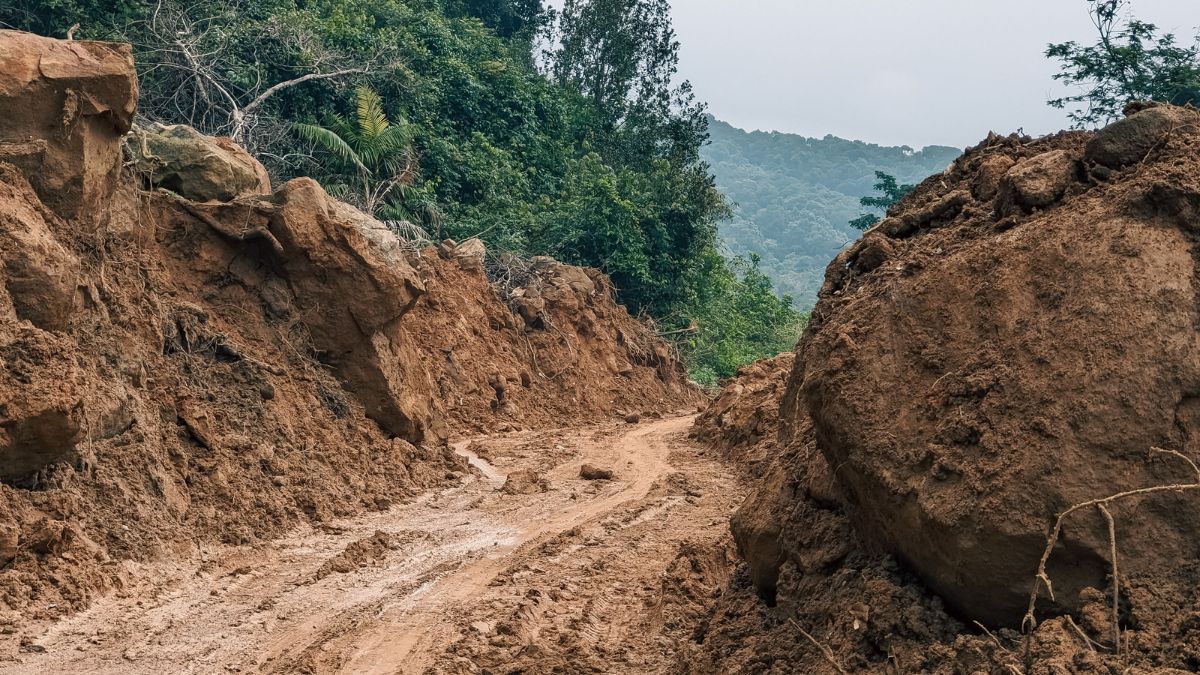
The death toll in the landslide that struck a tunnel construction site at Kalladi near Meppadi in Kerala’s Wayanad district has risen to five, with rescue teams recovering two more bodies from the debris today. Search operations are continuing to locate the remaining missing workers amid challenging weather conditions and unstable slopes.
The landslide occurred on 7 July after heavy monsoon rain triggered a slope failure at the construction site of the Anakkampoyil–Kalladi–Meppadi tunnel road project. According to officials, around 18 workers were present at the site when the hillside gave way, burying workers, machinery and temporary site facilities. Nine workers were rescued with injuries and shifted to nearby hospitals, while emergency teams continue to search for those still trapped.
Wayanad Landslide: Rescue operation enters critical phase
Personnel from the National Disaster Response Force (NDRF), Kerala Fire and Rescue Services, Police and other emergency agencies are leading the rescue effort. Teams are focusing on identified high-probability zones using earth-moving equipment and sniffer dogs, but intermittent rainfall and unstable debris continue to slow the operation. Authorities have also evacuated nearby areas as a precaution against further slope failures.
Questions raised over construction practices
The incident has renewed concerns over infrastructure development in the ecologically sensitive Western Ghats. The Kerala government has ordered an inquiry into the landslide, including whether excavation activities or the dumping of excavated earth from the tunnel project contributed to the slope collapse. The construction company has denied the allegations, maintaining that the landslide originated from a natural hillside above the project site.
The latest tragedy comes less than two years after the Mundakkai–Chooralmala landslides of July 2024, Kerala’s deadliest landslide disaster. The recurrence of landslides in the Meppadi region has intensified calls for stricter geological assessments, improved monitoring of infrastructure projects, and stronger safeguards for workers and communities living in landslide-prone areas.
Climate
Super El Niño Can’t Explain Mumbai’s Deluge, But Climate Change Can
Climate change is intensifying Mumbai’s rainfall, making downpours shorter and more extreme. Experts explain why El Niño alone cannot explain the floods.

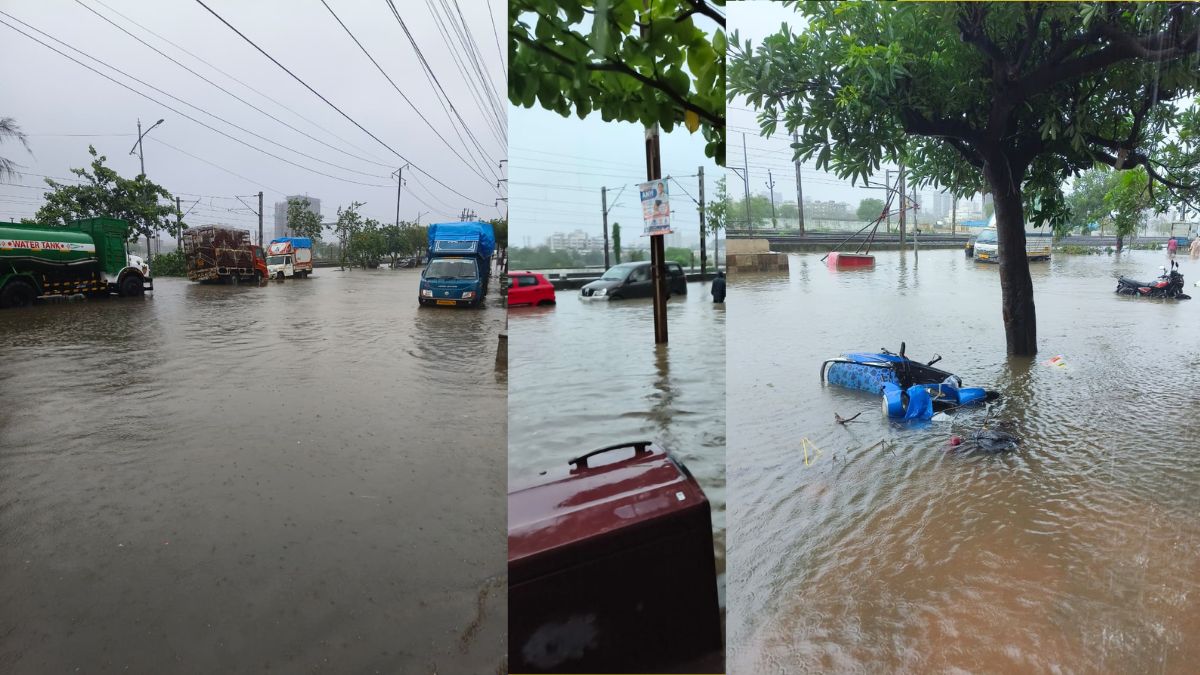
Mumbai Climate Change Rainfall: Mumbai’s recent deluge reflects a changing monsoon shaped by climate change as much as El Niño. Experts say warming oceans and a hotter atmosphere are driving fewer rainy days but far more intense downpours, exposing the city’s ageing drainage systems and growing vulnerability to urban flooding.
For most of June, the story of India’s monsoon was one of delay and deficit. A strengthening El Niño in the Pacific was pushing the Southwest Monsoon back, and by the end of the month the country was staring at a 40 percent rainfall shortfall. Then, within days, the sky flipped. As the monsoon shifted into an active phase, Mumbai and the rest of India’s west coast were hit by rain so intense that the national deficit collapsed from 40 percent to 20 percent in less than a week, as of July 6.
The whiplash has revived a debate among climate scientists that goes beyond this one season: it is no longer only about how much rain a city gets, but how that rain arrives.
A new briefing from Climate Trends lays out the case that a warmer atmosphere and rapidly heating oceans are loading the air with more moisture than before, which means fewer rainy days overall but far more violent bursts when the rain does come. El Niño, in this reading, still controls the timing and broad strength of the monsoon — but climate change is increasingly writing its character, turning downpours shorter, sharper, and more likely to overwhelm drains built for a gentler era.
Mumbai Climate Change Rainfall Intensifies Monsoon Extremes
Mumbai’s own numbers make the point. In the first seven days of July alone, the city saw four separate spells of triple-digit rainfall. The Colaba observatory logged 791 mm between July 1 and 7 — more than its entire climatological average for the whole month of 768.5 mm. Santa Cruz recorded 879 mm in the same window, brushing up against its monthly normal of 919.9 mm.
Mahesh Palawat, Vice President of Meteorology and Climate Change at Skymet Weather, pointed to a pile-up of weather systems as the immediate trigger. “Monsoon is presently in an active phase, with several weather systems prevailing across the country,” he said, noting a depression over Odisha and a cyclonic circulation over Maharashtra keeping both arms of the monsoon active, while continuous moisture from the Arabian Sea kept regenerating cloud cover over the state.
Dr Raghu Murtugudde, Emeritus Professor at the University of Maryland and a retired professor at IIT-Bombay, went further, arguing that the two forces driving this monsoon can no longer be pulled apart. “El Niño just cannot be separated from global warming anymore,” he said, describing how both the Arabian Sea and the Bay of Bengal were firing at once, feeding moisture into the core monsoon zone that eventually rides the Western Ghats and dumps over Mumbai.
Rewriting the Monsoon’s Rulebook
Palawat said the shift is structural, not a one-off. Weather systems that form in the Bay of Bengal, he explained, have started tracking west instead of northwest, while the Arabian Sea’s record warming has added extra moisture to the mix, keeping clouds regenerating for days on end wherever a weather system parks itself.
Dr K J Ramesh, former Director General of the India Meteorological Department, framed it as a break from the monsoon India used to know. “We know that the character of the monsoon has changed forever due to global warming,” he said. “Rains will be in the form of short duration and high intensity, whether there is an El Niño or no El Niño.” He pointed to Rajasthan, Gujarat and West Madhya Pradesh, where Western Disturbances alone can no longer explain the volume of rain now falling — an added moisture feed from the Arabian Sea, he said, has changed the pattern across the region.
Research cited in the briefing backs this up on a larger scale: the Middle East has been warming almost twice as fast as the rest of the inhabited world, and that heating has been linked to nearly half — 46 percent — of the intensified rainfall over Northwest India and Pakistan between 1979 and 2022, by pushing moisture northward out of the Arabian Sea.
The Long-term Drift
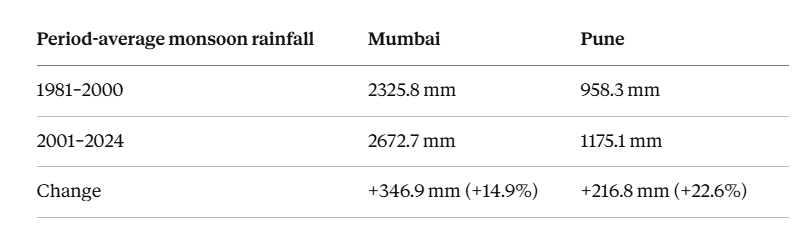
Zoom out from any single storm and the trend holds. Comparing 1981–2000 with 2001–2024, average monsoon rainfall has climbed by nearly 15 percent in Mumbai and 23 percent in Pune, according to data from the Council on Energy, Environment and Water (CEEW).
Looking ahead, a separate report — Indian Coastal Region: Climate Projections 2021–2040 — suggests suburban Mumbai and parts of coastal Maharashtra and Gujarat should expect almost an additional week of heavy rain during the Southwest Monsoon in the coming years, alongside a projected 18 percent rise in the region’s already-massive 1,749 mm monsoon baseline. The same projections point to rising temperatures across the board, including a 1.3°C increase in both summer wet-bulb and winter minimum temperatures.
When Rain meets a City That isn’t Ready
Climate change, though, is only half the story of why Mumbai floods. The briefing frames urban flooding as a climate-plus-exposure problem — extreme rainfall colliding with a city whose drains, floodplains and green cover haven’t kept pace.
Ramesh was blunt about what that means on the ground. “It is no longer a matter of warnings anymore as substantial warnings have been issued well in time. It is now a preparedness and response issue,” he said, calling for full desilting of drains ahead of every monsoon and blaming unchecked concretisation for leaving trees with no room for their roots to breathe.
Dr Vishwas Chitale, a Fellow at CEEW, described the immediate toll of the past week’s rain — an orange alert in Mumbai and a red alert in Pune, both signalling rainfall heavy enough to disrupt daily life. He pointed to early warning systems and structured flood-resilience plans, like the one CEEW helped develop with the Thane Municipal Corporation, as the kind of groundwork cities now need. “We need to come out with some practical solutions on the ground to be able to manage urban flooding better,” he said.
Aarti Khosla, Director of Climate Trends, put the challenge in starker terms: extreme rainfall is no longer a possibility to plan around but a near-certainty to plan for. “The question is no longer whether extreme rainfall events will occur, but whether our cities are prepared to withstand them,” she said, calling for climate-resilient drainage, nature-based flood defences and urban planning that treats risk as a starting assumption rather than an afterthought.
The briefing’s broader point is a simple one: urban flooding happens when saturated drainage meets any of several triggers — torrential rain, storm surge, sea-level rise, groundwater seepage, or simply a city with too little permeable ground left to absorb water. Global warming is intensifying the rainfall trigger, and dense, paved-over cities are amplifying what happens next.
As one line from the briefing puts it, cities designed for yesterday’s climate are struggling to cope with today’s extremes — and, if the projections hold, tomorrow’s will demand even more.


From Lost Wages to Rising Medical Bills: How Extreme Heat Is Already Costing India’s Economy

From Sky to Sea: Bird-Inspired Robot Could Transform Ocean Exploration

India Becomes World’s Fourth-Largest LNG Import Hub as Gas Infrastructure Grows

Wayanad Landslide Death Toll Rises to Five; Search Continues for Missing Workers

Indian Scientists Find a New Way to Tune How Metals Interact with Light

From Bell Labs to the Classroom: A Second Career in Teaching

10 Technologies That Could Change How We Power Homes, Fight Cancer and Feed the World

Beyond the IITs: India’s University Rankings Story Is Getting Bigger

Why Humid Heat Is Becoming India’s Most Dangerous Climate Threat

Why Kerala’s Children Are Missing School as Monsoon Illnesses Return?

-

 Space & Physics1 month ago
India Semiconductor Mission: ‘It’s Not About Fabs. It’s About Building An Entire Ecosystem’
-
Climate1 month ago
The Climate World Cup? How Climate Change Could Affect Player Performance at the 2026 World Cup
-
Society3 weeks ago
From Bell Labs to the Classroom: A Second Career in Teaching
-
Space & Physics1 month ago
Engineers Develop Dual-Mode Propulsion System for Next-Generation Small Satellites
-
Space & Physics2 months ago
Inside India’s Semiconductor Push: ‘This Is a 100-Year Bet’
-
Interviews5 months ago
Geometry, Curiosity and Finding ‘Her’ Place
-
Technology2 weeks ago
10 Technologies That Could Change How We Power Homes, Fight Cancer and Feed the World
-
Society1 month ago
From One Roman Classroom to 60,000 Schools: How Maria Montessori Quietly Changed the World