Technology
From Tehran Rooftops To Orbit: How Elon Musk Is Reshaping Who Controls The Internet
How Starlink turned the sky into a battleground for digital power — and why one private network now challenges the sovereignty of states

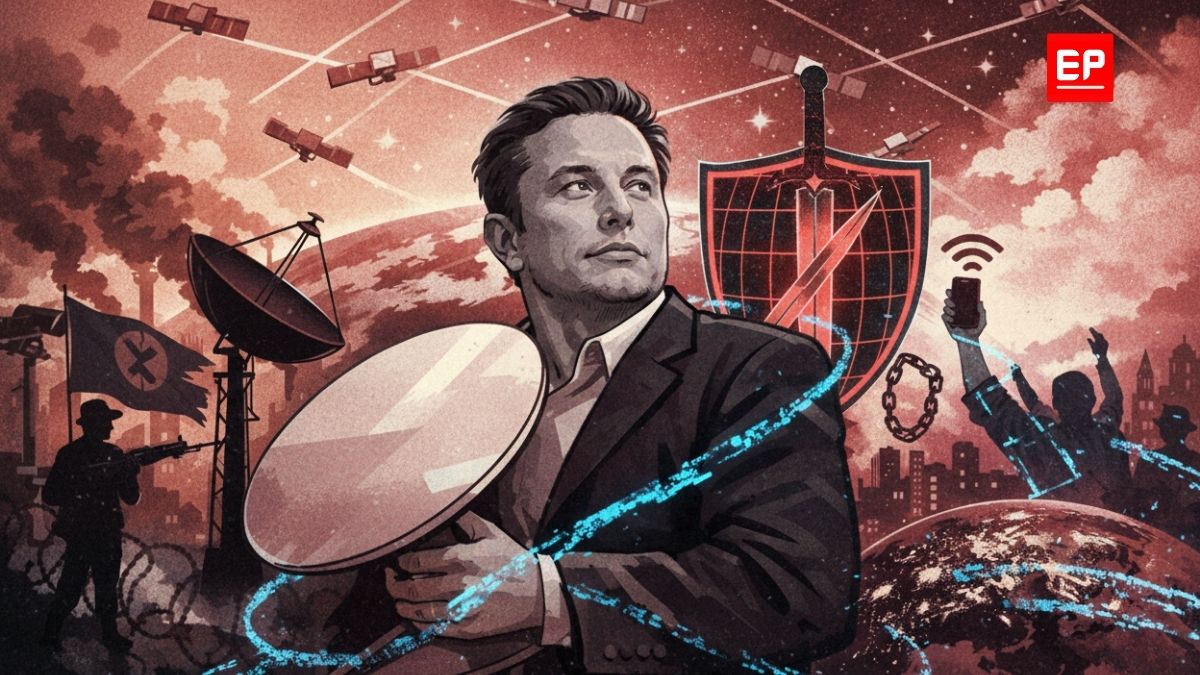
On a rooftop in northern Tehran, long after midnight, a young engineering student adjusts a flat white dish toward the sky. The city around him is digitally dark—mobile data throttled, social media blocked, foreign websites unreachable. Yet inside his apartment, a laptop screen glows with Telegram messages, BBC livestreams, and uncensored access to the outside world.
Scenes like this have appeared repeatedly in footage from Iran’s unrest broadcast by international news channels.
But there’s a catch. The connection does not travel through Iranian cables or telecom towers. It comes from space.
Above him, hundreds of kilometres overhead, a small cluster of satellites belonging to Elon Musk’s Starlink network relays his data through the vacuum of orbit, bypassing the state entirely.
For governments built on control of information, this is no longer a technical inconvenience. It is a political nightmare. The image is quietly extraordinary. Not because of the technology — that story is already familiar — but because of what it represents: a private satellite network, owned by a US billionaire, now functioning as a parallel communications system inside a sovereign state that has deliberately tried to shut its citizens offline.
The Rise of an Unstoppable Network
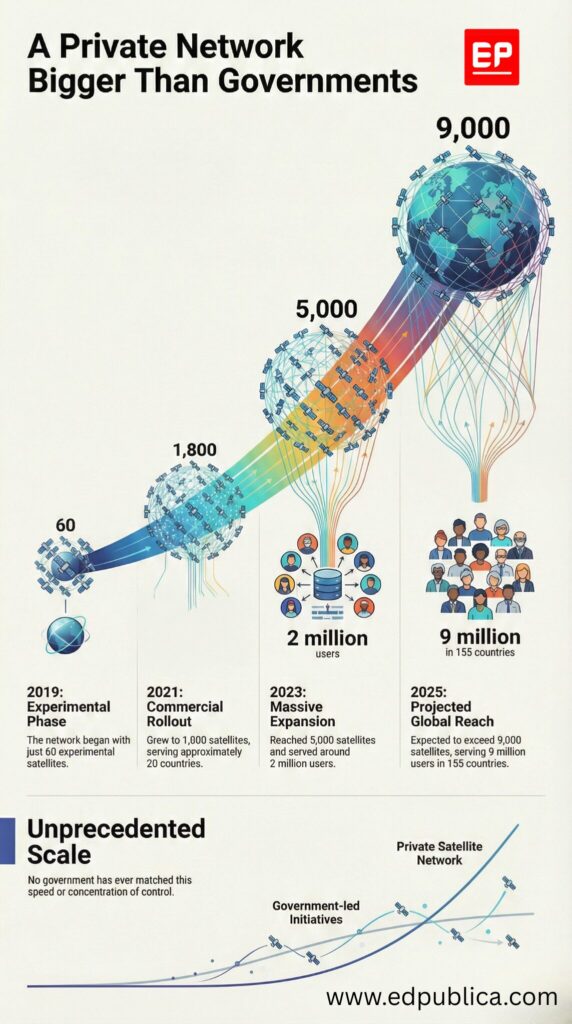
Starlink, operated by Musk’s aerospace company SpaceX, has quietly become the most ambitious communications infrastructure ever built by a private individual.
As of late 2025, more than 9,000 Starlink satellites orbit Earth in low Earth orbit (LEO) (SpaceX / industry trackers, 2025). According to a report in Business Insider, the network serves over 9 million active users globally, and Starlink now operates in more than 155 countries and territories (Starlink coverage data, 2025).
It is the largest satellite constellation in human history, dwarfing every government system combined.
This is not merely a technology story. It is a power story.
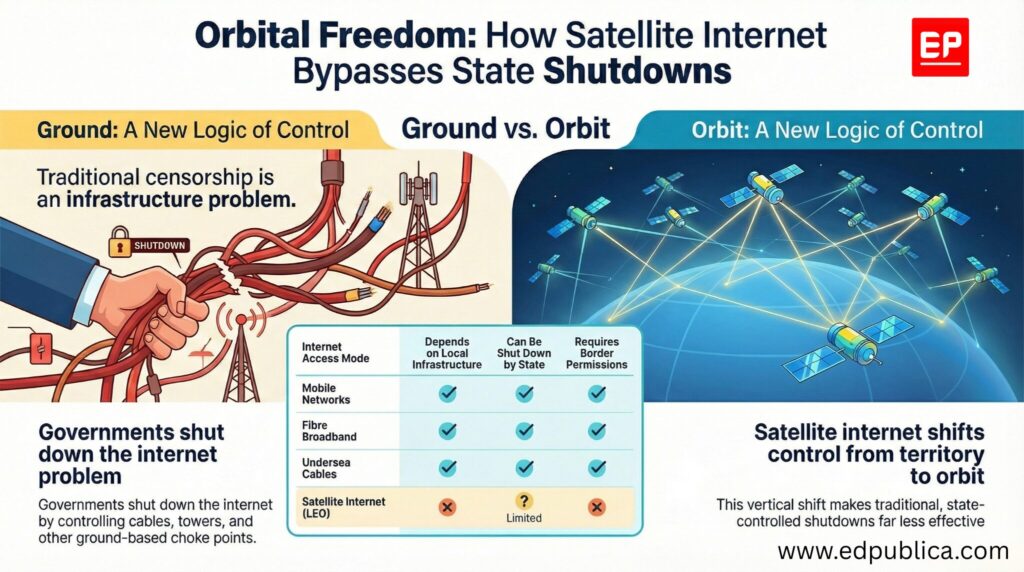
Unlike traditional internet infrastructure — fibre cables, mobile towers, undersea routes — Starlink’s backbone exists in space. It does not cross borders. It does not require landing rights in the conventional sense. And, increasingly, it does not ask permission.
Iran: When the Sky Replaced the State
During successive waves of anti-government protests in Iran, authorities imposed sweeping internet shutdowns: mobile networks crippled, platforms blocked, bandwidth throttled to near zero. These tactics, used repeatedly since 2019, were designed to isolate protesters from each other and from the outside world.
They did not fully anticipate space-based internet.
By late 2024 and 2025, Starlink terminals had begun appearing clandestinely across Iranian cities, smuggled through borders or carried in by diaspora networks. Possession is illegal. Penalties are severe. Yet the demand has grown.
Because the network operates without local infrastructure, users can communicate with foreign media, upload protest footage in real time, coordinate securely beyond state surveillance, and maintain access even during nationwide blackouts.
The numbers are necessarily imprecise, but multiple independent estimates provide a sense of scale. Analysts at BNE IntelliNews estimated over 30,000 active Starlink users inside Iran by 2025.
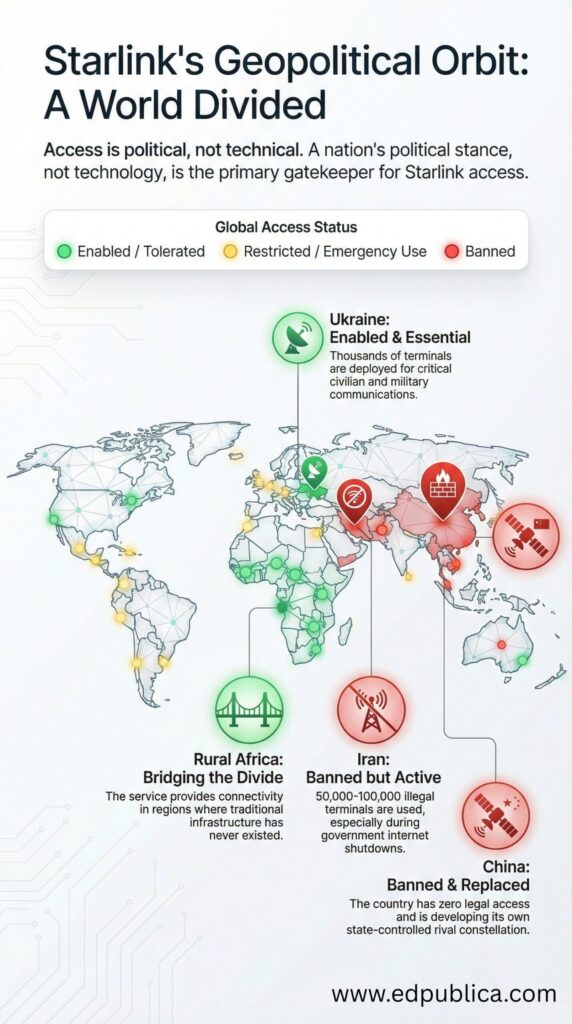
Iranian activist networks suggest the number of physical terminals may be between 50,000 and 100,000, many shared across neighbourhoods. Earlier acknowledgements from Elon Musk confirmed that SpaceX had activated service coverage over Iran despite the lack of formal licensing.
This is what alarms governments most: the state no longer controls the kill switch.
Ukraine: When One Man Could Switch It Off
The power — and danger — of this new infrastructure became even clearer in Ukraine.
After Russia’s 2022 invasion, Starlink terminals were shipped in by the thousands to keep Ukrainian communications alive. Hospitals, emergency services, journalists, and frontline military units all relied on it. For a time, Starlink was celebrated as a technological shield for democracy.
Then came the uncomfortable reality.
Investigative reporting later revealed that Elon Musk personally intervened in decisions about where Starlink would and would not operate. In at least one documented case, coverage was restricted near Crimea, reportedly to prevent Ukrainian drone operations against Russian naval assets.
The implications were stark: A private individual, accountable to no electorate, had the power to influence the operational battlefield of a sovereign war. Governments noticed.
Digital Sovereignty in the Age of Orbit
For decades, states have understood sovereignty to include control of national telecom infrastructure, regulation of internet providers, the legal authority to impose shutdowns, the power to filter, censor, and surveil.
Starlink disrupts all of it.
Because, the satellites are in space, outside national jurisdiction. Access can be activated remotely by SpaceX, and the terminals can be smuggled like USB devices. Traffic can bypass domestic data laws entirely.
In effect, Starlink represents a parallel internet — one that states cannot fully regulate, inspect, or disable without extraordinary countermeasures such as satellite jamming or physical raids.
Authoritarian regimes view this as foreign interference. Democratic governments increasingly see it as a strategic vulnerability. Either way, the monopoly problem is the same: A single corporate network, controlled by one individual, increasingly functions as critical global infrastructure.
How the Technology Actually Works
The power of Starlink lies in its architecture. Traditional internet depends on fibre-optic cables across cities and oceans, local internet exchanges, mobile towers and ground stations, and centralised chokepoints.
Starlink bypasses most of this. Instead, it uses thousands of LEO satellites orbiting at ~550 km altitude, user terminals (“dishes”) that automatically track satellites overhead, inter-satellite laser links, allowing data to travel from satellite to satellite in space, and a limited number of ground gateways connecting the system to the wider internet.
This design creates resilience: No single tower to shut down, no local ISP to regulate, and no fibre line to cut.
For protesters, journalists, and dissidents, this is transformative. For governments, it is destabilising.
A Private Citizen vs the Rules of the Internet
The global internet was built around multistakeholder governance: National regulators, international bodies like the ITU, treaties governing spectrum use, and complex norms around cross-border infrastructure.
Starlink bypasses much of this through sheer technical dominance, and it has become a company that: owns the rockets, owns the satellites, owns the terminals, controls activation, controls pricing, controls coverage zones… effectively controls a layer of global communication.
This is why policymakers now speak openly of “digital sovereignty at risk”. It is no longer only China’s Great Firewall or Iran’s censorship model under scrutiny. It is the idea that global connectivity itself might be increasingly privatised, personalised, and politically unpredictable.
The Unanswered Question
Starlink undeniably delivers real benefits, it offers connectivity in disaster zones, internet access in rural Africa, emergency communications in war, educational access where infrastructure never existed.
But it also raises an uncomfortable, unresolved question: Should any individual — however visionary, however innovative — hold this much power over who gets access to the global flow of information?
Today, a protester in Tehran can speak to the world because Elon Musk chooses to allow it.
Tomorrow, that access could disappear just as easily — with a policy change, a commercial decision, or a geopolitical calculation.The sky has become infrastructure. Infrastructure has become power. And power, increasingly, belongs not to states — but to a handful of corporations.
There is another layer to this power calculus — and it is economic. While Starlink has been quietly enabled over countries such as Iran without formal approval, China remains a conspicuous exception. The reason is less technical than commercial. Elon Musk’s wider business empire, particularly Tesla, is deeply entangled with China’s economy. Shanghai hosts Tesla’s largest manufacturing facility in the world, responsible for more than half of the company’s global vehicle output, and Chinese consumers form one of Tesla’s most critical markets.
Chinese authorities, in turn, have made clear their hostility to uncontrolled foreign satellite internet, viewing it as a threat to state censorship and information control. Beijing has banned Starlink terminals, restricted their military use, and invested heavily in its own rival satellite constellation. For Musk, activating Starlink over China would almost certainly provoke regulatory retaliation that could jeopardise Tesla’s operations, supply chains, and market access. The result is an uncomfortable contradiction: the same technology framed as a tool of freedom in Iran or Ukraine is conspicuously absent over China — a reminder that even a supposedly borderless internet still bends to the gravitational pull of corporate interests and geopolitical power.











Technology
India–Poland to Pursue Joint Research in AI, Semiconductors and Quantum Technology
India and Poland have agreed to pursue collaborative research in AI, semiconductors and quantum technologies, while identifying battery recycling, rare-earth processing and higher education as areas for closer cooperation.


Technology
AI Models Could Soon Spread Across Smart Devices, Raising Cybersecurity Fears
Anthropic’s experiments highlight how AI self-replication could create new cybersecurity risks, allowing malicious systems to spread across internet-connected devices.
Artificial intelligence (AI) models could soon spread from one internet-connected device to another, potentially creating networks of compromised devices that carry out cyberattacks with limited human involvement. The warning from AI company Anthropic highlights a possible new challenge for cybersecurity as AI systems become capable of performing increasingly complex tasks.
In experiments, Anthropic found that AI models with 30 billion parameters or fewer could already perform many of the individual tasks needed to copy and spread themselves. However, the models struggled to complete the entire process reliably. The findings point to a potential threat, although they do not establish that fully self-replicating AI networks are already operating in the real world.
How AI could spread through smart devices
Many everyday devices, including smart televisions, security cameras and household appliances, connect to the internet. Internet of Things (IoT) devices present a particular concern because many connect directly to networks while receiving limited security attention from users. Weak passwords, outdated software and unpatched vulnerabilities can leave devices exposed to remote exploitation.

Once compromised, a device can become part of a botnet — a network of devices secretly controlled by attackers. Such networks have long been used to spread harmful software, send spam messages and overwhelm websites with large volumes of unwanted traffic.
AI could make these attacks easier to carry out. A malicious AI system might help identify vulnerable devices, exploit security weaknesses and use compromised devices to reach others. Anthropic’s experiments examined whether an AI agent could combine the computing power of inexpensive, internet-connected devices to run other AI models. If such a process becomes reliable, attackers could potentially use large numbers of ordinary devices to support their operations.
Cybersecurity: Why these networks are difficult to stop
A major concern is that a botnet can operate across thousands of devices in different locations. Shutting down one infected device may not stop the others from continuing to operate.
For example, if a security camera is compromised, its owner may not immediately notice anything unusual. The camera could continue recording while its computing resources are used for activities the owner never authorised. If similar weaknesses exist in other devices, attackers could build a much larger network.
AI-assisted attacks could become harder to manage if systems learn to carry out several steps automatically, reducing the need for attackers to control every action themselves. However, Anthropic’s findings do not show that AI can yet carry out this entire process consistently without assistance.
Securing AI and connected devices
The warning raises questions about how AI developers can prevent their models from being used to exploit computer systems. It also draws attention to the security of the devices people bring into their homes.
Manufacturers can reduce risks by fixing software vulnerabilities, providing regular security updates and strengthening password and access protections. Users can help by changing default passwords, installing updates and replacing devices that no longer receive security support.
AI developers, meanwhile, need to test whether their systems can be misused to automate cyberattacks. The immediate concern is not that every smart device will become a threat. It is that weaknesses already present in internet-connected devices could become easier to exploit as AI gains the ability to perform complex tasks with less human direction.
Technology
Thorium-229 Nuclear Clock Opens New Way to Probe Dark Matter
Scientists have demonstrated a working thorium-229 nuclear clock, opening new possibilities for precision timekeeping and research into dark matter.
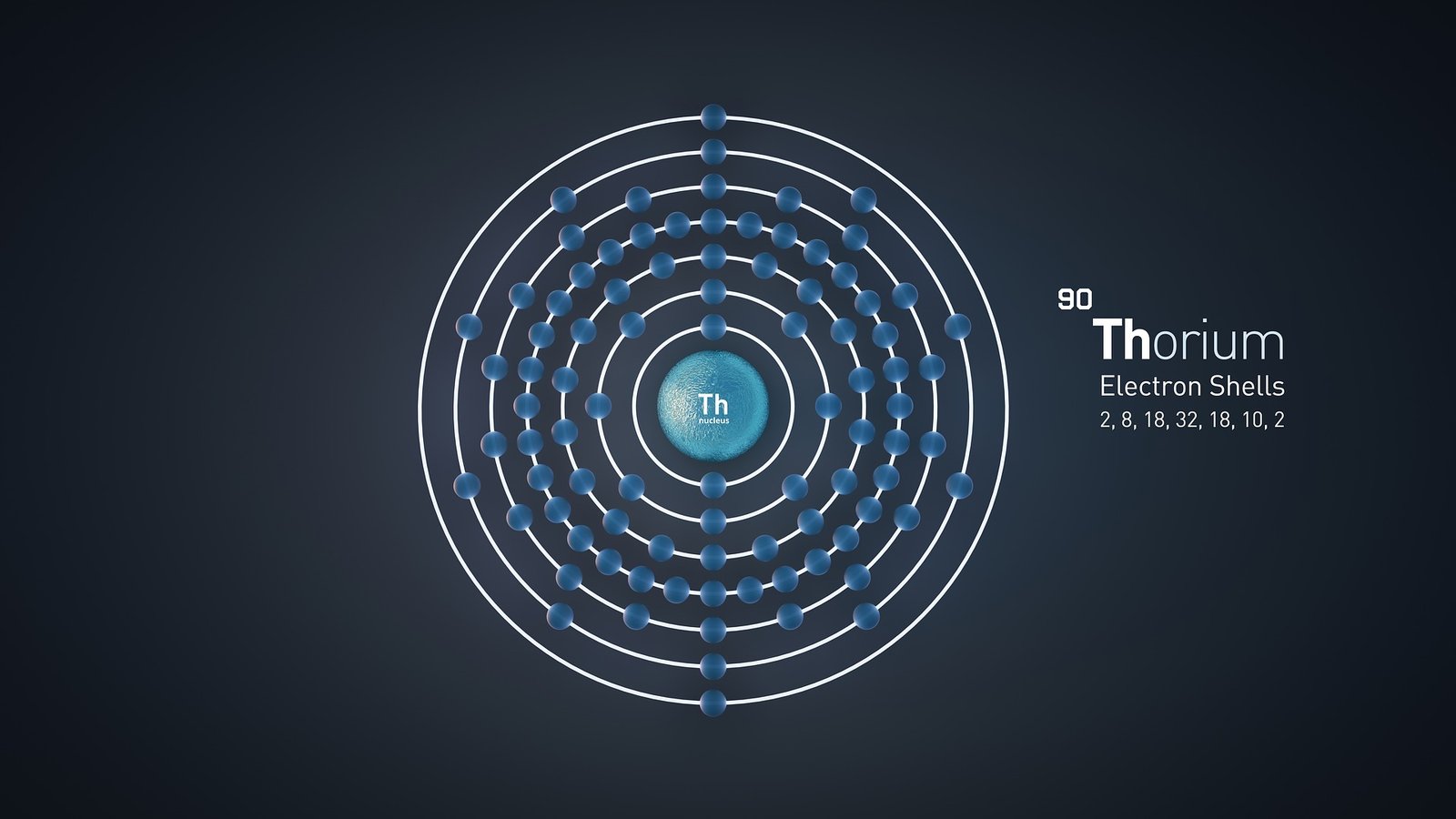
Scientists have demonstrated a working nuclear clock based on thorium-229, an advance that could open new possibilities for precision timekeeping and the search for dark matter. Unlike conventional atomic clocks, which measure transitions involving electrons, the device uses an energy transition inside an atomic nucleus. The clock operates with thorium-229 nuclei embedded in a small crystal at room temperature, offering a potential route towards compact and highly sensitive timekeeping technology.
The findings, published in Nature demonstrate how a laser can be continuously stabilised using the nuclear transition itself. The researchers also used the device to investigate whether dark matter might produce detectable changes in fundamental physical quantities.
From atomic transitions to the atomic nucleus
Modern atomic clocks measure the frequency of radiation associated with transitions between energy levels in atoms or ions. Because these frequencies are highly stable, they provide precise standards for measuring time and testing physical theories.
The proposed nuclear clock uses thorium-229, an isotope with an unusually low-energy nuclear transition that can be excited using ultraviolet light. Researchers have explored this possibility for decades because nuclear transitions are expected to be less sensitive to some external disturbances than electronic transitions.
In the new experiment, the researchers embedded thorium-229 nuclei in a millimetre-sized calcium fluoride crystal. The device operated at approximately room temperature, around 294.7 kelvin. A laser emitting radiation at a wavelength of 148 nanometres was used to probe the nuclear transition.
A central feature of the experiment was its feedback system. The researchers measured how much laser light the nuclei absorbed and used the resulting signal to correct the laser frequency. This allowed the nuclear transition to serve as the reference for stabilising the laser, rather than relying entirely on an external reference.
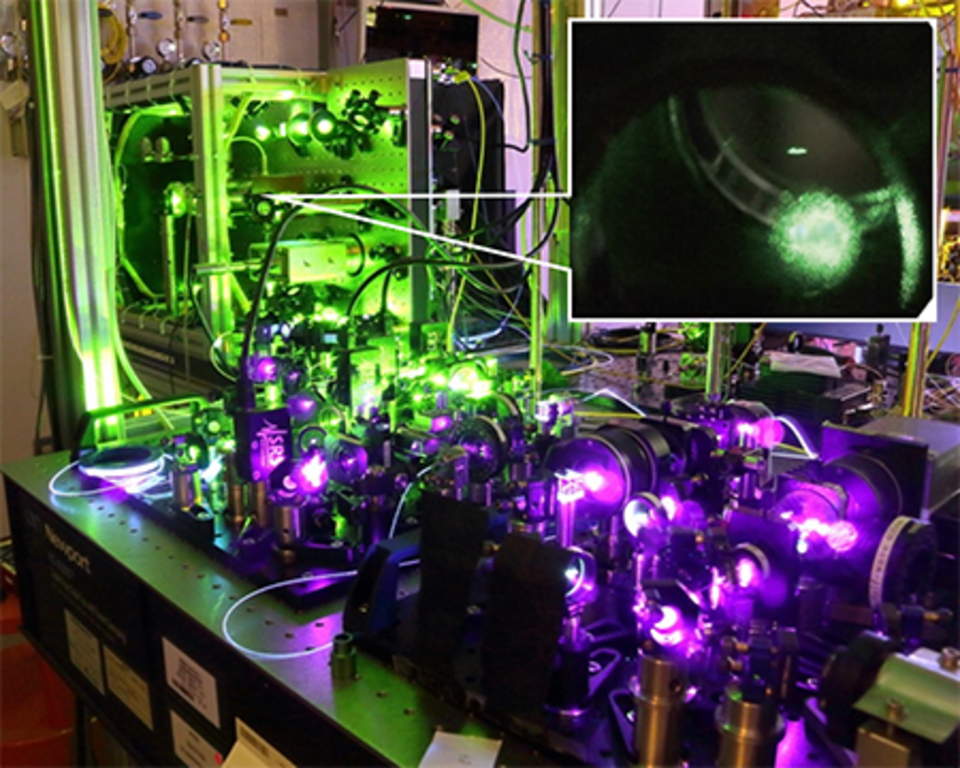
A ytterbium optical lattice clock at NMIJ, National Metrology Institute of Japan used to measure International Atomic Time (TAI).Image credi:Wikimedia commons
The team also compared the nuclear clock with an established ytterbium-ion optical clock. This comparison helped researchers assess the new device’s frequency stability and look for possible changes in the thorium transition.
A new tool in the search for dark matter
Beyond timekeeping, the clock offers a way to investigate possible changes in fundamental constants of nature. Some theoretical models propose that ultralight dark matter could cause these constants to vary over time, producing small changes in the frequencies measured by precision clocks.
The researchers compared the thorium clock’s frequency with that of the ytterbium reference over approximately 23 hours. They searched for periodic fluctuations and gradual drifts that could indicate such changes.
The experiment found no statistically significant periodic signal within the range examined. Instead, the measurements placed new limits on certain interactions between ultralight dark matter and ordinary matter. The resulting constraints were competitive with leading atomic-clock measurements for some photon-related interactions and improved previous constraints involving the strong nuclear force.
These results do not establish the existence of dark matter, nor do they rule out all possible models. They demonstrate how a nuclear clock can be used to test predictions that might otherwise be difficult to investigate experimentally.
Challenges remain
The device is still a developing technology. Its performance is limited by factors including laser power, measurement noise and variations in the crystal’s nuclear transition frequency at different locations. The researchers also identified reproducibility between measurements taken on different days as an important limitation.
They suggest that stronger ultraviolet laser sources and improvements to the crystal material could substantially improve the clock’s stability and sensitivity. Their projections indicate that future versions could approach the performance of leading optical atomic clocks while retaining the practical advantages of a solid-state system.
The demonstration marks a significant step towards nuclear clocks that can operate as standalone devices. Further improvements will determine how effectively the technology can support precision timekeeping and searches for new physics.


Greece Passes Social Media Ban for Children Under 15

Istanbul Floods Reveal How Climate Change and Urbanisation Combine to Raise Flood Risks

Nepal’s 4.7 Billion Flood Recovery Bill Dwarfs UN Climate Fund Allocation

India–Poland to Pursue Joint Research in AI, Semiconductors and Quantum Technology

Climate Disasters Disrupted Schooling for 171 Million Students in 2025, UNICEF Finds

Knowing When to Think for Ourselves: AI, Intuition and the Education of Discernment

After a Scorching Summer, Delhi’s Children Are Slow to Return Outdoors

Two Chemists Win Nobel Prize for Solving a Century-Old Puzzle: Why Life Picks One Hand Over the Other

Marshall Islands: Why the US Nuclear Legacy Is Back Before the UN

How Wind Turbines Could Produce More Power From the Same Wind

-

 Math3 months ago
The 2026 Fields Medals: Four Proofs, Four Decades-Old Problems Solved
-
EP Deep Dive: Data & Solutions3 months ago
After Kerala’s Deadliest Landslide, the Hardest Thing to Rebuild Was Childhood
-
EP Deep Dive: Data & Solutions4 months ago
West Asia Crisis: Can Kerala’s Returning Gulf Migrants Find a Future in the Green Economy?
-
Space & Physics5 months ago
India Semiconductor Mission: ‘It’s Not About Fabs. It’s About Building An Entire Ecosystem’
-
Interviews1 month ago
From Scams to Screens: How the National Stock Exchange Rewrote India’s Equity Story
-
Climate5 months ago
The Climate World Cup? How Climate Change Could Affect Player Performance at the 2026 World Cup
-
Society3 months ago
What Is Civilisational Diplomacy? Understanding India’s Newest Foreign Policy Tool
-
Society4 months ago
From Bell Labs to the Classroom: A Second Career in Teaching