Education
Enacted Career Identity and Why a Career Is a Pattern of Doing, Not a Plan
As AI reshapes professions and workplace expectations, Enacted Career Identity offers a fresh perspective on how people develop professional skills, judgment and a lasting sense of purpose through everyday work.


Most of us were given the same advice about careers. Choose a goal early, earn the right degree, pick up the right certificates, and climb steadily toward the destination you chose. The advice quietly assumes two things. It assumes the world will still look roughly the same when you arrive, and it assumes that who you are professionally is something you collect along the way and then carry with you, like a bag of qualifications.
Neither assumption holds up well anymore. Industries merge, roles are reorganised, and
artificial intelligence now reaches into the daily work of radiologists, lawyers, and software
engineers alike. A student who prepares for a single destination may find the destination has
moved. A professional who has stored up credentials may find that the credentials no longer
describe the work in front of them.
Enacted Career Identity (ECI) is a way of thinking about careers that starts from a different
place. It says that a career identity is not a plan, a certificate, or a story we tell about
ourselves. It is what a person keeps noticing, deciding, and doing. Over time, repeated cycles
of engagement with changing situations build a recognisable pattern, a way of contributing
that colleagues and clients come to rely on.
That pattern is the identity. In the fuller formulation, professionals encounter new situations, interpret what they mean, act within them, observe what follows, and in the process reorganise both their understanding of the situation and their understanding of themselves. Unlike approaches that primarily examine career adaptability, identity experimentation or the construction of career narratives, ECI directs attention to how professional identity emerges and evolves through repeated patterns of situated action, interpretation and interaction.
This has a plain consequence. Capability is not simply stored. It is sustained and refined
through use, in real situations. Some capabilities, such as practised manual routines, survive
long disuse, while others, such as judgment in irregular cases, fade without use.
The idea of dependent origination provides a philosophical foundation for ECI. Its central
claim is that nothing arises on its own. Things come into being because certain conditions are
present, and they change when those conditions change.
Applied to careers, this means that a professional identity is not a fixed core waiting to be discovered or expressed. It arises in the meeting between a person and the situations they keep engaging with. The relating is not something that happens to the identity afterward. The relating is what the identity is. Consider aviation, a field that has lived with heavy automation for decades.
In a 2014 study in the journal Human Factors, Stephen Casner and colleagues tested sixteen experienced airline pilots in a flight simulator with different levels of automation. The pilots could still fly the aircraft by hand and read the instruments. What suffered was the thinking side of flying. Without the flight computer, all but one pilot made a significant navigation error, and several struggled when instruments failed. Pilots whose minds wandered more during automation did worse on these tasks. The authors suggest that these skills may last longer when pilots actively supervise automation, though the evidence is only correlational.
A second line of evidence concerns what happens when an AI system shapes a person’s
decisions. In a 2023 experiment reported in Scientific Reports, Lucía Vicente and Helena
Matute found that people who received biased recommendations from an AI system in a
simulated medical diagnosis task went on to reproduce that bias afterwards, when the system
was no longer there. The influence did not end when the interface closed. For ECI, this is an
important observation, because a tool can shape the judgment that follows it and not only
assist an unchanged mind.
The Same Mechanism Now Appears Across Professions
In radiology, AI is increasingly a partner in image analysis and diagnostic workflows.
Nicoletta Gandolfo, president of the Italian Society of Medical and Interventional Radiology,
wrote in an editorial in La radiologia medica in 2025 that the radiologist’s role is moving
towards that of a clinical mediator, who brings precision judgment to harder cases,
communicates with patients and clinicians, and guards against imaging that is not truly
needed.

In legal services, a 2026 survey of 258 leaders across law, consulting, and accounting
firms by General Assembly, reported by Law360 Pulse, found that 71 percent of law firm
leaders expect junior roles to evolve. Ash Khanna, from General Assembly, said that
producing work is becoming a commodity, and the premium now is on accountability and
judgment. A lawyer’s identity increasingly sits in standing behind a position and answering
for it.
In software engineering, a randomised trial by the research organisation METR in 2025 asked sixteen experienced open source developers to complete real tasks in codebases they knew well, using early 2025 tools, with AI assistance allowed on some and not on others. They
took 19 percent longer when AI was allowed. Before the study they had expected AI to make
them 24 percent faster, and afterwards they still believed it had made them about 20 percent
faster. Judging whether a tool is actually helping is itself a skill that has to be practised, and it
can fail quietly even in experienced hands.
None of these professions is simply losing work to a machine. Each is left with a different
remainder, and what matters is what the people inside it keep doing with it.
AI agents make this plainest. A McKinsey report on HR in the agentic era estimates that by
2030 roughly two thirds of today’s HR activities could be fully automated, or automated in
delivery, with humans owning policy, outcomes, and “the case that doesn’t fit the rules.”
Microsoft’s 2025 Work Trend Index, a survey of 31,000 knowledge workers in 31 markets,
describes the same move from doing to directing, with leaders expecting their teams to train
and manage agents within five years.
Directing is not automatically enactment. In a 2023 field experiment with 758 consultants at
Boston Consulting Group, Fabrizio Dell’Acqua and colleagues found that AI users were 19
percentage points less likely to reach the correct answer on one task chosen to lie outside
what the AI did well. A director who simply approves whatever arrives is not necessarily
enacting anything.
It would be a mistake to conclude that ECI is only a response to AI. In 2026, Indian real
estate consultancies moved into adjacent services. In September, Anarock Group announced a
51 percent stake in the architecture and interior design firm DSP Design Associates, and in
April Savills took a majority stake in the hospitality advisory firm Hotelivate, according to
company announcements. Neither involves AI. Clients simply want one partner across site
selection, design, and delivery.
A firm can buy a capability, and a consultant can add a certificate, but neither automatically produces a new identity. That emerges only if the people involved keep working across the boundary until a recognisable way of contributing takes shape. ECI often emerges at precisely such boundaries, where a professional meets problems that the existing identity cannot resolve alone.
What Follows For Students, Educators, and Parents?
The first implication is that the environments a young person works and learns in matter as
much as the qualifications they collect. If identity is built through repeated engagement, then
the question to ask of any course, internship, or first job is what it will keep asking the person
to notice, decide, and do. A role that offers real problems, honest consequences, and good
mentors builds something. A role that offers only routine, or hands every difficult decision to
a tool, may quietly stop building anything.
The second implication is that a plan should be treated as a working hypothesis, because a
career held together by a fixed plan breaks when the plan breaks. A career held together by an
ongoing pattern of engagement can carry a person through the change, because a pattern can
be formed again in new conditions in a way a destination cannot.
The third implication concerns judgment, which is the quiet centre of all of this. Judgment is
not a possession acquired once in early adulthood. It is sustained by being exercised against
real, irregular situations. Educators who want students to develop it need to protect the
occasions on which students must decide for themselves, including the difficult, ambiguous
ones, rather than smoothing them away with ever better tools.
Employers face the same choice. A Stanford Digital Economy Lab working paper studied workers aged 22 to 25. In jobs most exposed to AI, their employment is 19 per cent lower than it would be had it kept pace with less exposed jobs. The drop is sharpest where AI replaces tasks, and flat or rising where AI helps workers. The authors stress this shows a pattern, not a cause. If agents take over entry-level work, the learning that once built judgment by accident must be built on purpose.
Behind all of this sits what could be called an ecological mindset, the orientation that follows
from dependent origination. It is the habit of treating one’s own attention, judgment, and skill
as arising together with a wider field of colleagues, tools, institutions, and now AI systems,
instead of as private assets to be accumulated and defended. A portfolio mindset asks what
skills a person owns and how to add more.
An ecological mindset asks what conditions their judgment is currently arising within, and whether those conditions are worth tending. None of this makes credentials worthless or planning foolish. It changes what they are for. A credential opens a door, and a plan gives direction. Neither is the identity. Identity is what shows up afterwards, in what a person keeps noticing, deciding, and doing when the situation in front of them doesn’t fit anything they were taught.
For a generation entering a world where the destination keeps shifting, that is the more
reliable thing to build. The question worth asking is not only what to become, but what to
keep doing, and in what context, until a way of contributing is recognisably their own.












Education
India’s Richest Agree on One Cause Above All Others: Education
India’s richest philanthropists donated ₹4,188 crore to education in 2026, making it the leading cause in the EdelGive Hurun India Philanthropy List.

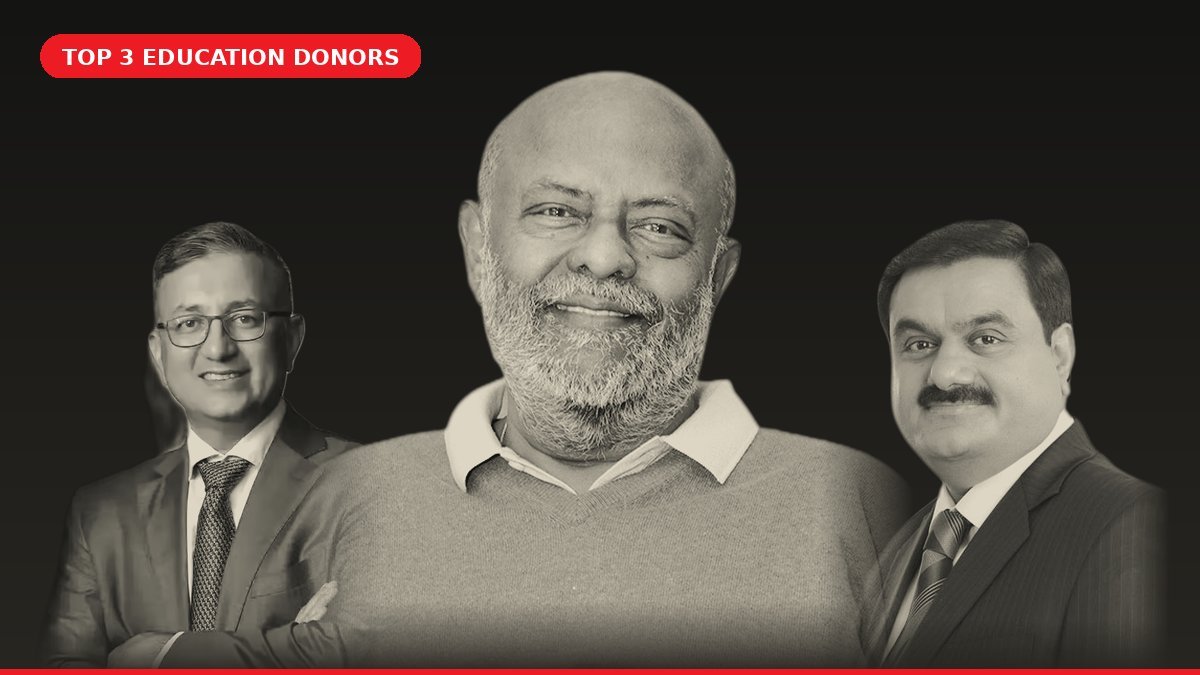
Every year the EdelGive Hurun India Philanthropy List produces the same headline, who sat at the top of the table. This year the more telling figure is a different one: INR 4,188 crore, and the 200 donors who sent it toward a single cause. That makes education philanthropy in India one of the clearest indicators of how the country’s wealthiest individuals are choosing to direct their social investments
Shiv Nadar will get the headlines again this year, as he has for five years running. His family’s ₹2,593 crore donation, which works out to roughly INR 7.1 crore a day, keeps them at the top of the EdelGive Hurun India Philanthropy List 2026, released on Friday by EdelGive Foundation and Hurun India. Gautam Adani and family will get the next headline. They more than doubled their overall giving this year, to ₹877 crore across every cause they fund, the single largest rupee jump anyone on the list recorded.
Both of those headlines are true. Neither is the most interesting number in the report.
That number is INR 4,188 crore, the amount India’s wealthiest donors sent toward education in the twelve months to March 2026. Nothing else comes close. Education made up 36 per cent of everything given on the list this year. It was funded by 200 of the 219 philanthropists named, that is 91 per cent of everyone on it, and it was the single biggest reason 95 of them gave at all. Healthcare, the next most popular cause, drew support from 175 donors but took in barely a third as much money.
Pull the individual rankings aside and a plainer pattern shows up underneath. When India’s richest people decide to give something back, more of them choose education, with more of their money, than anything else, and that has held true for years now.
The biggest cheque, just not the official one
There’s a small irony buried in how the list is counted. Shiv Nadar’s family sent INR 1,047 crore to education this year, the single largest sum any donor gave to the cause, and nearly double what the next biggest education donor gave. But the family gave even more to Arts, Culture and Heritage, ₹1,220 crore, much of it through institutions tied to the Shiv Nadar Foundation. So the list records his primary cause as arts and culture, not education. Read the rupee figures plainly, though, and no one in India put more money into education this year than the man who tops the list for something else entirely.
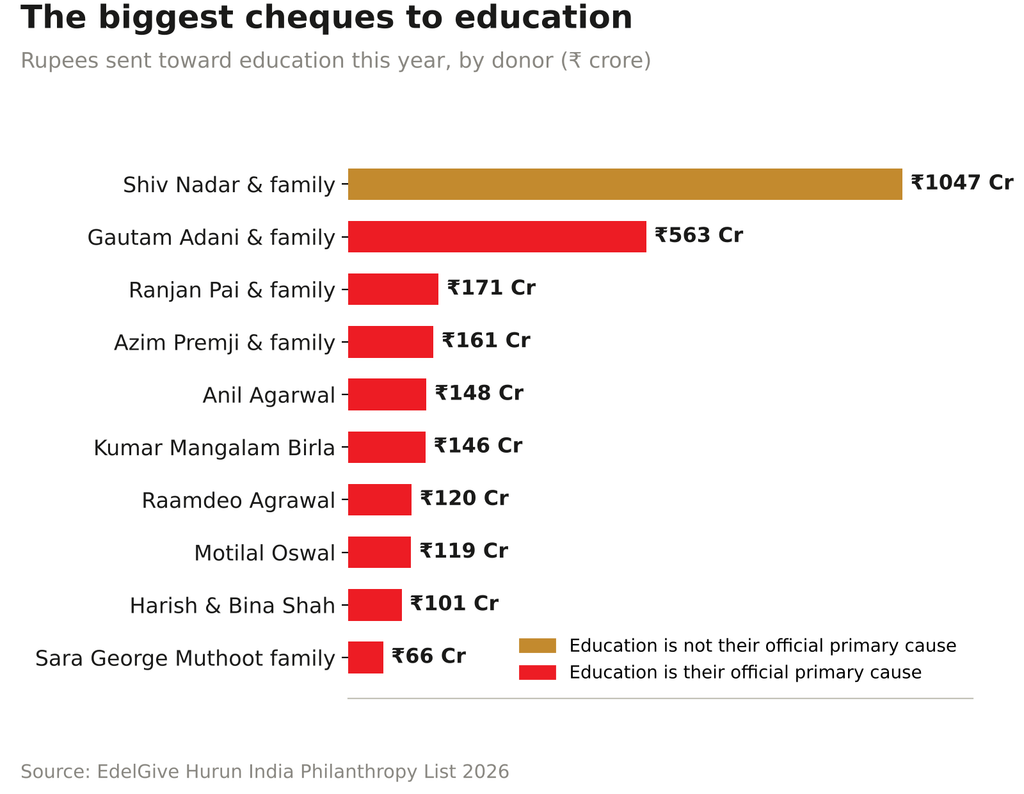
Gautam Adani’s number is a cleaner story. Of his INR 877 crore, INR 563 crore (his actual primary cause) went to education through the Adani Foundation, ahead of healthcare, rural transformation and livelihood work. It’s the clearest “education first” commitment among the top ten donors, and set against his jump from fifth place to second, it’s also the most visible sign this year that new money is moving toward the same cause older philanthropic families have favoured for decades.
The names behind the number
Education shows up as the stated priority again and again further down the list. Ranjan Pai, who entered the top ten this year at ninth place, gave INR 171 crore of his INR 219 crore to education, 98 per cent of it in his personal capacity and much of it tied to his work as chairman of Manipal Education and Medical Group. Kumar Mangalam Birla gave INR 146 crore to education, his stated primary cause.
Harish and Bina Shah sent two thirds of their INR 155 crore, INR 101 crore, to education, including a 2025 commitment of 100 crore to expand girls’ education with Educate Girls. Azim Premji and family, India’s most consistent education philanthropists over the list’s history, gave 161 crore this year. Anil Agarwal, giving from London, sent INR 148 crore. Kumari Shibulal gave INR 42 crore of her INR 44 crore total to education, almost all of it toward Vidyadhan, her family’s scholarship programme working toward one lakh scholarships for students from low income households by 2029.

The pattern held among this year’s new entrants too. Forty five philanthropists joined the list, up from just 12 last year, and education led there as well. Raamdeo Agrawal and Motilal Oswal, the Motilal Oswal Financial Services co founders, each gave roughly INR 120 crore, almost entirely to education, making them the most generous newcomers on the list. Chandrika and Ranjan Tandon, giving from New York, aimed their INR 100 crore at something more specific: a new School of Artificial Intelligence at IIM Ahmedabad, Chandrika Tandon’s alma mater. A reminder that “education” on this list stretches from rural scholarships all the way to frontier technology research chairs.
Why this is the number that matters
“Education remains the leading cause, supported by 200 of the 219 philanthropists, with nearly INR 4,200 crore donated,” Hurun India founder Anas Rahman Junaid said at the list’s release, pairing it with an 82 per cent jump in healthcare giving as the year’s other notable shift.
The list itself is built to reward the podium: who climbed, who gave the most, who cracked the top ten. But ranking individuals this way hides a more useful fact about where Indian wealth actually goes when it chooses to give something back. The EdelGive Hurun list says more as a signal than as a leaderboard, and this year’s signal isn’t subtle. Whatever else divides India’s 219 largest philanthropists, their industries, their ages, their home cities, whether their money was inherited or built from nothing, nine in ten of them landed on the same answer for where at least some of it should go.
Education
CUSAT ranks 849th globally in sustainability, tops Kerala universities
CUSAT has secured the 849th position globally and 37th place in India in the QS World University Rankings: Sustainability 2027. It is the only Kerala institution among the global top 1,000.


EduNews & Views
Global Patent Applications Hit Record 3.9 Million in 2025; India Sees 37.5% Growth
Global patent applications reached a record 3.9 million in 2025, with China accounting for more than half the increase. India recorded a 37.5% rise, crossing 100,000 applications for the first time.

Global patent applications crossed 3.9 million in 2025, registering a 6% increase over the previous year and the fastest annual growth since 2016. According to the World Intellectual Property Organization (WIPO), China accounted for more than half of the additional applications. India recorded a 37.5% rise, crossing 100,000 filings for the first time.
Patent applications are formal requests for legal protection of inventions. They allow individuals, companies and research institutions to seek exclusive rights over their innovations, preventing others from commercially using them without permission if a patent is granted. The number of applications therefore offers an indication of innovation and research activity, although not every application results in a granted patent or a marketable technology.
The increase of approximately 224,000 applications worldwide was concentrated largely in four countries: China, Japan, India and South Korea. Together, they accounted for about 94% of the net global increase, according to WIPO’s World Intellectual Property Indicators 2026 report.
China Accounts for More Than Half of Global Patent Application Increase
China contributed 113,693 additional patent applications in 2025, accounting for more than half of the worldwide increase. Inventors and applicants residing in China filed approximately 1.9 million applications globally, retaining the country’s position as the largest source of patent filings.
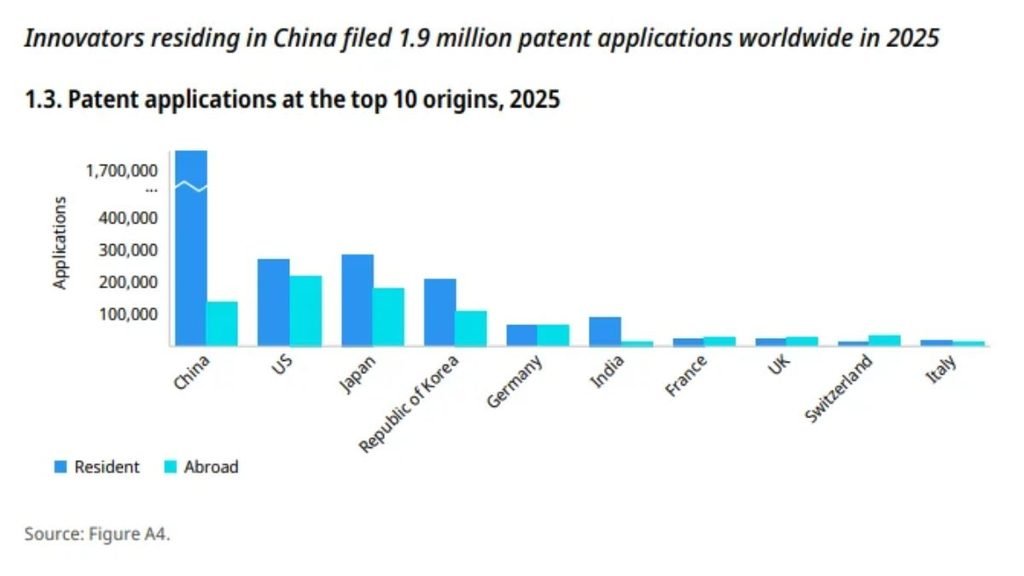
The United States followed with 489,766 applications, while Japan recorded 466,301. These figures include applications filed both within the respective countries and abroad. Japan added 45,310 applications during the year, making it the second-largest contributor to global growth. India followed with an additional 28,690 applications, while South Korea contributed 23,169.
India Crosses 100,000 Patent Applications
India recorded 105,163 patent applications in 2025, marking the first time the country crossed the 100,000 threshold. The 37.5% increase also marked its seventh consecutive year of double-digit growth. The rise was driven primarily by an increase in applications filed by Indian residents, indicating growing domestic participation in patent activity. India was the third-largest contributor to the global increase, after China and Japan.
WIPO’s figures also show that applications received by India’s patent office increased by 27.8% in 2025. This marks the ninth consecutive year of growth at the office and the fourth successive year of double-digit increases. Kerala recorded 827 patent applications in 2024–25, up from 637 in the previous financial year, according to the Indian Patent Office.
However, a separate analysis by the Gulati Institute of Finance and Taxation has pointed to a gap between the state’s research spending and patent generation, raising questions about how effectively research investments are translating into intellectual property. The study also highlighted a gap between government research funding and patent output. Educational institutions received 44.81% of the state’s R&D allocation but accounted for only 7.29% of its patents.
Asia Accounts for 71.2% of Global Patent Filings
Intellectual property offices located in Asia received approximately 2.8 million patent applications in 2025, accounting for 71.2% of the global total. The region’s share has increased from 61.9% in 2015, reflecting a steady shift in global patent activity over the past decade.
China accounted for approximately 68.5% of the applications received across Asian offices. Africa was the other region, besides Asia, to record an average annual growth rate above the global average over the past decade.
Computer Technology Leads Patent Filings
Computer technology remained the largest field of patenting, accounting for 13.6% of global patent filings, according to WIPO’s technology-sector analysis. The field’s share has grown over the past decade, reflecting its expanding role in technological development.
WIPO’s report also tracks patent activity across fields such as digital communication, medical technology and electrical machinery, offering insights into areas attracting research and development activity.

Enacted Career Identity and Why a Career Is a Pattern of Doing, Not a Plan

BepiColombo Enters Mercury’s Orbit Despite Thruster Glitch, Next Mission Milestone Set for December

Stanford’s AI100 Report Warns AI Development Is Outpacing Governance as Technology Enters Mainstream

CCMB Scientists Identify Compounds to Disarm Deadly Fungus, Offering New Approach to Antifungal Resistance

Delhi’s Pollution Control Efforts Show Uneven Progress, With 52.7 Lakh Tonnes of Landfill Waste Still Uncleared

India’s Richest Agree on One Cause Above All Others: Education

Indian universities lead Asia in research output per faculty, but the country’s top six all slip in QS ranking

Why Delhi’s Geography Makes It Vulnerable to Severe Air Pollution

Europe Braces for Extremes as Commission Unveils Climate Resilience Framework

NASA recruits new astronauts for future Moon Base and Mars missions
-

 Math4 months ago
The 2026 Fields Medals: Four Proofs, Four Decades-Old Problems Solved
-
EP Deep Dive: Data & Solutions4 months ago
After Kerala’s Deadliest Landslide, the Hardest Thing to Rebuild Was Childhood
-
EP Deep Dive: Data & Solutions5 months ago
West Asia Crisis: Can Kerala’s Returning Gulf Migrants Find a Future in the Green Economy?
-
Space & Physics6 months ago
India Semiconductor Mission: ‘It’s Not About Fabs. It’s About Building An Entire Ecosystem’
-
Interviews2 months ago
From Scams to Screens: How the National Stock Exchange Rewrote India’s Equity Story
-
Climate & Environment6 months ago
The Climate World Cup? How Climate Change Could Affect Player Performance at the 2026 World Cup
-
Society4 months ago
What Is Civilisational Diplomacy? Understanding India’s Newest Foreign Policy Tool
-
Education4 days ago
India’s Richest Agree on One Cause Above All Others: Education