Startups & Innovation
From Silicon Valley to Sustainable Period Care; How This Engineer Is Rethinking Menstruation with Science
A mechanical engineer who spent nearly a decade solving manufacturing problems in Silicon Valley has turned her attention to one of the world’s least-innovated products: the sanitary pad. Shagun Maheshwari, founder of Papaya, explains why she stopped trying to make pads absorb menstrual blood – and started asking what would happen if they let it clot instead.


For decades, the sanitary pad has remained largely unchanged. Smart phones have grown smarter and cars have gone electric, yet one of the world’s most widely used healthcare products has seen remarkably little innovation. Most conversations about menstrual health revolve around awareness, accessibility or affordabil ity. Rarely do they begin with engi neering. For Shagun Maheshwari, engineer ing was exactly where the conversa tion needed to start.
A mechanical engineer by training and founder of Bangalore-based Papaya, Maheshwari is challenging conventional menstrual care with a deceptively simple question: what if we stopped treating menstrual blood like water? That question eventually led to what Papaya describes as the world’s first sanitary pad designed to coagulate menstrual blood rather than simply absorb it — a shift that could redefine comfort, sustainability and the very logic of menstrual product design. Did you know But Papaya’s story began long before the product itself.

An engineer before an entrepreneur
Unlike many start-up founders, Maheshwari never set out to become an entrepreneur. Her journey began in a laboratory. “I did both my bachelor’s and master’s in mechanical engineering,” she says. “After graduating from Duke University, I moved to California for my first job.” For nearly eight years, she worked in Silicon Valley as a process and in tegration engineer, spending her days alongside materials scientists and chemists.
Her work centred on solving manufacturing problems through experimentation rather than conven tional product design. “It wasn’t a typical design role,” she explains. “It was experimental lab work — figuring out how to design processes to manufacture difficult things.” 48 Those years shaped how she approached problems. Rather than accepting existing solutions, she was trained to question assumptions and redesign systems from first principles — a mindset that would eventually lead her into an entirely different field: menstrual health.
When a personal problem became an engineering challenge
Maheshwari had long been in terested in both menstruation and climate change, and for a while, she believed she had found the ideal sus tainable solution. “I fell in love with the reusable silicone menstrual cup,” she recalls. “Engineering-wise, I thought the prob lem was solved.” Convinced she had cracked it, she began recommending menstrual cups to family and friends, assuming they would naturally switch over. They refused. “It doesn’t work for everyone,” she says. “There’s a steep learning curve, and people have different reasons for not using it.” That refusal changed everything.
Rather than asking why people weren’t adopting sustainable products, she began asking a different question: how could sustainable products adapt to people, instead of the other way round? Pads remained the most widely used menstrual product in India, and continued to be used by roughly half of menstruating people in many Western countries too. If she wanted meaning ful impact, the solution had to improve the product people were already using — and at the time, she was also look ing for a more technically demanding creative outlet outside her day job. “It started as a hobby project,” she says.
A laboratory that changed everything
Working on a medical product with out university backing wasn’t easy. Then came an unexpected opportunity. Near her office in California, Maheshwari discovered a community laboratory that rented research space for just fifty dollars a month — a rarity for independent researchers. “If you’re not affiliated with a uni versity, you usually don’t have access to laboratory facilities,” she explains. “I was incredibly lucky.” The lab became her playground. Surrounded by chemicals, testing equipment and countless failed exper iments, Papaya slowly began to take shape.

Why “Papaya”?
The company’s name often sparks curiosity. In many parts of India, papa ya is wrapped up in menstrual folklore — people are told either to eat it or avoid it altogether, in the belief that it can influence the menstrual cycle. “It’s a tongue-in-cheek reminder not to believe everything you’re told,” Maheshwari says. “We should fact check what we’re told.” And, she admits with a smile, there was another reason: “It also resem bles the vulva.” The name captures Papaya’s personality neatly — playful, sci ence-driven and unafraid of taboo.
Rethinking the sanitary pad
As her experiments progressed, Maheshwari found herself confront ing one of the biggest assumptions in menstrual product design: plastic works. It absorbs exceptionally well, which is why conventional pads rely heavily on petroleum-derived super absorbent polymers. Natural fibres, though kinder to the environment, simply cannot match plastic’s absor bency. Most sustainable products ask consumers to accept that trade-off. Maheshwari refused. “The problem I set myself was that sustainability shouldn’t come at the cost of comfort or performance,” she says. “It shouldn’t be a moral choice, where people say, ‘This isn’t as good, but I’ll use it because it’s better for the planet.”
That shift in thinking led to a bigger breakthrough. Instead of asking how to make natural fibres absorb as much liquid as plastic, she asked an entirely different question: what if absorbency wasn’t the problem to solve at all? While experimenting with menstru al blood in the lab, she noticed some thing simple, yet often overlooked: it behaves nothing like water. “So instead of asking how to absorb blood better, we asked how we could work with blood itself, to make people feel drier and more comfortable.” That question became the foun dation of Papaya’s blood-coagulating technology — an innovation born not from making existing pads marginally better, but from rethinking the science behind menstruation itself.
Turning an idea into a product
A breakthrough in the laboratory was only half the battle. Turning it into a product that millions of women could eventually use proved to be an entirely different challenge. Sanitary pads are manufactured at enormous scale, with industrial machines producing hundreds — sometimes thousands — every minute. Maheshwari was starting with nothing more than handmade prototypes as sembled in a lab. “When I first started, I was literally buying cotton from the drugstore, lay ering it together, putting it in a packet and testing it,” she recalls. “But that’s not a product you can sell. It wasn’t even something I could ask people to try.” Without large-scale infrastructure, she began ordering small quantities of materials from different suppliers and approaching manufacturers across India, hoping someone would produce a limited test batch.
Most refused. “I was asking them to stop a machine that produces thousands of pads a minute, just to make about a thousand pads with my materials,” she says. “For them, it wasn’t practical.” Eventually, one manufacturer in Mumbai agreed to help — and that, too, became a lesson in product development. A significant amount of material is wasted while a production line is calibrated. “Out of around a thousand pads we produced, only about a hundred were actually usable,” she says. The experience underlined a reality that consumers rarely see behind an innovative product: great ideas are rarely born fully formed. They are refined through repeated testing, unexpected setbacks and countless iterations before they ever reach a shop shelf.

Designing for people, not profit
For many environmentally con scious consumers, choosing sustain able products comes with an implicit trade-off — less convenience, lower performance or a higher price. Ma heshwari believes that mindset needs 49 Education Publica, July – August 2026 WOMEN IN SCIENCE FRONTIERS to change. “I wanted products that were healthier for people and didn’t harm the planet,” she says. “But I also didn’t want environmental action to feel like a moral responsibility.” In her view, sustainability shouldn’t become another burden placed on individuals — particularly women, during menstruation.
“It’s a strange thing to ask someone to make sustainable choices when they’re already uncomfortable, in pain or irritable,” she explains. “As an engi neer, I think the product should simply be designed better by default.” That philosophy has shaped Papaya from the outset. While reducing plastic waste is an important outcome, Ma heshwari says the company’s primary goal has always been improving wom en’s experience of their periods. “We want women to have better period experiences,” she says. “If we can reduce rashes, skin irritation and discomfort while also cutting plastic waste, that’s the real success.”
Changing the conversation around periods
Beyond product innovation, Ma heshwari believes menstrual health deserves more honest conversation. Too often, advertisements portray menstrual products as miracle solu tions that let women forget they’re on their period at all. “You see adverts suggesting that if you use this pad, suddenly you’re 50 walking on clouds and can do abso lutely anything,” she says, laughing.
“That’s unrealistic.” Rather than marketing perfec tion, she believes companies should involve users in improving their prod ucts. “We shouldn’t treat customers like they don’t understand technology,” she says. “People have valuable ex perience and insight that can help us design better products.” For Maheshwari, innovation isn’t a one-way process in which companies simply create for consumers — it’s an ongoing dialogue between engineers and the people using those products every day.

Why representation matters in science
One of the most striking insights from Maheshwari’s journey is how closely innovation is tied to lived experience. Instead of trying to recreate exist ing products, she explored how men strual blood itself behaves — leading to the insight that blood clots natural ly, and needn’t be treated like water. For Maheshwari, this extends well beyond women’s health.
The peo ple most affected by a problem, she believes, should also be involved in solving it — whether the issue is men struation or climate change. “India is going to be heavily affected by climate change, because of our geography and our long coastline,” she says. “The people experiencing those challenges need to be involved in designing the technologies that address them.” Innovation, in other words, isn’t about diversity for its own sake — it’s about arriving at better solutions.
Beyond labels
Although she is often introduced as a femtech entrepreneur, Maheshwari still sees herself first and foremost as an engineer. “I enjoy lab work. I enjoy experi menting,” she says. “I’m a mechanical engineer, but I spend a lot of time reading chemistry and studying ma terials.” She believes one of the biggest mistakes young professionals make is confining themselves to predefined career paths.
“People ask me, ‘You’re a mechanical engineer — how did you end up making sanitary pads?’ she says. To her, the transition makes perfect sense: “It’s still materials, chemistry, manufacturing and product design. From the outside it looks dif ferent, but for me there’s a continuity.” Her advice is simple: stop putting yourself in boxes.
Instead of chas ing whichever field happens to be fashionable — data science yesterday, artificial intelligence today — she encourages young people to pursue problems they genuinely care about. “When students are choosing careers, they’re always asked, ‘Which field has the most scope?’ But scope for what? Scope for whom?” she asks. “The trends keep changing, but you’re the one who’s going to spend your life doing that work.” For Maheshwari, meaningful inno vation doesn’t come from following trends.
It comes from curiosity, per sistence and a willingness to question assumptions. Her philosophy, ultimately, is a simple one: “Whatever you’re working on, try to do more good than harm. Leave the world a little better than you found it.” In many ways, that philosophy captures Papaya itself — a compa ny born not merely to make another sanitary pad, but to challenge long held assumptions about women’s health, engineering and sustain ability. By questioning one of the most overlooked everyday products, Shagun Maheshwari is showing that meaningful innovation doesn’t always require inventing something entirely new. Sometimes, it begins by asking a different question.





Startups & Innovation
The Engineer of Tomorrow Is Already Here
Artificial intelligence, quantum computers, and living laboratories are converging to rewrite what engineers do — and who, or what, does the designing.

Society
How a South Indian Startup Is Reimagining Agriculture From the Sky
From flood-ravaged fields in Kerala to precision farming systems powered by drones, Fuselage Innovations is rethinking agriculture through data, efficiency, and real-time intelligence.
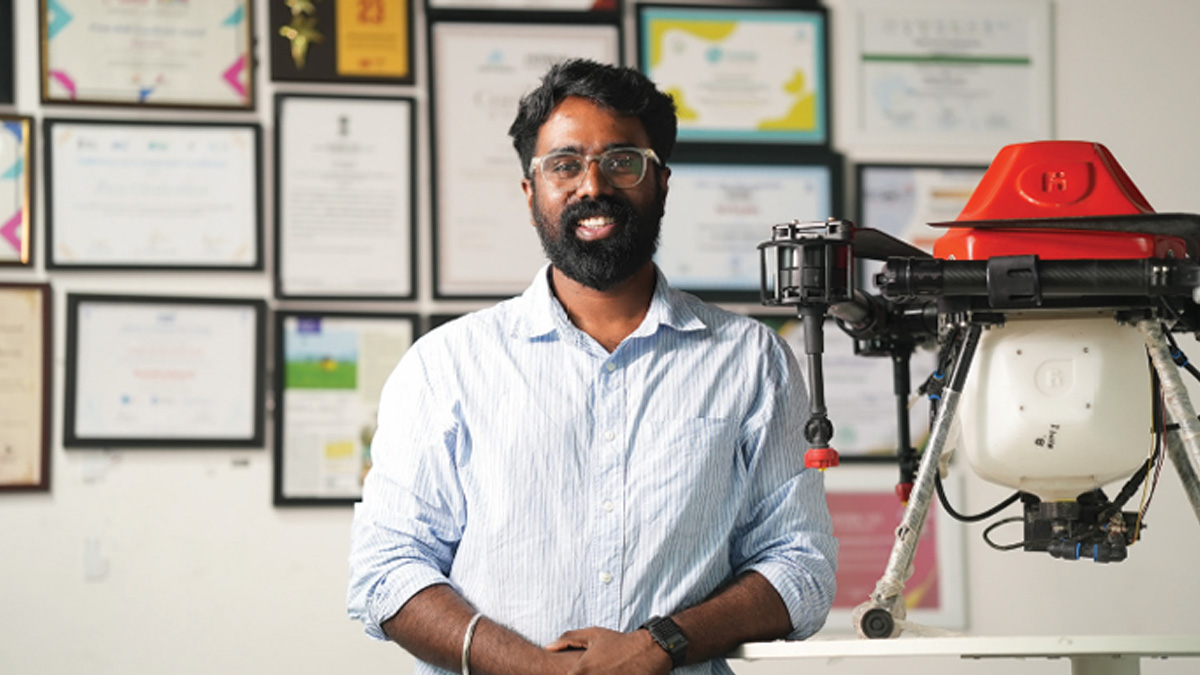
Drone technology in agriculture is rapidly changing how farmers monitor crops, manage resources and improve productivity. A South Indian startup is now using aerial innovation and precision farming tools to reshape agriculture from the sky
In 2018, catastrophic floods swept across South Indian state of Kerala, submerging farmland and leaving behind more than visible damage. When the waters receded, they revealed a deeper crisis—soil chemistry had changed, salinity had increased, and farming systems that had sustained communities for generations no longer behaved the same way.
For many farmers, the land had become unfamiliar.
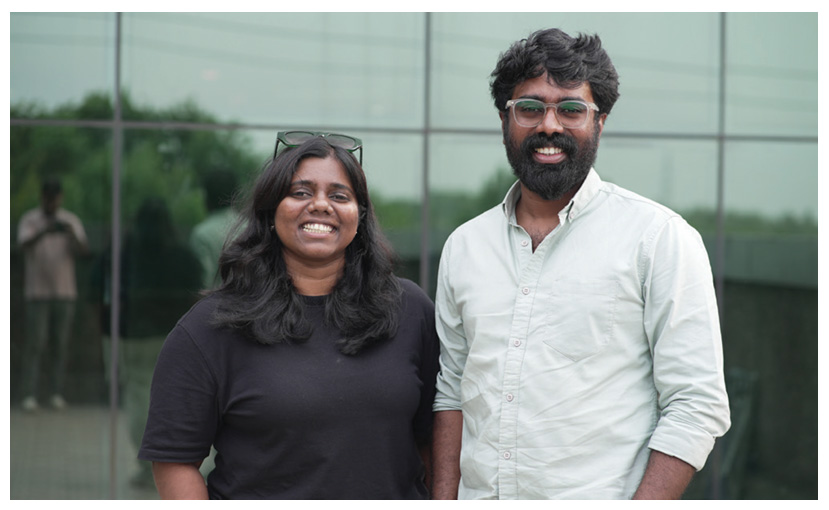
For Devan Chandrasekharan, an aeronautical engineer with roots in farming, this moment marked a turning point.
“That moment made it clear that agriculture needed more than incremental change,” he says. “It needed a different way of understanding what’s happening in the field.”
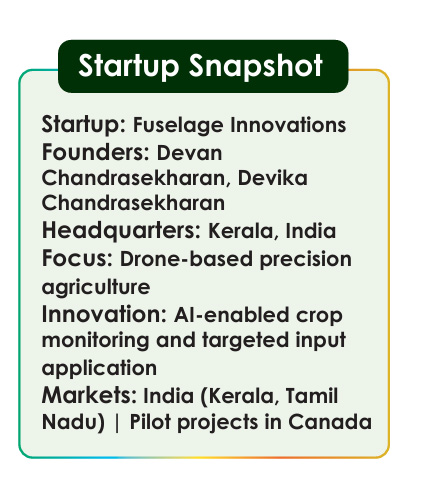
Today, as co-founder of Fuselage Innovations, a Kerala-headquartered agritech company with operations expanding across southern India and early international pilots, Devan is part of a new wave of innovators rethinking agriculture through technology.
Drone Technology in Agriculture: From Fields to Flight Paths
Modern agriculture is increasingly shaped by data. But while satellite systems offer scale, they often lack immediacy. Cloud cover, delays, and low resolution limit their usefulness in time-sensitive decisions.
“In farming, timing is everything,” Devan notes. “If you cannot act at the right moment, even the best data loses its value.”
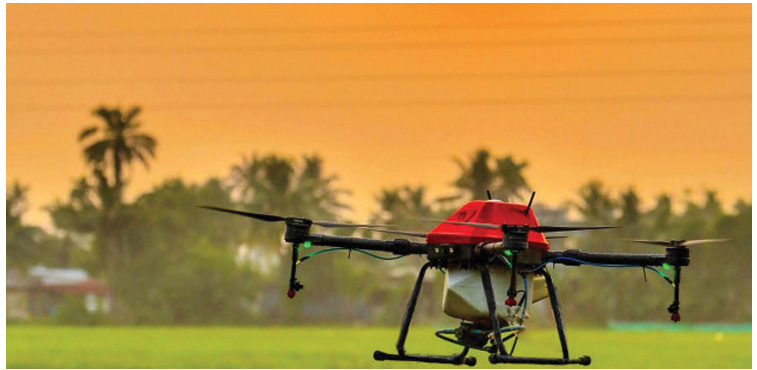
Fuselage Innovations addresses this gap using drones equipped with multispectral sensors, capable of capturing real-time, high-resolution data directly from the field. These systems detect early signs of stress—nutrient deficiencies, pest risks, or water imbalances—long before they become visible.
Farming as a Predictive System
The company’s approach goes beyond aerial imaging. It is built around a stage-wise model that tracks crop growth from early development to harvest, linking each phase to targeted interventions.
This transforms farming from a reactive process into a predictive one.
“Instead of responding to visible damage, we can identify stress signals early and intervene precisely,” Devan says. “That changes the entire economics of farming.”
The results are significant. Field applications have shown yield increases of up to 35 percent, alongside a reduction of nearly 50 percent in pesticide and fertiliser use. Precision spraying has also cut input volumes dramatically—from 150–200 litres per acre to just 10–15 litres—reducing both costs and environmental impact.
Scaling Beyond Boundaries
While the company’s early work was rooted in Kerala, its reach has expanded into Tamil Nadu and other parts of India, with pilot projects now extending to international markets such as Canada.
“Farming challenges may vary across regions, but the need for efficiency, sustainability, and better decision-making is universal,” Devan says.
Yet adoption remains a challenge. Farming is inherently risk-sensitive, and new technologies are often met with caution. To address this, the company initially offered its services free of cost, allowing farmers to see results before committing.
“Trust is the biggest barrier,” Devan says. “Farmers need to see the impact on their own fields before they adopt something new.”
The Future from Above
As climate pressures intensify and resource constraints deepen, agriculture is entering a new phase—one where data and precision will define productivity.
“Technology alone cannot solve agriculture,” Devan emphasises. “But when it is aligned with the realities of farmers and ecosystems, it can become a powerful tool for transformation.”
What began in the aftermath of a flood has now evolved into a model for the future—where farming is not just guided by tradition, but informed by intelligence.
Because the future of agriculture may not lie only in the soil—but in how we see it from above.


Why Global Tech and Industry Lean on Indian Talent

From Silicon Valley to Sustainable Period Care; How This Engineer Is Rethinking Menstruation with Science

India tops the world for population exposed to climate-driven risky heat

Can a Webcam Replace the Guru? A Kerala Startup Is Betting Yes

India’s Semiconductor Push Is About More Than Making Chips

Farmers Borrowed to Build ‘Diggis’. Two Years Later, They Are Still Waiting for the Subsidy

Our Algorithm Knows What We Want Before We Do. That is the Problem.

When Decarbonisation Becomes the Real Conversation at Tiruppur’s Knit Show

When the Himalayas Collapse Without Warning, What Counts as Preparedness?

The Engineer of Tomorrow Is Already Here

-

 Math2 months ago
The 2026 Fields Medals: Four Proofs, Four Decades-Old Problems Solved
-
Climate2 months ago
After Kerala’s Deadliest Landslide, the Hardest Thing to Rebuild Was Childhood
-
Society2 months ago
West Asia Crisis: Can Kerala’s Returning Gulf Migrants Find a Future in the Green Economy?
-
Space & Physics4 months ago
India Semiconductor Mission: ‘It’s Not About Fabs. It’s About Building An Entire Ecosystem’
-
Climate4 months ago
The Climate World Cup? How Climate Change Could Affect Player Performance at the 2026 World Cup
-
Society2 months ago
What Is Civilisational Diplomacy? Understanding India’s Newest Foreign Policy Tool
-
Society3 months ago
From Bell Labs to the Classroom: A Second Career in Teaching
-
Space & Physics4 months ago
Engineers Develop Dual-Mode Propulsion System for Next-Generation Small Satellites