
Society
Understanding AI: The Science, Systems, and Industries Powering a $3.6 Trillion Future
Explore how artificial intelligence is transforming finance, automation, and industry — and what the $3.6 trillion AI boom means for our future


Artificial Intelligence (AI) has become a major point of discussion and a defining technological frontier of our time. Experiencing remarkable growth in recent years, AI refers to computer systems capable of mimicking intelligent human cognitive abilities such as learning, problem-solving, critical decision-making, and creativity. Its ability to identify objects, understand human language, and act autonomously makes it increasingly feasible for industries like automotive manufacturing, financial services, and fraud detection.
As of 2024, the global AI market is valued at approximately USD 638.23 billion, marking an 18.6% increase from 2023, and is projected to reach USD 3,680.47 billion by 2034 (Precedence Research). North America leads this global growth with a 36.9% market share, dominated by the United States and Canada. The U.S. AI market alone is valued at around USD 146.09 billion in 2024, representing nearly 22% of global AI investments.
The Early Evolution of AI: From Reactive Machines to Learning Systems
Our understanding of AI has evolved through different models, each representing a step closer to mimicking human intelligence.
Reactive Machines: The First Generation
One of the earliest and most famous AI systems was IBM’s Deep Blue, the chess-playing computer that defeated world champion Garry Kasparov in 1997. Deep Blue was a reactive machine model, relying on brute-force algorithms that evaluated millions of possible moves per second. It could process current data and generate responses, but lacked memory or the ability to learn from past experiences.
Reactive machines are task-specific and cannot adapt to new or unexpected conditions. Despite these limitations, they remain integral to automation, where precision and repeatability are more important than learning—such as in manufacturing or assembly-line robotics.
Limited Memory AI: Learning from Experience
To overcome the rigidity of reactive machines, researchers developed Limited Memory AI, a model that can store and recall past data to make more informed decisions. This model powers technologies such as self-driving cars, which constantly analyze road conditions, objects, and obstacles, using stored data to adjust their behaviour.
Limited Memory AI is also valuable in financial forecasting, where it uses historical market data to predict trends. However, its memory capacity is still finite, making it less suited for complex reasoning or tasks like Natural Language Processing (NLP) that require deeper contextual understanding.
Theoretical Models: Towards Human-Like Intelligence
Theory of Mind AI
The next conceptual step is Theory of Mind AI, a model designed to understand human emotions, beliefs, and intentions. This approach aims to enable AI systems to interact socially with humans, interpreting emotional cues and behavioral patterns.
Researchers like Neil Rabinowitz from Google DeepMind have developed early prototypes such as ToMnet, which attempts to simulate aspects of human reasoning. ToMnet uses artificial neural networks modeled after brain function to predict and interpret behavior. However, replicating the complexity of human mental states remains a distant goal, and these systems are still largely experimental.
Self-Aware AI: The Future Frontier
The ultimate ambition of AI research is self-aware AI — systems that possess conscious awareness and a sense of identity. While this remains speculative, the potential applications are vast. Self-aware AI could revolutionize fields like environmental management, creating bots capable of predicting ecosystem changes and implementing conservation strategies autonomously.
In education, self-aware systems could understand a student’s cognitive style and deliver personalized learning experiences, adapting dynamically to each learner.
However, replicating human self-awareness is extraordinarily complex. The human brain’s intricate memory, emotion, and decision-making systems remain only partially understood. Additionally, self-aware AI raises profound ethical and privacy concerns, as such systems would require massive amounts of sensitive data. Strict guidelines for data collection, storage, and usage would be essential before such systems could be deployed responsibly.
Artificial Intelligence in the Financial Services Industry
The financial sector has undergone a massive transformation powered by AI-driven analytics, automation, and predictive intelligence. AI enhances Corporate Performance Management (CPM) by improving speed and precision in financial planning, investment analysis, and risk management.
Natural Language Processing and Automation
Leading financial firms such as JPMorgan Chase and Goldman Sachs employ Natural Language Processing (NLP) — AI systems that understand human language — to streamline customer interaction and analyze market information. NLP tools like chatbots handle millions of customer queries efficiently, while advanced systems process unstructured text data from financial reports and news sources to inform investment decisions.
Paired with Optical Character Recognition (OCR) and document parsing, NLP systems can convert scanned or image-based documents into machine-readable text, accelerating compliance checks, fraud detection, and financial forecasting.
However, the accuracy of NLP models depends on the quality and diversity of training data. Biased or incomplete data can lead to errors in analysis, potentially influencing high-stakes financial decisions.
Generative AI in Finance
Another major shift in finance comes from Generative AI, a branch of AI that creates new content — including text, images, videos, and even financial models — based on learned patterns. Using Large Language Models (LLMs) and Generative Adversarial Networks (GANs), these systems simulate complex financial scenarios, improving fraud detection and stress testing.
For instance, PayPal and American Express use generative AI to simulate fraudulent transaction patterns, strengthening their security systems. Transformers — deep learning architectures behind tools like OpenAI’s GPT — enable these models to understand and generate human-like language, allowing them to summarize extensive reports, produce research briefs, and assist analysts in decision-making.
Yet, Generative AI also presents challenges. It can be manipulated through adversarial attacks, producing misleading or biased outputs if trained on flawed data. Ensuring transparency and fairness in training datasets remains critical to prevent discriminatory outcomes, especially in credit scoring and loan assessment.
AI and Automation: Revolutionizing Industry Operations
Artificial Intelligence has become a cornerstone of intelligent automation (IA), reshaping business process management (BPM) and robotic process automation (RPA). Traditional RPA handled repetitive, rule-based tasks, but with AI integration, these systems can now manage complex workflows that require contextual decision-making.
AI-driven automation enhances productivity, reduces operational costs, and increases accuracy. For example, in manufacturing, AI-enabled systems perform predictive maintenance by analyzing sensor data to detect machinery issues before failures occur, minimizing downtime and extending equipment lifespan.
In the automotive sector, AI-powered machine vision systems inspect car components with higher accuracy than human inspectors, ensuring consistent quality and safety. These innovations make automation not only efficient but also economically advantageous for large-scale industries.
Machine Learning: The Engine of Artificial Intelligence
At the heart of AI lies Machine Learning (ML) — algorithms that allow computers to learn from data and improve over time without explicit programming. Three fundamental ML models underpin most modern AI applications: Decision Trees, Linear Regression, and Logistic Regression.
Decision Trees
Decision trees simplify complex decision-making processes into intuitive, branching structures. Each branch represents a decision rule, and each leaf node gives an outcome or prediction. This makes them powerful tools for disease diagnosis in healthcare and credit risk assessment in finance. They handle both numerical and categorical data, offering transparency and interpretability.
Linear Regression
Linear regression models relationships between one dependent and one or more independent variables, making it useful for predictive analytics such as stock price forecasting. It applies mathematical techniques like Ordinary Least Squares (OLS) or Gradient Descent to optimize prediction accuracy. Its simplicity, efficiency, and scalability make it ideal for large datasets.
Logistic Regression
While linear regression predicts continuous outcomes, logistic regression is used for classification problems — determining whether an instance belongs to a particular category (e.g., yes/no, fraud/genuine). It calculates probabilities between 0 and 1 using a sigmoid function, providing fast and interpretable results. Logistic regression is widely used in healthcare (disease prediction) and finance (loan default assessment).
Types of Machine Learning Algorithms
Machine Learning can be broadly classified into Supervised, Unsupervised, and Reinforcement Learning — each suited for different problem types.
Supervised Learning
In supervised learning, algorithms train on labelled datasets to identify patterns and make predictions. Once trained, they can generalize to new, unseen data. Applications include spam filtering, voice recognition, and image classification.
Supervised models handle both classification (categorical predictions) and regression (continuous predictions). Their strength lies in high accuracy and reliability when trained on quality data.
Unsupervised Learning
Unsupervised learning, in contrast, deals with unlabelled data. It identifies hidden patterns or groupings within datasets, commonly used in customer segmentation, market basket analysis, and anomaly detection.
By autonomously discovering relationships, unsupervised learning reduces human bias and is valuable in exploratory data analysis.
Reinforcement Learning (Optional Expansion)
While not yet as mainstream, reinforcement learning trains algorithms through trial and error, rewarding desired outcomes. It is foundational in robotics, autonomous systems, and game AI — including the systems that now outperform humans in complex strategic games like Go or StarCraft.

Ethical and Societal Considerations of AI
Despite its transformative potential, AI raises significant ethical and privacy challenges. Issues such as algorithmic bias, data exploitation, and job displacement are increasingly at the forefront of public discourse.
Ethical AI demands transparent data practices, accountability in algorithm design, and equitable access to technology. Governments and academic institutions, including Capitol Technology University (captechu.edu), emphasize developing AI systems that align with social good, human rights, and sustainability.
Furthermore, the rise of generative AI has intensified debates about content authenticity, intellectual property, and deepfake misuse, underscoring the urgent need for comprehensive AI regulation.
A Technology Still in Transition
Artificial Intelligence stands at the intersection of opportunity and uncertainty. From Deep Blue’s deterministic algorithms to generative AI’s creative engines, the technology has redefined industries and continues to evolve at an unprecedented pace.
While self-aware AI and full cognitive autonomy remain theoretical, the rapid integration of AI across industries signals an irreversible shift toward machine-augmented intelligence. The challenge ahead is ensuring that this evolution remains ethical, inclusive, and sustainable — using AI to enhance human potential, not replace it.
References
- Artificial Intelligence (AI) Market Size to Reach USD 3,680.47 Bn by 2034 – Precedence Research
- What is AI, how does it work and what can it be used for? – BBC
- 10 Ways Companies Are Using AI in the Financial Services Industry – OneStream
- The Transformative Power of AI: Impact on 18 Vital Industries – LinkedIn
- What Is Artificial Intelligence (AI)? – IBM
- The Ethical Considerations of Artificial Intelligence – Capitol Technology University
- What is Generative AI? – Examples, Definition & Models – GeeksforGeeks











Climate
Climate Disasters Disrupted Schooling for 171 Million Students in 2025, UNICEF Finds
Climate disasters disrupted schooling for 171 million students worldwide in 2025, highlighting the urgent need for climate-resilient schools and education systems.


Climate-related disasters disrupted schooling for at least 171 million students worldwide in 2025, affecting one in every 10 school-age children, according to a new UNICEF report that warns of growing threats to learning, educational equality and future economic prospects.
The report, Learning Interrupted: Global Snapshot of Climate-Related School Disruptions in 2025, released on September 10, analysed data from 106 countries and territories. It found that storms, floods, heatwaves, droughts and wildfires caused school closures, shortened teaching hours, reduced attendance and shifts to remote learning.
The findings underline how climate change is emerging as a threat to educational continuity, particularly in countries where schools lack the infrastructure and resources to withstand extreme weather.
Storms and floods interrupt learning
Storms were the leading cause of climate-related school disruptions in 2025, affecting 109 million students globally. Floods affected at least 70 million, while heatwaves disrupted schooling for approximately 50 million children. These figures overlap and should not be added together as separate groups.
In Pakistan, severe monsoon flooding in August delayed the return to school for more than 28 million students. In Egypt, a powerful Khamsin wind-and-dust storm prompted a nationwide suspension of classes for one day, affecting more than 28 million students.
The problem extends beyond individual disasters. Forty countries experienced multiple rounds of climate-related school disruptions during 2025, exposing students to repeated interruptions throughout the academic year.
Floods can damage classrooms, sanitation facilities and learning materials, while extreme heat can make classrooms unsafe and undermine students’ ability to concentrate. Even after schools reopen, damaged infrastructure, disrupted transport and household financial pressures can prevent children from returning to regular attendance.
A growing threat to educational equality
Three-quarters of the students affected in 2025 lived in low- and lower-middle-income countries, where education systems often have fewer resources to prepare for disasters and restore teaching afterwards, UNICEF found.
The World Bank’s 2024 report, Choosing Our Future: Education for Climate Action, offers further evidence of the long-term challenge. It estimated that 400 million students globally experienced school closures due to extreme weather between 2022 and 2024. In affected schools in low-income countries, students lost approximately 45 instructional days between January 2022 and June 2024, compared with around six days in high-income countries.
These interruptions can compound existing educational disadvantages. Students from wealthier households may have access to private tutoring, digital devices and alternative learning arrangements. Children from poorer households may lack internet connectivity, electricity or suitable spaces to study during closures.
South Asia’s exposure highlights the challenge
UNICEF’s previous assessment, covering 2024, recorded at least 242 million students experiencing climate-related school disruptions across 85 countries and territories. South Asia was the most affected region, with 128 million students impacted. Heatwaves affected an estimated 171 million students worldwide that year.
India was among the countries affected by heat-related educational disruptions. In April 2024, extreme heat contributed to school interruptions across Bangladesh, Cambodia, India, the Philippines and Thailand, affecting at least 118 million children collectively. The figure represents the five-country group, not India alone.
The 2024 and 2025 totals should not be interpreted as a direct year-on-year decline. The reports covered different sets of countries and climate events, and the number of recorded disruptions depends on the incidents identified in each assessment.
Climate-resilient schools become a priority
UNICEF estimates that disruptions experienced in 2025 could cost affected students at least US$200 billion in lifetime earnings through lost learning and widening educational inequalities. This is a projection of potential future losses, rather than income already lost.
The World Bank has argued that relatively modest investments can help schools adapt. Its 2024 analysis estimated that a one-time investment of US$18.51 per child could help mitigate learning losses through measures such as improving classroom temperatures, strengthening school infrastructure and training teachers.

Aerial view showing significant flood damage in a residential neighborhood with inundated streets and homes.Image credit:Pexels
UNICEF is calling for climate resilience to be incorporated into education planning, alongside investment in stronger school buildings, emergency preparedness and systems that allow teaching to continue during disasters.
As extreme weather increasingly interrupts academic calendars, education systems must prepare not only to enrol children but also to protect their ability to learn. Climate-resilient infrastructure, early-warning systems and plans for educational continuity will be essential to ensuring that disasters do not deepen existing inequalities in access to education.
Society
Global Job Market Faces a Growing Inclusion Gap as AI and Digitalisation Reshape Work
Global employment faces a growing inclusion gap as AI and digitalisation reshape the labour market. UN and ILO reports highlight persistent informal employment, youth exclusion and unequal access to the skills needed for emerging jobs.

The global economy is undergoing a profound employment transition, driven by artificial intelligence (AI), digitalisation, demographic changes and the shift towards greener industries. Yet, while these forces are expected to create new career opportunities, access to employment and the benefits of technological progress remain deeply unequal, according to the United Nations’ World Social Report 2026.
Released on October 15, the report, published by the UN Department of Economic and Social Affairs (UN DESA), warns that billions of people remain excluded from the jobs, skills, infrastructure and social protections required to participate in economic transformation. Its findings highlight a central challenge for policymakers: creating employment opportunities is not enough unless people can access them and secure decent working conditions.
The scale of the problem is evident in the report’s latest figures. In 2025, 58 per cent of workers worldwide were informally employed, while 27 per cent of young women aged 15–24 were neither employed nor participating in education or training. An estimated 2.2 billion people also lacked internet access, limiting their ability to benefit from digital services, online learning and emerging employment opportunities.
More Jobs, but Unequal Opportunities
The challenge extends beyond unemployment to the quality and security of work. The International Labour Organization’s Employment and Social Trends 2026 report estimated that global unemployment would remain at 4.9 per cent in 2026, equivalent to approximately 186 million people. However, nearly 300 million workers continued to live in extreme working poverty, surviving on less than US$3 a day. The report also projected that 2.1 billion workers would be in informal employment in 2026, often without adequate social protection or employment security.
Young people face particular difficulties entering the labour market. According to the ILO, youth unemployment reached 12.4 per cent in 2025, while approximately 260 million young people were not in employment, education or training. For many, the transition from education to work remains uncertain, particularly where economies fail to generate enough productive jobs.
These challenges coincide with substantial changes in the kinds of jobs employers expect to need. The World Economic Forum’s Future of Jobs Report 2025, based on projections from more than 1,000 employers, estimates that technological, economic, demographic and green-transition trends could create 170 million jobs globally by 2030 while displacing 92 million. This would produce a net gain of 78 million jobs. However, the report warns that the transition will require extensive workforce adaptation. Nearly 40 per cent of workers’ existing skills are expected to change by 2030, and 63 per cent of surveyed employers identified skills gaps as a major barrier to business transformation.
The projections suggest that the central employment challenge is not simply whether jobs will disappear, but whether workers can move into emerging roles. Demand is expected to grow in areas such as AI, data analysis and cybersecurity, alongside essential occupations in healthcare, education and agriculture. Workers whose skills do not match changing requirements risk being excluded even as new vacancies emerge.
Digital Access and Skills Will Shape the Transition
Access to technology is another dividing line. The World Bank’s Digital Progress and Trends Report 2025 identifies disparities in connectivity, computing infrastructure, relevant data and digital skills as barriers to wider participation in the AI economy. While AI adoption is expanding, high-income countries continue to dominate important areas of AI innovation and computing capacity.

Representational image.Image credit:Pexels
For people without reliable internet access, affordable devices or opportunities to acquire digital skills, the shift towards online recruitment, digital services and AI-assisted work can deepen existing disadvantages. Connectivity alone, however, is insufficient: workers also need relevant training, accessible education and opportunities to apply their skills in productive employment.
The UN report argues that governments must invest in quality education, lifelong learning, digital and AI capabilities, affordable connectivity and stronger social protection. Labour-market policies must also support decent working conditions, equal opportunities and training that helps workers move between occupations.
For developing economies with large young populations, the stakes are particularly high. A growing workforce can support economic growth only when enough productive jobs are available and workers can acquire the capabilities those jobs demand. Without such opportunities, demographic potential can translate into prolonged unemployment, insecure work and widening inequality.
EP Deep Dive: Data & Solutions
After a Scorching Summer, Delhi’s Children Are Slow to Return Outdoors
Extreme heat and children are the focus of this EdPublica report. Parents in Delhi and Noida explain how rising temperatures, air pollution and changing routines are keeping children indoors.


After months of extreme heat, Delhi’s children face another challenge: returning outdoors. Heat, air pollution and changing routines are reshaping how children play. EdPublica spoke to parents in Delhi to understand how extreme heat has changed their children’s play habits and what it might take to bring them back outdoors.
New Delhi: Mohini Bisht is a first-time mother. Her two-year-old son, Shomu (name changed), has just begun to string together his first words. Among the first he learned is “AC” (air conditioner). Living in the National Capital Territory, the family faces daytime temperatures that regularly reach between 42 and 45 degrees Celsius.
“Mummy, garmi lag rahi hai, AC chala do” (“Mummy, it’s hot, turn on the AC”), her son now says. He has learned to turn the AC on and off by himself. On especially humid days, he gets up and flicks the switch on his own.
In April, Delhi saw a maximum of 42.8 degrees Celsius, the hottest for that month in four years. In May, nighttime heat also broke records, with the minimum temperature hitting 32.4 degrees Celsius, the warmest May night in nearly 14 years, according to the India Meteorological Department (IMD).
In June, the heat index, or ‘feels-like’ temperature, soared to 51.3 degrees Celsius, the highest of the year. The heat index combines air temperature and relative humidity to show how hot it actually feels, not just what the thermometer shows.
“The whole day you’re just waiting for evening so you can go out,” Bisht said. As temperatures rose, she stopped taking her son out to play. “If the child gets dehydrated or faces issues, it becomes a big problem,” she said. Her parents and in-laws also advised her not to take him outside.
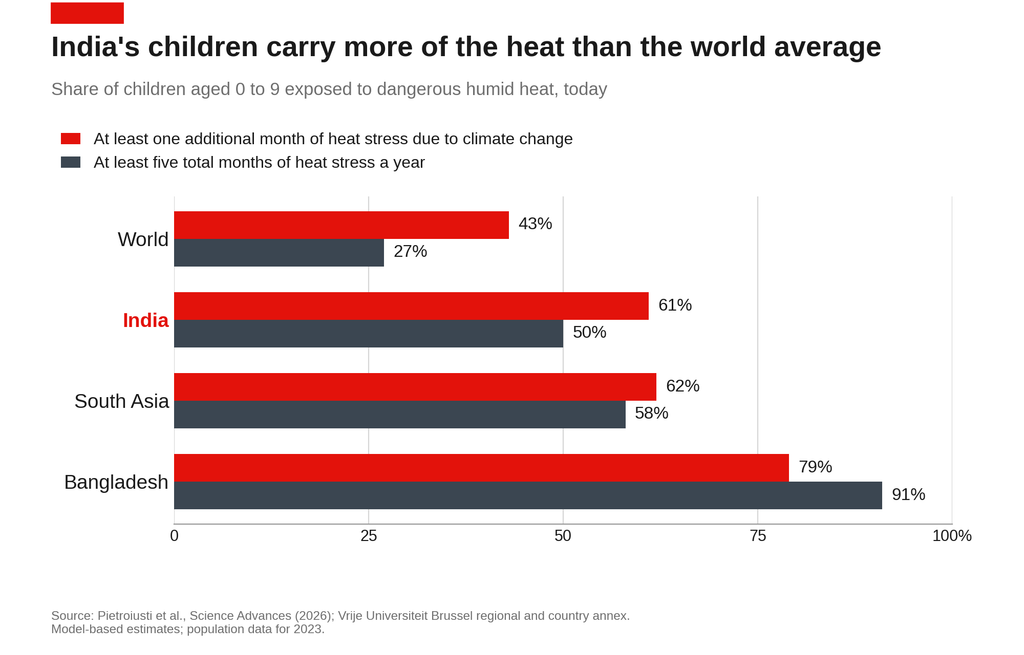
Her caution has a basis. India’s exposure is higher than the global average. Worldwide, up to 560 million children aged 0 to 9, or 43 per cent, live through at least one additional month of heat stress a year because of climate change. In India the share is 61 per cent. For five or more months of total heat stress, the Indian share is 50 per cent, against 27 per cent globally. South Asia is one of the regions with the most children exposed: about 167 million children, or 62 per cent, face an additional month, and in Bangladesh the share is 79 per cent.
Extreme Heat and Children: The Challenge of Outdoor Play
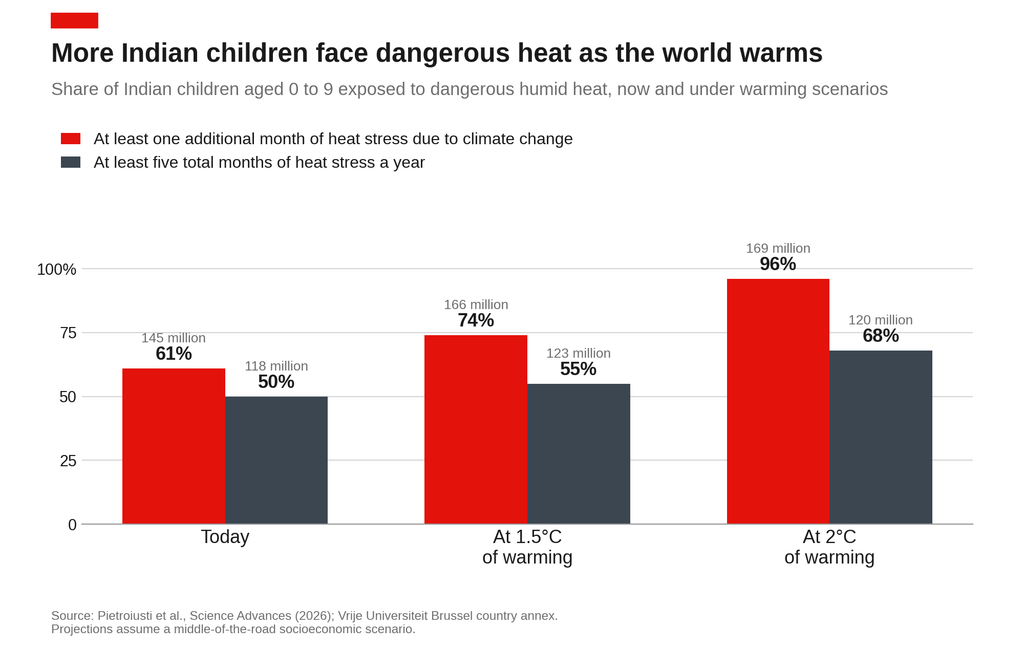
Nearly 145 million Indian children aged up to nine, or 61 per cent of that age group, live through at least one additional month of dangerous heat stress each year because of human-induced climate change, according to a study published in August in Science Advances by researchers led by Vrije Universiteit Brussel. The study estimates that climate change has doubled the number of Indian children facing five or more months of dangerous heat a year, from 59 million to 118 million. The authors note that children are especially vulnerable because their bodies heat up faster than adults’ and regulate temperature less efficiently.

Even as early October brings daytime highs in Delhi that linger in the mid-30s, according to IMD forecasts, summer is retreating from most of north India, bringing the season’s first pleasant evenings. For many families, this raises the question: after months indoors due to oppressive heat, will children return outside?
The challenges don’t end with summer. “Apart from the heat, there is also poor air quality,” said Dr Himani Narula, a development paediatrician in New Delhi. Seasonal illnesses, too, play a role: “Sometimes there is a dengue season and other times there is a flu season.” Parents worry their children will pick up infections, making it hard to let them outside for long. “For all these reasons, children are ultimately at home, even when the weather improves,” she said.
The air is a genuine constraint, not just a parental worry. A 2021 study in Environmental Science and Pollution Research reported an almost 30 per cent rise in daily emergency visits for acute respiratory symptoms among Delhi’s children on high-pollution days. Last winter, the Delhi government suspended outdoor school activities in November and December after the Supreme Court warned against holding outdoor sports in hazardous air.
EdPublica spoke to seven parents from middle-class households in Noida-Delhi, all of whom said they have reorganised their days around the heat, moving their children’s playtime from evening to night to escape gruelling temperatures and humidity. They are not a representative sample, and EdPublica did not measure how much time children actually spend outdoors.
“Dinner is cooked first, then comes the outing, then a late meal and bed. The schedule has changed because of the heat,” said Sunita Kumar, a home tutor and mother of three, including a six-year-old.
Kumar, who lives in Mayur Vihar, New Delhi, worries the routine is changing children’s relationship with the outdoors. “Kids nowadays aren’t seeing the sun,” she said. “They go to school in the morning, stay inside all day, then go home. Even a one-hour tuition is indoors.” This habit, she fears, may outlast the weather. “Kids have built a habit without realising,” she said.
“Kids nowadays aren’t seeing the sun”
The pattern has research behind it. In a 2023 study in JAMA Pediatrics, researchers fitted preschoolers at a university childcare centre in Texas with activity monitors for a week. On hotter days, the children spent more of their outdoor play sedentary, about 70 per cent of it at 35 degrees Celsius against 62 per cent at 22 degrees, and less in moderate-to-vigorous activity, 21 per cent against 27 per cent. The sample was small and the temperatures were milder than Delhi’s summer, but the direction is clear. A 2022 review of more than 150 studies in the journal Temperature also warned that parents’ perception that it is “too hot to play” can further restrict children’s activity.
Moving play to cooler hours is, in fact, what heat-safety guidance advises, alongside hydration and shaded, green outdoor spaces. In that sense, the parents’ adaptation is sensible. The concern is what happens once the heat passes.
The human body and brain tend to acclimatise to repeated exposure of any kind, Dr Narula explained. Keeping children in air-conditioned rooms and away from natural weather, she said, can get their bodies used to the indoor environment and blunt their heat tolerance.
Direct evidence in children is scarce. A small study in Indoor Air compared 20 adults used to air-conditioned and naturally ventilated environments in a climate chamber, measuring skin temperature, sweat rate and thermal comfort. It concluded that long-term exposure to stable air-conditioned environments may weaken thermal adaptability. The study involved adults, not children, and does not show that air conditioning harms a child’s heat tolerance, but it makes Dr Narula’s concern plausible.
But temperature isn’t the only factor shaping how children respond to heat. Bisht notes that her son complains about the heat when alone with her, but behaves differently around friends. “If I bring him with friends or cousins, he plays on the balcony in the sun and enjoys it,” she says. “But if he’s alone with me, he voices his opinions.”
“Children’s tolerance for discomfort changes when other kids are around,” Dr Narula explained. “What the kid is saying is I will accept the discomfort of heat if it means I am enjoying time with peers.” The brain is adapting to these climatic challenges, and according to her, the child needs to get used to this conditioning.
Research on friendship and physical activity points the same way. A 2013 systematised review of friendship networks in the International Journal of Behavioral Nutrition and Physical Activity found that higher activity among friends is associated with higher activity in the individual, and longitudinal studies showed children’s activity shifting to match their friends’. Much of this work is observational, and it is hard to separate influence from children simply choosing similar friends. Still, it hints at what could bring children back outdoors: the company of other children. Parents often tell Dr Narula their kids stay home because there are few other children for them to play with.
Schools, where children already gather, are the obvious place to start, Dr Narula said. Before lessons begin, when the morning heat is lower, children could spend time in the open air, she said: sports, a prayer assembly, physical training, “any kind of activity which children can do with each other in a good setting.”
From toddlerhood through the teenage years, “children look for peers,” something that motivates them far more than being around parents, Dr Narula explained. The outdoors, she said, offers something indoor play cannot, and sunlight helps raise dopamine levels and, with them, mood.
The best-documented benefit of outdoor time in children is for eyesight. A 2024 meta-analysis in Ophthalmic Research found that children and adolescents with the most time outdoors had roughly half the risk of developing myopia of those with the least, and that risk fell as outdoor hours rose: going from 3.5 to 7 hours a week was linked with a 20 per cent lower risk. The leading explanation is that bright outdoor light prompts the retina to release dopamine, which slows the eye’s growth, though the mechanism is not fully settled. Outdoor time did not slow the progression of myopia in children who already had it.
The cooler weeks may be a short window. Whether children use it will depend less on the thermometer than on whether there is anyone outside to play with, and on how long the air stays clear enough to let them.
This article is written as part of the Media Fellowship under the Cities on Fire Initiative in Bangkok, Colombo, Jakarta and Manila and ‘Cooler Cities. Healthier Children. Brighter Futures.’ Initiative in New Delhi.


Climate Disasters Disrupted Schooling for 171 Million Students in 2025, UNICEF Finds

Brazil’s Amazon deforestation hits record low. Can the recovery last?

How Scientists Traced the Flow of Matter Around a Dead Star Using X-rays

India Scores Just 2 Out of 32 for Integrating Health into Climate Commitments

Global Job Market Faces a Growing Inclusion Gap as AI and Digitalisation Reshape Work

From Scams to Screens: How the National Stock Exchange Rewrote India’s Equity Story

Knowing When to Think for Ourselves: AI, Intuition and the Education of Discernment

After a Scorching Summer, Delhi’s Children Are Slow to Return Outdoors

Two Chemists Win Nobel Prize for Solving a Century-Old Puzzle: Why Life Picks One Hand Over the Other

Marshall Islands: Why the US Nuclear Legacy Is Back Before the UN

-

 Math3 months ago
The 2026 Fields Medals: Four Proofs, Four Decades-Old Problems Solved
-
EP Deep Dive: Data & Solutions3 months ago
After Kerala’s Deadliest Landslide, the Hardest Thing to Rebuild Was Childhood
-
EP Deep Dive: Data & Solutions4 months ago
West Asia Crisis: Can Kerala’s Returning Gulf Migrants Find a Future in the Green Economy?
-
Space & Physics5 months ago
India Semiconductor Mission: ‘It’s Not About Fabs. It’s About Building An Entire Ecosystem’
-
Interviews4 weeks ago
From Scams to Screens: How the National Stock Exchange Rewrote India’s Equity Story
-
Climate5 months ago
The Climate World Cup? How Climate Change Could Affect Player Performance at the 2026 World Cup
-
Society3 months ago
What Is Civilisational Diplomacy? Understanding India’s Newest Foreign Policy Tool
-
Society4 months ago
From Bell Labs to the Classroom: A Second Career in Teaching