EDUNEWS & VIEWS
Global Highschool Rankings 2025: UK and US Dominate, China Rises
Among the standout institutions, Westminster School maintained its dominance with over 40% of graduates entering Oxbridge


In a global assessment of elite high schools, the HSBC Hurun Education Global High Schools 2025 report has named Westminster School in London as the world’s best high school for the third consecutive year. The annual ranking, now in its third edition, evaluates the top 180 independent schools across 11 countries based on university placements, co-curricular development, and institutional reputation.
The list reflects a shifting but still concentrated landscape of educational excellence. The United States and the United Kingdom together accounted for 85% of the world’s top highschools, with the US leading at 45% and the UK at 40%. However, China emerged as a strong contender, ranking third with 16 schools—up from 13 last year.
“The number of Chinese students studying abroad fell last year, but there are still nearly one million,” said Rupert Hoogewerf, Chairman and Chief Researcher of Hurun Education. “Interestingly, with 16 top-ranked highschools, Chinese families are finding viable options closer to home—avoiding time zone issues and maintaining cultural continuity.”
Among the standout institutions, Westminster School maintained its dominance with over 40% of graduates entering Oxbridge. St Paul’s School rose to second place, while The Dalton School in New York dropped to third. Notably, Winchester College returned to the top 10 and was named the world’s best boarding school, surpassing even Eton College and Phillips Andover.
“These rankings offer forward-looking insights for families planning their children’s international education,” said Kai Zhang, Head of International Wealth and Premier Banking, HSBC Asia, in a media statement. “Destinations like Hong Kong and Singapore are becoming increasingly attractive for their proximity and cultural alignment with Asian families.”
The report also revealed evolving trends in school environments and demographics:
>> 70% of the schools are co-educational, with a growing shift among historically boys-only UK schools admitting girls.
>> 51% offer boarding options, while half remain day schools.
>> The average school size was 1,050 students, with 140 graduating each year.
>> The average age of these schools is 204 years, with some—like King’s School, Canterbury—tracing roots back over a millennium.
Meanwhile, India’s Dhirubhai Ambani International School in Mumbai ranked 5th among schools outside the US and UK, continuing its position as a global outlier in quality private education from the subcontinent.
Despite steep tuition fees—averaging $63,000 annually for boarding schools—demand for places remains high. However, the UK’s recent addition of VAT on private school fees has prompted concerns, with schools like Winchester now costing over $80,000 per year.
Another key theme this year is the integration of creative thinking and AI literacy in education. “There is a real push toward STEAM, adding ‘Arts’ to STEM. Schools are under pressure to future-proof education and prepare students to thrive in the 2050s,” Hoogewerf added.
With data drawn from university destinations, co-curricular achievements, and alumni impact, the HSBC Hurun rankings offer more than a leaderboard—they reflect the evolving priorities and challenges in elite education worldwide.

EDUNEWS & VIEWS
India Emerging as a Global Education Hub as International Student Numbers Set to Rise Rapidly: QS Report
A QS report forecasts international student enrolments in India to grow 8% annually to 2030, positioning the country as a rising global education hub while highlighting challenges in reputation, employability, and infrastructure.

India international students are expected to grow rapidly over the next decade, with a new QS report forecasting annual growth of about 8% through 2030.
India is poised to strengthen its position as a major global education destination, with international student enrolments projected to grow steadily in the coming years, according to a new report by global higher education analytics firm QS Quacquarelli Symonds.
The report, QS Global Student Flows: India 2026, forecasts that inbound student numbers will grow by around 8% annually through 2030, starting from an estimated base of 58,000 international students in 2025.
The analysis highlights a shifting landscape in global student mobility. Tightening visa regulations and rising costs in traditional study destinations such as the United States, the United Kingdom, Canada, and Australia are encouraging many international students to consider more affordable and accessible alternatives — with India increasingly emerging as a strong contender.
Regional Demand Driving Growth
South Asia remains the largest source of international students for India. Countries such as Nepal and Bangladesh together account for more than 30% of incoming students, and Nepal’s numbers alone are projected to grow at roughly 11% annually.
Demand is also rising significantly from Africa. Student flows from Sub-Saharan Africa are expected to grow at around 6% annually, driven by expanding youth populations and limited higher education capacity in many African countries. Zimbabwe stands out as a particularly fast-growing market, with projected annual growth of around 11% in students choosing India as a study destination.
Meanwhile, the Middle East and North Africa region continues to contribute steadily to India’s inbound student population, with students from the United Arab Emirates expected to account for about 5% of India’s international student cohort by 2030.
Policy Reforms Strengthening India’s Appeal
The report attributes much of India’s growing attractiveness to policy initiatives and structural reforms in the higher education sector. Programmes such as Study in India have simplified admission processes and reduced financial barriers for international applicants.
At the same time, the National Education Policy (NEP) 2020 has introduced major changes aimed at internationalisation. These include allowing foreign universities to establish campuses in India and enabling institutions to expand seats for international students. The University Grants Commission now permits universities to reserve up to 25% additional seats for overseas applicants.
India’s long-term ambition is even more ambitious. The country aims to host 500,000 international students by 2047, signalling a strong national commitment to becoming a global education hub.
Indian Students Abroad Diversifying Destinations
Even as India attracts more international students, it continues to remain a major source of global student mobility. More than 800,000 Indian students were studying abroad in 2024, making India the world’s second-largest source of international students.
However, the report suggests that the traditional “Big Four” destinations — the US, UK, Canada, and Australia — may see a slight decline in their share of Indian students, with combined enrolments expected to fall by around 0.5% annually through 2030.
Instead, Indian students are increasingly exploring new destinations such as Germany, France, and the United Arab Emirates, attracted by lower tuition costs and accessible study pathways.
Key Challenges for Indian Universities
Despite the optimistic outlook, the report identifies several challenges that India must address to fully realise its potential as an international education hub.
One major issue is institutional reputation. While Indian universities have improved their employer reputation rankings — with the median score improving by 61 places since 2017 — academic reputation indicators have shown limited progress.
“India has long been central to global student mobility — as both a major sending market and an increasingly influential destination”
Another challenge relates to graduate employability. A Mercer-Mettl report in 2025 found that only 42.6% of Indian graduates are considered employable, highlighting the need for stronger industry connections and work-integrated learning opportunities.
Infrastructure also remains a concern. Rapid expansion of international enrolments without adequate investments in housing, campus facilities, and student support services could undermine the overall student experience.
A Strategic Moment for India
Ashwin Fernandes, Chair QS India and Vice President for Strategic and International Engagement at QS, emphasised that India now stands at a critical moment in global higher education mobility.
“India has long been central to global student mobility — as both a major sending market and an increasingly influential destination. The conditions are shifting in India’s favour, from government policy and affordability to regional demographic pressure. But sustaining this momentum will require institutions to close the gap between reputation and real-world graduate outcomes.”
Scenarios for 2030
The report outlines three possible scenarios for the future of India’s higher education landscape by 2030. These include stronger regional student flows across Asia and Africa, the rise of technology-enabled hybrid learning models, and a global competition among countries to attract international talent.
How India responds to these shifts, the report concludes, will determine whether the country can convert its growing demand advantage into lasting leadership in international education.
EDUNEWS & VIEWS
From Classrooms to Corridors: How India’s Budget Repositions Education
Budget 2026–27 reframes education as economic infrastructure—linking skills, research and industry—while shifting India’s learning system away from rote pathways towards future-ready ecosystems.


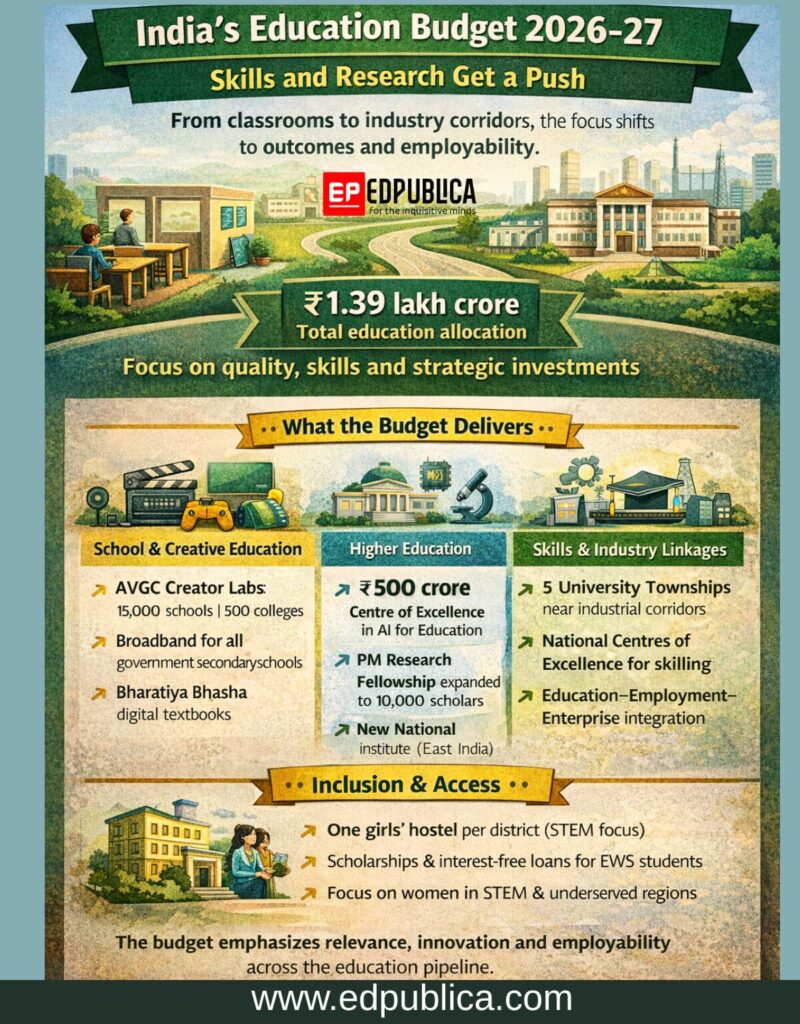
India’s Union Budget 2026–27 does not dramatically expand headline spending on education, but it signals a clear shift in how education is expected to deliver economic value. With a total allocation of Rs1.39 lakh crore—largely in line with last year—the focus moves decisively from enrolment expansion to outcomes, skills, and integration with industry and research ecosystems.
Presented alongside the government’s Viksit Bharat 2047 (Developed India) vision, the education budget positions learning as a strategic economic investment—one that links schools, universities, skilling centres and enterprises into a single pipeline aimed at employability, innovation and global competitiveness.
From Classrooms to Creative Economies
A major thrust of the budget is the expansion of creative and technology-driven learning. The proposal to establish AVGC (Animation, Visual Effects, Gaming and Comics) Content Creator Labs in 15,000 secondary schools and 500 colleges marks a significant bet on India’s “orange economy,” projected to require nearly two million professionals by 2030.
This creative push is complemented by the announcement of a new National Institute of Design in eastern India and expanded digital infrastructure, including mandatory broadband connectivity for all government secondary schools. Together, these measures signal a move away from textbook-centric learning towards experiential, project-based education aligned with emerging industries.
Dr Bushra, Associate Professor – Finance at JIMS Rohini, describes this as a long-overdue alignment between education and the real economy. “The Union Budget’s strong push to strengthen the education, employment, and enterprise continuum is a progressive step,” she notes, adding that University Townships near industrial and logistics corridors can “significantly enhance experiential education by integrating academia with real-world business ecosystems.”
University Townships and the Industry-Education Bridge
Perhaps the most structural reform in the budget is the proposal to establish five University Townships near major industrial corridors, developed in partnership with states. These townships are envisioned as integrated hubs combining universities, research institutions, skilling centres and industry partners—breaking the long-standing silos between education and employment.
This model reflects a broader policy shift: instead of producing graduates first and searching for jobs later, education is being spatially and institutionally embedded within production and innovation ecosystems.
For higher education institutions, this presents both opportunity and pressure. As Dr Bushra points out, institutions now have a chance to “deepen partnerships with industry, embed emerging technologies such as AI and analytics into curricula, and foster entrepreneurial thinking among students.” At the same time, the success of these townships will depend on execution, governance clarity and sustained state-level engagement.
AI, Research and the End of Rote Learning
The budget’s Rs 500 crore allocation for a Centre of Excellence in Artificial Intelligence for education reinforces the pivot towards research-led, technology-enabled learning. The centre is expected to support AI-driven teaching tools, personalised learning and adaptive assessments across school and higher education.
Atishay Jain, Managing Partner at Koncept Global Books, sees this as a clear departure from legacy learning models. “The Budget’s clear emphasis on research-led education and future technologies like AI signals a shift from rote learning to innovation-driven skill development,” he says. According to Jain, structured investments in advanced learning ecosystems encourage institutions to prepare students for emerging industries rather than “legacy roles.”
This emphasis is reinforced through the expansion of the PM Research Fellowship to 10,000 scholars, new national centres of excellence for skilling, and a stronger focus on translational research that connects academic output with industry application.
Equity, Access and Gender Inclusion
Alongside innovation, the budget also addresses access and equity—albeit selectively. The announcement of one girls’ hostel per district, particularly in STEM-focused institutions, is aimed at improving participation and retention of women in higher education. Scholarships, interest-free loans for economically weaker sections, and continued support for early childhood programmes such as Poshan 2.0 signal continuity in inclusion-focused policy.
“These measures ensure that education remains both aspirational and equitable,” says Dr Bushra, adding that inclusive access must remain central as curricula and delivery models evolve.
What the Budget Still Leaves Open
Despite its forward-looking design, the education budget leaves some structural questions unanswered. Public education spending still falls short of the long-articulated 6 percent of GDP target. Faculty shortages, research commercialisation challenges, and uneven state-level capacity remain persistent bottlenecks.
Moreover, while digital infrastructure and AI integration are emphasised, large-scale teacher upskilling and institutional readiness will determine whether these investments translate into improved learning outcomes rather than isolated pilots.
A Directional Budget for a Knowledge Economy
Union Budget 2026–27 may not be an expansionary education budget, but it is a directional one. By tying education more closely to industry, research and future technologies, it reflects an understanding that India’s demographic dividend can only be realised through relevance, quality and adaptability.
As Atishay Jain notes, strengthening the research and learning foundation will be “critical to nurturing future-ready talent and supporting India’s ambition of becoming a global knowledge powerhouse.” The real test, as with many education reforms, will lie not in intent but in execution—across classrooms, campuses and corridors of industry alike.
Society
Why the ‘Stanford Top 2% Scientists’ Label Is Widely Misrepresented
What began as a bibliometric dataset has quietly transformed into a badge of prestige across Indian academia…

Last month, a friend sent me a social media card celebrating a science researcher she knows personally. The card was crisp, congratulatory, and emphatic: the researcher had been included in the “Top 2% Stanford Scientists” list. My friend went a step further. In a lecture soon after, she cited the inclusion as proof that the researcher had made it to a prestigious list of Stanford University—a global stamp of academic excellence.
There was no doubt about the researcher’s merit. She is a solid scientist, respected in her field. But the framing stayed with me. Over the next few weeks, I began noticing similar announcements everywhere—university press releases, institutional websites, LinkedIn posts, WhatsApp forwards. The pattern was strikingly uniform: “Our faculty member named in Stanford University’s Top 2% Scientists list.” The implication was clear. Stanford had selected. Stanford had ranked. Stanford had endorsed.
But had it?
That question, according to Achal Agrawal of India Research Watch, is precisely where Indian media reporting has fallen short. “There is no official confirmation that Stanford University endorses this list,” he said while speaking at a recent science conference conducted by SJAI in Ahmedabad, India. “Yet the list is routinely presented as a Stanford ranking, without even basic verification.”
What the List Actually Is
The list commonly referred to as the “Stanford list of top 2% scientists” is based on a large-scale citation analysis developed by a group of researchers led by Professor John P. A. Ioannidis, who is affiliated with Stanford University. It draws on data from Scopus, Elsevier’s citation database, and ranks researchers using a composite bibliometric indicator that combines citations, h-index, co-authorship patterns, and related metrics.
Importantly, this is not an award, nor a peer-reviewed selection process. It is an algorithmic dataset. According to standardized science-wide citation databases created by Ioannidis and collaborators at Stanford, the “Top 2%” list compiles researchers based on composite citation metrics from Scopus — identifying highly cited authors within each field — but it is not a ceremonial award or formal Stanford ranking.
Crucially—and almost never mentioned in celebratory coverage—the dataset itself carries explicit caveats. “The list itself says that it should not be used for evaluation,” Experts pointed out. “That warning is written in the methodology section of the paper.”
What Is Rarely Reported
One of the most striking omissions in media coverage is that the dataset includes a separate column for retractions.
“There is an explicit column for retractions,” Agrawal noted. “There are people in the list with over 100 retractions. In some cases, nearly half of the people being celebrated by universities have retracted papers.”
Despite this, universities across India have published newspaper advertisements highlighting how many faculty members they have in the “top 2% list,” without acknowledging the list’s internal flags or limitations.
This selective storytelling, Agrawal argued, reflects a broader failure of journalistic scrutiny. “It is the media’s duty to question,” he said. “Instead, we have seen hundreds of articles simply reproducing the claim.”
How the Narrative Spreads
The pattern repeats itself across regions. Headlines announcing that “three people from Rajasthan” or “two people from Hyderabad” have made it to the top 2 percent appear regularly—almost always without context. “Unquestioning, putting it as the Stanford top 2% list,” Agrawal observed.
The result is a system where visibility replaces verification, and repetition stands in for rigour.
Rankings, Prestige, and the Illusion of Success
This uncritical acceptance of rankings is not limited to the Stanford list. Agrawal pointed to a striking example from global university rankings. “Times Higher Education once put IISc at 60th position in India in research quality,” he said. “Anyone would laugh at that. IISc is undoubtedly one of the best institutions in the country.”
Yet headlines rarely reflect such scepticism. Instead, rankings are framed as national achievements. Even political leadership has cited rising numbers of Indian universities in global rankings as evidence of progress.
“We need to change our measure of success”
“That cannot be a measure of success,” Agrawal warned. “If that is the measure we accept, then the distortions we see today are the outcome.”
A Call for Media Responsibility
The problem, experts argue, is not the existence of bibliometric datasets, but how they are communicated and consumed. Citation-based lists can serve useful analytical purposes when interpreted carefully. But when they are elevated into symbols of institutional excellence, without context or caveats, they risk misleading both the public and policymakers.
“We need to change our measure of success,” Agrawal concluded. “And the first step is for the media to stop reporting rankings as trophies, and start treating them as data that must be interrogated.”
The truth about the “Top 2% Scientists” list, then, is not that it is meaningless—but that its meaning has been repeatedly overstated. Used responsibly, it is one dataset among many. Used uncritically, it becomes a powerful illusion of prestige.


EVs avoided oil equal to 70% of Iran’s exports in 2025

Climate change heat impact affected over 2.5 billion people

Hormuz Crisis Exposes Global Fertiliser Dependency Risks

Study Reveals How Ocean Bacteria Drive Plastic Biodegradation

South Asia’s $107 Billion LNG Expansion Faces Risk Amid Middle East War: Report

How the Iran–Israel–US Conflict Ripples Through India’s Economy and Energy Future

AI in Classrooms: Threat to Learning or Catalyst for Educational Transformation?

Weather, Not Just Emissions, Driving PM2.5 Pollution in Indian Cities: Study

More Shade for the Rich: Study Exposes Global Urban Heat Inequality

IEA Ministerial 2026: Global Energy Leaders Expand Ties, Push Critical Minerals Security

-

 Society2 months ago
The Ten-Rupee Doctor Who Sparked a Health Revolution in Kerala’s Tribal Highlands
-
COP305 months ago
Brazil Cuts Emissions by 17% in 2024—Biggest Drop in 16 Years, Yet Paris Target Out of Reach
-
Society3 months ago
From Qubits to Folk Puppetry: India’s Biggest Quantum Science Communication Conclave Wraps Up in Ahmedabad
-
Earth4 months ago
Data Becomes the New Oil: IEA Says AI Boom Driving Global Power Demand
-
Women In Science5 months ago
The Data Don’t Lie: Women Are Still Missing from Science — But Why?
-
COP304 months ago
Corporate Capture: Fossil Fuel Lobbyists at COP30 Hit Record High, Outnumbering Delegates from Climate-Vulnerable Nations
-
Space & Physics3 months ago
Indian Physicists Win 2025 ICTP Prize for Breakthroughs in Quantum Many-Body Physics
-
Health5 months ago
Air Pollution Claimed 1.7 Million Indian Lives and 9.5% of GDP, Finds The Lancet