Blog
At IIMA, a $12 Million AI School Signals the Future of Management Education
India’s Premier Management Institute IIMA to Set Up School of Artificial Intelligence with $12 Million (₹100-Crore) Endowment, Positioning AI at the Core of Management Education

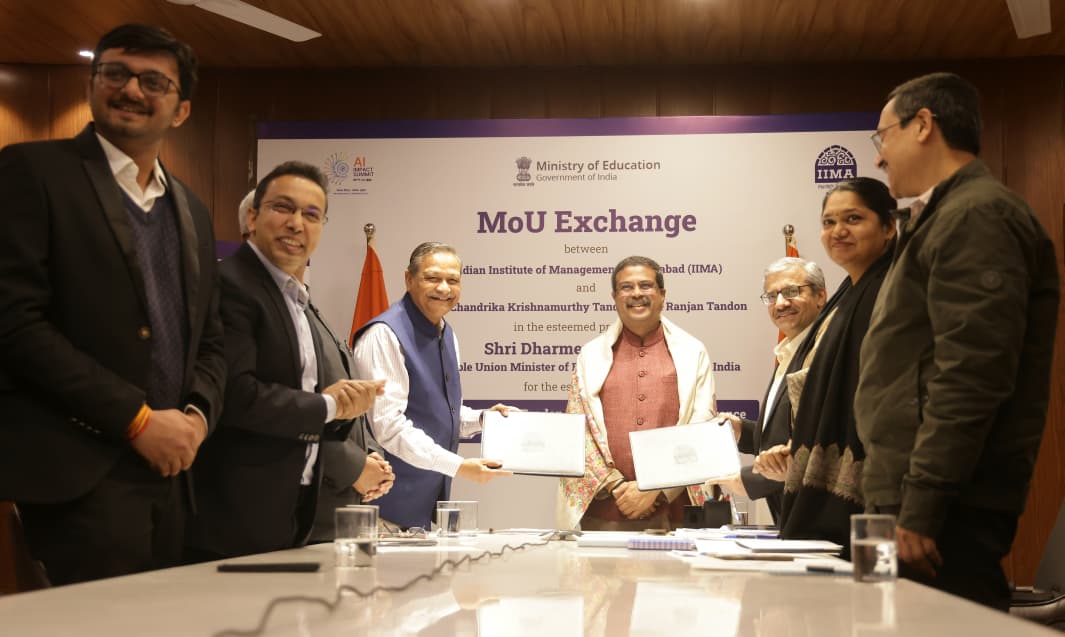
The Indian Institute of Management Ahmedabad (IIMA) has taken a significant step towards integrating artificial intelligence with management education by exchanging a Memorandum of Understanding (MoU) with philanthropists Chandrika Krishnamurthy Tandon and Ranjan Tandon to establish the Krishnamurthy Tandon School of Artificial Intelligence at the institute.
The MoU was exchanged in New Delhi in the presence of Dharmendra Pradhan, Union Minister of Education, while Vinay Kwatra, Ambassador of India to the United States, joined virtually from the US.
The School will be established through a $12 Million ( ₹100-crore) endowment by Chandrika Krishnamurthy Tandon, an alumna of IIMA’s PGP Class of 1975, and her husband Ranjan Tandon. Positioned as a pioneering School of Artificial Intelligence within a management institute in India, the new School aims to operate at the intersection of technology, management, and public impact.
Dharmendra Pradhan said in a media statement that he was happy to witness the exchange of the MoU for setting up the Krishnamurthy Tandon School of Artificial Intelligence at IIM Ahmedabad. He said the MoU, signed in the lead-up to the India–AI Impact Summit 2026, reflected the concrete actions India is taking to become a global AI superpower under the leadership of Narendra Modi.
Pradhan said that artificial intelligence would act as an enabler for powering people, progress, and the planet, adding that India’s AI leadership would be shaped not only by technology but also by the strength of its institutions and human capital. He appreciated Chandrika Krishnamurthy Tandon and Ranjan Tandon for their philanthropic contribution, noting that the endowment strengthened the tradition of alumni giving back to their alma mater.
He further said in the statement that the Krishnamurthy Tandon School of Artificial Intelligence would work towards boosting India’s AI capabilities, democratising AI, creating jobs from India for the global AI economy, and harnessing AI to improve lives and advance social good. As a School of Artificial Intelligence housed within a management institute, it will focus on responsible and effective AI applications while addressing India’s complex developmental challenges with a strong global outlook.
Anchored in IIMA’s long-standing legacy of leadership, governance, and institution-building, the School aims to influence how artificial intelligence is developed, deployed, and governed to generate long-term business and societal value. It is also envisioned as a natural extension of IIMA’s mission to advance management education in an increasingly AI-driven global economy.
Designed as a hub for business-focused and translational AI, the School will bring together faculty, industry leaders, policymakers, and global partners. Its research agenda will be application-led and case-based, focusing on translating cutting-edge AI research into deployable solutions, decision-making tools, and scalable systems for industry, government, and society.
Senior officials from the Ministry of Education and IIMA, including Secretary (Higher Education) Vineet Joshi and Director of IIMA Bharat Bhasker, were present at the event.
Sharing his views on the partnership, Bharat Bhasker said in a media statement, “The world is at an unprecedented inflection point where data and artificial intelligence are reshaping how businesses think, decide, and grow. At IIM Ahmedabad, we are committed to building leaders who stay ahead of the curve and can harness these technologies to make strategic decisions, drive innovation, and create greater impact. We are grateful to Ms. Chandrika Krishnamurthy Tandon and Ranjan Tandon for their generous contribution, which reflects their deep commitment to advancing education, institution-building, and the responsible application of artificial intelligence for societal good. Through its focus on translational AI, management-anchored research, and cross-sector partnerships, the Krishnamurthy Tandon School of AI will make a meaningful contribution to business and society, setting a global benchmark for AI research aligned with real-world impact.”
Explaining her motivation behind establishing the School, Chandrika Krishnamurthy Tandon said in a media statement, “It is an honour and privilege to be able to contribute to my beloved alma mater, IIMA, in such a pivotal area—one that I believe will redefine business and society in the years to come. I hope the Krishnamurthy Tandon School of Artificial Intelligence will allow us to train a new generation of far-thinking visionary leaders and help India address some of the most significant needs using the best technology and minds. Many of these lessons and learning will also be relevant to the world. It promises to be an exciting journey ahead.”
Chandrika Krishnamurthy Tandon is a business leader, philanthropist, and global advocate for education and the arts. An alumna of IIM Ahmedabad and former partner at McKinsey, she is the founder of Tandon Capital Associates and has played a key role in institution-building across the US and India. Ranjan Tandon, an alumnus of IIT Kanpur and Harvard Business School, is the founder and chairman of Libra Advisors and manages the Tandon family office. Together, the Tandons have supported academic institutions globally through faculty chairs, schools, and long-term philanthropic initiatives.

Blog
India’s Youngest Entrepreneurs at 36: The New Architects of India Inc.
At just 36 years of age, these entrepreneurs are already leading companies that are reshaping mobility, energy, e-commerce, aerospace, health, and digital infrastructure.

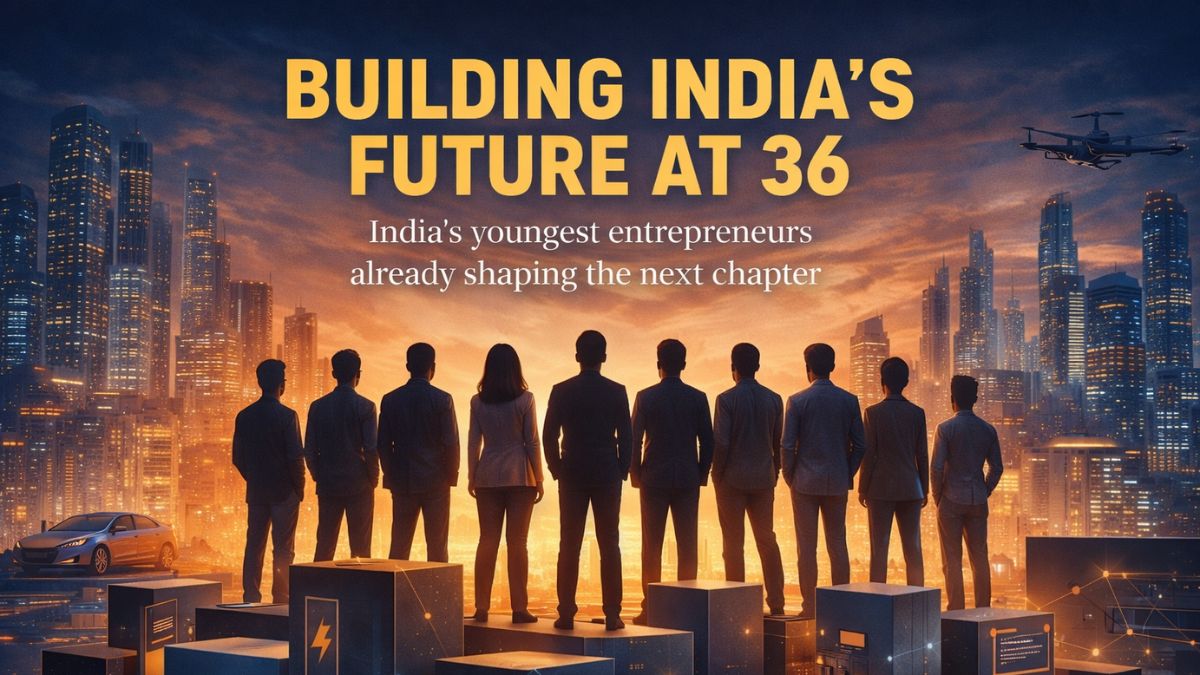
India’s entrepreneurial story is increasingly being written by founders who have not yet turned 40—but among them, a striking cohort stands out. At just 36 years of age, these entrepreneurs are already leading companies that are reshaping mobility, energy, e-commerce, aerospace, health, and digital infrastructure.
According to the Avendus Wealth – Hurun India U40 List 2025, the 10 youngest entrepreneurs on the list represent a generation that has combined technological depth with scale, ambition with execution, and innovation with institutional maturity.
Together, they reflect a broader shift in India’s economic leadership—from inheritance to invention, and from early success to long-term value creation.
The Youngest 10 Entrepreneurs in India (Age 36)
1. Sanjay Byalal Jagannath | Exponent Energy (Bengaluru)
The youngest entrepreneur on the U40 List, Sanjay Byalal Jagannath is co-founder of Exponent Energy, a company working on rapid-charging solutions for electric vehicles. At a time when EV adoption hinges on charging infrastructure, Exponent Energy’s focus on speed and scalability places it at the heart of India’s clean mobility transition.
2. Vivek Mishra | Raphe mPhibr (Noida)
Vivek Mishra leads Raphe mPhibr, a rare Indian startup operating at the intersection of aerospace, defence, and advanced manufacturing. The company reflects India’s growing push for self-reliance in high-technology defence systems, an area traditionally dominated by global majors.
3. Saurav Kumar | Euler Motors (New Delhi)
As founder of Euler Motors, Saurav Kumar is focused on electrifying India’s commercial vehicle segment. While much of the EV narrative revolves around personal mobility, Euler Motors is addressing last-mile logistics—one of India’s most emissions-intensive sectors.
4. Sanjeev Barnwal | Meesho (Bengaluru)
Sanjeev Barnwal, co-founder of Meesho, has helped build one of India’s most influential social commerce platforms. Meesho has enabled millions of small sellers—many from non-metro regions—to participate in the digital economy, redefining entrepreneurship at the grassroots level.
5. Mohit Kumar | Ultrahuman (Dubai)
Mohit Kumar heads Ultrahuman, a company operating at the convergence of wearable technology, metabolic health, and performance optimisation. Ultrahuman represents a new class of Indian-origin consumer health brands with global ambitions and science-led design.
6. Vishesh Khurana | Shiprocket (New Delhi)
Vishesh Khurana is co-founder of Shiprocket, a logistics and fulfilment platform powering India’s fast-growing e-commerce ecosystem. By simplifying shipping for small and medium sellers, Shiprocket has become a critical layer in India’s digital retail infrastructure.
7. Swapnil Babanlal Jain | Ather Energy (Bengaluru)
Swapnil Babanlal Jain is a co-founder of Ather Energy, one of India’s most prominent electric two-wheeler manufacturers. Beyond vehicles, Ather’s investment in charging networks and software ecosystems highlights how mobility is becoming a systems-level innovation challenge.
8. Swapnil Jain | Observe.AI (San Francisco)
Swapnil Jain leads Observe.AI, a company building AI-driven tools for contact centres and enterprise communication. Observe.AI illustrates the global footprint of Indian founders in advanced artificial intelligence and enterprise SaaS markets.
9. Ishaan Bector | Mrs. Bector’s Food Specialities (Gurugram)
Representing next-generation leadership, Ishaan Bector is steering Mrs. Bector’s Food Specialities, a well-established food company with strong consumer recall. His role reflects how legacy businesses are being reimagined through modern branding, scale, and governance.
10. Enbasekar D | MediBuddy (Bengaluru)
Enbasekar D is founder of MediBuddy, a healthtech platform focused on insurance, wellness, and healthcare access. As healthcare digitisation accelerates, MediBuddy sits at the intersection of policy, technology, and patient services.
What This Cohort Reveals About India’s Future
Several patterns emerge from this youngest group on the U40 List:
- Sectoral diversity: From aerospace and clean energy to healthtech and social commerce
- First-generation dominance: Most are self-made founders rather than inheritors
- Global outlook: Indian entrepreneurs are building companies for both domestic and international markets
- System-level thinking: These businesses are not just products, but platforms and ecosystems
Collectively, the Avendus Wealth – Hurun India U40 cohort leads enterprises valued at USD 357 billion, employs over 4.4 lakh professionals, and signals how early leadership responsibility is becoming the norm rather than the exception in India’s startup economy.
Editorial Note
This article is based on the Avendus Wealth – Hurun India U40 List 2025, with youngest entrepreneurs determined by birth month, as outlined in the methodology of the report
Blog
Social Media Corrupts Human Interactions
Students Launch ‘TheNextgenNarrative’ to Battle Social Media–Fuelled Isolation

By Ujjwal Prakash
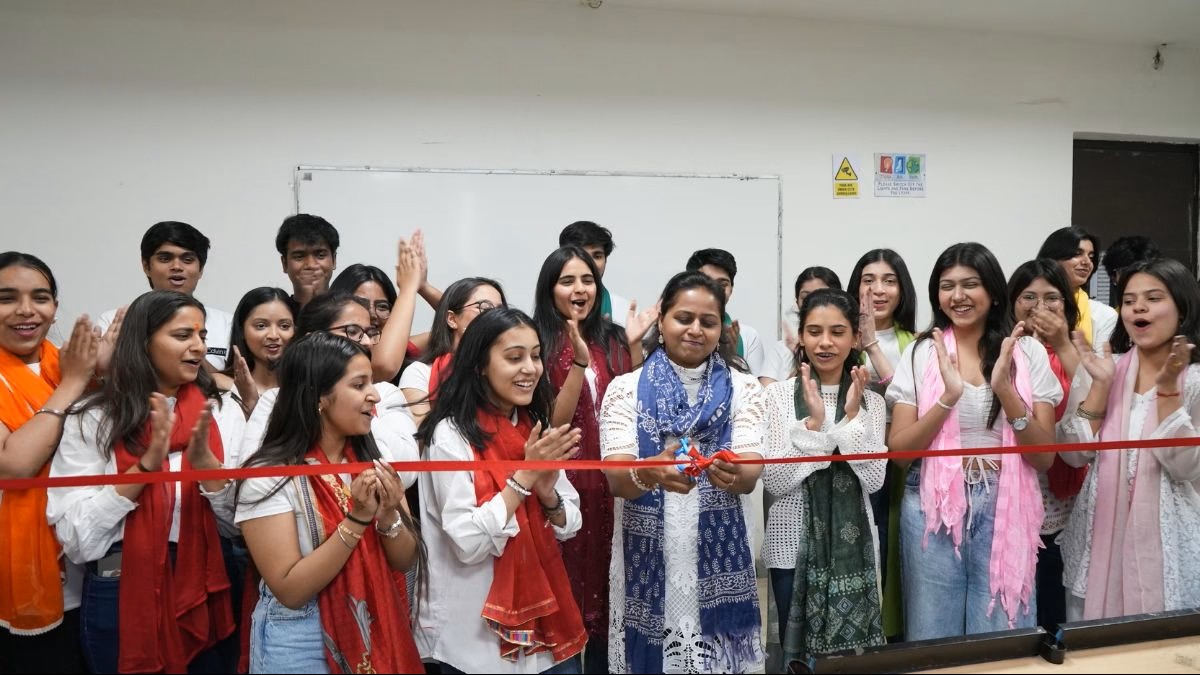
In a world where every moment is filtered through a phone screen, young people are increasingly finding themselves anxious, lonely, and creatively stuck. Alarmed by the rising tide of depression, anxiety, and what many call “brain rot” from endless social media feeds, second-year VSJMC students at Vivekananda Institute of Professional Studies–TC, Delhi, have launched #TheNextgenNarrative—a PR campaign aimed at pulling their peers out of the reel world and back into authentic, empathy-driven interactions.
Recent studies show that infinite scrolling heightens anxiety, depression, and FOMO (fear of missing out), fueling alarming rates of social isolation and declining creativity among youth. Students identified a critical issue: smartphones—now in 971.5 million Indian hands, up from 969.6 million in June 2024 (TRAI report, January 2025)—have eroded face-to-face human connection. Experts warn that constant digital engagement is replacing real conversations, leaving young people disconnected and adrift.
In response, TheNextgenNarrative introduced a series of low-tech, people-first events last month. Activities like Speed Friendship pairing, “Two Truths, One Lie” icebreakers, and Name-Tag Empathy sessions encouraged participants to move past curated online identities and connect with their peers as they truly are. A Creativity Showdown on Paper highlighted the importance of original thought in an age increasingly tempted to outsource creativity to AI, rekindling sparks dulled by mindless scrolling.
After just a few gatherings, many students reported feeling lighter, more present, and inspired to lift their eyes from their screens. What started as a small initiative among classmates has quietly become a wake-up call: empathy, laughter, and shared experiences can begin to heal the disconnect that social media creates.
This isn’t a flashy fix or a headline-hungry stunt—it’s a gentle yet powerful step toward reclaiming our fractured social compass. And in an age ruled by reels, it just might help us all remember how to live in colour again.
Note: This article is part of the student blog section, where students from the campus report on initiatives, events, and stories shaping their community.


Study Finds Warming Could Slightly Boost Atmosphere’s Methane-Cleaning Capacity

How China Is Redrawing the Global Map of Critical Minerals

Magnetic Fields Found to Shape Star Formation Near Milky Way Disc

Researchers Use AI to Enable Robots to ‘See’ Through Walls

India’s Power Future: 70% Non-Fossil Capacity by 2035-36, But Grid Challenges Loom

How the Iran–Israel–US Conflict Ripples Through India’s Economy and Energy Future

AI in Classrooms: Threat to Learning or Catalyst for Educational Transformation?

Climate change heat impact affected over 2.5 billion people

Weather, Not Just Emissions, Driving PM2.5 Pollution in Indian Cities: Study

Study Reveals How Ocean Bacteria Drive Plastic Biodegradation

-

 Society3 months ago
The Ten-Rupee Doctor Who Sparked a Health Revolution in Kerala’s Tribal Highlands
-
COP305 months ago
Brazil Cuts Emissions by 17% in 2024—Biggest Drop in 16 Years, Yet Paris Target Out of Reach
-
Society3 months ago
From Qubits to Folk Puppetry: India’s Biggest Quantum Science Communication Conclave Wraps Up in Ahmedabad
-
Women In Science5 months ago
The Data Don’t Lie: Women Are Still Missing from Science — But Why?
-
Earth4 months ago
Data Becomes the New Oil: IEA Says AI Boom Driving Global Power Demand
-
COP304 months ago
Corporate Capture: Fossil Fuel Lobbyists at COP30 Hit Record High, Outnumbering Delegates from Climate-Vulnerable Nations
-
Space & Physics3 months ago
Indian Physicists Win 2025 ICTP Prize for Breakthroughs in Quantum Many-Body Physics
-
Health5 months ago
Air Pollution Claimed 1.7 Million Indian Lives and 9.5% of GDP, Finds The Lancet