Connect with us

Society

AI reads inscriptions in a ‘rolled-up’ ancient scroll

Students win the first edition of the Vesuvius Challenge 2023 for deciphering over 15 columns of the Herculaneum scroll.  

Published

on

point jpeg
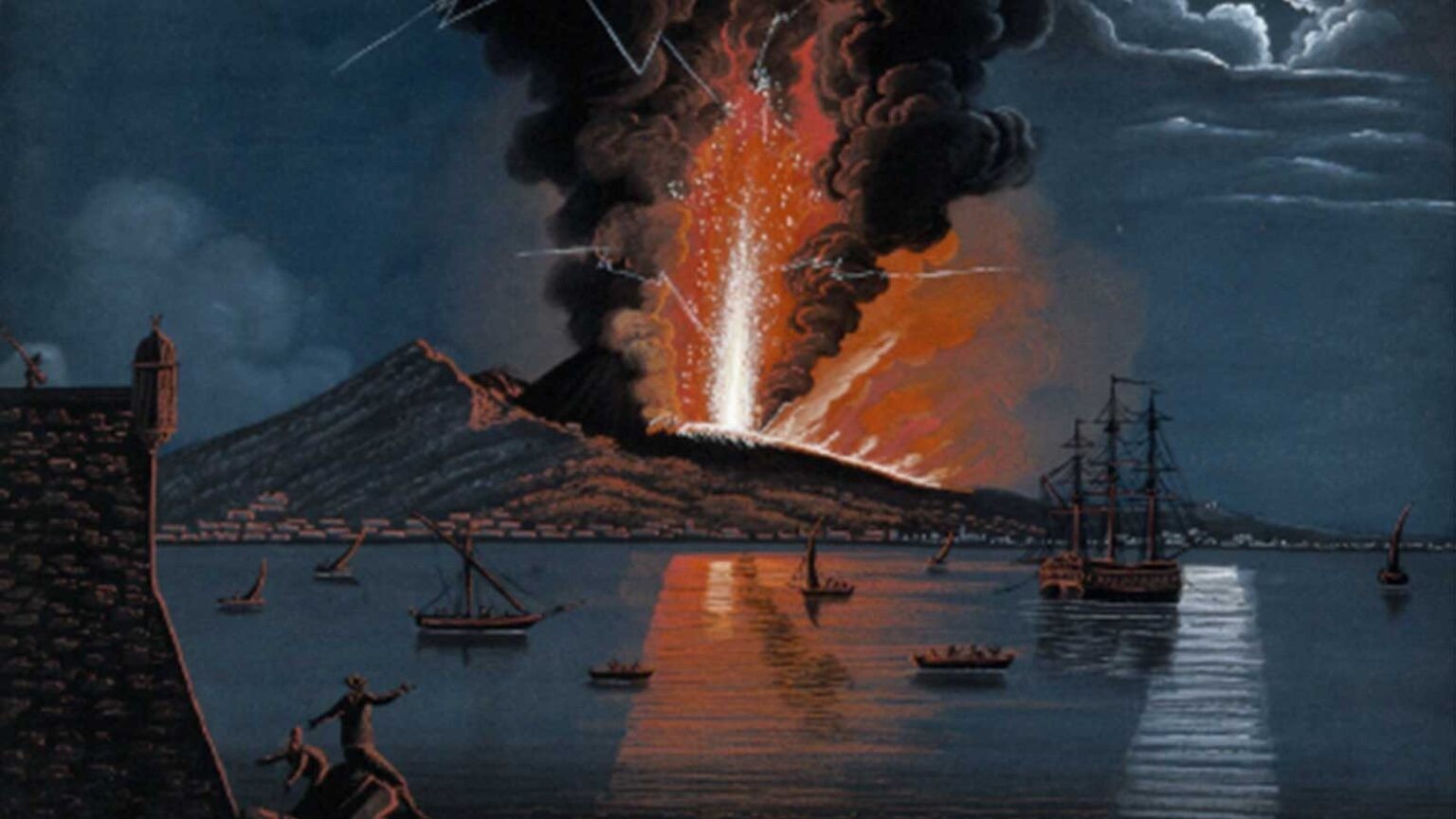
An artistic illustration of Mount Vesuvius erupting in 79 AD, Source: Wellcome Images

A poignant line from Kahlil Gibran’s 1926 poem, Sand and Foam reads, “Trees are poems the earth writes upon the sky, we fell them down and turn them into paper, that we may record our emptiness.” 

Papyrologists – scholars in reading ancient manuscripts – once deemed it impossible for themselves to make out fables that the 2000 year old Herculaneum papyri scrolls might hold. The scrolls hold archaeological, historical and cultural significance, as it can shed light on events and affairs that nobody still knows about during the Roman era. 

The Herculaneum papyri, numbering at 1,826 scrolls, became of scholarly interest after it was dug out from a luxury Roman villa in Herculaneum, Italy in the year 1709. Now just a grayish-black carbonized mound, they were ‘flash fried’ – or instantly burnt – in the Mount Vesuvius volcano eruption in 79 AD, that killed thousands.

But perhaps destiny was written for the papyri remains, as human ingenuity would ultimately yield success, with whatever it took them, to decipher their contents.

“A historic moment” 

News broke out, as a team of three young computer scientists – Youssef Nader, Luke Farritor, and Julian Schilliger – were awarded the Grand Prize for the Vesuvius Challenge 2023, and a whooping $700,000 prize money. “It’s a historic moment,” said Bob Fowler, a classicist at the University of Bristol, UK, to Nature. They used machine learning algorithms to decipher contents of the Herculaneum scroll. 

“We were all completely amazed by the images they were showing,” said Federica Nicolardi, a jury member and papyrologist at the University of Naples Federico II, to Nature.

Although no less a feat, the machine learning algorithms weren’t the only thing that enabled this historical discovery. The Vesuvius Challenge was set up in March 2023 , by computer scientist Brent Seales at the University of Kentucky, US, and Nat Friedman, the Silicon Valley billionaire and former GitHub CEO. The duo aimed to blend ‘competition and cooperation’ together to incentivize a research problem that wasn’t publicly funded anywhere in the world. Crowdsource funding through Twitter (now X), helped bring up the $1 million for the competition to go live. 

Until today, only 5% of that single scroll has been deciphered, with Vesuvius Challenge aiming to push further with renewed AI competitions, and get the rate to 90%.

As for the papyrologists, Nicolardi said to Nature that they are now racing to analyze the texts revealed. “We’re all very excited!” said Fowler.

Space & Physics

Inside India’s Semiconductor Push: ‘This Is a 100-Year Bet’

This is not an industry that rewards speed alone; it demands persistence, coordination, and long-term commitment. In semiconductors, success is not measured in years, but built over generations.

Dipin Damodharan

Published

on

IIT Bombay semiconductor experts Swaroop and Udayan Ganguly discussing India’s semiconductor mission
Swaroop Ganguly and Udayan Ganguly

In a conversation with Education Publica Editor Dipin Damodharan, leading semiconductor researchers Swaroop Ganguly and Udayan Ganguly delve into the science, strategy, and systemic challenges shaping India’s chip ambitions. Both are professors in the Department of Electrical Engineering at the Indian Institute of Technology Bombay. Swaroop Ganguly currently leads SemiX—the institute’s semiconductor initiative that brings together expertise across disciplines to advance India’s capabilities in the sector. Udayan Ganguly previously headed SemiX. India’s semiconductor journey, they argue, is only just beginning. The foundations— policy, infrastructure, talent, and partnerships—are being put in place, but the real challenge lies ahead. This is not an industry that rewards speed alone; it demands persistence, coordination, and long-term commitment. In semiconductors, success is not measured in years, but built over generations. Edited excerpts

India formally launched the semiconductor mission in 2021. Five years on, where does the country stand today?

Swaroop Ganguly:

The India Semiconductor Mission really began taking shape around 2021, but for a couple of years it was largely policy without visible industry participation. The turning point came around 2023 with the approval of the Micron packaging facility. That was important not just as a project, but as a signal—that global companies were willing to invest in India.

Following that, we saw a series of announcements, particularly in packaging and assembly. Now, packaging is not the highest value-add segment in the semiconductor value chain, but it is still a very important step. It generates employment, it helps build supporting capabilities, and it allows the ecosystem to start forming.

why India semiconductor mission matters
Image credit: Athena Sandrini/Pexels

But the real centrepiece—the crown of the semiconductor ecosystem—is the fabrication facility, or fab. That is where silicon wafers are actually processed into chips. We now have at least one major fab announcement, and that is a very significant milestone.

At the same time, we should be careful not to judge progress too quickly. This is not an industry where outcomes can be evaluated in five years. The correct time horizon is at least 10 to 15 years.

BUY THIS SEMICON SPECIAL MAGAZINE
Buy the latest issue of Education Publica. After completing the payment, please share your details at contact@edpublica.com

Why did India take so long to enter this space, especially given its strength in technology?

Swaroop Ganguly:

It’s not entirely accurate to say India never tried. There were attempts in the past. In fact, in the 1980s, India had a silicon fabrication facility in Chandigarh that was not very far behind global standards at that time.

Unfortunately, that facility was destroyed in a fire, and that event set India back significantly—by decades, in fact. But the loss was not just infrastructure. It was also talent. Many of the people who were working there moved abroad and went on to become leaders in global semiconductor companies.

When you lose something like that, you don’t just lose a facility—you lose the continuity of knowledge, mentorship, and ecosystem-building. That has long-term consequences.

After that, the global semiconductor industry moved very fast, and re-entering it became increasingly difficult. It required a level of policy support and industrial coordination that did not exist at the time. That is what has changed with the India Semiconductor Mission.

j4 2

How should we interpret the progress under India Semiconductor Mission 1.0 (ISM 1.0)? Has it delivered what was expected?

Swaroop Ganguly:

I think it would be a mistake to look at ISM 1.0 as something that should have delivered results within five years. This industry demands a long-term, patient approach.

ISM 1.0 has led to the approval of multiple manufacturing-related units, most of them in packaging. That is actually a sensible place to begin. Countries like Taiwan and South Korea also started their semiconductor journeys with packaging before moving up the value chain.

There has also been progress in specialty areas such as compound semiconductors, which are used in applications like power electronics, renewable energy, and communications.

So overall, I would say the direction is correct. But the success of ISM should be evaluated over a much longer period—10 to 15 years at least.

So India Semiconductor Mission (ISM) 2.0 is not a reset, but an expansion?

Swaroop Ganguly:

Exactly. ISM 2.0 should be seen as an expansion of scope.

In ISM 1.0, the focus was largely on attracting manufacturing—fabs and packaging units. Now, the thinking is evolving towards building a more complete ecosystem.

That means looking at materials, chemicals, gases, equipment, and all the ancillary industries that support semiconductor manufacturing. At the same time, there is increasing emphasis on research, innovation, education, and training.

This is important because semiconductors are not a one-time investment. As we often say, this is not a bandwagon you jump onto—it’s a treadmill.

What do you mean by that analogy?

Swaroop Ganguly:

The treadmill analogy simply means that once you enter this industry, you have to keep moving. If you stop, you fall off.

Udayan Ganguly:

Yes, and the reason is very simple. The industry evolves continuously. Every couple of years, chips become more powerful, more efficient, more densely packed.

If you don’t keep up with that pace of innovation, your products become uncompetitive. Unlike many other industries, you cannot just build a plant and continue producing the same thing for decades.

j5 2

For a layperson, what does this “semiconductor moment” actually mean for India?

Udayan Ganguly:

Think about everything you do today—medicine, education, transportation, entertainment. All of it runs on semiconductors.

Now imagine that every time you engage in any of these activities, you are effectively paying someone else for that underlying technology.

You go to a doctor—you are paying a semiconductor fee.

You drive a car—you are paying a semiconductor fee.

You watch a movie—you are paying a semiconductor fee.

So the question is: can a country continue to grow while constantly paying for the technological backbone of its economy?

So this is fundamentally about control over technology?

Udayan Ganguly:

Absolutely.

If India does not control semiconductors to some extent, we are basically fighting a losing battle. This is not just about manufacturing chips—it is about controlling the substrate on which modern society operates.

And this is not a short-term project. This is a 100-year bet. Even building meaningful capability will take at least 30 years.

What are the biggest challenges India faces in this journey?

Udayan Ganguly:

There are three core challenges: technology, talent, and governance.

On technology, the reality is that only a handful of companies globally have access to cutting-edge capabilities. These are not technologies that can simply be purchased at cost.

So India will have to start with slightly older technologies, which is perfectly fine. That is how most countries begin.

On talent, it is not just about having engineers—it is about having deep know-how. The ability to solve problems, innovate, and adapt.

And on governance, this is not a free-market industry. It requires sustained policy support and coordination. Without that, it cannot take off.

j8 1

What role do startups and academia play in this ecosystem?

Swaroop Ganguly:

They are central to innovation.

India has had design centres of global semiconductor companies for decades. But what we have not had is a large number of products that are designed, owned, and commercialised by Indian companies.

That is where startups and academia come in.

Innovation typically emerges from these spaces—either from academic research translating into startups, or from experienced professionals building new companies.

Can startups play a role in manufacturing as well?

Swaroop Ganguly:

Manufacturing is much more capital-intensive, so it is difficult for startups to enter that space in the conventional sense.

However, there are opportunities in specialised areas—materials, processes, equipment components—where startups can contribute.

Academia also plays a critical role, particularly in advancing research that can feed into industry.

Is there a missing link in India’s semiconductor ecosystem today?

Udayan Ganguly:

Yes—R&D infrastructure.

Globally, there are dedicated semiconductor research centres where new ideas can be tested at scale without disrupting commercial manufacturing.

These centres act as a bridge between academia and industry.

India needs similar facilities. Without them, it becomes difficult to translate research into real-world applications.

What about talent—are we producing enough skilled people?

Udayan Ganguly:

We have strong core capability, but we need to scale significantly.

To meet the demands of a domestic semiconductor ecosystem, we probably need to increase our talent pool by at least ten times.

And this is no longer just about selecting the best candidates. It is about building a pipeline—training, education, and capacity-building across institutions.

j6 3

Is semiconductor engineering limited to electronics?

Swaroop Ganguly:

Not at all. That is a common misconception.

Semiconductor manufacturing is highly interdisciplinary. It involves physics, chemistry, materials science, and mechanical engineering.

For example, consider a thermal processing step in fabrication. A wafer can be heated from room temperature to over 1000°C in a matter of seconds and then cooled rapidly. That involves complex thermal and mechanical engineering.

So the opportunities extend far beyond traditional electronics.

Who are the key stakeholders in building this ecosystem?

Swaroop Ganguly:

It essentially comes down to three groups: academia, industry, and government.

These three must work together very closely. Without that collaboration, the ecosystem cannot develop.

Government provides policy and support. Industry drives manufacturing and commercialisation. Academia contributes research, talent, and innovation.

j7 2
Image credit: Dipin Damodharan

Does India need to increase its R&D spending?

Swaroop Ganguly:

Spending is already increasing, which is a positive sign.

But equally important is how that money is used. There are global models where competing companies collaborate on early-stage research, pooling resources and working with academia.

Such models can significantly improve the effectiveness of R&D investment.

Finally, are you optimistic about India’s semiconductor journey?

Udayan Ganguly:

Yes, broadly.

The policy direction is strong, and the incentives are competitive. But this is not something that will succeed automatically.

It requires sustained effort over decades.

Swaroop Ganguly:

Exactly. The direction is right, but the time horizon is long. This is not a sprint—it is a marathon.

Continue Reading

Climate

FIFA Under Fire Over ‘Impossible to Justify’ Heat Rules for 2026 World Cup

Global experts warn FIFA’s heat safety rules for the 2026 World Cup could endanger players amid rising climate-driven temperatures.

Published

on

FIFA heat safety guidelines: Football players competing under extreme heat conditions during an international match as experts warn FIFA over 2026 Football World Cup safety risks.

Experts warn players could face life-threatening conditions as climate change intensifies heat risks across host cities

A coalition of leading global experts in health, climate science and sports performance has issued a sharp warning to FIFA, accusing football’s governing body of maintaining dangerously weak heat safety standards ahead of the 2026 FIFA World Cup. Experts criticize FIFA heat safety guidelines and warn players could face life-threatening conditions as climate change intensifies heat risks across host cities

In a strongly worded open letter, seen by EdPublica, the experts argue that FIFA’s current thresholds for allowing matches to continue in extreme heat are “impossible to justify”, even for athletes who are fully acclimatised to hot conditions.

FIFA heat safety guidelines raising alarm

The tournament, set to be hosted across 16 cities in the United States, Mexico and Canada, is already raising alarm among scientists because of the likelihood of soaring temperatures and humidity during summer matches. Experts fear that players could be pushed into dangerous levels of heat stress, especially during afternoon kick-offs.

The warning comes amid growing concern that climate change is making extreme heat events more frequent and more severe worldwide. Scientists say the burning of fossil fuels is directly contributing to these rising temperatures — a point the letter connects to FIFA’s controversial sponsorship relationship with Saudi oil giant Aramco.

FIFA heat safety guidelines and fossil fuels

The authors of the letter describe FIFA’s “active promotion” of fossil fuels as “a conflict of interest with the protection of player welfare.”

Prof Mike Tipton from the University of Portsmouth’s Extreme Environments Lab and President of The Physiological Society warned that the dangers go beyond simple discomfort.

“Competitive exercise in hot environments can lead to a range of problems from impaired performance and enforced alterations in game strategy, to the medical emergency of heat stroke. Amongst the most important ways of minimising the chance of such hazards is to employ effective interventions, including complying with internationally recognised heat-related thresholds for the postponement or relocation of events. As it stands, and due in part to climate-change driven increases in environmental thermal stress, some of the venues for the 2026 World Cup are likely to exceed the recommended heat-related “high risk” threshold, especially during afternoon kick-offs”

At the centre of the criticism is FIFA’s current Wet Bulb Globe Temperature (WBGT) threshold — a heat stress measure that factors in humidity, solar radiation, wind speed and air temperature. Under FIFA’s existing framework, matches may continue until WBGT levels exceed 32°C.

Experts argue that threshold is dangerously high. The open letter notes that a WBGT of nearly 32°C can correspond to air temperatures around 45°C with moderate humidity — conditions many scientists consider unsafe for intense athletic activity.

Professor Douglas Casa, CEO of the Korey Stringer Institute at the University of Connecticut, said FIFA’s current rules fall well behind accepted scientific standards.

“The science supports the concept that high intensity sport above a 28oC Wet Bulb Globe Temperature can compromise performance and put a player at risk. The fact that under current FIFA Guidelines action will only be taken above 32oC is far from optimal. Additionally, the hydration break in each half absolutely needs to be longer than 3 minutes- at least five minutes for each break and preferably six. We hope this open letter convinces FIFA to update its heat guidelines before the World Cup.”

Although FIFA has introduced cooling breaks and a Heat Illness Mitigation and Management Task Force for the tournament, the experts say current measures remain insufficient. The letter argues that the existing three-minute cooling breaks are “too short to have a meaningful impact on rehydration and body cooling.”

The group is urging FIFA to adopt stricter protections similar to those recommended by FIFPRO, the international footballers’ union. Among the proposed measures are mandatory cooling breaks once WBGT exceeds 26°C and postponement or relocation of matches once temperatures rise above 28°C.

Professor Hugh Montgomery of University College London connected the debate directly to the broader climate crisis.

Climate change threatens human health and survival, now. In this regard, the World Cup shines less bright, tarnished by its core funding coming from a major polluter and by the threat posed to players by the extreme temperatures to which they may now be exposed.”

The controversy also highlights the growing collision between elite sport and climate change. The 2026 FIFA World Cup is expected to become the most carbon-polluting tournament in history due to its expansion to 48 teams and the vast travel demands across three countries.

Recent events across global sport have intensified fears. In 2025, extreme heat at the Shanghai Masters reportedly caused Novak Djokovic to vomit on court, while tennis player Holger Rune publicly asked: “do you want a player to die on court?” after receiving treatment for heat stress.

As the countdown to the 2026 World Cup continues, pressure is now mounting on FIFA to decide whether football’s biggest spectacle can safely coexist with a rapidly warming planet.

Continue Reading

Society

When Pollinators Vanish, Children Go Hungry—Here’s the Proof

A landmark study has, for the first time, traced a direct line from the collapse of wild insect pollinators to the malnutrition and poverty of farming families — reframing biodiversity loss as a global public health emergency.

Dipin Damodharan

Published

on

Pollinator Decline Threatens Nutrition, Farm Incomes: Study
Image credit: Tom Timberlake

Two billion. That is how many people on this planet eat what smallholder farmers grow. Not what agri-industrial combines harvest, not what commodity markets trade — what families with small plots of land pull from the soil, season after season, with the tools and seeds and knowledge they have. Two billion people. And a significant share of what keeps those harvests coming, what puts vitamins into the food and income into the household, has no name on any payroll, files no tax return, and has never once been thanked.

It is insects. Wild insects — bees, hoverflies, moths, beetles — moving flower to flower across millions of smallholder fields, doing work that no machine replicates and no subsidy replaces. Pollinator decline is dismantling that system quietly, field by field, season by season. A study published today in Nature, led by researchers at the University of Bristol, has for the first time traced exactly what that loss costs — not in abstracted ecosystem valuations, but in the vitamin A missing from a child’s diet, in the folate a pregnant woman never gets, in the farm income that does not arrive at the end of a harvest. The number at the end of that calculation is not a projection or a model. It is a measurement. And it is arresting.

Insect pollinators, the study found, are responsible for 44% of the farming income of the households tracked, and contribute more than 20% of dietary intake of vitamin A, folate and vitamin E — three nutrients whose deficiency is already linked to stunted child growth, weakened immunity and higher rates of disease. When pollinators vanish, the families don’t just grow less food. They grow less nutritious food, earn less money and become more vulnerable to illness. The cycle reinforces itself, downward.

Numbers

Ten Villages, One Year, and a Chain of Evidence

The study centred on ten smallholder farming villages and their surrounding landscapes in Nepal. Over the course of a year, the research team — drawn from universities and non-governmental organisations across Nepal, the United Kingdom, the United States and Finland — tracked three things simultaneously: which insects were visiting which crops, what those crops yielded and how nutritious they were, and what the farming families were actually eating and earning.

The impact of pollinator decline on food production and nutrition is high
Nepal’s smallholder farming communities are highly dependent on diverse range of pollinator-dependent crops. Image credit: Tom Timberlake

It is, in structural terms, the kind of study that is very hard to pull off. Most research on pollinators stops at the field boundary — counting bee visits, measuring fruit set, estimating yield differentials. This one kept going, all the way to the dinner table and the household ledger. That continuity of evidence is what makes it significant.

why nepal

The picture that emerged was not abstract or statistical. It was human. Over half the children in the study villages were too short for their age — a condition that goes by the clinical name of stunting and signals not just poor growth but compromised brain development, reduced immunity and diminished life prospects. The underlying cause, as the researchers documented it, was diet. And that diet depended, in ways the families could not easily see or control, on the insects working their fields.

quote 1

Pollinator Decline: The Hidden Hunger Nobody Is Counting

There is a term in public health circles for the condition that the Nepal families illustrate: hidden hunger. It describes not the obvious, acute starvation that makes headlines, but the chronic, silent insufficiency of vitamins and minerals that undermines health even when enough calories are being consumed. A quarter of the global population currently suffers from it. It is, by most measures, one of the largest sources of preventable illness on the planet, and it is almost entirely invisible in the way society keeps score of environmental damage.

When a species goes extinct, when a forest is cleared, when an insect population crashes — the accounting of loss is typically measured in biodiversity metrics, in ecosystem service valuations, or in the emotional register of what is no longer there to see. It is almost never measured in folate deficiency, in children’s height-for-age charts, in the likelihood of a farming family falling into debt after a bad harvest.

That is what this study changes. It is not the first to establish that pollinator decline matters for nutrition in the abstract. But it is the first to demonstrate, with tracked data from real communities over a real year, the size and mechanism of the effect — and to show that the effect flows not just through calories but through the specific micronutrients that are hardest to replace.

quote 2

Biodiversity as Medicine

Planetary Health — the field Dr Myers directs at Johns Hopkins — proceeds from a deceptively simple premise: human health and ecological health are not separate subjects. They are the same subject, studied from different ends. The degradation of natural systems is not a background condition to human development; it is one of the primary mechanisms by which human health is undermined.

That claim has long had intuitive force. What the Bristol study on pollinator decline provides is something more demanding: empirical evidence at the household level. It is one thing to argue that biodiversity loss will eventually compromise food security in a generalised way. It is another to show, village by village, season by season, that the decline in the bee community visiting a particular set of crops reduces particular vitamins in particular families’ diets by a measurable amount.

Bee on a flowering crop showing the impact of pollinator decline on food production and nutrition
Image credit: Tom Timberlake

The phrasing matters. Biodiversity is not a luxury. In policy conversations, the language of luxury — or alternatively, of long-term concern — has frequently served to push ecological questions down the agenda. If the relationship between pollinator health and child health is as direct as this study finds, that framing becomes harder to sustain.

What Goes When the Bees Go

It is worth being specific about the nutritional stakes. Vitamin A deficiency impairs vision, particularly in low light, and compromises the immune system’s ability to fight infections that would otherwise be routine. Folate deficiency during pregnancy causes neural tube defects in developing foetuses, among other effects. Vitamin E is a key antioxidant, and its deficiency is associated with neurological damage and weakened immune function. These are not marginal health concerns. They sit near the top of the global burden of preventable disease.

The crops most dependent on animal pollination — fruits, many vegetables, pulses — are also, not coincidentally, among the most concentrated sources of these particular nutrients. A diet from which pollinator-dependent produce has been reduced or removed can look adequate in calorie terms while being profoundly inadequate in micronutrient terms. The families studied in Nepal were, in effect, already living that deficit, in a context where pollinator diversity is declining.

Globally, insect populations have been under sustained pressure for decades. Pesticide use, habitat loss, monoculture farming, climate change and artificial light at night have all been implicated in declines that researchers have called, in some cases, ecological collapse. The mechanisms are various; the direction of travel is consistent.

The Good News: Reversible by Design

The research is, in its implications, genuinely alarming. But the researchers are also at pains to emphasise something that is easy to miss in the headline findings: the relationship between pollinators and nutrition runs in both directions. If pollinator decline causes nutritional harm, pollinator recovery can produce nutritional gains. And the actions required are not exotic.

Planting wildflowers at field margins. Reducing pesticide inputs. Keeping native bee colonies. These are the kinds of changes that do not require new technology or large capital investment. They require farmers to understand what is happening in their fields at a level of detail most have not previously been given reason to consider. The researchers are already working on that — translating their findings into practical guidance and working with local organisations, government partners and farmers in Nepal to implement changes on the ground.

The approach is now informing Nepal’s emerging National Pollinator Strategy, an effort to make pollinator-friendly practices a standard part of everyday agriculture rather than a specialist conservation concern. The researchers report that farmers who have adopted even modest changes are already seeing improvements in crop yields, income and nutrition — a feedback loop that runs in the direction of health rather than away from it.

Screenshot 2026 05 06 135515

A Framework That Travels

Nepal is not an isolated case. Two billion people around the world depend on smallholder farming. Many of them face the same combination of circumstances: high dependence on pollinator-sensitive crops, limited dietary alternatives, micronutrient deficiencies that are already entrenched and ecosystems under stress. The findings from ten Nepali villages do not translate automatically to every agricultural context, but the framework — the method of tracing connections from insects to income to nutrition — does.

Diets even in industrialised countries still depend on pollinators and the ecosystems that sustain global agriculture. The buffer of wealth — the ability to import, substitute, supplement — is larger in wealthy countries, but it is not unlimited, and it does not protect the most economically vulnerable people even within those countries.

The lesson from this research on pollinator decline is less a specific warning about Nepal and more a methodological call to arms: to start measuring the connections that have, until now, been assumed or asserted but rarely demonstrated. When those connections are demonstrated, the case for protecting what remains of insect diversity becomes something different — not a moral preference or an aesthetic value, but a documented precondition for human health.

quote 3

The Stakes

A quarter of the world’s people are living with hidden hunger. Over half the children in ten Nepali villages are stunted. Forty-four percent of the farming income in those communities flows, invisibly, through the wings of insects that nobody counted or protected until researchers started looking. The insects are in decline.

The study’s authors are careful, as scientists should be, to describe what they found and what it implies rather than what must be done. But the shape of the implication is not obscure. The fabric of life — the phrase Dr Myers uses — is not an abstraction. It is the thing that puts vitamins in a child’s diet and money in a family’s pocket. Tear large enough holes in it, and the consequences are not primarily ecological. They are medical. They are economic. They are, in the most direct sense, human. That’s why the new findings on pollinator decline matter.

The bees were always doing the work. We just weren’t watching closely enough to see it — or to understand what we stood to lose.

Continue Reading

Trending