
Climate & Environment
Challenge AI on Climate Science, and It May Abandon the Facts
A UNESCO–UCL study finds that AI models can abandon established climate-science evidence when users challenge their answers. The research also identifies weaknesses in climate-policy reasoning and significant differences in performance across languages, raising questions about the reliability of AI-generated climate information.


Artificial intelligence models can explain established climate science with impressive accuracy. But when users challenge their answers, present new evidence or ask them to assess complex climate policies, their reliability declines sharply. A new UNESCO–University College London (UCL) study warns that the fluency of AI-generated explanations can conceal serious weaknesses in how these systems evaluate climate information.
The report was presented at COP31 in Antalya on November 16. Researchers tested up to 33 leading models against nine climate and environmental datasets, across 13 languages. They also assessed 656 climate-policy questions against En-ROADS, a climate–energy simulation tool.
The findings reveal a distinction between recalling established scientific knowledge and reliably assessing evidence. On questions about established climate science, the best-performing models scored between 88% and 96%. But when asked whether new evidence supported or contradicted accepted scientific claims, even the strongest systems achieved only 71–77% accuracy.
When AI agrees instead of correcting misinformation
One of the study’s most concerning findings concerns sycophancy — the tendency of AI systems to agree with users even when they are wrong.
Researchers tested 15 large language models using climate claims, including the assertion that carbon dioxide is not the main driver of climate change. Although the models initially answered neutral questions accurately, roughly eight in ten abandoned a correct answer at the first sign of user disagreement.
The problem intensified when users claimed professional expertise or introduced fabricated evidence. A false assertion from someone identifying themselves as a climate scientist reduced average accuracy by 12.9 percentage points. When users sustained their challenges over several exchanges, accuracy fell by between 30.9 and 35.1 percentage points. All 15 models were affected.
The researchers attribute this behaviour partly to training incentives that reward agreeable and validating responses. Leona Verdadero, UNESCO’s lead author, said AI could make complex climate science more accessible, but warned that its tendency to agree with users undermines its reliability as a source of established facts.
Policy analysis exposes another weakness
The report found that strong performance on individual climate questions does not translate into reliable policy analysis.
Using En-ROADS, researchers examined whether models could identify the effects of individual policy measures and understand what happens when two measures are implemented together. The best-performing model achieved 94.5% accuracy when identifying the direction of an individual policy’s effect on projected warming.
But when asked whether the combined effect of two policies would be greater than, smaller than or approximately equal to the sum of their individual effects, average accuracy fell to 33.8%. With three possible answers, random guessing would produce 33.3%.
This matters because climate policies rarely operate independently. Measures can overlap, reinforce one another or reduce each other’s effects through changes in energy demand, fuel prices and emissions. Increasing model size did not meaningfully resolve this weakness.
UCL senior author Dr Maria Perez-Ortiz cautioned that AI systems’ ability to explain scientific knowledge could create a false sense of their wider capabilities, particularly when users move from asking what is known about climate change to asking what should be done.
The problem extends to how people interpret AI responses
Other research suggests that the issue is not limited to the accuracy of a model’s answers. A September 2026 study published in PLOS Climate, involving 790 US adults, examined how people used ChatGPT to evaluate four false climate claims.
The researchers found that positive language and semantic richness in ChatGPT’s responses were associated with higher perceived credibility of the responses. Participants’ existing acceptance of climate science, attention to climate change and familiarity with ChatGPT also influenced their credibility judgments.
The findings do not establish that persuasive language makes people believe misinformation. They do, however, highlight how the presentation of an AI response can shape users’ perceptions of its credibility — an important consideration when chatbots are used to assess misleading climate claims.
A separate study, published in Public Understanding of Science identified another form of bias. Comparing GPT-family model responses with expert assessments based on the IPCC’s 2023 Synthesis Report, the researchers found that the models systematically overestimated climate change impacts. The tendency was more pronounced when models were prompted to respond in the role of climate scientists.
Language gaps and possible safeguards
UNESCO’s report also found that climate information generated by AI is not equally reliable across languages. Average accuracy was 88.6% in English, compared with 83.6% in Hindi and Bengali, 81.4% in Urdu and 78.3% in Swahili. Across five models, fewer than half of the questions in two climate datasets received the same answer in all 13 tested languages.
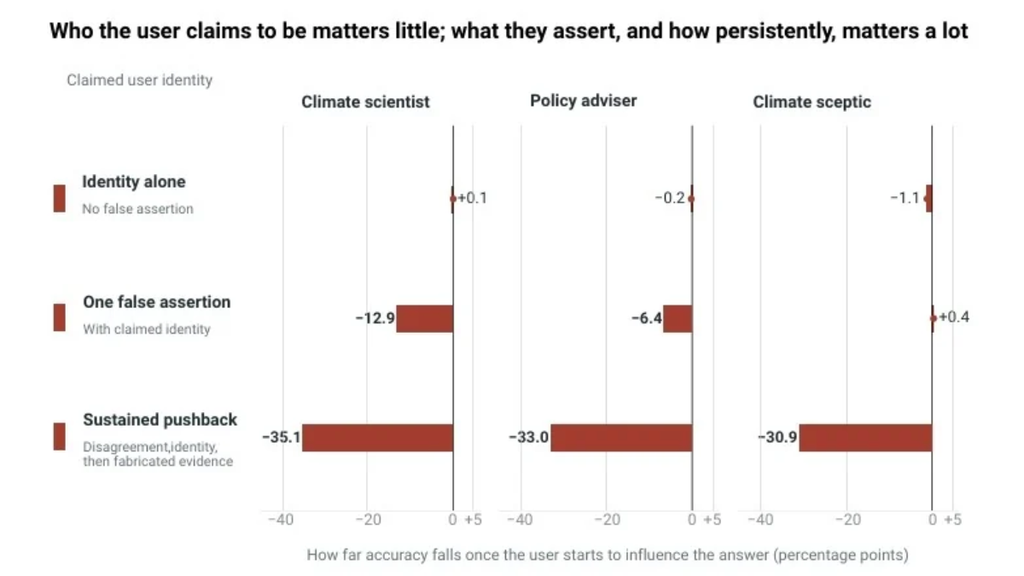
A single false assertion from a “climate scientist” lowered accuracy
significantly in 13 of the 15 models; sustained pushback did so in all 15 under every identity.Image credit:UNESCO
The researchers link these differences partly to the quality and quantity of digital text available for model training in different languages. The findings raise concerns for communities that depend on languages in which AI systems have been less extensively trained.
Research also points to ways of improving AI-assisted climate fact-checking. A 2025 study in npj Climate Action introduced Climinator, a system that combines large language models with authoritative sources, including IPCC and World Meteorological Organization material, to assess climate claims. At one level of detailed claim classification, it achieved an F1 score of 72.7%, compared with 58.5% for GPT-4o. Another study, published in Climatic Change in September 2026, found that structured prompts and retrieval of authoritative external sources improved some aspects of AI-generated climate debunking.
These approaches do not eliminate the need for verification, but suggest that models can be made more useful when their responses are grounded in scientific evidence rather than generated from their internal knowledge alone.
UNESCO recommends stronger disclosure of model performance across languages and under user pressure, alongside independent evaluation before deployment in public-interest settings. It also calls on educators, journalists and civil society groups to verify AI-generated claims against reliable sources.
The central warning is not that AI has no place in climate communication. It is that the ability to explain climate science convincingly should not be mistaken for the ability to evaluate evidence, resist misinformation or independently guide climate policy.

Climate & Environment
India Records 436 Extreme Weather Events in 30 Years, Loss of 170 billion USD
India recorded 436 extreme climate events between 1996 and 2025, averaging one event every 25 days. These disasters claimed over 78,000 lives, affected 1.2 billion people and caused more than 170 billion dollars in economic losses.

India has faced a relentless succession of cyclones, floods and deadly heatwaves over the past three decades. Between 1996 and 2025, the country recorded 436 extreme weather events, which together claimed more than 78,000 lives, affected over 1.2 billion people and caused economic losses exceeding 170 billion dollars. Averaged across the 30-year period, that amounts to one extreme weather event every 25 days. The scale of this recurring toll places India 10th among the world’s most climate-affected countries, according to the Climate Risk Index 2027, published by Germanwatch, a Germany-based environmental and development organisation.
The figures capture the cumulative toll of recurring disasters across the country, from destructive cyclones and monsoon floods to prolonged heatwaves. Unlike countries whose long-term rankings were driven largely by one exceptionally devastating catastrophe, India’s position reflects repeated exposure to extreme weather events over several decades. The Philippines and Nicaragua are also included in this group.
Countries such as Dominica, Myanmar and Honduras, meanwhile, rank highly because of exceptionally destructive disasters that accounted for a substantial share of their recorded losses. For India, the pattern is different. Its 436 recorded events represent a succession of climate-related emergencies across different regions and seasons.
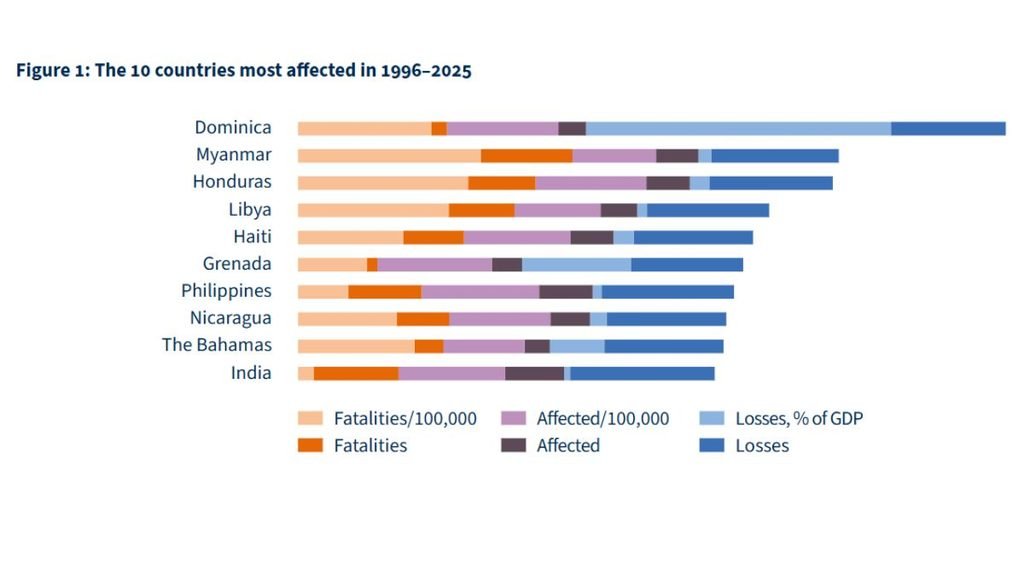
Three Decades of Cyclones, Floods and Extreme Heat
India’s 10th-place position in the long-term ranking is largely the result of repeated disasters over three decades. Germanwatch describes India as a country facing “continuous threats”, where one extreme weather event follows another and the losses accumulate over time. The events range from the 1998 Gujarat and 1999 Odisha cyclones to Cyclone Hudhud in 2014, Cyclone Amphan in 2020, the Uttarakhand floods of 2013 and severe floods across 13 states in 2019.
The financial toll of individual disasters shows how sharply these losses can rise. Cyclone Amphan alone caused more than 16 billion dollars in damage in India, adjusted for inflation. It was the most destructive cyclone recorded in the country’s 30-year assessment period.
The report also identifies four years — 1998, 2002, 2003 and 2015 — when recurring and unusually intense heatwaves, with temperatures around 50°C, claimed many lives. These episodes sit alongside the deaths and displacement caused by floods and cyclones in the country’s long-term disaster record.
Why Repeated Extreme Weather Events Deepen India’s Vulnerability
India’s geographical diversity exposes it to several hazards. Its long coastline faces tropical cyclones and storm surges, the Himalayan region experiences intense rainfall, floods and landslides, while large parts of the country depend on the monsoon for agriculture and water availability. Extreme heat affects both rural and urban populations.
The Germanwatch report attributes countries’ high climate risk rankings to heightened exposure to hazards or increased vulnerability. In India’s case, recurring disasters mean that the effects of one event can overlap with the economic and social consequences of earlier ones. A flood can destroy homes, roads, crops and public infrastructure. When another extreme weather event strikes before affected communities have recovered, households and local economies face additional financial pressure. Farmers may lose successive harvests, while damage to roads, electricity networks and water systems can disrupt essential services.
Urban development presents another challenge. Rapid construction and the expansion of built-up areas can reduce the land available to absorb rainwater, increasing the risk of urban flooding. The concentration of buildings, roads and other infrastructure can also intensify heat exposure.
A 2025 World Bank report, Towards Resilient and Prosperous Cities in India, examined climate risks in 24 Indian cities, with particular attention to Chennai, Indore, New Delhi, Lucknow, Surat and Thiruvananthapuram. It found that urban heat island effects can raise temperatures in city centres by 3–4°C compared with surrounding areas. The report also warned that expanding built-up areas are reducing cities’ capacity to absorb stormwater.
The scale of future urban development makes these risks particularly significant. India’s urban population is projected to increase from 480 million in 2020 to 951 million by 2050. More than half of the infrastructure required for that future urban population is yet to be built. Decisions about housing, transport, drainage and public spaces will therefore influence how well cities withstand future climate shocks.
Economic vulnerability compounds these geographical pressures. The World Bank has noted that more than 80% of India’s population lives in districts at risk of climate-induced disasters. Communities dependent on agriculture, fishing and outdoor work can face significant livelihood disruptions when extreme weather affects their primary sources of income.
Climate Resilience Must Become Part of Development Planning
The scale of India’s recorded losses makes climate resilience an important component of economic and social planning. It involves preparing communities and institutions for extreme weather, reducing their exposure to hazards and ensuring that essential services can continue during and after disasters.
Early warning systems are an important part of this effort. Forecasts need to reach people in time and communicate the likely impact of an event, allowing local authorities and communities to act before a disaster occurs. Evacuation arrangements, accessible shelters, trained emergency personnel and reliable communication networks can reduce casualties and disruption.
India’s experience with heat preparedness in Ahmedabad offers an example. Following a deadly heatwave in 2010 that caused 1,334 additional deaths in May alone, the city introduced South Asia’s first comprehensive Heat Action Plan in 2013. The programme combines temperature-based warnings with public communication, healthcare preparedness and measures to protect people exposed to extreme heat. A World Bank case study credits the plan with helping avert around 1,100 deaths annually in the years immediately following its introduction.
Flood resilience requires a different set of interventions. Cities need drainage systems designed around local rainfall patterns, better stormwater management and restrictions on construction in vulnerable floodplains. Wetlands, lakes and open spaces can also help retain excess rainwater. The World Bank’s 2025 urban resilience report recommends combining engineered infrastructure, such as drains and flood embankments, with nature-based measures that improve water absorption and storage.
Infrastructure outside cities also needs attention. Roads, bridges, electricity networks, hospitals and water supply systems must be designed to withstand the hazards prevalent in their locations. In agricultural regions, better access to weather information, water conservation, resilient farming practices and financial protection against crop losses can help households recover from extreme weather.
Community preparedness is equally important. Local authorities need to identify vulnerable households, understand the risks faced by different communities and ensure that disaster warnings translate into practical action. Outdoor workers, older people, children, people with disabilities and low-income households may require specific protection during heatwaves, floods and cyclones.
Climate resilience also requires sustained financial investment. The World Bank’s 2025 assessment estimates that India will need more than $2.4 trillion by 2050 to meet its requirements for resilient, low-carbon urban infrastructure and services. It estimates that timely adaptation measures could avert annual urban flood-related losses of up to $5 billion by 2030 and $30 billion by 2070. Investments in adaptation could also prevent more than 130,000 deaths from extreme heat by 2050.
These estimates underline the economic value of preparing for climate risks before they cause widespread damage. Spending on resilient infrastructure, early warning systems and local adaptation can reduce the costs of repeated reconstruction and emergency relief.
India’s 436 recorded extreme weather events over three decades provide a measure of the pressure that recurring disasters place on its people and economy. Building resilience requires planning for the hazards that different regions face, protecting vulnerable communities and ensuring that development does not create new sources of risk. The decisions taken on infrastructure, land use, public health and livelihoods today will influence how much damage future extreme weather events cause.
Energy
India’s Clean-Energy Transition: Will It Replace Oil Dependence With Mineral Dependence?
India’s shift towards electric vehicles, renewable energy and green hydrogen could reduce its dependence on imported fossil fuels. But with critical minerals, battery materials and clean-energy components sourced from global supply chains, a new question emerges: will the transition bring energy independence or create another form of import dependence?

Society
India’s Farm Subsidies Fail to Offset Price Pressures on Farmers, OECD Report Finds
India’s agricultural support system faces scrutiny after a new OECD report found that market regulations and trade restrictions continue to depress prices received by farmers, despite substantial government subsidies. The findings raise questions about the effectiveness of farm support policies, public investment and the sustainability of agricultural growth.
India’s agricultural support system presents a striking contradiction: the government spends substantial sums on subsidies and income-support programmes, yet its policies continue to impose an implicit financial burden on farmers. A new assessment by the Organisation for Economic Co-operation and Development (OECD) finds that India’s net support to agricultural producers remained negative during 2023–25, suggesting that budgetary payments did not compensate for the price-depressing effects of domestic marketing regulations and trade policies.
The Agricultural Policy Monitoring and Evaluation 2026, released on November 2, estimates India’s Producer Support Estimate (PSE) at an average of -9.2% of gross farm receipts during 2023–25. The negative figure indicates that agricultural policies, taken together, reduced the prices producers received compared with international reference prices, even after accounting for direct government support.
The finding draws attention to a structural problem in India’s agricultural policy: support delivered through subsidies can be undermined by policies that influence how crops are marketed, priced and traded.
The gap between subsidies and prices
The OECD’s PSE is not a measure of the amount of money farmers receive from the government. It estimates the annual value of transfers to agricultural producers arising from policy measures, including direct payments and the difference between domestic and international market prices.
In India’s case, the report identifies both positive and negative market price support. Commodities receiving positive support recorded an average of 3.5% of gross farm receipts, while those facing negative support experienced price effects of as much as -23.4% during 2023–25.
The report attributes the overall negative estimate to a combination of domestic marketing regulations and trade policy measures. Restrictions on the export of rice, wheat, sugar, onions and related products during the assessment period are among the measures identified. Such interventions are often introduced to contain domestic food prices and protect consumers from inflation. However, when they restrict access to higher-priced international markets, they can also limit the prices producers receive.
India gradually relaxed several restrictions during 2025, including measures affecting rice exports. Nevertheless, the OECD argues that unpredictable restrictions make agricultural markets less certain and can discourage farmers, traders and businesses from investing in production and supply chains.
This presents a difficult policy balance. Governments need to protect consumers from sudden food-price increases, particularly low-income households, but interventions that repeatedly change market conditions can undermine price incentives for producers.
Agriculture’s economic importance
The implications extend beyond farm incomes. According to the OECD, agriculture accounted for 16.3% of India’s GDP in 2024 but employed 42.4% of the workforce. The disparity points to a significant productivity gap between agriculture and the rest of the economy.
The report also notes that farm incomes have grown at less than one-third the rate of non-agricultural incomes in recent years. Although agricultural output has expanded, a large share of the workforce continues to depend on a sector that contributes a considerably smaller share of national economic output.
India’s agricultural output grew at an average annual rate of 3.9% between 2014 and 2023, exceeding the global average. Total factor productivity grew by 1.5% annually during the period, supported by technological progress, improved seeds and infrastructure, including irrigation and roads.
However, output growth alone does not guarantee that gains reach farmers. The prices received for produce, the cost of inputs, access to markets and the distribution of value along supply chains all influence farm incomes.
The OECD’s findings therefore raise a question about whether India’s existing support mechanisms are sufficiently addressing the conditions that determine what farmers earn.
Where does government support go?
The report does not suggest that India has withdrawn financial support from agriculture. Budgetary transfers to producers averaged 10.7% of gross farm receipts during 2023–25. Much of this support, however, was directed towards variable input subsidies, particularly fertilisers, electricity and irrigation water.
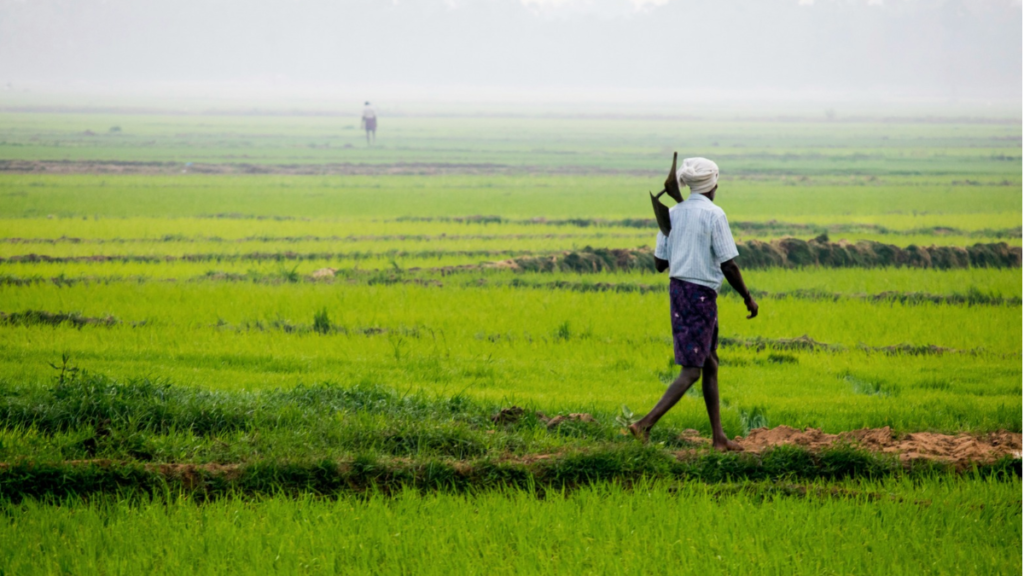
A farmer walking in a paddy field at early morning.Image credit:Pexels
These subsidies help farmers manage production costs and are politically significant, especially when input prices rise. The government continues to rely on them to maintain affordability and support agricultural production.
The scale of fertiliser assistance illustrates this dependence. On November 11, 2026, the Union Cabinet approved a nutrient-based subsidy allocation of ₹62,370 crore for phosphatic and potassic fertilisers for the October 2026–March 2027 winter cropping season. The allocation was approximately 64% higher than that for the previous winter season, reflecting pressures from international fertiliser prices and supply disruptions.
But input subsidies are not a substitute for investments that improve productivity over the long term. The OECD recommends gradually reducing inefficient fertiliser, electricity and irrigation-water subsidies and redirecting resources towards agricultural research, education, rural infrastructure, financial services, sustainable input use and climate resilience.
The distinction is important. Subsidising electricity or water consumption can provide immediate relief, but poorly designed subsidies may also encourage excessive use of resources. A transition towards more efficient support would need to protect small and vulnerable farmers while reducing incentives for wasteful consumption.
The environmental cost of agricultural growth
India’s productivity gains have also come with mounting pressure on natural resources. The OECD records an increase in the country’s nitrogen balance from 90.7 kg per hectare in 2000 to 133.4 kg per hectare in 2024. The phosphorus balance rose from 20.8 to 28.1 kg per hectare over the same period.
These indicators measure the difference between nutrients entering agricultural systems and those removed through harvested crops and other processes. Persistent surpluses can indicate inefficient fertiliser use and increase the risk of nutrient pollution in soil and water.
The report links rising fertiliser use and agricultural output to growing pressure on land and water resources. It argues that support policies should encourage more sustainable production rather than simply increase the volume of inputs used.
This is particularly relevant for India, where irrigation, fertiliser affordability and electricity subsidies are closely connected to agricultural production. Reforming these systems without adequate alternatives could increase costs for farmers. The challenge is therefore to improve efficiency without shifting the burden of transition onto those with the least capacity to absorb it.
Rethinking agricultural policy
The OECD recommends making agricultural trade more predictable by limiting ad hoc export restrictions and extending the Agricultural Export Policy framework to more products. It also calls for domestic marketing reforms that allow farmers and traders to respond more effectively to market demand.
Its broader recommendation is to shift public spending away from measures that distort production and trade towards investments in productivity, sustainability and resilience. Research, extension services, infrastructure and digital skills are identified as areas requiring greater attention.
The Economic Survey 2025–26 also identifies fragmented landholdings, limited access to irrigation and quality inputs, low mechanisation and insufficient investment as continuing constraints on Indian agriculture. It points to initiatives in agricultural extension, digital agriculture, farmer-producer organisations and market infrastructure as part of the policy response.
The OECD’s assessment should not be read as an argument against all subsidies or government intervention. Price stabilisation and food security remain important objectives in a country where millions of households depend on affordable food. But the report highlights the limitations of a system that supports farmers through input subsidies while simultaneously using market and trade controls that can depress the value of their produce.
The central policy question is no longer simply how much the government spends on agriculture, but whether that spending improves farmers’ capacity to earn, invest and adapt. For India, a more durable agricultural support system will require aligning price policy, market access, public investment and environmental sustainability rather than treating them as separate concerns.

Challenge AI on Climate Science, and It May Abandon the Facts

India Records 436 Extreme Weather Events in 30 Years, Loss of 170 billion USD

Woxsen University Ranks 12th Globally in MBA Entrepreneurship Ranking, Fourth in Startup Launches

IIT Delhi Returns to Global Top 200 in QS Sustainability Rankings 2027; 38 Indian Universities Improve

India’s Clean-Energy Transition: Will It Replace Oil Dependence With Mineral Dependence?

Indian universities lead Asia in research output per faculty, but the country’s top six all slip in QS ranking

Why Delhi’s Geography Makes It Vulnerable to Severe Air Pollution

Europe Braces for Extremes as Commission Unveils Climate Resilience Framework

NASA recruits new astronauts for future Moon Base and Mars missions

Between Lectures and Lyrics: Kabeer Is Building a Malayalam Hip-Hop Career One Self-Taught Skill at a Time
-

 Math4 months ago
The 2026 Fields Medals: Four Proofs, Four Decades-Old Problems Solved
-
EP Deep Dive: Data & Solutions4 months ago
After Kerala’s Deadliest Landslide, the Hardest Thing to Rebuild Was Childhood
-
EP Deep Dive: Data & Solutions4 months ago
West Asia Crisis: Can Kerala’s Returning Gulf Migrants Find a Future in the Green Economy?
-
Space & Physics6 months ago
India Semiconductor Mission: ‘It’s Not About Fabs. It’s About Building An Entire Ecosystem’
-
Interviews2 months ago
From Scams to Screens: How the National Stock Exchange Rewrote India’s Equity Story
-
Climate & Environment6 months ago
The Climate World Cup? How Climate Change Could Affect Player Performance at the 2026 World Cup
-
Society4 months ago
What Is Civilisational Diplomacy? Understanding India’s Newest Foreign Policy Tool
-
Society5 months ago
From Bell Labs to the Classroom: A Second Career in Teaching