
Biodiversity
96% of the World’s Coral Reef Ecosystems Face Collapse Risk by 2075, IUCN Warns
A global IUCN assessment finds that 122 of 127 shallow-water coral reef regions face a critical risk of collapse by 2075, with rising ocean temperatures posing the greatest threat.

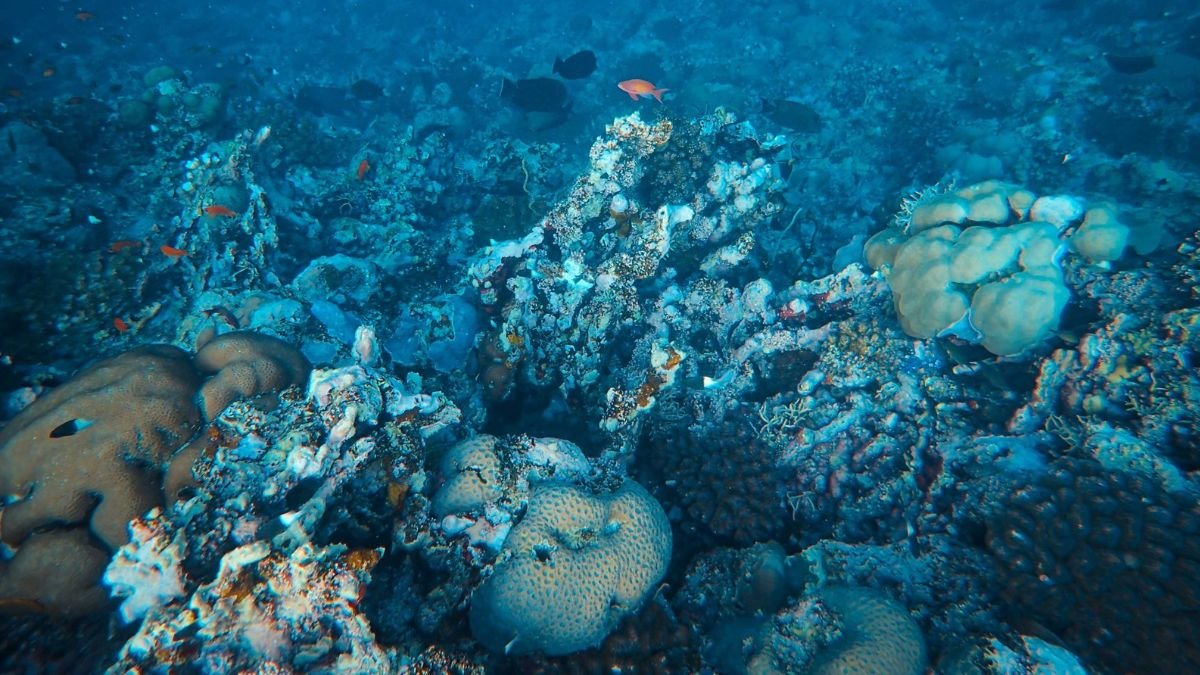
Coral reefs can recover from bleaching and rebuild after damage, but repeated marine heatwaves are giving them less time to recover. A new global assessment by the International Union for Conservation of Nature (IUCN) warns that 122 of the 127 shallow-water coral reef regions studied face a critical risk of collapse by 2075.
Published on October 22, 2026, the assessment is the first global study of coral reefs under the IUCN Red List of Ecosystems. It covers 188,362 square kilometres of reefs across tropical and subtropical waters in more than 80 countries and territories.
The finding that 96% of the assessed ecosystems are Critically Endangered does not mean that nearly all the world’s coral reefs have already died. It means they face a very high risk of losing the natural features and processes that allow them to function. The outcome will depend partly on future global warming and how well other threats to reefs are managed.
Heat Stress Leaves Corals Less Time to Recover
Corals live alongside tiny algae that provide much of their food through photosynthesis. When seawater becomes too warm, corals expel these algae and turn white. This process is called coral bleaching. If the heat continues, corals can lose their main source of energy and die.
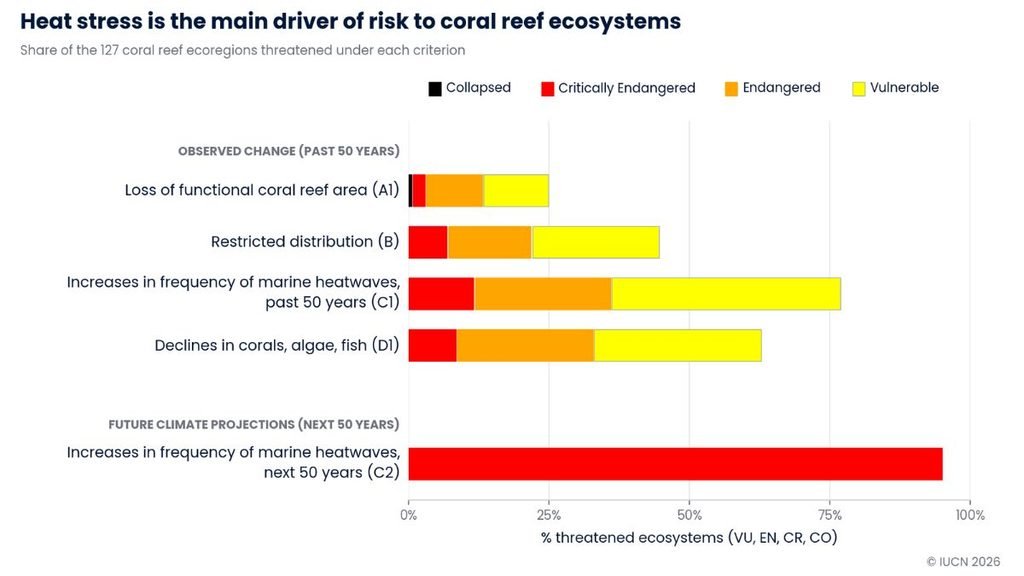
Bleaching does not always mean a coral is dead. If the water cools in time, corals can recover and regain their algae. However, when marine heatwaves occur repeatedly, corals may not have enough time to recover between events. The IUCN assessment found that marine heat stress had threatened 77% of the reef regions studied over the past 50 years. Under the future warming scenario used in the study, heat stress alone puts 95% of the assessed ecosystems in the Critically Endangered category.
The projections are based on an intermediate emissions pathway under which global temperatures rise by about 2.7°C above pre-industrial levels by the end of this century. The year 2075 is therefore part of a risk projection, not a deadline by which all threatened reefs will disappear.
What Does Coral Reef Collapse Mean?
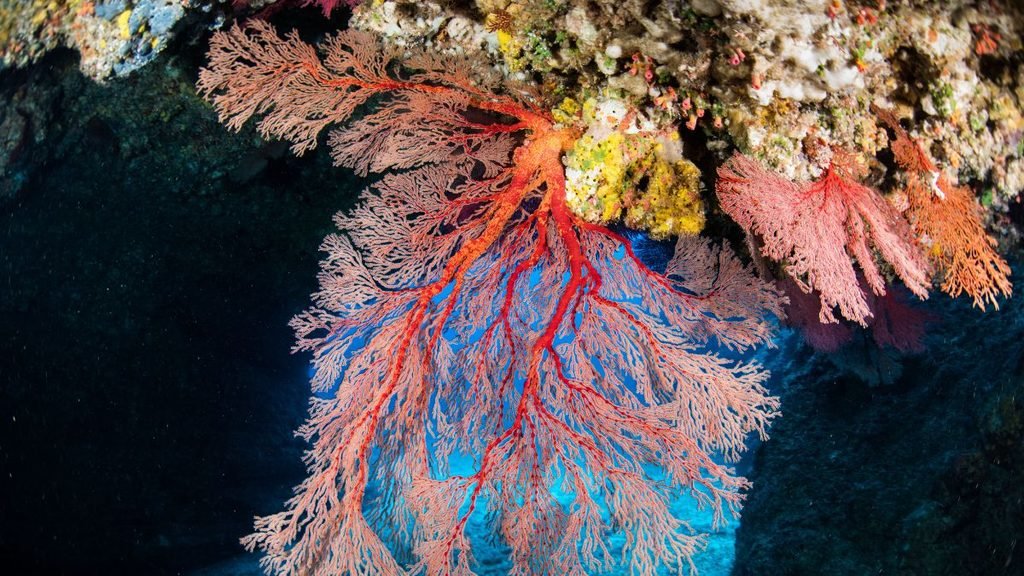
A coral reef is much more than a group of living corals. It provides shelter, feeding grounds and breeding areas for many marine species. Reef-building corals also create the hard structures that support this underwater habitat.
“Corals carry a deep evolutionary record of coping with environmental change, yet the reef ecosystems we see today are remarkably young, shaped over only the last 5,000 to 7,000 years of stable climate. Ocean warming is now outpacing anything in their history, and recurring heatwaves are causing mass bleaching faster than reefs can recover or adapt,” said Marcos Valderrábano, Programme Manager at IUCN, Red List of Ecosystems.
When coral populations decline severely, the reef can change. Algae, broken coral pieces and sponges may become more common, leaving less suitable habitat for many of the species that once lived there. This is what scientists mean by ecosystem collapse. It does not necessarily mean that every living organism in the area has died.
The assessment identifies a reef region in the western Galápagos Islands as already collapsed following the severe El Niño event of 1982–83. This shows how extreme heat can damage an entire reef system, although the effects and chances of recovery vary between locations.
Local Pressures Add to the Threat
Climate change is the main concern, but human activities also affect how well reefs withstand and recover from damage. The IUCN assessment found that overfishing and the depletion of important fish populations threaten 63% of the reef regions studied.
Some fish, including parrotfish, feed on algae that compete with corals for space. When their numbers fall, algae can spread over damaged reefs and make it harder for young corals to grow. Pollution, sediment flowing into coastal waters and poorly managed development can add further pressure.
These threats need different solutions. Better fisheries management and cleaner coastal waters cannot prevent marine heatwaves caused by global warming. However, reducing these local pressures can improve the chances of coral recovery when sea temperatures return to suitable levels.
Why Coral Reef Loss Matters to Humans
Coral reefs support marine life, provide food and income, attract tourists and help protect coastlines from waves. Fisheries in reef areas support local food supplies and jobs, while tourism businesses depend on healthy marine environments.
The hard structures formed by corals also reduce wave energy before it reaches the shore. As reefs deteriorate, coastal communities may face declining fish catches, losses in tourism income and greater exposure to coastal erosion and wave damage. The extent of these effects depends on local conditions and how strongly people rely on reef resources.
These risks are particularly important for island nations and countries with large reef systems. In India, coral reefs are found in the Gulf of Mannar, the Gulf of Kachchh, the Andaman and Nicobar Islands, and Lakshadweep. Their health is important for marine biodiversity and the communities that depend on these waters.
However, the global finding that 96% of assessed reef ecosystems face a critical risk of collapse cannot be applied directly to Indian reefs. A separate regional assessment would be needed to establish the level of risk in India.
The assessment also compares reef conditions over the past 50 years with projections that include future climate change. Based on changes observed over the past five decades, 24% of the assessed reef ecosystems would fall into the Critically Endangered category. When projected climate warming is included, that share rises to 96%.
This difference shows how strongly the future of coral reefs depends on the amount of warming the world allows. Many of the assessed reefs still have living corals, and some have shown a greater ability to withstand heat stress than others. This offers opportunities for conservation, although past resilience does not guarantee survival under continued warming.
Reducing greenhouse gas emissions is essential to limit the heat stress reefs face. Protecting fish populations, controlling pollution and managing coastal development can also reduce the pressures that make recovery harder. The IUCN assessment warns that almost all the reef ecosystems studied face a high risk of collapse under the projected conditions. How much of that risk becomes reality will depend largely on future global warming and the steps taken to protect these ecosystems.









Biodiversity
Project Cheetah: A Young Big Cat Killed by Gunfire Outside Kuno National Park
The death of a 19-month-old cheetah from firearm pellet injuries outside Kuno National Park raises fresh questions about wildlife protection under Project Cheetah, which began in September 2022.

Biodiversity
COP17: Can the World Still Meet Its Biodiversity Goals by 2030?
COP17 in Armenia will assess progress towards global biodiversity targets for 2030, focusing on ecosystem protection, conservation finance, harmful subsidies and equitable benefit-sharing.
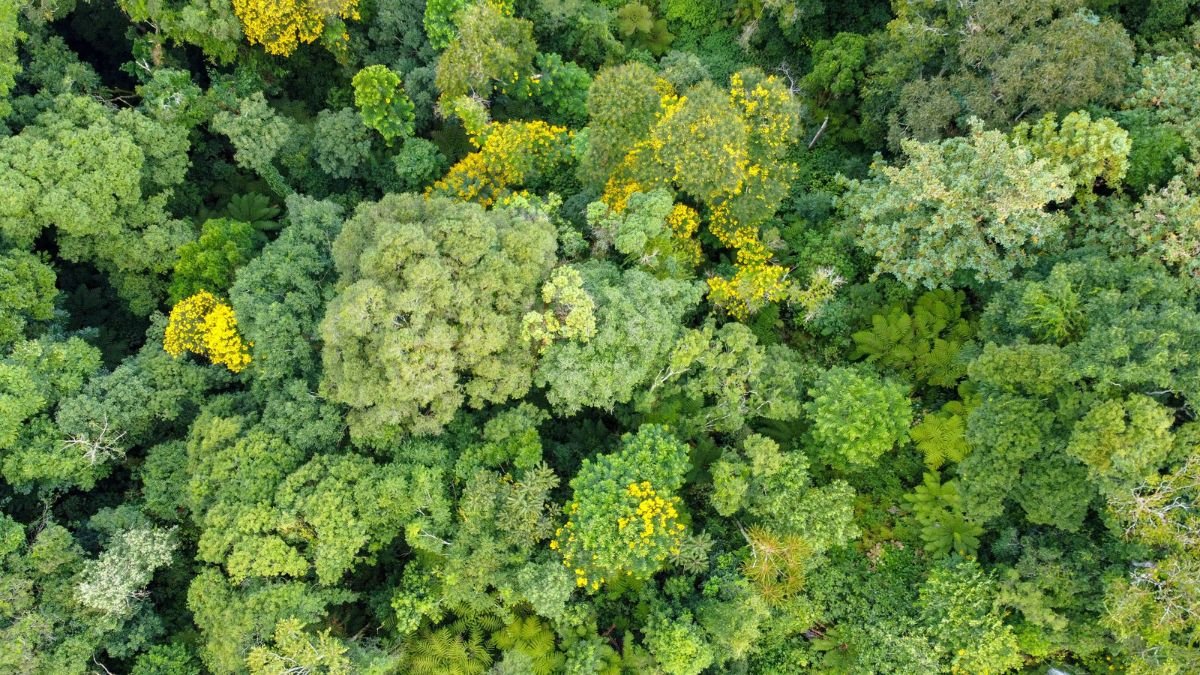
As governments prepare for the first global assessment of progress under the Kunming-Montreal Global Biodiversity Framework, financing shortfalls, harmful subsidies and uneven implementation threaten to undermine commitments to protect nature. The world has four years left to meet its 2030 biodiversity targets. Yet, as governments prepare to gather in Yerevan, Armenia, the distance between their commitments and the action required to fulfil them remains substantial.
The 17th Conference of the Parties to the Convention on Biological Diversity (COP17), scheduled for October 19–30, will bring governments, scientists, Indigenous Peoples, civil society organisations and businesses together for the first global review of collective progress under the Kunming-Montreal Global Biodiversity Framework. Adopted in December 2022, the framework established an international plan to halt and reverse biodiversity loss through four overarching goals and 23 targets. The Convention on Biological Diversity’s official COP17 identifies the meeting as a critical opportunity to assess implementation and determine where additional action is needed.
Governments have agreed on the scale of the biodiversity crisis and outlined measures to address it. The harder task is to translate those commitments into protected habitats, restored ecosystems, reformed economic incentives and reliable funding. COP17 will test whether countries can accelerate that work before the 2030 deadline.
Global Framework Under Pressure
The Kunming-Montreal Global Biodiversity Framework established several measurable ambitions. These include conserving at least 30% of terrestrial and inland water areas and 30% of marine and coastal areas by 2030, restoring 30% of degraded ecosystems, mobilising at least 200 billion dollars annually for biodiversity from all sources, and identifying and eliminating or reforming incentives harmful to biodiversity worth at least 500 billion dollars annually.
The framework also calls for increased international biodiversity finance, including 30 billion dollars annually in international financial flows to developing countries by 2030. Its provisions cover the sustainable use of biodiversity, equitable sharing of benefits arising from genetic resources, and the integration of nature into decisions made across government and economic sectors.
These targets recognise that conservation cannot be confined to isolated protected areas. Agricultural production, infrastructure development, financial decisions, trade and consumption all influence the condition of ecosystems. The first global review will examine collective progress using national reports, national biodiversity strategies and action plans, and other relevant information. Its findings should help governments identify where implementation is lagging and what changes are needed.
The challenge is already visible in conservation projections. A Reuters report published on October 14 found that current commitments were projected to protect 27% of land and inland waters by 2030, compared with approximately 20% at present. Marine protection was projected to rise from 10% to just 12%. These figures indicate that existing commitments fall short of the 30% targets, particularly for marine ecosystems.
Nature Loss is an Economic Problem
Biodiversity decline is frequently discussed through the disappearance of species and the destruction of habitats. Its consequences extend into food production, water availability, employment and economic stability. The explainer supplied for this article cites a 2024 assessment that found monitored wildlife populations across more than 5,500 species had declined by 73% between 1970 and 2020. It also reports that 460 million hectares of forest are degraded, an area larger than the combined territory of the European Union’s 27 member states.
Wetlands have suffered substantial losses, too. According to the same source, 35% of the world’s wetlands have disappeared since 1970, while a quarter of those remaining are degraded. It also reports that 56% of assessed mangrove ecosystems across 34 provinces are at risk of collapse. These figures describe damage to ecological systems that sustain human livelihoods. Small-scale fisheries, which depend heavily on healthy coastal habitats, account for 40% of the global catch and support the livelihoods of approximately one in every 12 people worldwide, according to the supplied explainer.
Forest loss can also affect rainfall patterns, with implications for farmers who depend on predictable seasonal water supplies. Wetland degradation reduces the natural functions these ecosystems perform, while the destruction of mangroves removes habitats that support fisheries and coastal communities.
The economic consequences are therefore not confined to conservation budgets. Damage to ecosystems can undermine agricultural productivity, disrupt supply chains and increase the vulnerability of communities already exposed to environmental stress. For COP17, the implications are direct: biodiversity policy must account for the economic decisions that accelerate ecological decline, rather than treating conservation as a separate environmental concern.
The Subsidy Contradiction
One of the most consequential issues facing negotiators is the continued flow of money towards activities that damage nature. The framework calls for governments to identify and eliminate, phase out or reform incentives harmful to biodiversity, reducing them by at least 500 billion dollars annually by 2030. Yet a Reuters report published on October 12 cited estimates that approximately 2.6 trillion dollars is channelled each year into incentives that harm ecosystems. The report also noted that only 5% of governments had fully addressed the relevant target.
This creates a fundamental contradiction in public policy. Governments may allocate funds to conservation while other subsidies encourage activities associated with habitat destruction, unsustainable resource extraction or environmentally damaging production. Reforming these incentives requires more than announcing a reduction target. Governments must identify which subsidies cause harm, examine who benefits from them and establish alternatives that do not shift the economic burden onto vulnerable communities.
Agriculture, fisheries, energy and infrastructure can all involve competing economic and environmental priorities. Abruptly withdrawing support without considering livelihoods can create additional hardship. Reform therefore requires transparent assessments, appropriate safeguards and credible alternatives for affected workers and producers.
COP17 is expected to examine how finance ministers can be brought more directly into this process. The objective is to align economic incentives with biodiversity commitments, so that public spending does not continue to undermine the goals governments have endorsed.
The Unresolved Question of Biodiversity Finance
Meeting the global targets will require sustained funding for conservation, restoration, monitoring and implementation. The framework’s annual biodiversity finance ambition of 200 billion dollars encompasses resources from public and private sources, domestic and international funding, and other financial channels.
Within this total, international financial flows to developing countries are expected to reach 30 billion dollars annually by 2030. Establishing the target was a significant step, but governments must still determine how to mobilise the required resources and ensure that they reach the places and communities where conservation is needed.
Developing countries face competing demands on public expenditure, including debt servicing, infrastructure, health and education. Biodiversity commitments can become difficult to implement when governments lack fiscal room to fund them. The negotiations are expected to consider interim milestones for international public finance and ways to address the links between debt burdens and biodiversity loss. Such measures could help make funding commitments more concrete, although their effectiveness will depend on the terms agreed and the resources actually delivered.
The management of biodiversity finance is another concern. Governments agreed at COP16 to review where biodiversity funding is held and how it is governed. COP17 is expected to consider initial options arising from that process. The distinction between announced finance and money available for implementation matters. Funding targets have little practical value if they do not translate into resources that conservation agencies, local governments and communities can access.
Can the Cali Fund deliver equitable benefits?
Another issue concerns the use of digital sequence information derived from genetic resources. Genetic information obtained from plants, animals and microorganisms can support research and commercial development in fields such as pharmaceuticals, biotechnology and agriculture. Digital sequence information allows researchers and companies to use genetic data without necessarily handling the original biological material.
The resulting benefits raise questions about fairness. Countries and communities that conserve biodiversity may not receive a proportionate share of the value generated from genetic information derived from their biological resources. At COP16, governments established the Cali Fund to help address this issue. Under the arrangement described in the supplied explainer, companies in sectors benefiting from digital sequence information are expected to contribute to the fund under specified conditions.
However, the mechanism has struggled to attract contributions. A scientific editorial published in Nature Reviews Biodiversity on October 13 reported that the fund had received only $6,000 against a target of 1 billion dollars annually. The editorial identified limited awareness and unresolved implementation details as obstacles to wider participation.
COP17 will need to address the practical barriers preventing the fund from fulfilling its intended purpose. Clearer rules, incentives and potentially regulatory measures could help establish a functioning system for benefit-sharing.
The issue extends beyond revenue. Equitable benefit-sharing is also connected to the rights of Indigenous Peoples and local communities whose knowledge and stewardship contribute to biodiversity conservation. A system that recognises the commercial value of genetic resources without adequately addressing these interests would leave a central part of the framework unfulfilled.
Indigenous Knowledge and Community Rights
The framework recognises that biodiversity protection depends on the participation of people who live in and manage ecosystems. Indigenous Peoples and local communities hold knowledge about species, landscapes and ecological practices that can contribute to conservation and sustainable resource use.
Yet recognition in an international agreement does not automatically translate into influence over decisions on the ground. The supplied COP17 explainer identifies human rights, Indigenous knowledge and community participation as areas requiring greater attention across the framework’s targets. It also notes that COP16 established a subsidiary body concerned with Indigenous Peoples’ knowledge, innovations and practices.
The task now is to ensure that these commitments shape implementation. This includes meaningful participation in decisions, respect for rights and the fair distribution of benefits arising from biodiversity and its use. Community participation should not be measured simply by the number of consultations held. Its value depends on whether people can influence decisions affecting their territories, livelihoods and knowledge.
Test of Implementation
COP17’s first global review will provide governments with an opportunity to examine the collective record against the commitments made in Montreal. Its significance will depend on what countries do with that assessment. A credible outcome would identify implementation gaps, establish clearer milestones and strengthen accountability for finance and policy reform. It would also address the contradiction between spending on conservation and the much larger financial flows that continue to harm ecosystems.
The remaining four years will require action across national governments, financial institutions, businesses and local communities. Protected areas must be supported by effective management; restoration must produce ecological gains; and biodiversity finance must become accessible and dependable.
The framework already sets out the broad direction. COP17 must determine whether countries are prepared to change the policies, budgets and economic incentives that stand in its way. By 2030, the measure of success will not be the number of declarations adopted at international meetings. It will be whether ecosystems are recovering, species and habitats are better protected, and the people whose lives depend on nature have stronger reasons and greater capacity to sustain it.
Biodiversity
Chandigarh’s Sukhna Wetland Gets Ramsar Recognition, Taking India’s Count to 103
Chandigarh’s Sukhna Wetland has received Ramsar recognition, taking India’s total to 103 internationally important wetlands and renewing focus on urban wetland conservation.

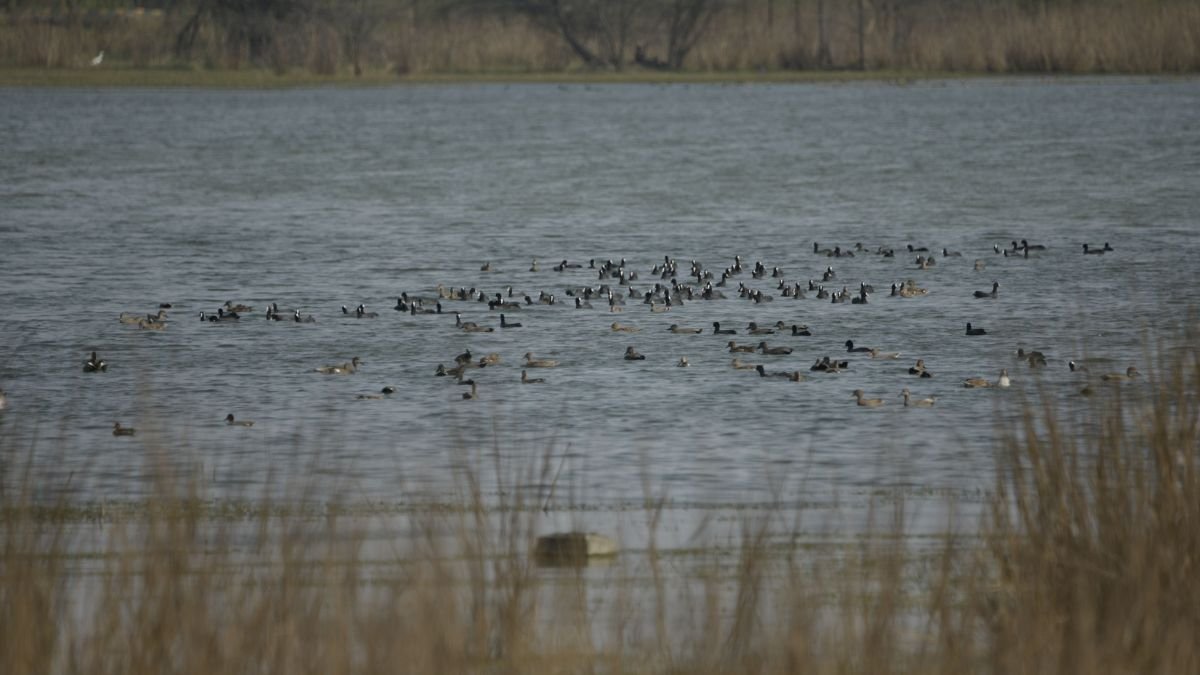
Chandigarh’s Sukhna Wetland, an urban wetland ecosystem centred on Sukhna Lake, has been designated a Ramsar site, bringing greater international attention to its ecological importance and the need to protect its habitats.
Union Environment Minister Bhupender Yadav announced the designation on Thursday, naming Sukhna Wetland in Chandigarh and Sheelaj in Uttar Pradesh among India’s latest additions to the list of internationally important wetlands. The announcement brings India’s Ramsar site count to 103, according to the minister’s post on X.
The Ramsar Convention is an intergovernmental treaty adopted in 1971 to promote the conservation and sustainable use of wetlands. Sites are recognised for their ecological significance, including their role in supporting biodiversity and maintaining essential environmental processes.
Why Sukhna Wetland Matters
Sukhna Lake, an artificial reservoir created in 1958, is a prominent landmark in Chandigarh. The associated wetland ecosystem extends beyond the open water to include habitats shaped by seasonal water levels, vegetation and the interaction between land and water. The Ramsar designation applies to the officially identified wetland site, rather than automatically covering every area surrounding the lake.
Wetlands provide benefits that extend well beyond their role as wildlife habitats. Depending on their characteristics and condition, they can absorb excess rainfall, help regulate water flows, recharge groundwater and trap sediments. They also support aquatic organisms and provide feeding, breeding and resting grounds for birds.
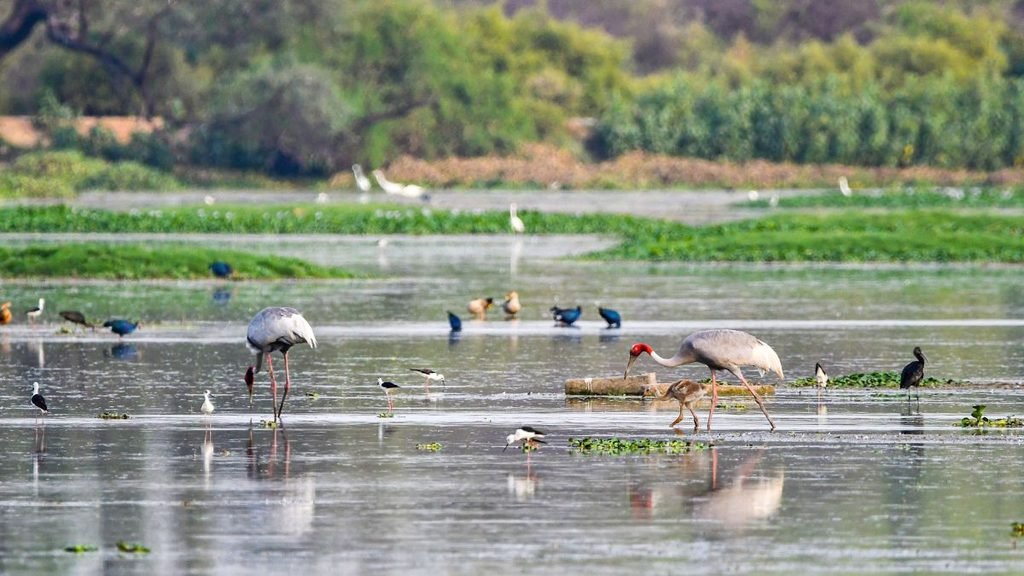
These functions are particularly important in urban areas, where construction, land-use changes and pressure on water resources can degrade natural ecosystems. Wetlands may also face threats from pollution, waste accumulation, encroachment and changes in water inflows.
International recognition can strengthen the case for conservation and encourage more systematic monitoring. However, Ramsar status does not by itself eliminate these pressures. The long-term benefits depend on effective management and enforcement of conservation measures.
India’s Expanding Ramsar Network
India’s wetlands range from high-altitude lakes and inland floodplains to coastal lagoons, mangroves and marshes. These ecosystems sustain diverse plant and animal communities while contributing to water regulation and local livelihoods.
The addition of Sukhna Wetland and Sheelaj expands the country’s internationally recognised wetland network. The designation also draws attention to the need to maintain the ecological character of these sites through regular assessments of water quality, habitat protection and responsible land and water management.
For Chandigarh, the recognition offers an opportunity to strengthen the protection of an important urban ecosystem. Preserving Sukhna Wetland will require sustained attention to the health of the lake, its surrounding habitats and the environmental pressures affecting them. The designation establishes international recognition; effective conservation will determine whether that recognition translates into lasting ecological benefits.


96% of the World’s Coral Reef Ecosystems Face Collapse Risk by 2075, IUCN Warns

India’s Electronics Boom Masks a Deeper Dependence on Semiconductor Imports

Project Cheetah: A Young Big Cat Killed by Gunfire Outside Kuno National Park

Cyclone Arnab Makes Landfall in Andhra Pradesh, Uproots Trees and Disrupts Power Supply

Indian-Belgian Team Develops Portable Detectors to Image Mountains and Monuments Using Cosmic Rays

Knowing When to Think for Ourselves: AI, Intuition and the Education of Discernment

After a Scorching Summer, Delhi’s Children Are Slow to Return Outdoors

Two Chemists Win Nobel Prize for Solving a Century-Old Puzzle: Why Life Picks One Hand Over the Other

Marshall Islands: Why the US Nuclear Legacy Is Back Before the UN

How Wind Turbines Could Produce More Power From the Same Wind

-

 Math3 months ago
The 2026 Fields Medals: Four Proofs, Four Decades-Old Problems Solved
-
EP Deep Dive: Data & Solutions3 months ago
After Kerala’s Deadliest Landslide, the Hardest Thing to Rebuild Was Childhood
-
EP Deep Dive: Data & Solutions4 months ago
West Asia Crisis: Can Kerala’s Returning Gulf Migrants Find a Future in the Green Economy?
-
Space & Physics5 months ago
India Semiconductor Mission: ‘It’s Not About Fabs. It’s About Building An Entire Ecosystem’
-
Interviews1 month ago
From Scams to Screens: How the National Stock Exchange Rewrote India’s Equity Story
-
Climate5 months ago
The Climate World Cup? How Climate Change Could Affect Player Performance at the 2026 World Cup
-
Society4 months ago
What Is Civilisational Diplomacy? Understanding India’s Newest Foreign Policy Tool
-
Society4 months ago
From Bell Labs to the Classroom: A Second Career in Teaching