EP Deep Dive: Data & Solutions
West Asia Crisis: Can Kerala’s Returning Gulf Migrants Find a Future in the Green Economy?
Kerala Gulf migrants face growing uncertainty as the West Asia crisis threatens livelihoods. Can green jobs, reskilling and climate investments provide a sustainable future?


Up to 12 million Indian livelihoods are at risk from the West Asia crisis — Kerala alone accounts for 1.5 to 2 million of them. In the state most built on Gulf money, the jobs coming next don’t match the jobs going away. India’s most literate state is testing whether reskilling, entrepreneurship support and a reimagined green economy can catch its returning workers before they fall through.
When Cinil, who grew up in the hill district of Idukki, boarded his flight home from the Gulf earlier this year, no one had handed him a termination letter. He read the signs instead. For years he had worked in automobile advertising, chasing campaigns for car dealerships across the region — steady, unglamorous work that had financed a life back in Kerala. Then the campaigns got smaller. Clients cut budgets. Contracts that used to renew themselves simply stopped renewing. As the West Asia crisis deepened around him, Cinil made a calculation that hundreds of thousands of Keralites are now quietly making too: better to leave on your own terms than wait to be pushed.
Kerala Gulf Migrants Face an Uncertain Future
For others, there was no such choice to make. “Around 300 to 350 people lost their jobs in a single company in the hospitality sector,” says Baheej, from Kozhikode, a coastal district in Kerala, who has worked in the Gulf for many years. “That means 300 to 350 families were pushed into uncertainty almost overnight.” As tourist arrivals and travel activity declined amid the ongoing crisis, hospitality workers were among the first to feel it. Businesses cut costs to survive, and layoffs followed.
Lijesh’s story, from Malappuram, is a quieter kind of uncertainty. A driver, he has been sent home by his employer on a month of forced leave. He hasn’t told his own family that the leave is compulsory — his two daughters, both still in school, don’t know. “There is a lot of uncertainty,” he tells EdPublica.
Even those still employed are living with a different kind of strain. Workers in oil and gas facilities, particularly refineries, worry that escalating tensions could put critical energy infrastructure at risk. For many, simply reporting to work has become a source of anxiety.
“The ongoing West Asia crisis has affected almost every industry to varying degrees. However, the sectors most significantly impacted in terms of employment and business continuity are Oil & Gas, Construction, Hospitality, Facility Management, Aviation, Logistics, Manufacturing, Shipping and related service industries. The greatest challenges are supply chain disruptions, rising energy costs, project delays and reduced business activity,” said Suresh Kumar Madhusudhanan, a Mumbai-based veteran of the global human resource industry and Managing Director of Seagull International, to EdPublica.
Yet the picture isn’t uniformly bleak — at least not yet, and not for everyone. Net remittances from the region to India rose to $16 billion this April, the second month of the conflict, up 70% over the same period last year, according to data presented by the Union Finance Ministry in its latest report. Cinil’s story and Baheej’s exist alongside that number, not despite it: money is still flowing home even as jobs disappear, a lag that officials and economists are watching closely for signs of how long it can hold.
What Happens to Kerala?
For more than five decades, migration to the Gulf has shaped Kerala’s economy. In districts such as Malappuram — Lijesh’s home district — Kozhikode, where Baheej is from, and Thrissur, remittances have financed homes, education, healthcare and small businesses, woven into the fabric of everyday life rather than sitting apart from it. Idukki, where Cinil is from, has historically sent far fewer workers to the Gulf than the state’s traditional migration belt along the coast — a sign that the crisis’s reach is not confined to the districts usually associated with it.
According to the Kerala Migration Survey (KMS) 2023, the state received ₹2.17 lakh crore in inward remittances that year, with 80.5% of its emigrants living in Gulf Cooperation Council (GCC) countries.
A new study by IPE Global, an international development consultancy, puts a number on the exposure this creates. The West Asia crisis could put 10 to 12 million livelihoods across India at risk, the report estimates. Kerala alone accounts for 1.5 to 2 million of them — behind Uttar Pradesh (3.5 to 4 million) and Bihar (2 to 2.5 million), but still among the states most exposed. (The report’s estimates are built from a triangulated synthesis of migration and remittance data from the Ministry of External Affairs and the RBI, cross-referenced with state-wise sectoral employment patterns, rather than new primary surveys — a methodology the authors say reflects genuine uncertainty in how the crisis will actually unfold.)
“The movement of migrants has always remained relatively steady. Every year, around 2.5 to 3 lakh Keralites migrate to GCC countries, while nearly 1.5 lakh return. We saw similar situations during the 1990 Gulf War, the 2008 global financial crisis, the return of workers from Saudi Arabia following labour reforms in 2013, and again during the COVID-19 pandemic. Our system is seasoned and proven to manage such situations,” said Ajith Kolassery, former CEO of Norka Roots, the Kerala government agency tasked with the welfare and rehabilitation of the state’s Non-Resident Keralites.
“Kerala’s heavy dependence on the Gulf makes it particularly vulnerable. A prolonged West Asia crisis could reduce overseas jobs, cut remittances and bring more expatriates back home, putting additional pressure on the state’s economy. Kerala must respond by diversifying overseas employment, strengthening skills, creating more jobs at home and promoting entrepreneurship,” Madhusudhanan said.
The Green Transition Offers Hope
The IPE Global report argues that the crisis presents an opening to accelerate India’s green transition — and that the money to do it largely already exists inside the government’s own scheme architecture. By converging existing programmes such as PM-KUSUM (India’s mega solar initiative that turns farmers from energy consumers into energy producers by subsidizing solar pumps and rural solar power plants), the National Green Hydrogen Mission, Production Linked Incentive (PLI) schemes and the Carbon Credit Trading Scheme, the report estimates India could unlock USD 42–53 billion (₹4–5 lakh crore) without new outlay.
If implemented effectively, the report projects these initiatives could generate 35 million green jobs by 2047 and contribute to a USD 15 trillion green economy by 2070, spread across agriculture, renewable energy and industry:
- Agriculture: Reframing PM-KUSUM as a “Farmer-as-Energy-Producer” programme — letting farmers sell surplus solar power back to the grid — could create 15 lakh (1.5 million) jobs on its own, add 50,000 MW of agri-solar capacity, raise farmers’ annual incomes by ₹25,000 to ₹40,000, and cut roughly 70 million tonnes of CO2 equivalent a year. The agriculture sector as a whole is projected to generate 6 to 7 million jobs.
- Energy: Hitting India’s 500 GW renewable energy target could generate 3.4 million jobs, while the National Green Hydrogen Mission — backed by up to ₹8 lakh crore in mobilised investment — could add another 1.5 to 2 million, for 5 to 8 million jobs sector-wide.
- Industry: A proposed National Green Steel Mission, decarbonising India’s 140-million-tonne steel sector, could help preserve the country’s USD 8 billion steel export market from EU carbon border tariffs (CBAM) while avoiding 55 million tonnes of CO2e annually. Alongside a Green Transformation Mission for India’s 63 million MSMEs, the industrial sector’s job potential runs past 20 million.
Abinash Mohanty, Head of the Climate Change and Sustainability Practice at IPE Global and the study’s lead author, frames the numbers starkly: with 85% of India’s crude oil imported and 10 to 12 million livelihoods exposed to a single geopolitical shock, he says, “the fragility is real. But so is the opportunity.”
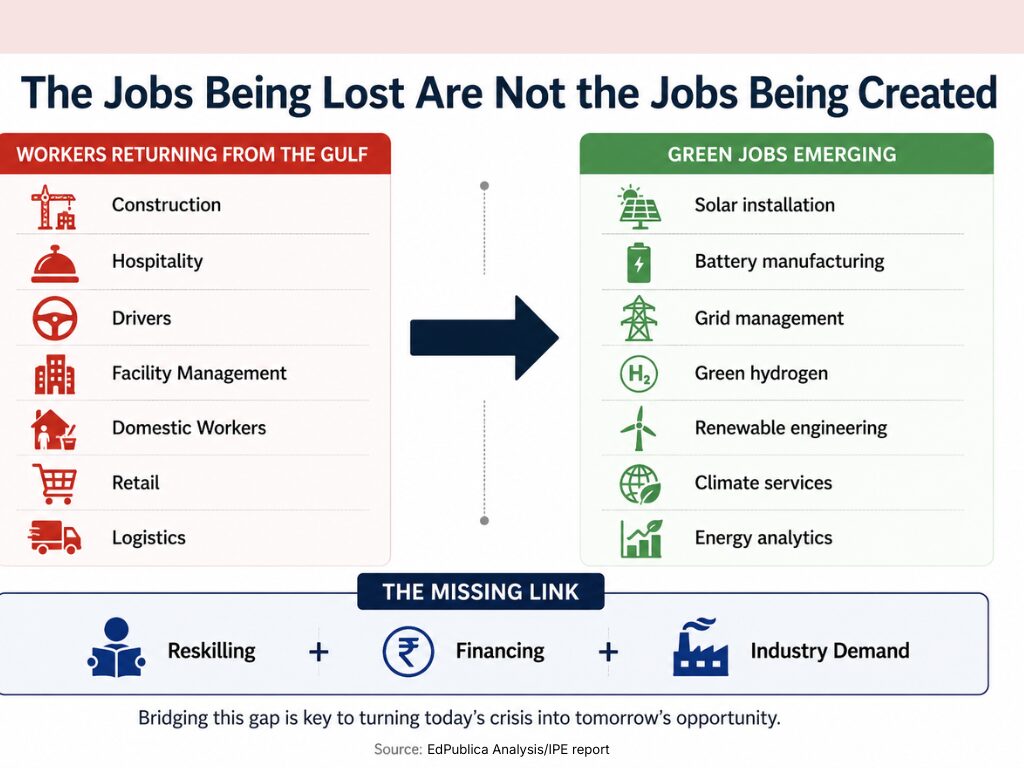
The scale is real too — but so is the catch. The jobs the report says are coming are not, for the most part, the jobs currently being lost.
The Jobs Being Lost Are Not the Jobs Being Created
The workers most vulnerable to the current crisis are largely construction workers, hospitality staff, drivers and domestic workers employed across the Gulf. The jobs driving India’s green transition require a very different skill set.
Solar installation, battery manufacturing, power systems, renewable supply chains and green hydrogen production demand technical qualifications that many returning Gulf migrants have never had the chance to acquire.
Green hydrogen illustrates the gap sharply. The report estimates the sector could create 1.5 to 2 million jobs, but these roles require expertise in electrochemistry, fuel cell technology and industrial-scale systems management. For someone who has spent years working in a hotel, on a construction site or in facility management, moving directly into these sectors is unlikely without substantial reskilling.
A Significant Geographic Mismatch
The mismatch isn’t just about skills — it’s about geography. Rajasthan has the potential to generate around 5 million green jobs by 2047 while facing only about 0.5 million livelihoods at risk from the West Asia crisis. Gujarat could generate 4.5 million green jobs against just 0.28 million at risk. Tamil Nadu’s exposure (roughly 1 to 1.2 million livelihoods at risk) is dwarfed by its green jobs potential of 3.5 million.
Kerala sits at the opposite end of that spread. Despite being among the states most exposed to the Gulf economy, its estimated green jobs potential is only around one million — roughly half its at-risk livelihoods.
The mismatch is rooted in geography and infrastructure. Rajasthan and Gujarat have abundant land, large renewable energy parks and heavy industrial investment. Kerala has limited land for utility-scale renewable projects and few openings for large-scale green manufacturing.
Kerala’s Gulf Paradox: When Prosperity Becomes a Liability
Abinash Mohanty, the study’s lead author, explained to EdPublica why Kerala stands apart from the other states examined in the report.
“There is a peculiar irony embedded in Kerala’s economic story,” he said. “For four decades, the desert sands of the Gulf have nourished the rice fields of Malabar, remittances flowing back to fund concrete houses, college fees, and gold jewellery, transforming the state’s social fabric in the process. Today, Kerala still draws nearly a fifth of India’s entire remittance pie, even as its Gulf-bound workforce has shrunk sharply over the past decade. It is a state living off the echo of a migration boom that has already peaked.”
“Herein lies the mismatch,” Mohanty continued. “The IPE Global study reveals that India’s green transition — its solar parks, hydrogen valleys, and battery gigafactories — is gravitating naturally towards Rajasthan’s deserts and Tamil Nadu’s coastlines, not Kerala’s backwaters. Kerala, like a seasoned sailor stranded as the tide recedes, finds itself with deep economic dependence but a comparatively shallow green jobs harbour to dock in.”
“The solution cannot be importing Rajasthan’s solar playbook wholesale,” he said. “Kerala must instead lean into what it already possesses: a highly literate, internationally exposed workforce. Its future lies not in manufacturing solar panels, but in becoming India’s hub for green services — climate fintech, renewable energy project management, marine and coastal resilience engineering, and the skilled re-export of its own returning diaspora as consultants to other Gulf-exposed states. Kerala’s comparative advantage was always human capital, not hectares of sunlight — and that, fortunately, travels well.”
A Different Transition for Kerala
For Kerala, the transition is unlikely to mirror Rajasthan’s or Gujarat’s. Instead, sectors such as the blue economy, sustainable fisheries, marine industries, eco-tourism and green services may offer opportunities better aligned with the state’s geography and workforce. Alongside these, returning migrants will need structured reskilling programmes that connect training directly to employment.
Even some of the report’s own recommendations run into Kerala-specific limits. The report proposes expanding PM-KUSUM so farmers can earn by selling surplus solar power to the grid — but eligibility under Component A generally requires 3–4 acres of land, clear ownership records and proximity to an electricity substation, conditions that are far harder to meet in a state of small, fragmented landholdings.
Kolassery believes Kerala should focus first on helping returning migrants find immediate livelihoods before chasing long-term structural change. “NORKA Roots has already demonstrated that this can be done,” he said, pointing to the NORKA Department Project for Returned Emigrants (NDPREM), which offers a 15% capital subsidy, a 3% interest subsidy for the first four years of timely loan repayment, and bank loans ranging from ₹1 lakh to ₹30 lakh, alongside entrepreneurship training and technical guidance through the Centre for Management Development.
“Our immediate priority should be short-term absorption. Kerala may not have the industrial advantages of larger states, but it has a knowledge-based economy and a workforce with international exposure,” he said. Rather than viewing returning migrants as a burden, he argues, Kerala should channel their experience into entrepreneurship and niche industries while courting new investment. “The Middle East’s investment landscape has shattered due to security concerns. This is the right time for India, especially Kerala, to position itself as a safe destination for investment. If we provide the right support, we can convert this challenge into an opportunity,” he said.
What’s Actually Working — and What Isn’t Yet
“The recommendations presented in the report demonstrate that climate action is not merely an environmental obligation — it is a pathway to economic transformation, energy sovereignty, livelihood security and long-term prosperity,” said Ashwajit Singh, Founder and Managing Director of IPE Global.
That pathway isn’t purely theoretical in Kerala. NDPREM, the state’s existing returnee-support scheme, already provides a working template — a 15% capital subsidy, a 3% interest subsidy for the first four years of timely repayment, loans up to ₹30 lakh, and hands-on entrepreneurship training through the Centre for Management Development. It is, in effect, a smaller-scale version of what the IPE Global report says the country needs at national scale: existing institutional capacity, redirected rather than rebuilt from scratch. Kolassery points to it as proof that Kerala doesn’t need to wait for green jobs to materialise before it starts absorbing returning workers — it can start now, with tools already in hand.
But the template has real limits, and they mirror the gaps in the national scheme architecture it’s modelled on. NDPREM works best for migrants with capital and a business idea already in mind; it does little for the hospitality and construction workers Baheej describes, who need wage employment, not a loan. And the state’s proposed long-term bet — blue economy jobs, sustainable fisheries, eco-tourism — remains mostly aspirational, without the scheme convergence or funding commitments that agriculture and energy have already secured nationally through PM-KUSUM and the Green Hydrogen Mission.
For Cinil, back in Kerala and weighing what comes next, the choice in front of him is a narrower version of the one facing policymakers: use what exists now, or wait for something better suited to arrive. What would close that gap, according to both the report and Kerala’s own migration officials, is not a single scheme but three things moving together — reskilling programmes that lead directly into named jobs rather than general training, financing that reaches wage-seekers as well as entrepreneurs, and faster investment in the blue-economy and green-services sectors the state is actually positioned to build. None of that requires new institutions to invent. It requires the ones already in place — NORKA Roots, PM-KUSUM, state industrial policy — to move at the speed the crisis demands. As opportunities in the Gulf grow more uncertain, the test for Kerala’s green transition won’t be how large the numbers get by 2047, but whether workers like Cinil find a next job before the wait becomes permanent.







EP Deep Dive: Data & Solutions
After a Scorching Summer, Delhi’s Children Are Slow to Return Outdoors
Extreme heat and children are the focus of this EdPublica report. Parents in Delhi and Noida explain how rising temperatures, air pollution and changing routines are keeping children indoors.

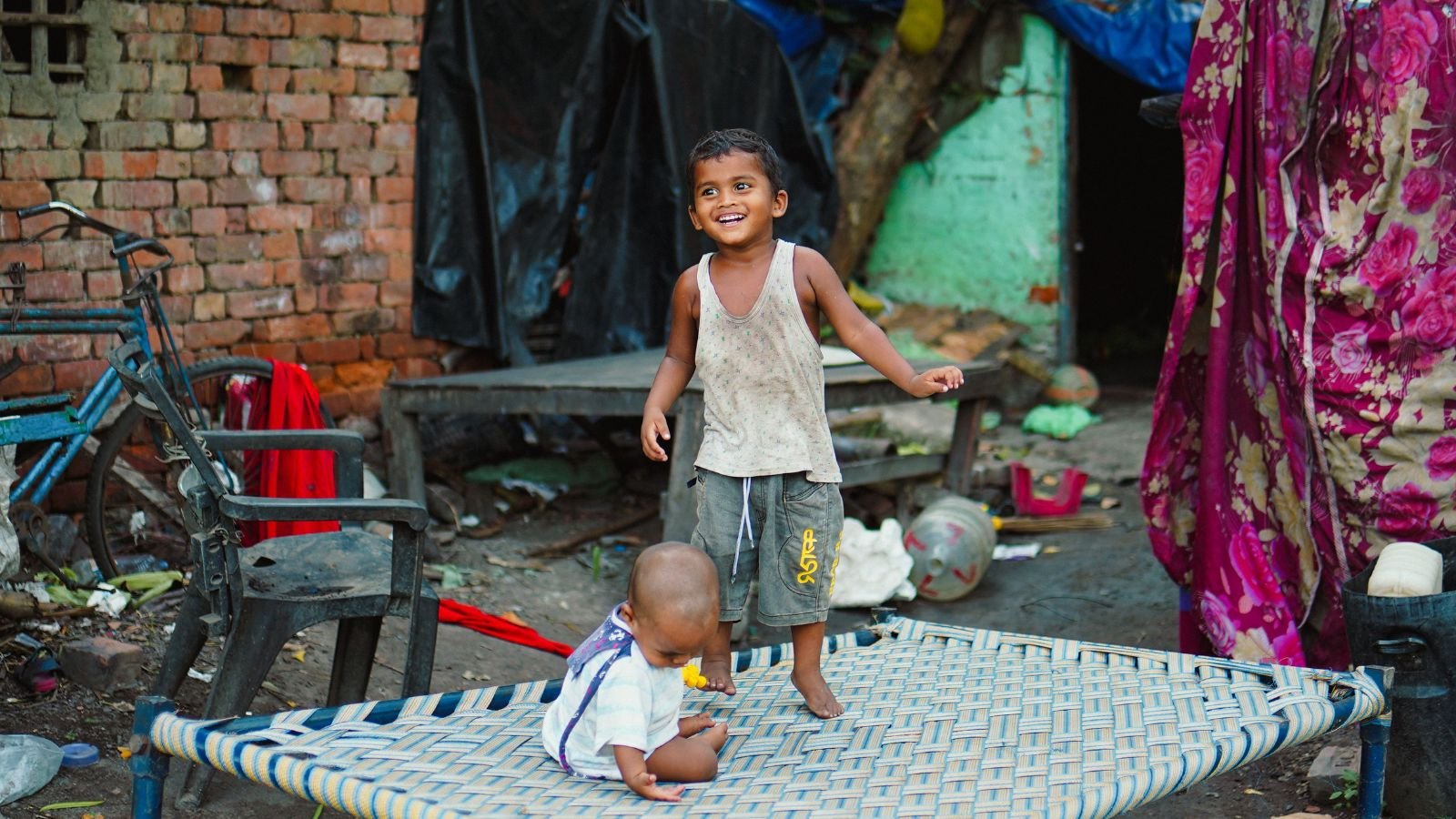
After months of extreme heat, Delhi’s children face another challenge: returning outdoors. Heat, air pollution and changing routines are reshaping how children play. EdPublica spoke to parents in Delhi to understand how extreme heat has changed their children’s play habits and what it might take to bring them back outdoors.
New Delhi: Mohini Bisht is a first-time mother. Her two-year-old son, Shomu (name changed), has just begun to string together his first words. Among the first he learned is “AC” (air conditioner). Living in the National Capital Territory, the family faces daytime temperatures that regularly reach between 42 and 45 degrees Celsius.
“Mummy, garmi lag rahi hai, AC chala do” (“Mummy, it’s hot, turn on the AC”), her son now says. He has learned to turn the AC on and off by himself. On especially humid days, he gets up and flicks the switch on his own.
In April, Delhi saw a maximum of 42.8 degrees Celsius, the hottest for that month in four years. In May, nighttime heat also broke records, with the minimum temperature hitting 32.4 degrees Celsius, the warmest May night in nearly 14 years, according to the India Meteorological Department (IMD).
In June, the heat index, or ‘feels-like’ temperature, soared to 51.3 degrees Celsius, the highest of the year. The heat index combines air temperature and relative humidity to show how hot it actually feels, not just what the thermometer shows.
“The whole day you’re just waiting for evening so you can go out,” Bisht said. As temperatures rose, she stopped taking her son out to play. “If the child gets dehydrated or faces issues, it becomes a big problem,” she said. Her parents and in-laws also advised her not to take him outside.
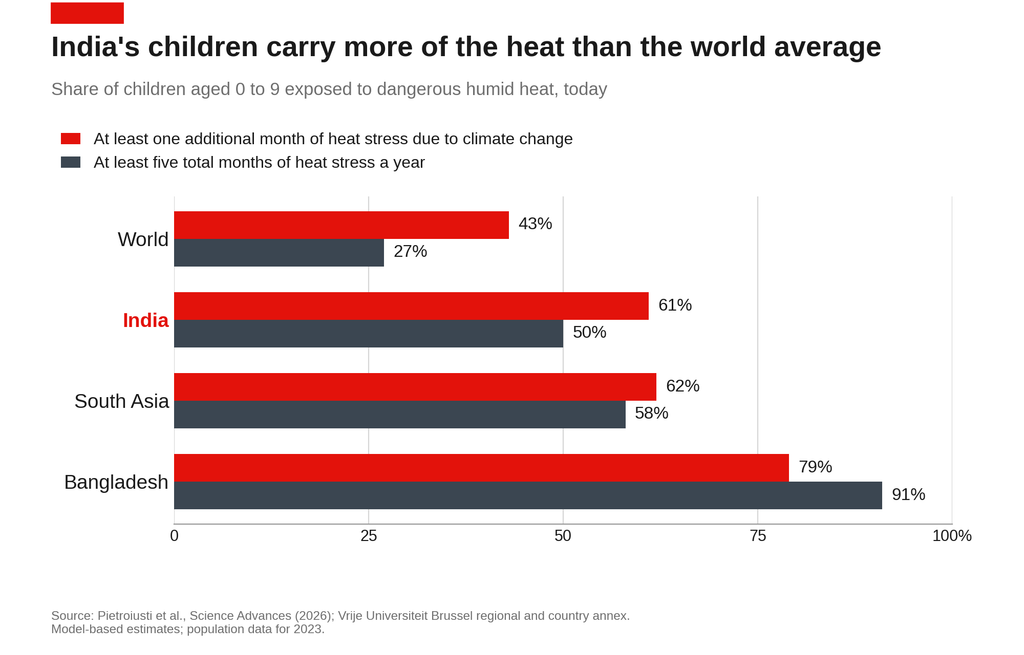
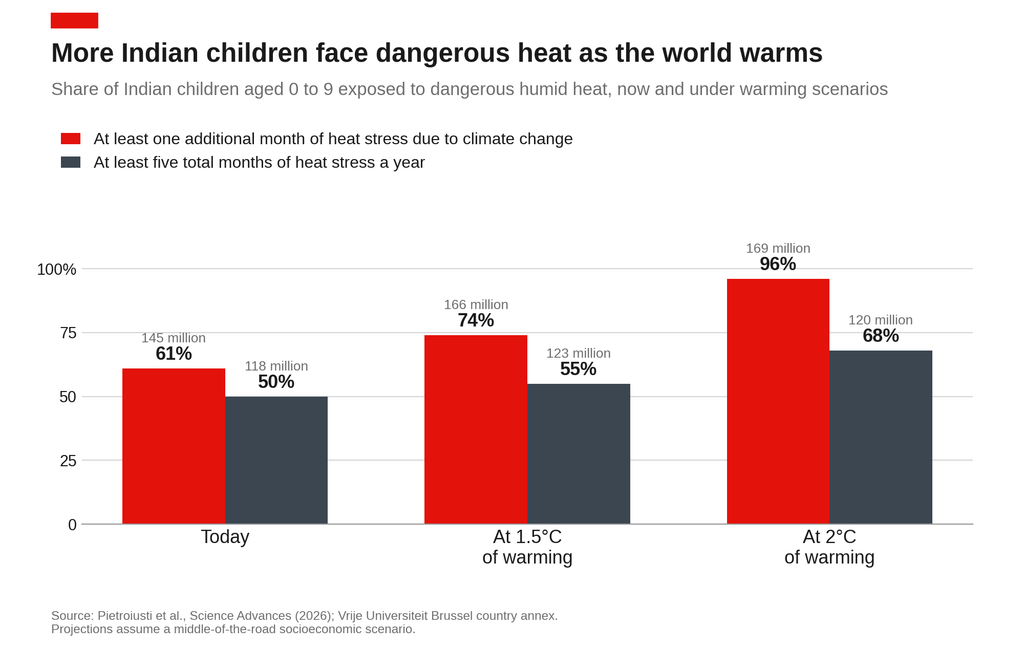
Her caution has a basis. India’s exposure is higher than the global average. Worldwide, up to 560 million children aged 0 to 9, or 43 per cent, live through at least one additional month of heat stress a year because of climate change. In India the share is 61 per cent. For five or more months of total heat stress, the Indian share is 50 per cent, against 27 per cent globally. South Asia is one of the regions with the most children exposed: about 167 million children, or 62 per cent, face an additional month, and in Bangladesh the share is 79 per cent.
Extreme Heat and Children: The Challenge of Outdoor Play
Nearly 145 million Indian children aged up to nine, or 61 per cent of that age group, live through at least one additional month of dangerous heat stress each year because of human-induced climate change, according to a study published in August in Science Advances by researchers led by Vrije Universiteit Brussel. The study estimates that climate change has doubled the number of Indian children facing five or more months of dangerous heat a year, from 59 million to 118 million. The authors note that children are especially vulnerable because their bodies heat up faster than adults’ and regulate temperature less efficiently.
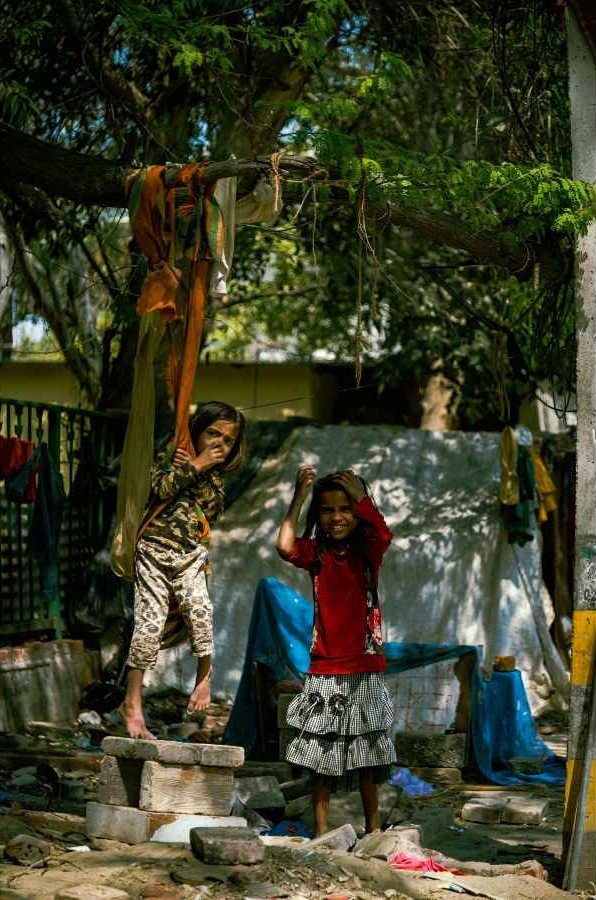
Even as early October brings daytime highs in Delhi that linger in the mid-30s, according to IMD forecasts, summer is retreating from most of north India, bringing the season’s first pleasant evenings. For many families, this raises the question: after months indoors due to oppressive heat, will children return outside?
The challenges don’t end with summer. “Apart from the heat, there is also poor air quality,” said Dr Himani Narula, a development paediatrician in New Delhi. Seasonal illnesses, too, play a role: “Sometimes there is a dengue season and other times there is a flu season.” Parents worry their children will pick up infections, making it hard to let them outside for long. “For all these reasons, children are ultimately at home, even when the weather improves,” she said.
The air is a genuine constraint, not just a parental worry. A 2021 study in Environmental Science and Pollution Research reported an almost 30 per cent rise in daily emergency visits for acute respiratory symptoms among Delhi’s children on high-pollution days. Last winter, the Delhi government suspended outdoor school activities in November and December after the Supreme Court warned against holding outdoor sports in hazardous air.
EdPublica spoke to seven parents from middle-class households in Noida-Delhi, all of whom said they have reorganised their days around the heat, moving their children’s playtime from evening to night to escape gruelling temperatures and humidity. They are not a representative sample, and EdPublica did not measure how much time children actually spend outdoors.
“Dinner is cooked first, then comes the outing, then a late meal and bed. The schedule has changed because of the heat,” said Sunita Kumar, a home tutor and mother of three, including a six-year-old.
Kumar, who lives in Mayur Vihar, New Delhi, worries the routine is changing children’s relationship with the outdoors. “Kids nowadays aren’t seeing the sun,” she said. “They go to school in the morning, stay inside all day, then go home. Even a one-hour tuition is indoors.” This habit, she fears, may outlast the weather. “Kids have built a habit without realising,” she said.
“Kids nowadays aren’t seeing the sun”
The pattern has research behind it. In a 2023 study in JAMA Pediatrics, researchers fitted preschoolers at a university childcare centre in Texas with activity monitors for a week. On hotter days, the children spent more of their outdoor play sedentary, about 70 per cent of it at 35 degrees Celsius against 62 per cent at 22 degrees, and less in moderate-to-vigorous activity, 21 per cent against 27 per cent. The sample was small and the temperatures were milder than Delhi’s summer, but the direction is clear. A 2022 review of more than 150 studies in the journal Temperature also warned that parents’ perception that it is “too hot to play” can further restrict children’s activity.
Moving play to cooler hours is, in fact, what heat-safety guidance advises, alongside hydration and shaded, green outdoor spaces. In that sense, the parents’ adaptation is sensible. The concern is what happens once the heat passes.
The human body and brain tend to acclimatise to repeated exposure of any kind, Dr Narula explained. Keeping children in air-conditioned rooms and away from natural weather, she said, can get their bodies used to the indoor environment and blunt their heat tolerance.
Direct evidence in children is scarce. A small study in Indoor Air compared 20 adults used to air-conditioned and naturally ventilated environments in a climate chamber, measuring skin temperature, sweat rate and thermal comfort. It concluded that long-term exposure to stable air-conditioned environments may weaken thermal adaptability. The study involved adults, not children, and does not show that air conditioning harms a child’s heat tolerance, but it makes Dr Narula’s concern plausible.
But temperature isn’t the only factor shaping how children respond to heat. Bisht notes that her son complains about the heat when alone with her, but behaves differently around friends. “If I bring him with friends or cousins, he plays on the balcony in the sun and enjoys it,” she says. “But if he’s alone with me, he voices his opinions.”
“Children’s tolerance for discomfort changes when other kids are around,” Dr Narula explained. “What the kid is saying is I will accept the discomfort of heat if it means I am enjoying time with peers.” The brain is adapting to these climatic challenges, and according to her, the child needs to get used to this conditioning.
Research on friendship and physical activity points the same way. A 2013 systematised review of friendship networks in the International Journal of Behavioral Nutrition and Physical Activity found that higher activity among friends is associated with higher activity in the individual, and longitudinal studies showed children’s activity shifting to match their friends’. Much of this work is observational, and it is hard to separate influence from children simply choosing similar friends. Still, it hints at what could bring children back outdoors: the company of other children. Parents often tell Dr Narula their kids stay home because there are few other children for them to play with.
Schools, where children already gather, are the obvious place to start, Dr Narula said. Before lessons begin, when the morning heat is lower, children could spend time in the open air, she said: sports, a prayer assembly, physical training, “any kind of activity which children can do with each other in a good setting.”
From toddlerhood through the teenage years, “children look for peers,” something that motivates them far more than being around parents, Dr Narula explained. The outdoors, she said, offers something indoor play cannot, and sunlight helps raise dopamine levels and, with them, mood.
The best-documented benefit of outdoor time in children is for eyesight. A 2024 meta-analysis in Ophthalmic Research found that children and adolescents with the most time outdoors had roughly half the risk of developing myopia of those with the least, and that risk fell as outdoor hours rose: going from 3.5 to 7 hours a week was linked with a 20 per cent lower risk. The leading explanation is that bright outdoor light prompts the retina to release dopamine, which slows the eye’s growth, though the mechanism is not fully settled. Outdoor time did not slow the progression of myopia in children who already had it.
The cooler weeks may be a short window. Whether children use it will depend less on the thermometer than on whether there is anyone outside to play with, and on how long the air stays clear enough to let them.
This article is written as part of the Media Fellowship under the Cities on Fire Initiative in Bangkok, Colombo, Jakarta and Manila and ‘Cooler Cities. Healthier Children. Brighter Futures.’ Initiative in New Delhi.
EP Deep Dive: Data & Solutions
Climate Change, Overfishing and the Uncertain Future of Bangladesh’s Hilsa Fishermen
EDPUBLICA GROUND REPORT: Climate change, overfishing and pollution are putting Bangladesh’s Hilsa fishery under pressure, threatening catches and fishermen’s livelihoods.

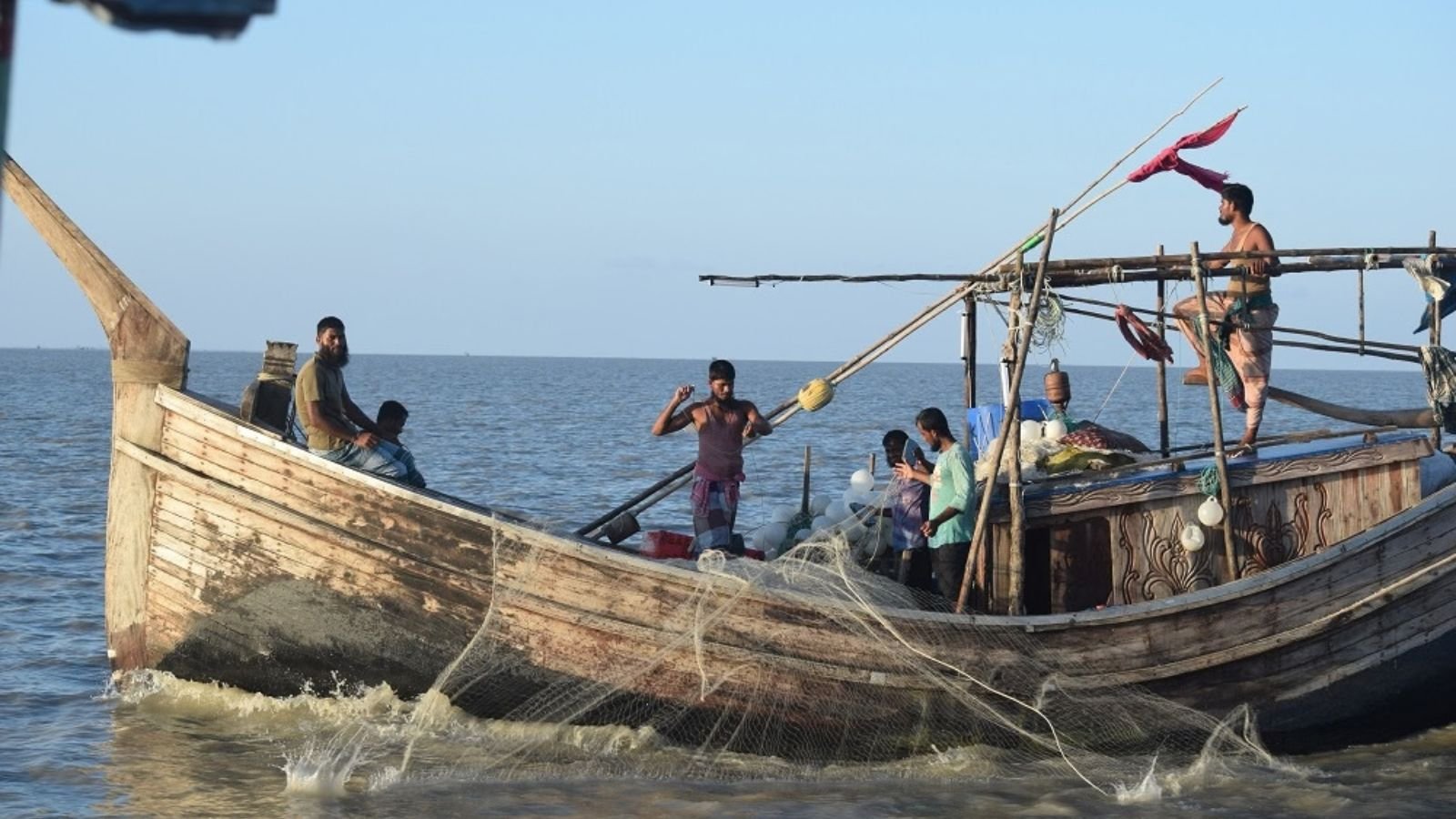
An EdPublica ground report from Bangladesh examines why the Hilsa catch has fallen after nearly two decades of growth, and what climate change and human pressures mean for the fishermen who depend on the fish.
DHALCHAR, Bhola, Bangladesh–At the fish landing centre, boats still come in one after another, and the crowd of fishermen on the shore grows with each arrival. But Ruhul Amin has stopped counting on what they carry.
“I can no longer support my family by catching Hilsa. I have been carrying the burden of debt for years. I wait for the Hilsa season every year with high hopes, but time and again, those hopes are dashed. There is no sign of Hilsa this year either, so I have to return home facing a loss.”
Ruhul Amin, 45, spoke these words amid the clamour of the fish landing centre on Dhalchar Island, situated along the banks of the Meghna River, one of the three principal rivers that form the vast Ganges Delta. Several other fishermen echoed his sentiments.
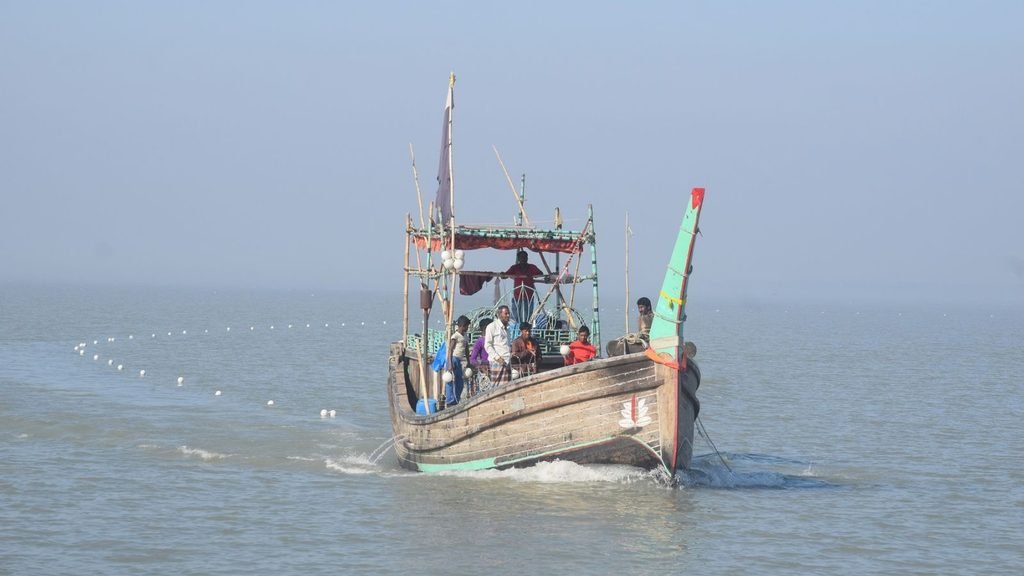
Dhalchar Island, located in the Meghna estuary, lies 100 kilometres from the Bhola district headquarters and 347 kilometres from the capital, Dhaka. Waves from the Meghna River crash against the island’s fish landing centre. The morning sun has just risen. Seagulls fly in flocks alongside the river waves. Boats dock one after another at the landing centre, and the crowd of fishermen grows. Yet, most of the boats arriving at the dock carry no Hilsa.
The area is bustling with activity—tea stalls, eateries, boat repair shops, and other establishments are crowded. However, there is a scarcity of the very fish—Hilsa—around which this landing centre was built. The fragile Dhalchar landing centre is shrinking due to river erosion, yet it remains a lifeline for the fishermen. Dhalchar Island remains quiet for most of the year but comes alive during the Hilsa season. Every year, thousands of fishermen gather here, filled with hope. It is not just Dhalchar Island; numerous fish landing centres along the coast of Bangladesh inspire similar hope among fishermen. About one million fishermen earn their livelihoods by catching Hilsa at these centres. Yet, they can no longer rely on Hilsa for their sustenance.
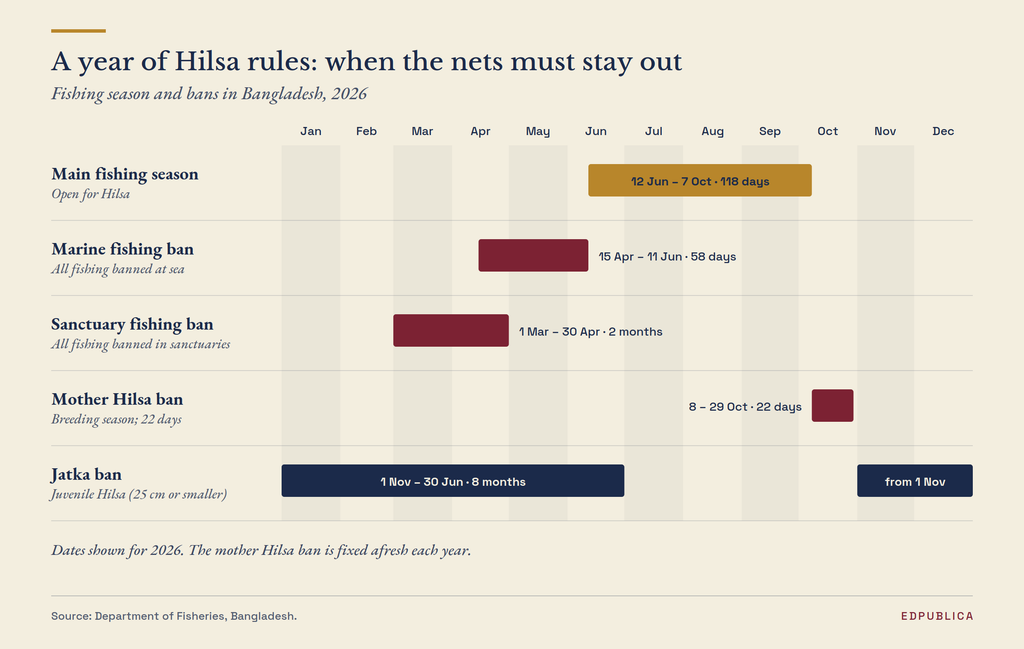
Ruhul Amin is one of those million fishermen. Amidst this despair and financial loss, the four-month-long Hilsa season is set to conclude on 7 October. The government has banned the catching, storing, transporting, and marketing of Hilsa for 22 days—from 8 October to 29 October—during the fish’s breeding season. Fishermen will once again have to wait until the following year for the Hilsa season.
“Fishing no longer sustains a livelihood”
Amidst the bustle and noise of the Dhalchar fish landing centre, Ruhul Amin voiced his frustration: “Every year, I’m forced to take out loans to go fishing with my boat and nets. I cast my nets during the Hilsa season with high hopes, but the catch is so meagre that it doesn’t even cover the operating costs. How am I supposed to repay the loans? How will I support my family? I may have to abandon this ancestral fishing profession; I can no longer bear the burden of debt.”
Bangladesh’s Hilsa Catch Is Falling After Two Decades of Growth
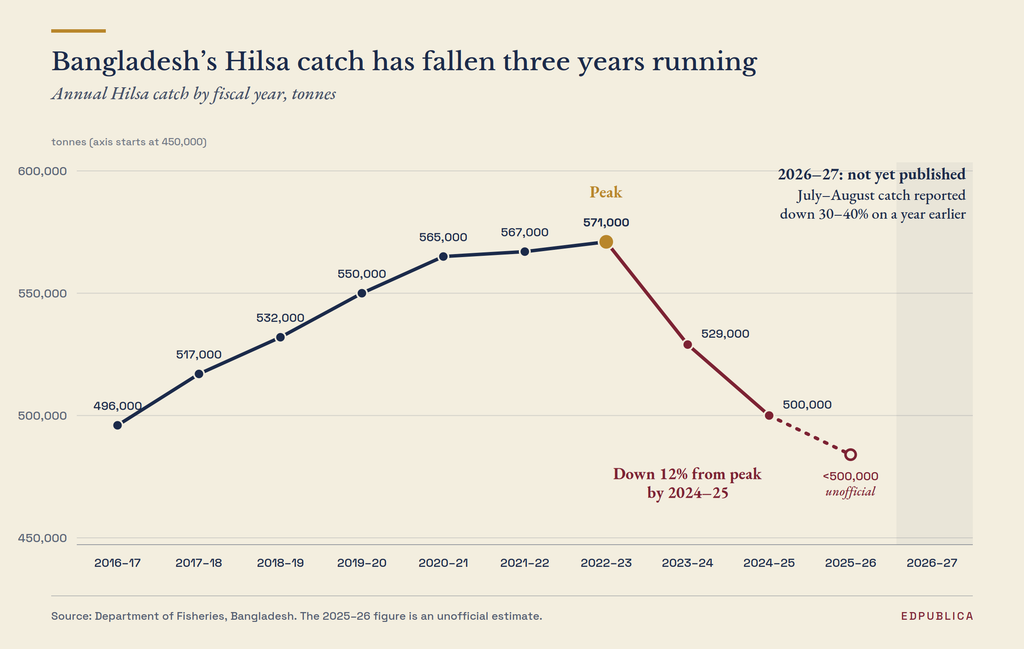
Even as the Hilsa season draws to a close, Ruhul Amin and many other fishermen have failed to recover their fishing expenses; they are ending the season at a loss. After nearly two decades of steady growth in Hilsa production in Bangladesh, the catch has fallen in each of the past three years. Simultaneously, the average weight of the fish is decreasing—a trend that has raised concerns among researchers.
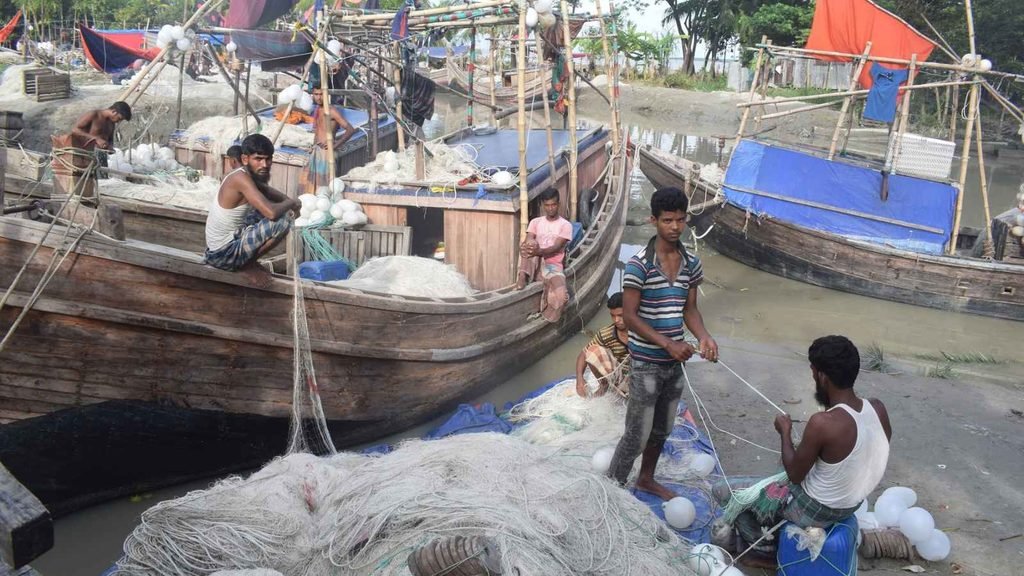
“Same nets, same boats, same rivers. Yet, the spots where we used to catch Hilsa in the past no longer yield any fish,” said Abdur Rob and several other fishermen from Kuakata on the Bangladeshi coast. They explained that as times change, they are encountering new crises while fishing at sea. Fishermen across most coastal districts—including Barguna, Patuakhali, Bhola, Bagerhat, and Lakshmipur—are grappling with professional crises. Climate change has impacted their lives and livelihoods, while natural disasters create obstacles to their fishing activities. Another group of fishermen believes that, beyond natural disasters, government-imposed seasonal fishing bans and various human-induced factors are hindering their profession.
According to records from the Bangladesh Department of Fisheries, the volume of Hilsa catch in Bangladesh began to rise in the 2016–17 fiscal year. That year, 496,000 tonnes of Hilsa were harvested within Bangladesh’s waters. In the 2017–18 fiscal year, the catch rose to 517,000 tonnes. The upward trend continued steadily until the 2022–23 fiscal year, when the harvest reached 571,000 tonnes. However, in the following year—2023–24—the catch volume suddenly dropped to 529,000 tonnes. It declined further to 500,000 tonnes in the 2024–25 fiscal year. Sources indicate that the Hilsa catch during July and August of the current year has fallen by 30–40% compared to the previous year.
According to data from WorldFish and the Department of Fisheries, Bangladesh accounts for roughly 70–86% of the world’s Hilsa catch. India lands about 10–15%, mainly in West Bengal, Odisha, and Gujarat, and Myanmar about 3–10%. The remainder is caught in the coastal rivers and seas of Pakistan, Iran, Iraq, Kuwait, Bahrain, Thailand, Malaysia, and Indonesia.
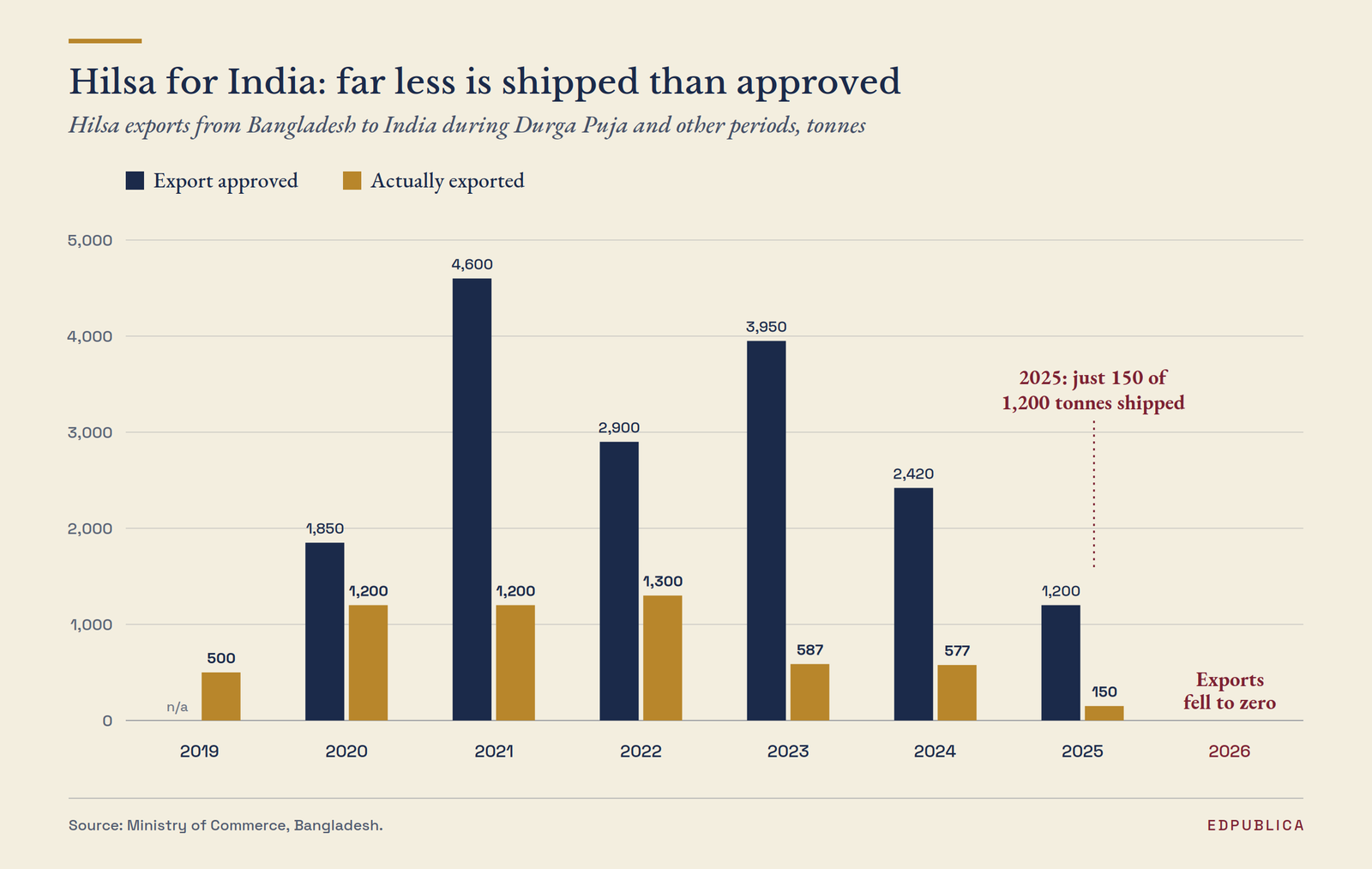
Since 2019, Bangladesh has exported Hilsa to India, particularly during Durga Puja and other occasions; this practice continued until last year. However, this year, the situation reversed, with India exporting Hilsa to Bangladesh.
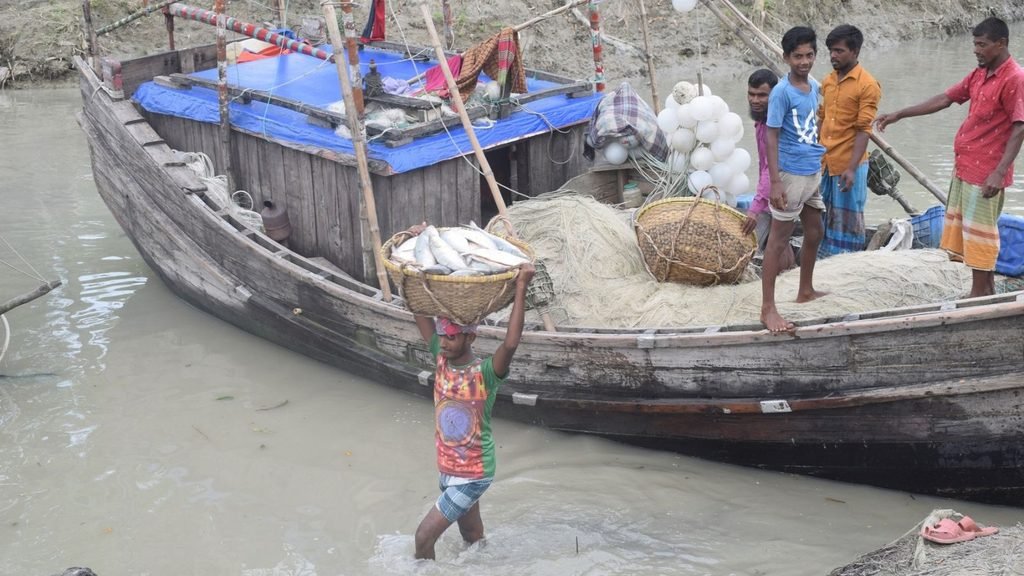
Climate change has created crises in various marine sectors, including the Hilsa fishery. As catch volumes decline, fishermen are facing new challenges. Scientists fear that marine risks will escalate in the future. A study titled “Climate Change as Observed in the Bay of Bengal” highlights the dangers posed to the marine environment by climate change. Another study by the World Bank also addresses the impact of climate change on fishermen at sea.
Hilsa Is Losing Its Favourable Habitat
Fishermen observe that coastal temperatures, rainfall patterns, and the nature of the monsoon season have all shifted. The timing of freshwater influx into rivers and coastal salinity levels are changing, as are marine environmental conditions. Collectively, these changes influence the migration and breeding cycles of the Hilsa fish. A specific combination of factors—including water temperature, salinity, currents, tides, water density, oxygen levels, and rainfall—is required to create the right conditions for Hilsa migration and spawning. However, the environment essential for the Hilsa has been significantly degraded.
Hilsa experts largely concur with these observations made by fishermen. Anisur Rahman, former Director of the Bangladesh Fisheries Research Institute (BFRI), states, “Hilsa require specific water currents and depths to migrate into inland waters. They need a water depth of at least 10 metres to navigate the rivers, but they are not finding it.”
In some areas, river depth has dropped to just 18–20 feet (about 5.5–6 metres)—far below the 75–80 feet (about 23–24 metres) required for Hilsa breeding. Furthermore, submerged shoals and sandbars have obstructed waterways between Chandpur and Monpura, leaving only narrow channels for navigation. Hilsa migrate from the sea to inland waters by swimming against the current; however, reduced river navigability and diminished water flow are hindering this migration. Hilsa from the Padma River are renowned for their superior taste, yet the fish are no longer entering the Padma in significant numbers.
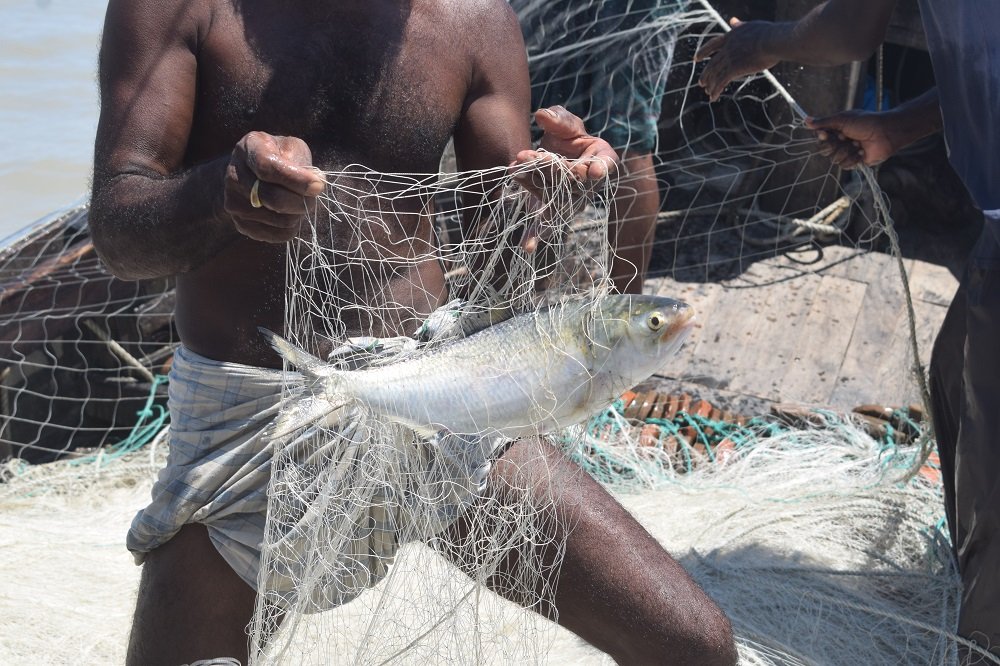
Hilsa production in Bangladesh—which had been steadily rising for two decades—is now declining. This has raised concerns regarding the survival of this popular fish and its affordability for ordinary people. Anisur Rahman has been conducting research on Hilsa for a long time. Expressing concern over the decline in Hilsa catches, he said, “I’m truly worried about the population or stock of Hilsa.”
“The fish’s food chain is being disrupted by falling water levels, rising temperatures, and changes in water quality. This balance is further destabilized by excessive heat and altered rainfall patterns caused by climate change,” added Anisur Rahman.
Dr Md Sajedul Haque, a professor in the Department of Fisheries Technology at Patuakhali Science and Technology University (PSTU), observed, “Hilsa catches used to be higher; now they are lower. This is a global problem. It is happening due to global warming.”
“If Hilsa does not find a suitable environment, it will neither stay there nor spawn. Factors such as water salinity, the availability of plankton for food, and water temperature are crucial for Hilsa. If salinity is too high, they will not spawn, or the eggs will fail to hatch and perish. Without food, they will not grow. If the temperature is not optimal, the eggs will not be fertilized, and the fry will not hatch. The Hilsa’s life cycle is directly linked to these factors,” added Sajedul Haque.
To a fisherman, climate change is not a PowerPoint presentation; it is a harsh reality and a matter of life and death.
Human-Induced Factors
Alongside climate change, human-induced factors are jeopardising the breeding of Hilsa fish. Local fishermen, trawler owners, and wholesalers engage in unregulated and illegal fishing practices. The number of illegal trawlers in the sea has multiplied significantly. Trawlers are essentially large wooden boats powered by high-capacity engines. They operate by dragging illegal ‘Behundi’ nets (bag nets) through the sea for hours using this engine power. These nets catch not only large fish but also small fish fry and juvenile Hilsa (Jatka), thereby destroying the primary breeding grounds of Hilsa and other marine species.
Three power plants are located within Hilsa sanctuaries along the Bangladeshi coast—the Payra Power Plant, the Patuakhali Power Plant on the banks of the Ramnabad Channel, and the Barishal Power Plant at Taltali on the banks of the Bishkhali River. Many have expressed concern regarding the pollution caused by these facilities. These coal-fired power plants discharge waste and heated water into the rivers. A decline in Hilsa populations has been observed since the establishment of these plants. Fishermen are no longer catching Hilsa in the Ramnabad River (Patuakhali district) and the Payra River (Barguna district) as they used to; consequently, many are turning to other professions.
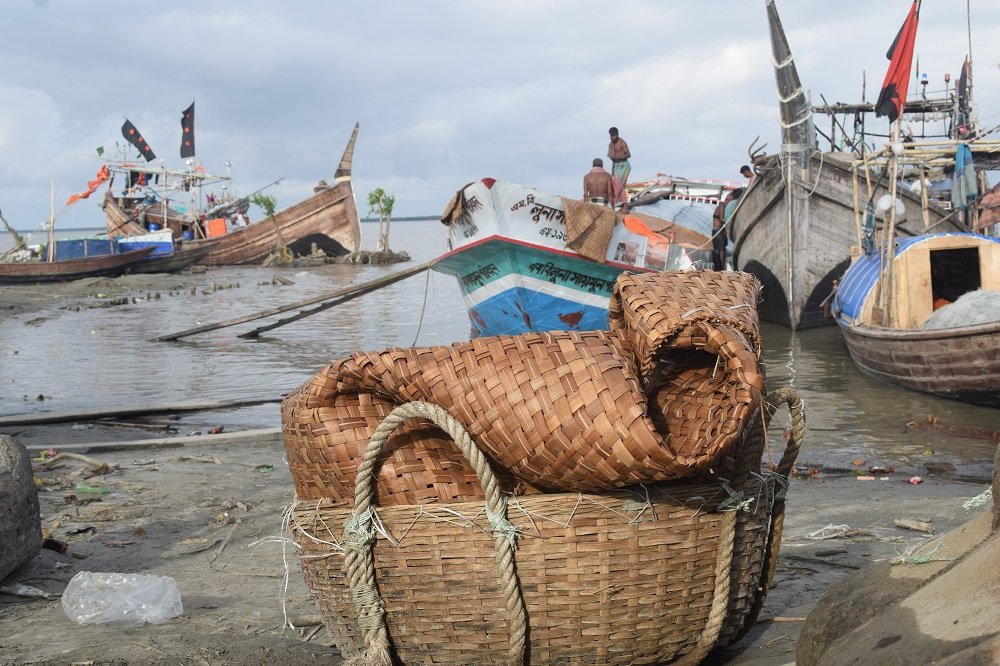
Fishermen Face Growing Risks at Sea
Fishermen report that while Hilsa exists in the deep sea, the fish are not migrating to shallower waters, as the environment there is no longer suitable for their survival. Small-scale fishermen face a dire crisis because the Hilsa do not venture into shallow waters, and many have already abandoned the trade. Those who remain in the profession are forced to venture into the deep sea to catch Hilsa, where they face increasing risks.
Every year, many fishermen go missing due to various natural hazards. The sea is becoming more turbulent than in the past, and the level of danger is rising. Nuruddin, a fisherman from Char Fasson in Bhola district, says, “I have been going out to sea to fish since childhood. I used to have no fear, but now venturing out to sea is frightening for us. I cannot say for certain if it is due to climate change, but the waves are rougher than before. We often face accidents because we do not receive weather warnings in time. I have personally been involved in accidents a few times; fortunately, I survived and returned.”
A study titled “Resilient Bangladesh: Fishermen Cope with Rough Seas” notes that for centuries, the fishermen’s traditional boats were sturdy enough to withstand conditions in the Bay of Bengal. That is no longer the case. Fishermen are increasingly facing more powerful storms and turbulent seas. Every time they head out to fish, they are essentially gambling with their lives.
Even as the risks for fishermen rise, fish stocks in the sea are declining, impacting their livelihoods. Despite this crisis, fishermen continue to struggle for survival. Research titled “Dwindling Coastal Fisheries Biodiversity of Bangladesh: The Causes and Effects” indicates that coastal fish stocks are being overexploited, leading to a depletion of many species. The marine sector’s contribution to the country’s fisheries is shrinking annually. According to assessments by the IUCN (International Union for Conservation of Nature), approximately 28% of coastal fish species now fall under the IUCN Red List of threatened species.
Golam Mostafa Chowdhury, President of the Barguna District Trawler Owners’ Association, states, “In most cases, fishermen go missing when their trawlers capsize. The sea has become rougher than before, and weather conditions have deteriorated. Siltation has occurred in many areas, and many fishermen fail to receive proper weather warnings. These factors are contributing to a rise in the number of missing fishermen. Rescue vessels need to be stationed in areas with high concentrations of fishermen, and arrangements must be made for the rehabilitation of those who go missing.”
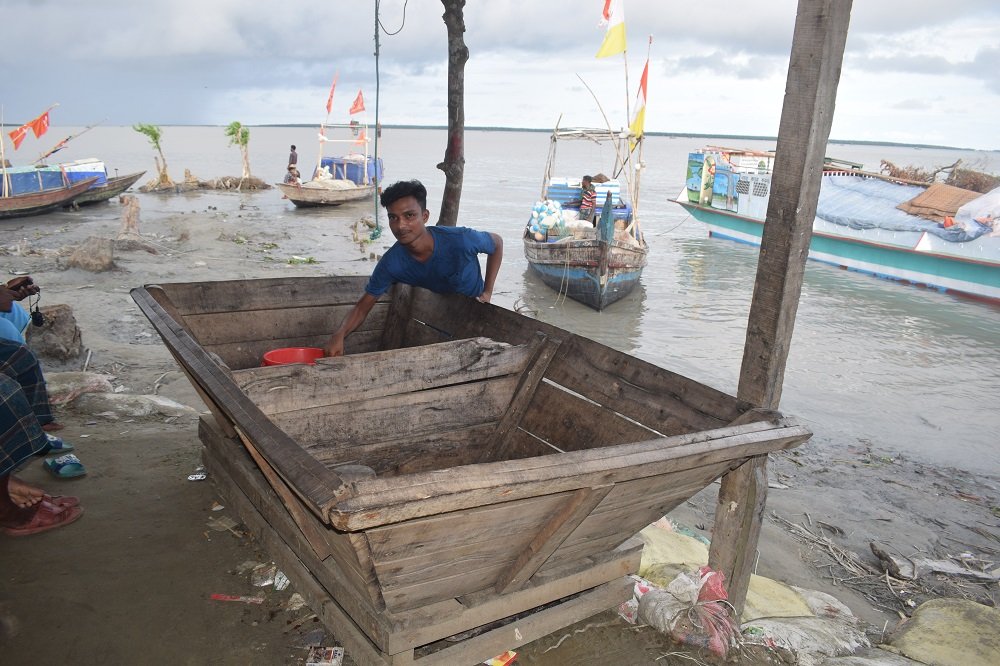
Initiatives to Protect Hilsa
The government is taking various measures to protect the Hilsa fish. Conservation and management activities for Hilsa in Bangladesh are conducted under the Protection and Conservation of Fish Act, 1985. A programme to protect Jatka (juvenile Hilsa) was launched in Bangladesh in 2003–04, leading to a gradual increase in Hilsa production. The Jatka conservation drive runs for two months—March and April—during which fishing of all kinds, including Hilsa, is prohibited in designated sanctuaries across the country. Additionally, fishing for all species, including Hilsa, is banned in marine waters for 58 days, from 15 April to 11 June. Initially, in 2008, the ban on catching mother Hilsa (Ma Hilsh) was set for 11 days, but from the following year onwards, this period was extended to 22 days. A ban on catching mother Hilsa is in effect from 8 October to 29 October this year. For two decades, the trend of Hilsa harvesting had been on the rise; however, research is currently underway to understand why the catch rate has recently begun to decline.
Ruhul Amin, a fisherman, is spending the final days of the Hilsa season at the Dhalchar fish landing centre. He might venture out to sea a few more times with other fishermen to catch Hilsa. Yet, amidst the crowds and grueling labor, a question weighs on his mind: will he be able to take home enough earnings to support his family for the coming months? Ruhul Amin does not know the answer—nor do many other fishermen.
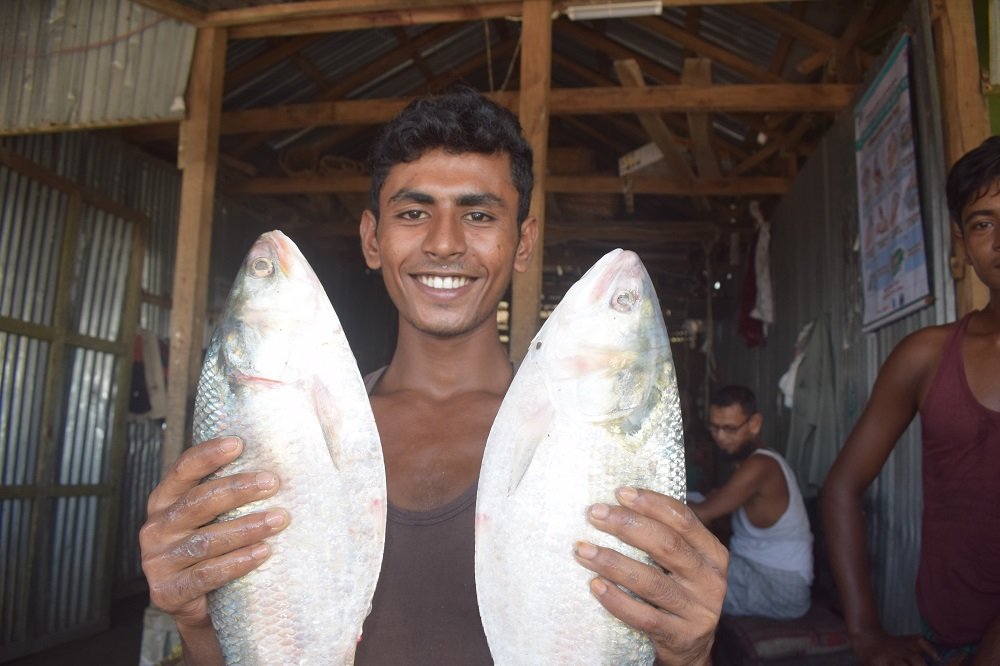
For the fishermen of Bangladesh, the Hilsa season is drawing to a close amidst a period of uncertainty. The voices of the crowd at the fish landing centre fade into the air, carrying with them the indistinct sounds of the fishermen’s suffering.
EP Deep Dive: Data & Solutions
India Has Robots. So Why Does Manual Scavenging Still Put Workers in Sewers?
India has recorded at least 662 sewer and septic-tank deaths in 10 years, despite a legal ban on hazardous sanitation work and growing use of robotic cleaning. EdPublica examines why manual scavenging persists—and what it will take to end dangerous human entry into sewers.
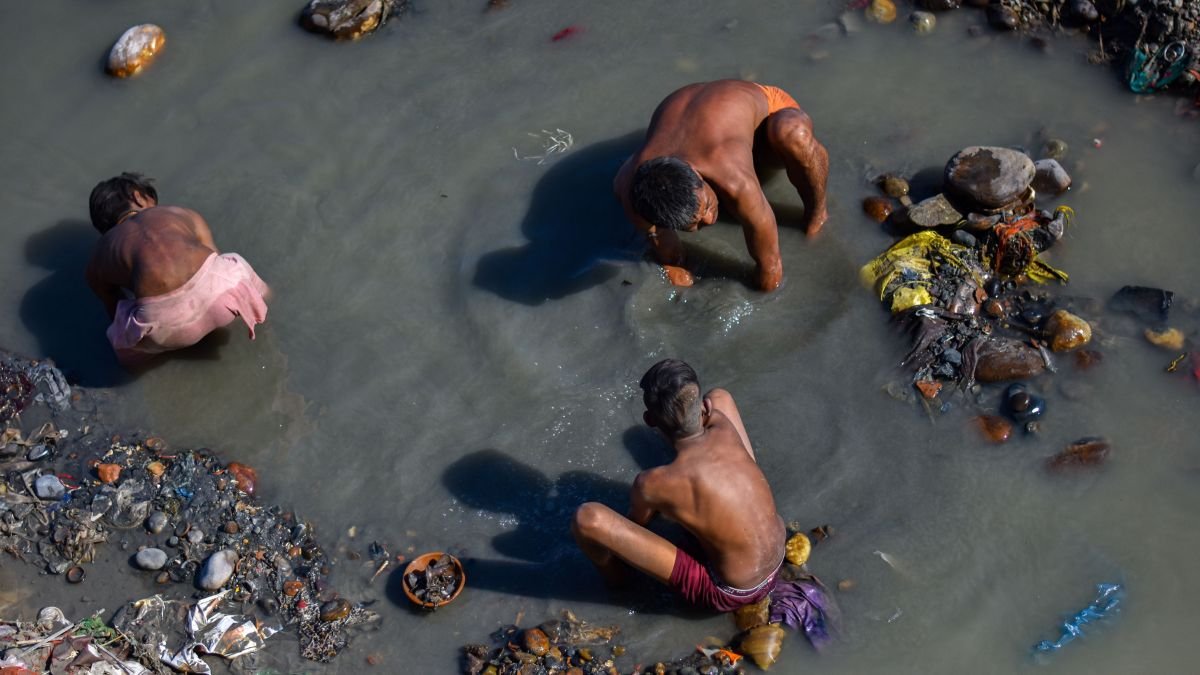
Around 10 pm on 30 September 2025, a worker went down into the septic tank of a hotel in Kattappana, in Kerala’s Idukki district, to clean it. He became trapped. Two colleagues went in to pull him out and were trapped too.
The manhole was too small for rescuers to enter. The fire force brought in an earthmover to break open part of the structure, and after a rescue operation of about an hour and a half the three men were taken to hospital, where they could not be saved. They were Jayaraman, from Cumbum in Tamil Nadu’s Theni district, and Sundara Pandian, 36, and Michael, 23, both from Gudalur in the Nilgiris. The Idukki District Collector’s report later attributed the deaths to inhalation of toxic gas in a tank with critically low oxygen, though the gas itself was not identified. It recommended a multi-department inquiry and compensation for their families of the dead involved in manual scavenging.
Kerala is the state where this is least expected. In the dataset used for this report, it recorded three sewer deaths in the decade to 2025: two in 2016, one in 2017, and none since. The men of Kattappana do not appear in that count. Nor does Joy, a sanitation worker who drowned in a waste-choked canal in Thiruvananthapuram in July 2024. Every figure in this story is a minimum.
Between 2016 and 2025, the National Commission for Safai Karamcharis (NCSK) recorded 662 deaths across India in connection with hazardous sanitation work. India banned the employment of manual scavengers in 1993. The 2013 Act went further, barring anyone from being employed to clean sewers and septic tanks hazardously, that is, without the protective gear and safeguards its rules prescribe. Yet sanitation workers still enter through narrow openings, sometimes with only basic protective equipment, to clear blockages and clean spaces where sewage, toxic gases and human waste accumulate. The work can take hours; in the wrong conditions, it takes lives.
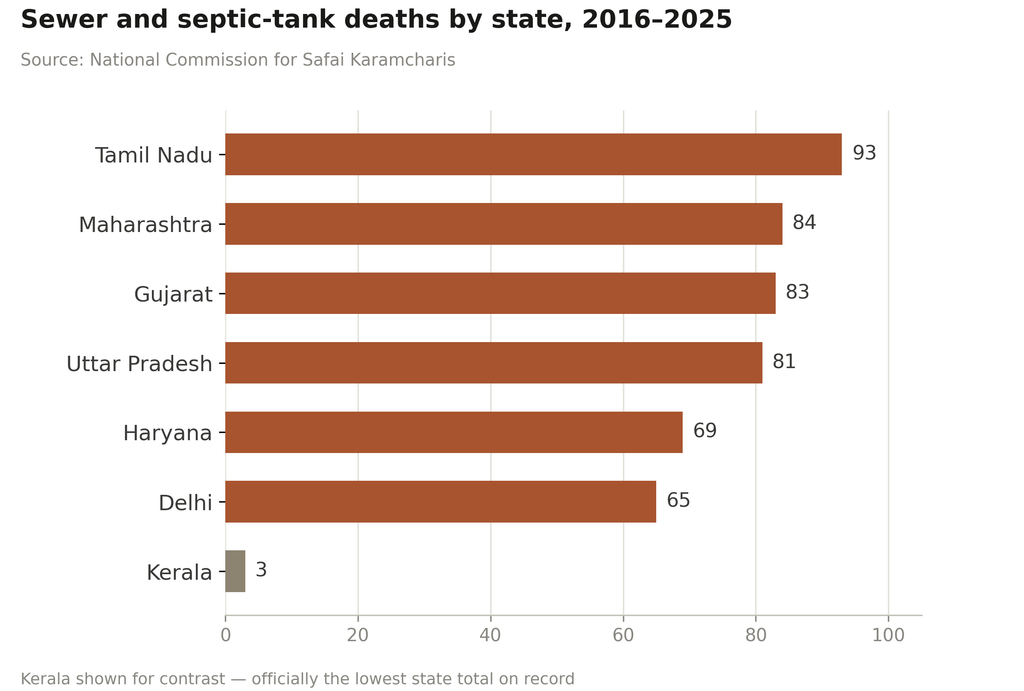
The toll peaked in 2019, at 124 deaths. Tamil Nadu recorded the most over the decade, at 93, followed by Maharashtra (84), Gujarat (83), Uttar Pradesh (81) and Haryana (69); Delhi recorded 65. The five states named accounted for about 62 per cent of the deaths. Since the NCSK began counting in 1993, it has logged 1,361 such deaths, 264 of them in Tamil Nadu and 13 in Kerala.
Official series differ by source and date, because states report late. Replies in Parliament have put the toll for 2019 anywhere between 116 and 133, and a reply in March 2026 that counted from 2017 onwards ranked Uttar Pradesh first (86), ahead of Maharashtra (82) and Tamil Nadu (77). The pattern is consistent even if the totals are not.
A note on terms also matters here. The government draws a legal line between “manual scavenging”, which the 2013 Act defines as lifting human excreta from insanitary latrines, and the “hazardous cleaning” of sewers and septic tanks. It has told Parliament that no deaths have been reported from the first, while counting those in the second. Campaigners treat both as the same caste-bound labour. This report uses “manual scavenging” for the wider practice and “sewer deaths” for the deaths.
Behind the toll lies a harder question: if India has achieved significant technological advancement, why does manual scavenging still persist at all? What keeps people entering spaces they should never have to enter?
For Bezwada Wilson, national convenor of the Safai Karmachari Andolan (SKA) and a Ramon Magsaysay Award winner, the fight against manual scavenging has always been about more than sewers. Through the SKA, he helped document the practice, challenge official claims and take the issue to the Supreme Court. The Supreme Court’s 2014 judgment recognised the continuing problem, ordered the identification and rehabilitation of workers, and directed compensation of ₹10 lakh to the families of those who died in sewers, bringing dignity, equality and caste discrimination to the centre of the debate.
The Work Begins Long Before the Sewer
Wilson grew up in a community that has been tied to sanitation work for generations, and he has spent much of his life challenging the system that kept it that way. As a child, he says, he studied in a separate school near his settlement, where caste and language shaped where children from his community were sent to learn. He came to the movement against manual scavenging through an understanding of what prolonged contact with human excreta does to a person’s health and life.
People who come into contact with human excreta, he says in an interview with EdPublica, are exposed to deadly diseases. Their quality of life deteriorates. That, for Wilson, was reason enough to act. But the deeper problem is what happens when a community is identified with one kind of work for generations. Even education does not necessarily erase that association.
Wilson says government programmes aimed at upskilling members of sanitation-worker communities exist, but questions whether they are reaching people effectively. The Ministry of Social Justice and Empowerment told the Lok Sabha in 2022 that it had spent ₹266.16 crore on its self-employment scheme for the rehabilitation of manual scavengers since 2013-14; that scheme has since been replaced by NAMASTE. Students in these communities still face difficulties accessing education in many places.
Then there is discrimination. When people have been treated as inferior for generations, Wilson argues, a change in law does not automatically change the way society sees them. That matters because manual scavenging is not simply a story about a hazardous job. It is also a story about who is expected to do it.
The Number that Remains Visible
The 662 deaths recorded between 2016 and 2025 are a floor, not a full count. They are the deaths captured in the available dataset, and that distinction matters: the scale of the problem is larger than the deaths that make it into official or reported records. The NCSK says its figures draw on state governments’ reports, media reports and complaints it receives.
The gap between official and civil-society counts is wide. The Ministry told the Lok Sabha in August 2026 that 498 people died in hazardous sewer and septic-tank cleaning between January 2019 and June 2026, a toll that fell from 132 in 2019 to 47 in 2025. The SKA’s own tracking runs the other way, as the table shows. It has counted 113 deaths in the first seven months of 2026 alone; the government’s figure for the first four months is 52.
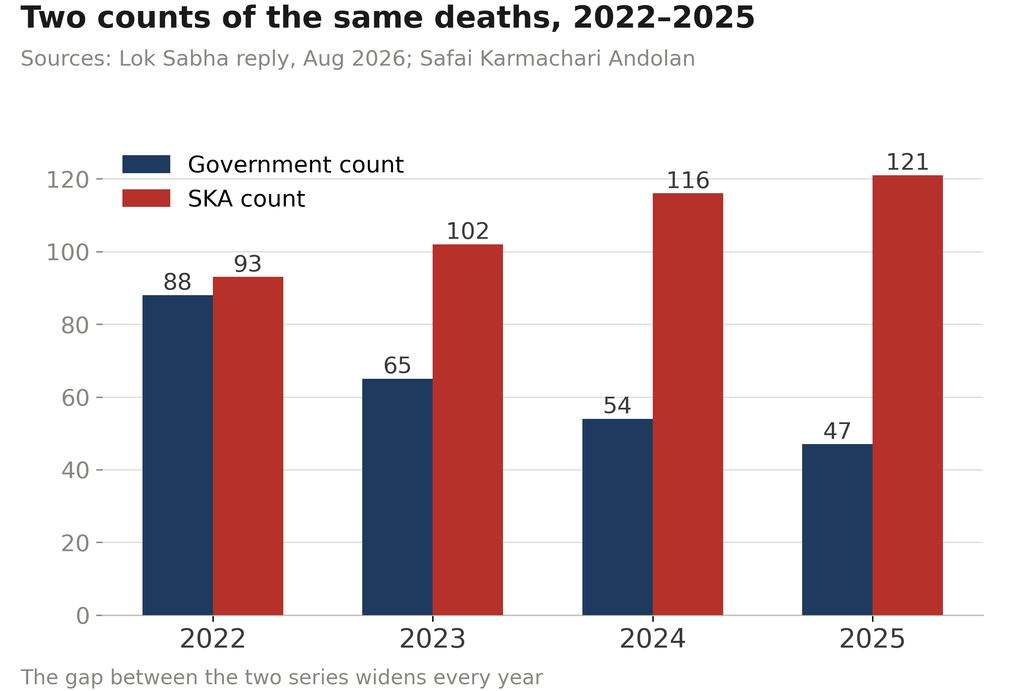
The two series cannot both be right, and the difference is not only about counting. It is also about classification, since the government counts hazardous cleaning but not “manual scavenging”. Even among the deaths that are recorded, accountability is slow: the NCSK says compensation has been paid in 1,206 of the 1,361 cases logged since 1993, with 101 still pending.
Vimal Govind M K, founder and CEO of Kerala-based Genrobotics, came to the problem from the technology side. His company turned its robotics towards sewer cleaning, he says, after the founders came across a newspaper photograph of a man who had died inside a sewer in Kozhikode, Kerala. The image changed the direction of their work.
“We decided to pivot the technology we were developing towards a completely different problem—to prevent people from entering sewers and doing this dangerous work manually,” Govind said.
That decision eventually produced Bandicoot, a robotic system designed to clean manholes without sending a person inside. Genrobotics says it was first deployed in Kerala in 2018. But the existence of a machine does not mean people stop entering sewers.
A Robot Exists. So Why are People Still Entering?
Genrobotics says it has trained more than 3,000 workers and has around 400 robots operating in India. Its public figures have varied: a March 2026 press release spoke of more than 275 deployments, while earlier interviews cited 300 and 350 robots. Govind says a task that can take three to four hours when done manually can be completed in around 20 minutes using the technology. Operating one robot takes two workers, he says.
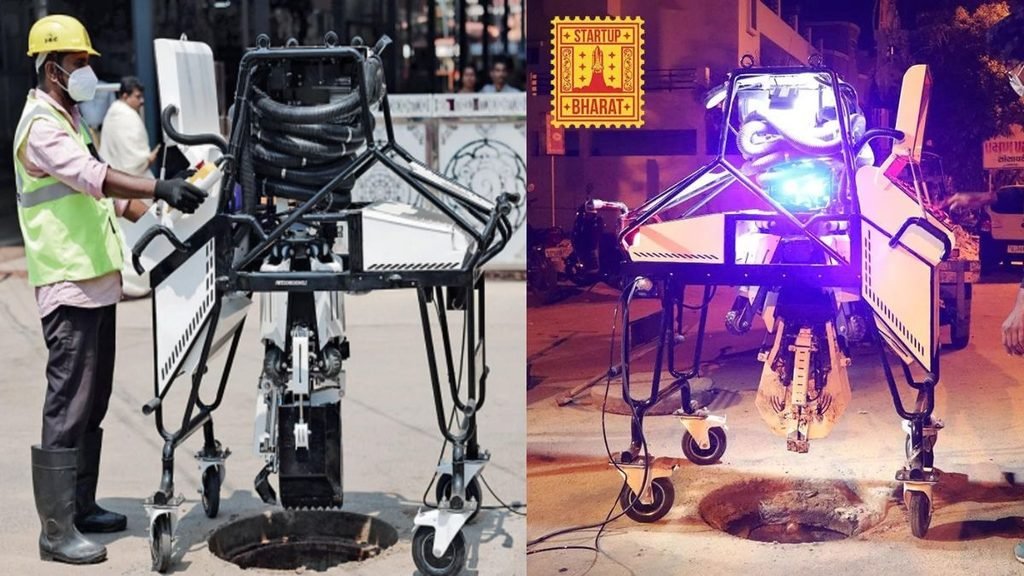
Figures from the field point the same way. Chennai’s water board has been reported to have cleaned more than 5,000 manholes in the first year of deployment, and a company case study lists 1,111 manholes cleaned by two robots for Mumbai’s civic body between September 2024 and March 2025. Both figures come from the company or from secondary reports.
On paper, the logic seems straightforward: if a machine can enter a sewer, a human being should not have to. But India’s sanitation infrastructure does not operate on paper. Municipalities and water boards buy machines, yet many of the deadliest jobs are commissioned by someone else. Kattappana was a hotel’s tank. This week in Mumbai’s Santacruz East, Santosh Kashate, 50, died and Ajay Thakur, 30, was hospitalised after they allegedly entered a municipal sewer manhole while cleaning a housing society’s drain. Police were registering a case of death by negligence against the contractor, and said society members could also be booked for hiring private workers without informing the Brihanmumbai Municipal Corporation.
Some facilities need specialised cleaning only occasionally. Private establishments have little reason to invest in technology for a task they might need once a year, or once in several years. Govind points to another problem: safety enforcement.
In India, confined-space management and workplace safety remain uneven, he says. In countries such as Singapore and the UAE, workers require safety training and permits before undertaking such work, with safety procedures built into the job itself. India’s problem is therefore not simply a shortage of machines. It is also a shortage of systems that make entering the sewer unacceptable.
The courts have pushed in that direction. In October 2023, in Dr Balram Singh v Union of India, the Supreme Court raised compensation for sewer deaths from ₹10 lakh to ₹30 lakh. In January 2025 it barred manual sewer cleaning in six metropolitan cities, and in July 2026 it issued show-cause notices on contempt to the chief secretaries of five states. After two contract workers died in a Tiruchirappalli manhole on 22 September 2025, the corporation announced ₹30 lakh for each family and filed a complaint against the contractor. Compensation and complaints now follow such deaths. Prevention still lags.
When Protective Equipment is not Enough
For years, the response to hazardous sanitation work has often included protective equipment—masks, gloves and other safety gear. But Govind says equipment alone does not necessarily change behaviour. He says workers who have spent years entering sewers can become accustomed to the practice, and that even after being provided with protective equipment, some continue to enter because that is how the work has traditionally been done.

Official figures show the limits of the equipment route. Under the government’s NAMASTE scheme, 89,915 sewer and septic-tank workers had been validated by August 2026, and about 87,000 protective kits had been distributed by the scheme’s third anniversary in July. The Lok Sabha was also told that 52 people died in hazardous cleaning in the first four months of 2026. The figures do not say who the dead were or whether they had been profiled. They do show that distributing equipment has not, by itself, ended the deaths.
Changing that, Govind says, requires training and a cultural shift. That observation brings the technology debate back to Wilson’s argument. If caste has historically determined who performs sanitation work, and if generations of workers have been conditioned to see hazardous cleaning as part of their occupation, then a robot can solve only one part of the problem. It can keep a person out of the sewer. It cannot, by itself, determine what happens to that person afterwards.
What Happens to the Worker When the Robot Arrives?
This may be the most important question in the mechanisation debate. Automation is often discussed in terms of machines replacing people. In sanitation, however, the better outcome is different: workers moving from hazardous manual entry to safer, skilled roles.
Genrobotics says sanitation workers are trained to operate its technology and become part of its teams. The company said in January 2025 that more than 1,000 of the workers it had trained had become robot operators. It says the transition removes direct interaction with sewage from their work. A worker who once entered a manhole could instead operate a machine from outside it.
The job remains. The danger does not have to. Those numbers are the company’s own, though. What would settle the question is what operators earn, who employs them and whether the jobs last. The model also depends on municipalities and other employers actually investing in mechanisation, training workers and enforcing the rules.
Govind says budget allocation remains one of the major barriers to adoption. Government programmes and funds can support mechanisation, but ultimately policymakers and local administrators have to decide to spend the money. The government’s main programme is NAMASTE, launched in July 2023 with an outlay of ₹349.73 crore over three years to 2025-26 across more than 4,800 urban local bodies. It profiles sewer and septic-tank workers, provides protective kits and health insurance, and offers capital subsidies of up to 50 per cent for sanitation machines and enterprises. An extension to rural areas, with an additional outlay of about ₹498.73 crore for 2026-27 to 2030-31, has been reported.
The Geography Tells Another Story
The deaths are not evenly distributed across India. Kerala, by comparison, recorded three deaths in the dataset, two in 2016 and one in 2017, with none from 2018 to 2025.
That contrast is worth examining, but not celebrating too quickly. A decline in reported deaths does not, by itself, prove that hazardous sanitation work has disappeared. Differences in reporting, infrastructure, enforcement and the kinds of sanitation work carried out in each state can all affect the numbers. Kattappana and Joy’s death in Thiruvananthapuram sit outside Kerala’s count.
Govind says Kerala has stronger safety practices than many other states, while acknowledging that enforcement and investment remain challenges nationally. Genrobotics first deployed Bandicoot in Kerala in 2018, the year the zero run begins. The timing is suggestive, not proof, and Kattappana shows what a municipal robot does not reach: a private tank behind a hotel.
The more useful question, then, is not simply which state has the fewest deaths. It is what is different about the systems that keep workers out of hazardous spaces.
Besides the Number 662
India’s response has increasingly moved towards mechanisation. The government has also introduced programmes aimed at eliminating hazardous sanitation work, rehabilitating workers and creating safer sanitation systems.
The experiences of Wilson and Govind point to two requirements for the same goal. One is technological: make it possible to clean a sewer without sending a person inside. The other is social: make sure the person who no longer enters the sewer has the education, income, skills and social acceptance to move into safer work. Neither can replace the other. A third, the law, is meant to hold them together.
A robot can pull a worker away from toxic sewage. A law can prohibit an employer from sending that worker back in. A rehabilitation programme can offer another livelihood. But unless all three work together, the prohibition remains vulnerable to the same pressures that created the occupation in the first place.
Govind predicts that the sanitation industry could become almost completely automated within the next five to six years, with very little human involvement in hazardous work. It is an ambitious prediction. Against more than 4,800 urban local bodies, the company’s own count is a few hundred robots.
The technology may arrive before the social transformation does. And that is the real test for India. Not whether it can build a robot capable of entering a sewer. But whether it can build a system in which no human being has to.
-

 Math3 months ago
The 2026 Fields Medals: Four Proofs, Four Decades-Old Problems Solved
-
EP Deep Dive: Data & Solutions3 months ago
After Kerala’s Deadliest Landslide, the Hardest Thing to Rebuild Was Childhood
-
Space & Physics5 months ago
India Semiconductor Mission: ‘It’s Not About Fabs. It’s About Building An Entire Ecosystem’
-
Interviews1 month ago
From Scams to Screens: How the National Stock Exchange Rewrote India’s Equity Story
-
Climate5 months ago
The Climate World Cup? How Climate Change Could Affect Player Performance at the 2026 World Cup
-
Society3 months ago
What Is Civilisational Diplomacy? Understanding India’s Newest Foreign Policy Tool
-
Society4 months ago
From Bell Labs to the Classroom: A Second Career in Teaching
-
Space & Physics5 months ago
Engineers Develop Dual-Mode Propulsion System for Next-Generation Small Satellites