
Technology
Japan PM India Visit: Why Technology is at the Heart of New Delhi and Tokyo’s Partnership
The Japan PM India visit highlights how semiconductors, AI, critical minerals and resilient supply chains are reshaping the India-Japan partnership beyond trade and infrastructure.


Japanese Prime Minister Sanae Takaichi begins her three-day visit to India, technology has emerged as the defining pillar of the India-Japan partnership, with both countries looking to collaborate in semiconductors, artificial intelligence, critical minerals and advanced manufacturing.
The discussions at the 16th India-Japan Annual Summit come as governments worldwide race to secure critical technologies and reduce dependence on fragile global supply chains. For India, Japan brings decades of expertise in high-precision manufacturing. For Japan, India offers a rapidly expanding market, a skilled workforce and ambitions to become a global manufacturing hub.
Semiconductors Take Centre Stage
One of the most significant areas of cooperation is semiconductors. While Japan no longer dominates chip manufacturing, it remains a global leader in semiconductor materials, manufacturing equipment and precision components—essential building blocks for producing advanced chips.
India, meanwhile, is investing heavily in developing a domestic semiconductor ecosystem through the India Semiconductor Mission. In 2023, the two countries signed a Memorandum of Cooperation on the Japan-India Semiconductor Supply Chain Partnership to strengthen collaboration in manufacturing, research, design, talent development and supply-chain resilience.
As artificial intelligence, electric vehicles, 5G networks and data centres fuel global demand for advanced chips, semiconductor cooperation has become a strategic priority for both governments.
Beyond Infrastructure to Technology Transfer
The India-Japan relationship has traditionally been associated with infrastructure projects such as the Mumbai-Ahmedabad High-Speed Rail corridor. However, the partnership is increasingly shifting towards technology transfer and industrial capability.
The bullet train project, built using Japan’s Shinkansen technology and financed largely through concessional loans from the Japan International Cooperation Agency (JICA), has introduced advanced signalling, train control systems and specialised engineering expertise to India. The project also includes training for Indian engineers, helping develop domestic capabilities in high-speed rail technology.
Broader Technology Ecosystem
Technology cooperation now extends well beyond transport. India and Japan are expanding collaboration in artificial intelligence, digital infrastructure, clean energy, robotics and critical minerals—sectors that are expected to underpin future economic growth and industrial competitiveness.
Japan’s strengths in advanced manufacturing complement India’s focus on scaling electronics production and attracting global technology investment. Together, the two countries are seeking to build resilient supply chains that are less vulnerable to geopolitical disruptions.
Why the visit matters
The significance of Takaichi’s visit lies in the changing nature of the India-Japan partnership. What began as a relationship centred on infrastructure and investment is increasingly becoming one driven by technology, innovation and economic security.
As countries compete for leadership in next-generation industries, the outcomes of this summit could help shape India’s ambitions to become a global manufacturing and technology hub while reinforcing Japan’s role as one of its most important strategic technology partners.












Climate
The Giant Steel Gates Guarding the Netherlands from the Sea
The Maeslantkering is the Netherlands’ giant movable flood barrier, protecting Rotterdam and South Holland while keeping one of Europe’s busiest ports open.

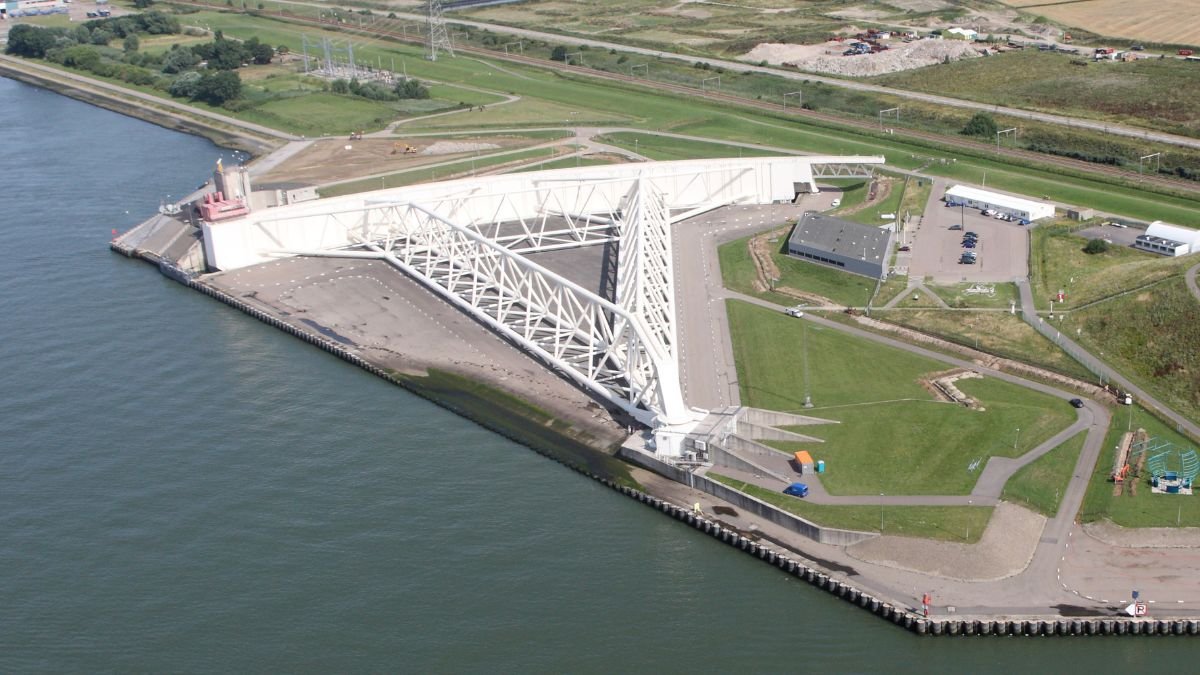
The Maeslantkering uses two enormous movable steel gates to protect Rotterdam and South Holland from extreme storm surges while keeping the river open to ships.
Imagine a wall of water rising from the sea, threatening to flood low lying towns, farmlands, and entire cities. Now picture two massive steel arms, each as long as the Eiffel Tower, floating out from the riverbanks to join together and hold that water back.
This is not a scene from a movie. It is a real piece of infrastructure spanning the Nieuwe Waterweg river channel near Hoek van Holland in the Netherlands. Known as the Maeslantkering, or the Maeslant Barrier, it is the largest movable flood barrier on Earth. For more than three million people living in South Holland, including the port city of Rotterdam, these steel gates are the main defense against extreme ocean storms.
Maeslantkering: Why the Netherlands’ Giant Flood Barrier Matters
Why the Dutch Built a Gate Instead of a Wall The Netherlands has managed water for centuries, as nearly a third of the country sits below sea level. After a devastating North Sea flood in 1953, the Dutch government built a vast network of dams, dikes, and storm surge barriers across the country, known as the Delta Works.
However, the river route leading to Rotterdam created a practical problem. Rotterdam is home to Europe’s largest and busiest seaport. Blocking the river permanently with a fixed dam was impossible because cargo ships need round the clock access. The initial plan was to build higher earthen dikes along the riverbanks. But as engineers examined future sea level projections, they realized standard dikes would have to be enormous. Building them meant demolishing historic neighborhoods and disrupting communities for decades.
The solution was a different approach altogether: a storm surge barrier that stays open during normal weather to keep shipping lanes clear, but swings shut when severe storms approach.
How the Gates Work
The mechanics of the Maeslantkering are straightforward in design, but huge in scale. The barrier relies on two hollow steel gates parked in dry docks on opposite sides of the river.
When a major storm hits, hydraulic engines push the gates out into the waterway, where they float like barges until they meet in the middle. Once aligned, valves open and the gates fill with river water. As they gain weight, they sink onto a concrete bed built into the river floor.
The operation of the Maeslantkering relies heavily on automation. The entire closure process is directed by a specialized computer system called the Decision Support System, known by its Dutch acronym BOS
As the gates lower, water rushes underneath them at high speed. This natural currents sweep away sand and silt so the structures rest flat against the riverbed without getting stuck on sediment. When the storm passes and ocean levels drop, pumps empty the water from inside the gates. The buoyant structures float back up and swing back into their docks, reopening the river to maritime traffic.
Automated Controls with Human Oversight
The operation of the Maeslantkering relies heavily on automation. The entire closure process is directed by a specialized computer system called the Decision Support System, known by its Dutch acronym BOS.
The software constantly monitors weather forecasts, incoming tides, and river flow rates. If calculations show water levels will rise 3 meters above normal in Rotterdam, the system initiates the closure process automatically. Leaving the trigger to software removes the risk of human delay or miscalculation during a sudden storm emergency.
Even with automation running the system, human engineers remain on site. Whenever severe weather threatens the coast, a technical team monitors the operations from a nearby control room, ready to take manual control if a system fault occurs.
Balancing Ships, Farms, and Rising Tides
Closing the barrier stops all ship traffic into Rotterdam, so shutting the gates is never done without cause. The barrier only closes during major storm events, though engineers run a routine test closure every September to keep the machinery and operational teams prepared.
As sea levels change and seasonal river flows shift, the Maeslantkering remains a critical piece of Dutch water management. It demonstrates how civil engineering can function alongside natural waterways, protecting millions of residents while keeping an essential trade route open to the world.
Technology
Chinese Humanoid Robots Beat Human Records at Beijing Games
Chinese humanoid robots have surpassed long-standing human benchmarks in sprinting and jumping at the World Humanoid Robot Games in Beijing, showcasing rapid advances in robotic speed, balance and autonomous movement.

Chinese humanoid robots have beaten long-standing human athletic records at the second World Humanoid Robot Games in Beijing, showcasing how quickly machines are improving at running, jumping and coordinated movement. A robot completed the 100-metre sprint in 9.39 seconds on Saturday, faster than Jamaican sprinter Usain Bolt’s men’s world record of 9.58 seconds, set in 2009. Another robot recorded a 2.88-metre standing high jump, surpassing the 2.45-metre high-jump record set by Cuba’s Javier Sotomayor.
The performances are not official human athletics records. Robots compete under different physical conditions and their results are better understood as demonstrations of advances in robotics.
What are the World Humanoid Robot Games?
The World Humanoid Robot Games are an Olympic-style international competition designed specifically for humanoid robots. The event was first held in Beijing in 2025 and returned this year with a much larger field.
The five-day 2026 edition features more than 2,000 humanoid robots representing 666 teams from 16 countries. The competitions cover sports such as athletics, football, gymnastics, weightlifting, martial arts, dancing and tug-of-war.
The games are being held at Beijing’s National Speed Skating Oval, the venue known as the “Ice Ribbon” that was built for the 2022 Winter Olympics.
From running tracks to real-world tasks
The event is not limited to sporting competitions. Organisers have also introduced scenario-based challenges designed to test whether humanoid robots can perform useful tasks outside controlled sporting environments.
These include activities related to factories, hotels, homes, hospitals, emergency response and retail. Robots are expected to perform tasks such as handling objects, assisting in service environments and responding to practical situations.
This year’s 100-metre race has also been upgraded to allow fully autonomous robots, removing the need for direct human control during the event.
Speed is improving, but control remains a challenge
The record-breaking sprint also showed one of the problems humanoid robots still face: stopping.
After completing the 100 metres, some robots struggled to slow down and crashed into padded barriers. The incident highlighted the difference between achieving high speed and controlling a machine reliably at the end of a movement.
That distinction matters because the broader goal of humanoid robotics is not simply to make machines run faster than humans. Researchers and companies are trying to develop robots that can move through unpredictable environments, manipulate objects and complete tasks with minimal human intervention.
The Beijing games therefore serve as both a sporting spectacle and a test bed for a rapidly developing technology. The record-breaking performances show what humanoid robots can do under controlled conditions; the scenario-based events test whether those abilities can translate into useful work in the real world.
Society
Our Algorithm Knows What We Want Before We Do. That is the Problem.
What 42 Indian high school students taught me about AI, and what a sociologist’s warning about McDonald’s has to do with it


Between July and September 2025, I interviewed 42 high school students as part of ongoing research into career aspirations and problem-solving. One pattern kept recurring, and it unsettled me more each time I saw it.
Students who regularly used AI tools gave curiously superficial answers to everyday problems. They would address the obvious aspect of a question, then stop, almost as if waiting for a “next suggestion” that never came. But when I asked simple follow-up questions such as “What other possibilities exist?” or “Is there an alternative perspective?”, something shifted. They began weighing trade-offs, generating options, thinking out loud in ways they hadn’t a moment before. The capacity for deeper analysis was clearly there. They just weren’t reaching for it on their own.
AI and Critical Thinking: What Studies Reveal
This pattern aligns with what researchers call cognitive offloading, one of the more quietly consequential effects of living alongside AI. The term describes our long-standing habit of delegating mental tasks to external tools like notebooks, calculators, and calendars to lighten cognitive load. But AI changes the nature of the offload. A calculator stores a number. AI generates the finished thought. When a tool not only holds information but produces the answer itself, students can begin expecting ready-made solutions rather than exercising their own problem-solving capacity. What is meant to scaffold learning risks becoming a crutch that quietly atrophies the very skills it was meant to build.
This is not a fringe worry. A 2025 mixed-methods study of 666 participants across age groups found a significant negative relationship between frequent AI tool use and critical thinking performance, with cognitive offloading identified as the mediating mechanism, and the effect most pronounced among younger, heavier users. My 42 interviews cannot establish that kind of statistical relationship on their own, but they offered a close-up view of the same mechanism in action, most visibly in that pause where a student seemed to be waiting for a “next suggestion” that never came.
A 2026 study on generative AI and learner agency distinguishes between two very different modes of AI use, dependent offloading, where the tool substitutes for a student’s own thinking, and autonomous offloading, where AI scaffolds thinking without replacing it. The dependent form threatens autonomy by making choices on the student’s behalf, even when it may feel helpful. A parallel systematic review frames the same divide as amplification versus substitution, where guided, metacognitively aware AI use extends a student’s cognitive reach, while passive, unreflective use displaces the mental effort deep learning actually requires. My follow-up questions seemed to pull a few students from dependent mode into autonomous mode. The capacity for deeper analysis was clearly still there. They just were not reaching for it on their own.
From McDonald’s to the Algorithm
Thirty years ago, sociologist George Ritzer described what he called McDonaldization, the spread of fast-food logic, efficiency, calculability, predictability, and control, into hospitals, universities, even relationships. It was a troubling process, but at least it was visible. We could see the golden arches multiplying, see the assembly line replacing the artisan.
What we are living through now is harder to see, because it inverts the logic. Call it AI-zation. Where McDonaldization imposed visible uniformity, AI-zation offers something that feels like the opposite — personalisation. Our search results are tailored to us. Our feed reflects our interests. Our recommendations are, supposedly, uniquely ours.
This is the seduction of AI-zation. It feels personal while quietly manufacturing a new kind of conformity, not the visible sameness of a fast-food counter, but an invisible narrowing of thought, preference, and possibility. Recommendation systems are trained on existing patterns, so they inevitably steer people toward what is already popular, already “successful,” already proven. The menu looks infinite. The actual range of what people consume keeps narrowing.

I think of this as programmed spontaneity, the feeling of free choice operating inside an algorithmically constrained space. The pattern is easiest to notice somewhere trivial. Watch one dance reel, and the next fifty look almost identical to it. The platform has correctly identified what will keep you watching and, in doing so, has quietly narrowed the world to a single, endlessly repeated genre. Nobody decided this for us, exactly, and yet our options shrank the moment we engaged.
The same logic operates in domains that matter far more than reels, and it does not require any AI to appear at all. As a professor who has placed students in internships across dozens of organisations, I have watched a version of this play out for years. A student’s developmental need is exposure to something unfamiliar; if they have already worked in one area, the internship that would serve them best is often in a different one entirely, so they build range rather than repetition. But host organisations want the opposite. If a student has prior exposure to, say, employee engagement work, an organisation wants exactly that student, because they arrive already useful and need less onboarding. The organisation optimises for efficiency, minimum ramp-up, and maximum immediate output. The student needs breadth; the system rewards depth in a single, already-proven groove. Multiply that logic across a career, and a person can end up highly efficient at one narrow thing and never discover the other things they might have been.
This is the same tension recommendation algorithms formalise and accelerate, not invent. Efficiency, for any system, means doing more of what has already worked. Development, for a person, means doing something not tried yet. AI-zation is what happens when that older institutional logic gets encoded into infrastructure that operates continuously, at population scale, and largely out of sight.
Consider a career platform’s job suggestions, or a course recommendation engine, operating on the same principle as the internship market. It is optimising for patterns it has already seen. If your interests do not fit an existing category, the system is unlikely to help you find your way there, and the more you see what “people like you” are doing, the more that pattern starts to feel natural rather than constructed.
Why This Should Worry India Specifically
India has long been a civilisation organised around multiplicity, languages, philosophical schools, and ways of solving problems coexisting, often in productive tension. That diversity was never just decoration. It was, and is, epistemological, made of different ways of knowing and different definitions of a life well lived.
AI-zation threatens this precisely because it operates through standardisation disguised as personalisation. Search algorithms are globally standardised. Ed-tech platforms structure content around what optimises engagement metrics, not around pedagogical diversity. Jugaad, the distinctly Indian capacity for improvisation, depends on encountering a problem the “official” system has not already solved, and then building a workaround. But if an algorithm is always ready with the “right” answer before a student has fully sat with the question, where does that improvisational instinct come from?
This is not a case for rejecting technology. Digital tools have brought genuine benefit, access to information, connection, and efficiency gains that matter enormously in a country still building out infrastructure
This is not a case for rejecting technology. Digital tools have brought genuine benefit, access to information, connection, and efficiency gains that matter enormously in a country still building out infrastructure. The distinction that matters is between technology that augments human capability and technology that quietly programs human behaviour. Increasingly, we are getting more of the latter than the former.
The Illusion of Control
Defenders of algorithmic systems often point out that users retain control, that you can adjust settings, opt out, switch platforms. This misses something important. When algorithms mediate access to jobs, credit, education, and healthcare, individual opt-out becomes practically impossible for most people. And the “preferences” we express are themselves shaped by prior exposure. You keep choosing certain content partly because the algorithm keeps showing it to you. The system trains you as much as you train it.
The same illusion holds for the reasons AI systems offer when they do explain themselves. Research on explainable AI has repeatedly found that these explanations are often generated after the decision, plausible stories rather than faithful accounts of how the system actually arrived at its answer, and that even explanations carrying no real information can produce as much user trust as genuine ones. Demanding explanations from algorithms is necessary, but it is not sufficient. A system can learn to produce a persuasive explanation without that explanation being true.
Scale up the pattern from my student interviews and ask what happens when algorithms do our remembering (search), our navigating (maps), our reading choices (feeds), and increasingly our writing (generative AI). Each instance looks helpful in isolation. Together, they add up to something closer to the outsourcing of cognition itself.
What Can Actually Be Done
Four responses seem worth taking seriously, none of them rejecting technology.
First, algorithmic literacy needs to become collective, not just individual. When people understand that their “personalised” experience is shaped by hidden, profit-driven choices, they can begin to question the pattern rather than simply live inside it. For educators specifically, this means treating AI tools as objects of critical scrutiny in the classroom, not just productivity aids, and explicitly teaching students to pause and probe past the first answer, the way my follow-up questions did in those interviews.
Second, we need to protect spaces of deliberate non-optimisation. Not everything should be made efficient. Deep learning requires struggle. Creativity requires wandering. We need to consciously build and defend spaces, in classrooms, in workplaces, where algorithms do not intrude by default.
Third, India already has a structural alternative worth naming directly. The Open Network for Digital Commerce (ONDC) is public infrastructure built on the same logic that made UPI transform payments, an open protocol that keeps any single company from owning the whole stack of app, algorithm, and data. It has scaled fast, past 500 million transactions by mid-2026. Adoption is still uneven outside metro cities, but this is what building alternative infrastructure looks like in practice.
Cooperative ownership is a related, distinct model, workers or citizens owning the platform itself. Europe’s Smart cooperative serves over 100,000 freelancers; Switzerland’s MIDATA lets citizens govern their own health data. New York’s Drivers Cooperative is the cautionary case. Launched as a driver-owned Uber alternative, it now struggles because collective ownership has to compete with venture capital willing to lose money for years to win the market. Whether India’s cooperative tradition can extend into education technology or data governance, alongside infrastructure like ONDC, remains an open question.
Fourth, algorithmic systems that affect access to opportunity need to be explainable and challengeable. This requires regulation, but it also requires organised public demand, because voluntary transparency from platforms whose business model depends on opacity is not something to wait for.
The Stakes
Mahatma Gandhi’s idea of swadeshi, self-reliance rather than dependence on external systems, has an obvious digital-age analogue, something like cognitive sovereignty, the capacity to think, choose, and imagine outside the boundaries an algorithm has already drawn. In education specifically, this means treating AI as scaffolding to be gradually withdrawn, not a permanent support to lean on.
| “We are not choosing between technology and tradition. We are choosing who controls the cognitive infrastructure young people grow up inside.” — Dr Vijayakumar Parameswaran Unnithan |
We are not choosing between technology and tradition. We are choosing who controls the cognitive infrastructure young people grow up inside, and whether that infrastructure preserves the messy, effortful, sometimes inefficient work of actually thinking something through. My conversations with those 42 students suggested the capacity for that kind of thinking has not gone anywhere. It just needs to be asked for.
EDITOR’S FACT-CHECK
Key claims independently verified against primary sources: Gerlich (2025), Societies 15(1):6, on cognitive offloading and critical thinking (n=666); Zhu et al. (2026), Frontiers in Psychology, on dependent vs. autonomous cognitive offloading; ONDC’s 500-million-transaction milestone (reported July 2026); Smart cooperative’s membership figures; and the trajectory of New York’s Drivers Cooperative.


Nepal’s Glacier Disaster Exposes the Unequal Cost of Climate Change

When Health Care Becomes a Target, Patients Pay the Price

Academic Diplomacy: How India Can Build Global Influence Through Universities

Six Months of the Hormuz Crisis: A USD 330 Billion Global Fuel Bill — and India’s USD 22.5 Billion Share

The Giant Steel Gates Guarding the Netherlands from the Sea

When the Monsoon Returns, Fear Returns: How Climate Disasters Are Reshaping Mental Health in Himachal Pradesh

Astronomers Discover a ‘Black Hole Star’, a New Kind of Object in the Early Universe

From Bell Labs to the Classroom: Finding Purpose After Retirement

From Soil to Profit: How Organic Turmeric Changed the Fortunes of a Tribal Farming Family

Kerala Floods Highlight a Recurring Health Crisis as Disease Risks Rise

-

 Math1 month ago
The 2026 Fields Medals: Four Proofs, Four Decades-Old Problems Solved
-
Climate1 month ago
After Kerala’s Deadliest Landslide, the Hardest Thing to Rebuild Was Childhood
-
Society2 months ago
West Asia Crisis: Can Kerala’s Returning Gulf Migrants Find a Future in the Green Economy?
-
Space & Physics3 months ago
India Semiconductor Mission: ‘It’s Not About Fabs. It’s About Building An Entire Ecosystem’
-
Climate3 months ago
The Climate World Cup? How Climate Change Could Affect Player Performance at the 2026 World Cup
-
Society2 months ago
What Is Civilisational Diplomacy? Understanding India’s Newest Foreign Policy Tool
-
Society2 months ago
From Bell Labs to the Classroom: A Second Career in Teaching
-
Space & Physics3 months ago
Engineers Develop Dual-Mode Propulsion System for Next-Generation Small Satellites