
Society
Understanding AI: The Science, Systems, and Industries Powering a $3.6 Trillion Future
Explore how artificial intelligence is transforming finance, automation, and industry — and what the $3.6 trillion AI boom means for our future


Artificial Intelligence (AI) has become a major point of discussion and a defining technological frontier of our time. Experiencing remarkable growth in recent years, AI refers to computer systems capable of mimicking intelligent human cognitive abilities such as learning, problem-solving, critical decision-making, and creativity. Its ability to identify objects, understand human language, and act autonomously makes it increasingly feasible for industries like automotive manufacturing, financial services, and fraud detection.
As of 2024, the global AI market is valued at approximately USD 638.23 billion, marking an 18.6% increase from 2023, and is projected to reach USD 3,680.47 billion by 2034 (Precedence Research). North America leads this global growth with a 36.9% market share, dominated by the United States and Canada. The U.S. AI market alone is valued at around USD 146.09 billion in 2024, representing nearly 22% of global AI investments.
The Early Evolution of AI: From Reactive Machines to Learning Systems
Our understanding of AI has evolved through different models, each representing a step closer to mimicking human intelligence.
Reactive Machines: The First Generation
One of the earliest and most famous AI systems was IBM’s Deep Blue, the chess-playing computer that defeated world champion Garry Kasparov in 1997. Deep Blue was a reactive machine model, relying on brute-force algorithms that evaluated millions of possible moves per second. It could process current data and generate responses, but lacked memory or the ability to learn from past experiences.
Reactive machines are task-specific and cannot adapt to new or unexpected conditions. Despite these limitations, they remain integral to automation, where precision and repeatability are more important than learning—such as in manufacturing or assembly-line robotics.
Limited Memory AI: Learning from Experience
To overcome the rigidity of reactive machines, researchers developed Limited Memory AI, a model that can store and recall past data to make more informed decisions. This model powers technologies such as self-driving cars, which constantly analyze road conditions, objects, and obstacles, using stored data to adjust their behaviour.
Limited Memory AI is also valuable in financial forecasting, where it uses historical market data to predict trends. However, its memory capacity is still finite, making it less suited for complex reasoning or tasks like Natural Language Processing (NLP) that require deeper contextual understanding.
Theoretical Models: Towards Human-Like Intelligence
Theory of Mind AI
The next conceptual step is Theory of Mind AI, a model designed to understand human emotions, beliefs, and intentions. This approach aims to enable AI systems to interact socially with humans, interpreting emotional cues and behavioral patterns.
Researchers like Neil Rabinowitz from Google DeepMind have developed early prototypes such as ToMnet, which attempts to simulate aspects of human reasoning. ToMnet uses artificial neural networks modeled after brain function to predict and interpret behavior. However, replicating the complexity of human mental states remains a distant goal, and these systems are still largely experimental.
Self-Aware AI: The Future Frontier
The ultimate ambition of AI research is self-aware AI — systems that possess conscious awareness and a sense of identity. While this remains speculative, the potential applications are vast. Self-aware AI could revolutionize fields like environmental management, creating bots capable of predicting ecosystem changes and implementing conservation strategies autonomously.
In education, self-aware systems could understand a student’s cognitive style and deliver personalized learning experiences, adapting dynamically to each learner.
However, replicating human self-awareness is extraordinarily complex. The human brain’s intricate memory, emotion, and decision-making systems remain only partially understood. Additionally, self-aware AI raises profound ethical and privacy concerns, as such systems would require massive amounts of sensitive data. Strict guidelines for data collection, storage, and usage would be essential before such systems could be deployed responsibly.
Artificial Intelligence in the Financial Services Industry
The financial sector has undergone a massive transformation powered by AI-driven analytics, automation, and predictive intelligence. AI enhances Corporate Performance Management (CPM) by improving speed and precision in financial planning, investment analysis, and risk management.
Natural Language Processing and Automation
Leading financial firms such as JPMorgan Chase and Goldman Sachs employ Natural Language Processing (NLP) — AI systems that understand human language — to streamline customer interaction and analyze market information. NLP tools like chatbots handle millions of customer queries efficiently, while advanced systems process unstructured text data from financial reports and news sources to inform investment decisions.
Paired with Optical Character Recognition (OCR) and document parsing, NLP systems can convert scanned or image-based documents into machine-readable text, accelerating compliance checks, fraud detection, and financial forecasting.
However, the accuracy of NLP models depends on the quality and diversity of training data. Biased or incomplete data can lead to errors in analysis, potentially influencing high-stakes financial decisions.
Generative AI in Finance
Another major shift in finance comes from Generative AI, a branch of AI that creates new content — including text, images, videos, and even financial models — based on learned patterns. Using Large Language Models (LLMs) and Generative Adversarial Networks (GANs), these systems simulate complex financial scenarios, improving fraud detection and stress testing.
For instance, PayPal and American Express use generative AI to simulate fraudulent transaction patterns, strengthening their security systems. Transformers — deep learning architectures behind tools like OpenAI’s GPT — enable these models to understand and generate human-like language, allowing them to summarize extensive reports, produce research briefs, and assist analysts in decision-making.
Yet, Generative AI also presents challenges. It can be manipulated through adversarial attacks, producing misleading or biased outputs if trained on flawed data. Ensuring transparency and fairness in training datasets remains critical to prevent discriminatory outcomes, especially in credit scoring and loan assessment.
AI and Automation: Revolutionizing Industry Operations
Artificial Intelligence has become a cornerstone of intelligent automation (IA), reshaping business process management (BPM) and robotic process automation (RPA). Traditional RPA handled repetitive, rule-based tasks, but with AI integration, these systems can now manage complex workflows that require contextual decision-making.
AI-driven automation enhances productivity, reduces operational costs, and increases accuracy. For example, in manufacturing, AI-enabled systems perform predictive maintenance by analyzing sensor data to detect machinery issues before failures occur, minimizing downtime and extending equipment lifespan.
In the automotive sector, AI-powered machine vision systems inspect car components with higher accuracy than human inspectors, ensuring consistent quality and safety. These innovations make automation not only efficient but also economically advantageous for large-scale industries.
Machine Learning: The Engine of Artificial Intelligence
At the heart of AI lies Machine Learning (ML) — algorithms that allow computers to learn from data and improve over time without explicit programming. Three fundamental ML models underpin most modern AI applications: Decision Trees, Linear Regression, and Logistic Regression.
Decision Trees
Decision trees simplify complex decision-making processes into intuitive, branching structures. Each branch represents a decision rule, and each leaf node gives an outcome or prediction. This makes them powerful tools for disease diagnosis in healthcare and credit risk assessment in finance. They handle both numerical and categorical data, offering transparency and interpretability.
Linear Regression
Linear regression models relationships between one dependent and one or more independent variables, making it useful for predictive analytics such as stock price forecasting. It applies mathematical techniques like Ordinary Least Squares (OLS) or Gradient Descent to optimize prediction accuracy. Its simplicity, efficiency, and scalability make it ideal for large datasets.
Logistic Regression
While linear regression predicts continuous outcomes, logistic regression is used for classification problems — determining whether an instance belongs to a particular category (e.g., yes/no, fraud/genuine). It calculates probabilities between 0 and 1 using a sigmoid function, providing fast and interpretable results. Logistic regression is widely used in healthcare (disease prediction) and finance (loan default assessment).
Types of Machine Learning Algorithms
Machine Learning can be broadly classified into Supervised, Unsupervised, and Reinforcement Learning — each suited for different problem types.
Supervised Learning
In supervised learning, algorithms train on labelled datasets to identify patterns and make predictions. Once trained, they can generalize to new, unseen data. Applications include spam filtering, voice recognition, and image classification.
Supervised models handle both classification (categorical predictions) and regression (continuous predictions). Their strength lies in high accuracy and reliability when trained on quality data.
Unsupervised Learning
Unsupervised learning, in contrast, deals with unlabelled data. It identifies hidden patterns or groupings within datasets, commonly used in customer segmentation, market basket analysis, and anomaly detection.
By autonomously discovering relationships, unsupervised learning reduces human bias and is valuable in exploratory data analysis.
Reinforcement Learning (Optional Expansion)
While not yet as mainstream, reinforcement learning trains algorithms through trial and error, rewarding desired outcomes. It is foundational in robotics, autonomous systems, and game AI — including the systems that now outperform humans in complex strategic games like Go or StarCraft.

Ethical and Societal Considerations of AI
Despite its transformative potential, AI raises significant ethical and privacy challenges. Issues such as algorithmic bias, data exploitation, and job displacement are increasingly at the forefront of public discourse.
Ethical AI demands transparent data practices, accountability in algorithm design, and equitable access to technology. Governments and academic institutions, including Capitol Technology University (captechu.edu), emphasize developing AI systems that align with social good, human rights, and sustainability.
Furthermore, the rise of generative AI has intensified debates about content authenticity, intellectual property, and deepfake misuse, underscoring the urgent need for comprehensive AI regulation.
A Technology Still in Transition
Artificial Intelligence stands at the intersection of opportunity and uncertainty. From Deep Blue’s deterministic algorithms to generative AI’s creative engines, the technology has redefined industries and continues to evolve at an unprecedented pace.
While self-aware AI and full cognitive autonomy remain theoretical, the rapid integration of AI across industries signals an irreversible shift toward machine-augmented intelligence. The challenge ahead is ensuring that this evolution remains ethical, inclusive, and sustainable — using AI to enhance human potential, not replace it.
References
- Artificial Intelligence (AI) Market Size to Reach USD 3,680.47 Bn by 2034 – Precedence Research
- What is AI, how does it work and what can it be used for? – BBC
- 10 Ways Companies Are Using AI in the Financial Services Industry – OneStream
- The Transformative Power of AI: Impact on 18 Vital Industries – LinkedIn
- What Is Artificial Intelligence (AI)? – IBM
- The Ethical Considerations of Artificial Intelligence – Capitol Technology University
- What is Generative AI? – Examples, Definition & Models – GeeksforGeeks












Society
Who Cares for India’s Older People?
On International Day of Older Persons, a HelpAge India study highlights gaps in healthcare, income, family care and social support facing older people in India, including added risks from climate-related hazards.


Growing older can change something as ordinary as getting medicines, visiting a doctor or managing a difficult day alone. For many older people, the question is not simply whether help exists, but whether someone is close enough and able to provide it when it is needed.
A recent HelpAge India study of 2,224 older people across 20 districts in 10 states offers a picture of the support systems on which they depend. It found that 94% of older people who needed care received it from family members. But that support is not equally available to everyone.
Thirteen percent of those surveyed lived alone, 33% were widows and 28% were aged 80 or above. Nearly half reported a long-term impairment, including mobility and vision difficulties. These circumstances matter because everyday care often depends on another person being physically present.
When Family is not Nearby
India’s older population continues to rely heavily on family for care. But migration for work is changing household arrangements. In the HelpAge study, 18% of households reported that a family member had migrated for work. Sons accounted for 76% of those migrants.
For older people living alone, neighbours often fill part of the gap. Thirty-eight percent depended on neighbours for care, while 20% relied on family members living elsewhere. Sixteen percent said they received no care.
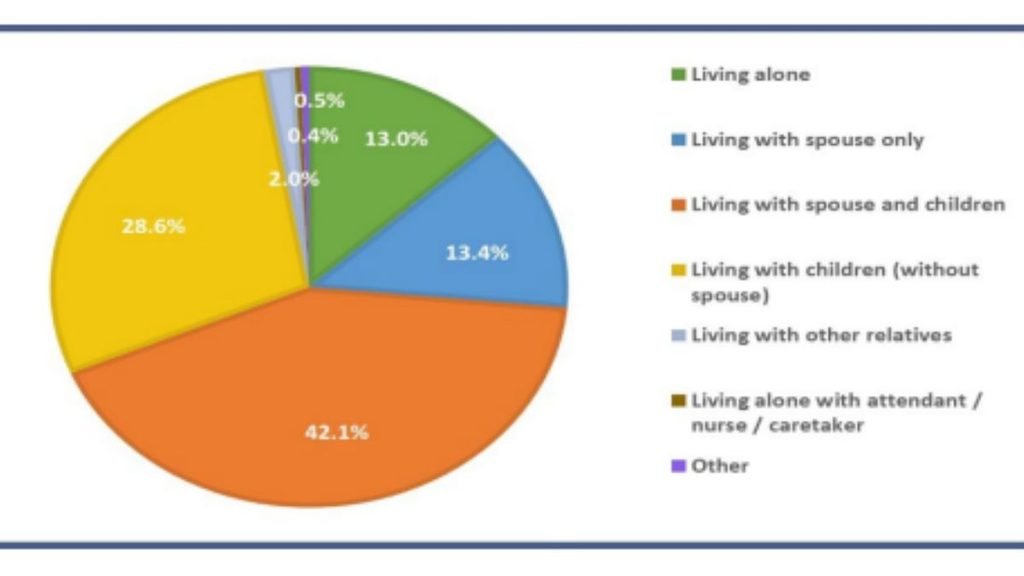
Distance does not necessarily mean that families stop supporting older relatives. Financial assistance and regular communication can continue. But some needs cannot be met remotely: taking someone to a hospital, collecting medicines, helping them move around the house or responding when they suddenly fall ill. This distinction becomes particularly important during emergencies.
Health Harder to Manage
The study found that 52% of respondents could not afford medicines. Public facilities were an important source of healthcare, with 51% using primary health centres and 49% government hospitals.
Climate-related events exposed some of these existing difficulties further. Seventy-eight percent of those surveyed had experienced at least one such hazard in the previous three years, with heatwaves the most common.
Among those who experienced heatwaves, 74% said illness increased and 44% said existing health conditions worsened. One-third reported difficulty accessing healthcare. These figures are less about the hazard itself than about what happens when an older person already managing health problems has fewer options for care.
“Older persons are among those most at risk from rising climate shocks, particularly those living alone or with impairments, yet they remain largely invisible in climate response efforts,” says Rohit Prasad, CEO, HelpAge India. “Climate impacts extend beyond physical hazards, affecting health, income, housing, care and social wellbeing.”
Prasad says age-related physical, financial and social challenges can limit older people’s ability to prepare for, withstand and recover from climate events. He calls for ageing to be integrated into climate adaptation, climate financing, elder-centric disaster risk reduction and social protection policies.
Income Constraint
Healthcare is only one part of financial insecurity in later life. Pensions were the main source of income for 49% of respondents. Sixteen percent had neither work nor income, while others continued to work in agriculture, agricultural labour or other forms of employment.
The ability to pay for medicines, travel to healthcare facilities, household repairs or basic necessities depends heavily on this income. Work also changes with age. The HelpAge study found that the proportion reporting no work or income rose from 11% among those aged 60–69 to 21% among those aged 80 and above.
For people who have spent much of their lives in informal employment, growing older can therefore mean entering a period with limited savings, little employment protection and greater healthcare needs.
The Problem of Access
Government schemes can provide important support, but knowing about a benefit does not always mean being able to obtain it. The study found relatively high awareness of the Public Distribution System, pensions, subsidised healthcare and housing schemes. Yet access was more difficult for people with poor health, those severely affected by climate hazards, people without formal education and those from lower socioeconomic groups.
Respondents also reported delays, difficulties with digital access and a lack of assistance with applications. For an older person with limited mobility, poor eyesight or little experience with digital services, even a relatively straightforward application can become difficult without help.
Ageing Needs More Than Family Care
India’s ageing population is growing, while the family structures that have traditionally provided care are changing.
UNFPA estimates that the number of Indians aged 60 and above could approach 193 million by 2030. That growth will increase the need for healthcare, financial support and forms of care that do not depend entirely on whether an older person’s children live nearby.
The answer is not to replace family care, which remains central to the lives of many older people. It is to ensure that those who do not have family nearby, cannot afford private care or need support beyond what relatives can provide are not left without alternatives.
Ageing policy therefore needs to look beyond longevity. It has to account for who provides care, who pays for healthcare, how older people access public services and what happens when the person they depend on is no longer close by. For many older Indians, these are not future questions. They are questions of everyday life.
Health
Not Broken but Unheld: A New UN Report Asks Us to Tend the Forest, Not Only the Tree
A new UN report on youth mental health calls for an ecosystem approach linking well-being with education, work, housing, climate, technology and community.


Society
Digital Detox: Why Taking a Break From Screens Matters
A digital detox can help children and adults reduce screen dependence, reconnect with nature and relationships, and create space for reflection and creativity.




Icnoic Matterhorn Almost Snow-Free as Record Heat Accelerates Swiss Glacier Loss

Who Cares for India’s Older People?

Climate Change Is Already on Your Dinner Table. Here Is How It Got There

India Records Driest Monsoon in 11 Years as Rainfall Deficit Hits 12.6%

Not Broken but Unheld: A New UN Report Asks Us to Tend the Forest, Not Only the Tree

From Scams to Screens: How the National Stock Exchange Rewrote India’s Equity Story

Aim for the Stars: Anjali Thomas’s Journey from a Small College in Kerala to the Frontiers of Medical Imaging

Anxiety Freezes Career Decisions. Curiosity Unfreezes Them

The Engineer of Tomorrow Is Already Here

India’s AI Moment Rests on More Than Code

-

 Math2 months ago
The 2026 Fields Medals: Four Proofs, Four Decades-Old Problems Solved
-
Climate2 months ago
After Kerala’s Deadliest Landslide, the Hardest Thing to Rebuild Was Childhood
-
Society3 months ago
West Asia Crisis: Can Kerala’s Returning Gulf Migrants Find a Future in the Green Economy?
-
Space & Physics4 months ago
India Semiconductor Mission: ‘It’s Not About Fabs. It’s About Building An Entire Ecosystem’
-
Interviews1 week ago
From Scams to Screens: How the National Stock Exchange Rewrote India’s Equity Story
-
Climate4 months ago
The Climate World Cup? How Climate Change Could Affect Player Performance at the 2026 World Cup
-
Society3 months ago
What Is Civilisational Diplomacy? Understanding India’s Newest Foreign Policy Tool
-
Society4 months ago
From Bell Labs to the Classroom: A Second Career in Teaching