Society
Science Is Talking – Why Aren’t We Hearing?
Why the world still struggles to communicate science, and how researchers, journalists, and
institutions can rebuild a broken chain


Have you ever listened to an expert discuss their work and felt like they were speaking a completely different language? You’re not alone. Scientific breakthroughs have the power to shape our health, environment, and future, yet they often remain locked behind a wall of jargon and complexity, failing to reach the public or the policymakers who write our laws.
This communication breakdown creates a “broken chain of knowledge,” with crucial information stuck at its source. The path from a scientific discovery to public understanding and sound policy is fraught with obstacles, from the culture inside the lab to systemic barriers in government.
Let us look at the most significant reasons for this disconnect. By understanding the challenges from the perspectives of scientists, journalists, and policymakers, we can begin to see how we might mend the chain and ensure that knowledge flows to where it’s needed most.
The First Barrier Isn’t a Wall, It’s a Mindset
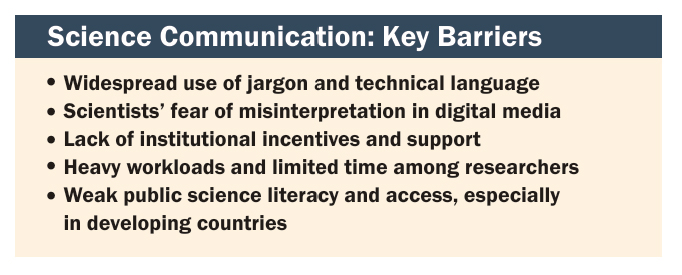
The communication problem often begins not with external hurdles, but within the culture of science itself. Before a single word is spoken to the public, an internal mindset can prevent scientists from effectively sharing their work. Some researchers operate with what former Indian minister Jairam Ramesh calls a “high pad” mentality, believing their specialized knowledge places them above the need for public engagement.
As Ramesh recently points out at the Science Journalists Conference of India, Ahmedabad University, this attitude is a primary barrier: “Too often I find scientists sitting on a high pad thinking that they have a better knowledge than the rest of the people… they speak in jargon they speak in their own language and they are really appealing to the community and not necessarily to the non-scientific community.”
Dr. Abhijit Majumdar of IIT Bombay acknowledges that scientists are often poor communicators — but he stresses a deeper issue: “Before learning how to communicate, scientists must first appreciate the need to communicate with the general public.” That awareness, he says, is still lacking in many settings. Experts note that this gap persists for two key reasons. The first is mindset: a cultural tendency to work in isolation — an “ivory tower inside their own ego.” The second is Language: after years of specialization, many scientists use technical vocabulary without realizing it’s incomprehensible jargon to outsiders, effectively building a wall where they intend to build a bridge. Overcoming this internal culture is the first step toward unlocking the mutual benefits of communication.
It’s Not ‘Dumbing Down,’ It’s a Two-Way Street
A fundamental misunderstanding of science communication is that it’s simply “dumbing down” complex work; in reality, it is a transformative, two-way exchange that can lead to deeper insights for the researchers themselves.
When scientists are challenged to explain their work to non-experts, they must distill complex ideas to their “’observable conceptual’ level.” This act of translation often forces them to see their own work from a new perspective, uncovering fresh insights. As Dr. Majumdar states, the benefits flow in both directions:
“It’s a two-way street, it is beneficial for the sides if we learn how to communicate.”
Furthermore, this process can generate questions from the public that are “much more superior” to those scientists typically receive from their peers, pushing their research in new and unexpected directions.
A Scientist’s Silence Creates a Vacuum for Misinformation
In our modern digital world, many scientists are hesitant to speak publicly, “scared that one wrong use of the work can be taken out of the context,” potentially leading to professional backlash. While this caution is understandable, it creates a dangerous paradox.
When credible experts stay silent on a complex issue, they create an “information vacuum.” That empty space will not remain empty for long. It is inevitably filled by less informed, less qualified, or even malicious actors eager to become the spokesperson on the topic. The silence of experts, therefore, directly enables the spread of false narratives.
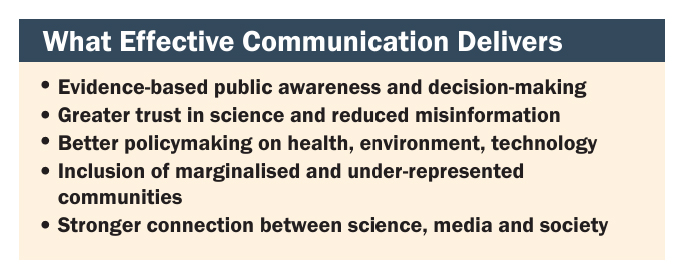
In an era with a “lot of misinformation,” the proactive solution is a strong partnership between cautious, responsible scientists and trusted journalists. This collaboration is the public’s best and most powerful defense against falsehoods.
The System Itself Is Designed to Fail
Even when individual scientists are willing to engage, they are often crushed by systemic and structural barriers. The larger systems governing science and media are frequently not built to support public communication, a problem that is truly global in scope.
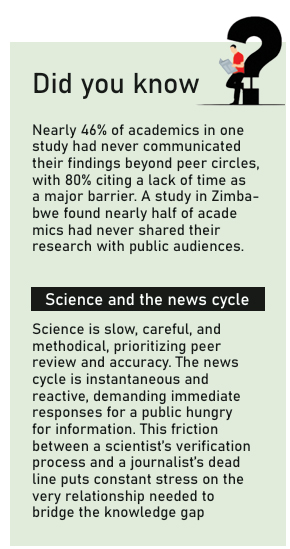
Studies reveal a stark reality. Nearly 46% of academics in one study had never communicated their findings beyond peer circles, with 80% citing a lack of time as a major barrier. A global survey of geoscientists found that while 90% believe they have a moral duty to engage, 87% identified a lack of funding as a key obstacle. This isn’t confined to one region; a study in Zimbabwe found nearly half of academics had never shared their research with public audiences.
In India, this is compounded by institutional support that suffers from “irregular funding” and offers little incentive for sustained engagement. Interestingly, a 2020 Pew Research survey found that 75% of Indians believe government investment in science is worthwhile, suggesting a public appetite for knowledge that the system is failing to meet.
Further straining the system is the inherent conflict between the clashing timelines of science and journalism. Science is slow, careful, and methodical, prioritizing peer review and accuracy. The news cycle is instantaneous and reactive, demanding immediate responses for a public hungry for information. This friction between a scientist’s verification process and a journalist’s deadline puts constant stress on the very relationship needed to bridge the knowledge gap.

In Policy, There’s a Structural Wall Between Science and Law
Even when science successfully reaches the public, the final link in the chain—influencing policy—is often completely broken. In India, for instance, Jairam Ramesh describes a profound structural disconnect between the nation’s scientific community and its lawmakers.
He explains that Members of Parliament receive their information almost exclusively from “government bodies” and “ministries,” not from the independent scientific institutions that house the country’s experts. This has led to a glaring absence of science-informed debate on some of the most critical issues facing the nation, including:
- GM crops
- Nuclear policy
- The increasing frequency of landslides and earthquakes
Global warming and its impact on agriculture, health, and energy
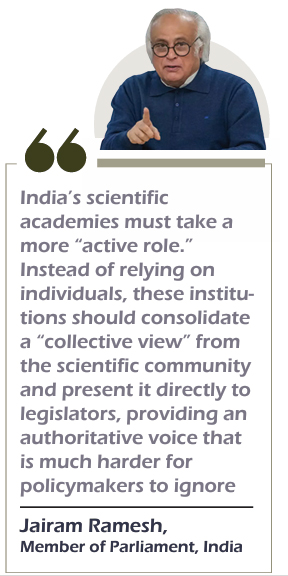
To fix this, Ramesh proposes that India’s scientific academies must take a more “active role.” Instead of relying on individuals, these institutions should consolidate a “collective view” from the scientific community and present it directly to legislators, providing an authoritative voice that is much harder for policymakers to ignore.
Building the Bridge, Together
Mending the broken “chain of knowledge” is not a simple task, nor is it the responsibility of a single group. It requires a collaborative effort from scientists who see communication as a duty, journalists who build trust and provide context, and institutions that create systems that reward and support public engagement.
Breaking down these barriers is a critical responsibility for any society that wishes to be guided by evidence and shared understanding. By strengthening every link in the chain—from the lab to our laws—we can build the bridge to a future shaped by insight and reason. If knowledge is power, how can we each help ensure it flows to where it’s needed most?

Society
Why Campuses Need a Happiness Officer Now
Rising student stress and depression highlight the need for a happiness officer on campus to promote wellbeing and prevent mental health crises.


As student stress and mental health challenges rise, educational institutions must move beyond symbolic gestures and invest in structured wellbeing systems—starting with a dedicated happiness officer on campus.
The rising need for happiness
20 March was celebrated as the International Day of Happiness.
The idea of creating an International Day of Happiness is a great one; it deserves to be taken seriously. However, there is a need to do much more than celebrate happiness for just one day a year. This becomes crucial when one considers the rising problem of stress, depression and suicides among young people around the world, including in India.
The challenges of stress, depression and suicides among students
The education system places significant pressure on students, yet they are rarely taught how they, their parents, teachers or the system itself can help them cope with this pressure—or how to view their efforts in the right perspective.
Because of a lack of awareness, education and capability, stress has become a major issue in students’ lives, often leading to depression and, in some cases, suicides. These challenges have far-reaching negative impacts across different aspects of life, as supported by multiple research studies.
A happiness officer on campus
Since happiness is an essential ingredient for a fulfilling life—and also acts as a preventive factor in dealing with stress—it is important to give it greater importance in educational institutions.
Institutions already place heavy demands on faculty and staff, who may not have the time to actively focus on student wellbeing. In this context, employing a dedicated happiness officer to address health and wellbeing on campus could be a significant step forward.

The happiness officer’s primary responsibility should be to raise awareness about happiness, as well as the dangers of stress and depression, among students, faculty, staff and others on campus. This awareness must be continuous rather than occasional.
The second responsibility should be to organise regular programmes in engaging ways, covering themes such as what happiness is, why it matters, and how it can be cultivated, alongside practical approaches to understanding, avoiding and managing stress.

The third responsibility should be to track individuals who may be experiencing stress or depression and ensure they receive timely support. Additional responsibilities can be developed depending on the needs and context of each institution.
Avoiding the trap of tokenism
However, awareness initiatives and programmes must be implemented with sincerity and intent. The happiness officer must work in both letter and spirit to create meaningful impact, rather than simply fulfilling formal requirements.
This role should not fall into the common institutional trap where ticking boxes becomes more important than creating real change on the ground.
Society
The hidden fault lines of global energy: why oil and gas chokepoints are a permanent risk
What are “paper chokepoints” in global energy markets?


Global energy chokepoints pose persistent risks to oil and LNG supply, with E3G warning import-dependent economies face long-term vulnerability.
Even in an era of apparent energy abundance, the global system that powers economies is built on a fragile foundation: a handful of narrow maritime routes that cannot be bypassed.
A new analysis by E3G warns that these global energy chokepoints—from the Strait of Hormuz to critical shipping corridors in Asia—are not occasional vulnerabilities but permanent features of the fossil fuel economy.
A system where disruption is inevitable
For decades, energy security has been framed as a question of supply: more oil, more gas, more infrastructure. But the report challenges that assumption, arguing that supply expansion does little to address the deeper structural risks embedded in global trade routes.
Introducing the findings, Richard Smith, a senior policy advisor at E3G, cautioned that recent tensions around key transit routes are not exceptional.
“What we’re seeing in Hormuz isn’t a freak, one-off event. It’s an inherent and unavoidable part of the global oil and gas system. Even though we were just in an era of low price and oversupply, globally integrated fossil fuel markets leave all oil and gas consumers bracing for an inflation shock. Renewables aren’t without risk – there are also solar panels stuck in Hormuz right now. But for every solar panel that makes it through, that’s secure energy every day for a generation. Renewables and energy efficiency are the only realistic way to escape this crisis loop.”

The implication is stark: even in well-supplied markets, the concentration of energy flows through a limited number of routes ensures that disruption remains a constant threat.
The rise of “paper chokepoints”
While physical blockages—conflict, piracy, or accidents—remain the most visible risks, the report highlights a quieter and increasingly influential set of constraints.
So-called “paper chokepoints” include shipping bottlenecks, insurance withdrawals, regulatory barriers and climate-related disruptions. None require a single tanker to be stopped outright, yet all can constrict supply and drive up prices.
Because oil and LNG markets are deeply interconnected, these disruptions cascade quickly across regions. A bottleneck in one location can trigger volatility far beyond it, intensifying competition for cargoes and amplifying price shocks.
This interconnectedness means that even countries not directly reliant on a specific chokepoint are still exposed to its consequences.
Asia’s vulnerability—and India’s economic exposure
The risks are most acute in Asia, which depends heavily on energy imports moving through a small number of strategic routes.
Madhura Joshi, programme lead for global clean power diplomacy at E3G, pointed to the region’s deep exposure to the Strait of Hormuz.
“Asia receives nearly 90% of the oil and LNG transiting the Strait of Hormuz, and the consequences of prolonged disruption will be felt unevenly across the region. For India, sustained high oil prices translate directly into widening current account deficits, currency pressure, and fiscal stress that could constrain both growth and public spending. Japan and South Korea, among the world’s most LNG-dependent economies, face acute supply vulnerability with limited ability to absorb prolonged market tightness.
“This crisis makes clear that energy security for these economies cannot rest on access to the same fragile chokepoints; accelerating electrification and domestic clean energy is the most durable path to genuine resilience.”
For India, where energy imports are tightly linked to inflation, fiscal balance and currency stability, the stakes are particularly high. Prolonged disruptions are not just supply issues—they are macroeconomic shocks.
Energy security—and the illusion of control
The report reframes energy security as a question not simply of access, but of control. Maria Pastukhova, programme lead for energy transition at E3G, emphasised that reliance on distant supply chains fundamentally limits national resilience.
“Energy systems are a backbone of national security, but for many importers, that backbone depends on infrastructure and routes far beyond their control. Reliance on distant supply chains and chokepoints means disruption risk is built in. Clean energy systems are not immune to shocks, but they shift more of the system under domestic control and reduce exposure to geopolitical and market volatility. That is the strategic energy security lesson from this crisis.”
In other words, the vulnerability lies not just in scarcity but in dependence—on infrastructure and geopolitics beyond national reach.
A pathway out of the chokepoint trap
The analysis outlines a five-track strategy to reduce exposure, combining short-term crisis management with long-term structural change.
Emergency measures—strategic reserves, diversified suppliers, infrastructure protection—can help absorb immediate shocks. But they do not eliminate the underlying risks.
Only structural shifts—reducing reliance on imported fossil fuels through electrification, efficiency, storage and domestic clean energy—offer durable resilience.
Unlike fossil fuel systems, where exposure to chokepoints is persistent, clean energy systems become more secure over time as domestic capacity expands.
A permanent feature of the fossil fuel era
The report’s conclusion is clear: chokepoint risk is not a temporary disruption but a defining characteristic of the global oil and gas system.
As long as energy flows depend on narrow, contested routes, the possibility of sudden shocks—economic, political or logistical—will remain ever-present.
For policymakers, the question is no longer whether disruptions will occur, but how quickly they can reduce their exposure to them.
And in that transition, the shift to clean energy is no longer just a climate imperative—it is a strategic one.
Society
How China Is Redrawing the Global Map of Critical Minerals
China’s $120bn critical minerals investment is reshaping global supply chains and strengthening its dominance in the clean energy economy.

China’s $120 billion investment surge into critical minerals is not just about securing resources—it is about shaping the architecture of the global clean energy economy. As supply chains realign, the balance of industrial power is shifting in ways that could define the next century
The global energy transition is often framed as a technological race—who will build the best batteries, the most efficient solar panels, or the most advanced electric vehicles. But beneath this narrative lies a more fundamental contest: control over the raw materials that make these technologies possible.
Lithium, cobalt, nickel, rare earths—these are not just commodities. They are the building blocks of the new industrial economy.
Over the past few years, China has moved decisively to secure them.
A recent analysis by Climate Energy Finance (CEF) estimates that China has committed more than $120 billion in outbound investment into critical minerals and metals since 2023, spanning multiple continents and resource categories.
What this report documents is not merely investment flows, but the architecture of a new global green industrial order,” says Tim Buckley, report lead author and Director at CEF.
This is not a scattered set of deals. It is a coordinated strategy—one that is rapidly reshaping the global resource landscape.
Beyond Extraction: Building a System
Historically, global resource investment followed a familiar pattern: capital flowed from developed economies into resource-rich regions, extracting raw materials for export with limited local value creation.
China’s current approach marks a significant departure.
Instead of focusing solely on extraction, Chinese firms are increasingly investing in processing, infrastructure, and industrial ecosystems within host countries—building ports, railways, clean energy systems, and enabling manufacturing capacity.
As Associate Professor of the Australia–China Relations Institute at the University of Technology, Marina Yue Zhang notes, the strategy has moved “well beyond simple resource extraction towards a more integrated model linking resource acquisition with processing, infrastructure, manufacturing, and long-term industrial partnerships.”
The result is a vertically integrated system that connects resource acquisition, refining, and industrial production into a single coordinated framework.
China already dominates many parts of this chain—accounting for roughly 90% of global rare earth refining, over 70% of cobalt processing, and around 60% of lithium processing.
The Logic of Vertical Integration
At the heart of China’s strategy is a simple economic insight: control the entire value chain, and you control the market.
By investing simultaneously in mines, processing facilities, and downstream manufacturing, China reduces its dependence on external suppliers while increasing global reliance on its capabilities.
Buckley underscores the scale and intent of this approach: China has built “a vertically integrated green supply chain spanning every continent, combining state-directed capital with private enterprise execution at a speed and scale no competitor country comes close to matching.”
For competitors, replicating this model is not just a matter of capital—it requires alignment between policy, industry, and long-term planning.
A New Partnership Model in the Global South
One of the most significant shifts in China’s strategy is how it engages with resource-rich nations.
Earlier models of foreign investment were often criticised as extractive. Today, Chinese firms are increasingly offering in-country processing, infrastructure investment, skilled employment, and technology transfer in exchange for long-term resource access.
As CEF analyst Matt Pollard explains, these are “not just mining deals, but blueprints for green industrialisation,” offering pathways for emerging economies to build domestic industries.
For many countries in the Global South, this represents a significant opportunity—but also a strategic choice.
A Multipolar Shift
China’s resource strategy is unfolding in a rapidly changing geopolitical landscape.
As Western economies adopt more protectionist measures and retreat from multilateral engagement, China has expanded its global investment footprint—particularly across emerging markets.
Buckley argues that this divergence is accelerating China’s momentum: its trajectory is “one of adaptation and acceleration, not retreat,” even amid rising geopolitical tensions.
The result is a shift toward a more multipolar global economy, where influence is distributed across multiple centres rather than concentrated in traditional Western powers.
Supply Chain Risks and Strategic Vulnerabilities
China’s growing dominance also raises concerns.
The concentration of extraction and processing capacity creates risks for global supply chains, energy security, and industrial competitiveness.
Countries dependent on these supply chains face potential vulnerabilities—from geopolitical disruptions to market imbalances.
Efforts to diversify supply are emerging, including strategic collaborations such as Japan’s partnership with Australia’s Lynas Rare Earths to secure long-term supply.
But scaling such alternatives remains a complex and time-intensive challenge.
The Limits of Protectionism
In response to China’s rise, some governments have turned to tariffs, trade barriers, and restrictive policies.
While these measures may offer short-term protection, they do little to address the underlying structural gap.
The challenge is not simply one of market access—it is one of capability.
Without investment in processing, infrastructure, and industrial capacity, alternative supply chains remain incomplete. Protectionism, in this context, risks isolating economies rather than strengthening them.
More effective responses are likely to involve strategic partnerships and targeted investments, similar to emerging collaborations in rare earth supply chains.
Implications for India and Emerging Economies
For countries like India, the evolving resource landscape presents both opportunity and urgency.
India has ambitions to become a major player in clean energy manufacturing and supply chain diversification. It has a large domestic market, growing industrial capacity, and a strong talent base.
But it faces significant gaps.
Processing capabilities remain limited. Access to critical minerals is constrained. And integration across the value chain is still developing.
To compete effectively, India will need to move beyond isolated initiatives and adopt a more coordinated approach—linking resource access, industrial policy, and global partnerships.
More broadly, resource-rich nations face a strategic choice. They can remain suppliers of raw materials, or they can leverage current demand to build domestic industries and capture greater value.
China’s model offers one pathway. Whether others can develop alternatives will shape the future of the global economy.
The New Resource Order
The transition to a low-carbon economy is not just an environmental imperative—it is an industrial transformation.
At its core lies a simple reality: technologies may evolve, but they are built on physical resources. Control those resources, and you shape the trajectory of the transition.
China’s $120 billion investment surge is a reflection of this understanding. It is not merely securing supply—it is constructing a system.
The implications are profound.
As the world moves toward net zero, the question is no longer just who will innovate, but who will control the inputs that make innovation possible.
In that contest, the contours of a new resource order are already emerging—and China is at its centre.


Scientists Crack the Genetic Code Behind Seedless Grapes

Climate Change Could Turn Ocean Food into ‘Fast Food’, MIT Study Warns

Why Campuses Need a Happiness Officer Now

The hidden fault lines of global energy: why oil and gas chokepoints are a permanent risk

NASA to launch first crewed Artemis Moon mission on April 1
NASA to launch first crewed Artemis Moon mission on April 1

Climate change heat impact affected over 2.5 billion people

How China Is Redrawing the Global Map of Critical Minerals

Study Reveals How Ocean Bacteria Drive Plastic Biodegradation

Weather, Not Just Emissions, Driving PM2.5 Pollution in Indian Cities: Study

-

 Society3 months ago
The Ten-Rupee Doctor Who Sparked a Health Revolution in Kerala’s Tribal Highlands
-
COP305 months ago
Brazil Cuts Emissions by 17% in 2024—Biggest Drop in 16 Years, Yet Paris Target Out of Reach
-
Society3 months ago
From Qubits to Folk Puppetry: India’s Biggest Quantum Science Communication Conclave Wraps Up in Ahmedabad
-
Women In Science6 months ago
The Data Don’t Lie: Women Are Still Missing from Science — But Why?
-
Earth5 months ago
Data Becomes the New Oil: IEA Says AI Boom Driving Global Power Demand
-
COP305 months ago
Corporate Capture: Fossil Fuel Lobbyists at COP30 Hit Record High, Outnumbering Delegates from Climate-Vulnerable Nations
-
Space & Physics4 months ago
Indian Physicists Win 2025 ICTP Prize for Breakthroughs in Quantum Many-Body Physics
-
Health5 months ago
Air Pollution Claimed 1.7 Million Indian Lives and 9.5% of GDP, Finds The Lancet