Math
The 2026 Fields Medals: Four Proofs, Four Decades-Old Problems Solved
The 2026 Fields Medal honours Yu Deng, John Pardon, Jacob Tsimerman and Hong Wang for solving some of mathematics’ longest-standing problems.

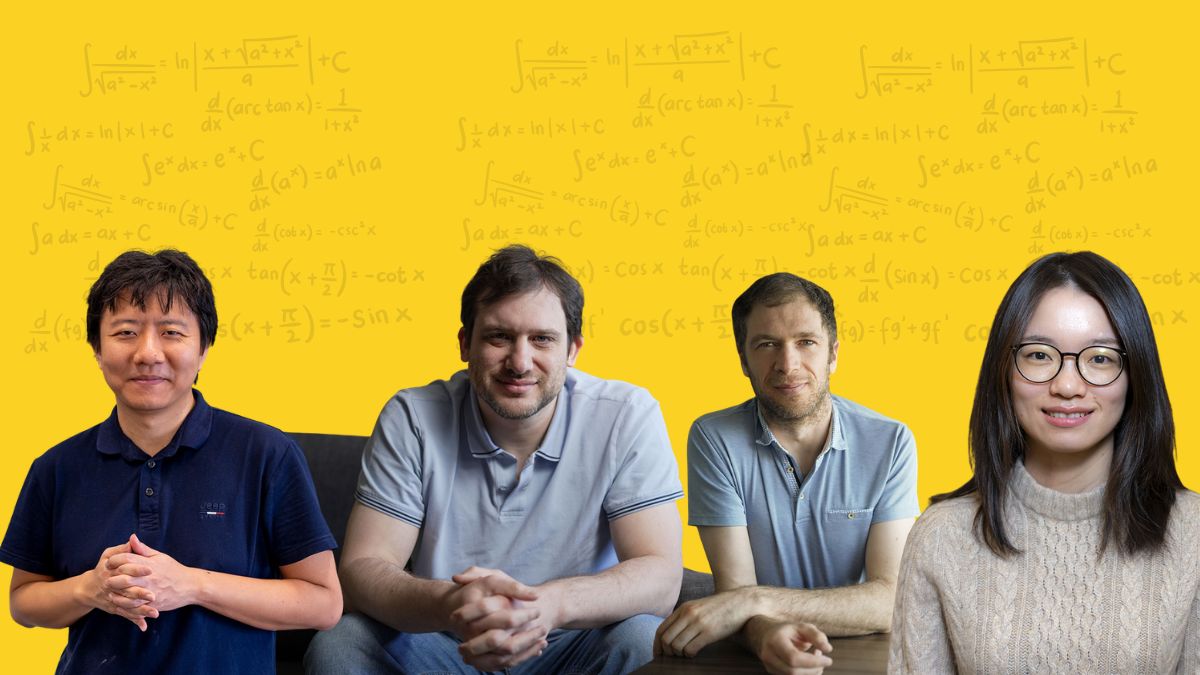
2026 Fields Medal winners Yu Deng, John Pardon, Jacob Tsimerman and Hong Wang were honoured for solving mathematical problems that had challenged researchers for decades. From Hilbert’s Sixth Problem to the Kakeya conjecture, their breakthroughs are reshaping modern mathematics.
Every four years, the International Mathematical Union hands out the closest thing mathematics has to a Nobel Prize. The Fields Medal comes with a modest cheque — 15,000 Canadian dollars, worth about US$10,600, a sum untouched since 2006 — and a gold medal stamped with the head of Archimedes. Nobody wins it for the money. They win it because a committee of the world’s leading mathematicians has decided that, sometime before their 40th birthday, they cracked something the rest of the field had been stuck on for years, sometimes decades.
This year’s ceremony, held on 23 July at the International Congress of Mathematicians in Philadelphia — the first time the congress has met in the United States since 1986 — went to four mathematicians: Yu Deng of the University of Chicago, John Pardon of Stony Brook University, Jacob Tsimerman of the University of Toronto, and Hong Wang of New York University and the Institut des Hautes Études Scientifiques in France. Wang is only the third woman to win the medal since it was first awarded in 1936, following Maryam Mirzakhani in 2014 and Maryna Viazovska in 2022. Deng and Wang are also the first Chinese-born mathematicians to win since Shing-Tung Yau in 1982.
2026 Fields Medal Winners: Four Mathematicians Who Solved Decades-Old Problems
Each of the four solved a problem that had outlasted its original solvers by a human generation or more. Here is what they actually did, and why it matters.
Yu Deng: connecting Newton to the weather
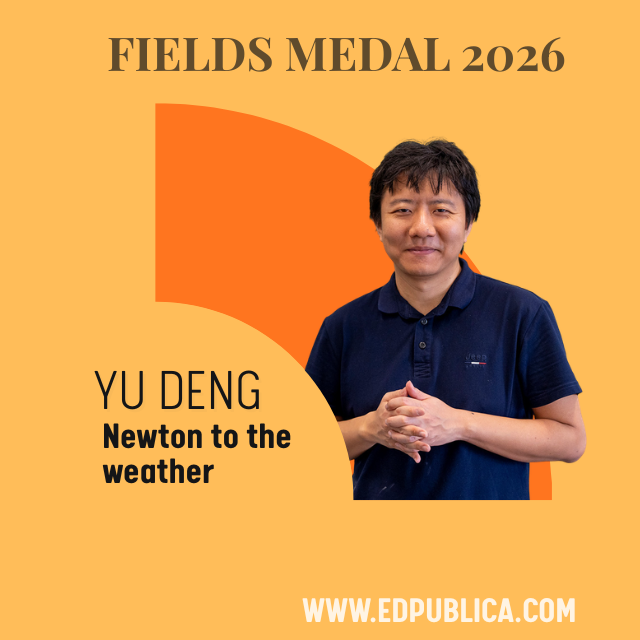
In 1900, the mathematician David Hilbert drew up a list of 23 problems he thought would define the coming century of mathematics. The sixth asked for something that sounds almost philosophical: a way to show, with full mathematical rigour, that the everyday physics of gases and fluids can be derived from the motion of individual particles bouncing off each other according to Newton’s laws.
Physicists had a working answer since the 1870s. Ludwig Boltzmann proposed an equation describing how a cloud of colliding particles settles into predictable statistical behaviour, and decades later, other equations described how that gas behaves as a continuous fluid — the same mathematics used to model weather systems and airflow over a wing. The trouble was the middle step. Nobody could prove that Boltzmann’s equation actually follows from Newton’s laws once you let the collisions run for a realistic length of time. An attempt in 1975 by the mathematician Oscar Lanford got partway there, but only for a fleeting initial period, before particles had the chance to collide with each other more than once.
Deng, working with Zaher Hani and Xiao Ma, closed that gap. Starting from a large number of hard spheres bouncing elastically inside a bounded space, they showed that even once particles start colliding with each other repeatedly — which happens constantly in any real gas — the overall statistical picture Boltzmann predicted still holds. They then carried the argument one step further, showing it leads to the equations that describe fluids as a continuous medium. For the first time, a straight mathematical line runs from a box of colliding billiard balls to the equations meteorologists use to predict tomorrow’s weather.
Deng had built toward this for years, having already proved — with Hani — that a related equation describing ocean and atmospheric waves emerges correctly from the underlying wave physics. Colleagues describe his working method as having less to do with sudden insight than with total command of the calculation: one collaborator recalled him reciting 200 pages of computation from memory. The Fields committee cited him for “the rigorous derivation of the Boltzmann equation from hard-sphere dynamics for rarefied gases,” alongside his work on wave equations and the mathematics of the Schrödinger equation.
John Pardon: curves, knots, and a 20-year-old disagreement
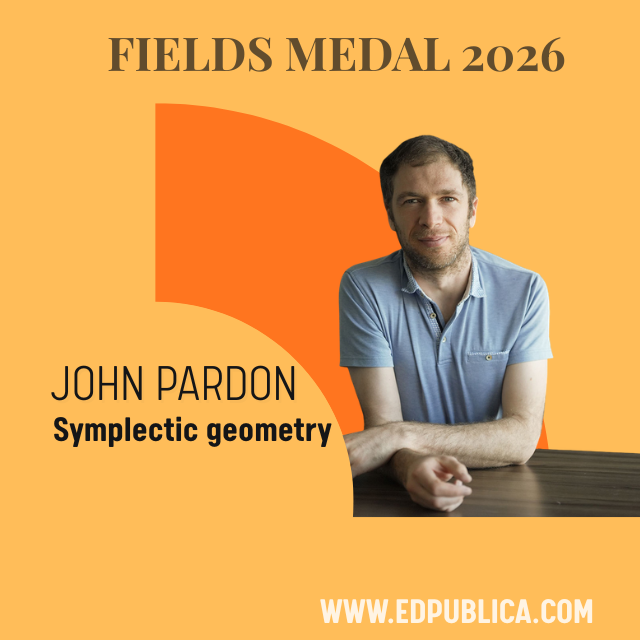
Pardon’s Fields Medal recognises work spread across several corners of geometry and topology, but the throughline is a knack for finding exactly the right structure to settle an argument that had stalled.
His first major result came as a Princeton undergraduate, when he answered a question the mathematician Mikhail Gromov had posed about how badly a knot can be distorted — essentially, how much you have to stretch and twist a loop of string to untangle it — a problem that had sat unsolved for more than two decades. He wrote the proof after a walk in an English park during a summer break; his Stony Brook colleague Simon Donaldson has said it is short enough to sit down and read in one sitting.
His most recent major achievement is in a very different area: counting curves. In string theory, physicists model the extra, curled-up dimensions of the universe using shapes called Calabi–Yau threefolds. Mathematicians had developed several competing methods for counting the curves that can be drawn on these shapes, and in 2006 a group of researchers — Maulik, Nekrasov, Okounkov and Pandharipande — conjectured that two of these methods, despite looking completely different, always produce the same answer. Pardon proved they were right, closing a conjecture that had stood for nearly 20 years and that touches on questions in representation theory and quantum physics as well as pure geometry.
In between, Pardon built new mathematical machinery — including a rigorous way to define “virtual fundamental cycles,” a technical tool symplectic geometers had relied on informally for years without a fully solid foundation — and made progress on the 70-year-old Hilbert–Smith conjecture, about which kinds of mathematical groups can act on ordinary space. The Fields committee’s citation runs through all of it: “achievements in symplectic geometry including new approaches to virtual fundamental cycles, Fukaya categories of certain manifolds and counting holomorphic curves,” and contributions to “group actions on 3-manifolds and knot theory.”
Jacob Tsimerman: finding order in scattered points
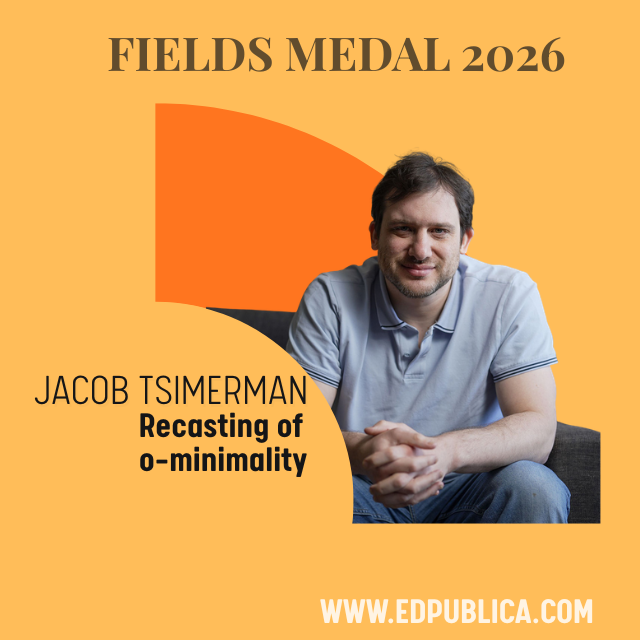
Tsimerman’s medal centres on a problem he first encountered as a Princeton graduate student and never really left: the André–Oort conjecture, which concerns certain “special points” that turn up inside geometric spaces used to encode deep arithmetic information — the kind of spaces number theorists use to study elliptic curves and modular forms. The conjecture predicted that these special points can’t scatter randomly; wherever they cluster, there has to be a hidden algebraic reason.
Proving it meant reaching outside number theory entirely, into a branch of mathematical logic called o-minimality, which had mostly been used to describe well-behaved geometric shapes rather than to prove theorems in arithmetic. Tsimerman, working with several collaborators over more than a decade, showed that o-minimal methods could be turned into genuine tools for algebraic and arithmetic geometry — recasting a fairly obscure logical framework into one of the sharper instruments in the field. Along the way, he and his collaborators Benjamin Bakker and Yohan Brunebarbe also proved the Griffiths conjecture, a separate longstanding problem about when certain geometric maps must be algebraic rather than merely analytic, and developed a set of techniques nicknamed “o-minimal GAGA” that let mathematicians detect hidden algebraic structure in spaces that don’t obviously have any.
Colleagues describe him as unusual in combining two different temperaments: he is, as his doctoral adviser Peter Sarnak put it, both “a problem solver and a theory builder” — someone who chases a specific hard question to the end, and also builds the general-purpose machinery that outlives the original problem. The Fields committee credited him “for his contribution in the recasting of o-minimality as a fundamental method of arithmetic and complex algebraic geometry, and his role in the proof of many central conjectures including Griffiths’ conjecture… and the André–Oort conjecture for Siegel modular varieties.”
Hong Wang: how small can a needle’s path be?
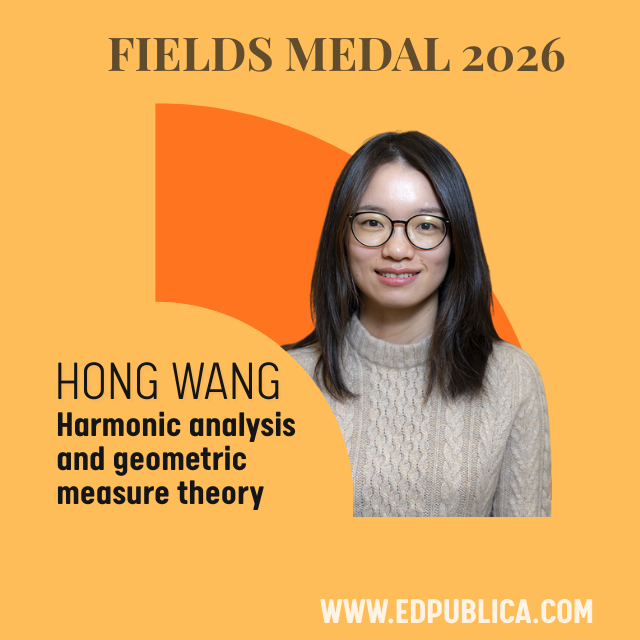
The Kakeya problem started as a puzzle. In 1917, the Japanese mathematician Sōichi Kakeya asked: what is the smallest area in which you can rotate a needle a full 180 degrees, so that it points in every direction at some point during the rotation? The surprising answer, worked out not long after, is that the area can be made arbitrarily small — the needle can sweep through every direction while confined to a spiky, star-shaped region with almost no area at all.
That answer only deepened the underlying question, which mathematicians have spent a century turning into one of the hardest open problems in the field: if a set has to contain a full line segment pointing in every possible direction, how “thin” can it possibly be? In three-dimensional space, the conjecture held that such a set could have zero volume, but could never be less than three-dimensional in a more technical sense involving something called Hausdorff dimension — it could be thin, but not too thin. Despite real progress by several mathematicians over the decades, including some announced proofs that were later found to contain errors, a full proof in three dimensions had eluded everyone who tried it.
In February 2025, Wang and her collaborator Joshua Zahl posted a 127-page proof settling the three-dimensional case. Wang had picked up the trail during the pandemic, working from a strategy the mathematician Terence Tao had sketched in a 2014 blog post but never carried through. She and Zahl spent months quietly checking their own argument — sending it to a handful of trusted colleagues before making it public, still worried less that it contained an error than that it might simply be unclear. It wasn’t. Nets Katz, another mathematician who had spent years on the same problem, called it “a once-in-a-century kind of result.”
The proof’s significance runs beyond the needle puzzle itself. The Kakeya conjecture sits at a junction between geometric measure theory, harmonic analysis, and number theory, and results in one area often unlock progress in the others — number theorists studying prime numbers and analysts studying how waves focus and spread have both drawn on Kakeya-type reasoning before. The Fields citation recognises Wang for “her major advances in Fourier restriction and the Kakeya problem,” building on a body of work that, colleagues say, has already reshaped how both fields are studied.
A prize built around a deadline
What ties these four together isn’t a shared subject. Deng works in the mathematics of fluids and waves, Pardon in geometry inspired by string theory, Tsimerman in the arithmetic of number theory, Wang in the geometry of how shapes fill space. What they share is the medal’s defining constraint: all the work being honoured happened before each of them turned 40, a rule the medal’s namesake, the Canadian mathematician John Charles Fields, set deliberately when he funded the prize from the surplus of the 1924 mathematics congress in Toronto. Fields wanted a prize that rewarded not just what a mathematician had already done, but the likelihood that their best work was still ahead of them.
Three of the four — Deng, Pardon, and Tsimerman — did their doctoral work at Princeton, under different advisers and in different decades, a detail that says as much about how mathematical talent gets identified and trained as it does about any one institution. All four, notably, solved problems that had been sitting in plain sight for a long time: Hilbert’s sixth problem waited 125 years, the MNOP conjecture 20, the André–Oort conjecture more than three decades, and the three-dimensional Kakeya conjecture the better part of a century. None of the four found a shortcut. Each built, over years, the specific tools their problem needed — and then used them.













Learning & Teaching
What India’s Foundational Learning Crisis Is Really Telling Us About Math
“They Can Count in the Market, But Not in the Classroom”: What India’s Foundational Learning Crisis Is Really Telling Us

Earlier this year, EdPublica reported on an unsettling truth emerging from a collaborative study by MIT and Indian education researchers: Indian children demonstrate impressive mathematical ability when navigating real-life situations—like calculating change in a vegetable market—but often fail when asked to solve similar problems in the classroom. The findings struck a chord, revealing a deep fracture between what children learn and how they learn it.
Now, new data from the government-backed PARAKH Rashtriya Sarvekshan 2024 confirms the broader scale of that crisis. Together, the two reports offer a sobering diagnosis of foundational learning in India—and an urgent call to rethink how education is delivered.
The transfer gap: Street-smart, classroom-stranded
In the February study we reported on, researchers observed that children who work in markets—some out of necessity—could perform complex mental arithmetic swiftly and accurately. But the same children struggled with formal school problems like structured division or textbook subtraction. Meanwhile, their peers in schools did well on written math tests but faltered when asked to apply the same concepts in spontaneous, real-life situations.
This disconnect isn’t just about math—it’s about transferability. What good is education if it doesn’t translate beyond the exam sheet?
PARAKH’s alarming snapshot
The Performance Assessment, Review, and Analysis of Knowledge for Holistic Development (PARAKH) is India’s new national assessment platform launched under the National Education Policy 2020. Managed by the NCERT in collaboration with CBSE and overseen by the Ministry of Education, PARAKH represents a shift away from traditional rote exams to competency-based evaluation.
Its first large-scale survey, conducted in December 2024 across 23 lakh students from Classes 3, 6, and 9, paints a picture that is both revealing and troubling.
In Class 3, only 55% of students could correctly sequence numbers up to 99 or perform simple addition and subtraction. By Class 6, just 53% had mastered multiplication tables up to 10. Math proficiency hovered at 46% overall. The pattern held across language and environmental studies as well.
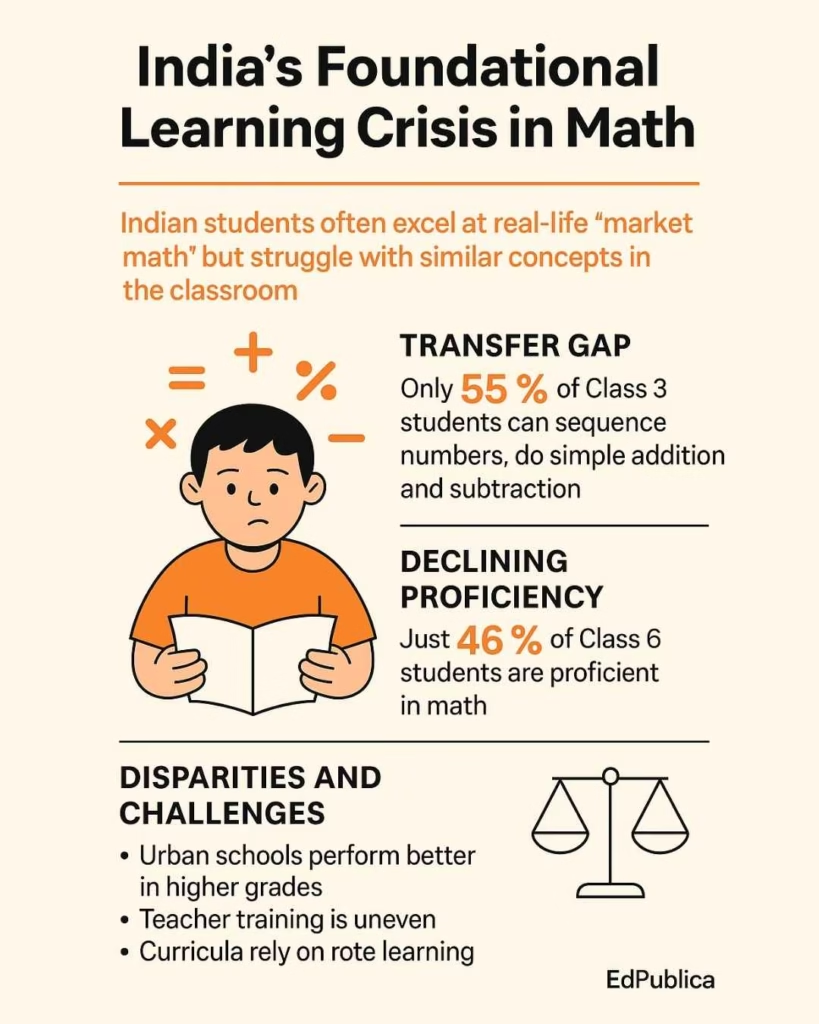
Perhaps most alarming is the steady decline in foundational ability as students progress. What begins as a fragile grasp in Class 3 becomes a gaping void by Class 9.
Where you study matters
The data also revealed a curious twist: in Class 3, rural students marginally outperformed their urban peers in both math and language. But by Class 6 and 9, the urban students pulled ahead decisively. It suggests that whatever edge rural systems may offer in the early years is quickly lost due to resource constraints, poor infrastructure, or lack of academic support.
Meanwhile, central government-run schools—such as Kendriya Vidyalayas—consistently outperformed state-run and aided schools, particularly in mathematics. The gaps are not just between regions, but embedded within the structure of the system itself.
A system teaching at children, not with them
What both the MIT study and the PARAKH survey show is this: India’s education system, despite enormous progress in enrolment and infrastructure, still hasn’t solved the puzzle of meaningful learning. It teaches children how to arrive at the “right” answer on paper, but not how to reason, estimate, or solve problems in the real world.
This isn’t simply a curriculum issue—it’s pedagogical. Teachers often default to formulas and procedures, driven by syllabus completion and exam pressures. Conceptual understanding, critical thinking, and the space to make mistakes are rare in crowded classrooms with little support for differentiated learning.
Moving from numbers to nuance
To its credit, the Ministry of Education has recognized this crisis. The PARAKH framework is designed not just to assess but to inform change. Its next phase will involve teacher workshops, state- and district-level consultations, and detailed “health reports” of learning outcomes.
A country with one of the youngest populations in the world cannot afford a foundational crisis
But meaningful change will require more than data. It demands political will, sustained investment in teacher training, reduced pupil–teacher ratios, and a shift in classroom culture. Most of all, it requires a rethinking of what education is meant to do—not just pass students from one grade to the next, but prepare them for life.
The stakes couldn’t be higher
A country with one of the youngest populations in the world cannot afford a foundational crisis. Poor learning in early years compounds over time, leading to disengagement, dropout, and economic vulnerability. The students struggling to divide 96 by 8 today are tomorrow’s workforce—and the gaps in their learning will define the future of the nation.
If India wants to reap its much-discussed demographic dividend, it must invest in the one thing that can turn numbers into citizens, and citizens into leaders: deep, transferable learning.
-

 Climate2 months ago
After Kerala’s Deadliest Landslide, the Hardest Thing to Rebuild Was Childhood
-
Society3 months ago
West Asia Crisis: Can Kerala’s Returning Gulf Migrants Find a Future in the Green Economy?
-
Space & Physics4 months ago
India Semiconductor Mission: ‘It’s Not About Fabs. It’s About Building An Entire Ecosystem’
-
Climate4 months ago
The Climate World Cup? How Climate Change Could Affect Player Performance at the 2026 World Cup
-
Society2 months ago
What Is Civilisational Diplomacy? Understanding India’s Newest Foreign Policy Tool
-
Society3 months ago
From Bell Labs to the Classroom: A Second Career in Teaching
-
Space & Physics4 months ago
Engineers Develop Dual-Mode Propulsion System for Next-Generation Small Satellites
-
Sustainability3 months ago
Sharing Over Shopping: How Kerala’s Swap House Is Modelling a Different Way to Consume