The Sciences
Fossilized skin soaked in petroleum!
Paleontologists confirmed a rare discovery of what may now be the oldest, fossilized skin found yet amongst vertebrate animals called amniotes.


The fossilized skin was unearthed at Richard Spurs, a known Permian-age fossil facility, and the find is presumed to be from the now-extinct reptilian species Captorhinus aguti (C. aguti for short).
Upon closer examination, paleontologists additionally discovered petroleum in the sample, helping explain how the skin never decomposed and was kept intact for what could be over 289 million years – an estimation made using U-Pb dating techniques done over stalagmite at the Richard Spurs facility in Oklahoma.
Fossil collectors Bill and Julie May, who discovered the skin, had a working relationship lasting years with paleontologists Robert Reisz, Ethan Mooney and Tea Maho, all from the University of Toronto, Mississauga in Canada.

Source: Mooney, E. et. al (2024)
To the paleontologists however, the discovery was shocking, given the rarity of finding such preserved skin. In a Nature report, Stephanie Drumheller-Horton, a taphonomist at the University of Tennessee, Knoxville, who was not involved in the study, was quoted saying, “Any time we’re asking questions in palaeontology, we’re at the mercy of what has ended up in the fossil record.” Getting something as soft and prone to decomposition as skin is a “fantastic window into the evolution of those groups.”
The research was published in a peer-reviewed journal Current Biology, and is available for online access.
References:
- Mooney, E. et. al (2024), ‘Paleozoic cave system preserves oldest-known evidence of amniote skin’, Current Biology. Date Accessed: 20/01/2024
- Emma Marris, Nature











The Sciences
MIT Researchers Develop Origami-Based Method for Lightweight, Load-Bearing Structures
MIT researchers have developed an origami-inspired construction technique that could enable lightweight, rigid structures using less material and simpler assembly methods.
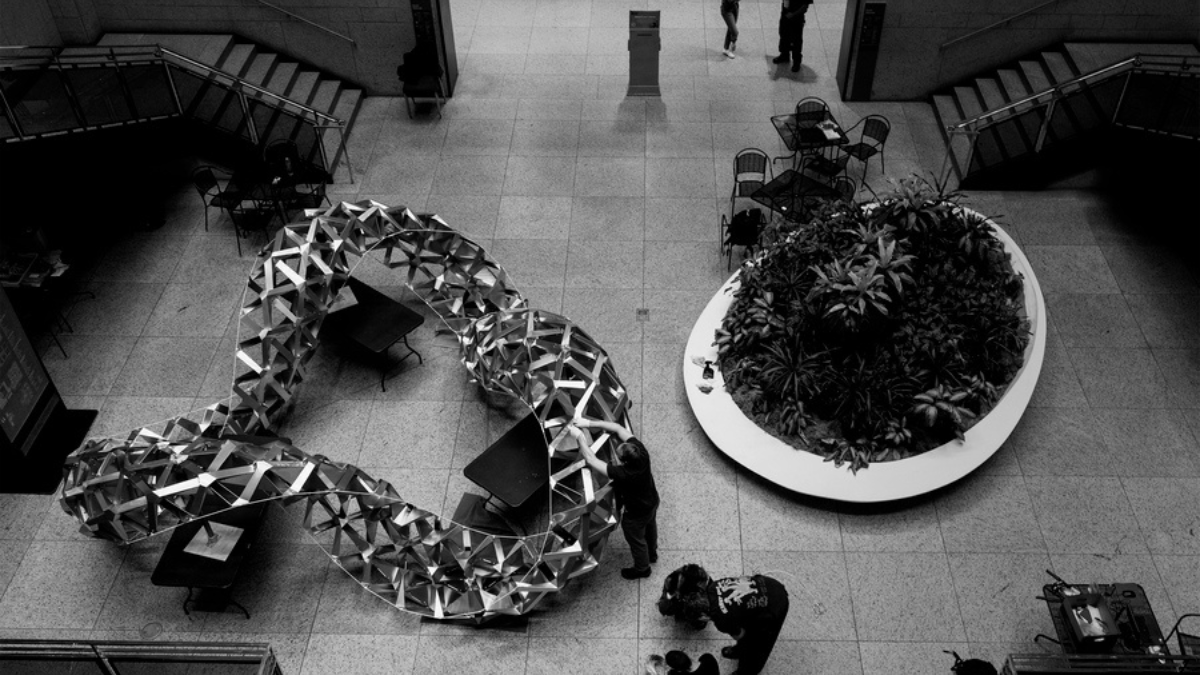
Researchers at the Massachusetts Institute of Technology (MIT) have developed an origami-inspired construction method that could enable the fabrication of lightweight, rigid structures using less material and simpler assembly techniques. The approach could eventually be used for emergency shelters, architectural components and lightweight aerospace parts.
The modular system uses components cut from flat sheets of material, folded into shape and connected to form three-dimensional structural shells. According to MIT, simulations indicate that the structures can be approximately 3.5 times stiffer than those produced using some other structural origami techniques, while requiring only about two-thirds as much material.The research was announced by MIT on October 27 and published in the International Journal of Solids and Structures.
Building structures through folding
The researchers drew inspiration from geometric patterns developed by artist and scientist Ron Resch in the 1960s. Unlike methods that fold a single sheet into a complete structure, the new approach uses individually fabricated components that are folded and connected to create a larger framework.
Alfonso Parra Rubio, a graduate student at MIT’s Center for Bits and Atoms and lead author of the study, developed a method for combining two tripod-shaped units into a rigid building block. These blocks can be interconnected to form a network of beams that creates a lightweight structural shell.
To simplify the design process, the team developed computational software that automatically generates components according to the intended structure. The software checks whether individual units can be folded before combining them into the final design.
The resulting files can be sent to computer-controlled cutting equipment to manufacture components from flat sheets of material, including aluminium. Workers can then fold and assemble the units using basic hand tools, without requiring large-scale welding equipment.
Demonstration at architectural scale
To demonstrate the method’s scalability, the researchers constructed a 23-foot folded-aluminium sculpture that was installed in the atrium of the Boston Public Library. According to MIT, a team without professional construction experience assembled the structure in a matter of days.
The researchers say the modular design simplifies assembly because the components are engineered to fit into their intended positions as the structure takes shape.

Representational image.Image credit:Pexels
However, the reported stiffness improvements are based on simulations comparing the method with other origami-based systems. Further testing will be necessary to establish its performance across different materials, loading conditions and real-world construction environments.
Potential applications
One potential application is disaster-relief housing. Flat-packed components could be transported efficiently to areas affected by earthquakes or floods and assembled on site, potentially reducing transportation and construction requirements.
The approach could also be explored for lightweight aerospace components, modular robots, sound-dampening panels and building facades. Its ability to create rigid structural shells without interior support columns could offer additional flexibility in architectural design.
The researchers plan to test the technique in larger architectural structures and investigate more complex component geometries that could improve strength and stiffness. They also intend to develop a more accessible interface for designing structures using the system.
While the method has yet to demonstrate widespread use in buildings, the research illustrates how geometric design and digital manufacturing could offer alternatives for constructing complex structures.
Its practical adoption will depend on factors including durability, manufacturing costs, structural safety and performance under real-world conditions. Nevertheless, the approach presents a potential option for applications where reducing material use and simplifying assembly are priorities.
Space & Physics
Indian-Belgian Team Develops Portable Detectors to Image Mountains and Monuments Using Cosmic Rays
Portable cosmic-ray detectors could help researchers examine mountains, tunnels and historical monuments without invasive procedures, opening new possibilities for scientific imaging and infrastructure inspection.
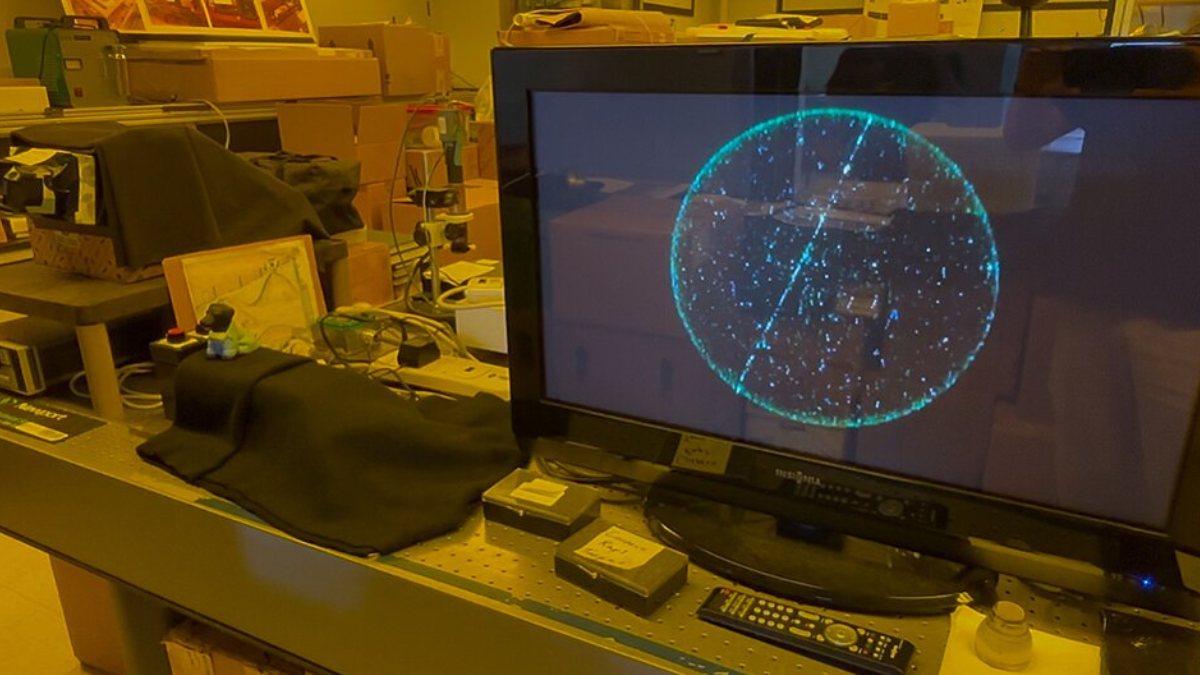
An international team of researchers from India and Belgium has developed portable particle detectors that could help scientists examine the interiors of mountains, tunnels and historical monuments without damaging them. The technology uses naturally occurring cosmic-ray particles to map variations in the density of objects, offering a potential approach to non-invasive imaging of large structures.
The detectors, developed using glass-based Resistive Plate Chambers (RPCs), achieved a particle-detection efficiency exceeding 95% during testing, according to a report published by Research Matters on October 24, 2026. The findings demonstrate the potential of compact detector systems to investigate dense materials and support future applications in geology, archaeology and infrastructure assessment.
The collaboration includes researchers from India’s National Institute of Science Education and Research (NISER), Bhubaneswar, and the Homi Bhabha National Institute (HBNI), alongside researchers from Belgian institutions, including Université catholique de Louvain and the Inter-University Institute for High Energies.
How cosmic rays reveal hidden structures
The technology uses muons, high-energy particles produced when cosmic rays interact with Earth’s atmosphere. These particles continuously reach the Earth’s surface and can penetrate substantial thicknesses of rock, concrete and other materials.
As muons travel through an object, some are absorbed or deflected depending on its density and thickness. By measuring the number and trajectories of particles passing through a structure, researchers can identify variations in internal density and reconstruct images of otherwise inaccessible areas.
The technique, known as muography, is comparable in principle to X-ray imaging, but uses naturally occurring particles instead of an artificial radiation source. It has previously been used to investigate geological formations, including volcanoes, and to explore archaeological structures.
However, conventional muon detectors can be bulky, difficult to transport and challenging to operate in remote locations. The new glass-based detectors aim to address some of these limitations through a compact design and sealed operation, reducing dependence on continuous gas supplies.
Testing the detector system
The researchers developed three glass RPC prototypes using thin glass electrodes separated by gas-filled gaps. When a muon passes through a chamber, it ionises the gas, generating an electrical signal that can be recorded to determine the particle’s position.
Electronic readout systems capture these signals and help reconstruct the trajectories of incoming particles. During testing, the detectors achieved an efficiency exceeding 95%, with a timing resolution of approximately 1.8 nanoseconds, according to the research report.
To examine the system’s ability to detect dense materials, the team conducted an absorption experiment using one prototype. During an open-sky measurement, researchers recorded nearly 55,000 muon tracks. After placing a lead block in the experimental setup, the recorded count fell to 30,894, demonstrating how dense material reduced the number of particles reaching the detector.

Representational image.Image credit:Pexels
The experiment provided proof of principle that the system could measure muon attenuation and support radiographic imaging. However, imaging complex structures such as mountains or monuments requires measurements from multiple directions and further computational reconstruction.
Applications and challenges ahead
Portable muon detectors could eventually help researchers investigate hidden cavities, examine geological formations, inspect tunnels and study the internal structures of historical monuments. Engineers could also explore their application in assessing infrastructure such as dams and bridges, although these uses would require additional testing and validation.
For cultural heritage conservation, muography could offer a valuable alternative where drilling or other invasive investigations risk damaging fragile structures. A 2025 review published in iScience highlighted the technique’s potential as a complementary, non-destructive method for studying cultural heritage objects, while noting that the relatively low flux of naturally occurring muons can require lengthy data-collection periods.
The technology is not yet a universal replacement for existing inspection methods. Its practical application will depend on factors such as spatial resolution, detector size, measurement duration and the complexity of the structure being examined.
The researchers have proposed further improvements, including lighter structural materials, larger detector areas and enhanced readout systems. These developments could make the detectors easier to deploy and improve the quality of reconstructed images.
Technology
Thorium-229 Nuclear Clock Opens New Way to Probe Dark Matter
Scientists have demonstrated a working thorium-229 nuclear clock, opening new possibilities for precision timekeeping and research into dark matter.
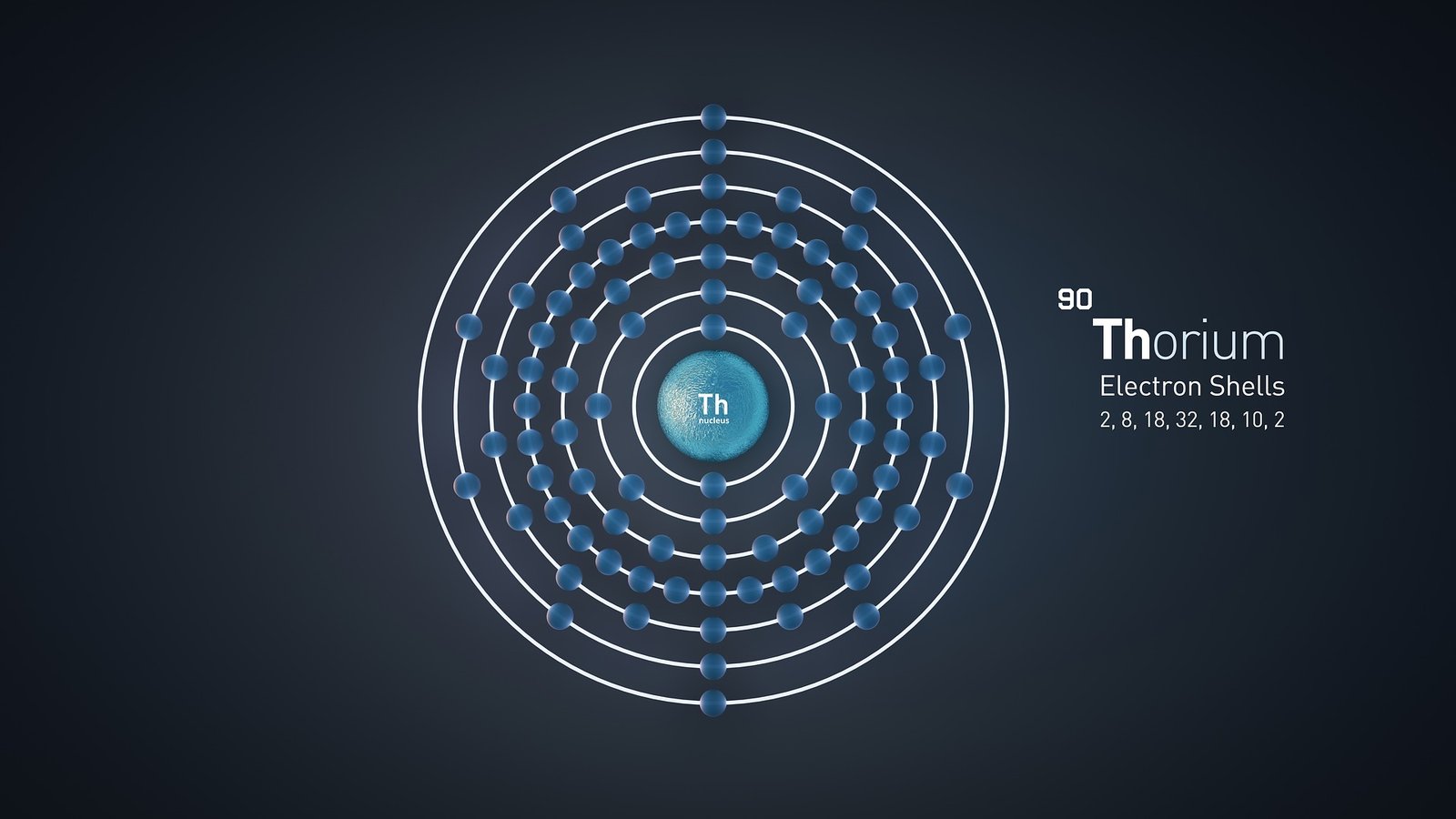
Scientists have demonstrated a working nuclear clock based on thorium-229, an advance that could open new possibilities for precision timekeeping and the search for dark matter. Unlike conventional atomic clocks, which measure transitions involving electrons, the device uses an energy transition inside an atomic nucleus. The clock operates with thorium-229 nuclei embedded in a small crystal at room temperature, offering a potential route towards compact and highly sensitive timekeeping technology.
The findings, published in Nature demonstrate how a laser can be continuously stabilised using the nuclear transition itself. The researchers also used the device to investigate whether dark matter might produce detectable changes in fundamental physical quantities.
From atomic transitions to the atomic nucleus
Modern atomic clocks measure the frequency of radiation associated with transitions between energy levels in atoms or ions. Because these frequencies are highly stable, they provide precise standards for measuring time and testing physical theories.
The proposed nuclear clock uses thorium-229, an isotope with an unusually low-energy nuclear transition that can be excited using ultraviolet light. Researchers have explored this possibility for decades because nuclear transitions are expected to be less sensitive to some external disturbances than electronic transitions.
In the new experiment, the researchers embedded thorium-229 nuclei in a millimetre-sized calcium fluoride crystal. The device operated at approximately room temperature, around 294.7 kelvin. A laser emitting radiation at a wavelength of 148 nanometres was used to probe the nuclear transition.
A central feature of the experiment was its feedback system. The researchers measured how much laser light the nuclei absorbed and used the resulting signal to correct the laser frequency. This allowed the nuclear transition to serve as the reference for stabilising the laser, rather than relying entirely on an external reference.
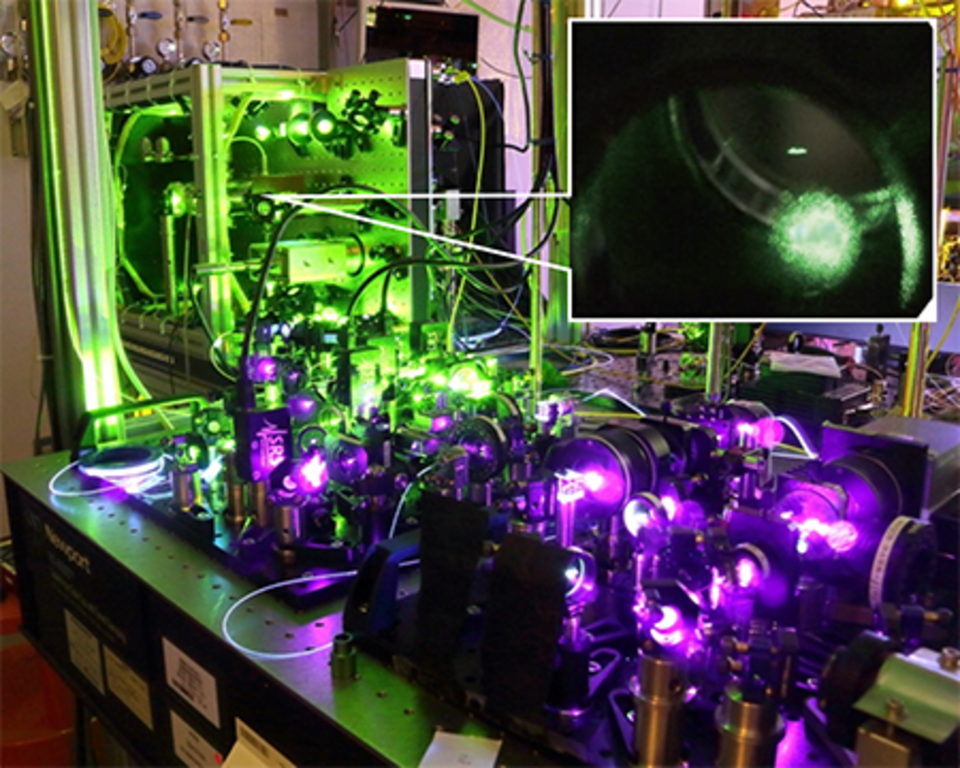
A ytterbium optical lattice clock at NMIJ, National Metrology Institute of Japan used to measure International Atomic Time (TAI).Image credi:Wikimedia commons
The team also compared the nuclear clock with an established ytterbium-ion optical clock. This comparison helped researchers assess the new device’s frequency stability and look for possible changes in the thorium transition.
A new tool in the search for dark matter
Beyond timekeeping, the clock offers a way to investigate possible changes in fundamental constants of nature. Some theoretical models propose that ultralight dark matter could cause these constants to vary over time, producing small changes in the frequencies measured by precision clocks.
The researchers compared the thorium clock’s frequency with that of the ytterbium reference over approximately 23 hours. They searched for periodic fluctuations and gradual drifts that could indicate such changes.
The experiment found no statistically significant periodic signal within the range examined. Instead, the measurements placed new limits on certain interactions between ultralight dark matter and ordinary matter. The resulting constraints were competitive with leading atomic-clock measurements for some photon-related interactions and improved previous constraints involving the strong nuclear force.
These results do not establish the existence of dark matter, nor do they rule out all possible models. They demonstrate how a nuclear clock can be used to test predictions that might otherwise be difficult to investigate experimentally.
Challenges remain
The device is still a developing technology. Its performance is limited by factors including laser power, measurement noise and variations in the crystal’s nuclear transition frequency at different locations. The researchers also identified reproducibility between measurements taken on different days as an important limitation.
They suggest that stronger ultraviolet laser sources and improvements to the crystal material could substantially improve the clock’s stability and sensitivity. Their projections indicate that future versions could approach the performance of leading optical atomic clocks while retaining the practical advantages of a solid-state system.
The demonstration marks a significant step towards nuclear clocks that can operate as standalone devices. Further improvements will determine how effectively the technology can support precision timekeeping and searches for new physics.


Dementia Risk Extends to Middle Age in Rural India, New Study Finds

Delhi’s Air Quality Paradox: Lower Average, Higher Everyday Pollution

Lesser Florican, Bengal Florican Top India’s Priority List for Bird Conservation, Study Finds

252 Million Hectares Under Restoration Across 149 Countries, but UN Warns of 2030 Target Gap

El Niño Could Help Forecast India’s Humid-Heat Risks Six Months Ahead, Study Finds

Knowing When to Think for Ourselves: AI, Intuition and the Education of Discernment

After a Scorching Summer, Delhi’s Children Are Slow to Return Outdoors

Two Chemists Win Nobel Prize for Solving a Century-Old Puzzle: Why Life Picks One Hand Over the Other

Marshall Islands: Why the US Nuclear Legacy Is Back Before the UN

Climate Change, Overfishing and the Uncertain Future of Bangladesh’s Hilsa Fishermen

-

 Math3 months ago
The 2026 Fields Medals: Four Proofs, Four Decades-Old Problems Solved
-
EP Deep Dive: Data & Solutions3 months ago
After Kerala’s Deadliest Landslide, the Hardest Thing to Rebuild Was Childhood
-
EP Deep Dive: Data & Solutions4 months ago
West Asia Crisis: Can Kerala’s Returning Gulf Migrants Find a Future in the Green Economy?
-
Space & Physics5 months ago
India Semiconductor Mission: ‘It’s Not About Fabs. It’s About Building An Entire Ecosystem’
-
Interviews1 month ago
From Scams to Screens: How the National Stock Exchange Rewrote India’s Equity Story
-
Climate5 months ago
The Climate World Cup? How Climate Change Could Affect Player Performance at the 2026 World Cup
-
Society4 months ago
What Is Civilisational Diplomacy? Understanding India’s Newest Foreign Policy Tool
-
Society5 months ago
From Bell Labs to the Classroom: A Second Career in Teaching