


Society
Why the Arts Matter As Much As Science or Math
It is time to recalibrate. To reclaim the arts not as an extra, but as essential. Not just because they improve test scores—but because they improve lives.

A decade ago, a quiet crisis was unfolding in classrooms across the world—a crisis that continues to deepen. As the race to master STEM subjects quickens and strategic thinking becomes the gold standard of education, another essential pillar of learning is being pushed to the periphery: the arts.
In corridors where brush strokes once danced, and where theatre, music and storytelling ignited young minds, silence now lingers. Time and resources are reallocated. Arts periods shrink. Drama rooms gather dust. And with every such decision, we inch closer to a narrow, fragmented vision of what it means to educate a human being.
This cultural shift—palpable in countries like India—has been unsettling for educators and researchers who have long argued that art is not an elective luxury, but an essential ingredient of a well-rounded education. One such voice is that of Dr. Ellen Winner, a leading scholar of arts education, who warned in an interview with this author nine years ago: “When schools cut short the time reserved for the arts and redirect it to what they call ‘important’ subjects, they’re not just risking the future of potential artists. They’re losing out on the inventors, the empathetic leaders, the bold thinkers of tomorrow.”
Her message was clear. The arts do not merely decorate our cultural fabric—they weave it. Ellen Winner, a leading expert in the psychology of art, is Professor Emerita of Psychology at Boston College and a Senior Research Associate at Project Zero. She is the author of five books, including Invented Worlds (1982), The Point of Words (1988), Gifted Children (1996), How Art Works (2019), and An Uneasy Guest in the Schoolhouse (2022). She has also co-authored five influential titles in arts education, notably the Studio Thinking series and The Child as Visual Artist (2022).
More Than a Side Show
To ask, “What is the role of the arts in shaping a person?” is to ask what kind of world we want to build. For centuries, societies have turned to art not just for beauty, but for insight—for truth. From ancient cave paintings to Renaissance frescoes to street murals that challenge injustice today, art has never been a passive pursuit. It has always spoken, always provoked, always taught.
And yet, as Dr. Winner noted in our conversation, “The arts are the only school subjects constantly required to prove their usefulness.”
Imagine applying the same standard to history, or even to sports. Suppose a school coach claimed that playing baseball boosts students’ math scores due to statistical scoring. If researchers debunked the claim, would school boards eliminate baseball from the curriculum? Of course not. Because we instinctively know that athletics builds discipline, teamwork, resilience. That it matters. So why not extend the same understanding to the arts?
Beyond the Test Scores
It is tempting—and common—for policymakers to justify the arts in terms of their “spillover effects” on math or reading. And indeed, there is research that shows a correlation: students exposed to the arts tend to perform better across disciplines. But relying solely on this line of defense, Dr. Winner cautioned, is dangerous.

The arts are not new. They have outlived empires. They have inspired revolutions. And they have told the stories of civilizations long after their rulers and battles were forgotten
“Arts education must not be justified only by its secondary benefits,” she said. “If we do that, we grant permission for it to be cut whenever those benefits don’t show up clearly on a chart.”
The truth is, arts education offers something far deeper. It cultivates imagination, nurtures curiosity, and fosters emotional intelligence. It teaches us to live with ambiguity, to see from multiple perspectives, to create from chaos. These are not fringe skills. These are survival skills—in life, and in leadership.
A Legacy We Must Honour
The arts are not new. They have outlived empires. They have inspired revolutions. And they have told the stories of civilizations long after their rulers and battles were forgotten.
Dr. Winner, summarizing a lifetime of scholarship, told me this:
“Let’s bet on history. Cultures have always been remembered by their art. The arts predate the sciences. Education that excludes them is impoverished—and it leads to an impoverished society.”
We would never teach a child only numbers and grammar and send them out into the world. Yet when we sideline the arts, that’s exactly what we do. We deny them the tools to feel deeply, to question power, to imagine alternatives. We deny them the full experience of being human.
Looking ahead
This is not a plea for token inclusions. It is a call for equal footing. The arts must not sit at the kiddie table of education, forever proving their worth. They are the worth. Just as we revere science for its logic and discovery, we must revere art for its meaning and soul.
It is time to recalibrate. To reclaim the arts not as an extra, but as essential. Not just because they improve test scores—but because they improve lives.
Because in the end, we are remembered not for how efficiently we solved equations—but for the songs we sang, the stories we told, and the visions we dared to paint on the canvas of our times.
Society
Under Lalbagh: How a Botanical Garden Forced Bengaluru to Rethink Its Tunnel Road
The Lalbagh tunnel road project has forced Bengaluru to rethink plans for a proposed tunnel through one of the city’s oldest and most important green spaces. EdPublica visits Lalbagh Botanical Garden and speaks to the people who walk through it every day. The Lalbagh tunnel road has become the clearest test yet of how far public pressure can move a government once a decision looks final.
A Rs 17,000-crore-plus tunnel road was meant to cut Bengaluru’s commute times. Instead, it ran into a three-billion-year-old rock — and a government now scrambling to find another way through. EdPublica visits Lalbagh Botanical Garden and speaks to the people who walk through it every day.The Lalbagh tunnel road has become the clearest test yet of how far public pressure can move a government once a decision looks final.
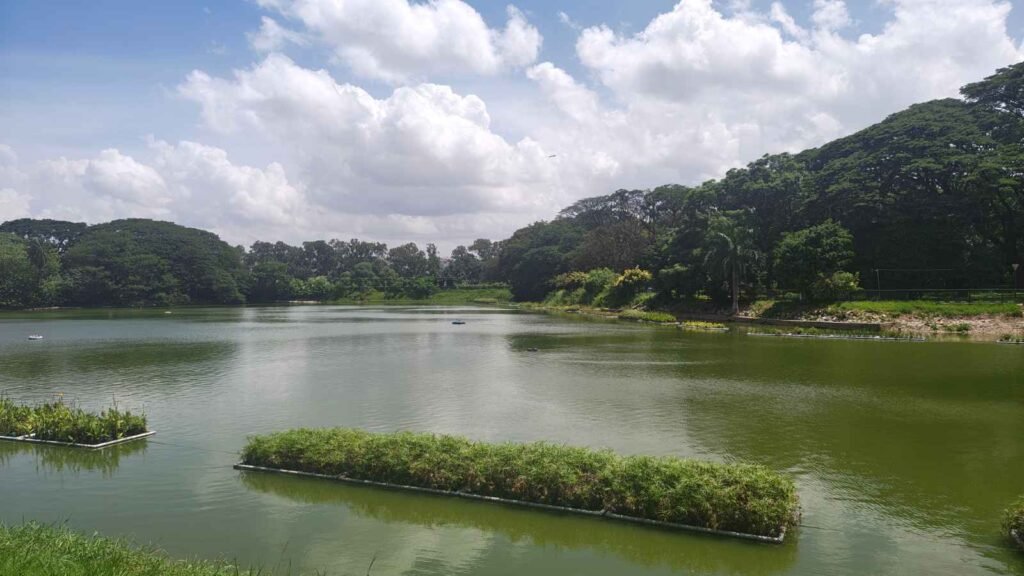
It is early morning at Lalbagh’s West Gate, and walkers are already streaming in — no ticket needed at this hour, the entry stays free until nine. Somewhere past the bougainvillea, the Rose Garden is waking up in the mist, and a flock of parakeets is making its usual racket around the glasshouse. For most of the people filing in, this is simply the start of another day — a walk, a stretch, a bit of quiet before Bengaluru’s traffic takes over. Few of them are thinking about what lies beneath their feet: a proposed ten-lane road tunnel that, on paper, was meant to run straight through this ground.
The autorickshaw driver who dropped this reporter near the gate had his own way of putting it. He’d seen the protest that filled the park on a Sunday morning not long ago — thousands of people, banners, a human chain stretching around the old rock. He didn’t have strong views either way about tunnels and traffic, he said, but he’d noticed something: when the government backed down on the law that triggered it all, and signalled it might route the project around the garden instead of under it, people he spoke to seemed relieved. Since then, he said, he’d been getting more fares to Lalbagh than usual — visitors curious, it seemed, about the garden that had been all over the news.
Rajendar, who lives in Jigani on the city’s southern edge and drives roughly ninety minutes to visit, put it more simply. He comes for the green, he said — for a couple of hours where the air feels different, away from the concrete and the horns. A garden like this, he felt, was not something the city had many more of to spare.
Credit: Dipin Damodharan/EdPublica
Not everyone was willing to be named. A corporate employee, mid-morning break, walking briskly along the lake path, agreed to talk only on condition of anonymity. His view was blunt: whatever the traffic problem is, running infrastructure like this under a garden like Lalbagh is not the way to solve it. The government, he said, needs to reconsider — and find a fix that doesn’t ask a 240-acre lung space to absorb the cost.
A garden older than the city’s traffic problem
Lalbagh’s story predates the automobile by more than a century. Hyder Ali, the ruler of Mysore, laid it out in 1760 as a private garden modelled partly on Mughal design; his son Tipu Sultan expanded it with plants brought back from campaigns and trading contacts across the region. British superintendents took over after, adding the glasshouse in 1890 — built, like much of the era’s civic architecture, in conscious echo of London’s Crystal Palace — and the garden has hosted its twin flower shows around Republic Day and Independence Day ever since.
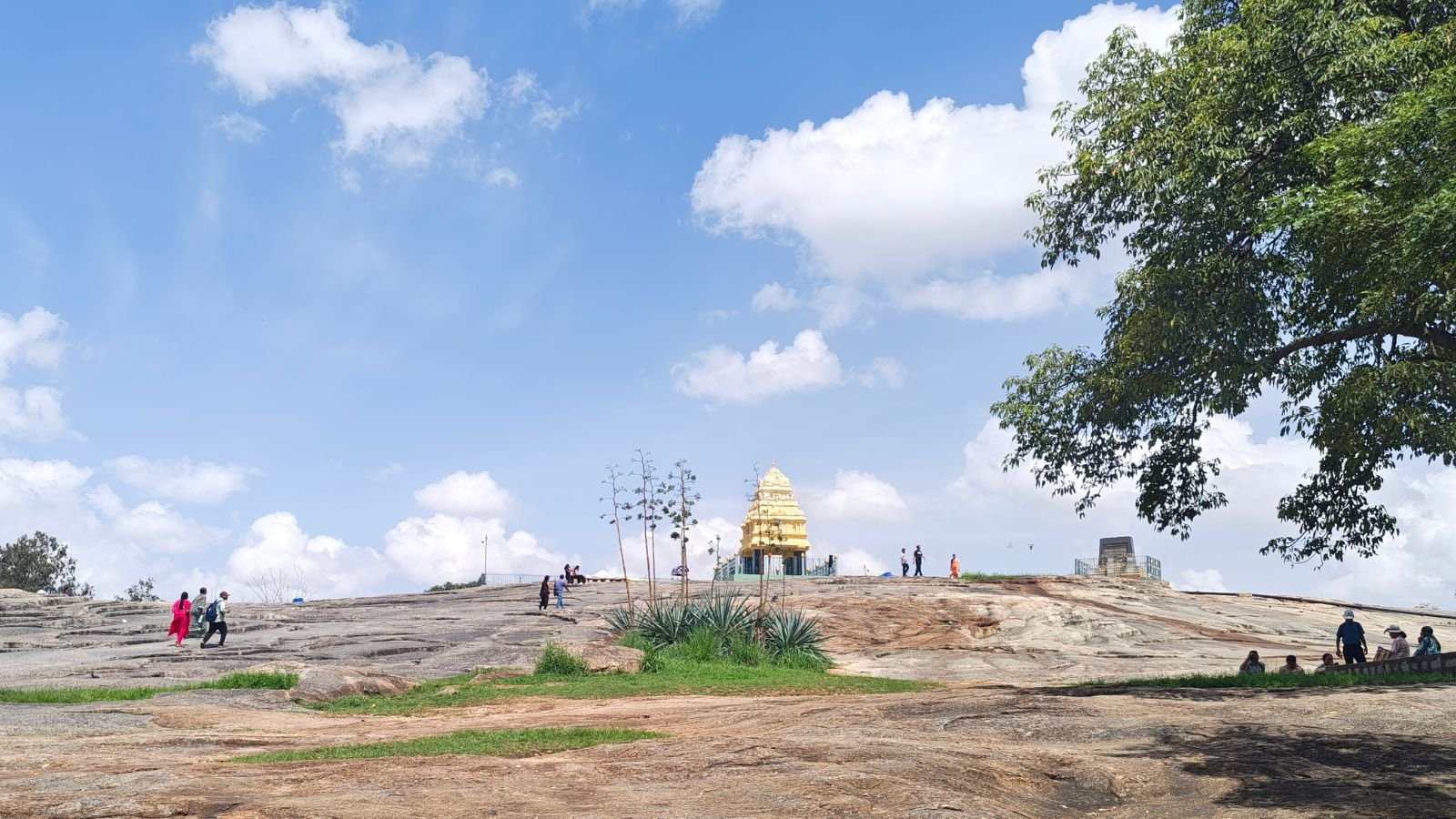
Today it holds more than 1,850 plant species across 240 acres, including a roughly 250-year-old silk cotton tree said to date to Tipu Sultan’s time, and the Lalbagh Rock — a granite-gneiss outcrop now estimated by geologists to be about three billion years old, among the oldest exposed rock formations anywhere on the peninsula. A watchtower built during the reign of Kempegowda II sits on it. Campaigners have been pushing to have the rock considered for UNESCO recognition, in the same conversation as sites like Hampi.
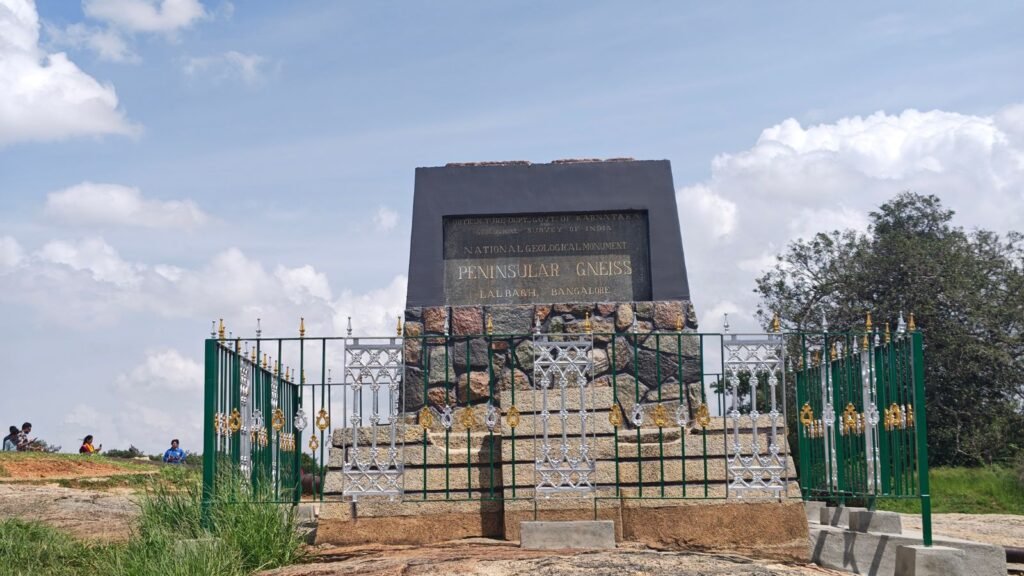
That rock, and the ground around it, is precisely what the tunnel road project has to pass through.
Lalbagh’s fight is, in that sense, a small and very local chapter of a much bigger story. UN-Habitat’s World Cities Report 2024 found that the average share of green space in cities worldwide fell from 19.5 per cent in 1990 to just 13.9 per cent by 2020 — and the decline has been sharper still in this part of the world, with East and Southeast Asia’s urban green cover dropping from 32.5 per cent to 18.6 per cent over the same period. Every city loses its green space to something that looks, at the time, like a reasonable trade-off — a road, a housing block, a transit line. Bengaluru’s version of that trade-off currently runs 50 to 100 feet under a botanical garden.
What the Lalbagh Tunnel Road Project actually proposes
The Bengaluru Tunnel Road — sometimes called the Twin Tunnel Road — is planned to run 16.5 to 16.75 kilometres between Hebbal in the north and Central Silk Board in the south, largely beneath the Outer Ring Road corridor. Its cost has been quoted at different points as roughly INR 17,000 crore, INR17,698 crore and, more recently, INR 22,267 crore, after Adani Group entities were reported to have won the contract. As originally designed, the alignment required roughly six acres of Lalbagh land — most of it temporary, during construction — for two entry and exit ramps and a ventilation shaft, with one ramp passing within a few hundred metres of Lalbagh Lake and another running close to the rock formation itself, at depths of 50 to 100 feet.
What the reports found
Three separate technical reports have shaped the debate, and none of them offer the government much comfort.
A Geotechnical Interpretative Report prepared for the city’s civic body by Rodic Consultants, dated September 2024, flagged the Lalbagh stretch as a “bedrock transition zone” and noted a geological lineament — a fault-like feature — crossing the proposed alignment near the lake, along with risks of groundwater seepage and seasonal water-table shifts.
A Geological Survey of India expert committee went further. Its report, submitted to the government in April 2026, warned that tunnelling and blasting near the rock could widen existing cracks, destabilise parts of the formation, and disturb groundwater flows into Lalbagh Lake — and separately flagged risk to the historic Kempegowda watchtower. GSI also noted civil-society efforts to have the rock nominated as a UNESCO site.
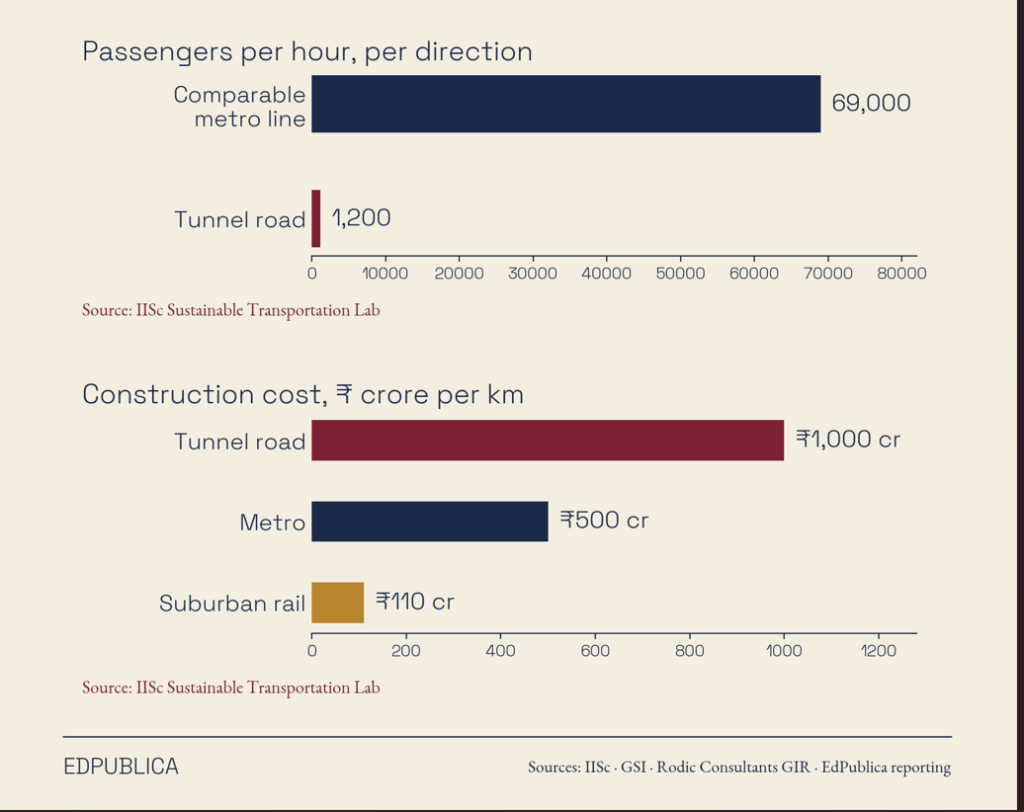
A third, independent study — by the Sustainable Transportation Lab at the Indian Institute of Science, led by Professor Ashish Verma — questioned the project’s basic logic rather than its geology. Modelling suggested the tunnel would carry only around 1,200 passengers per hour per direction, against roughly 69,000 for a nine-coach metro line built at comparable cost; in a high-toll scenario, the study projected the tunnel’s volume-to-capacity ratio could fall as low as 0.1 — a road built for far more traffic than would likely use it. The same analysis suggested the project could, in some scenarios, add to the city’s overall emissions rather than cut them, by drawing commuters away from mass transit and towards private cars.
The law that lit the fuse
If one thing turned this from a planning dispute into a street movement, it was a single piece of legislation.
The Karnataka Government Parks (Preservation) (Amendment) Bill, 2026, amends a 1975 law that has, until now, given government parks and gardens fairly strong statutory protection. The amendment inserts a new provision allowing the state to “alienate” — that is, sell, lease, gift, exchange, mortgage or otherwise transfer — up to 5 per cent of the total area of any government park or garden in Karnataka, for specified public infrastructure and utility projects. Applied to a 240-acre site like Lalbagh, that threshold works out to roughly 12 acres, twice what the tunnel’s original design was reported to need.
The government’s case is that the change is generic policy, not a Lalbagh-specific fix: Chief Minister D.K. Shivakumar has said it is meant to enable ordinary public works, such as road-widening, without the cost and delay of separately acquiring private land, and that the provision does not open parkland to private developers — land can only be leased, transferred or exchanged to government departments, statutory authorities and local bodies. Critics were not persuaded. The Bill was cleared by the Cabinet and passed by both Houses of the legislature on 24 August 2026 amid opposition protests inside the Assembly and, its critics say, with little substantive debate — timing that, coming as the tunnel’s alignment through Lalbagh was already under challenge in court, read to many as a legislative route around the garden’s protections rather than a coincidence.
How the fight unfolded
The reaction outside the legislature was faster than the government seemed to expect. Within three days of the Bill’s passage, more than 200 citizens, resident groups and environmental organisations gathered at Lalbagh on 27 August to form a human chain around the ancient rock, demanding the amendment be withdrawn. That Sunday, 30 August, the numbers swelled into the thousands for a march titled “Walk in Lalbagh, Walk for Lalbagh” — residents, walkers’ associations, cycling groups and pro-Kannada organisations alongside Bengaluru South MP Tejasvi Surya, Union Minister Shobha Karandlaje and other BJP lawmakers, plus veteran environmentalist A.N. Yellappa Reddy. Marchers sat and lay across the Peninsular Gneiss rock itself and raised slogans in Kannada and English with a common refrain: not one inch of Lalbagh.
The mobilisation built on opposition that had already been running for months through the courts — public-interest litigation in the Karnataka High Court led in part by theatre personality Prakash Belawadi and civic figures including Adikesavalu Ravindra and N.S. Mukunda, and an earlier, smaller human chain in early August aimed specifically at protecting the geological monument from the tunnel.
Facing that pressure, and with BJP leaders petitioning the Governor to withhold assent to the Bill, the state Cabinet withdrew it within days, on 3 September 2026. Shivakumar said the legislation would be reintroduced later, after wider public consultation — it has not been dropped for good. A week after that, on 9 September, he went a step further and said he had asked Greater Bengaluru Development Minister Krishna Byre Gowda to study alternatives to using Lalbagh land for the tunnel. That is an instruction to examine options, not a decision to reroute — no revised alignment has been published, and the original six-acre land requirement, the detailed project report and the tender awarded to Adani entities all remain officially in force.
Several petitioners have said they intend to keep challenging the project on transport and procedural grounds regardless of what happens to the amendment or the alignment. Their case — over the withheld 2025 expert report, the missing environmental impact assessment and questions about statutory transport-authority approvals — is due back before the Karnataka High Court in December.
Why the green matters, in numbers
- 240 acres — Lalbagh’s total area, one of the two largest green lungs in central Bengaluru alongside Cubbon Park.
- 1,850+ plant species recorded in the garden, built up over roughly 265 years by Mysore rulers, British superintendents and the state horticulture department.
- ~3 billion years — estimated age of the Lalbagh Rock, a Peninsular Gneiss formation and protected National Geological Monument.
- 16.5–16.75 km — length of the proposed tunnel road corridor between Hebbal and Silk Board.
- ~6 acres — Lalbagh land originally required for the tunnel’s ramps and ventilation shaft.
- 1,200 vs 69,000 — projected passengers-per-hour-per-direction for the tunnel versus a comparably priced metro line, per the IISc study.
- INR 1,000 crore/km — estimated tunnel construction cost, against roughly ₹500 crore/km for metro and INR 110 crore/km for suburban rail, by the same analysis.
A retreat, not a resolution
For now, the garden itself shows no sign of the fight above and around it. The lake is calm, the rock still draws its usual scatter of visitors reading the noticeboard about its age, and the morning walkers keep coming. What has shifted is something real but narrower than it looks: a government caught off guard by how fast a legislative manoeuvre turned into a mass protest, and forced into a public climbdown within ten days of passing a law.
That is not the same as Lalbagh being safe. The amendment is shelved, not repealed, and Shivakumar has said it will return after “consultation.” The instruction to study a route around the garden is exactly that — a study, with no published alternative and no change yet to the project’s land requirement, tender or contractor. The Geological Survey of India’s warnings about the rock, the watchtower and the groundwater, submitted in April and made public only in September, have not been formally answered. And the oldest thread of opposition — the court case over how the project was tendered and cleared in the first place — continues in December, indifferent to whichever way the alignment eventually bends.
So the honest answer, for Rajendar driving in from Jigani, or for the corporate employee unwilling to give his name, is not that they won. It is that a fight most people assumed was already lost turned out not to be — and that the next few months, in a courtroom and in a minister’s office rather than at a human chain, will decide whether that counts for anything.
Society
Lumpy Skin Disease Returns to Rajasthan, Fear Spreads Among Livestock Owners Again
Lumpy Skin Disease in Rajasthan has infected 6,694 cattle across five districts of Bharatpur division, raising concerns over vaccination and further spread.

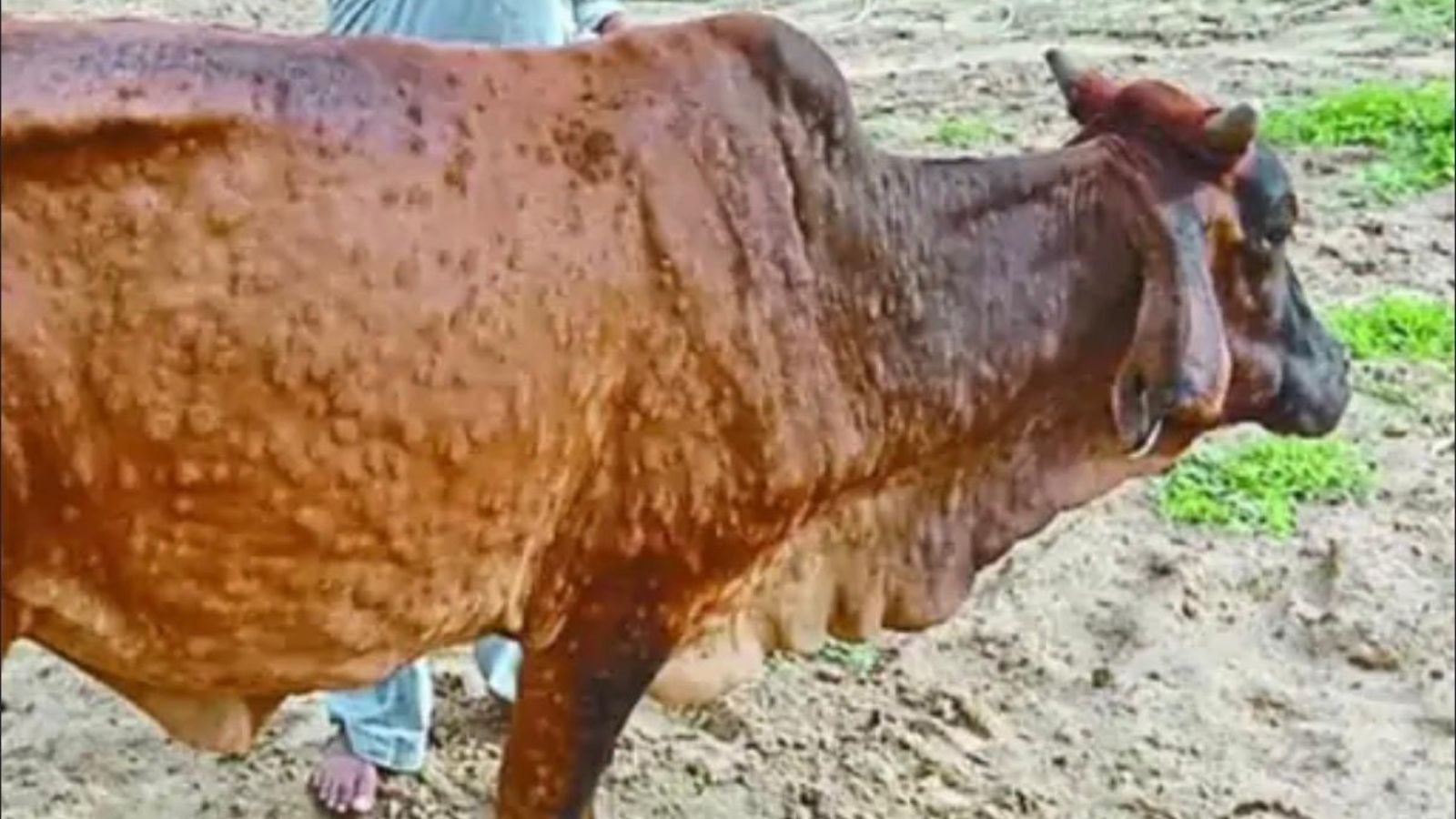
Lumpy Skin Disease in Rajasthan has returned to the Bharatpur division, with 6,694 cattle infected across five districts. Livestock owners fear a repeat of the devastating 2022-23 outbreak.
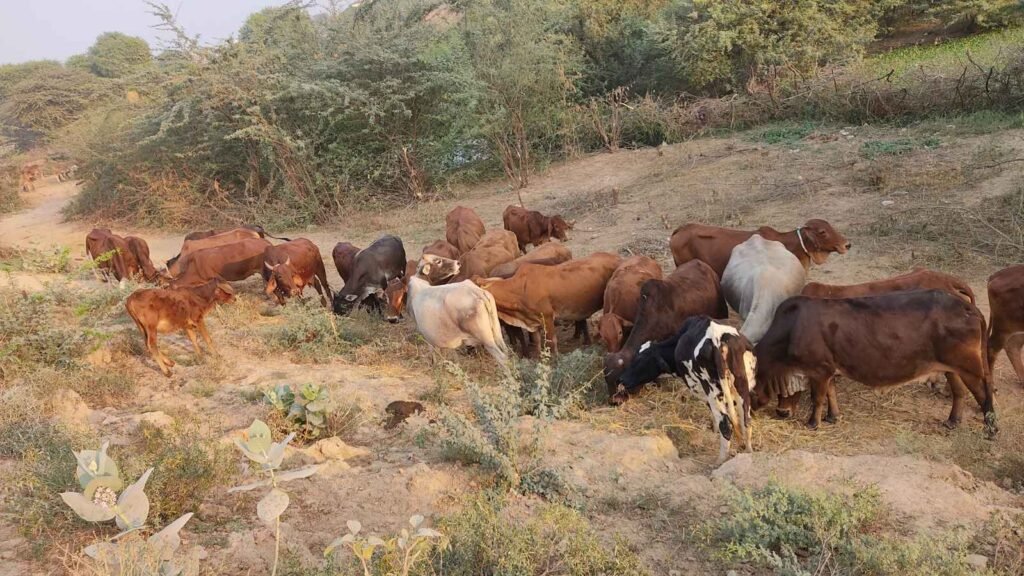
Lumpy Skin Disease has returned to Rajasthan, bringing back painful memories from four years ago. For now, the infection remains confined to the Bharatpur division. Cases began to surface in the division in August, and the disease has since spread rapidly. As of September 3, a total of 6,694 cattle have been found infected across five districts of the division. These include 4,000 animals in Deeg, 2,500 in Bharatpur, 124 in Dholpur, 69 in Karauli and one in Sawai Madhopur.
Following the spread of the infection, the administration has banned cattle fairs, animal exhibitions and other gatherings involving animals in the Bharatpur division. More than two dozen animals have died in the affected areas in recent days. According to the Animal Husbandry Department, 13 of these deaths have been confirmed to be caused by Lumpy Skin Disease. Information obtained from district animal husbandry officials shows that six animals have died of the disease in Bharatpur district and seven in Deeg. A total of 21 animals have died in Deeg in recent days, but only seven deaths have so far been confirmed as being caused by Lumpy. Reports on the remaining deaths are still awaited.
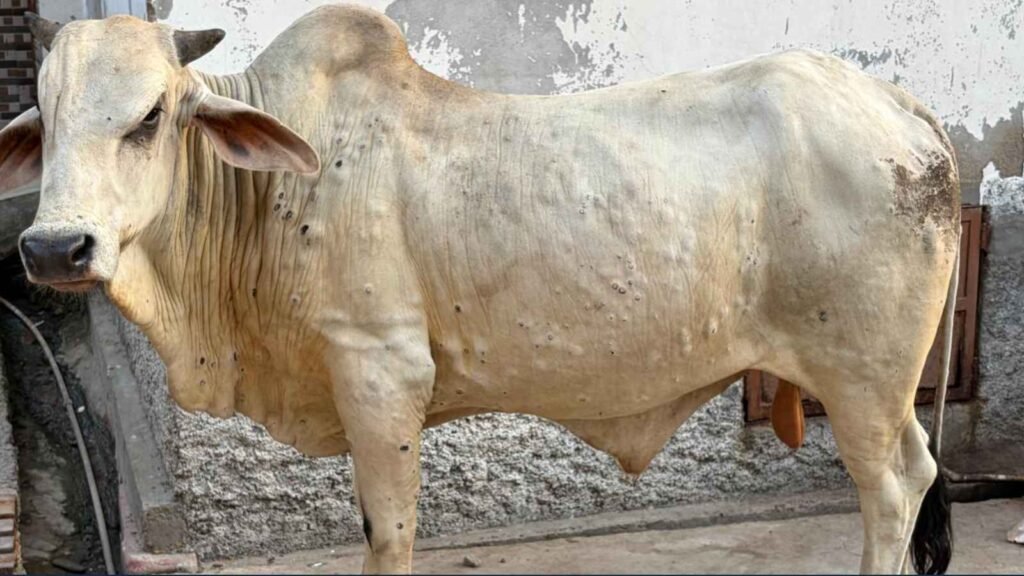
However, given the situation in Bharatpur division, the administration has now tightened measures to control the spread of the disease. On September 3, Divisional Commissioner Nalini Kathotia directed officials to immediately stop animal markets, livestock fairs and the mass movement of animals in Bharatpur, Dholpur, Deeg, Karauli and Sawai Madhopur. Officials have also been directed to ensure the availability of medicines to control external parasites in affected areas, carry out disinfection, organise treatment camps and safely dispose of dead animals as per the prescribed protocol.
Divisional Commissioner Nalini Kathotia has also raised concerns over the vaccination coverage. A review found that only 49.92 per cent of the total cattle population in Dholpur, 64.14 per cent in Karauli and 60.16 per cent in Sawai Madhopur had been vaccinated. The Divisional Commissioner termed the coverage unsatisfactory and directed the concerned officials to ensure that the vaccination target is achieved in full.
Lumpy Skin Disease in Rajasthan: Vaccination Gaps and Rising Concerns
Following the spread of the disease, the Animal Husbandry Department has stepped up surveillance and vaccination. But livestock owners are also raising questions about whether adequate vaccination was carried out before the disease began spreading.
Brahmdev Shastri, a People for Animals activist and farmer from Kaman in Bharatpur, alleges that a large number of cows have been infected and that the situation worsened because vaccination was not carried out on time.
“Instructions had been issued to start vaccination in June, but the Animal Husbandry Department officials and employees remained asleep. Vaccination did not take place in most areas. Meanwhile, infections among animals began in August. Before anyone could realise what was happening, the infection had spread to thousands of animals. The department has now woken up. Department teams are now reaching villages one by one,” he says.
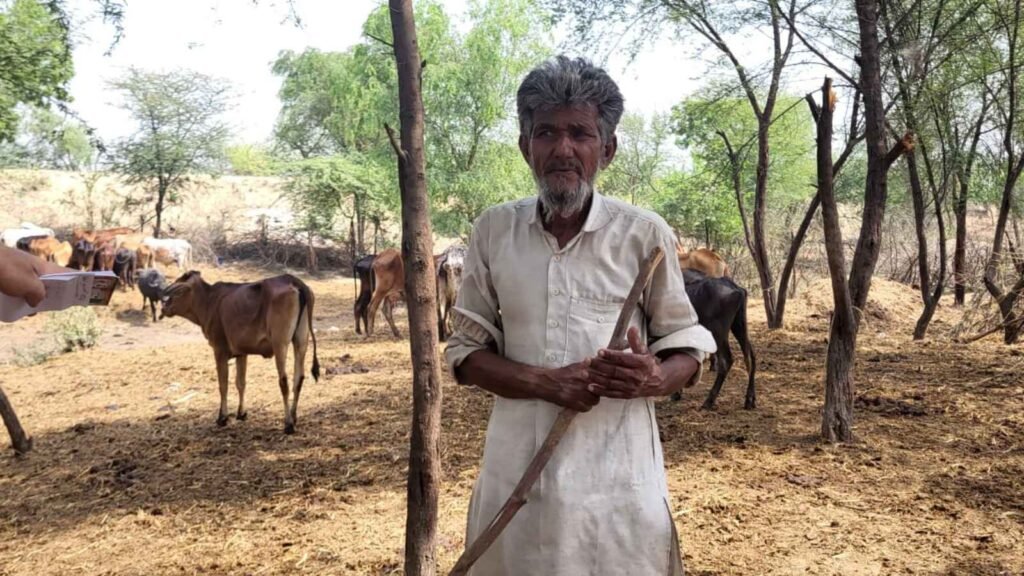
The Animal Husbandry Department has taken these complaints seriously. Officials posted in Bharatpur, Sawai Madhopur, Karauli, Dholpur and Deeg have been issued notices seeking explanations.
Department officials, however, say vaccination could not be carried out in several places because vaccines were not available on time. In Nadbai town of Bharatpur district, where there have been complaints that vaccination did not take place for two months, Deputy Director of Animal Husbandry Dr Rajesh Chaudhary says 4,000 doses were received on June 16 and administered to animals in surrounding areas. After that, there was no vaccine available. The next consignment arrived on August 6 and vaccination began the following day, August 7.
As of September 3, 915 animals have been found infected in the Nadbai area, including 32 animals detected on September 3. The relief, however, is that 605 of the infected animals have recovered.
Department teams are also now reaching Brahmdev Shastri’s village, Bamni. He says several animals had already fallen ill by the time the teams arrived.
“Teams are now reaching our village, Bamni, but by then many animals had already been affected. Because vaccination had not been done, a cow at my son’s home in the village contracted Lumpy and fell ill. We are now getting her treated,” he says.
He says two cows at his farmhouse in Kaman had been vaccinated on time and remained safe.
There is also considerable anxiety over Lumpy in Deeg, where 4,000 animals had been found infected as of September 3. Local voluntary organisations are helping care for sick and abandoned animals. Pratap Prajapat, a worker with the Bajrangi Goseva Samiti in Deeg, says, “You can see infected animals everywhere. We are taking sick, abandoned animals to gaushalas and getting them treated.”
The fear of four years ago
The current outbreak is particularly worrying for livestock owners because they witnessed the devastating impact of the disease in 2022-23. According to government figures, 76,030 cows died of Lumpy Skin Disease in Rajasthan during that period. The government provided assistance of Rs 40,000 per cow to 48,892 livestock owners for the deaths of 51,430 milch cows. Livestock owners, however, claim that the actual number of deaths was much higher than the official figure.
This time, the infection is still confined to the Bharatpur division, but the fear has travelled much farther.
In Hanumangarh, 529 km from Bharatpur, livestock owners are also worried. Bag Ali, a cattle owner living in Sector 12, has 40 cows, and his family depends on them for their livelihood.
“Hearing that Lumpy is spreading again is frightening in itself. We have 40 cows and our family survives because of them. God forbid they should face a crisis like Lumpy again,” he says.
When Lumpy spread in the area in 2022, six of his cows were infected. Five of them died, but he received compensation for only two.
“The government rules required a slip showing that the cow had been treated at a government veterinary hospital. We had treatment slips from the government hospital for two cows, while we had the remaining cows treated by private doctors,” he says.
Bag Ali says, “Four years ago, every livestock owner in the area had to suffer the loss of cows. Now, hearing that Lumpy is raising its head again is very disturbing.”
As of September 3, no animal has been found infected in Hanumangarh. Surveillance and vaccination have nevertheless been started as a precaution. According to officials, the district has set a target of vaccinating 380,000 cattle, of which around 363,000 have already been vaccinated.
The threat and the government’s preparedness
Dr Lakshman Shridhar Rao, Additional Director at the Animal Husbandry Department headquarters in Jaipur, says that as of September 3, Lumpy Skin Disease cases in Rajasthan remain confined to the Bharatpur division. The department has not received information about infected animals from any other district.
According to him, the Bharatpur division shares a border with Uttar Pradesh, where Lumpy cases have been reported. There is a possibility that the infection reached Bharatpur through stray animals coming into Rajasthan from Uttar Pradesh.
Dr Rao says the Lumpy situation is not limited to Rajasthan. Cases have been reported in several states across the country, and the respective states are taking steps to control the disease. Rajasthan, too, has increased surveillance and vaccination.
However, the risk of the disease cannot be assessed only on the basis of the number of animals currently infected. The National Institute of Veterinary Epidemiology and Disease Informatics (ICAR-NIVEDI), under the Indian Council of Agricultural Research (ICAR), through its National Animal Disease Referral Expert System (NADRES) V2, has issued a forewarning for Lumpy Skin Disease for November 2026. The forecast includes Andhra Pradesh, Arunachal Pradesh, Assam, Jammu and Kashmir, Jharkhand, Karnataka, Kerala, Maharashtra, Manipur, Odisha, Puducherry, Rajasthan, Sikkim, Tamil Nadu, Tripura and Uttarakhand.
The forewarning does not confirm that the disease will spread in these states. It is a forecast of the potential risk of Lumpy Skin Disease in November 2026 based on available data. Rajasthan’s inclusion is significant because, according to the department, as of September 3 the infection had been detected only in the Bharatpur division.
In this context, a media report published on September 1, 2026, citing an ICAR-NIVEDI forecast, spoke of a possible Lumpy Skin Disease risk in around 220 districts across the country. According to the report, these included 27 districts in Bihar, 25 in Tamil Nadu, 18 each in Rajasthan, Jharkhand and Karnataka, 12 in Manipur, 11 in Goa, 10 in Madhya Pradesh, nine in West Bengal, seven in Uttar Pradesh and two in Himachal Pradesh.
However, the figure of 220 districts is different from the November 2026 state-wise forewarning. The official November forewarning names 16 states and Union Territories, while the report citing 220 districts refers to a district-level risk forecast. Neither figure should be treated as the number of districts where the disease is currently present.
The impact could go beyond livestock owners
If Lumpy spreads further, its impact will not be limited to livestock owners. According to the 2019 Livestock Census, Rajasthan had 13.938 million cattle, and the livelihoods of millions of families depend on animal husbandry. Cattle fairs and animal markets are also an important part of the rural economy. At present, restrictions on such activities are limited to the Bharatpur division, but if the disease spreads widely, such activities could be affected across the state.
Dr Santosh Rajpurohit, former state president of the Rajasthan Economic Council, says, “If the infection reaches other districts, it will affect not only animal husbandry but also cattle fairs, animal markets and the rural economy linked to them. Our economy is agriculture-based, and animal husbandry is closely linked to agriculture. The dairy business is directly connected to it. When animals die, it is as if the backbone of livestock owners is broken.”
Rajpurohit says, “The government should launch a campaign on a war footing so that Lumpy does not spread further.”
For livestock owners who went through the 2022 crisis, the return of Lumpy is therefore more than just news about a disease. When a cow falls sick or dies, it means losing a part of the family’s income. And when the very name of the disease brings back memories of animals that died and families that suffered four years ago, fear reaches their homes even before the infection numbers rise.
For now, the government machinery says it has stepped up surveillance and vaccination. The question is whether these measures will be enough to keep the disease confined to the Bharatpur division this time.
For livestock owners, however, real relief will come only if they do not have to see the kind of devastation they witnessed in 2022 all over again.
Society
India’s Investment Growth Has Doubled. Is Private Capital Finally Moving?
India’s investment growth is accelerating, with GFCF rising 11.9% in Q1 FY27. But the bigger question is whether this momentum signals a sustained revival in private capital. From factory utilisation and bank credit to manufacturing and employment, the next few quarters will reveal whether India’s public investment push is finally drawing private businesses into a broader investment cycle.


India’s latest GDP numbers offer a reason to look beyond the headline 7.8% growth. Gross fixed capital formation (GFCF), a measure of private investment in fixed assets across the economy, grew 11.9% in the first quarter of 2026-27, compared with 5.8% a year earlier. Its share of nominal GDP also increased to 34.3%, from 31.4% a year earlier.
Other indicators point in the same direction. Capital-goods production grew 15.2% in the quarter, compared with 8.8% a year earlier, while industrial credit expanded 20% year-on-year in July, compared with 6.5% a year earlier.
The numbers suggest that investment activity is gaining momentum. But raising concern is whether India is finally moving from a period of government-led capital spending towards a broader private investment cycle?
From Public Capex to Private Investment
For several years, public capital expenditure has been central to India’s growth strategy. The government has invested heavily in roads, railways, ports, power and other infrastructure, with the broader objective of improving connectivity and lowering the cost of doing business.
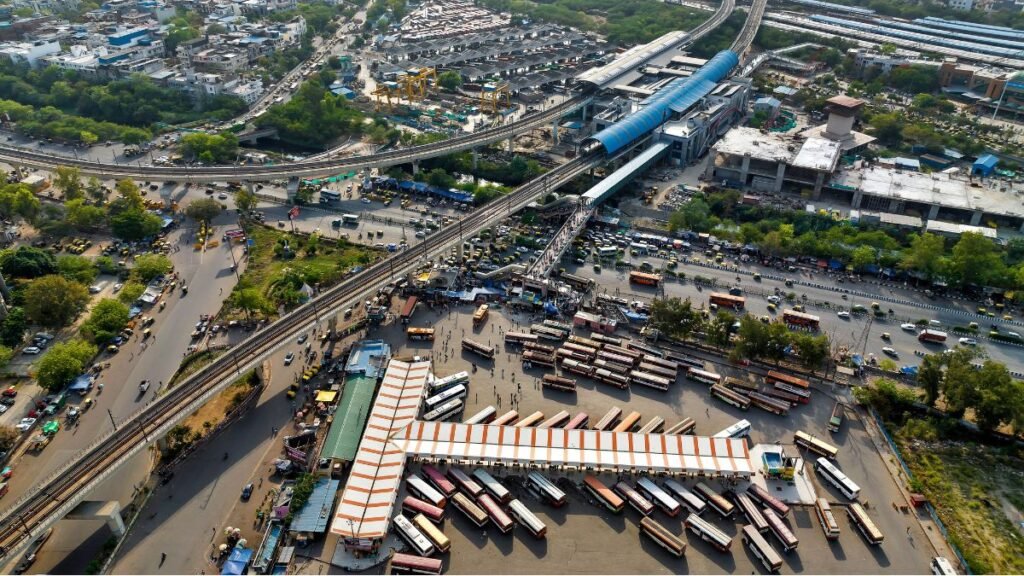
The idea was not simply for the government to build more infrastructure. Public investment was also expected to create conditions in which businesses would become more willing to invest in factories, machinery and new capacity. The latest data provide some evidence that this process may be gaining traction.
GFCF grew 11.9% in Q1 FY27, more than twice the 5.8% growth recorded a year earlier. Capital-goods production also accelerated, growing 15.2% in the quarter. In July, capital-goods production increased another 16.1%. Industrial credit provides another signal. Lending to industry grew 20% year-on-year in July, compared with 6.5% a year earlier.
Taken together, these indicators suggest that the investment story is broader than a single GDP component. But they do not, by themselves, prove that India has entered a private investment boom. GFCF measures investment across the economy; it is not the same as private capital expenditure.
Is Private Capital Actually Returning?
This is the more important test. Reuters reported that private-sector capital investment increased by more than 5 trillion rupees from a year earlier during the April-June quarter. It pointed to stronger factory utilisation, healthier corporate balance sheets and rising bank credit as some of the factors supporting the revival.
There is another encouraging signal from the Centre for Monitoring Indian Economy (CMIE). Private companies announced projects worth 15.4 rupees lakh crore during the quarter, a 97% increase from a year earlier. But project announcements are not the same as money actually being spent. Companies can delay, scale down or abandon projects after announcing them.
That distinction matters because private capital expenditure had actually moderated in FY26. A Union Bank of India analysis reported by The Tribune found that private capex fell 2.8% to 11.9 lakh crore rupees in FY26 from 12.3 lakh crore rupees in FY25, after reaching a record level the previous year. The picture, therefore, is not of a private investment boom that has already been established. It is a possible revival that still needs to prove itself.
Why Might Companies be Investing Now?
One possible explanation is that existing industrial capacity is being used more intensively. When factories operate closer to capacity, companies have less room to increase output using existing machinery. That can make investment in new equipment, facilities and production lines more attractive.
Recent Reserve Bank of India assessments indicate that capacity utilisation has moved above its long-term average. Reuters reported that factory utilisation approached 77% in the fourth quarter of FY26. At the same time, corporate balance sheets have strengthened and bank credit has accelerated.
These conditions can reinforce each other. Higher utilisation can encourage investment. New investment can increase production capacity. Stronger demand can then encourage another round of expansion. But this cycle depends on one thing: whether companies believe demand will remain strong enough to justify investing in new capacity.
Where is the Money Going?
The sectoral composition provides another clue. Manufacturing grew 9.2% in Q1 FY27. Within manufacturing, electrical equipment production increased 27%, other transport equipment 19.5%, and computer, electronic and optical products 12.4%. These are among the sectors central to India’s effort to expand domestic manufacturing and build strategic industrial capacity.
Government policy is reinforcing this direction. The Mobile Phone Manufacturing Scheme, approved in July, has an outlay of 62,500 crore rupees through 2030-31. Semicon 2.0 has an allocation of 1.275 lakh crore rupees for areas including chip design, manufacturing, advanced packaging and research. These are government outlays designed in part to catalyse private investment. They should therefore not be treated as private capital expenditure themselves.
The bigger question is whether such support helps create industries that can eventually compete and expand without remaining permanently dependent on government incentives.
The Employment Test
More investment means more factories, machinery and infrastructure. But it does not automatically mean more jobs. The employment impact depends heavily on what is being built. A highly automated semiconductor facility can involve enormous capital expenditure while creating relatively few direct jobs compared with a labour-intensive manufacturing plant.
For India, this distinction matters. A successful investment cycle should ideally do more than increase the value of fixed assets. It should raise production, improve productivity and create employment, particularly in sectors capable of absorbing large numbers of workers.
The current GDP data cannot yet tell us whether that is happening. That makes employment one of the most important tests of the investment revival in the quarters ahead.
The Demand Problem
There is another basic question: who will buy what the new investment produces? Household consumption grew 7.1% in Q1, while exports grew 12%. Both provide some support for companies considering expansion.
But investment decisions depend on expectations about future demand, not just one quarter’s performance. If domestic consumption weakens, businesses may postpone capacity expansion. If global trade becomes more uncertain, export-oriented companies could face the same pressure.
India is therefore attempting to build a private investment cycle while the global economy remains exposed to geopolitical tensions and trade uncertainty. That makes the transition from public investment to private investment more difficult than simply recording one strong quarter.
The Real Test Begins Now
The 11.9% increase in GFCF matters because it is accompanied by several other positive signals. Capital-goods production is rising. Industrial credit has accelerated. Manufacturing is expanding. Private companies are announcing more projects. Corporate capacity utilisation has strengthened.
But one quarter cannot establish a structural investment cycle. The more meaningful test will be whether companies continue to announce and execute new projects over the next several quarters; whether investment spreads beyond a limited group of sectors; and whether higher capital formation translates into greater production and employment.
The investment numbers also need to be read alongside the broader debate over India’s revised GDP methodology. The government has defended the new series, while some economists have raised questions about aspects of the estimates. That debate makes it even more important to look at several independent indicators rather than relying on the GDP figure alone.
For now, the data offer something more useful than a declaration of an investment boom. They suggest that the conditions for a shift from public investment towards stronger private capital formation may be improving. Whether that becomes a durable engine of India’s growth will depend less on what happened in one quarter than on what businesses do next.


India’s Semiconductor Push Is About More Than Making Chips

As AI Workers Warn of Risks, Researchers Seek Better Guardrails

India’s Data Centre Boom Is Bigger Than It Looks

Under Lalbagh: How a Botanical Garden Forced Bengaluru to Rethink Its Tunnel Road

August 2026 Was the Warmest Month on Record

Farmers Borrowed to Build ‘Diggis’. Two Years Later, They Are Still Waiting for the Subsidy

Our Algorithm Knows What We Want Before We Do. That is the Problem.

Sophie Adenot Makes History as First Frenchwoman to Walk in Space

When Decarbonisation Becomes the Real Conversation at Tiruppur’s Knit Show

The Colleges That Will Never Welcome Another Freshman

-

 Math2 months ago
The 2026 Fields Medals: Four Proofs, Four Decades-Old Problems Solved
-
Climate2 months ago
After Kerala’s Deadliest Landslide, the Hardest Thing to Rebuild Was Childhood
-
Society2 months ago
West Asia Crisis: Can Kerala’s Returning Gulf Migrants Find a Future in the Green Economy?
-
Space & Physics4 months ago
India Semiconductor Mission: ‘It’s Not About Fabs. It’s About Building An Entire Ecosystem’
-
Climate3 months ago
The Climate World Cup? How Climate Change Could Affect Player Performance at the 2026 World Cup
-
Society2 months ago
What Is Civilisational Diplomacy? Understanding India’s Newest Foreign Policy Tool
-
Society3 months ago
From Bell Labs to the Classroom: A Second Career in Teaching
-
Space & Physics4 months ago
Engineers Develop Dual-Mode Propulsion System for Next-Generation Small Satellites