
Climate & Environment
Global fossil fuel emissions projected to fall in 2026, but India’s emissions to rise 4.4%
Global climate finance reached a record annual average of $1.9 trillion in 2023–2024, but developing countries continue to face significant barriers to accessing adaptation funding. As COP31 begins in Antalya, questions remain over the delivery of the new $300 billion annual climate-finance target and the support available to climate-vulnerable nations.

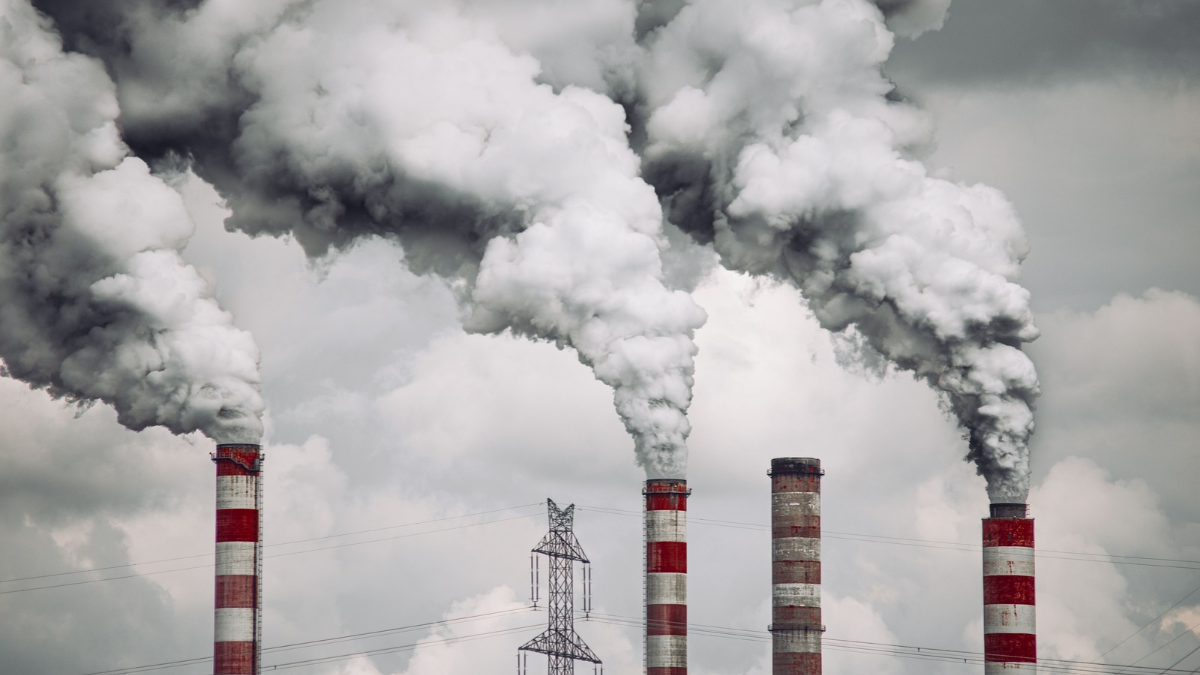
Global carbon dioxide emissions from fossil fuels are projected to decline marginally in 2026, even as India’s emissions are expected to increase by 4.4%, according to the latest Global Carbon Budget released by the Global Carbon Project on November 10. The findings highlight the uneven pace of the global energy transition, with expanding renewable energy capacity yet to deliver a sustained reduction in fossil fuel emissions.
The 2026 assessment estimates that global fossil fuel CO₂ emissions will reach 38.2 billion tonnes, representing a 0.4% decline compared with 2025. However, the projected reduction is partly attributed to lower oil consumption following the energy shock associated with the Iran conflict, rather than solely to structural changes in energy systems.
India’s fossil fuel emissions are projected to grow by 4.4% in 2026, exceeding the country’s average annual growth rate of 3.5% over the previous decade. India accounts for approximately 8% of global fossil fuel CO₂ emissions. The report notes that the projected increase partly reflects a rebound from relatively low emissions growth in 2025.
The contrasting trends in major economies underline the challenges of reducing emissions while meeting growing energy demand. China’s fossil fuel emissions are projected to decline by 0.9%, while those of the United States and the European Union are expected to fall by 1.3% and 1.5%, respectively.
Renewable energy offsets growing demand
The expansion of renewable energy and electric vehicles is increasingly limiting the growth of global emissions. According to the assessment, solar and wind power, alongside electric vehicles, are now offsetting approximately two-thirds of the additional emissions that would otherwise arise from increasing energy demand.
Emissions avoided through solar and wind power have increased substantially, from 0.28 billion tonnes in 2010 to an estimated 4.6 billion tonnes in 2026. The findings indicate that clean technologies are becoming increasingly important in meeting rising energy requirements without a corresponding increase in fossil fuel consumption.
However, the transition remains insufficient to achieve a sustained decline in global emissions. A research paper published alongside the carbon budget in Nature Climate Change, titled ‘A further acceleration of clean energy is needed for global CO₂ emissions to peak and decline‘, estimates that economic growth and changing energy consumption could add 2.59 billion tonnes of emissions between 2025 and 2028.
Solar power, wind power and electric vehicles could offset approximately 1.64 billion tonnes of this increase under current deployment trends. An accelerated deployment scenario could raise the avoided emissions to around 2 billion tonnes.
The researchers argue that renewable energy expansion must accelerate further to ensure that the growth in clean energy outpaces increasing global energy demand.
Land-use emissions add to the challenge
The projected decline in fossil fuel emissions does not translate into an overall reduction in carbon dioxide emissions. When emissions from land-use changes, including deforestation and forest degradation, are included, global CO₂ emissions are expected to reach 43.3 billion tonnes in 2026, compared with 42.8 billion tonnes in 2025.
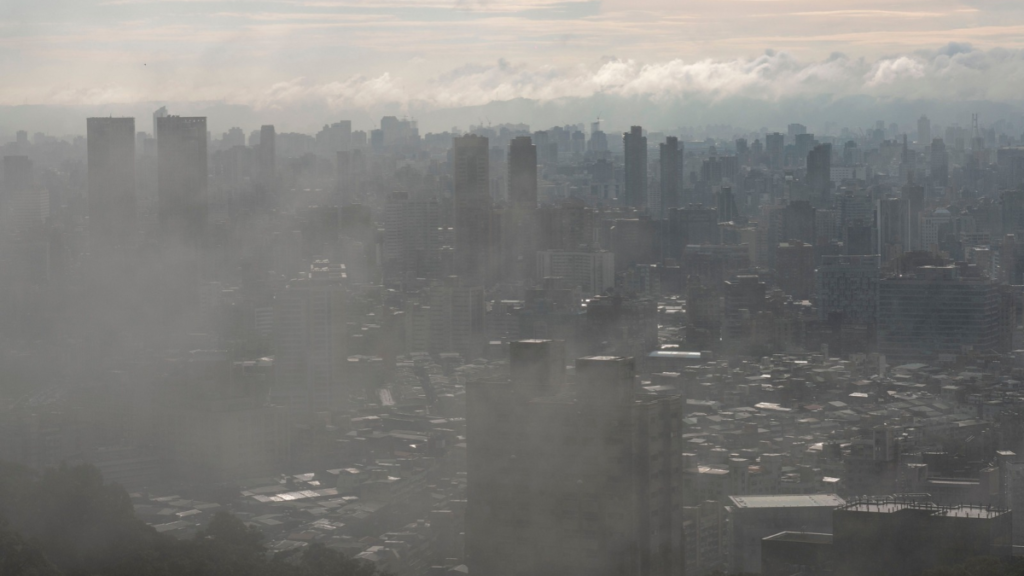
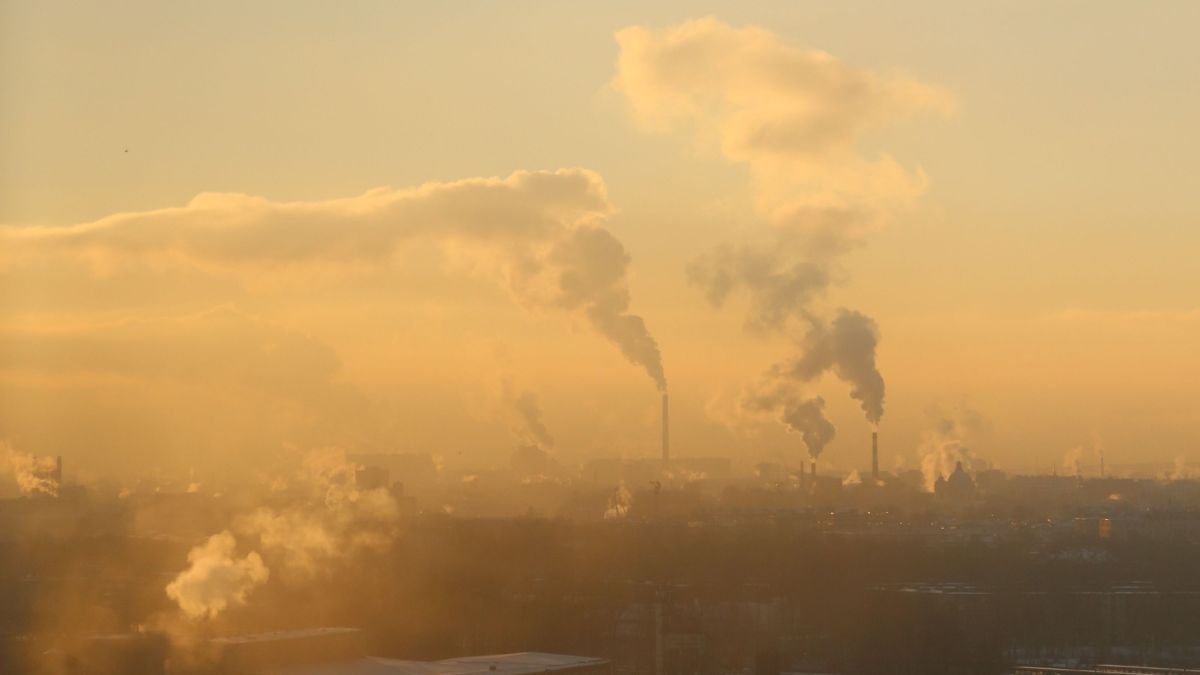
View of Taipei’s skyline shrouded in smog.Image credit:Pexels
Emissions from land-use changes are projected to rise to 5.1 billion tonnes this year. The increase is associated with peatland fires and forest degradation in Southeast Asia, amid drier conditions linked to the developing El Niño.
The assessment also highlights the importance of natural carbon sinks. Land and ocean ecosystems absorbed approximately 49% of human-caused carbon emissions over the past decade. However, climate change is increasingly affecting their ability to absorb and store carbon.
Atmospheric CO₂ concentrations are projected to reach 427.7 parts per million in 2026, approximately 54% above pre-industrial levels.
Less than four years of the 1.5°C carbon budget remain
The report estimates that the remaining global carbon budget for limiting warming to 1.5°C is approximately 150 billion tonnes of CO₂. At current emission levels, this amount could be exhausted in less than four years.
The findings reinforce the urgency of accelerating the transition away from fossil fuels while protecting forests and other natural carbon sinks. Although renewable energy and electric mobility are increasingly limiting emissions growth, the researchers caution that their expansion has not yet reached the scale required to reverse the global emissions trajectory.
For India, the projected 4.4% increase highlights the challenge of aligning expanding energy requirements with climate commitments. The findings point to the need for faster renewable energy deployment, improvements in energy efficiency and stronger protection of natural ecosystems.
The 2026 Global Carbon Budget is the 21st annual assessment produced by an international research collaboration involving more than 140 scientists. It provides updated estimates of global carbon emissions, natural carbon sinks and the implications for meeting the goals of the Paris Agreement.












Climate & Environment
India Ranks 28th in Global Climate Ranking, Down Five Places
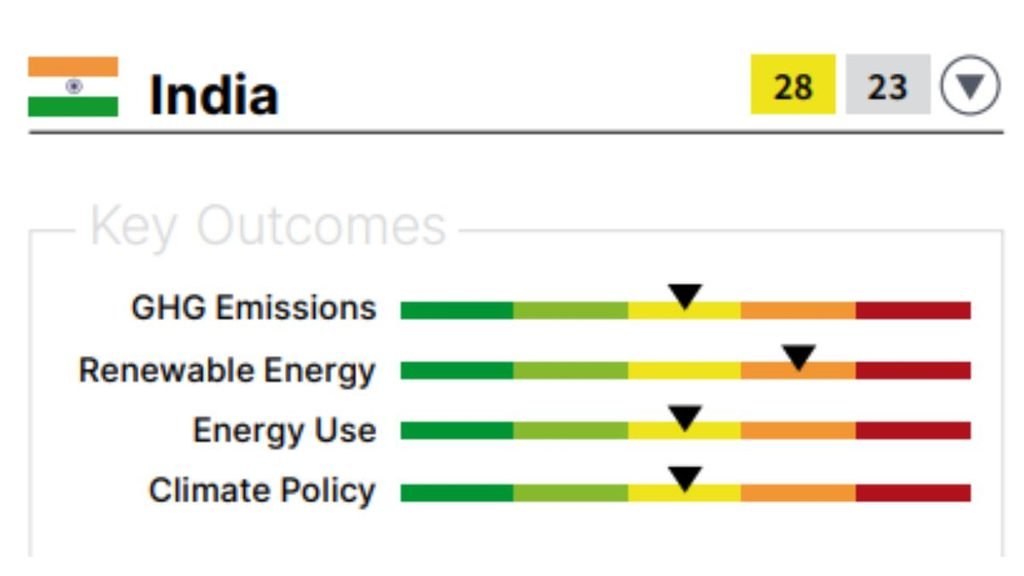
ndia has dropped five places to 28th in the Climate Change Performance Index 2027. Despite reaching 50% non-fossil installed power capacity, coal supplied 71% of its electricity in 2025.

India has reached a major milestone in renewable energy capacity, with non-fossil fuel sources accounting for half of its installed electricity capacity in June 2025. Yet coal continued to generate 71% of the country’s electricity that year. This gap between capacity additions and the actual electricity mix is central to India’s performance in the Climate Change Performance Index (CCPI) 2027, where the country has slipped five places to 28th.
The index, published by Germanwatch and the NewClimate Institute, gives India an overall medium rating. Its assessment points to a mixed record: India has made substantial progress in expanding renewable energy and has performed relatively well on climate policy, but its energy use, emissions and renewable energy performance remain areas of concern.
India’s fall in the rankings should not be read as evidence that its renewable energy expansion has stalled. The country reached the 50% non-fossil capacity milestone five years ahead of its earlier 2030 target. However, installed capacity measures the potential to generate electricity, not how much power sources actually supply. The milestone also includes nuclear energy.
Data from Ember’s Global Electricity Review 2026 show that coal accounted for 71% of India’s electricity generation in 2025, against a global average of 33%. India’s coal generation did fall by 2.9% that year, while renewable generation rose sharply. But the continued dominance of coal in the electricity mix shows how much of the country’s power demand remains tied to fossil fuels.
Grid Constraints Slow the Transition
The challenge is becoming visible in the way India’s electricity grid handles solar power. An Ember analysis published in January 2026 estimated that the country curtailed 2.3 terawatt hours (TWh) of solar generation between late May and December 2025. Grid operators had to reduce solar output as an emergency measure to maintain grid security.
The problem is linked partly to the limited flexibility of conventional power plants. Solar generation rises during daylight hours, while electricity demand continues into the evening, when solar output falls. Coal-fired plants that remain online to meet demand can have limited room to reduce their output further. Without sufficient storage and other flexible sources of electricity, the grid cannot always accommodate the full amount of renewable power available.
This creates a practical constraint for India’s energy transition. Adding solar and wind capacity is essential, but the electricity system also needs stronger transmission networks, battery storage and power plants capable of adjusting output to changes in demand and renewable generation. Otherwise, more installed capacity will not translate into an equivalent reduction in coal-fired electricity.
The CCPI’s category rankings reflect the uneven progress. India ranks 13th in climate policy, but 31st in greenhouse gas emissions, 33rd in energy use and 40th in renewable energy. Its renewable energy category receives a low overall rating, despite a high trend indicator. This suggests that recent progress is significant, while the overall level of renewable energy deployment and its contribution to the energy system still have considerable room to improve.
India’s targets: Stronger Implementation
India’s updated climate commitments set out targets for 2035. These include reducing the emissions intensity of its gross domestic product by 47% from 2005 levels, raising the share of non-fossil sources to around 60% of cumulative installed electricity capacity, and creating a carbon sink of 3.5–4 billion tonnes of carbon dioxide equivalent through forest and tree cover.
The country has also begun implementing its Carbon Credit Trading Scheme, with emissions-intensity targets assigned to 490 industrial entities from January 2026. The effectiveness of the scheme will depend on the ambition of those targets, reliable monitoring and verification, and evidence that participating industries are actually reducing emissions.
The index also draws attention to gaps in energy efficiency. Building energy codes and appliance standards exist, but compliance remains uneven, particularly in informal markets. In transport, urban rail connectivity had expanded to 26 cities by August 2026. However, public transport improvements will also require affordable and reliable bus services, along with safer infrastructure for walking and cycling.
India’s dependence on imported fossil fuels adds an economic and energy-security dimension to the transition. Disruptions to shipping through the Strait of Hormuz have highlighted the risks faced by countries that rely on international supplies of oil and gas. Reducing fossil fuel consumption would help limit exposure to such external shocks, alongside its climate benefits.
Climate Change Performance Index: How India Compares With Other Major Economies
The CCPI leaves its first three positions vacant because no country meets the highest performance standards across all assessed categories. Denmark ranks highest at fourth place, followed by Lithuania and Luxembourg. Denmark has remained the best-performing country in the index for six consecutive years.
The contrast with the United Kingdom is also instructive. The UK, ranked seventh, is the only G20 economy to receive a high overall rating. Its electricity system became coal-free in 2025, according to Ember. Ten G20 members, meanwhile, received very low ratings in the CCPI, underscoring the difficulty major economies face in aligning their energy systems and climate commitments. India’s 28th position places it ahead of several developing economies, including Brazil at 21st, the Philippines at 16th and Nigeria at 17th. But its ranking also shows that early gains in clean-energy capacity do not, on their own, secure a stronger overall climate performance.
India has set a net-zero emissions target for 2070. The CCPI assessment points to the need for clearer, time-bound pathways for reducing the use of coal, oil and gas, with sector-specific milestones and plans to support workers and regions dependent on fossil fuel industries. The immediate test is visible in the electricity system: India must make its growing renewable capacity more usable, while reducing the share of power generated from coal. Until that happens, the country’s clean-energy expansion will continue to coexist with a power mix heavily dependent on fossil fuels.
Climate & Environment
Why Delhi’s Geography Makes It Vulnerable to Severe Air Pollution
Delhi’s geographical location, surrounding agricultural and industrial regions, and winter weather conditions contribute to its recurring air pollution crisis.
Delhi’s air pollution is a recurring problem shaped by more than the emissions produced within the city. Its location in the Indo-Gangetic Plain, proximity to agricultural and industrial regions, and seasonal weather conditions contribute to the accumulation of pollutants, particularly during winter.
The national capital lies in a relatively flat region surrounded by densely populated cities, agricultural land and industrial clusters. Emissions from vehicles, factories, construction activities and crop-residue burning add to the pollution load across this wider region. Atmospheric conditions often determine how quickly these pollutants disperse.
Location in the Indo-Gangetic Plain
Delhi is situated in the northwestern part of the Indo-Gangetic Plain, which extends across several northern and eastern Indian states. The region’s relatively flat terrain allows air masses to move across state boundaries, carrying dust, smoke and other pollutants over long distances.
Industrial emissions, vehicle exhaust, construction dust and agricultural burning across Delhi and neighbouring states contribute to this regional pollution burden. As a result, the city’s air quality is influenced by emissions generated beyond its administrative boundaries.

Delhi’s Air Pollution: Winter Weather Traps Pollutants
Temperature inversion is a major reason for the deterioration of Delhi’s air quality during winter. Under normal conditions, warm air near the surface rises and helps disperse pollutants. During an inversion, a layer of warmer air sits above cooler air near the ground, restricting vertical movement.
The atmospheric boundary layer, the lowest part of the atmosphere where surface emissions mix with surrounding air, also becomes shallower during winter. This reduces the volume of air available to dilute pollutants. Combined with low wind speeds, these conditions allow particulate matter to accumulate close to the ground.
The geographical influence on Delhi’s air quality is also documented in studies examining regional wind patterns and pollution transport. A 2015 study published in the Journal of the Air & Waste Management Association, titled An Investigation of Potential Regional and Local Source Regions Affecting Fine Particulate Matter Concentrations in Delhi, India, used backward air-mass trajectories to trace the movement of pollutants reaching the city.
It identified Pakistan, Punjab, Haryana and Uttar Pradesh as significant potential source regions. The study also found that wind direction influenced particulate concentrations in Delhi, with air arriving from industrial and urban centres in the surrounding National Capital Region carrying additional emissions. These findings show how pollution can move across state boundaries and affect the capital’s air quality.
Crop-residue Burning Adds to Pollution
Punjab, Haryana and western Uttar Pradesh have extensive paddy-growing regions. After harvesting, some farmers burn crop residue to clear their fields for the next cultivation cycle. Smoke from these fires contains fine particulate matter that can travel towards Delhi, depending on wind direction and speed. The practice coincides with the onset of winter, when weaker winds and atmospheric stability already favour pollution accumulation.
Crop-residue burning is a seasonal contributor, however. Vehicle emissions, industrial activities, construction dust and waste burning continue to affect air quality throughout the year. Delhi’s proximity to Rajasthan also exposes it to dust transported from arid and semi-arid regions, including the Thar Desert. During summer, strong winds can carry desert dust towards the capital, increasing concentrations of particulate matter, particularly PM10. Construction sites, unpaved roads and exposed soil within the National Capital Region add to the dust burden.
Why the Monsoon Brings Relief
Monsoon rainfall helps remove airborne particles through a process called wet deposition, in which raindrops capture pollutants and bring them to the ground. Stronger winds and atmospheric mixing during this season also improve pollutant dispersion.
After the monsoon withdraws, rainfall decreases and atmospheric conditions gradually become more favourable for pollution accumulation. The combination of reduced rainfall, declining wind speeds and winter temperature inversions contributes to the seasonal deterioration in air quality.
Pollution Needs a Regional Response
Delhi’s geographical position makes air pollution a regional problem. Controlling emissions within the capital remains important, but pollution transported from surrounding agricultural, industrial and urban areas also needs attention.
Stronger winds can temporarily improve air quality by dispersing pollutants. Sustained improvement, however, requires reductions in emissions across the wider airshed, alongside measures to address local sources and seasonal pollution.
Climate & Environment
Extreme weather affects India on 92% of days in 2026, raises concerns over climate preparedness
Extreme weather affected India on 92% of days between January and September 2026. A CSE–Down To Earth report documents thousands of deaths and extensive damage to crops, houses and livestock.


India experienced extreme weather events on 92 per cent of days between January and September 2026, resulting in thousands of deaths and extensive damage to agricultural land, houses and livestock, according to a new assessment by the Centre for Science and Environment (CSE) and Down To Earth released on Nov 4. The findings highlight the growing frequency of weather-related disasters and the mounting pressure on communities, livelihoods and public infrastructure.
The report, Climate India 2026: An Assessment of Extreme Weather Events, released on November 4, recorded extreme weather on 251 of the 273 days during the first nine months of the year. These events included heatwaves, cold waves, lightning, thunderstorms, heavy rainfall, floods and landslides.
The assessment estimated that extreme weather claimed 3,220 lives, affected 4.25 million hectares of cropped area, destroyed 128,334 houses and killed 47,244 animals during the period. The scale of the damage points to the increasing exposure of communities and economic activities to climate-related hazards.
The report’s five-year analysis also indicates that extreme weather has become a persistent feature of India’s climate risk. The proportion of days affected by such events increased from 86–88 per cent in 2022 and 2023 to 93 per cent in 2024 and 99 per cent in 2025. Across the five-year assessment period, extreme weather events claimed an estimated 16,200 lives and affected at least 20.6 million hectares of cropped land.
Regional differences and changing weather patterns
The effects were unevenly distributed across the country. Uttar Pradesh and Himachal Pradesh recorded extreme weather on nearly 64 per cent of the 273 days assessed in 2026, the highest frequency among states. Uttar Pradesh reported the highest death toll, with 811 fatalities, followed by Maharashtra with 286 and Bihar with 245.
Maharashtra recorded the largest area of affected crops at 2.83 million hectares. Uttar Pradesh followed with 0.69 million hectares and Bihar with 0.23 million hectares. At the regional level, northwest India recorded extreme weather on 235 days, followed by east and northeast India with 218 days.
The assessment also identified unusual temperature and rainfall patterns during the year. February 2026 was India’s driest February since 1901 and the fourth warmest in 125 years. July recorded the country’s third-highest mean temperature for the month, while the minimum temperature was the second highest on record.
The monsoon season presented another contrast. Despite an overall rainfall deficit, heavy rainfall, floods or landslides occurred somewhere in the country on all 122 days of the monsoon season, according to the assessment. This illustrates how a seasonal rainfall deficit can coexist with destructive episodes of intense rainfall in particular locations. The distribution and intensity of rainfall can therefore be as consequential as the seasonal total.
Agriculture and livelihoods under pressure
Agriculture remains particularly vulnerable to these changes. The CSE–Down To Earth assessment found that the area of cropped land affected by extreme weather increased from 1.84 million hectares in 2022 to 9.47 million hectares in 2025. In 2026, a further 4.25 million hectares were affected during the first nine months.
Crop damage can have consequences beyond a single harvest. For small and marginal farmers, repeated losses can reduce household income, increase borrowing and undermine their ability to invest in the next agricultural season. Flooding can destroy standing crops, damage irrigation systems and erode fertile soil, while prolonged dry spells and heat stress can reduce yields and increase irrigation requirements.
The impact also extends to livestock and rural infrastructure. The loss of animals affects household assets and agricultural productivity, while damaged houses and roads can disrupt access to markets, schools and healthcare. Communities already facing economic insecurity may find it difficult to recover before another extreme weather event occurs.
Government data also underline the scale of the challenge. A Ministry of Home Affairs response published by the Press Information Bureau in August 2026 provides state-reported figures on human deaths, cattle losses, damaged houses and affected cropped areas due to hydro-meteorological disasters during 2023–24, 2024–25 and 2025–26. Disaster management and relief are primarily the responsibility of state governments, which makes local preparedness and response capacity particularly important.
Rising temperatures and disaster risks
The India Meteorological Department’s assessment of 2025 provides further context for the country’s changing climate conditions. Its Statement on the Climate of India during 2025 recorded the annual mean land-surface air temperature at 0.28°C above the 1991–2020 average, making 2025 the eighth warmest year since records began in 1901. The report also documented deaths associated with lightning, thunderstorms, floods, heavy rainfall and landslides.
Rising temperatures can intensify heat-related health risks and contribute to conditions favourable for more intense rainfall. However, individual extreme weather events cannot automatically be attributed to climate change. Their occurrence and severity are influenced by several factors, including natural climate variability, local geography, land-use changes and infrastructure.

Representative image of temeperature rise.Image credit:Pixabay
The death estimates in the IMD and CSE–Down To Earth assessments differ because the reports use different datasets and methods of tracking extreme weather. They should therefore be treated as separate assessments rather than combined into a single national total.
Strengthening preparedness
The findings raise questions about India’s preparedness for increasingly frequent weather-related hazards. Early-warning systems, resilient infrastructure, effective urban drainage, heat action plans and better protection for agricultural communities are important components of disaster-risk reduction.
Forecasts must also reach vulnerable communities in time and in accessible languages. In flood-prone areas, improved drainage, protection of wetlands and floodplains, and restrictions on construction in high-risk zones can reduce exposure. In agriculture, crop diversification, climate-resilient varieties, better water management and accessible crop insurance can help farmers manage weather-related losses.
The CSE assessment also points to gaps in the availability of consolidated information. Government agencies use different definitions and data-collection methods for extreme weather events, making it difficult to build a comprehensive picture of their frequency and impact. Consistent reporting and transparent disaster-loss databases would help policymakers identify vulnerable regions and evaluate the effectiveness of adaptation measures.
As extreme weather affects more regions and sectors, coordination between meteorological agencies, disaster-management authorities, local governments and agricultural departments will become increasingly important. The challenge is no longer limited to responding after disasters occur. It also involves reducing exposure, protecting livelihoods and strengthening the capacity of communities and infrastructure to withstand future climate risks.

India Ranks 28th in Global Climate Ranking, Down Five Places

Global fossil fuel emissions projected to fall in 2026, but India’s emissions to rise 4.4%

NASA recruits new astronauts for future Moon Base and Mars missions

Between Lectures and Lyrics: Kabeer Is Building a Malayalam Hip-Hop Career One Self-Taught Skill at a Time

Can Studying Cancer Tumours in Space Help Improve Chemotherapy on Earth?

Indian universities lead Asia in research output per faculty, but the country’s top six all slip in QS ranking

Europe Braces for Extremes as Commission Unveils Climate Resilience Framework

Delhi’s Air Quality Paradox: Lower Average, Higher Everyday Pollution

NMC Directs Medical Colleges to Set Up Patient Safety Committees

Brazil’s Amazon deforestation hits record low. Can the recovery last?
-

 Math4 months ago
The 2026 Fields Medals: Four Proofs, Four Decades-Old Problems Solved
-
EP Deep Dive: Data & Solutions4 months ago
After Kerala’s Deadliest Landslide, the Hardest Thing to Rebuild Was Childhood
-
EP Deep Dive: Data & Solutions4 months ago
West Asia Crisis: Can Kerala’s Returning Gulf Migrants Find a Future in the Green Economy?
-
Space & Physics6 months ago
India Semiconductor Mission: ‘It’s Not About Fabs. It’s About Building An Entire Ecosystem’
-
Interviews2 months ago
From Scams to Screens: How the National Stock Exchange Rewrote India’s Equity Story
-
Climate & Environment5 months ago
The Climate World Cup? How Climate Change Could Affect Player Performance at the 2026 World Cup
-
Society4 months ago
What Is Civilisational Diplomacy? Understanding India’s Newest Foreign Policy Tool
-
Society5 months ago
From Bell Labs to the Classroom: A Second Career in Teaching