

Space & Physics
From Ashes To Atoms
How India is rebuilding its How India is rebuilding its semiconductor future—from a semiconductor future—from a lost opportunity in the 1980s to a lost opportunity in the 1980s to a high-stakes push to master the high-stakes push to master the science, scale, and systems that science, scale, and systems that define the global chip industry.

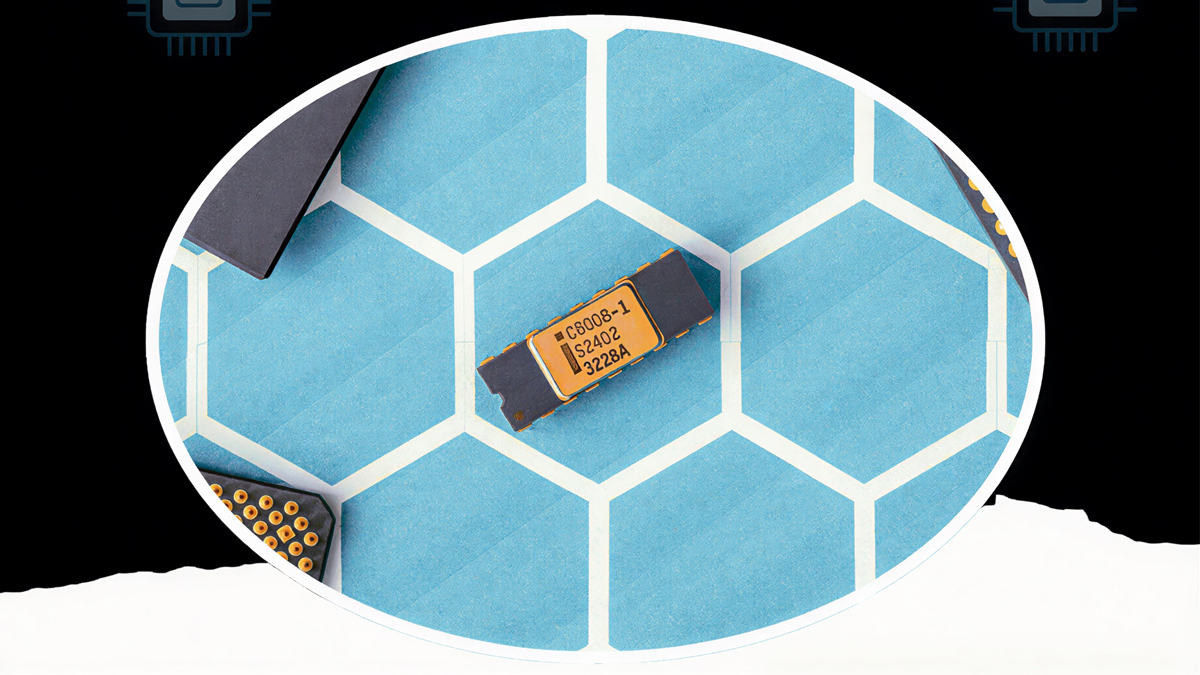
India’s semiconductor ambition is not India’s semiconductor ambition is not merely an industrial policy experiment merely an industrial policy experiment —it is an attempt to rebuild a —it is an attempt to rebuild a technological capability lost decades technological capability lost decades ago, and to do so in a world where ago, and to do so in a world where chips have become instruments of chips have become instruments of economic power and geopolitical economic power and geopolitical leverage. From the ashes of an early leverage. From the ashes of an early setback to a renewed push backed by setback to a renewed push backed by billions in investment, the country is billions in investment, the country is seeking to construct an ecosystem that seeking to construct an ecosystem that spans physics, engineering, and global spans physics, engineering, and global supply chains. The challenge is not supply chains. The challenge is not simply to manufacture chips, but to simply to manufacture chips, but to master the science, scale, and systems master the science, scale, and systems that define the industry—an effort that that define the industry—an effort that will unfold not over years, but over will unfold not over years, but over generations.
From early setbacks to a renewed national push, India is attempting to build one of the world’s most complex industrial ecosystems – where physics, policy, and geopolitics converge.
In the early months of 1989, India’s most ambitious experiment in semiconductor manufacturing came to an abrupt halt. A fire tore through the country’s primary chip fabrication facility in Mohali, Punjab, crippling an ecosystem that had taken years to build and, more importantly, interrupting a trajectory that might have placed India far closer to the global frontier.
The Semiconductor Complex Limited (SCL), established in 1976, had begun producing chips in 1984—at 5000 nanometers, just one generation behind global standards. India was not leading the semiconductor race, but it was not far behind either—especially in an industry where catching up later becomes exponentially harder.
This was only 13 years after Intel introduced the world’s first microprocessor—and three years before Taiwan Semiconductor Manufacturing Company (TSMC) began production. The fire changed everything. Its cause was never officially determined. Investigators noted that it appeared to have started at multiple points—fuelling speculation of sabotage. What followed was not just physical damage, but institutional collapse.
India lost infrastructure.
India lost talent.
India lost time.
The disruption was not merely industrial. It was institutional. Engineers dispersed, expertise dissipated, and momentum stalled. By the time operations resumed years later, the global semiconductor landscape had already shifted irreversibly. Today, SCL—now a research-focused facility—produces legacy chips of around 180 nanometers, primarily for defence and space applications. Meanwhile, TSMC is manufacturing 3-nanometer chips and preparing for 2-nanometer production.
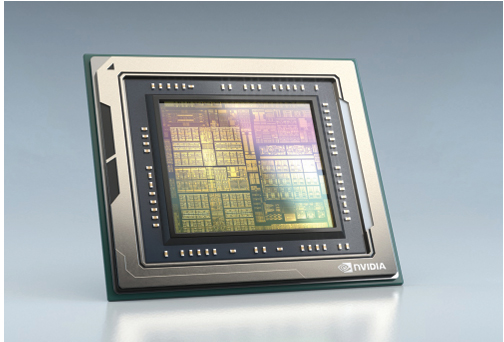
The gap is not incremental, it is generational. India imported semiconductor chips worth nearly $20 billion in 2024, with demand growing rapidly as electronics penetrate every aspect of life. And yet, semiconductors remain invisible—embedded in everything, owned by others. TSMC produces chips for global giants like Apple and Nvidia. SCL serves strategic domestic needs
More than three decades on, India is attempting to rebuild that lost trajectory.
But the context has changed. Semiconductors are no longer obscure components buried within devices. They are the foundation of artificial intelligence, telecommunications, defence systems, and economic competitiveness. They shape not just markets, but geopolitics.
India is not simply re-entering an industry it once attempted to build. It is stepping into one of the most complex and strategically contested systems in the modern world.
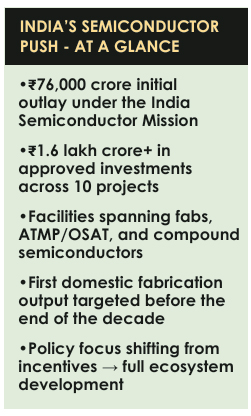
In March 2026, Prime Minister Narendra Modi inaugurated a ₹3,300 crore semiconductor facility in Gujarat, declaring India a “reliable global supplier” in an increasingly fragmented chip economy. Around the same time, Union Minister Ashwini Vaishnaw announced that multiple semiconductor plants are expected to come online over the next few years, with the first fabrication output targeted before the end of the decade. But behind the announcements lies a deeper reality. India is not building a factory. It is attempting to build one of the most complex scientific-industrial ecosystems ever created.
The Physics Beneath the Industry
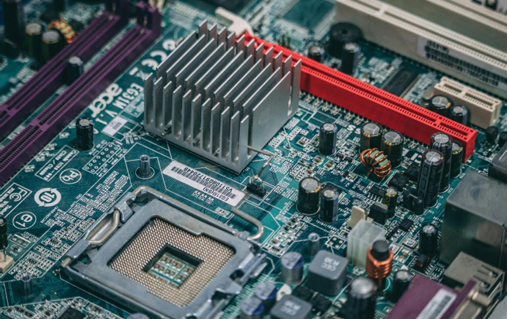
To understand the scale of India’s ambition, it is necessary to understand what a semiconductor actually is—not as a product, but as a process. Modern chips are constructed at nanometre scales, where the behaviour of electrons begins to defy classical expectations. Transistors—billions of which are embedded within a single chip—operate by controlling the flow of these electrons through carefully engineered silicon structures. But as these structures shrink, the physics becomes increasingly unstable.
Electrons leak across barriers that were once reliable. Heat accumulates in ways that are difficult to dissipate. Materials behave unpredictably under extreme miniaturisation. What appears as incremental progress in computing power is, in reality, a constant negotiation with the limits of matter.
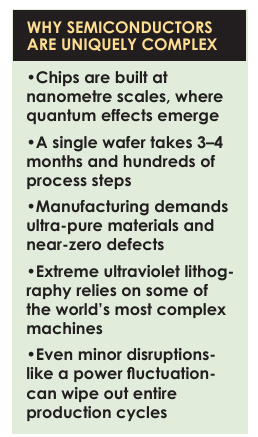
“A single wafer can take three to four months to manufacture, and there are hundreds of layers that have to be deposited,” notes Neelkanth Mishra, an expert on India’s semiconductor policy and Chief Economist at Axis Bank.
Each of these layers involves a sequence of deposition, etching, doping, and cleaning processes, repeated dozens of times with near-perfect precision. The tolerances are so tight that even microscopic contaminants can render entire batches unusable.
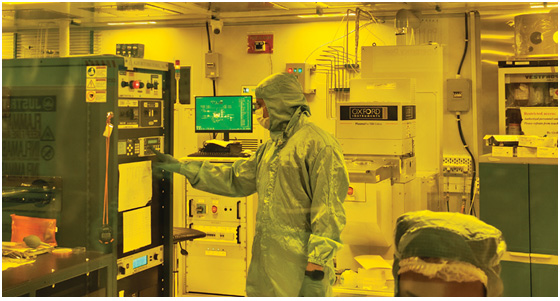
“The chemicals used in wafer cleaning are extraordinarily high purity, and even small impurities can affect yields,” Mishra adds. The process is not only delicate but energy-intensive. As IIT Bombay’s Udayan Ganguly explains, a single thermal step in fabrication can raise the temperature of a silicon wafer from ambient levels to over 1,000 degrees Celsius within seconds, requiring enormous power and precise control.
What emerges from this process is not simply a manufactured object, but a highly controlled physical system—engineered at scales where conventional intuition no longer applies.
A System Defined by Control
If the science of semiconductors is unforgiving, the global ecosystem built around it is equally restrictive.
“From design software to lithography to testing equipment, 90% of the industry is controlled by just two or three companies in each segment,” Mishra observes.
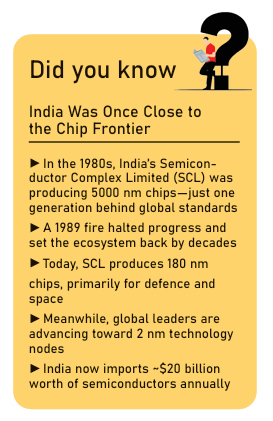
This concentration reflects decades of accumulated expertise, capital investment, and intellectual property. In some areas, such as extreme ultraviolet lithography—the process required to produce the most advanced chips—the dependence is even more pronounced.
“If you want to do extreme ultraviolet lithography, there is only one company in the world that can do it.” Such chokepoints have transformed semiconductors into strategic assets. Access to technology is no longer determined solely by markets, but increasingly by geopolitical alignment and national priorities.
For countries seeking to build domestic capabilities, this creates a paradox: the need to integrate into a global system while simultaneously reducing dependence on it.
India’s Return: Policy Meets Scale
India’s renewed push into semiconductors is structured around this tension.
The India Semiconductor Mission, launched in 2022 with a substantial fiscal outlay, represents one of the most ambitious industrial policy initiatives in the country’s recent history. Since then, the government has approved ten semiconductor projects with investments exceeding ₹1.6 lakh crore across six states, covering fabrication, packaging, and specialised semiconductor technologies.
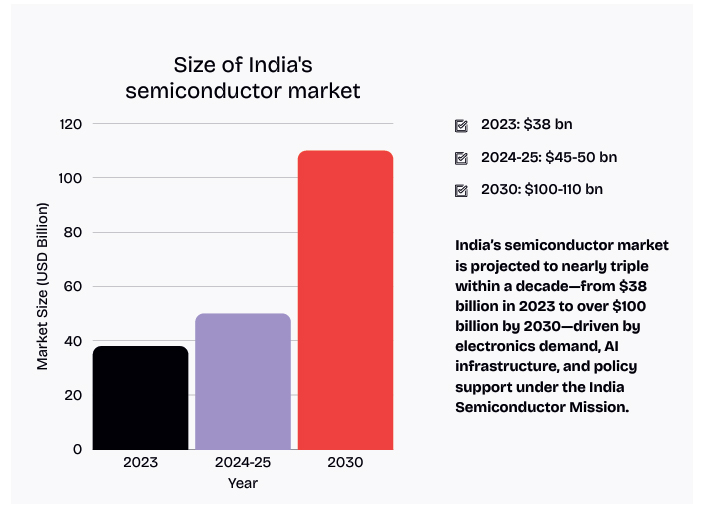
This is not an isolated effort. It is an attempt to build multiple layers of the value chain simultaneously. Early investments have focused on assembly, testing, and packaging facilities—segments that are less capital-intensive and can be scaled relatively quickly. Projects such as the Micron packaging facility in Gujarat, along with other recently approved units, are expected to serve as entry points for building industrial capability.
At the same time, larger and more complex initiatives—such as the proposed fabrication facility in Dholera—are intended to anchor the ecosystem over the longer term.
The second phase of the mission signals a shift in emphasis. Beyond manufacturing, the focus is expanding to include materials, equipment, and intellectual property—areas that are critical for long-term self-reliance.
Prime Minister Narendra Modi has framed semiconductors as central to India’s technological future, calling for the country to become a “reliable global supplier.” Union Minister Ashwini Vaishnaw has indicated that multiple plants are expected to become operational within this decade.
The Design Advantage
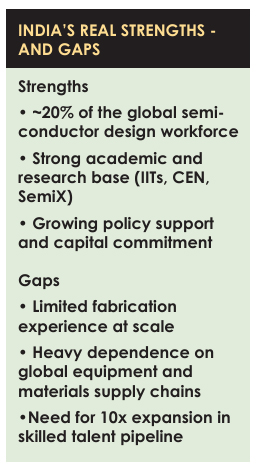
Despite its limited manufacturing footprint, India occupies a significant position in the global semiconductor landscape through design.
Nearly one-fifth of the world’s semiconductor design engineers are based in the country. Global firms rely on Indian teams to develop chips used in everything from consumer electronics to advanced computing systems. Nearly 20% of the global semiconductor design workforce is based in India. Companies such as Intel, Qualcomm, Nvidia, AMD, and Broadcom rely on Indian engineers for chip design.
“In a ten-dollar chip, five to six dollars of value is captured by the designer,” Mishra points out. This concentration of talent provides India with a strategic advantage, particularly in a world where intellectual property increasingly determines value. India has mastered design. What it has not yet built is manufacturing scale. However, this strength has historically been tied to global companies. The challenge now is to translate it into domestic capability—developing Indian firms that can own and commercialise their designs.
The Ecosystem Question
The central challenge for India lies not in any single segment of the semiconductor value chain, but in the integration of all its components.
“You cannot just build wafer fabs. You need everything—from capital equipment to chemicals—to make the ecosystem viable,” Mishra says.
A semiconductor industry requires:
- Reliable energy and water infrastructure
- Access to specialised materials and gases
- Advanced manufacturing equipment
- A continuous pipeline of skilled talent
It also requires coordination across institutions.
“The ecosystem is a triple helix—academia, industry, and government,” says Swaroop Ganguly of IIT Bombay. “Without tight collaboration, it cannot work.”
This interdependence makes semiconductors fundamentally different from most other industries. Progress in one area depends on parallel advances in others.

Institutions That Sustained the Science
Even during the decades when India lacked large-scale manufacturing, certain institutions preserved and advanced semiconductor research.
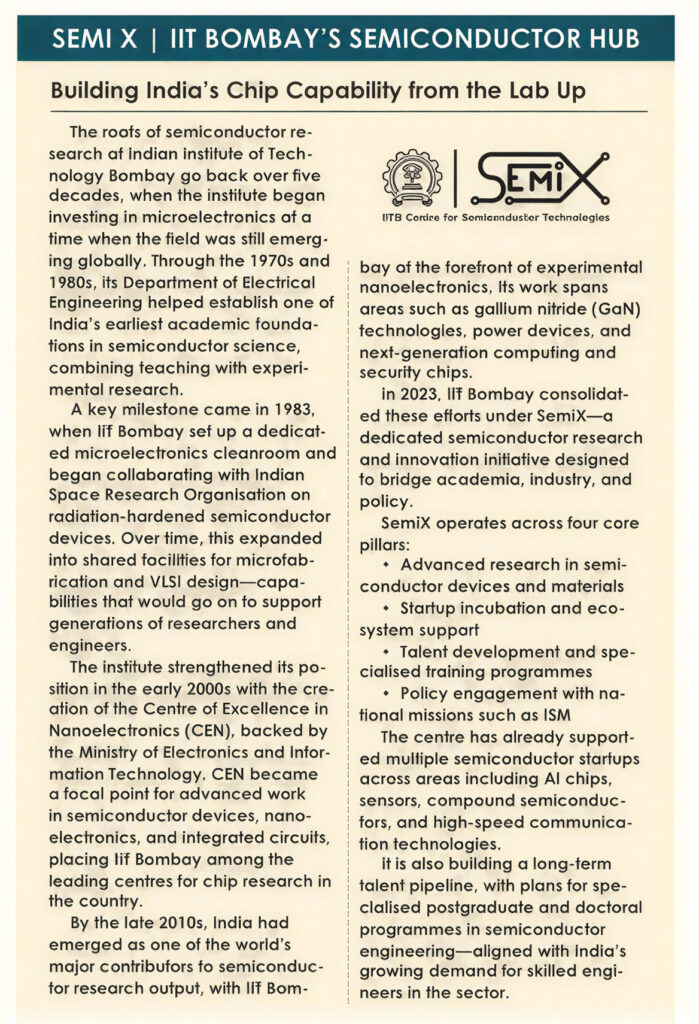
At IIT Bombay, work in microelectronics dates back to the 1970s, when the institute began building capabilities in semiconductor devices and integrated circuits. Over time, this evolved into more sophisticated infrastructure, including cleanroom facilities and collaborative programmes with organisations such as ISRO.
The establishment of the Centre of Excellence in Nanoelectronics (CEN) in the early 2000s further strengthened this foundation, enabling advanced research in semiconductor devices and fabrication techniques. By the late 2010s, India had emerged as a significant contributor to global semiconductor research, with IIT Bombay playing a leading role in experimental nanoelectronics.
In 2023, these efforts were consolidated under SemiX, a dedicated centre aimed at integrating research, talent development, and industry collaboration.
The Economics of Dependence
Semiconductors underpin virtually every modern activity, yet their economic footprint often goes unnoticed. “Every time you go to a doctor, drive a car, or watch a movie—you are effectively paying a semiconductor fee,” says Udayan Ganguly.
The observation is less rhetorical than it appears. As digital systems expand, the cost of semiconductors becomes embedded in everything from healthcare to transportation.
“If India does not control semiconductors to some extent, we are basically fighting a losing battle.”
This framing shifts the conversation from industrial policy to economic sovereignty. Control over semiconductors is not merely about manufacturing capacity; it is about retaining value within the economy.
Innovation as a Continuous Process
One of the defining characteristics of the semiconductor industry is its pace of change. “Semiconductors are not a bandwagon you jump onto—it’s a treadmill,” Ganguly notes. “If you stop running, you fall off.” Technological progress is relentless. Every generation of chips introduces new architectures, materials, and manufacturing techniques. Companies that fail to keep up quickly lose relevance.
“You cannot just build a plant and expect to coast,” Udayan Ganguly adds.
For India, this implies that building initial capacity is only the first step. Sustained investment in research and development will be essential to remain competitive.
Scaling Talent and Capability
India’s talent base is often cited as its greatest advantage, but scaling that advantage presents its own challenges. “We have the core capability,” says Udayan Ganguly. “But to meet demand, we need to scale talent by at least ten times.” This expansion cannot rely solely on elite institutions. It requires a broader transformation of engineering education, incorporating interdisciplinary training across physics, chemistry, materials science, and mechanical engineering. “Semiconductors are not just electronics,” Swaroop Ganguly emphasises. “They require multiple disciplines working together.”
The Long Horizon
Semiconductor ecosystems are not built quickly. The experience of other countries underscores this timeline. Taiwan, South Korea, and China invested consistently over decades before achieving their current positions.
“The Chinese started investing in the late 1990s and are still building capabilities—this is at least a 15–20 year journey,” Mishra notes.
For India, the challenge is not only to start, but to sustain momentum across political and economic cycles.
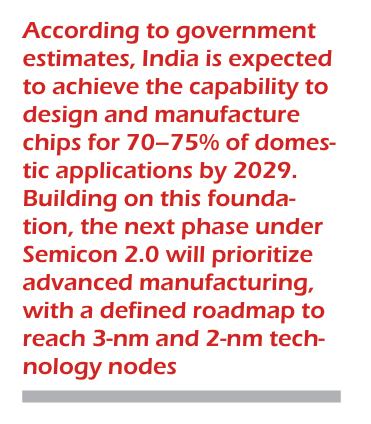
According to government estimates, India is expected to achieve the capability to design and manufacture chips for 70–75% of domestic applications by 2029. Building on this foundation, the next phase under Semicon 2.0 will prioritize advanced manufacturing, with a defined roadmap to reach 3-nm and 2-nm technology nodes. By 2035, India aims to establish itself as one of the world’s leading semiconductor nations.
India’s semiconductor ambitions are rooted as much in history as in future aspirations. The loss of early momentum in the late twentieth century delayed its entry into an industry that rewards continuity and scale. Today, the country is attempting to rebuild that trajectory under far more complex conditions. The progress made so far—policy frameworks, investment commitments, institutional capacity—suggests that the foundation is being laid. But the real test lies ahead.
Semiconductors are not merely manufactured. They are engineered—through sustained effort, coordinated systems, and long-term commitment.
From the ashes of past setbacks to the atomic precision of modern chipmaking, India’s semiconductor journey has begun again. Whether it can be sustained will determine not just the future of an industry, but the contours of technological power in the decades to come.

Space & Physics
Inside India’s Semiconductor Push: ‘This Is a 100-Year Bet’
This is not an industry that rewards speed alone; it demands persistence, coordination, and long-term commitment. In semiconductors, success is not measured in years, but built over generations.

In a conversation with Education Publica Editor Dipin Damodharan, leading semiconductor researchers Swaroop Ganguly and Udayan Ganguly delve into the science, strategy, and systemic challenges shaping India’s chip ambitions. Both are professors in the Department of Electrical Engineering at the Indian Institute of Technology Bombay. Swaroop Ganguly currently leads SemiX—the institute’s semiconductor initiative that brings together expertise across disciplines to advance India’s capabilities in the sector. Udayan Ganguly previously headed SemiX. India’s semiconductor journey, they argue, is only just beginning. The foundations— policy, infrastructure, talent, and partnerships—are being put in place, but the real challenge lies ahead. This is not an industry that rewards speed alone; it demands persistence, coordination, and long-term commitment. In semiconductors, success is not measured in years, but built over generations. Edited excerpts
India Semiconductor Mission: ‘This Is a 100-Year Bet’
India formally launched the semiconductor mission in 2021. Five years on, where does the country stand today?
Swaroop Ganguly:
The India Semiconductor Mission really began taking shape around 2021, but for a couple of years it was largely policy without visible industry participation. The turning point came around 2023 with the approval of the Micron packaging facility. That was important not just as a project, but as a signal—that global companies were willing to invest in India.
Following that, we saw a series of announcements, particularly in packaging and assembly. Now, packaging is not the highest value-add segment in the semiconductor value chain, but it is still a very important step. It generates employment, it helps build supporting capabilities, and it allows the ecosystem to start forming.
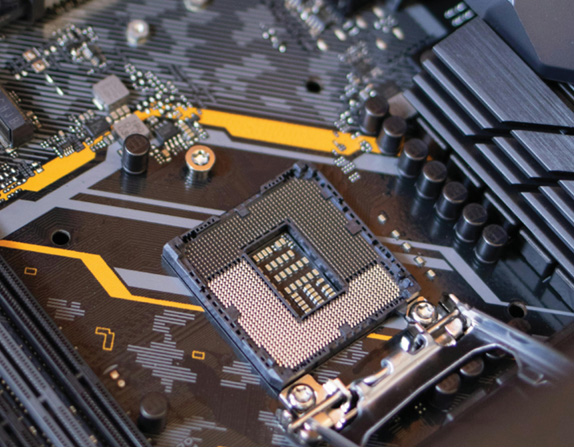
But the real centrepiece—the crown of the semiconductor ecosystem—is the fabrication facility, or fab. That is where silicon wafers are actually processed into chips. We now have at least one major fab announcement, and that is a very significant milestone.
At the same time, we should be careful not to judge progress too quickly. This is not an industry where outcomes can be evaluated in five years. The correct time horizon is at least 10 to 15 years.
Why did India take so long to enter this space, especially given its strength in technology?
Swaroop Ganguly:
It’s not entirely accurate to say India never tried. There were attempts in the past. In fact, in the 1980s, India had a silicon fabrication facility in Chandigarh that was not very far behind global standards at that time.
Unfortunately, that facility was destroyed in a fire, and that event set India back significantly—by decades, in fact. But the loss was not just infrastructure. It was also talent. Many of the people who were working there moved abroad and went on to become leaders in global semiconductor companies.
When you lose something like that, you don’t just lose a facility—you lose the continuity of knowledge, mentorship, and ecosystem-building. That has long-term consequences.
After that, the global semiconductor industry moved very fast, and re-entering it became increasingly difficult. It required a level of policy support and industrial coordination that did not exist at the time. That is what has changed with the India Semiconductor Mission.
How should we interpret the progress under India Semiconductor Mission 1.0 (ISM 1.0)? Has it delivered what was expected?
Swaroop Ganguly:
I think it would be a mistake to look at ISM 1.0 as something that should have delivered results within five years. This industry demands a long-term, patient approach.
ISM 1.0 has led to the approval of multiple manufacturing-related units, most of them in packaging. That is actually a sensible place to begin. Countries like Taiwan and South Korea also started their semiconductor journeys with packaging before moving up the value chain.
There has also been progress in specialty areas such as compound semiconductors, which are used in applications like power electronics, renewable energy, and communications.
So overall, I would say the direction is correct. But the success of ISM should be evaluated over a much longer period—10 to 15 years at least.
So India Semiconductor Mission (ISM) 2.0 is not a reset, but an expansion?
Swaroop Ganguly:
Exactly. ISM 2.0 should be seen as an expansion of scope.
In ISM 1.0, the focus was largely on attracting manufacturing—fabs and packaging units. Now, the thinking is evolving towards building a more complete ecosystem.
That means looking at materials, chemicals, gases, equipment, and all the ancillary industries that support semiconductor manufacturing. At the same time, there is increasing emphasis on research, innovation, education, and training.
This is important because semiconductors are not a one-time investment. As we often say, this is not a bandwagon you jump onto—it’s a treadmill.

What do you mean by that analogy?
Swaroop Ganguly:
The treadmill analogy simply means that once you enter this industry, you have to keep moving. If you stop, you fall off.
Udayan Ganguly:
Yes, and the reason is very simple. The industry evolves continuously. Every couple of years, chips become more powerful, more efficient, more densely packed.
If you don’t keep up with that pace of innovation, your products become uncompetitive. Unlike many other industries, you cannot just build a plant and continue producing the same thing for decades.

For a layperson, what does this “semiconductor moment” actually mean for India?
Udayan Ganguly:
Think about everything you do today—medicine, education, transportation, entertainment. All of it runs on semiconductors.
Now imagine that every time you engage in any of these activities, you are effectively paying someone else for that underlying technology.
You go to a doctor—you are paying a semiconductor fee.
You drive a car—you are paying a semiconductor fee.
You watch a movie—you are paying a semiconductor fee.
So the question is: can a country continue to grow while constantly paying for the technological backbone of its economy?
So this is fundamentally about control over technology?
Udayan Ganguly:
Absolutely.
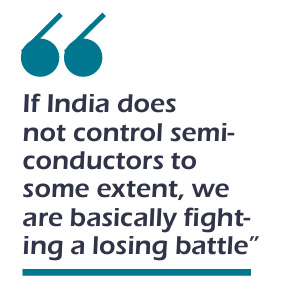
If India does not control semiconductors to some extent, we are basically fighting a losing battle. This is not just about manufacturing chips—it is about controlling the substrate on which modern society operates.
And this is not a short-term project. This is a 100-year bet. Even building meaningful capability will take at least 30 years.
What are the biggest challenges India faces in this journey?
Udayan Ganguly:
There are three core challenges: technology, talent, and governance.
On technology, the reality is that only a handful of companies globally have access to cutting-edge capabilities. These are not technologies that can simply be purchased at cost.
So India will have to start with slightly older technologies, which is perfectly fine. That is how most countries begin.
On talent, it is not just about having engineers—it is about having deep know-how. The ability to solve problems, innovate, and adapt.
And on governance, this is not a free-market industry. It requires sustained policy support and coordination. Without that, it cannot take off.

What role do startups and academia play in this ecosystem?
Swaroop Ganguly:
They are central to innovation.
India has had design centres of global semiconductor companies for decades. But what we have not had is a large number of products that are designed, owned, and commercialised by Indian companies.
That is where startups and academia come in.
Innovation typically emerges from these spaces—either from academic research translating into startups, or from experienced professionals building new companies.
Can startups play a role in manufacturing as well?
Swaroop Ganguly:
Manufacturing is much more capital-intensive, so it is difficult for startups to enter that space in the conventional sense.
However, there are opportunities in specialised areas—materials, processes, equipment components—where startups can contribute.
Academia also plays a critical role, particularly in advancing research that can feed into industry.
Is there a missing link in India’s semiconductor ecosystem today?
Udayan Ganguly:
Yes—R&D infrastructure.
Globally, there are dedicated semiconductor research centres where new ideas can be tested at scale without disrupting commercial manufacturing.
These centres act as a bridge between academia and industry.
India needs similar facilities. Without them, it becomes difficult to translate research into real-world applications.
What about talent—are we producing enough skilled people?
Udayan Ganguly:
We have strong core capability, but we need to scale significantly.
To meet the demands of a domestic semiconductor ecosystem, we probably need to increase our talent pool by at least ten times.
And this is no longer just about selecting the best candidates. It is about building a pipeline—training, education, and capacity-building across institutions.
Is semiconductor engineering limited to electronics?
Swaroop Ganguly:
Not at all. That is a common misconception.
Semiconductor manufacturing is highly interdisciplinary. It involves physics, chemistry, materials science, and mechanical engineering.
For example, consider a thermal processing step in fabrication. A wafer can be heated from room temperature to over 1000°C in a matter of seconds and then cooled rapidly. That involves complex thermal and mechanical engineering.
So the opportunities extend far beyond traditional electronics.
Who are the key stakeholders in building this ecosystem?
Swaroop Ganguly:
It essentially comes down to three groups: academia, industry, and government.
These three must work together very closely. Without that collaboration, the ecosystem cannot develop.
Government provides policy and support. Industry drives manufacturing and commercialisation. Academia contributes research, talent, and innovation.
Does India need to increase its R&D spending?
Swaroop Ganguly:
Spending is already increasing, which is a positive sign.
But equally important is how that money is used. There are global models where competing companies collaborate on early-stage research, pooling resources and working with academia.
Such models can significantly improve the effectiveness of R&D investment.
Finally, are you optimistic about India’s semiconductor journey?
Udayan Ganguly:
Yes, broadly.
The policy direction is strong, and the incentives are competitive. But this is not something that will succeed automatically.
It requires sustained effort over decades.
Swaroop Ganguly:
Exactly. The direction is right, but the time horizon is long. This is not a sprint—it is a marathon.
Space & Physics
JWST study reveals how rare exoplanet pair formed
MIT study uses JWST to decode a rare exoplanet system, revealing how mini-Neptunes form beyond the frost line.


Astronomers have uncovered fresh clues about how distant worlds form, thanks to a new JWST mini-Neptune study that examines a rare planetary system 190 light years away. Using NASA’s powerful space telescope, researchers analysed the atmosphere of a small gas planet orbiting unusually close to its star — and found evidence that challenges long-held assumptions about where such planets originate.
In a discovery that’s quietly reshaping how astronomers think about planet formation, scientists have uncovered new clues behind one of the Milky Way’s strangest planetary pairings — a hot Jupiter and a mini-Neptune orbiting the same star.
The finding by scientists from MIT, based on observations from NASA’s James Webb Space Telescope (JWST), suggests that these two unlikely neighbours didn’t form where they are today. Instead, they likely began life much farther out in their star system and gradually migrated inward — staying together against the odds. The study, appeared in The Astrophysics Journal of Letters, reveals new measurements of the mini-Neptune’s atmosphere.
JWST mini-Neptune study : A rare planetary pairing
The system, located about 190 light years from Earth, has puzzled astronomers since its discovery in 2020. Hot Jupiters — massive gas giants that orbit very close to their stars — are usually “lonely,” with no nearby planetary companions.
But this one breaks the rule.
“This is the first time we’ve observed the atmosphere of a planet that is inside the orbit of a hot Jupiter. This measurement tells us this mini-Neptune indeed formed beyond the frost line,” says Saugata Barat, a postdoc in MIT’s Kavli Institute for Astrophysics and Space Research and the lead author of the study.
“This was a one-of-a-kind system,” Chelsea X. Huang, faculty at University of South Queensland, said in a media statement, explaining how such massive planets typically scatter away anything inside their orbit.
Yet in this case, a smaller mini-Neptune somehow survives closer to the star, orbiting every four days, while the hot Jupiter circles every eight.
Back in 2020, Chelsea Huang — then a Torres Postdoctoral Fellow at MIT — spotted something unusual: a mini-Neptune orbiting its star alongside an unexpected companion, a hot Jupiter.
JWST captures a crucial clue
To understand how this system formed, researchers from MIT and international institutions turned to JWST, focusing on the inner planet, TOI-1130b.
What they found was telling.
The mini-Neptune’s atmosphere is unusually “heavy,” rich in water vapour, carbon dioxide, sulfur dioxide, and traces of methane — a composition that shouldn’t exist if the planet formed close to its star.
JWST mini-Neptune study : Rethinking planet formation
That “frost line” — the region in a young star system where temperatures are low enough for ice to form — appears to be central to the story.
Scientists now believe both planets likely formed in this colder, outer region, where icy materials helped build dense atmospheres. Over time, they migrated inward together, maintaining their unusual orbital arrangement.
The findings challenge earlier assumptions that mini-Neptunes forming close to stars should have lighter atmospheres dominated by hydrogen and helium.
A system that shouldn’t exist — but does
Even observing the system was no easy task. The two planets are in what astronomers call a “mean motion resonance,” subtly tugging at each other’s orbits and making their movements harder to predict.
“It was a challenging prediction, and we had to be spot-on,” Barat said, referring to the effort required to time JWST’s observations precisely.
JWST mini-Neptune study : Why this matters
Mini-Neptunes are among the most common planets in the galaxy, yet none exist in our own solar system — making them both familiar and mysterious.
This study, appeared in Astrophysical Journal Letters, offers the clearest evidence yet that such planets can form far from their stars and migrate inward, carrying their atmospheres with them.
“This system represents one of the rarest architectures that astronomers have ever found,” Barat said in a media statement.
And in a universe full of planets, that rarity might just hold the key to understanding how many of them — including worlds very different from our own — come to be.
Space & Physics
Researchers Develop Ultra-Efficient Chip for Post-Quantum Security in Medical Devices
The breakthrough addresses a critical vulnerability in next-generation healthcare technology as quantum computing advances threaten current encryption standards.
Breakthrough Enables Strong Encryption on Tiny, Power-Constrained Devices
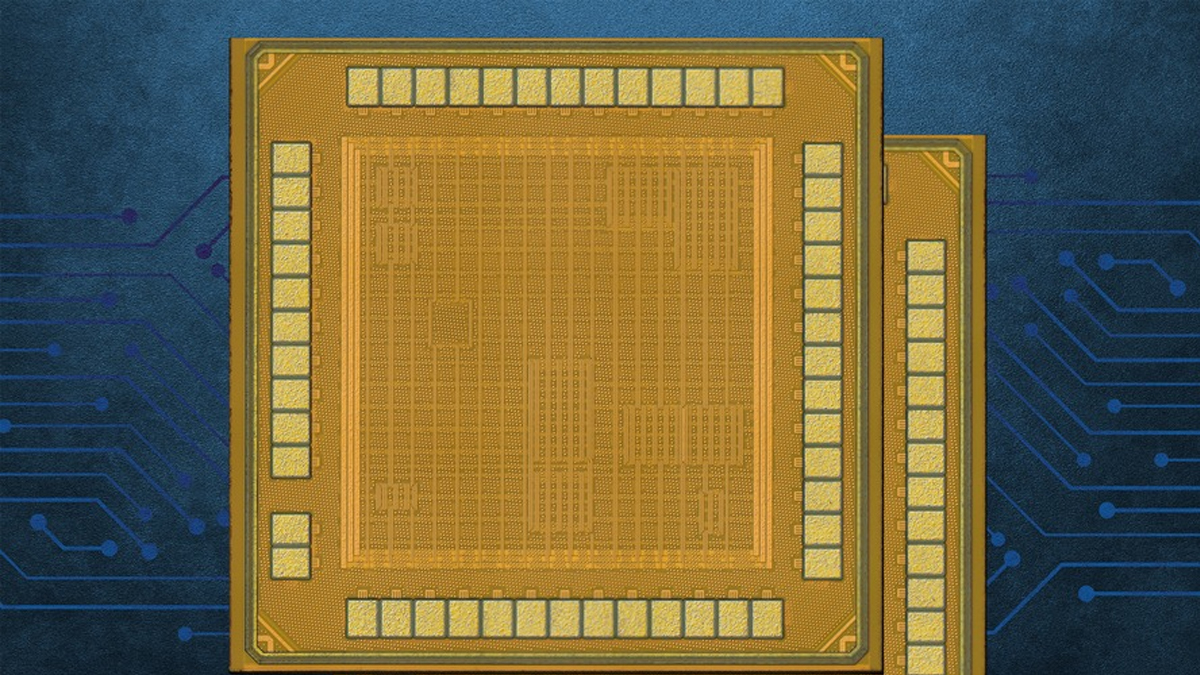
Researchers at the Massachusetts Institute of Technology have developed a highly energy-efficient microchip capable of running advanced post-quantum cryptography (PQC) on small, power-limited devices such as pacemakers, insulin pumps, and ingestible sensors. The breakthrough addresses a critical vulnerability in next-generation healthcare technology as quantum computing advances threaten current encryption standards.
The chip, roughly the size of a needle tip, integrates robust security features designed to protect sensitive patient data while maintaining extremely low power consumption. This makes it suitable for wireless biomedical devices that have historically lacked strong encryption due to energy constraints.
Why Post-Quantum Cryptography Matters
As quantum computers evolve, traditional encryption methods are expected to become obsolete. Governments and regulatory bodies, including the National Institute of Standards and Technology (NIST), are already preparing to transition toward PQC algorithms to safeguard digital infrastructure.
However, PQC techniques are computationally intensive, often increasing energy usage by up to 100–1000 times—making them impractical for small, battery-powered devices until now.
This new chip bridges that gap by enabling advanced encryption without significantly increasing energy demand.
Key Innovations Behind the Chip
Multi-Layered Security Design
The chip incorporates multiple PQC algorithms to ensure long-term resilience, even if one encryption method becomes vulnerable in the future.
Built-in Random Number Generator
A highly efficient on-chip random number generator strengthens encryption by producing secure cryptographic keys internally, eliminating reliance on external components.
Protection Against Physical Attacks
The design includes safeguards against “power side-channel attacks,” where hackers attempt to extract data by analyzing power consumption patterns.
Early Fault Detection
The chip can detect voltage irregularities and abort compromised operations early, preventing energy waste and potential security breaches.
Major Gains in Energy Efficiency
The researchers report that the chip achieves 20 to 60 times greater energy efficiency compared to existing PQC implementations, while also occupying a smaller physical footprint.
This efficiency breakthrough is crucial for expanding secure computing to edge devices—systems that operate outside traditional data centers, often with strict power limitations.


From Ashes To Atoms

Green Steel Could Help India Avoid $1 Trillion Coal Burden

Inside India’s Semiconductor Push: ‘This Is a 100-Year Bet’

FIFA Under Fire Over ‘Impossible to Justify’ Heat Rules for 2026 World Cup

‘The story of sea-level rise is not a story about water. It is a story about people’

Five Deaths in a Week: How Kerala’s Heatwave Is Driving Snakes Indoors
Inside India’s Semiconductor Push: ‘This Is a 100-Year Bet’
‘The story of sea-level rise is not a story about water. It is a story about people’

How Clean Energy Stepped Up After the Hormuz Blockade

When Pollinators Vanish, Children Go Hungry—Here’s the Proof

-

 Society4 months ago
The Ten-Rupee Doctor Who Sparked a Health Revolution in Kerala’s Tribal Highlands
-
Society5 months ago
From Qubits to Folk Puppetry: India’s Biggest Quantum Science Communication Conclave Wraps Up in Ahmedabad
-
Space & Physics5 months ago
Indian Physicists Win 2025 ICTP Prize for Breakthroughs in Quantum Many-Body Physics
-
Sustainable Energy5 months ago
The $76/MWh Breakthrough: Battery-Backed Solar Becomes the Cheapest Firm Power
-
Society5 months ago
Why the ‘Stanford Top 2% Scientists’ Label Is Widely Misrepresented
-
Sustainable Energy6 months ago
How Better Storage and Smarter Grids Could Break India’s Heat–Power Loop
-
COP306 months ago
Greenwashing at Scale: How Big Oil Flooded Brazil With Ads Ahead of COP30
-
Space & Physics5 months ago
When Quantum Rules Break: How Magnetism and Superconductivity May Finally Coexist