
Society
India Built the Pipes. Now It Needs Better Water Data
JalSoochak is helping strengthen rural water delivery in India by turning paper-based records into real-time data for faster monitoring and response.

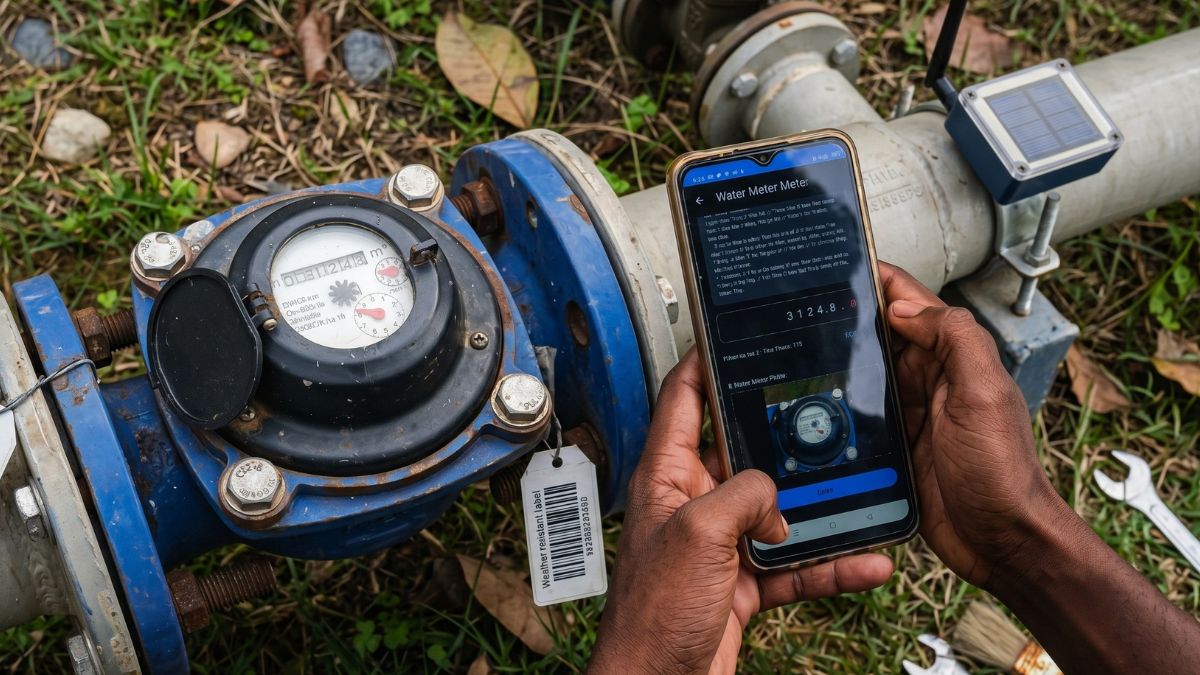
>> Rural water delivery in India has expanded rapidly under the Jal Jeevan Mission. But ensuring that water actually reaches homes every day now depends on better data, real-time monitoring, and systems like JalSoochak.
India built the pipes. Now comes the harder part.
Under the Jal Jeevan Mission (JJM), more than 1.5 crore rural households have been connected to piped water supply — a number that would have been unthinkable a decade ago. But connection is not the same as service. The pipe in the ground tells you nothing about whether water came out of the tap this morning, in what quantity, or whether the source feeding it is under stress.
That gap — between infrastructure built and service delivered — is where India’s rural water systems are now being tested. And it is a gap that turns, fundamentally, on data.
Why Rural Water Delivery Depends on Better Data
Pump operators and Jal Mitras are the ones who know. They manage supply cycles, monitor pumps, and record water delivery across thousands of villages every day. But in most states, those records live in paper registers. They cannot be verified, compared across districts, or acted on quickly. By the time a problem surfaces through the usual channels, it has often been festering for weeks. Engineers and administrators are left reconciling inconsistent figures instead of responding to the thing that actually went wrong.

Arghyam, a Bengaluru-based philanthropic organisation founded by Rohini Nilekani, has been working on this problem. In partnership with Assam’s Public Health Engineering Department (PHED), it developed JalSoochak (Water indicator) — a platform designed to make frontline water delivery measurable, verifiable, and useful, all the way up the system.
How JalSoochak Is Transforming Rural Water Delivery
“Since the expansion of rural water infrastructure, understanding what is actually happening on the ground at scale has remained difficult. JalSoochak addresses this by enabling frontline workers to capture a simple image as evidence of water supply, while also giving Jal Mitras a verifiable record of their service delivery and attendance,” said Kailash Karthik, Secretary, Public Health Engineering Department, Government of Assam and Mission Director, Jal Jeevan Mission Assam.
The tool itself is straightforward. A frontline worker photographs a meter reading on their mobile phone. The image is processed using AI, the user verifies the reading, and it is logged as a daily record. What used to be a handwritten entry in a register — easily disputed, easily lost — becomes a time-stamped, verifiable data point that engineers, block-level officers, and state administrators can all see and act on.
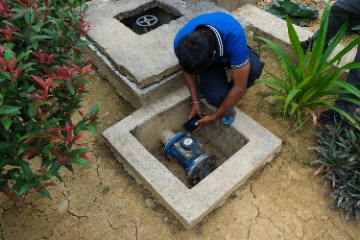
Accumulated over months, those daily records start to show things that no single entry would. A supply dip that recurs every fortnight. A pump whose readings are quietly declining. A source under pressure before anyone has formally flagged it. Problems get caught earlier, and the people responsible for fixing them have the evidence they need to act.
How Assam Is Digitising Rural Water Delivery
The numbers from Assam are substantial. More than 16,500 pump operators now use JalSoochak, collectively logging over 20 lakh readings. Together, those entries account for more than 37,600 million litres of water supply recorded.
Assam also made something else clear: what works in one state will not simply work everywhere. Each state has its own administrative logic, its own infrastructure, its own ways of capturing supply data. JalSoochak had to be rebuilt to absorb that variation rather than ignore it.
The platform now supports multiple modes of input — bulk flow meters, electric meter readings, pump operation duration, IoT devices, and manual entries. It works in local languages. Rather than running parallel to existing government systems, it is built to plug into them, so the data flows to where decisions are actually made, without creating extra work for anyone in the chain.
“JalSoochak is not just a technology platform. It is an attempt to strengthen service delivery to ensure that the investments made in rural water systems translate into reliable services for people. The journey from Assam to a national scale Digital Public Good has been about one core idea: making data useful for action, where it matters most,” said Deepak Gupta, Director of Digital Infrastructure and Government Partnerships, Arghyam.
JalSoochak is part of a broader effort to build a Digital Public Infrastructure for India’s water sector — a set of open, interoperable systems through which data can move across programmes and institutions, enabling governments to respond to problems where and when they actually occur, rather than when they finally show up in a report.
Crores of households now have a connection. The question that follows is simpler, and harder: is the water actually there? Getting a reliable answer to that question, consistently, across every village and every state, is what the next phase of rural water delivery will depend on.
Society
Why Global Tech and Industry Lean on Indian Talent
A look at how cultural roots, rigorous logic, and specialized management education shape a distinct global edge.

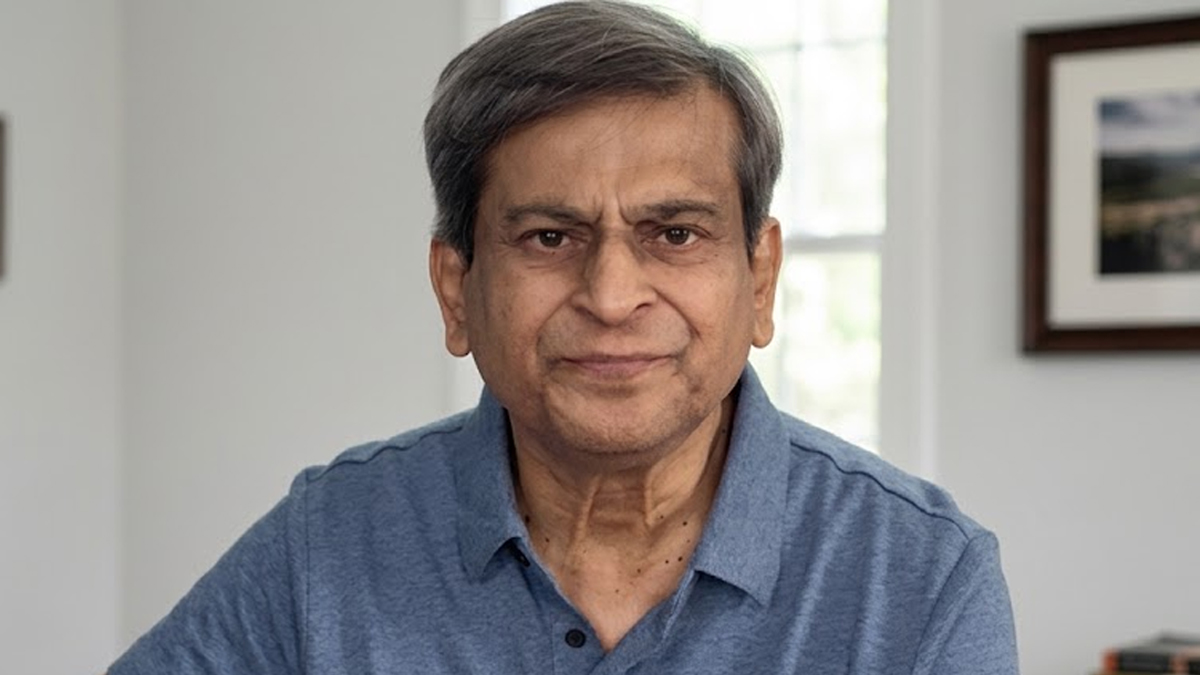
The modern corporate land scape is undergoing a massive, structural transformation. Across the globe, industries are no longer merely supported by in formation technology; they are entirely defined by it. From algorithmic finance to decentralized operations, “IT has become like a god—like, all-pervad ing,” observes management education expert Bharat Nadkarni.
As every sector moves toward an IT-based core, Indian youngsters have consistently found themselves at the forefront of this digital shift. This glob al positioning is not accidental. It is the result of a unique intersection be tween deep-seated cultural strengths, specialized technical streams, and a fundamentally logic-driven approach to solving problems.

Early Specialization and Management Polish
The journey of an Indian profes sional entering the global workforce typically begins with early academic focus. The current education system is structured to allow students who ex hibit a passion for scientific domains to concentrate deeply and cultivate a strict specialization early on. However, technical expertise alone is rarely enough to drive massive organizations forward. The real leverage happens when this scien tific groundwork is polished through management education.
By picking up the finer operational and structural points of business—whether special izing in strategic finance, logistics and operations, targeted marketing, or human resource frameworks—young professionals learn the art of execut ing at scale. Historically, these business silos operated independently. Today, tech nology acts as the universal connec tive tissue, smoothly binding opera tions, finance, and human resources into a single data-driven ecosystem. Because Indian students are trained to bridge the gap between technical execution and management strategy, they adapt exceptionally well to these interconnected systems.
A 500-Year Heritage of Logic
Beyond specialized academic pipe lines, a far deeper, cultural variable drives this aptitude. According to Nad karni, one of the primary foundational strengths of the demographic is a deeply ingrained ing manifests clearly in the career paths young professionals gravitate toward. Logic-dominant fields—such as advanced software engineering, mathematics, database architecture, and corporate finance—require an innate comfort with structure, pattern recognition, and systemic control. It is a space where clear, algorithmic thinking directly dictates success.capacity for rigorous logic. “Indian students are logically very strong,” Nadkarni explains.
“Maybe it is in our culture, and that culture may be of last 500 years.” This legacy of analytical reasoning manifests clearly in the career paths young professionals gravitate toward. Logic-dominant fields—such as advanced software engineering, mathematics, database architecture, and corporate finance—require an innate comfort with structure, pattern recognition, and systemic control. It is a space where clear, algorithmic thinking directly dictates success.
Navigating an All-Pervading Digital Future
As the international market evolves, the demand for this exact combination of deep logic and tech nical management is accelerating. The global shift toward data-centric business models plays directly to these intrinsic cultural and education al strengths.
For organizations trying to navigate this landscape, the lesson is clear: the strength of the emerging work force lies not just in their familiarity with modern tools, but in the struc tural logic they use to build them. By leveraging a historical foundation of analytical thought and refining it through modern management princi ples, a new generation is proving that they are uniquely equipped to lead an all-pervading digital economy.
Climate
India tops the world for population exposed to climate-driven risky heat
Climate-driven heat exposed 117 million people in India to a month or more of risky heat between June and August 2026, Climate Central found.


Society
Under Lalbagh: How a Botanical Garden Forced Bengaluru to Rethink Its Tunnel Road
The Lalbagh tunnel road project has forced Bengaluru to rethink plans for a proposed tunnel through one of the city’s oldest and most important green spaces. EdPublica visits Lalbagh Botanical Garden and speaks to the people who walk through it every day. The Lalbagh tunnel road has become the clearest test yet of how far public pressure can move a government once a decision looks final.
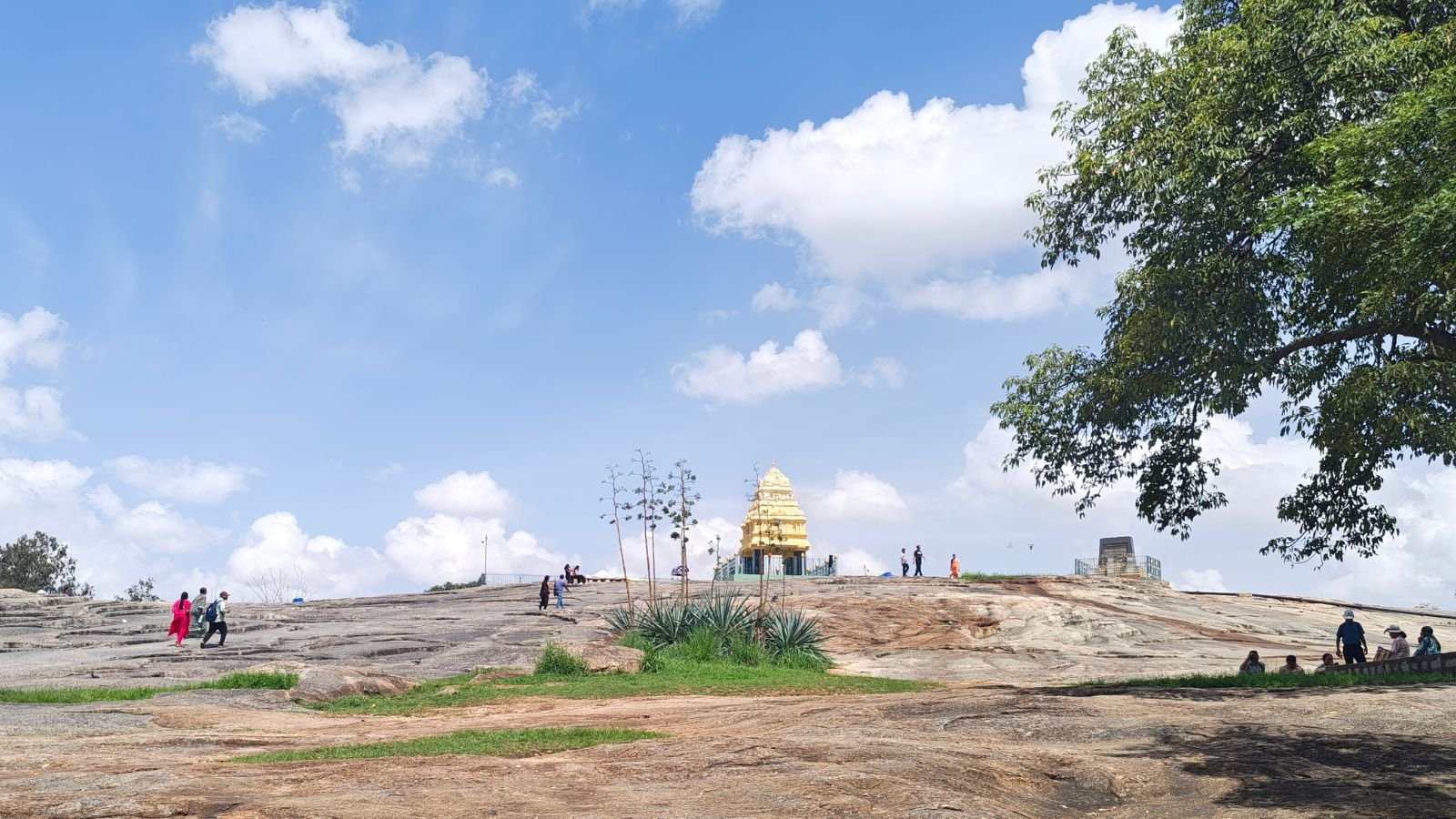
A Rs 17,000-crore-plus tunnel road was meant to cut Bengaluru’s commute times. Instead, it ran into a three-billion-year-old rock — and a government now scrambling to find another way through. EdPublica visits Lalbagh Botanical Garden and speaks to the people who walk through it every day.The Lalbagh tunnel road has become the clearest test yet of how far public pressure can move a government once a decision looks final.
It is early morning at Lalbagh’s West Gate, and walkers are already streaming in — no ticket needed at this hour, the entry stays free until nine. Somewhere past the bougainvillea, the Rose Garden is waking up in the mist, and a flock of parakeets is making its usual racket around the glasshouse. For most of the people filing in, this is simply the start of another day — a walk, a stretch, a bit of quiet before Bengaluru’s traffic takes over. Few of them are thinking about what lies beneath their feet: a proposed ten-lane road tunnel that, on paper, was meant to run straight through this ground.
The autorickshaw driver who dropped this reporter near the gate had his own way of putting it. He’d seen the protest that filled the park on a Sunday morning not long ago — thousands of people, banners, a human chain stretching around the old rock. He didn’t have strong views either way about tunnels and traffic, he said, but he’d noticed something: when the government backed down on the law that triggered it all, and signalled it might route the project around the garden instead of under it, people he spoke to seemed relieved. Since then, he said, he’d been getting more fares to Lalbagh than usual — visitors curious, it seemed, about the garden that had been all over the news.
Rajendar, who lives in Jigani on the city’s southern edge and drives roughly ninety minutes to visit, put it more simply. He comes for the green, he said — for a couple of hours where the air feels different, away from the concrete and the horns. A garden like this, he felt, was not something the city had many more of to spare.
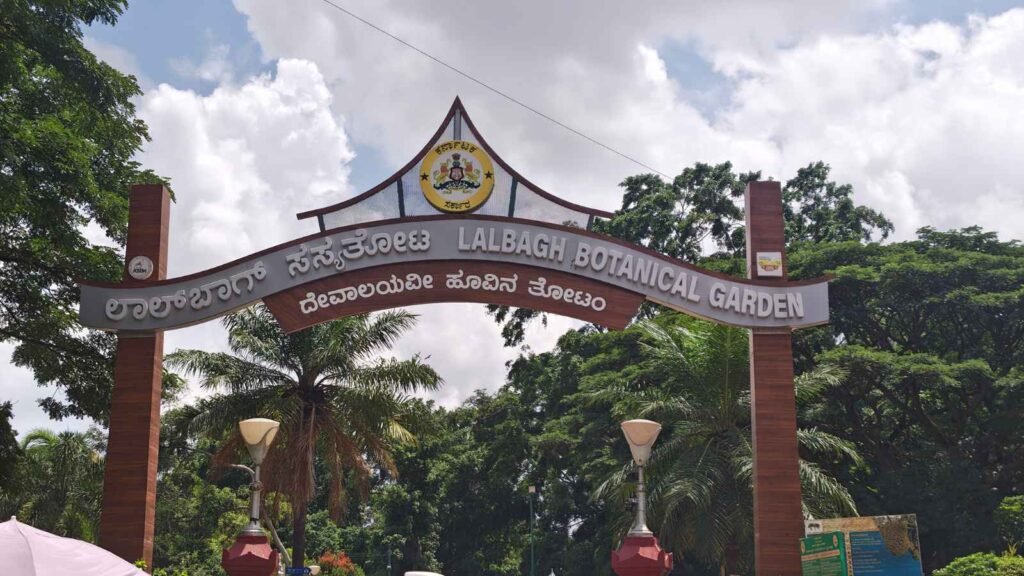
Credit: Dipin Damodharan/EdPublica
Not everyone was willing to be named. A corporate employee, mid-morning break, walking briskly along the lake path, agreed to talk only on condition of anonymity. His view was blunt: whatever the traffic problem is, running infrastructure like this under a garden like Lalbagh is not the way to solve it. The government, he said, needs to reconsider — and find a fix that doesn’t ask a 240-acre lung space to absorb the cost.
A garden older than the city’s traffic problem
Lalbagh’s story predates the automobile by more than a century. Hyder Ali, the ruler of Mysore, laid it out in 1760 as a private garden modelled partly on Mughal design; his son Tipu Sultan expanded it with plants brought back from campaigns and trading contacts across the region. British superintendents took over after, adding the glasshouse in 1890 — built, like much of the era’s civic architecture, in conscious echo of London’s Crystal Palace — and the garden has hosted its twin flower shows around Republic Day and Independence Day ever since.
Today it holds more than 1,850 plant species across 240 acres, including a roughly 250-year-old silk cotton tree said to date to Tipu Sultan’s time, and the Lalbagh Rock — a granite-gneiss outcrop now estimated by geologists to be about three billion years old, among the oldest exposed rock formations anywhere on the peninsula. A watchtower built during the reign of Kempegowda II sits on it. Campaigners have been pushing to have the rock considered for UNESCO recognition, in the same conversation as sites like Hampi.
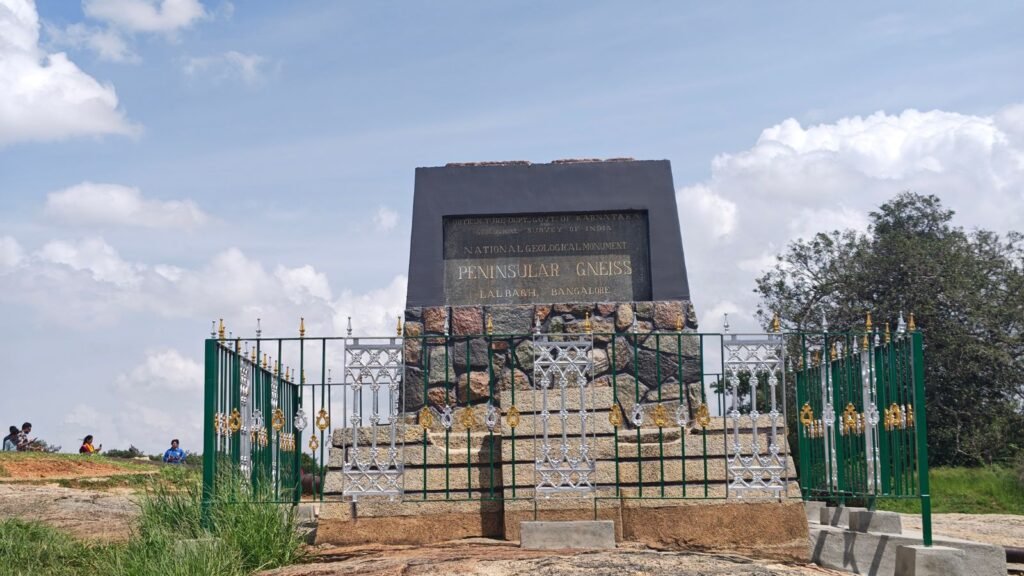
That rock, and the ground around it, is precisely what the tunnel road project has to pass through.
Lalbagh’s fight is, in that sense, a small and very local chapter of a much bigger story. UN-Habitat’s World Cities Report 2024 found that the average share of green space in cities worldwide fell from 19.5 per cent in 1990 to just 13.9 per cent by 2020 — and the decline has been sharper still in this part of the world, with East and Southeast Asia’s urban green cover dropping from 32.5 per cent to 18.6 per cent over the same period. Every city loses its green space to something that looks, at the time, like a reasonable trade-off — a road, a housing block, a transit line. Bengaluru’s version of that trade-off currently runs 50 to 100 feet under a botanical garden.
What the Lalbagh Tunnel Road Project actually proposes
The Bengaluru Tunnel Road — sometimes called the Twin Tunnel Road — is planned to run 16.5 to 16.75 kilometres between Hebbal in the north and Central Silk Board in the south, largely beneath the Outer Ring Road corridor. Its cost has been quoted at different points as roughly INR 17,000 crore, INR17,698 crore and, more recently, INR 22,267 crore, after Adani Group entities were reported to have won the contract. As originally designed, the alignment required roughly six acres of Lalbagh land — most of it temporary, during construction — for two entry and exit ramps and a ventilation shaft, with one ramp passing within a few hundred metres of Lalbagh Lake and another running close to the rock formation itself, at depths of 50 to 100 feet.
What the reports found
Three separate technical reports have shaped the debate, and none of them offer the government much comfort.
A Geotechnical Interpretative Report prepared for the city’s civic body by Rodic Consultants, dated September 2024, flagged the Lalbagh stretch as a “bedrock transition zone” and noted a geological lineament — a fault-like feature — crossing the proposed alignment near the lake, along with risks of groundwater seepage and seasonal water-table shifts.
A Geological Survey of India expert committee went further. Its report, submitted to the government in April 2026, warned that tunnelling and blasting near the rock could widen existing cracks, destabilise parts of the formation, and disturb groundwater flows into Lalbagh Lake — and separately flagged risk to the historic Kempegowda watchtower. GSI also noted civil-society efforts to have the rock nominated as a UNESCO site.
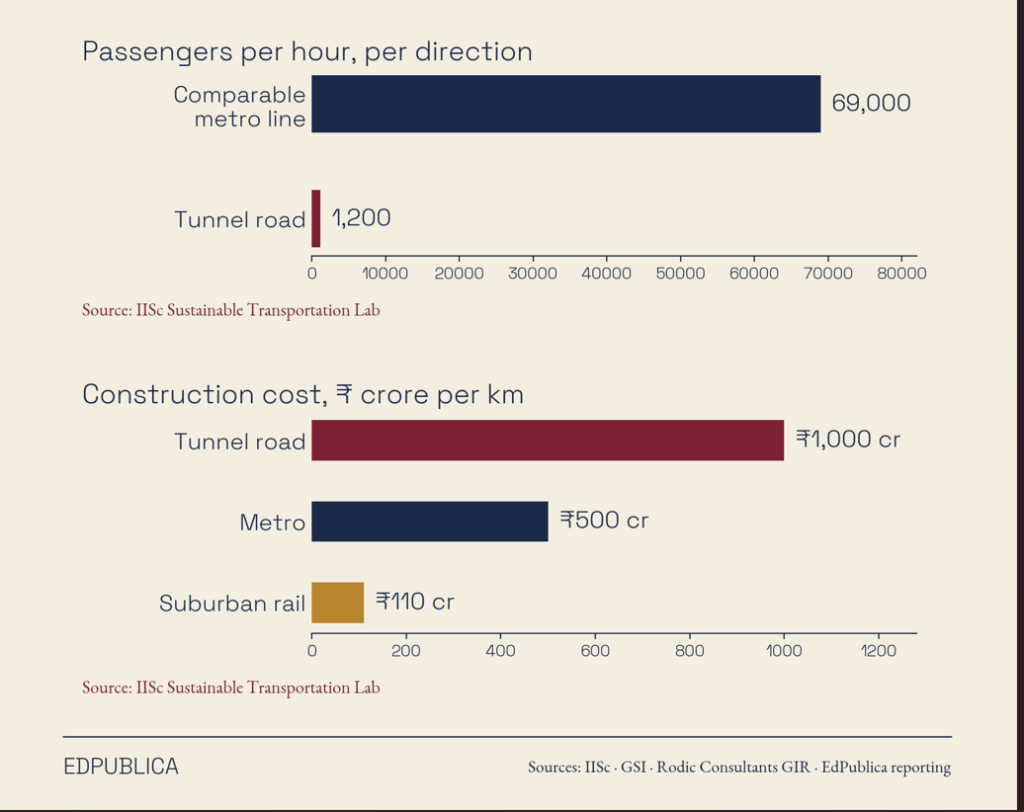
A third, independent study — by the Sustainable Transportation Lab at the Indian Institute of Science, led by Professor Ashish Verma — questioned the project’s basic logic rather than its geology. Modelling suggested the tunnel would carry only around 1,200 passengers per hour per direction, against roughly 69,000 for a nine-coach metro line built at comparable cost; in a high-toll scenario, the study projected the tunnel’s volume-to-capacity ratio could fall as low as 0.1 — a road built for far more traffic than would likely use it. The same analysis suggested the project could, in some scenarios, add to the city’s overall emissions rather than cut them, by drawing commuters away from mass transit and towards private cars.
The law that lit the fuse
If one thing turned this from a planning dispute into a street movement, it was a single piece of legislation.
The Karnataka Government Parks (Preservation) (Amendment) Bill, 2026, amends a 1975 law that has, until now, given government parks and gardens fairly strong statutory protection. The amendment inserts a new provision allowing the state to “alienate” — that is, sell, lease, gift, exchange, mortgage or otherwise transfer — up to 5 per cent of the total area of any government park or garden in Karnataka, for specified public infrastructure and utility projects. Applied to a 240-acre site like Lalbagh, that threshold works out to roughly 12 acres, twice what the tunnel’s original design was reported to need.
The government’s case is that the change is generic policy, not a Lalbagh-specific fix: Chief Minister D.K. Shivakumar has said it is meant to enable ordinary public works, such as road-widening, without the cost and delay of separately acquiring private land, and that the provision does not open parkland to private developers — land can only be leased, transferred or exchanged to government departments, statutory authorities and local bodies. Critics were not persuaded. The Bill was cleared by the Cabinet and passed by both Houses of the legislature on 24 August 2026 amid opposition protests inside the Assembly and, its critics say, with little substantive debate — timing that, coming as the tunnel’s alignment through Lalbagh was already under challenge in court, read to many as a legislative route around the garden’s protections rather than a coincidence.
How the fight unfolded
The reaction outside the legislature was faster than the government seemed to expect. Within three days of the Bill’s passage, more than 200 citizens, resident groups and environmental organisations gathered at Lalbagh on 27 August to form a human chain around the ancient rock, demanding the amendment be withdrawn. That Sunday, 30 August, the numbers swelled into the thousands for a march titled “Walk in Lalbagh, Walk for Lalbagh” — residents, walkers’ associations, cycling groups and pro-Kannada organisations alongside Bengaluru South MP Tejasvi Surya, Union Minister Shobha Karandlaje and other BJP lawmakers, plus veteran environmentalist A.N. Yellappa Reddy. Marchers sat and lay across the Peninsular Gneiss rock itself and raised slogans in Kannada and English with a common refrain: not one inch of Lalbagh.
The mobilisation built on opposition that had already been running for months through the courts — public-interest litigation in the Karnataka High Court led in part by theatre personality Prakash Belawadi and civic figures including Adikesavalu Ravindra and N.S. Mukunda, and an earlier, smaller human chain in early August aimed specifically at protecting the geological monument from the tunnel.
Facing that pressure, and with BJP leaders petitioning the Governor to withhold assent to the Bill, the state Cabinet withdrew it within days, on 3 September 2026. Shivakumar said the legislation would be reintroduced later, after wider public consultation — it has not been dropped for good. A week after that, on 9 September, he went a step further and said he had asked Greater Bengaluru Development Minister Krishna Byre Gowda to study alternatives to using Lalbagh land for the tunnel. That is an instruction to examine options, not a decision to reroute — no revised alignment has been published, and the original six-acre land requirement, the detailed project report and the tender awarded to Adani entities all remain officially in force.
Several petitioners have said they intend to keep challenging the project on transport and procedural grounds regardless of what happens to the amendment or the alignment. Their case — over the withheld 2025 expert report, the missing environmental impact assessment and questions about statutory transport-authority approvals — is due back before the Karnataka High Court in December.
Why the green matters, in numbers
- 240 acres — Lalbagh’s total area, one of the two largest green lungs in central Bengaluru alongside Cubbon Park.
- 1,850+ plant species recorded in the garden, built up over roughly 265 years by Mysore rulers, British superintendents and the state horticulture department.
- ~3 billion years — estimated age of the Lalbagh Rock, a Peninsular Gneiss formation and protected National Geological Monument.
- 16.5–16.75 km — length of the proposed tunnel road corridor between Hebbal and Silk Board.
- ~6 acres — Lalbagh land originally required for the tunnel’s ramps and ventilation shaft.
- 1,200 vs 69,000 — projected passengers-per-hour-per-direction for the tunnel versus a comparably priced metro line, per the IISc study.
- INR 1,000 crore/km — estimated tunnel construction cost, against roughly ₹500 crore/km for metro and INR 110 crore/km for suburban rail, by the same analysis.
A retreat, not a resolution
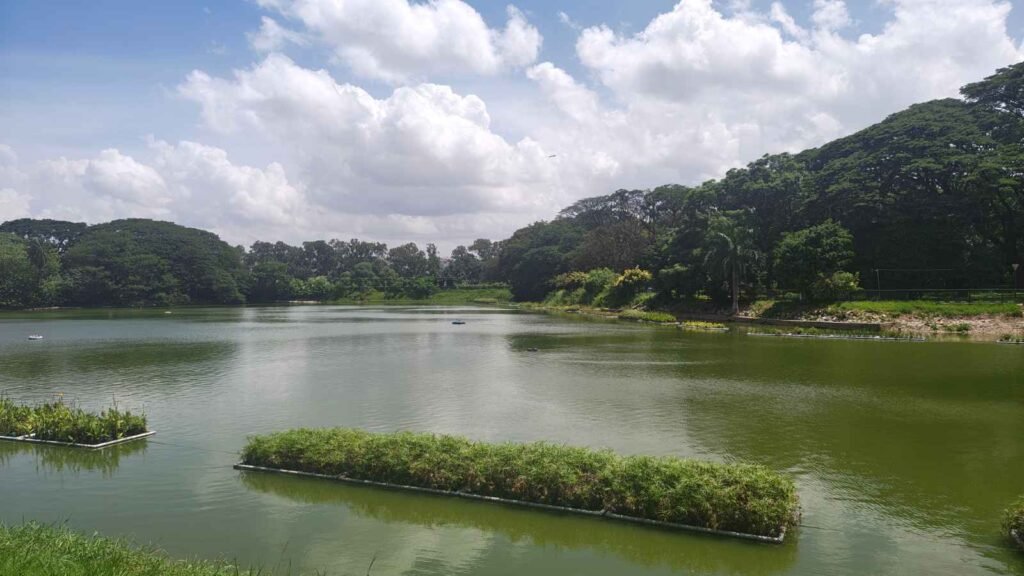
For now, the garden itself shows no sign of the fight above and around it. The lake is calm, the rock still draws its usual scatter of visitors reading the noticeboard about its age, and the morning walkers keep coming. What has shifted is something real but narrower than it looks: a government caught off guard by how fast a legislative manoeuvre turned into a mass protest, and forced into a public climbdown within ten days of passing a law.
That is not the same as Lalbagh being safe. The amendment is shelved, not repealed, and Shivakumar has said it will return after “consultation.” The instruction to study a route around the garden is exactly that — a study, with no published alternative and no change yet to the project’s land requirement, tender or contractor. The Geological Survey of India’s warnings about the rock, the watchtower and the groundwater, submitted in April and made public only in September, have not been formally answered. And the oldest thread of opposition — the court case over how the project was tendered and cleared in the first place — continues in December, indifferent to whichever way the alignment eventually bends.
So the honest answer, for Rajendar driving in from Jigani, or for the corporate employee unwilling to give his name, is not that they won. It is that a fight most people assumed was already lost turned out not to be — and that the next few months, in a courtroom and in a minister’s office rather than at a human chain, will decide whether that counts for anything.


KSBB Workshop Examines Biodiversity, Climate and Environmental Reporting

Why Global Tech and Industry Lean on Indian Talent

From Silicon Valley to Sustainable Period Care; How This Engineer Is Rethinking Menstruation with Science

India tops the world for population exposed to climate-driven risky heat

Can a Webcam Replace the Guru? A Kerala Startup Is Betting Yes

Farmers Borrowed to Build ‘Diggis’. Two Years Later, They Are Still Waiting for the Subsidy

Our Algorithm Knows What We Want Before We Do. That is the Problem.

When Decarbonisation Becomes the Real Conversation at Tiruppur’s Knit Show

When the Himalayas Collapse Without Warning, What Counts as Preparedness?

The Engineer of Tomorrow Is Already Here

-

 Math2 months ago
The 2026 Fields Medals: Four Proofs, Four Decades-Old Problems Solved
-
Climate2 months ago
After Kerala’s Deadliest Landslide, the Hardest Thing to Rebuild Was Childhood
-
Society2 months ago
West Asia Crisis: Can Kerala’s Returning Gulf Migrants Find a Future in the Green Economy?
-
Space & Physics4 months ago
India Semiconductor Mission: ‘It’s Not About Fabs. It’s About Building An Entire Ecosystem’
-
Climate4 months ago
The Climate World Cup? How Climate Change Could Affect Player Performance at the 2026 World Cup
-
Society2 months ago
What Is Civilisational Diplomacy? Understanding India’s Newest Foreign Policy Tool
-
Society3 months ago
From Bell Labs to the Classroom: A Second Career in Teaching
-
Space & Physics4 months ago
Engineers Develop Dual-Mode Propulsion System for Next-Generation Small Satellites