Society
The Ten-Rupee Doctor Who Sparked a Health Revolution in Kerala’s Tribal Highlands
Dr. V. Narayanan’s Swami Vivekananda Medical Mission Hospital in Agali — known locally as the 10-rupee hospital — stands as one of the most remarkable community health transformations in modern Kerala

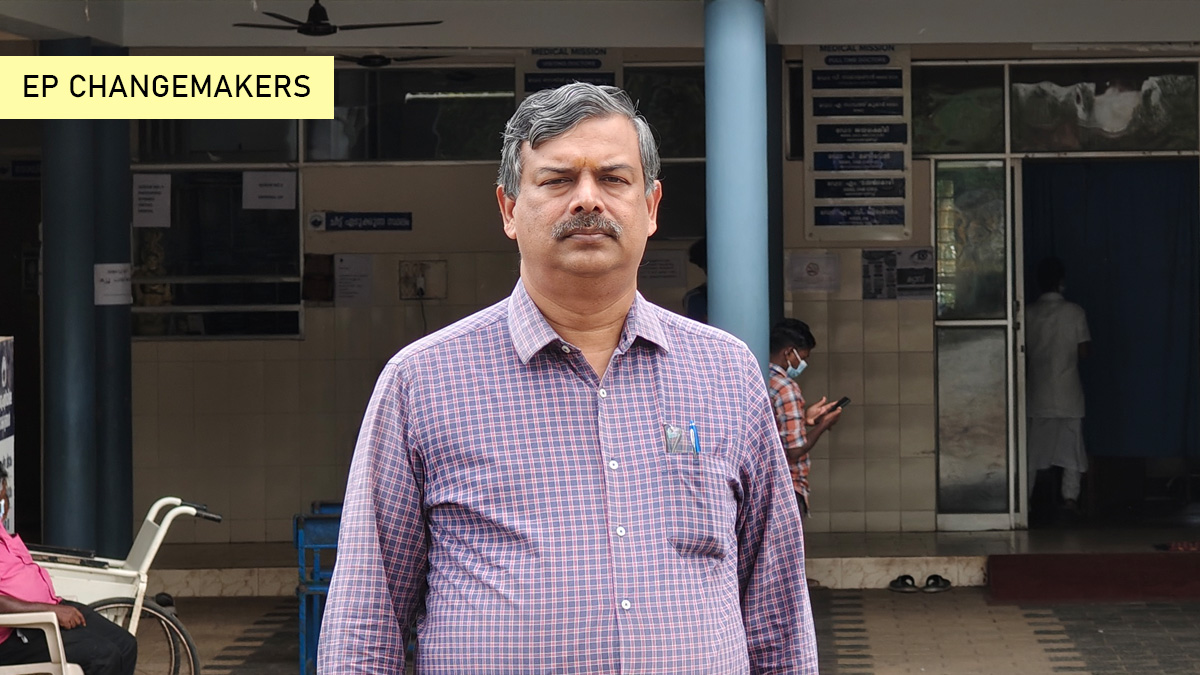
Swami Vivekananda — arguably India’s most influential modern monk and one of the world’s most celebrated humanist thinkers — once said, “They alone live who live for others.” In the remote Adivasi (tribal) hamlets of Attappadi, deep in the hills of Kerala, that line is not philosophy. It is the force that quietly reshaped an entire community’s destiny.
Two decades ago, a young doctor arrived in this valley armed with nothing more than Vivekananda’s teachings and an unusual certainty: that his life’s purpose lay not in hospitals with polished floors or specialised units, but in the neglected tribal belts where even an ambulance was a distant dream. In a medical world chasing high salaries and urban careers, he walked away from all of it. Today, they call him simply: “The Ten-Rupee Doctor.”
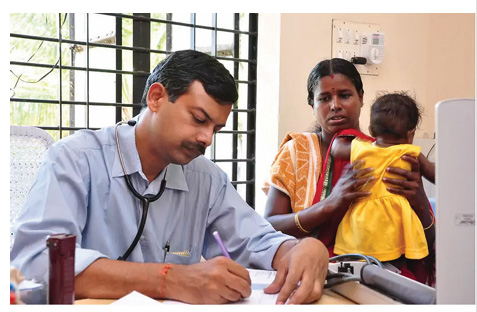
Dr. V. Narayanan’s Swami Vivekananda Medical Mission Hospital in Agali — known locally as the 10-rupee hospital — stands as one of the most remarkable community health transformations in modern Kerala. For thousands of tribal families who once had no healthcare, the hospital is not merely a building. It is dignity restored.
The road to Attappadi coils through steep cliffs and dense forests, revealing slivers of green and shadows of mountains that appear to move with each turn. For years, headlines from this tribal hotspot in Kerala’s Palakkad district were heartbreakingly similar: child malnutrition, maternal deaths, anaemia, and a healthcare system fractured beyond recognition.
We were travelling from Kochi not to revisit that trauma, but to meet the man whose quiet, steady efforts helped change it.
When Dr. V. Narayanan arrived in 2002, Attappadi’s healthcare landscape was desolate. A few primary health centres existed in name, but medicines were scarce, staff irregular, transport unreliable, and trust nearly non-existent. Many Adivasi (tribal) families walked hours for simple ailments. Women delivering babies often did so without skilled care.
“In those early days,” he recalls, “you wouldn’t even see a bike on the road. Healthcare wasn’t inadequate — it was absent.”
But absence was precisely what he had come to confront.
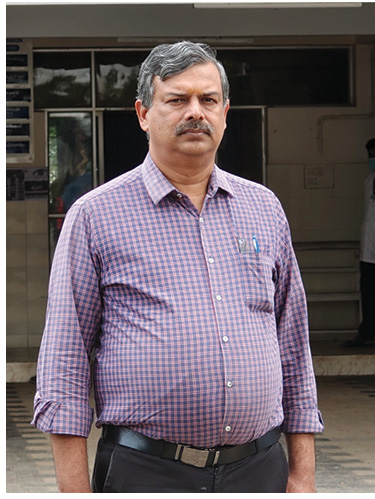
How Vivekananda Became a Field Manual
The roots of his journey stretch back to his teenage years. “I was in Class 12,” he says. “It’s an age when you question everything. I began reading Vivekananda deeply. His call to serve the poor, to work in backward areas — that stayed with me.”
Medicine wasn’t his ambition. Rural development was. But his family persuaded him to study MBBS, believing it would broaden his capacity for service. It did — but only because he refused to choose the conventional path.
After completing a postgraduate programme in child health, he didn’t apply for a job. He headed straight to Attappadi — without doubts, without second thoughts. “This wasn’t a career decision,” he says. “It was a life decision.”
His first “clinic” was a mobile medical unit borrowed from the Vivekananda Medical Mission in Wayanad. Every evening he visited a different hamlet, listening to people speak about water scarcity, hunger, infections, unemployment, fear, distrust — and neglect that had accumulated over generations.
Slowly, he became a familiar figure in the valley. Mothers insisted he be the first to hold their new-borns. Elders began greeting him as one of their own.
A belonging was forming — one that medicine alone cannot create.
The Birth of the Ten-Rupee Hospital
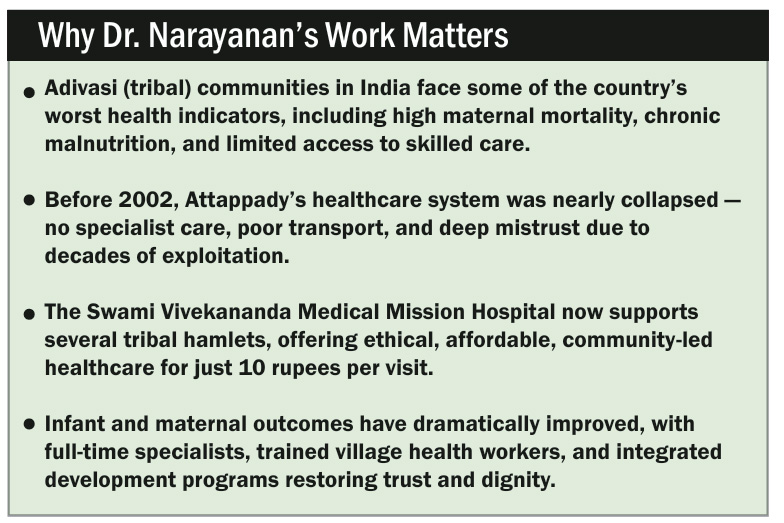
In 2003, as patients multiplied beyond what the mobile clinic could handle, he opened a small outpatient centre in Agali. By 2006, after raising 22 lakh rupees from well-wishers and small donors, the Swami Vivekananda Medical Mission Hospital opened its doors with 10 beds, two consulting rooms, and a lab.
Its defining principle was radical: Adivasi patients would be charged only ten rupees. Always.
Administrators warned him it was economically unviable. But the doctor had seen families pushed into debt by even minor medical expenses.
“The hospital must belong to them,” he says. “Cost should never decide who lives and who dies.”
People came. Trust deepened. And trust became infrastructure.
A patient visited in the hospital says, “Here, we feel like human beings. Not cases. Not numbers. Narayanan doctor listens to us like we are his family. That is why we come.”
Another woman added softly: “When we step inside this hospital, we feel safe. There is no fear here.”
For communities long accustomed to humiliation and exploitation in medical spaces, this emotional safety mattered as much as treatment.
A Global Gap Mirrored in a Valley
Attappadi’s early struggles are not isolated. Across India, Adivasi (tribal) communities face some of the poorest health indicators — high maternal mortality, anaemia, malnutrition, tuberculosis, and limited access to skilled care.
Globally, too, Indigenous communities — from the Māori of New Zealand to Native American nations and Aboriginal groups in Australia — experience higher infant and maternal mortality, limited access to hospitals, distrust due to historic exclusion, lower life expectancy, and underfunded primary care
A 2021 UN report states that Indigenous peoples worldwide are nearly twice as likely to lack basic healthcare access. What was happening in Attappadi was part of a wider pattern — the world’s margins suffering the world’s worst health outcomes.
Dr. Narayanan stepped directly into that gap.
Healing Required More Than Hospitals
Over time, he realised medical treatment alone could not fix Attappadi’s pain.
“Pregnant women worked until delivery because they had no choice,” he says. “Many ate barely one meal a day. How can a baby survive that?”
He conducted a participatory rural appraisal across several hamlets — and what he saw changed everything. Malnutrition was linked to income instability. Illnesses persisted because basic hygiene wasn’t possible. Women were dying because poverty didn’t allow rest.
“It felt like pouring water into a pot full of holes,” he says. “We had to strengthen the pot — not just keep pouring.”
The hospital expanded into a movement that worked on, restoring nutrition, improving sanitation, supporting livelihoods, strengthening housing, reviving agriculture, education, and building self-reliance.
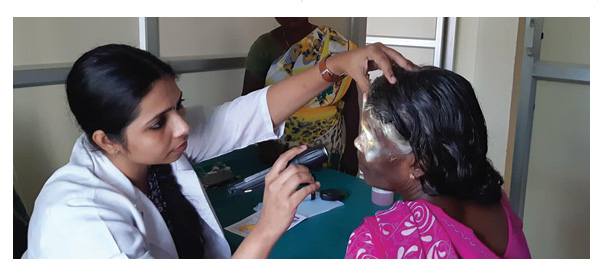
Village health workers — trained women and men from each hamlet — became ambassadors of preventive care. From an initial 40, tthe network has grown to nearly 130 health workers across Attappadi.
Education too became central. The Mission school today teaches 600+ children, and the valley now has young people pursuing medicine, nursing, and engineering — an unimaginable shift a decade ago.
Growing, But Never Losing Its Soul
The hospital today has 50 beds, 12 full-time doctors, and over 80 staff. Across the Mission’s programmes, more than 200 people work toward one idea: dignity. Nearly 70% of all patients remain Adivasi (tribal).
The next dream: a 100-bed hospital. Construction for new OP wings and a skill development centre has already begun.
CSR funding keeps the institution afloat, but the ten-rupee fee remains untouched.
“It will never change,” he says. “This hospital exists because of them. It must always belong to them.”
A Revolution Fuelled by Belonging
When asked what sustains him, Dr. Narayanan doesn’t speak of recognition. Instead, he points to his staff — many of whom left better-paying jobs to join the Mission.
“They believe in this work more than anything I’ve done,” he says. “I’m just one person. They are the movement.”
Two decades after he arrived here, the Ten-Rupee Doctor still walks through the corridors of his hospital with the same simplicity and calm that first won the valley’s trust.
In the world of global public health — dominated by budgets, systems, and crises — Attappadi offers a different narrative: that change is possible when a community finds a place where it is seen, heard, and treated as human.
Sometimes, revolutions don’t begin with policy. They begin with one person who refuses to turn away.






Society
Sonam Wangchuk: Educator, Engineer, and a Legal Fight Still Unfolding
Educator, engineer, hunger striker, NSA detainee — is Sonam Wangchuk a rebel, a hero, or both? A data-checked profile of the man and the unresolved fight around him.
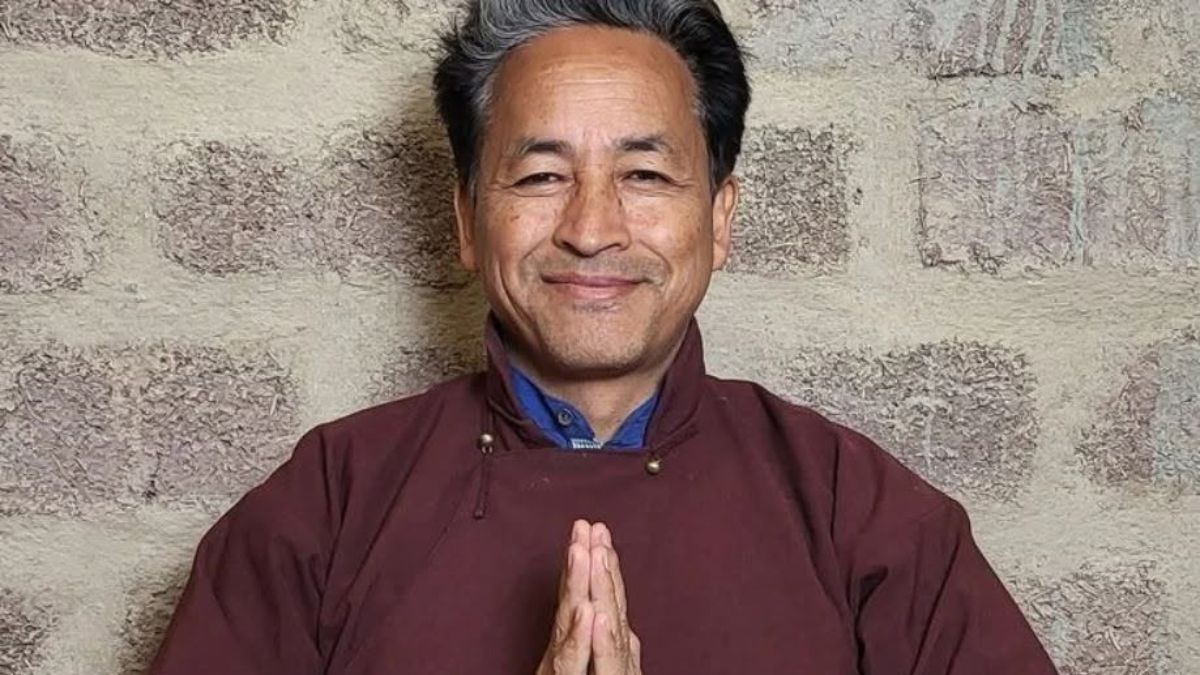
Sonam Wangchuk turned a 5% pass rate into 75%, engineered an artificial glacier that needs no electricity, and seeded a university with his own prize money. He has also spent six months in jail under India’s National Security Act, and this July was hospitalized after a three-week hunger strike in Delhi. This profile separates the engineering record from the ongoing legal and political fight — and reports both without resolving either.
Sonam Wangchuk has spent nearly four decades building things designed to work without him: a school where students, not staff, set the rules; an artificial glacier that needs no electricity or pump; a university seeded with his own prize money rather than a donor’s. He has also, over the past two years, been jailed under one of India’s most restrictive security laws, had his organisation’s foreign-funding licence revoked by the federal government, watched a protest he was supporting while on hunger strike descend into violence in which four people were killed. Both of these are true, and both are part of the record.
This piece separates the two. It sets out, with as much precision as the public record allows, what Sonam Wangchuk actually built and measured in education and engineering — and then reports, without taking a side, on the legal and political conflict that has consumed much of the last eighteen months of his public life.
The education crisis that inspired Sonam Wangchuk. The diagnosis: 1988
Sonam Wangchuk was born in 1966 in a village near Alchi, in what was then Jammu and Kashmir’s Ladakh region. He trained as a mechanical engineer at what is now the National Institute of Technology, Srinagar. In 1988, together with his brother and five friends, he founded the Students’ Educational and Cultural Movement of Ladakh (SECMOL).
The problem they set out to address was specific: at the time, close to 95% of Ladakhi students were failing their Class 10 board examinations. Wangchuk’s explanation, restated in interviews for decades since, was that the curriculum was the wrong one for the place — children who spoke Ladakhi or Tibetan at home were taught in Urdu and English, memorising material with no relevance to a high-altitude cold desert.
SECMOL’s campus near Leh took students who had already failed their board exams — failure was the admission criterion, not marks. The school ran on student self-governance: pupils cooked, budgeted, and voted on rules. Wangchuk designed the buildings himself: passive-solar structures of rammed earth that held an interior temperature of roughly 15°C even when it was minus 15°C outside, without any purchased heating.
| The two sides |
|---|
| Regional Class 10 pass rates in Ladakh rose from roughly 5% to 75% over two decades under Operation New Hope, a multi-agency effort in which Wangchuk’s SECMOL school was one contributor, not the sole architect. |
| His Ice Stupa design stores meltwater as a cone of ice using no electricity, pumps, or moving parts — but a 2019 academic study found the technique requires heavy labor and maintenance and can only store limited volumes relative to the effort involved. |
| In September 2025, a hunger strike Sonam Wangchuck led preceded a riot that killed four people; he was detained without trial under India’s National Security Act for nearly six months, while his organization’s foreign-funding license was revoked and a university land lease was cancelled. |
| The government maintains his rhetoric contributed to the violence; he and his wife maintain the detention was retaliation for his activism — a dispute that reached the Supreme Court and remains legally unresolved even after his release in March 2026. |
| www.edpublica.com |
Regional pass rates climbed from around 5% to close to 75% over the following two decades, according to figures compiled by SECMOL and the Himalayan Institute of Alternatives. That reversal is not attributable to SECMOL alone. It happened under Operation New Hope, a joint effort involving the state government, the local school system, and several NGOs, of which SECMOL was one. What is specifically attributable to Wangchuk is the diagnosis that anchored the wider reform, and the SECMOL campus itself, which functioned as both training ground and proof of concept for it.
The Ice Stupa: What the Record Shows, and What Critics Say
Ladakh’s farmers face a seasonal mismatch: glacial meltwater arrives in June, sowing season starts in April. In January and February 2014, Sonam Wangchuk and a group of SECMOL students built a test structure in Leh — a roughly six-metre cone holding about 150,000 litres, built with no shade, no machinery, just gravity-fed piping and freezing night air. Piled water froze into a cone rather than spreading flat, the way earlier artificial glaciers had; a cone’s smaller surface-area-to-volume ratio means it loses less ice to direct sun. The structure held until 18 May, weeks into a season with daytime temperatures above 20°C.
That result persuaded Drikung Kyabgon Chetsang Rinpoche, a senior Buddhist leader who visited and blessed the prototype, to offer land at Phyang village for a full-scale version. Built the following winter, it was roughly 20 metres tall and stored an estimated two million litres — more than ten times the first prototype. Figures compiled by the Council on Energy, Environment and Water put the count at 52 functioning ice stupas in Ladakh a few years after 2019, with additional pilot structures elsewhere, including a confirmed installation in Switzerland’s Val Roseg valley (2016) built with Wangchuk’s direct involvement, and an independently developed project in Chile’s Andes that has cited the Ladakh design as its starting point.
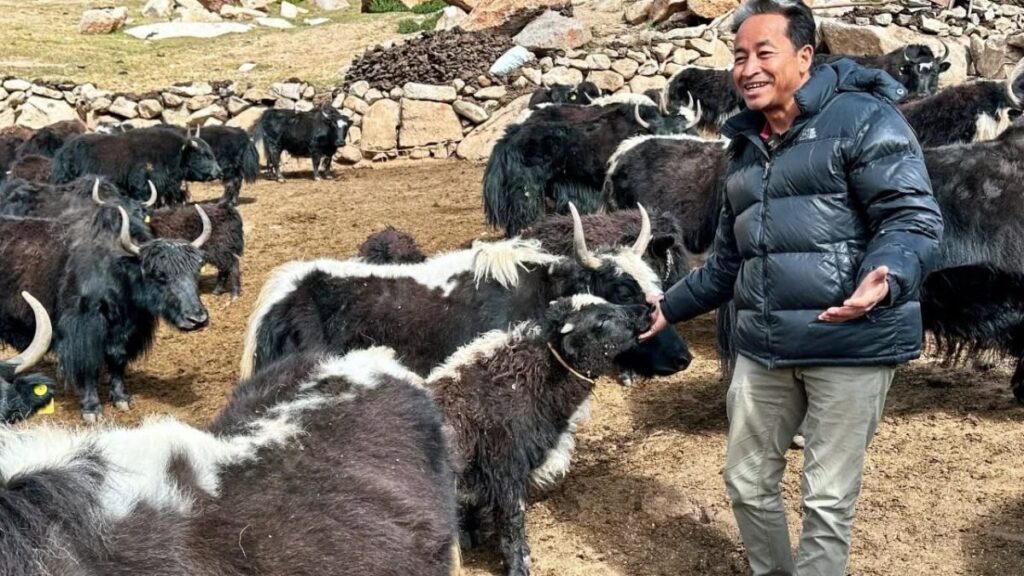
Independent researchers have raised real limitations. A 2019 study by the geographer Marcus Nüsser and colleagues, cited by the climate-adaptation research group climateinterventions.org, found that ice stupas require substantial ongoing maintenance, investment, and construction labour, can only store limited volumes of water relative to the effort involved, and — because they divert water that would otherwise flow into rivers — can carry knock-on effects for communities and ecosystems downstream. None of this contradicts the basic engineering result Wangchuk demonstrated; it does complicate the more sweeping claims sometimes made on his behalf about the technique as a scalable, general-purpose fix for Himalayan water scarcity.
HIAL, and the funding fight that followed
Sonam Wangchuk’s plans for a university predate his exit from SECMOL’s day-to-day leadership. By the time he collected the 2016 Rolex Award for Enterprise — 100,000 Swiss francs, then worth roughly ₹67–68 lakh (about US$104,000) — reporting from the ceremony described him as already “busy establishing” the new institution, with the Leh Autonomous Hill Development Council and the Drikung Kagyu Cultural Welfare Society allocating land for it. He put the entire prize toward it as seed funding. The Himalayan Institute of Alternatives, Ladakh (HIAL) was formally founded with his wife and collaborator, Gitanjali J. Angmo, in 2017; Wangchuk stepped back from SECMOL’s leadership only in 2018, by which point HIAL was already underway. According to Angmo, more than 400 students had passed through the institute by 2025.
That funding relationship became contested in 2025. In August, the Ladakh administration cancelled a 40-year land lease it had granted HIAL in 2018, citing non-execution of a formal lease deed and lack of progress on construction. The Wire, examining official correspondence, reported that the delay in executing the deed stemmed from the administration’s own unfinished “New Lease Policy,” despite repeated requests from HIAL to formalise the agreement — an account the Ladakh administration disputes; officials have said HIAL violated the terms of the original allotment. Angmo has separately alleged that a federal minister told her the lease would stay frozen unless Wangchuk abandoned his campaign for Ladakh’s inclusion in the Constitution’s Sixth Schedule. That allegation could not be independently verified for this piece, and no official response to it appears in the public record reviewed here.
In September 2025, the federal Ministry of Home Affairs cancelled SECMOL’s licence to receive foreign donations under the Foreign Contribution (Regulation) Act, citing irregularities in its 2021–22 accounts — chiefly a cash deposit of ₹3.5 lakh that SECMOL said was the sale proceeds of an old bus bought years earlier with foreign funds, an explanation the ministry called insufficient. The Central Bureau of Investigation opened a parallel inquiry into HIAL’s foreign funding and into a trip Wangchuk made to Pakistan in February 2025. As of this writing, that inquiry’s outcome has not been made public.
The political fight: statehood, a hunger strike, and a riot
Since Ladakh’s 2019 reorganisation into a Union Territory without a local legislature, Sonam Wangchuk has campaigned for full statehood and for extending the Constitution’s Sixth Schedule protections to the region — protections that would give local bodies greater authority over land and resources. He announced a five-day fast in January 2023, led a 21-day fast in March 2024, and fasted again that October, each time pressing the same demand.
In September 2025, Wangchuk began a hunger strike in Leh in support of the same cause. On 24 September, after 14 days of fasting, protesters at the site moved away and clashes broke out elsewhere in the city; buildings and police vehicles were burned, and police opened fire. Four people were killed and, depending on the account, between 70 and 100 were injured — the worst unrest Ladakh had seen in years. Wangchuk ended his fast and publicly condemned the violence.
The federal government’s position, stated by the Ministry of Home Affairs, was that Wangchuk’s speeches — which it said had invoked the Arab Spring and the 2025 Gen Z protests in Nepal — had “guided” the crowd toward violence. Two days after the deaths, he was arrested and detained under the National Security Act, a law that permits preventive detention for up to twelve months without formal trial. He was held in Jodhpur Central Jail, more than 1,000 kilometres from Ladakh.
Sonam Wangchuk denied inciting the violence. In a letter released from jail, he called it “the saddest day of his life” and asked for an independent judicial inquiry into the four deaths, adding that he was prepared to remain in custody until one was held. His wife challenged the detention before the Supreme Court, arguing it relied on stale or unrelated police complaints — by her account, three of the five FIRs cited predated the September violence entirely, and three did not name Wangchuk at all.
The Court agreed to hear the case; a bench questioned why Angmo had not been given the grounds for the detention, as required by precedent. Before the matter was fully resolved in court, the federal government revoked the detention on 14 March 2026, “after due consideration,” and Wangchuk was released after nearly six months. It is not publicly clear whether any underlying charges against him were dropped.
Three months after his release, in June 2026, Wangchuk began a new hunger strike in New Delhi — this time in support of a youth-led protest group calling itself the Cockroach Janta Party, demanding the resignation of India’s federal education minister over a series of examination paper leaks. He fasted for roughly three weeks before being taken to hospital by Delhi Police; opposition politicians had publicly urged him to stop, citing his health.
This account has tried to state the competing claims plainly rather than adjudicate them: the government’s position that Wangchuk’s rhetoric contributed to fatal violence, and Wangchuk’s and his wife’s position that the detention was a pretext to end his activism, are both matters of ongoing legal dispute, not settled fact. Readers wanting the fullest, most current picture of that dispute are better served by ongoing news coverage than by a profile written for an education and science audience.
The “3 Idiots” connection
In 2009, the Bollywood film 3 Idiots featured Phunsukh Wangdu, an inventor who rejects rote learning. Wangchuk has said the character was inspired by, rather than based directly on, his work, and has generally kept some distance from the comparison. It nonetheless made him recognisable to a much wider Indian public than his engineering or education record alone would have.
The awards record
By 2025, Wangchuk had received close to 15 national and international honours, including the Ramon Magsaysay Award (2018) — often described as Asia’s equivalent of the Nobel Prize — the Rolex Award for Enterprise (2016), the Fred M. Packard Award (2016) for protected-area leadership, the Global Award for Sustainable Architecture (2017), an Ashoka Fellowship (2002), the Real Heroes Award (2008), and recognition as “Eminent Technologist of the Himalayan Region” from IIT Mandi (2018). He has also appeared as a panellist at Nobel Week Dialogue in Stockholm.
Two records, not one
Wangchuk’s engineering and education work has a clear, checkable structure: a defined problem, a low-cost intervention, and a mechanism — student self-governance at SECMOL, a maintenance-free physical design in the Ice Stupa — meant to let the fix outlast its inventor’s direct involvement. Independent researchers have found real limits to how far that model scales, particularly with the Ice Stupa, but the underlying results — the pass-rate shift, the functioning prototypes — are documented by more than his own organisations.
His political record over the past two years is a live, contested legal matter involving a federal law, a state government, a Supreme Court petition, and four deaths whose full circumstances have not been publicly settled. Presenting that record honestly means reporting the claims of both the state and the activist without resolving them — which is what this piece has tried to do, rather than folding one story into the other.
EDUNEWS & VIEWS
Is Something Really Wrong With India’s Education System?
From NEET paper leaks to education spending and ASER learning outcomes, here’s what the data reveals about the strengths and weaknesses of India’s education system.

A Sonam Wangchuk hunger strike over exam leaks has put education back in the headlines. The data underneath the headlines tells a more complicated story about India’s education system than any single protest can.
On a hot July afternoon at Jantar Mantar, New Delhi, Sonam Wangchuk sat on an indefinite hunger strike for the third week running. The Ladakhi educationist, known for decades of quiet work on schooling in the trans-Himalayan region long before he became a familiar face on the evening news, was not protesting for Ladakh this time. He was protesting for something that touches every Indian household with a child preparing for a competitive exam: the integrity of the system that decides who gets to become a doctor, an engineer, or a civil servant.
His demand was blunt — the resignation of the Union Education Minister, over the repeated leaking of question papers, most recently NEET-UG. By mid-July, doctors at Delhi’s Safdarjung Hospital had moved him in for observation as his health declined. Whatever one makes of the politics around him, the strike forced a question into the open that has been sitting quietly under the surface for years: is something actually wrong with Indian education, or is this one more news cycle that will pass once the cameras move on?
The honest answer, once you sit with the numbers, is both. Some things are visibly getting better. Others have been broken for so long that the system now treats the brokenness as normal.
India’s Education System Is at a Crossroads
Start with the trigger for Wangchuk’s protest, because it is the most visible symptom. In May 2026, the National Testing Agency did something it had never done before — it cancelled NEET-UG itself, the exam held on 3 May, after a leak scandal, and handed the matter to the CBI. It was not the first time. NEET’s predecessor, AIPMT, was scrapped entirely in 2015 after the Supreme Court called it a national shame. NEET 2024 produced 67 students with a perfect score of 720 out of 720, an anomaly that triggered nationwide protests; the Supreme Court eventually let the exam stand but ordered a limited re-test for 1,563 candidates after acknowledging that at least 155 students had directly benefited from a leak in Bihar. Independent tallies of major recruitment and entrance exams — NEET, UGC-NET, state police and teacher-eligibility tests among them — count at least eight to a dozen serious leak episodes between 2024 and 2026 alone.
This is not a story about one exam or one government. It is a story about what happens when a country tries to sort tens of millions of young people through a small number of high-stakes gates, using an examination infrastructure that has not kept pace with the scale of demand it is asked to manage. Roughly 2.3 million candidates sit for NEET each year. When the gate itself cannot be trusted, the damage is not abstract — it lands on families who spent years and savings preparing a child for a fair shot.
The Money Question Nobody Quite Answers
Wangchuk’s protest is about exams, but the deeper argument about Indian education has always been about money — specifically, how much of it the state is willing to commit.
In 1966, the Kothari Commission recommended that India spend 6 percent of GDP on education. Sixty years on, the country has never got there. The Economic Survey’s own figures show total education spending — centre and states combined — sliding from 2.8 percent of GDP in 2017-19 to 2.7 percent in 2021-22, before edging back to around 2.9 percent more recently. The Union Budget for 2026-27 gave education its largest rupee allocation ever, ₹1,39,289 crore, split roughly ₹83,562 crore for schools and ₹55,727 crore for higher education. The headline sounds generous. But measured against a Union Budget that has itself grown to over ₹53 lakh crore, education’s share has actually shrunk — down to about 2.6 percent of the total outlay, compared with roughly 3 percent a few budgets ago. The rupee number grows every year; the priority, measured as a share of what the country spends on everything else, has been quietly declining.
Compare this with what other economies do. Developed nations typically spend upward of 10 percent of GDP on education when private and public spending are combined; India’s combined centre-state figure sits closer to 4-5 percent, and the Union government’s own direct spending is a much smaller sliver of that. This is the least politically charged number in the whole debate — it has stayed roughly the same distance from the 6 percent target under governments of every stripe. That consistency is itself a data point: underfunding education relative to ambition is not a partisan failure, it is a structural one.
Where the National Education Policy actually stands
Much of the reform activity in Indian education over the last five years has been an attempt to implement the National Education Policy of 2020, the third such policy since Independence and the first sweeping rewrite of school and higher education since 1986. It is worth pausing on where that project actually stands, because the honest picture is split down the middle: the school-level changes are running roughly on schedule, while the bigger institutional promises in higher education are not.
On the school side, the old 10+2 structure has been replaced by the 5+3+3+4 framework — foundational, preparatory, middle and secondary stages — and the National Curriculum Framework for School Education, which spells out what each stage is meant to teach, was notified in 2023. The push for mother-tongue or regional-language instruction up to Class 5 is underway, unevenly, across states. Crucially, the foundational literacy and numeracy campaign under NIPUN Bharat is the same effort ASER 2024 credited for the reading and arithmetic gains described later in this piece — which suggests that where NEP’s school-level reforms have actually reached classrooms, the data backs them up.
Higher education tells a different story. The Academic Bank of Credits, which lets students bank and transfer credits across institutions, is operational and covers more than 620 universities. The Common University Entrance Test is in its sixth year and now draws over 25 lakh applicants. The four-year undergraduate degree with multiple entry and exit points has been adopted by most central universities, though state universities have been slower, citing faculty shortages and infrastructure gaps. Three foreign university campuses are now running on Indian soil under the new rules.
But NEP’s central institutional promise — a single Higher Education Commission of India to replace the UGC, AICTE, NCTE and the tangle of professional councils that currently regulate different corners of higher education — has not materialised. A bill to create it was introduced in 2024 and lapsed without being passed. The UGC and AICTE continue to function exactly as they did before the policy was announced. And the policy’s own financial ask has not been met either: NEP 2020 revives the same 6 percent of GDP figure the Kothari Commission proposed in 1966, while actual spending sits closer to 2.9 to 3.2 percent — the policy, in other words, inherited the funding gap rather than closing it.
There is a federal dimension to this too, worth noting without taking a side in it. Tamil Nadu, Kerala and West Bengal have resisted the three-language formula and declined to sign the MoUs required for the PM-SHRI school scheme, arguing the conditions attached amount to a central mandate on a subject the Constitution places on the Concurrent List, shared between the Centre and the states. The Centre, in turn, withheld Samagra Shiksha funds from states that did not sign, a decision Tamil Nadu has contested in the Supreme Court. Whatever the merits on either side, it illustrates a structural reality that any national education reform in India has to work through: education is not one government’s to redesign alone, and disagreements over pace and design are, in some sense, built into the system rather than a sign that the system has failed.
What that money buys — or doesn’t
Numbers on spending, and on policy intent, only matter if they translate into what children in a classroom actually know. Here the picture, to its credit, is not uniformly grim.
The Annual Status of Education Report (ASER) 2024, which surveys reading and arithmetic among roughly 6.5 lakh rural children, found the sharpest improvement in learning outcomes since 2022 — the biggest gains coming, notably, in government rather than private schools. The share of Class 3 government-school students able to read a Class 2-level text rose from 16.3 percent to 23.4 percent between 2022 and 2024, and those able to do subtraction jumped from about 20 percent to nearly 28 percent over the same period.
Read that again, though, and the improvement looks smaller against the baseline it started from. Even after this recovery, roughly three in four Class 3 students still cannot read a simple Class 2-level passage, and about two in three Class 3 students and seven in ten Class 5 students still struggle with basic arithmetic. This is the uncomfortable middle ground Indian education sits in: real, measurable progress, layered on top of a foundational learning crisis so deep that “progress” still leaves most children behind grade level.
Teachers: more of them, but not where they are needed
The government’s own UDISE+ data, released this year, shows school education crossing a symbolic threshold — over 1.02 crore teachers nationwide, up from 94.8 lakh just three years earlier. Pupil-teacher ratios have improved across every level and now sit comfortably inside the 30:1 ceiling the National Education Policy recommends. Dropout rates have fallen too: at the secondary level, from 8.2 percent in 2024-25 to 7 percent in 2025-26; at the preparatory level, from 2.3 percent to 1.8 percent over the same year.
Set against this, a Parliamentary Standing Committee report flagged something the aggregate numbers hide — vacancy rates of 30 to 50 percent in central schools like Kendriya Vidyalayas and Navodaya Vidyalayas, and roughly 10 lakh unfilled teaching posts in Samagra Shiksha-funded state schools, more than 7.5 lakh of them at the elementary level. A national average can look healthy while entire school networks remain understaffed. The pattern recurs across almost every education indicator in India: the country-wide figure moves in the right direction while the distribution underneath it stays deeply uneven, with rural districts, tribal blocks and a handful of states consistently carrying the shortfall.
Higher education’s arithmetic problem
Beyond school, the picture gets harder still. The Gross Enrolment Ratio in higher education — the share of 18-to-23-year-olds actually enrolled — has climbed from around 24 percent a decade ago to roughly 32-33 percent now. NITI Aayog has said India would need something like 2,500 universities to hit the NEP’s own target of 50 percent GER by 2035; at the current pace of institution-building, that target looks out of reach. India has fewer than 1,400 registered universities today, expanding at a rate that will not double, let alone nearly triple, in time.
The other pillar, told through the same numbers
Education rarely gets discussed alongside its natural twin, but the comparison is instructive precisely because it shows the pattern is not confined to schools and colleges. India’s public health spending has hovered around 1.9 to 2 percent of GDP for years, still short of the National Health Policy’s own 2.5 percent target that was supposed to be met by 2025. The global benchmark the World Health Organization points to for universal health coverage is 5 percent; the worldwide average is closer to 6.7 percent. Union government health spending as a share of GDP has actually fallen in recent budgets even as state governments have picked up more of the load — a near-exact echo of what is happening with education, where rupee totals rise while their share of national output and of the total budget quietly slips.
Put the two pillars side by side and a single story emerges, not of neglect exactly, but of a state that keeps announcing bigger numbers while the underlying commitment — measured against the size of the economy and the scale of need — stays roughly where it always was.
So, is something wrong?
Depending on which slice of data you hold up, you can tell two honest but very different stories about Indian education. One is a story of undeniable movement: more teachers, better pupil-teacher ratios, falling dropout rates, rising rural learning scores, a school system now generating one of the largest integrated education databases anywhere in the world through UDISE+. The other is a story of a system that still asks millions of families to gamble their child’s future on an exam whose integrity keeps failing, that has never come close to the funding levels its own commissions recommended sixty years ago, and where a majority of ten-year-olds still cannot read a book meant for eight-year-olds.
Both stories are true at once. That is, in fact, the most accurate way to describe where Indian education stands in 2026 — not collapsing, not thriving, but a system whose gains keep getting undercut by the parts nobody has fixed for decades: chronic underfunding relative to ambition, an examination architecture that has not scaled with demand, and a persistent gap between what the national average shows and what a child in an under-resourced district actually experiences.
Wangchuk’s hunger strike will end, one way or another, and the news cycle will move to something else. The data underneath it will still be there, largely unchanged, waiting for whoever is willing to look at it honestly — not as a political weapon, but as an unfinished national project that both major pillars of any developing country, education and health, still deserve.
Sources: UDISE+ 2025-26 Report (Ministry of Education);ASER 2024 (Pratham/ASER Centre); Economic Survey 2024-25 and 2025-26; Union Budget documents 2026-27; Parliamentary Standing Committee on Education reports; NITI Aayog statements on higher education; National Health Policy 2017 and WHO benchmarks on health financing;
Society
What Is Civilisational Diplomacy? Understanding India’s Newest Foreign Policy Tool
What is civilisational diplomacy? Learn how India is using shared heritage, culture and history to strengthen strategic partnerships with countries like Indonesia.
India is increasingly using civilisational diplomacy to strengthen its foreign policy by drawing on shared history, religion, culture and heritage. From Buddhist diplomacy to temple restoration projects in Indonesia, this emerging strategy blends cultural ties with economic, security and geopolitical partnerships in an evolving Indo-Pacific landscape.
Every few years, a new phrase enters the vocabulary of Indian foreign policy. There was “non-alignment” during the Cold War, “Look East” in the 1990s, and “Act East” after 2014. Lately, another term has been showing up in official statements and think-tank papers: civilisational diplomacy.
It sounds abstract, maybe even a little grand. But strip away the jargon and the idea is fairly simple: instead of building relationships with other countries only around trade figures and security pacts, use the older, deeper connections — shared religion, language, epics, art, trade routes that go back centuries — as a foundation that makes the newer, harder cooperation easier to build.
So What Does The Term Civilisational Diplomacy Actually Mean?
Traditional diplomacy runs on interests: two governments decide they need each other for defence, energy, or market access, and they sign agreements accordingly. Soft power, a term coined by the American scholar Joseph Nye, is about a country’s culture, values and policies making it attractive to others — something like the global popularity of Indian Bollywood or Korean K-pop.
Civilisational diplomacy is a step further back in time. It leans on ties that predate the modern nation-state altogether — a shared epic, a common script, a religion that travelled along old trade routes — and treats that inheritance as a working asset in present-day foreign policy, not just a talking point for a state banquet speech.
India’s most visible version of this has been built around Buddhism. Relics of the Buddha have been sent on tour to Thailand, Mongolia, Sri Lanka and Vietnam, drawing crowds in the hundreds of thousands. India has helped restore Buddhist and Hindu heritage sites well beyond its own borders — Angkor Wat in Cambodia, historic pagodas in Myanmar, and temples in Sri Lanka. The idea driving all of it is the same: countries that share a civilisational thread with India are often easier to talk to about everything else, from trade corridors to maritime security.
The India–Indonesia Version, Up Close
The most recent, and probably most fully worked-out, example of this approach played out during Prime Minister Narendra Modi’s state visit to Indonesia in early July 2026 — the opening leg of a longer tour that also took him to Australia and New Zealand.
India and Indonesia don’t share a border, a colonial history, or even a dominant religion today. What they do share is older than either government: Sanskrit loanwords still used in the Indonesian language, an Indonesian national airline named Garuda after the mythical bird of Hindu tradition, and a national epic tradition that draws heavily on the Ramayana and Mahabharata, still performed as ballet and shadow puppetry across Java and Bali.
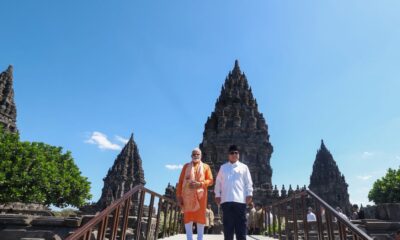
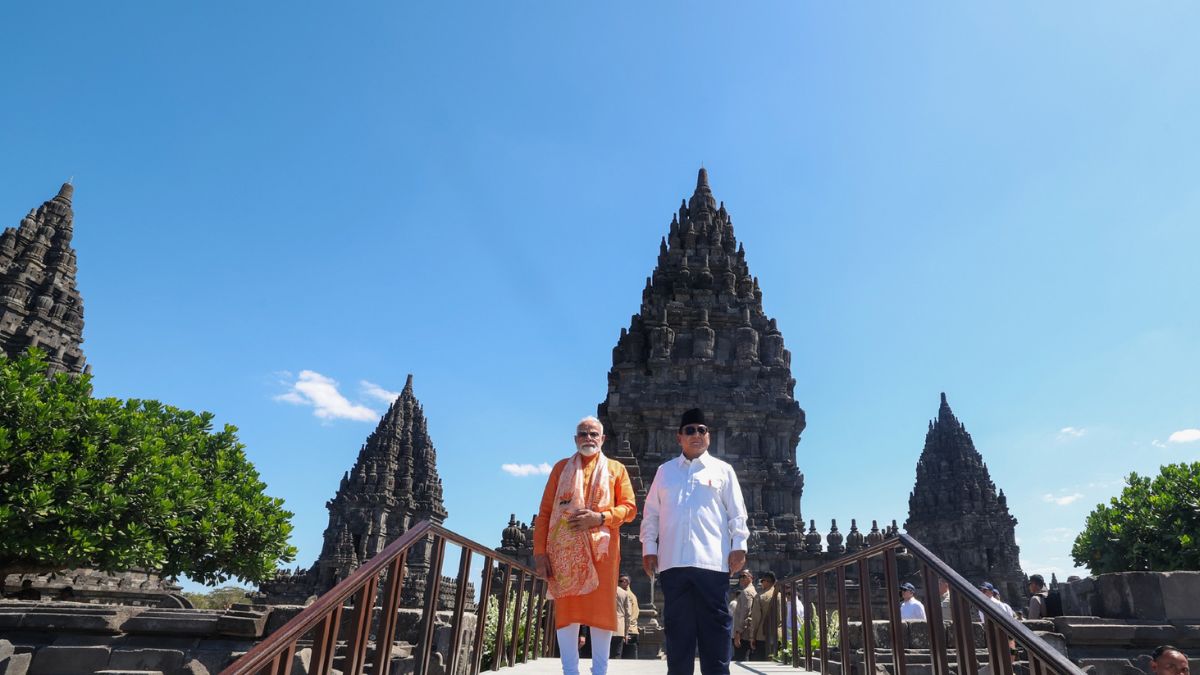
Indonesian President Prabowo Subianto conferred on Modi the country’s highest civilian honour, the Bintang Adipurna, during the visit. The two leaders then travelled together to Prambanan, a ninth-century Hindu temple complex near Yogyakarta and one of Southeast Asia’s largest surviving Hindu monuments, where they jointly launched a restoration project. Under the plan, India’s Archaeological Survey will work alongside Indonesian heritage authorities to repair the smaller shrines scattered around the main complex, many of which have sat in ruins for decades. The two countries also agreed to mark 2026–27 as the “Tagore–Dewantara Year” of cultural and educational exchange, named after the Indian and Indonesian literary figures Rabindranath Tagore and Ki Hajar Dewantara.
What makes this moment interesting isn’t the temple visit by itself — it’s what it was bundled with. In the same set of talks, India and Indonesia signed on to a BrahMos missile deal, a maritime security framework covering the Sabang port near the Strait of Malacca, a rare-earth minerals partnership, plans to link India’s UPI payment system with Indonesia’s QRIS, and an agreement to help Indonesia build its own electronic voting machines. The temple restoration and the missile deal were announced in the same breath, not treated as separate tracks of the relationship.
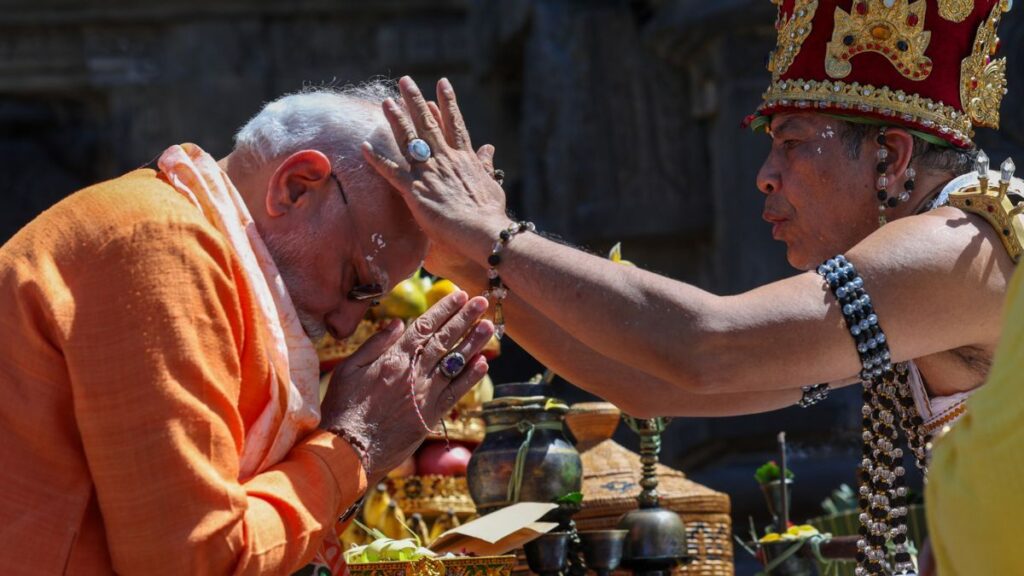
That pairing is really the point of civilisational diplomacy as a strategy: cultural gestures aren’t a substitute for hard security and economic cooperation, they’re the trust-building layer underneath it. A restoration project or a relic exhibition costs relatively little and rarely generates controversy, but it puts a government’s name on something the host country’s public already feels warmly about — which can make it politically easier to sign the bigger, more consequential deals alongside it.
Why Now, And Why This Framing
There’s a specific historical wrinkle in the India–Indonesia case that gets mentioned often in Indian commentary: in 1965, during the India–Pakistan war, Indonesia’s government was seen as closer to Pakistan. Six decades on, Jakarta is buying Indian missiles and inviting an Indian business school to open a campus on its soil. Officials frame that shift as proof that patient, culture-first diplomacy pays off over the long run — though it’s worth noting that plenty of factors besides shared heritage were behind that reversal, including changed regional security calculations and decades of separate bilateral work that had nothing to do with temples or epics.
It’s also fair to say this approach isn’t unique to India. China has pursued something structurally similar, using Buddhism as a soft-power thread through Belt and Road-linked countries such as Nepal, Sri Lanka, Myanmar and Mongolia — a reminder that civilisational diplomacy is as much a competitive tool in the region as a warm, cultural one.
The Honest Caveat
Civilisational diplomacy photographs well — a prime minister at a thousand-year-old temple makes for a better headline than a memorandum on customs procedures. That’s exactly why it’s worth watching critically rather than taking entirely at face value. Shared heritage doesn’t automatically translate into aligned strategic interests, and cultural warmth between two governments can cool quickly if underlying disputes over trade, migration or security resurface. What can genuinely be said is narrower: it’s a real and increasingly deliberate instrument in India’s foreign policy toolkit, it appears to be working as intended in the Indonesia relationship at this particular moment, and it’s most useful as a companion to concrete agreements rather than a replacement for them.


Can Integrated Clean Energy Reshape India’s Steel Industry?

The 2026 Fields Medals: Four Proofs, Four Decades-Old Problems Solved

India Beat Hunger. Now It Has to Make Healthy Food Affordable

Climate Change, Not El Niño, Is Driving Global Coral Bleaching, New Study Finds

Global Experts Seek Treaty to Keep AI Out of Nuclear Decisions
The 2026 Fields Medals: Four Proofs, Four Decades-Old Problems Solved

West Asia Crisis: Can Kerala’s Returning Gulf Migrants Find a Future in the Green Economy?

What Is Civilisational Diplomacy? Understanding India’s Newest Foreign Policy Tool

Sharing Over Shopping: How Kerala’s Swap House Is Modelling a Different Way to Consume

Every Rumble Sounds Like the Mountain Falling Again: Inside Meppadi’s Second Landslide in Two Years

-

 Math1 day ago
The 2026 Fields Medals: Four Proofs, Four Decades-Old Problems Solved
-
Society3 weeks ago
West Asia Crisis: Can Kerala’s Returning Gulf Migrants Find a Future in the Green Economy?
-
Space & Physics2 months ago
India Semiconductor Mission: ‘It’s Not About Fabs. It’s About Building An Entire Ecosystem’
-
Climate2 months ago
The Climate World Cup? How Climate Change Could Affect Player Performance at the 2026 World Cup
-
Society2 weeks ago
What Is Civilisational Diplomacy? Understanding India’s Newest Foreign Policy Tool
-
Society1 month ago
From Bell Labs to the Classroom: A Second Career in Teaching
-
Space & Physics2 months ago
Engineers Develop Dual-Mode Propulsion System for Next-Generation Small Satellites
-
Sustainability3 weeks ago
Sharing Over Shopping: How Kerala’s Swap House Is Modelling a Different Way to Consume