
Climate & Environment
Europe’s Potato Crisis Could Hit Your Chips
More than 3.5 million tonnes of potatoes could be lost across Europe and Britain as extreme heat and drought cut yields and push up processing prices.


Europe’s potato harvest is heading into a difficult season after extreme heat and drought cut yields across some of the continent’s biggest potato-growing regions. Germany, France, Belgium and the Netherlands could lose around 3.1 million tonnes of potatoes compared with their five-year average, according to a new analysis by the Energy and Climate Intelligence Unit (ECIU). When Great Britain is included, the estimated weather-related loss rises to more than 3.5 million tonnes.
At current prices, the lost production across the five countries could be worth between €498 million and €818 million. The impact is already visible in the potato market, where processors are paying substantially more for supplies.
Smaller Crop Before the Drought
The weather shock came after European farmers had already reduced potato planting. A glut in 2025 pushed potato prices down, prompting growers to cut the area planted in 2026. The planted area fell by 11% in Germany, 10% in France, 15% in the Netherlands and 17% in Belgium.
Had yields remained at their five-year averages, the smaller planted area alone would have resulted in an estimated 3.6 million-tonne reduction in production. The drought added another layer of losses. ECIU estimates yields are 13% below the five-year average in France, 21% lower in Belgium, 10% lower in Germany and 7% lower in the Netherlands.
For Great Britain, where the Agriculture and Horticulture Development Board stopped publishing harvest and yield estimates in 2021, the analysis uses an estimate from World Potato Markets. It puts yields around 11% below the 2021–25 average, based on conditions similar to the 2018 drought.
Tom Lancaster, land, food and farming analyst at ECIU, said the effects of the summer’s heat and drought were becoming increasingly visible in industry yield estimates. “As one of Europe’s thirstiest crops, it was inevitable that the potato harvest would be hit hard,” he said.
Heat Shrinking the Potatoes
The problem is not only the amount harvested. Heat and water shortages are also affecting potato size. Belgium, the world’s largest exporter of frozen fries, has reported particularly severe problems with Fontane, its main frying variety.

By the end of August, Fontane was yielding around 32 tonnes per hectare, 30% below the previous year. Only about half of the crop was above the 50 mm size preferred by processors. For the processing industry, that distinction matters. A potato crop can survive a dry season while still producing fewer tubers that meet the size requirements for products such as chips and frozen fries.
Recent rainfall may have improved conditions in some areas, but industry estimates suggest it came too late to reverse much of the damage.
Potato Prices are Rising
The tighter supply is showing up in processing markets. Belgian free-market potatoes have risen from zero in April to €200 or more a tonne. German processing potatoes have reached about €240 a tonne, compared with a season low of €15 in June.
In Britain, processors are paying more than £300 a tonne, up from £180 in February. These are processing-market prices rather than direct measures of what consumers will pay. But they show the pressure developing further up the supply chain as processors compete for potatoes that meet their requirements.
Farmers Caught Between Two Bad Years
For potato farmers, the weather shock has come after a difficult market year. Jean-Paul Dallene, a potato farmer in Pas-de-Calais, said he had surplus potatoes last year and was forced to sell them at a loss. This year, drought has reduced his yield by 12 tonnes per hectare. He estimates the resulting loss of income at around €4,300 per hectare, from lower yields and contract prices.
Dallene has already changed his farming practices, including adopting no-till methods to reduce the impact of water shortages. But the severity of this year’s drought and heat exceeded what he expected.
His experience highlights the economic difficulty of adapting to a more volatile climate. Farmers can change cultivation practices, but they still face weather they cannot control and markets that can swing sharply between oversupply and shortage.
Water Management Crisis
Potatoes require substantial water during tuber development. Higher temperatures can increase the crop’s water demand at the same time that drought reduces the water available.
That makes water management increasingly important. Cedric Porter, editor of World Potato Markets, said farmers would need to prepare for both extremes. “Investment in water management, whether it is conserving water when there is too much or irrigating during dry summers, will be essential to the continued success of the crop,” he said.
That means adaptation cannot depend on irrigation alone. Storing water during wetter periods, improving soil moisture retention and making more efficient use of available water could become increasingly important for potato production.
Climate Problem With Food Price Effect
The potato losses are part of a wider pattern of climate stress across Europe. World Weather Attribution found that temperatures during this summer’s European heatwave would have been virtually impossible” 50 years ago. Its assessment of the drought also found that human-caused warming had increased the likelihood and severity of the conditions.
For agriculture, the significance lies in the combination of hazards. Heat increases water demand. Drought reduces water availability. Heavy rainfall at other times can damage soils and crops or make fields difficult to work. These shifts make it harder for farmers to rely on historical growing conditions when deciding what and how much to plant.
The Biological Hangover
The immediate concern is supply. But the longer-term issue is predictability. Europe went from a potato glut and low prices in 2025 to reduced planting in 2026, followed by heat and drought that further cut yields. The result could be more than 3.5 million tonnes of weather-related production losses across five major markets.
For consumers, that pressure can eventually feed into the price of chips and other potato products. For farmers, the bigger challenge is managing a crop when both sides of the equation are becoming more uncertain: the weather that determines yields and the market that determines whether those yields are profitable.
Porter notes that Europe has experienced four droughts since 2018, alongside periods of heavy rainfall during winter and spring. The potato may be an everyday food, but its increasingly unpredictable journey from field to processor is another measure of how climate change is reshaping Europe’s food system.









Climate & Environment
Global Climate Finance Hits Record $1.9 Trillion, but Vulnerable Nations Continue to Face Adaptation Funding Gap
Global climate finance reached a record $1.9 trillion in 2023–2024, but vulnerable developing countries continue to face an adaptation funding gap. As COP31 begins, questions remain over the delivery of the new $300 billion annual climate-finance target and equitable access to funding.

Global climate finance reached an unprecedented annual average of $1.9 trillion in 2023–2024, increasing by 32 per cent compared with the previous two-year period. However, despite the growth in investment, developing countries continue to face significant barriers in accessing the resources needed to adapt to climate change, according to assessments by the United Nations Framework Convention on Climate Change (UNFCCC) and the Organisation for Economic Co-operation and Development (OECD).
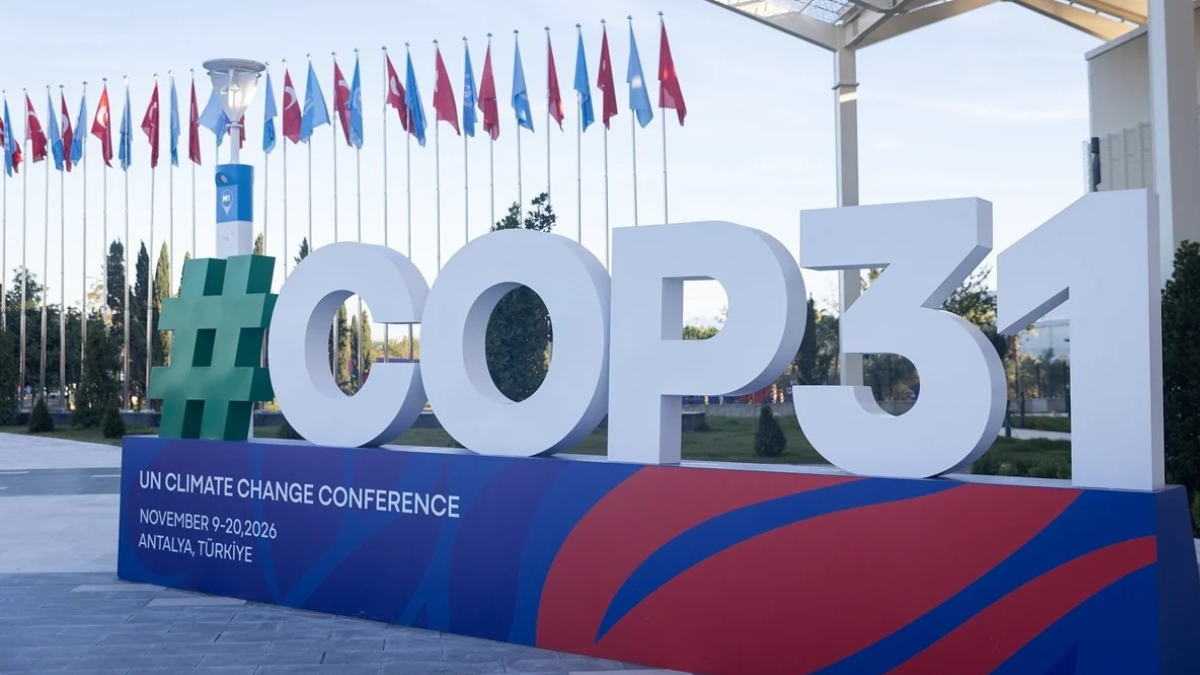
The findings come as countries meet for the 31st United Nations Climate Change Conference (COP31) in Antalya, Türkiye, from November 9 to 20. The conference takes place during the transition from the previous $100 billion annual climate-finance commitment to a new target of $300 billion by 2035.
Developed countries exceed $100 billion target, but questions remain
Developed countries had pledged to mobilise $100 billion annually by 2020 to support climate action in developing countries. The commitment was subsequently extended through 2025. According to the OECD’s 2026 assessment, developed countries provided and mobilised $132.8 billion in 2023 and $136.7 billion in 2024, exceeding the target for the third consecutive year.
However, the reported totals do not necessarily represent grants or money directly disbursed to developing countries. They include different forms of public finance, multilateral development bank contributions and private finance mobilised through public interventions.
Differences in accounting methods have also complicated assessments of whether countries are meeting their commitments. The UNFCCC’s 2026 assessment highlights variations in how countries report loans, grants, commitments and disbursements, making comparisons between datasets difficult.
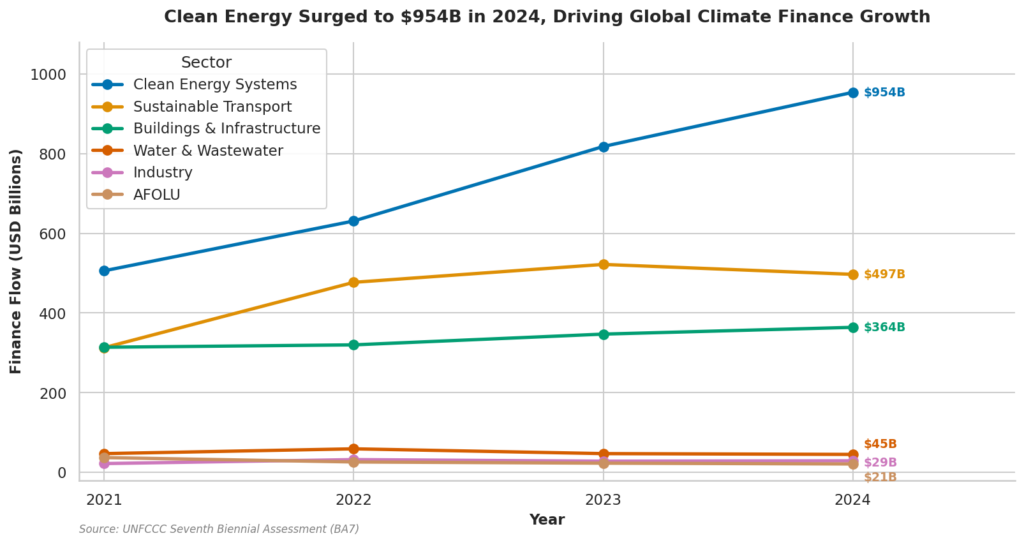
Total global climate finance reached an annual average of USD 1.9 trillion in 2023–2024.
The earlier target is now being replaced by the New Collective Quantified Goal (NCQG), adopted at COP29 in 2024. It calls for developed countries to take the lead in mobilising at least $300 billion annually for developing countries by 2035. The wider ambition is to scale up climate finance from all sources to at least $1.3 trillion annually by the same year.
Adaptation remains dependent on public finance
The expansion of climate finance has not translated into comparable support for adaptation. Investments in mitigation, including renewable energy and low-emission transport, have attracted substantial private capital. Adaptation projects such as flood protection, resilient agriculture, water management and coastal infrastructure, however, often generate fewer direct commercial returns.
The OECD reported that developed countries’ adaptation finance reached $33.6 billion in 2023 and $34.7 billion in 2024. Public finance accounted for more than 90 per cent of the tracked adaptation finance in both years, highlighting the continued dependence of adaptation initiatives on government and multilateral funding.
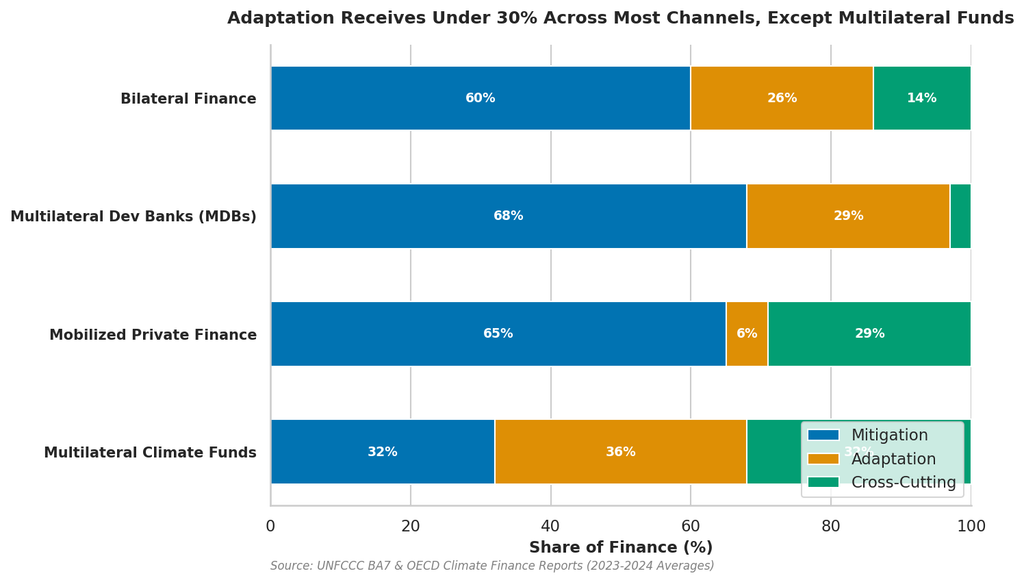
The broader financing gap is considerably larger. The United Nations Environment Programme’s Adaptation Gap Report 2026 estimates that developing countries will require approximately $305 billion annually by 2035 to meet their adaptation needs. This is substantially higher than the current international public adaptation finance flows.
LDCs and island nations receive a limited share
The financing imbalance is particularly significant for Least Developed Countries (LDCs) and Small Island Developing States (SIDS), which face high exposure to extreme weather, rising sea levels and other climate-related risks.
According to the OECD, LDCs received an annual average of $24.5 billion in climate finance in 2023–2024. SIDS received $3.8 billion in each of those years. The figures underline the limited scale of financial support reaching countries with substantial adaptation requirements.
A report published by the United Nations Capital Development Fund ahead of COP31 found that LDCs, which are home to almost 20 per cent of the global population, received only 1.9 per cent of global climate finance in 2024.
The terms on which finance is provided are also important. The UNFCCC’s assessment found that loans accounted for 91 per cent of multilateral development bank climate finance in its 2023–2024 channel-level breakdown. While loans can support large infrastructure projects, debt-based finance may place additional pressure on countries already facing economic constraints.
COP31 must move from targets to delivery
The latest figures reveal a gap between the scale of global climate investment and the resources reaching countries most vulnerable to climate impacts. Although the new $300 billion target represents an increase in the international climate-finance commitment, its effectiveness will depend on how much funding is accessible, predictable and directed towards adaptation.
For developing countries, particularly LDCs and SIDS, increasing the grant component, improving transparency in financial reporting and expanding concessional funding will be essential.
COP31 offers an opportunity to address these concerns as countries begin implementing the new climate-finance framework. The challenge is no longer only to mobilise larger sums, but to ensure that finance reaches communities facing the greatest climate risks.
Climate & Environment
India Ranks 28th in Global Climate Ranking, Down Five Places
ndia has dropped five places to 28th in the Climate Change Performance Index 2027. Despite reaching 50% non-fossil installed power capacity, coal supplied 71% of its electricity in 2025.

India has reached a major milestone in renewable energy capacity, with non-fossil fuel sources accounting for half of its installed electricity capacity in June 2025. Yet coal continued to generate 71% of the country’s electricity that year. This gap between capacity additions and the actual electricity mix is central to India’s performance in the Climate Change Performance Index (CCPI) 2027, where the country has slipped five places to 28th.
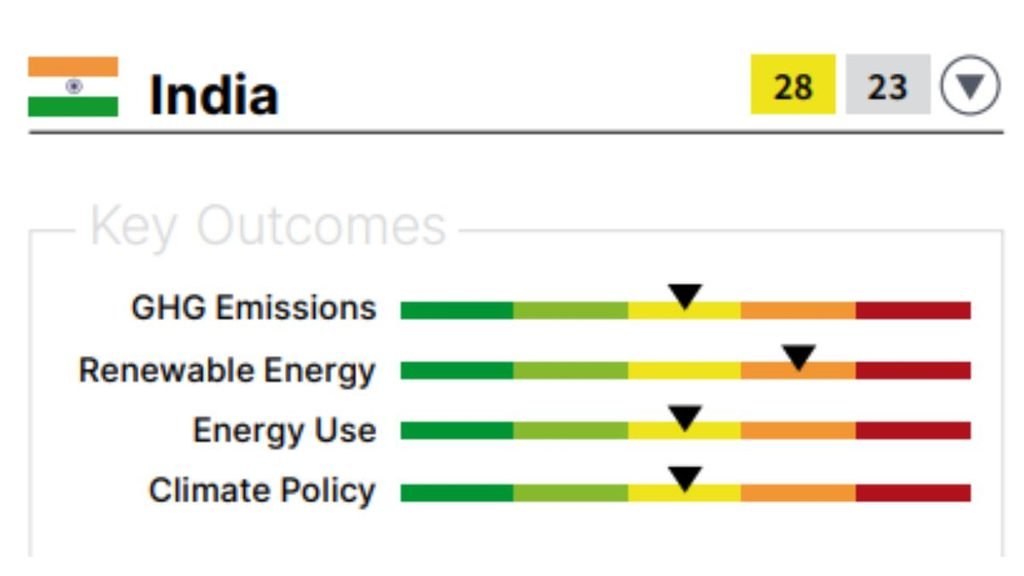
The index, published by Germanwatch and the NewClimate Institute, gives India an overall medium rating. Its assessment points to a mixed record: India has made substantial progress in expanding renewable energy and has performed relatively well on climate policy, but its energy use, emissions and renewable energy performance remain areas of concern.
India’s fall in the rankings should not be read as evidence that its renewable energy expansion has stalled. The country reached the 50% non-fossil capacity milestone five years ahead of its earlier 2030 target. However, installed capacity measures the potential to generate electricity, not how much power sources actually supply. The milestone also includes nuclear energy.
Data from Ember’s Global Electricity Review 2026 show that coal accounted for 71% of India’s electricity generation in 2025, against a global average of 33%. India’s coal generation did fall by 2.9% that year, while renewable generation rose sharply. But the continued dominance of coal in the electricity mix shows how much of the country’s power demand remains tied to fossil fuels.
Grid Constraints Slow the Transition
The challenge is becoming visible in the way India’s electricity grid handles solar power. An Ember analysis published in January 2026 estimated that the country curtailed 2.3 terawatt hours (TWh) of solar generation between late May and December 2025. Grid operators had to reduce solar output as an emergency measure to maintain grid security.
The problem is linked partly to the limited flexibility of conventional power plants. Solar generation rises during daylight hours, while electricity demand continues into the evening, when solar output falls. Coal-fired plants that remain online to meet demand can have limited room to reduce their output further. Without sufficient storage and other flexible sources of electricity, the grid cannot always accommodate the full amount of renewable power available.
This creates a practical constraint for India’s energy transition. Adding solar and wind capacity is essential, but the electricity system also needs stronger transmission networks, battery storage and power plants capable of adjusting output to changes in demand and renewable generation. Otherwise, more installed capacity will not translate into an equivalent reduction in coal-fired electricity.
The CCPI’s category rankings reflect the uneven progress. India ranks 13th in climate policy, but 31st in greenhouse gas emissions, 33rd in energy use and 40th in renewable energy. Its renewable energy category receives a low overall rating, despite a high trend indicator. This suggests that recent progress is significant, while the overall level of renewable energy deployment and its contribution to the energy system still have considerable room to improve.
India’s targets: Stronger Implementation
India’s updated climate commitments set out targets for 2035. These include reducing the emissions intensity of its gross domestic product by 47% from 2005 levels, raising the share of non-fossil sources to around 60% of cumulative installed electricity capacity, and creating a carbon sink of 3.5–4 billion tonnes of carbon dioxide equivalent through forest and tree cover.
The country has also begun implementing its Carbon Credit Trading Scheme, with emissions-intensity targets assigned to 490 industrial entities from January 2026. The effectiveness of the scheme will depend on the ambition of those targets, reliable monitoring and verification, and evidence that participating industries are actually reducing emissions.
The index also draws attention to gaps in energy efficiency. Building energy codes and appliance standards exist, but compliance remains uneven, particularly in informal markets. In transport, urban rail connectivity had expanded to 26 cities by August 2026. However, public transport improvements will also require affordable and reliable bus services, along with safer infrastructure for walking and cycling.
India’s dependence on imported fossil fuels adds an economic and energy-security dimension to the transition. Disruptions to shipping through the Strait of Hormuz have highlighted the risks faced by countries that rely on international supplies of oil and gas. Reducing fossil fuel consumption would help limit exposure to such external shocks, alongside its climate benefits.
Climate Change Performance Index: How India Compares With Other Major Economies
The CCPI leaves its first three positions vacant because no country meets the highest performance standards across all assessed categories. Denmark ranks highest at fourth place, followed by Lithuania and Luxembourg. Denmark has remained the best-performing country in the index for six consecutive years.
The contrast with the United Kingdom is also instructive. The UK, ranked seventh, is the only G20 economy to receive a high overall rating. Its electricity system became coal-free in 2025, according to Ember. Ten G20 members, meanwhile, received very low ratings in the CCPI, underscoring the difficulty major economies face in aligning their energy systems and climate commitments. India’s 28th position places it ahead of several developing economies, including Brazil at 21st, the Philippines at 16th and Nigeria at 17th. But its ranking also shows that early gains in clean-energy capacity do not, on their own, secure a stronger overall climate performance.
India has set a net-zero emissions target for 2070. The CCPI assessment points to the need for clearer, time-bound pathways for reducing the use of coal, oil and gas, with sector-specific milestones and plans to support workers and regions dependent on fossil fuel industries. The immediate test is visible in the electricity system: India must make its growing renewable capacity more usable, while reducing the share of power generated from coal. Until that happens, the country’s clean-energy expansion will continue to coexist with a power mix heavily dependent on fossil fuels.
Climate & Environment
Global fossil fuel emissions projected to fall in 2026, but India’s emissions to rise 4.4%
Global climate finance reached a record annual average of $1.9 trillion in 2023–2024, but developing countries continue to face significant barriers to accessing adaptation funding. As COP31 begins in Antalya, questions remain over the delivery of the new $300 billion annual climate-finance target and the support available to climate-vulnerable nations.
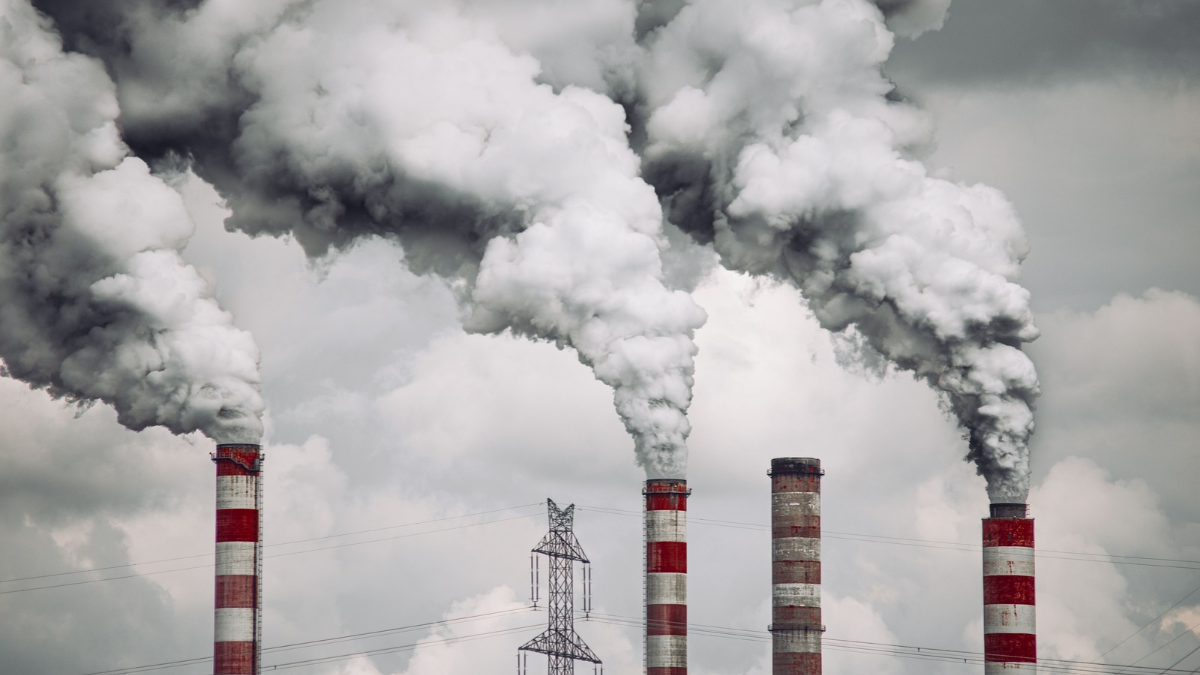
Global carbon dioxide emissions from fossil fuels are projected to decline marginally in 2026, even as India’s emissions are expected to increase by 4.4%, according to the latest Global Carbon Budget released by the Global Carbon Project on November 10. The findings highlight the uneven pace of the global energy transition, with expanding renewable energy capacity yet to deliver a sustained reduction in fossil fuel emissions.
The 2026 assessment estimates that global fossil fuel CO₂ emissions will reach 38.2 billion tonnes, representing a 0.4% decline compared with 2025. However, the projected reduction is partly attributed to lower oil consumption following the energy shock associated with the Iran conflict, rather than solely to structural changes in energy systems.
India’s fossil fuel emissions are projected to grow by 4.4% in 2026, exceeding the country’s average annual growth rate of 3.5% over the previous decade. India accounts for approximately 8% of global fossil fuel CO₂ emissions. The report notes that the projected increase partly reflects a rebound from relatively low emissions growth in 2025.
The contrasting trends in major economies underline the challenges of reducing emissions while meeting growing energy demand. China’s fossil fuel emissions are projected to decline by 0.9%, while those of the United States and the European Union are expected to fall by 1.3% and 1.5%, respectively.
Renewable energy offsets growing demand
The expansion of renewable energy and electric vehicles is increasingly limiting the growth of global emissions. According to the assessment, solar and wind power, alongside electric vehicles, are now offsetting approximately two-thirds of the additional emissions that would otherwise arise from increasing energy demand.
Emissions avoided through solar and wind power have increased substantially, from 0.28 billion tonnes in 2010 to an estimated 4.6 billion tonnes in 2026. The findings indicate that clean technologies are becoming increasingly important in meeting rising energy requirements without a corresponding increase in fossil fuel consumption.
However, the transition remains insufficient to achieve a sustained decline in global emissions. A research paper published alongside the carbon budget in Nature Climate Change, titled ‘A further acceleration of clean energy is needed for global CO₂ emissions to peak and decline‘, estimates that economic growth and changing energy consumption could add 2.59 billion tonnes of emissions between 2025 and 2028.
Solar power, wind power and electric vehicles could offset approximately 1.64 billion tonnes of this increase under current deployment trends. An accelerated deployment scenario could raise the avoided emissions to around 2 billion tonnes.
The researchers argue that renewable energy expansion must accelerate further to ensure that the growth in clean energy outpaces increasing global energy demand.
Land-use emissions add to the challenge
The projected decline in fossil fuel emissions does not translate into an overall reduction in carbon dioxide emissions. When emissions from land-use changes, including deforestation and forest degradation, are included, global CO₂ emissions are expected to reach 43.3 billion tonnes in 2026, compared with 42.8 billion tonnes in 2025.
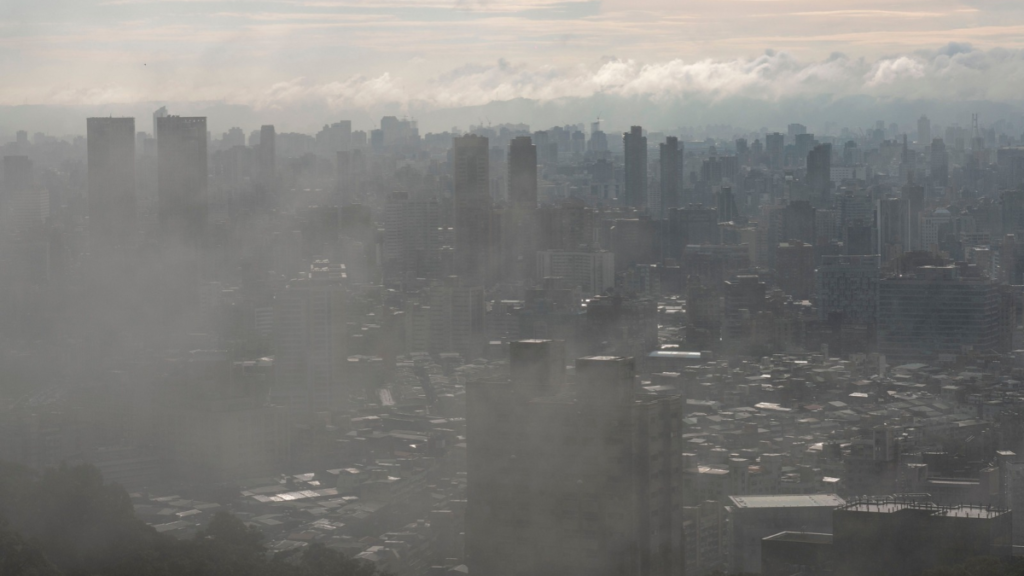
View of Taipei’s skyline shrouded in smog.Image credit:Pexels
Emissions from land-use changes are projected to rise to 5.1 billion tonnes this year. The increase is associated with peatland fires and forest degradation in Southeast Asia, amid drier conditions linked to the developing El Niño.
The assessment also highlights the importance of natural carbon sinks. Land and ocean ecosystems absorbed approximately 49% of human-caused carbon emissions over the past decade. However, climate change is increasingly affecting their ability to absorb and store carbon.
Atmospheric CO₂ concentrations are projected to reach 427.7 parts per million in 2026, approximately 54% above pre-industrial levels.
Less than four years of the 1.5°C carbon budget remain
The report estimates that the remaining global carbon budget for limiting warming to 1.5°C is approximately 150 billion tonnes of CO₂. At current emission levels, this amount could be exhausted in less than four years.
The findings reinforce the urgency of accelerating the transition away from fossil fuels while protecting forests and other natural carbon sinks. Although renewable energy and electric mobility are increasingly limiting emissions growth, the researchers caution that their expansion has not yet reached the scale required to reverse the global emissions trajectory.
For India, the projected 4.4% increase highlights the challenge of aligning expanding energy requirements with climate commitments. The findings point to the need for faster renewable energy deployment, improvements in energy efficiency and stronger protection of natural ecosystems.
The 2026 Global Carbon Budget is the 21st annual assessment produced by an international research collaboration involving more than 140 scientists. It provides updated estimates of global carbon emissions, natural carbon sinks and the implications for meeting the goals of the Paris Agreement.

Global Climate Finance Hits Record $1.9 Trillion, but Vulnerable Nations Continue to Face Adaptation Funding Gap

India Ranks 28th in Global Climate Ranking, Down Five Places

Global fossil fuel emissions projected to fall in 2026, but India’s emissions to rise 4.4%

NASA recruits new astronauts for future Moon Base and Mars missions

Between Lectures and Lyrics: Kabeer Is Building a Malayalam Hip-Hop Career One Self-Taught Skill at a Time

Indian universities lead Asia in research output per faculty, but the country’s top six all slip in QS ranking

Europe Braces for Extremes as Commission Unveils Climate Resilience Framework

Delhi’s Air Quality Paradox: Lower Average, Higher Everyday Pollution

NMC Directs Medical Colleges to Set Up Patient Safety Committees

Brazil’s Amazon deforestation hits record low. Can the recovery last?
-

 Math4 months ago
The 2026 Fields Medals: Four Proofs, Four Decades-Old Problems Solved
-
EP Deep Dive: Data & Solutions4 months ago
After Kerala’s Deadliest Landslide, the Hardest Thing to Rebuild Was Childhood
-
EP Deep Dive: Data & Solutions4 months ago
West Asia Crisis: Can Kerala’s Returning Gulf Migrants Find a Future in the Green Economy?
-
Space & Physics6 months ago
India Semiconductor Mission: ‘It’s Not About Fabs. It’s About Building An Entire Ecosystem’
-
Interviews2 months ago
From Scams to Screens: How the National Stock Exchange Rewrote India’s Equity Story
-
Climate & Environment5 months ago
The Climate World Cup? How Climate Change Could Affect Player Performance at the 2026 World Cup
-
Society4 months ago
What Is Civilisational Diplomacy? Understanding India’s Newest Foreign Policy Tool
-
Society5 months ago
From Bell Labs to the Classroom: A Second Career in Teaching