



Two early-career Indian physicists have won the 2025 ICTP Prize for their pioneering contributions to quantum many-body physics, a field central to next-generation quantum technologies


New observations reveal a towering column of superheated gas and confirm long-suspected features of a rare “intermediate polar” system.
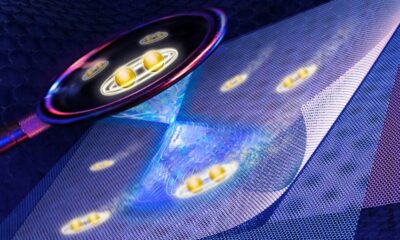

Physicists have directly observed unconventional superconductivity in magic-angle twisted tri-layer graphene using a new experimental platform, revealing a unique pairing mechanism

Physicists at MIT have devised a table-top method to peer inside an atom’s nucleus using the atom’s own electrons
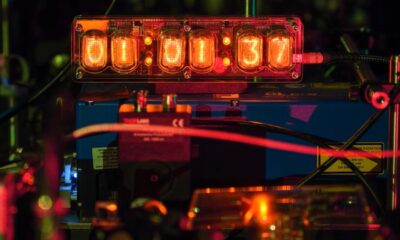

MIT researchers develop a quantum-enhanced method that doubles the precision and stability of optical atomic clocks, paving the way for portable, ultra-accurate timekeeping.


The 2025 Nobel Prize in Physics honours John Clarke, Michel H. Devoret, and John M. Martinis for revealing how entire electrical circuits can display quantum behaviour...

Indian scientists build new optical tweezer module—set to transform single-molecule research and medical Innovation


A team of MIT physicists has created a magnetic transistor that could make future electronics smaller, faster, and more energy-efficient. By swapping silicon for a new...


Researchers from MIT propose that a primordial black hole’s final explosion could be responsible for the most energetic neutrino ever observed, potentially marking the first direct...


Astronomers uncover how interstellar dust grains align with galactic magnetic fields, revealing new insights into star formation and cosmic evolution.


